A hotel operator in the USA approached Computools after operating costs continued to rise despite occupancy having recovered and guest demand remaining stable. Service expectations remained high, but daily hotel operations still depended on manual workflows, overloaded staff, reactive maintenance, and fragmented communication between departments.
The business needed a hotel operations platform that could reduce the cost of serving each guest without lowering service quality. Front desk teams spent too much time on repetitive guest requests; housekeeping managers relied on manual task distribution; maintenance teams reacted to issues only after they affected operations; and leadership lacked real-time visibility into workload, delays, and OPEX drivers.
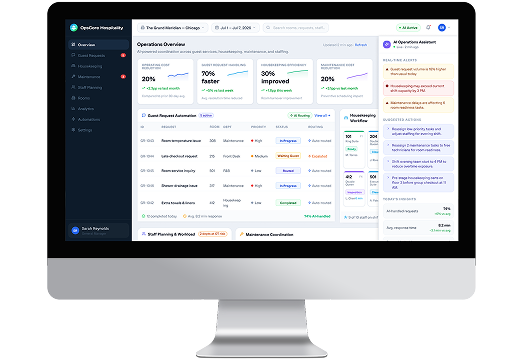
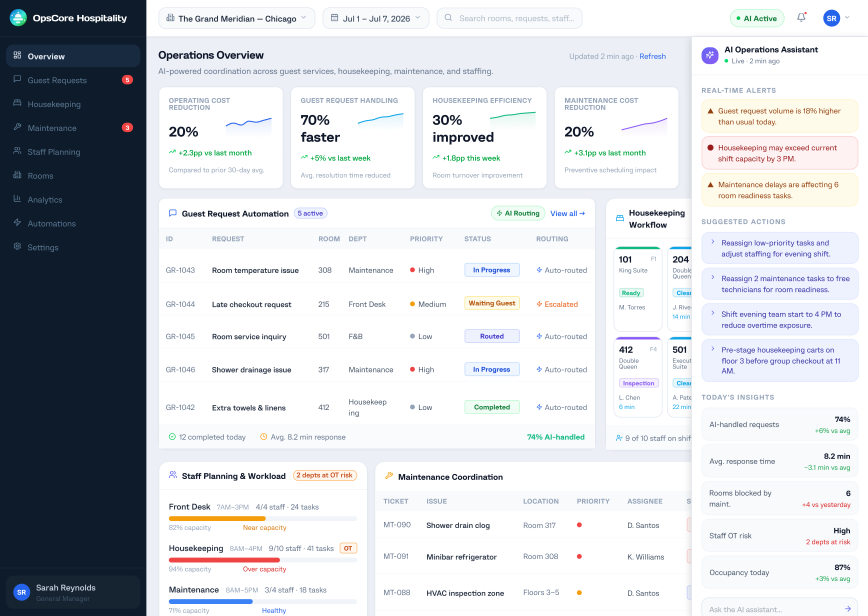
Computools delivered OpsCore Hospitality, an AI operations platform that connected guest request automation, housekeeping workflows, staff scheduling, maintenance coordination, and operational analytics. Within three months of adoption, the client reduced OPEX and labor costs by 20%, accelerated guest request processing by 70%, increased housekeeping efficiency by 30%, and lowered maintenance costs by 20%.
The client is a US-based hospitality operator that manages hotel properties and handles daily front desk, housekeeping, maintenance, guest services, and workforce coordination. The business serves leisure and business guests in an environment where room readiness, service consistency, staff availability, and cost control directly affect profitability.
As operating pressure increased, the client needed hotel operations management software to support daily property workflows and provide managers with a clearer view of operational performance. Existing processes relied on disconnected tools, internal messages, spreadsheets, phone calls, and manual status updates, making it difficult to manage workload across departments.
The project became part of the client’s broader hospitality digital transformation roadmap. The company needed a scalable digital foundation to automate routine work, optimize staff allocation, reduce operational delays, and manage hotel processes with greater operational visibility.
The client’s main challenge was rising OPEX across hotel operations. Labor costs, repetitive guest service tasks, reactive maintenance, delayed room status updates, and inefficient internal communication increased daily operating costs even when occupancy remained stable.
Hotel teams needed better hospitality workflow automation because too many tasks were still handled through phone calls, messaging apps, paper notes, and manual handovers. A standard guest request could involve the front desk, housekeeping, maintenance, and guest services, with each transfer increasing the risk of delays, duplicate work, or missed information.
The client also needed a hotel workforce management system to align staff schedules with actual workload. Without reliable visibility into occupancy-related demand, task volume, and department capacity, managers had limited ability to reduce overtime, prevent understaffing during peak periods, or avoid unnecessary labor costs during quieter shifts.
The business required a connected operational platform that could automate repetitive requests, centralize department coordination, improve housekeeping and maintenance workflows, and help management identify where time, labor, and OPEX were being lost.

Computools designed and delivered OpsCore Hospitality, an AI operations platform for hotels, created to reduce manual workload and improve control over daily hotel operations.
The hotel process automation platform connected guest request handling, maintenance, and operational analytics, while hotel housekeeping workflow automation and hotel staff scheduling software improved room readiness and workforce planning.
An AI concierge for hotels handled routine requests and task routing, while managers gained better visibility into room status, staff workload, and operational priorities. The solution created a scalable foundation for more efficient operations and lower OPEX without compromising service quality.
Within three months of adoption, OpsCore Hospitality improved coordination across guest service, housekeeping, workforce planning, and maintenance.
The client achieved:
These results showed how to reduce hotel operating costs with hotel OPEX reduction software that connects guest service, staffing, housekeeping, and maintenance workflows without compromising service quality.
Computools was selected because the client needed a technology partner with experience in travel and hospitality software development, workflow analysis, product strategy, role-based UX, platform engineering, analytics, and launch support, all within a single delivery model.
The project required practical AI for hotel operations management, connected to real front desk, housekeeping, maintenance, and workforce workflows. Computools structured the solution around measurable operational priorities, including lower manual workload, better staff allocation, faster guest request processing, and stronger OPEX visibility.
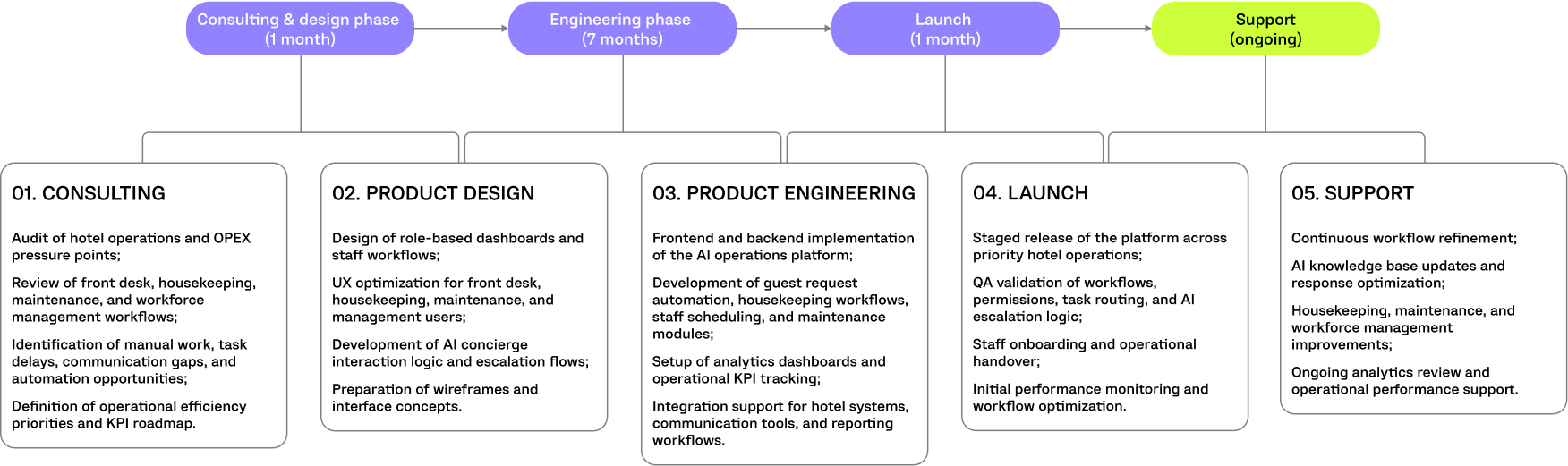
A phased delivery model and KPI roadmap helped the client validate priorities, reduce implementation risk, and prepare the platform for expansion across additional properties and operational processes.
When designing OpsCore Hospitality, the team focused on operational clarity, fast task execution, and role-based visibility for hotel teams.
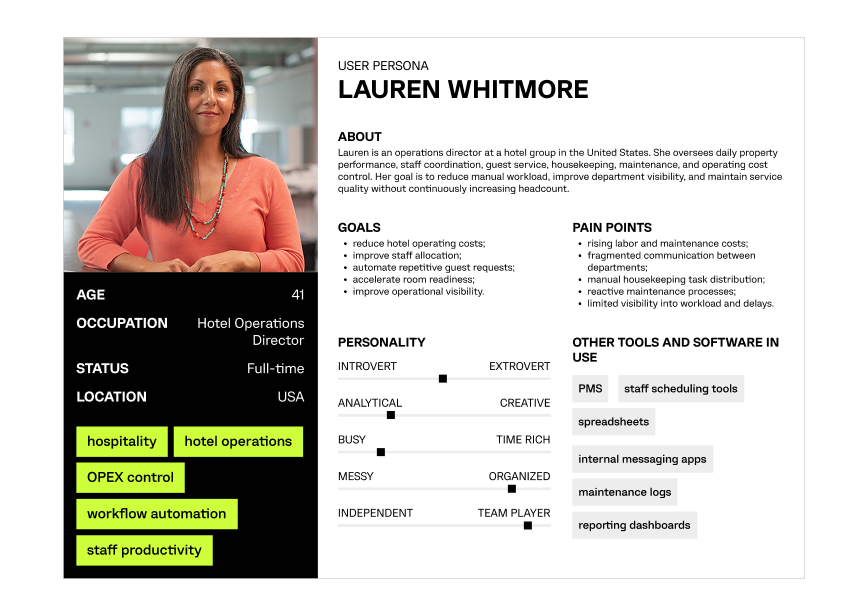
A detailed profile created to guide operational workflows, AI concierge logic, staff scheduling, housekeeping task management, and dashboard priorities.
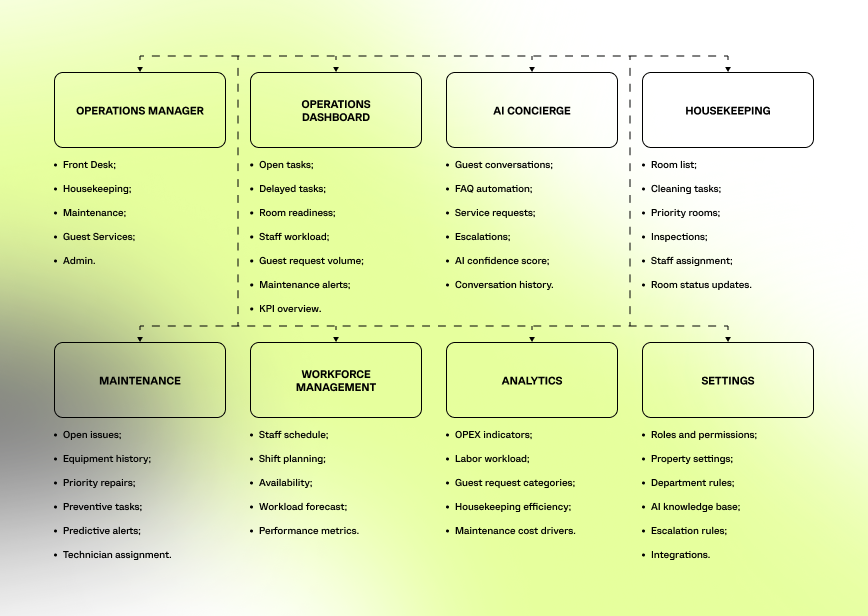
Hierarchical structure built to support seamless operational control across guest requests, housekeeping, maintenance, staff scheduling, and analytics.
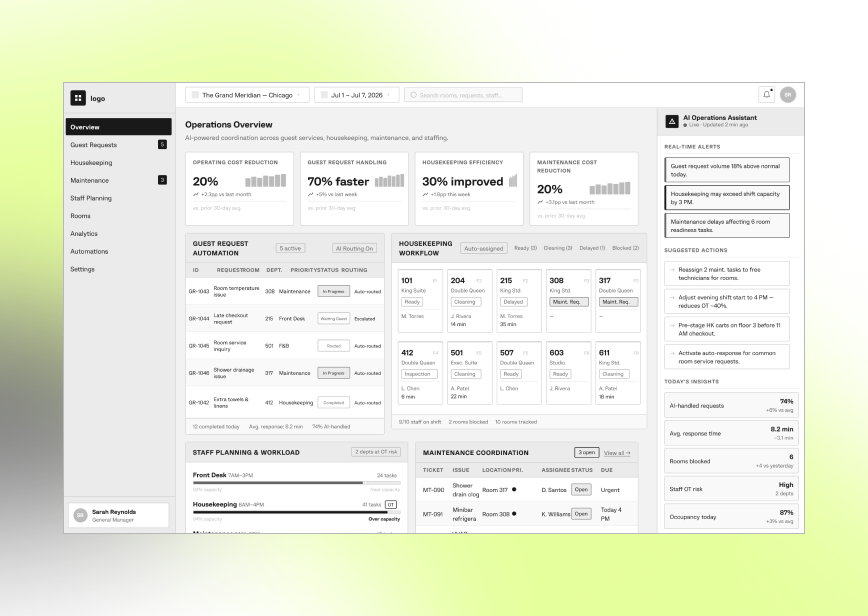
Low-fidelity layouts prepared to simplify daily hotel operations and reduce task friction across departments.
Streamlined interface designed to help hotel teams manage guest requests, staff workload, housekeeping, maintenance, and operational KPIs from one connected platform.
TYPESCRIPT
TypeScript provides a shared development foundation across the platform’s frontend and backend. Static typing improves code reliability, simplifies maintenance, and helps engineering teams scale complex hotel workflows with fewer runtime errors.
NEXT.JS / REACT
Next.js and React power responsive interfaces for hotel managers, front desk teams, housekeeping supervisors, and maintenance staff. The frontend supports role-based dashboards, real-time task updates, and mobile-friendly workflows across the platform.
NODE.JS / NESTJS
Node.js and NestJS handle the core business logic for guest requests, task routing, staff scheduling, housekeeping workflows, and maintenance operations. The modular backend allows the system to scale across departments and additional hotel properties.
POSTGRESQL
PostgreSQL stores room statuses, staff schedules, guest requests, maintenance records, task history, and operational KPIs. It provides a reliable data foundation for workflow automation, reporting, and daily hotel operations.
PYTHON / FASTAPI
Python and FastAPI support AI services, data processing, and predictive analytics. This layer enables request classification, workload forecasting, and predictive maintenance for hotels based on equipment history and recurring operational patterns.
OPENAI API
OpenAI API powers the AI concierge, automated responses, request classification, and escalation logic. It helps hotel teams process routine guest requests faster while keeping staff involved in complex or service-sensitive cases.
AWS / DOCKER / TERRAFORM
AWS, Docker, and Terraform support secure deployment, consistent environments, and scalable infrastructure. Docker standardizes application packaging, Terraform automates cloud provisioning, and AWS provides the infrastructure needed to run and scale the AI operations software across additional properties and operational modules.
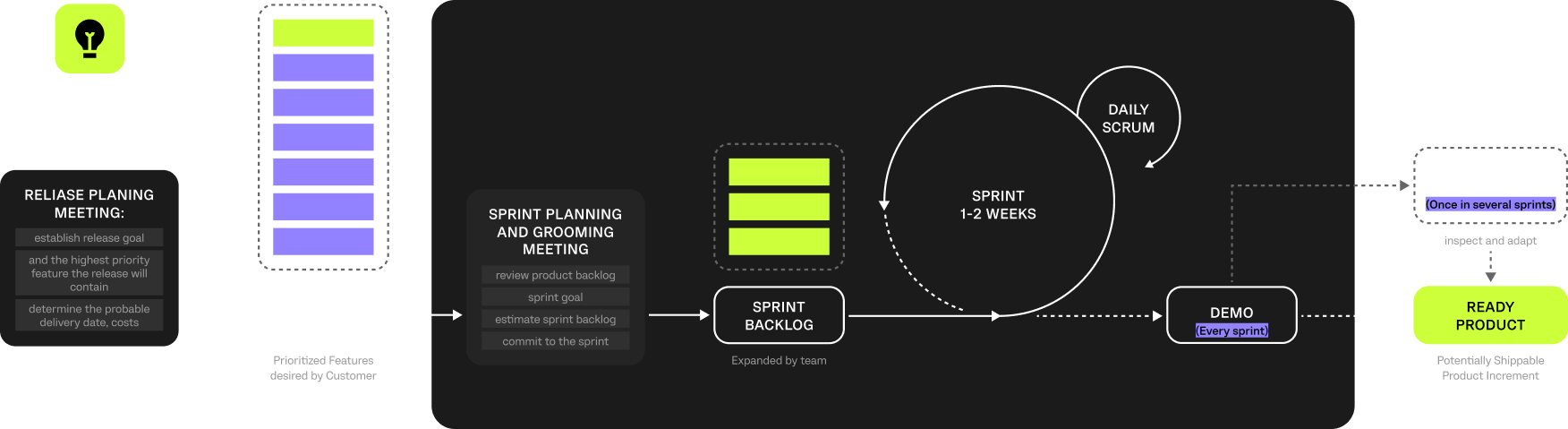
Computools used a Scrum-based delivery approach to keep the project aligned with both technical execution and operational efficiency goals. Work was organized into short iterations, each focused on a defined improvement area such as guest request automation, housekeeping workflow automation, workforce management, maintenance coordination, or analytics.
This method allowed the team to validate priorities early, release platform modules in stages, and refine the solution based on operational feedback rather than waiting for a single large rollout. It also kept the client involved throughout the process and allowed business priorities to be adjusted as hotel workflows evolved.
We knew our costs were getting harder to control, but the bigger problem was how much time our teams were losing every day. People were calling each other for updates, answering the same guest questions, and fixing issues only after they had already caused delays.
Computools helped us simplify that. Now our teams can see what is happening, who is responsible, and what needs attention first. It has made daily operations much easier to manage and given us a clearer path to reducing costs without affecting the guest experience.