



THE AUTHOR:

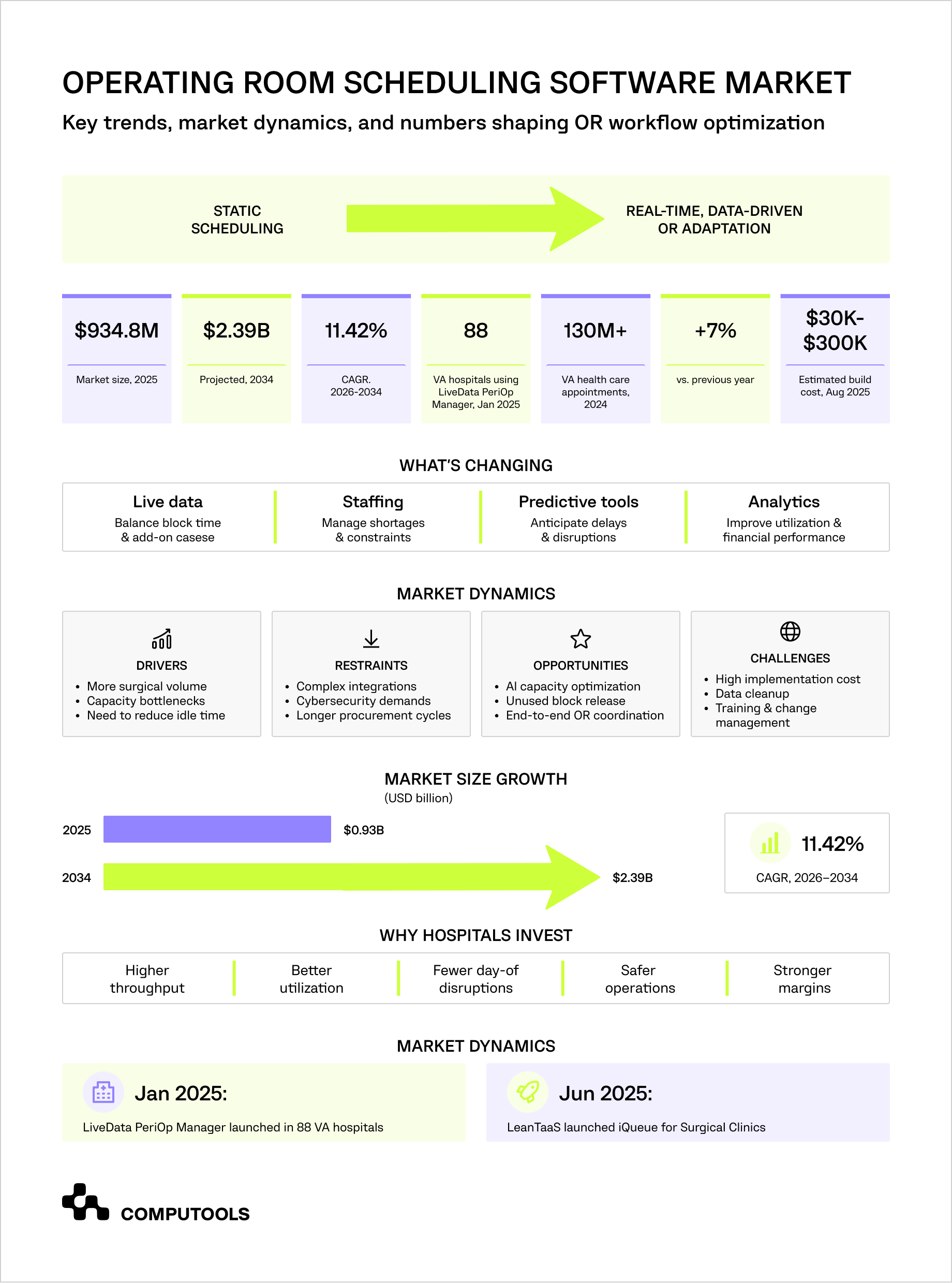
Hospitals planning to build a surgical workflow management platform face a capacity problem with their outdated systems. The demand for surgery continues to outpace the labor supply, increasing operating costs. In 2025, US hospital workforce costs increased by 5.6%, supply expenses rose by 9.9%, and total expenses grew by 7.5%. Additionally, the global operating room scheduling software market grew to $934.8 million in 2025 and is predicted to reach $2.39 billion by 2034. The data show that hospitals need to make better use of their resources and maximize the use of available rooms, hospital staff, equipment, and time allocated for surgery.
This article explains how to define the operating model, architecture, data structure, integrations, scheduling logic, security controls, analytics, and phased rollout required to create an effective perioperative workflow software platform.
Why hospitals need to build a surgical workflow management platform
The long-term problems in hospital operations are not just related to appointments. A study in 2025 found that during the observed 50,675 minutes of surgery, delays and interruptions made up a total of 7,920 minutes, or 16.83% of working time. Several factors can disrupt the surgical day, including staff availability, patient readiness, and equipment issues, as well as gaps in communication and management issues. When these elements exist in disparate spreadsheets, calendars, modules in the electronic health record (EHR), and messaging platforms, coordinators are unable to see conflicts in time to prevent empty operating room (OR) time, delays, overtime, and, in the worst case, cancellations.
There are many things that can cause disruption to a planned surgical day, including staffing issues, operational readiness of patients, and even equipment issues. All of these things are tracked separately by different systems such as spreadsheets, calendars, modules of the EHR, or even messaging applications. This makes it difficult for coordinators to identify or resolve conflicts in a timely manner, and can also cause prolonged delays, overtime, or even cancellations of operations.
What features should a surgical workflow management platform have?
| Industry shift | What it means for hospital operations | Platform response |
| Growing surgical demand | Rooms, staff, equipment, and recovery capacity come under greater pressure. | Constraint-based scheduling and coordinated resource planning. |
| Persistent staffing gaps | Delays, overtime, and workload imbalances become harder to prevent. | Live availability data, workload controls, and targeted alerts |
| Move toward real-time OR coordination | Fixed schedules cannot adjust quickly to overruns, emergencies, or room changes. | Event-driven updates, live case tracking, and automatic schedule recalculation. |
| Longer surgical backlogs | Hospitals must increase throughput without relying on new operating rooms. | Block utilization analysis, faster release of unused capacity, and delay forecasting. |
| Disconnected clinical and operational systems | Teams spend more time reconciling data across EHRs, calendars, imaging, and inventory tools. | Integration with EHR, HL7, FHIR, PACS, DICOM, staffing, and supply systems. |
| Wider adoption of analytics and AI | Leaders need earlier warning of cancellations, overruns, and capacity shortages. | Procedure-duration prediction, cancellation-risk analysis, and demand forecasting. |
| Stronger security and continuity requirements | System outages and unauthorized access can disrupt procedures and expose patient data. | Role-based access, encryption, audit trails, monitoring, backup, and failover. |
The best surgical workflow automation software should automate the complete perioperative process by integrating patient clearance and surgical scheduling, surgeon and anesthesia availability and preferences, required room and equipment allocations, sterile and other supplies, and transportation and recovery capacity. In addition, operating room workflow management should include rules for emergency cases, overruns, resource conflicts, adjustments to schedules, and escalation.
Hospitals that build a surgical workflow management platform create a shared operational data source for automating routine tasks, tracking real-time performance and operational bottlenecks, and analyzing capacity loss. Predictive models can shorten estimation of procedure duration, identify cancellation risks, and even estimate future demands for the operating room and recovery. These capabilities hinge on the availability of clean and structured operational data and the quality of integrations with other hospital systems. The intent is to improve operating room efficiency and enhance opportunities for clinical and administrative teams to influence the daily scheduling of surgery.
The SurgeryOps case: from fragmented planning to coordinated surgical operations
One of our clients, a US multi-specialty hospital needed to improve planning across several procedure rooms handling approximately 30–50 procedures per day. Its teams coordinated surgeons, administrators, patient information, diagnostic data, rooms, and specialized equipment through separate calendars, spreadsheets, and disconnected systems. As surgical volume increased, this fragmented process created schedule conflicts, uneven physician workloads, idle procedure rooms, and more manual work for administrators.
The hospital needed centralized surgical operations management software that could apply operational rules, connect clinical data, identify resource conflicts, and give authorized users a shared view of upcoming procedures. Any change to a doctor’s availability, patient status, room assignment, or diagnostic requirement had to be reflected across the planning process.
Our team developed SurgeryOps as a secure preoperative planning and surgery coordination platform. The system used an ASP.NET Core and C# backend, a React-based web interface, and Microsoft SQL Server for schedules, patient parameters, user permissions, and audit records. REST APIs connected the platform with internal hospital systems, while DICOM integration provided access to relevant diagnostic imaging data.
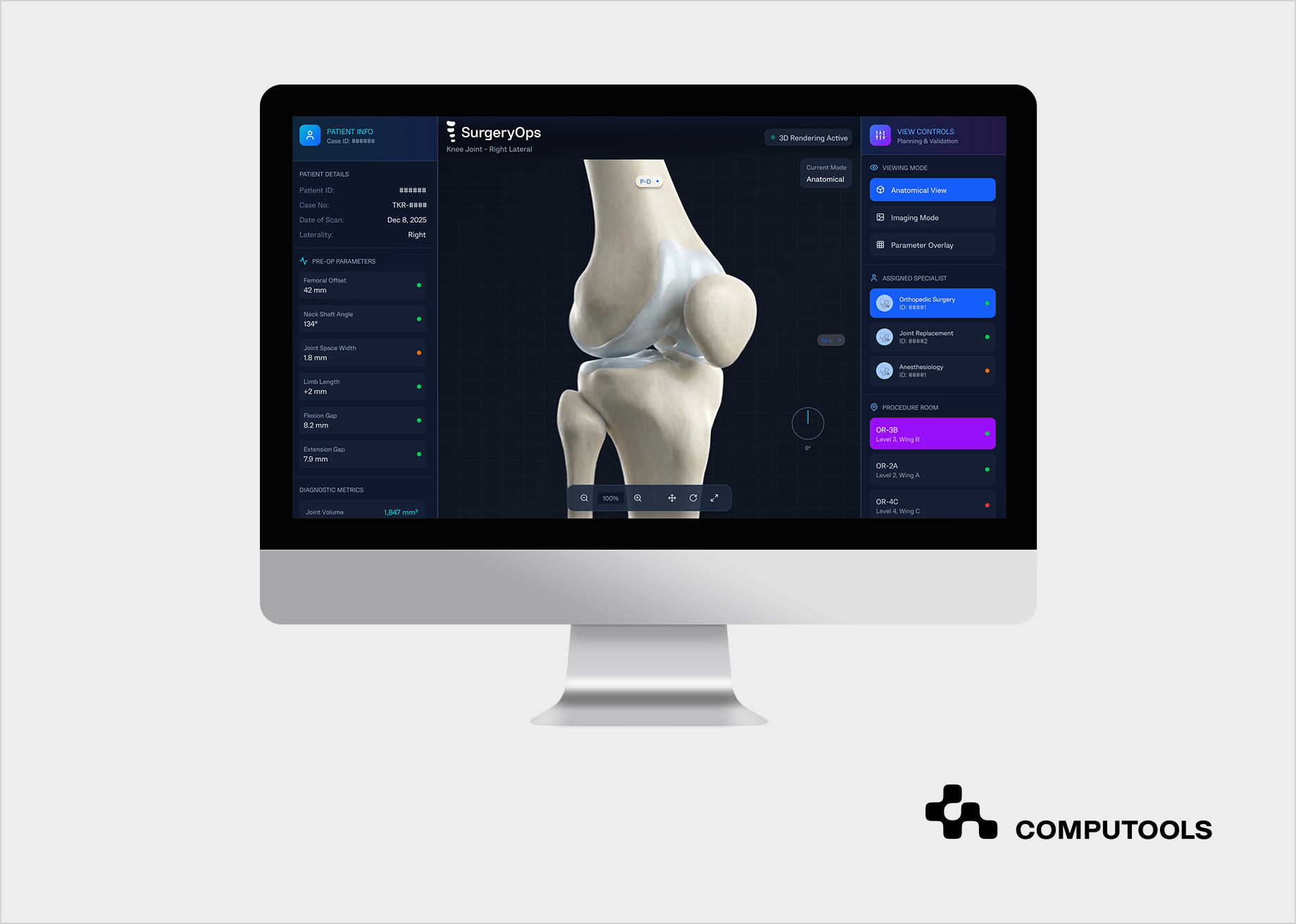
The solution also included rule-based doctor assignment, workload calculations, room booking, and conflict detection. Instead of relying on coordinators to compare multiple schedules manually, the system checked physician availability, procedure requirements, patient parameters, and room capacity before confirming an assignment. Role-based access, encryption, and audit logging protected sensitive data and recorded administrative actions.
The project produced measurable operational results. Manual planning time fell by 60%, planning errors decreased by 40%, and scheduling conflicts and idle procedure rooms were reduced by 98%. These outcomes came from connecting the workflow, data, and allocation rules in one system, rather than adding another calendar to the hospital’s software environment.
SurgeryOps also demonstrates an important principle of custom surgical software development: the value of the platform depends on how accurately it reflects real hospital constraints. Software architecture, integrations, scheduling rules, access controls, and administrative workflows must support the same operational process. The following development steps explain how to make those decisions in practice.
How to build a surgical workflow management platform step-by-step
Before beginning architecture selection or interface design, the hospital must understand what aspects of the surgical process the platform will manage. The scope may initially include scheduling of elective surgeries, the readiness of patients, the insertion of emergency cases, and the handoff of patients following surgery.
1. Define the surgical operating model and performance baseline
Map the process from case request to discharge and identify where teams still depend on spreadsheets, calls, messages, or repeated manual checks. Effective perioperative management requires clear coordination between surgeons, anesthesia teams, nurses, transport, sterile processing, recovery units, and bed management.
Each workflow milestone must have a precise definition. For example, “patient ready” may depend on completed consent, diagnostic results, anesthesia clearance, medication review, authorization, transport, and bed availability. Every condition should have an owner, deadline, source system, status, and escalation rule.
Establish baseline metrics before development, including:
- first-case on-time starts;
- room and block utilization;
- turnover time;
- cancellations and rescheduling;
- idle room minutes;
- overtime;
- patient-readiness delays;
- equipment and staffing delays;
- manual planning time.
The technical team should convert these definitions into an event model that records planned and actual times, responsible roles, delay reasons, source systems, and manual overrides. This data supports real-time monitoring, automation, and analytics.
The platform needs to establish common rules and allow control for variables such as room capabilities, staffing, approvals and exemptions, and escalation limits. Adjustable workflows become critical for operating theatre management in multiple departments and sites.
Without this preparation, the system may reproduce inconsistent processes, unreliable timestamps, and inaccurate performance data.
2. Design the data model and integration architecture
The platform must create a shared operational view without replacing the hospital’s existing clinical systems. Define which system owns each data type, including patient records, procedure details, staff schedules, imaging, equipment, room capacity, and workflow events.
A typical data model should cover:
- patients and surgical cases;
- procedures and clinical requirements;
- surgeons, anesthesiologists, and supporting staff;
- rooms, equipment, and supplies;
- schedule blocks and assignments;
- readiness checks;
- workflow events and delays;
- notifications and audit records.
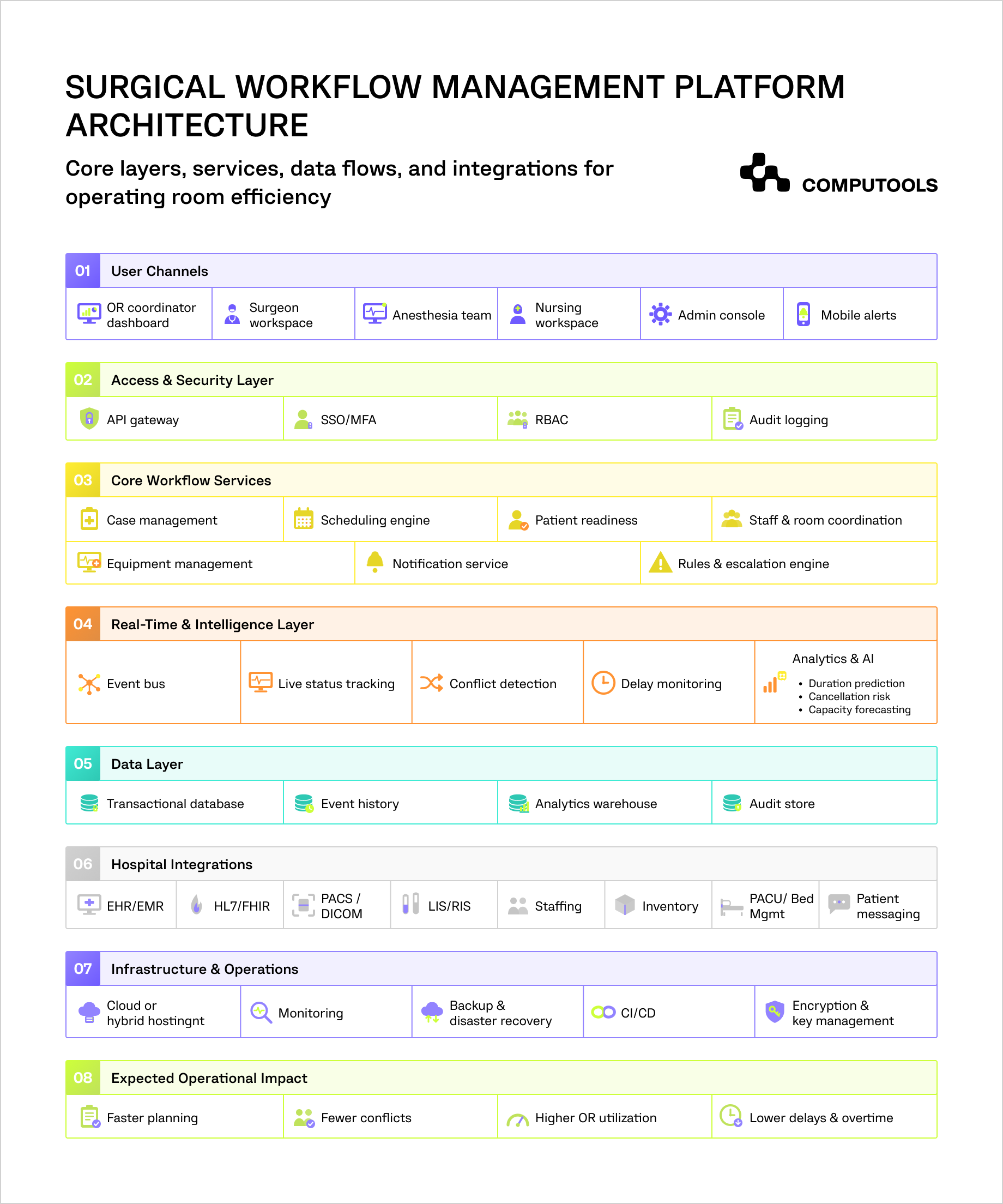
A modular architecture works well for perioperative workflow software. Core components may include an API gateway, identity service, workflow engine, scheduling service, resource service, notification service, transactional database, event history, and analytics storage.
Integrations commonly include EHR or EMR systems, HL7 or FHIR interfaces, PACS and DICOM imaging, laboratory systems, staff scheduling, inventory, sterile processing, and bed management. In SurgeryOps, Computools used REST APIs and DICOM to connect planning workflows with hospital and diagnostic systems.
Every integration should support validation, retry logic, duplicate detection, and health monitoring. Without these controls, a digital operating room solution may display outdated availability, duplicate cases, or incomplete patient information.
3. Build constraint-aware scheduling and resource allocation
A surgical schedule must account for more than an open room and an available surgeon. The hospital should define hard constraints that cannot be violated and soft constraints that improve the schedule but allow exceptions.
Hard constraints may include:
- physician credentials;
- room capability;
- required equipment;
- anesthesia coverage;
- staff availability;
- patient clearance;
- infection-control requirements.
Soft constraints may include preferred rooms, block ownership, expected duration, overtime exposure, and surgeon preferences.
The operating room management software should use a configurable rules engine to detect conflicts, rank available slots, recommend alternatives, and explain why an assignment was accepted or rejected. Coordinators should be able to override recommendations, but the system must record the reason and retain the previous schedule version.
In SurgeryOps, Computools implemented rule-based doctor assignment, workload calculations, room booking, and conflict detection. Similar logic supports OR workflow optimization by preventing double bookings, uneven workloads, and schedules that depend on unavailable equipment or teams.
If the rules remain hidden or hard-coded, administrators cannot adapt them when staffing models, room capabilities, or hospital policies change.
Hospitals that need a more detailed treatment of room constraints, staff eligibility, schedule versioning, conflict detection, manual overrides, and emergency case insertion can review Computools’ guide on how to develop operating room scheduling software.
These mechanisms become especially important when several coordinators edit the same schedule or one delayed procedure affects rooms, staff, and equipment across the surgical day.
4. Coordinate patient, team, and room status in real time
The platform should represent each surgical case as a sequence of defined states.
A typical flow may include:
Requested
→ under review
→ requirements pending
→ ready to schedule
→ scheduled
→ patient ready
→ room ready
→ procedure started
→ procedure completed
→ recovery
→ case closed
Each status change should trigger the relevant surgery workflow automation. For example, confirming patient readiness may notify transport, reserve required equipment, and update the room board.
Real-time logic should also respond when a case overruns, a surgeon becomes unavailable, or recovery capacity reaches its limit. The platform may recalculate expected start times, flag affected cases, and send role-specific notifications.
Patient communication should follow the same verified workflow events. A connected patient engagement platform can send preoperative instructions, missing-document reminders, arrival updates, and rescheduling notices based on the current case status.
This helps in patient flow optimization, as it allows the preoperative, surgical, and recovery teams to see dependencies before they create delays. It also improves surgical team coordination, since it eliminates the need for repeated calls and messages, providing a shared operational view.
Use event processing or message queues if multiple modules need to respond to the same update. For reliable real-time OR monitoring, the system needs to show integration issues, delayed messages, and manually entered data.
5. Create role-based workspaces and administrative controls
Different users need different data. A surgeon may require the next case list and patient readiness status, while an OR coordinator needs available and conflicting rooms, available and required staff, and pending exceptions.
Create role-specific workspaces for:
- coordinators;
- surgeons;
- anesthesia teams;
- nurses;
- sterile processing;
- patient transport;
- recovery units;
- operations managers;
- system administrators.
Each interface should prioritize decisions and exceptions. Avoid placing every available data field on one dashboard. Mobile or tablet access may be useful for rapid status updates, but complex schedule changes should remain controlled.
The administrative layer should allow authorized users to configure room calendars, staffing rules, procedure templates, equipment compatibility, delay categories, and escalation thresholds. This prevents the surgical operations software from depending on code changes every time hospital policies or resources change.
All important administrative actions should be versioned and auditable. Otherwise, teams may not know who changed a schedule rule, removed a resource, or modified a staff assignment.
6. Add analytics, automation, and AI after establishing reliable data
AI should be tasked with solving particular operational issues. Examples of AI applications could include using surgery scheduling software to determine case duration by analyzing historical patient, procedure, surgeon, room, or case data. Decreased guesswork regarding case duration leads to reduced scheduling inefficiencies, such as scheduling gaps and overtime.
AI can create a cancellation-risk model to identify cases negatively impacted by other scheduling issues, such as pending lab draws, case authorization, case clearance, or communication issues. The scheduling coordinator can then take action to remove the scheduling issue and/or schedule a different case to fill the time slot.
AI can predict the demand for surgery rooms, anesthesia teams, recovery beds, and special equipment needed to perform a case. It can be used to perform surgical readiness checks and remove the guesswork for surgery staff.
Where patient condition affects readiness, staffing, or postoperative capacity, hospitals may extend the platform with predictive surgical risk functionalities. It can combine EHR data, patient risk stratification, explainable scores, alerts, and assigned follow-up actions.
For more information, see our guide on how to build a predictive surgical risk platform.
Surgery analytics can be used for tracking first-case delays, surgery overruns, case cancellations, and surgery equipment interruptions. Surgery management can use analytics to address the underlying causes of poor performance, as opposed to averages alone, to create case turnover improvements.
AI may also support documentation checks and clinical decision support, but operational recommendations and medical decisions must remain clearly separated. Qualified clinicians should review any recommendation that could affect patient care.
These capabilities depend on clean and structured data. Inconsistent procedure names, missing timestamps, undocumented schedule changes, and unreliable status updates will reduce prediction quality.
Computools’ guide to building an AI system for clinical documentation explains how data processing, medical NLP, access controls, and review workflows can reduce manual input without allowing generated content to bypass clinical validation.
7. Protect patient data and keep the platform available
Both privacy and operational security need consideration. The platform needs role-based access, least-privilege permissions, multifactor authentication, encryption, audit logging, and active control monitoring.
Sensitive data should be encrypted while in transit and when stored. Analytics datasets should either exclude or de-identify patient data whenever possible and appropriate. Access policies should integrate considerations for the facility and department as well as for the role and case assignment.
SurgeryOps included role-based access, encryption, and audit records to protect patient and operational data. Similar controls reduce unauthorized access and make investigations easier when an unusual action occurs.
Reliability controls should include:
- automated backups;
- retry queues;
- duplicate-message handling;
- schedule version control;
- integration monitoring;
- disaster recovery;
- failover testing;
- degraded-operation procedures.
For example, when an EHR integration becomes unavailable, staff should still see the latest confirmed schedule. New updates can remain queued until the connection returns. Without this fallback, a technical outage may disrupt the entire surgical day.
Also, security must cover the entire AI lifecycle, including data ingestion, training datasets, feature storage, model endpoints, inference logs, service accounts, and generated outputs.
Computools’ guide on how to design HIPAA-compliant AI architecture provides a technical framework for encryption, data minimization, access control, model traceability, network segmentation, and auditability.
8. Test real operational scenarios and roll out in phases
QA testing of surgical workflow software should reflect the pressure and complexity of real surgical operations. Standard functional tests are not enough.
Include scenarios such as:
- two coordinators editing the same room;
- an emergency case entering a full schedule;
- a surgeon becoming unavailable;
- a procedure running longer than expected;
- equipment being reassigned;
- the EHR connection failing;
- duplicate patient data arriving;
- recovery capacity reaching its limit.
The testing plan should cover workflow rules, integrations, access permissions, concurrency, system load, failover, recovery, security, and usability. Use synthetic or properly protected patient data.
Roll out the platform in stages. Start with one facility, department, or procedure type. Run the system in shadow mode to compare its results with current decisions before allowing it to control live workflows.
A practical rollout may follow these stages:
- Validate workflows and data.
- Introduce read-only dashboards.
- Activate scheduling and conflict detection.
- Add automated notifications.
- Measure operational results.
- Expand to more departments or facilities.
- Introduce forecasting and AI.
After launch, track integration failures, missing timestamps, manual overrides, alert usefulness, prediction accuracy, adoption, room utilization, and planning time. Computools used iterative delivery and regular hospital feedback in SurgeryOps, allowing the platform to adapt as operational requirements became clearer.

Launch your surgical workflow management platform in 1–3 months, not years, and give OR teams the tools to coordinate schedules, staff, rooms, and procedures with fewer delays and less manual work.
Why choose Computools for custom surgical software development
Computools builds surgical workflow management platforms that give hospitals tighter control over the entire surgical day. The systems connect scheduling, patient readiness, staff availability, room capacity, equipment, diagnostic data, and administrative workflows in one place. This directly addresses fragmented planning, manual conflict checks, late cancellations, idle operating rooms, uneven workloads, disconnected hospital systems, and poor visibility into the causes of delays.
Our healthcare software development services focus on hospital operations, clinical data, integrations, and secure access.
Data engineering creates consistent records for cases, resources, delays, and timestamps, giving managers reliable information for performance analysis. AI development can then support procedure-duration forecasting, cancellation-risk detection, and resource planning using structured hospital data.
Web development services provide fast, role-specific workspaces for coordinators, surgeons, nurses, and administrators.
Pharmaceutical software development services add experience with regulated data, validation, traceability, controlled access, and audit-ready workflows.
This allows us to create a platform that targets measurable operating indicators: decreased idle time, reduced conflicts, lowered overtime, improved resource allocation, and productivity. Using this software, hospital administrators gain insight into where capacity in the OR is being lost.
Computools can introduce the platform in phases, starting with workflow visibility and scheduling control before expanding into automation, forecasting, and multi-facility coordination.
Final thoughts
A surgical workflow platform creates value when it controls the dependencies that determine whether a case starts on time. Common dependencies include patient readiness, surgeon and anesthesia availability, the capability of the room, equipment, diagnostic data, recovery space, and schedule conflicts.
The platform should capture the reason for delays, the owner of the next task, and the cascading effect of delays and/or task ownership. Without these features, hospitals will still rely on coordinators to perform manual conflict resolution by comparing spreadsheets and calling departments.
Hospitals planning to build a surgical workflow management platform should aim to achieve one of the following outcome metrics: reducing delays for first cases, planning time, idle room time, cancellations, or overtime. These can serve as the early-stage focus, and the platform can be expanded to include real-time status tracking, automated alerts, duration forecasting, and workflow management across multiple sites.
Computools
Software Solutions
Computools is an IT consulting and software development company that delivers innovative solutions to help businesses unlock tomorrow.