


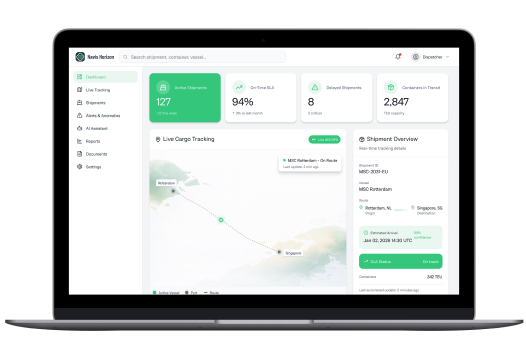
Our client required a unified platform to gain real-time cargo visibility, reduce dispatcher workload, and enhance customer communication. We built a system that consolidates AIS/GPS data, automates shipment status updates, and adds AI-driven support for both dispatchers and customers—the result: fewer support requests, more stable SLAs, and higher customer satisfaction.
Our client is a mid-sized port logistics operator in Hamburg, providing end-to-end cargo handling and transportation across major European and global trade routes. Serving corporate clients that rely on accurate, real-time shipment updates, the company previously depended on manual reporting and fragmented data systems, leading to delays and inefficiencies.
The operator faced increasing pressure to offer accurate, real-time shipment visibility. Customers frequently contacted support for updates, while dispatchers were overloaded with manual data gathering from carrier portals, port messages, and spreadsheets.
This resulted in slow issue resolution, inconsistent communication, and periodic SLA breaches. The client required a unified platform to centralize cargo data, automate routine tasks, and deliver proactive updates.
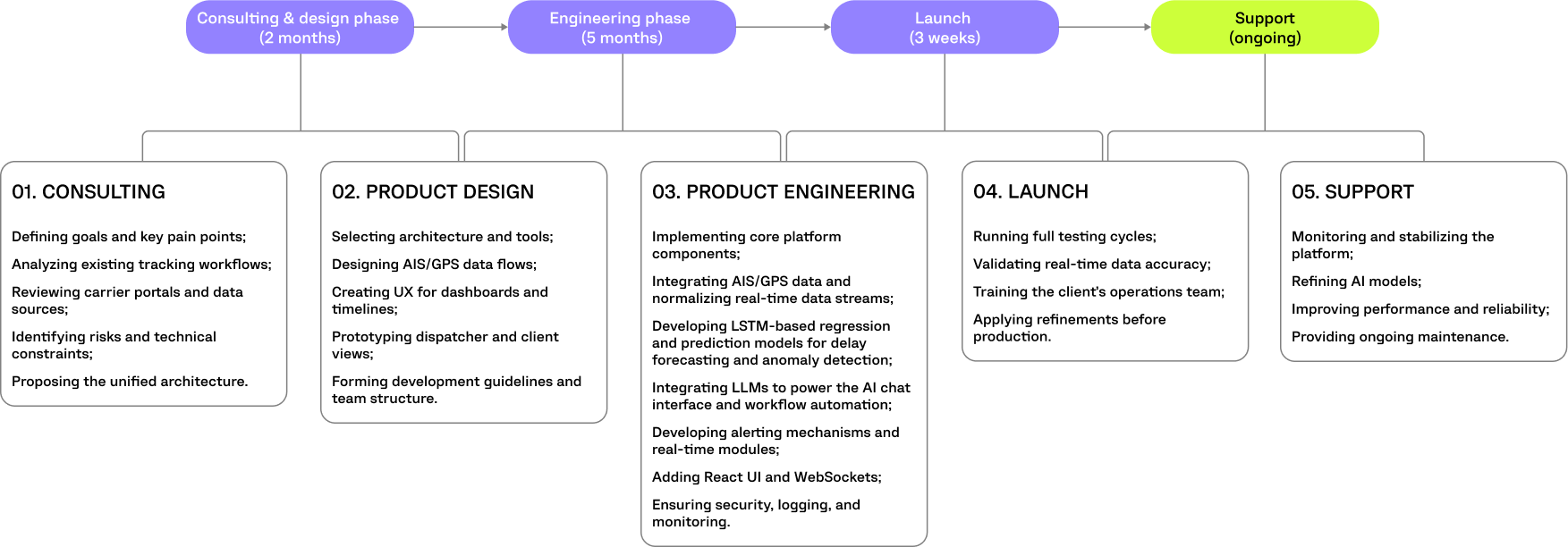
The project was delivered in iterative phases to implement real-time tracking, automated alerts, and AI-driven assistance.
We developed a unified cargo tracking platform that consolidates AIS, GPS, and carrier-event data into a single operational interface. The system automatically detects status changes, predicts potential delays, and notifies both dispatchers and customers.
An integrated AI assistant serves two main user groups:
Close collaboration with the client’s operations team ensured seamless workflow integration and minimal disruption.
Navis Horizon drove significant operational and customer-service improvements:
The client selected Computools due to the company’s proven expertise in logistics technology, real-time data processing, and AI-enabled platforms. Computools demonstrated an ability to integrate multiple complex data sources, design highly usable dashboards, and build scalable systems tailored to operational environments.
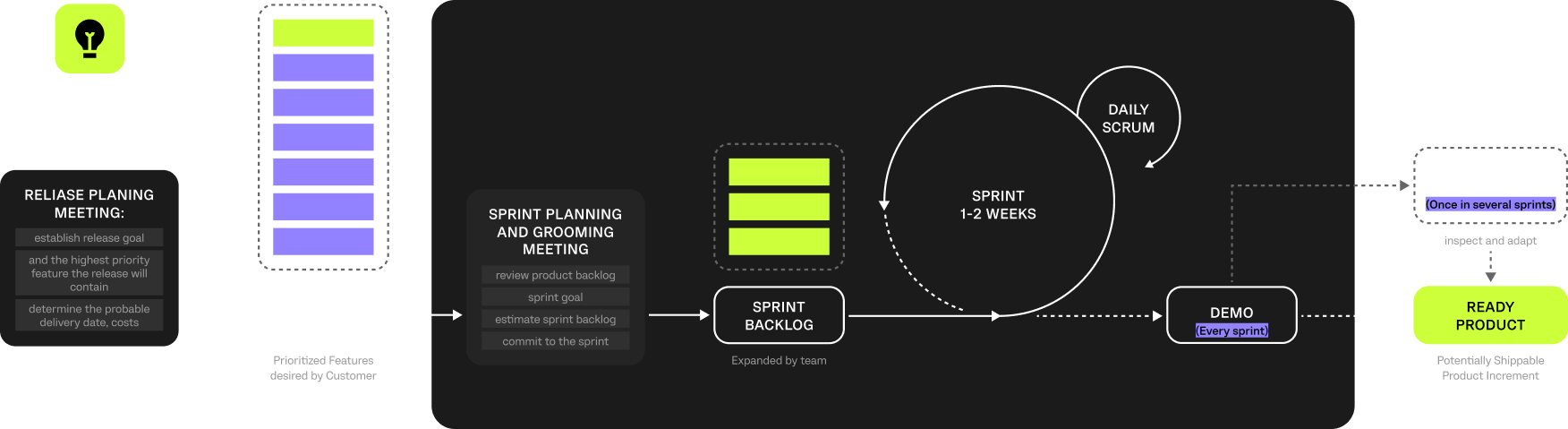
The Scrum approach ensured transparency, flexibility, and rapid adaptation to evolving client requirements.

Before the platform was implemented, dispatchers spent much of their workday gathering updates from various sources. Customers lacked visibility and often asked for manual status checks. This created operational bottlenecks and limited the company’s ability to deliver consistent, predictable service.
Computools analyzed the client’s operational workflows, communication patterns, and data dependencies. Off-the-shelf tools fell short of providing unified tracking, predictive insights, and AI-driven customer interaction.
A custom platform was designed to centralize all data streams, automate status updates, and support both dispatchers and customers through an AI assistant, ensuring seamless integration with existing operations.
We provided full-cycle discovery and consulting, analyzing the client’s operational workflows and defining the architecture for real-time AIS/GPS data aggregation. We integrated multiple carrier APIs and port-event systems into a single, reliable data stream. We also developed an AI assistant designed specifically for dispatchers and customers to streamline communication and reduce manual workload. Furthermore, we also created the UX/UI for dashboards and shipment timelines, and completed all stages of engineering, QA, deployment, and system optimization to ensure a stable, scalable platform.
Navis Horizon was designed to deliver an intuitive and efficient user experience for both dispatchers and customers.
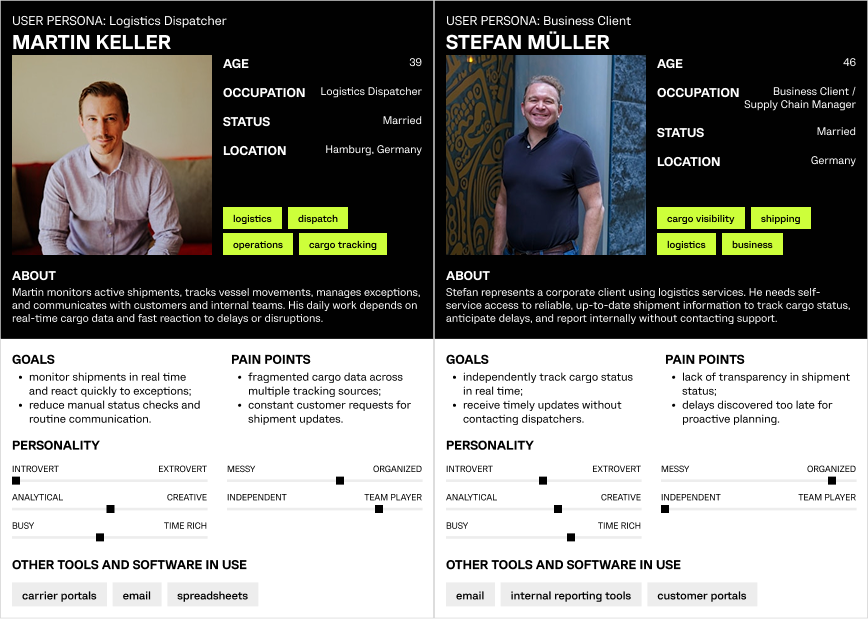
Designed the platform around real operational roles, focusing on logistics dispatchers responsible for monitoring shipments and managing exceptions, and business clients who required self-service access to real-time cargo visibility and documentation.
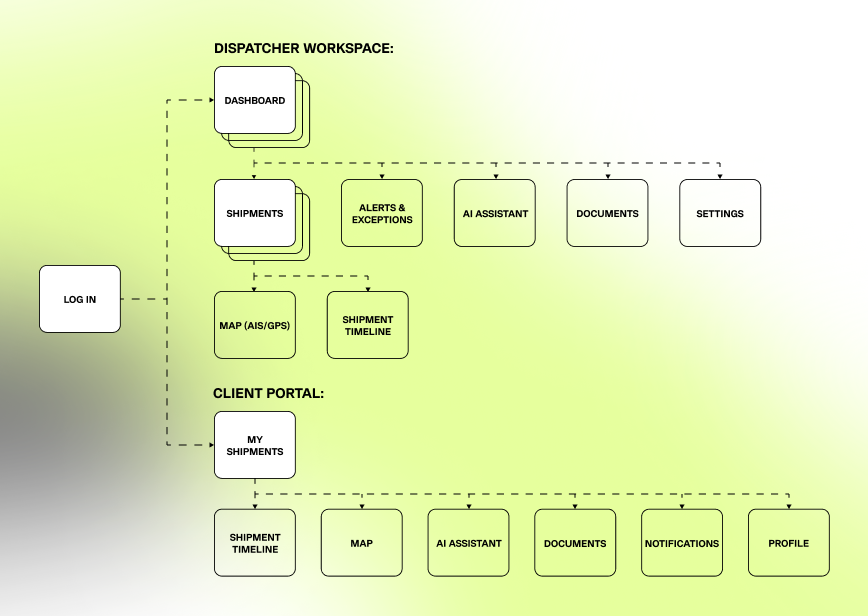
Structured with role-based access, separating dispatcher workflows from client portals and defining clear navigation paths to shipments, alerts, documents, and AI tools.
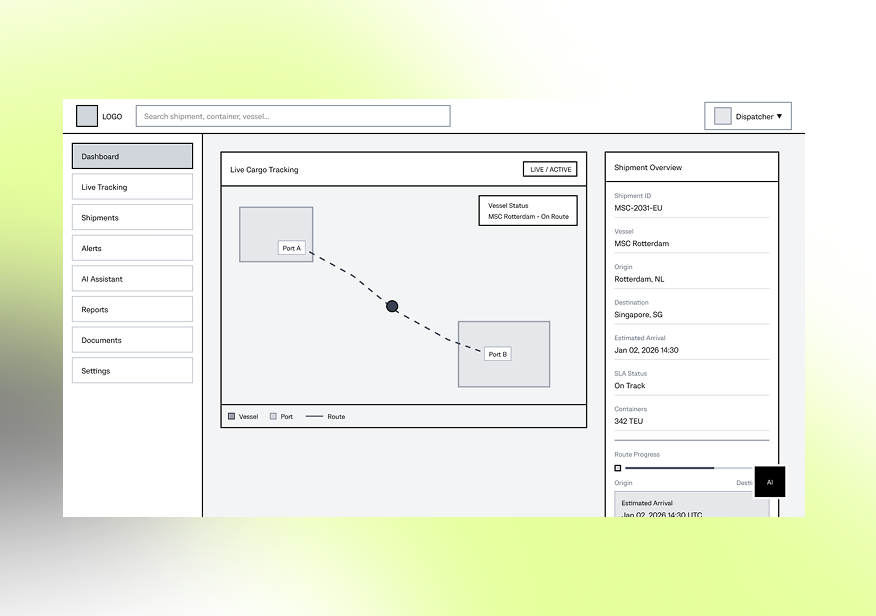
Visualized shipment cards, a global map with markers, timeline events, and an AI chat interface to ensure smooth navigation and minimal cognitive load.

Focused on clarity and operational speed: real-time map, color-coded statuses, streamlined data panels, and conversational AI sidebar. Consistent across dispatcher and customer views while adapting complexity to user roles.

Python(AI)
Python powers predictive and regression modeling across the platform, including LSTM-based forecasting for delay prediction and anomaly detection. It also drives statistical analysis and AI logic, enabling reliable insights from both historical and real-time shipment data.

Go (Core)
Golang (Go) was used to implement core backend services that process real-time AIS/GPS data streams. Its high performance, concurrency model, and low-latency execution ensure stable data ingestion and uninterrupted access to operational tracking data.

AI Assistant & Predictive Models
Python-based LSTM models (TensorFlow, Keras) forecast delays and detect anomalies from live and historical shipment data, while an LLM-powered assistant with RAG enables natural-language access, automation, and real-time operational insights.

React
React enables a fast, interactive user interface that handles frequent data updates. Its component-based structure enables the platform to display maps, shipment timelines, alerts, and live status updates efficiently, without visual delays. This ensures a smooth experience for dispatchers working in high-pressure, time-sensitive environments.

PostgreSQL
PostgreSQL supports reliable storage of structured data, including shipment events, timeline updates, logs, and tracking history. Its transactional integrity and ability to handle complex queries make it ideal for systems that require accuracy, consistency, and auditability.

AIS/GPS Integrations
The platform aggregates data from multiple maritime tracking providers (MarineTraffic, VesselFinder, ORBCOMM) and partner GPS devices. These integrations consolidate disparate data formats into a single source of truth, providing precise, real-time visibility into cargo movement and vessel status.

WebSockets
WebSockets enable instantaneous communication between the server and the user interface. They allow dispatchers and customers to receive live updates on shipment status, delays, and events without refreshing the page. This technology ensures a true real-time experience, a critical requirement for modern logistics operations.

Security
The platform is fully aligned with GDPR requirements and uses encryption for data in transit and at rest. Role-based access control protects sensitive operational information, including shipment routes, customer details, and event logs. A zero-trust front-end approach, combined with a modular backend architecture, ensures secure access, component isolation, and enterprise-grade resilience.
Scrum methodology enabled fast, structured progress and full visibility throughout development. Regular testing cycles and incremental feature releases ensured the platform remained stable as it evolved. The iterative approach allowed the client to review functionality early, provide feedback, and refine requirements as operational needs became clearer.
We now have full visibility without relying on multiple sources. Customers receive updates instantly, and our dispatchers finally have the tools to work proactively instead of reactively. The AI assistant became one of the most impactful improvements for our team.

Computools | 341 Raven Cir, Camden Wyoming, Delaware 19934, US