


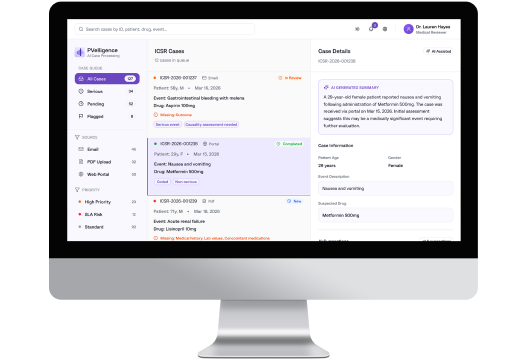
Our client, a contract research organization managing pharmacovigilance operations for multiple sponsors, needed to reduce manual workload across high-volume ICSR processing while maintaining regulatory compliance and review quality.
Computools developed an AI-enabled workflow that automates case intake, structuring, validation, coding, narrative generation, and regulatory preparation while augmenting medical review with decision-support tools. The platform helped the client process safety cases faster, reduce operational bottlenecks, and improve visibility across multi-client PV workflows.
The client is a CRO (contract research organization) operating in a high-volume pharmacovigilance environment, delivering PV services for multiple life sciences clients with different SOPs, regulatory obligations, and reporting priorities.
Its teams process thousands of ICSRs per month from email, PDFs, portals, and other fragmented data sources. Because case volumes keep growing while turnaround expectations remain strict, efficiency and consistency directly affect profitability, SLA performance, and audit readiness.
The client faced growing pressure across several areas of pharmacovigilance operations.
Case intake was fragmented across multiple channels, including email, PDF attachments, portals, and semi-structured submissions, creating heavy manual data entry requirements at the start of each workflow. Critical activities such as validity checks, MedDRA coding, WHO-DD mapping, and case narrative creation required substantial manual effort, often taking hours per case.
The complexity increased further because the CRO handled PV operations for multiple clients, each with different business rules, SOPs, and review expectations. This created inconsistency, slowed triage and follow-up, and increased the risk of delays for serious cases subject to strict reporting deadlines.
Existing safety systems stored and processed cases, but they did not significantly reduce manual work. As volumes increased, the client needed a scalable way to accelerate case handling, reduce burnout, improve control over operational bottlenecks, and support medical reviewers without removing human oversight from critical decisions.
Computools designed and implemented PVelligence, an AI-driven pharmacovigilance automation platform built around two connected layers: ICSR workflow automation and medical review augmentation.
The first layer automates intake, data extraction, case structuring, validity checks, triage, coding, automatic case creation in safety systems, narrative drafting, and regulatory output generation. Incoming reports from email, PDFs, web forms, and other sources are transformed into structured safety cases with standardized fields ready for downstream processing.
The second layer supports physicians and PV specialists during review. AI-generated pre-assessments surface seriousness, expectedness, causality cues, and reporting suggestions, while the final medical and regulatory decisions remain fully human-controlled. This combination reduced repetitive operational work while improving review consistency and decision speed.
PVelligence delivered measurable improvements across pharmacovigilance operations.
Computools was selected for its ability to combine AI engineering, workflow automation, and regulated healthcare software expertise within a single delivery model.
The project required more than document extraction or chatbot logic. It demanded an end-to-end understanding of pharmacovigilance workflows, validation points, human-in-the-loop review, and multi-client operational complexity. Computools translated these requirements into a practical automation architecture that improved speed without compromising control.

The CRO operated in a high-pressure PV environment, processing thousands of ICSRs each month across multiple sponsor accounts. Incoming reports arrived in different formats and from different channels, creating heavy manual work at the very start of the workflow.
As case volumes increased, routine activities such as intake, coding, case entry, and narrative drafting became major operational bottlenecks. Teams spent too much time on repetitive preparation tasks instead of focusing on quality review, while management had limited visibility into real workload distribution and SLA exposure.
Computools approached the project as an operational automation initiative with clinical decision support built in. The first objective was to reduce manual effort in the most time-consuming parts of case processing. The second was to make medical review faster and more consistent without replacing human judgment.
The solution was designed as a chain of AI-enabled services that extract, structure, validate, prioritize, code, and prepare safety cases before they reach the reviewer. On top of that, a decision-support layer was added to help physicians assess seriousness, expectedness, and reporting obligations with better speed and consistency.
Computools acted as the end-to-end technology partner responsible for workflow design, AI integration, automation logic, review interface design, and system connectivity.
The team led architecture design for case intake and processing orchestration, NLP- and LLM-based extraction workflows, validation logic, coding support, narrative generation, medical review augmentation, and integration with downstream safety systems.
One of the most important decisions was to separate automation from decision-making. Repetitive operational work was automated as much as possible, while clinically sensitive judgments remained under human control. This kept the system scalable and efficient without creating unacceptable compliance risk.
Another key decision was to build the platform around modular services rather than a single AI step. That enabled independent automation of intake, structuring, coding, and reporting while preserving traceability and reviewability at each stage. As a result, the CRO gained both speed and operational control, not just another layer of software.
The platform design focused on reducing manual effort in high-volume pharmacovigilance workflows while maintaining full control and traceability for regulated processes. The goal was to streamline case handling and support faster, more consistent medical review without removing human oversight.
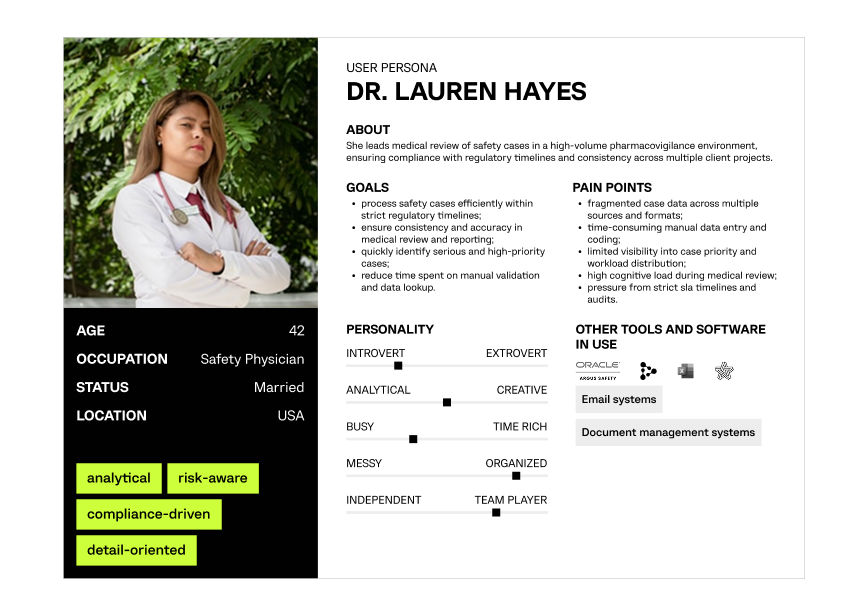
The product design was guided by semi-fictional personas representing pharmacovigilance professionals to ensure efficient workflows, regulatory compliance, and user-centric medical review processes.
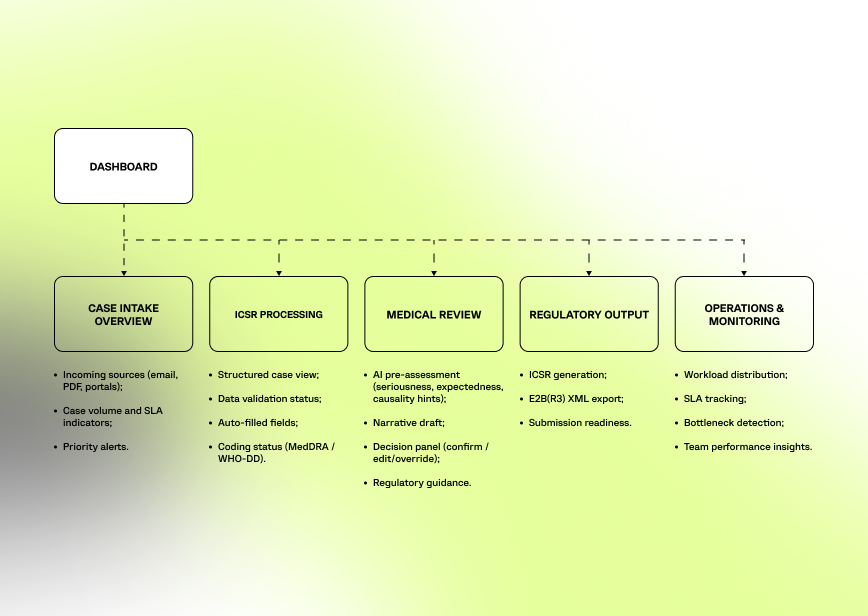
The platform structure was built around actual pharmacovigilance workflows rather than generic data displays.
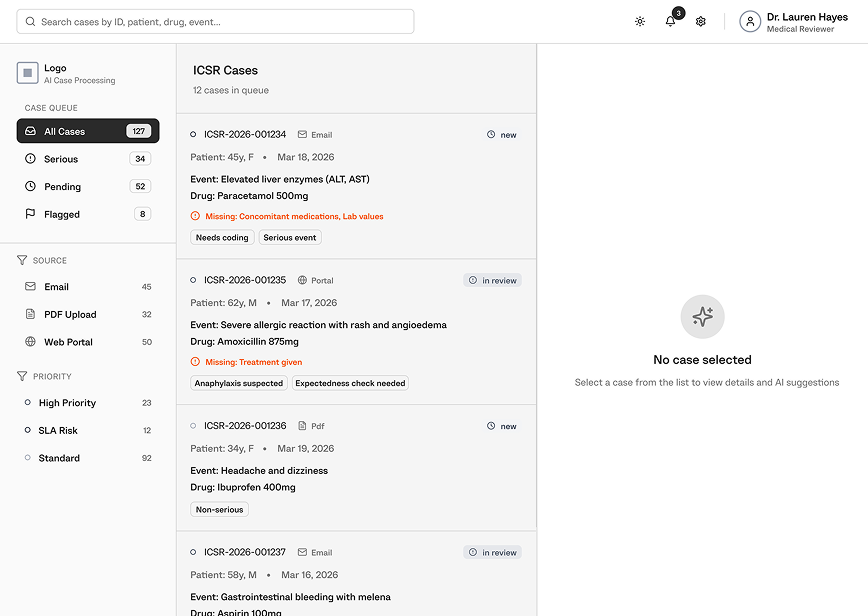
Low-fidelity layouts focused on simplifying case intake, structuring complex safety data, and enabling fast navigation between case fields, coding, and medical review decisions.
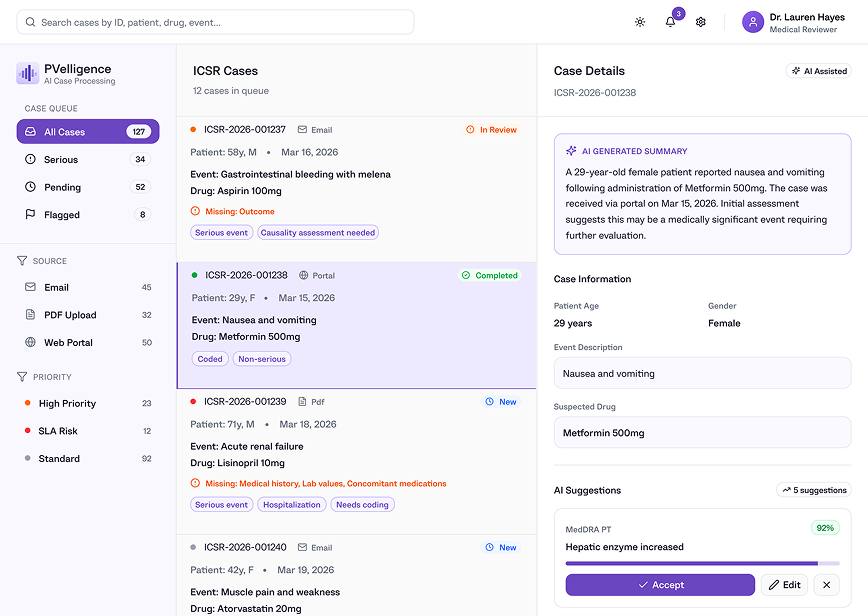
The interface provides a structured, priority-driven case view with AI insights, auto-filled fields, highlighted missing information, coding suggestions, and a decision-support panel for physicians to validate or adjust AI assessments while maintaining full control.

PYTHON
Used for the orchestration of data processing pipelines, integration logic, and AI model execution across pharmacovigilance workflows.
NLP & LLM MODELS
Natural language processing and large language models are used to extract structured safety data from unstructured sources such as emails, PDFs, and web forms. The models identify key ICSR elements, including patient, reporter, suspect drug, and adverse event, and support narrative generation and medical review pre-assessment. Models are built with Python, using TensorFlow and Keras to ensure scalability and efficient model training.

MACHINE LEARNING
Applied for case triage, seriousness classification, prioritization, and early signal detection through pattern analysis across incoming safety data, complementing NLP/LLM extraction with structured risk assessment.

RPA
Automates repetitive tasks such as data entry, case creation in safety systems, and regulatory document preparation, reducing manual workload and processing time.
INTEGRATION LAYER
Ensures seamless data exchange with existing pharmacovigilance systems, such as Oracle Argus and ARISg, as well as with external data sources, including email systems and document repositories.

CLOUD & HYBRID INFRASTRUCTURE
Supports secure, scalable deployment with role-based access control, audit trails, and compliance with data governance requirements in regulated environments, including AWS Cloud and containerization with Docker.
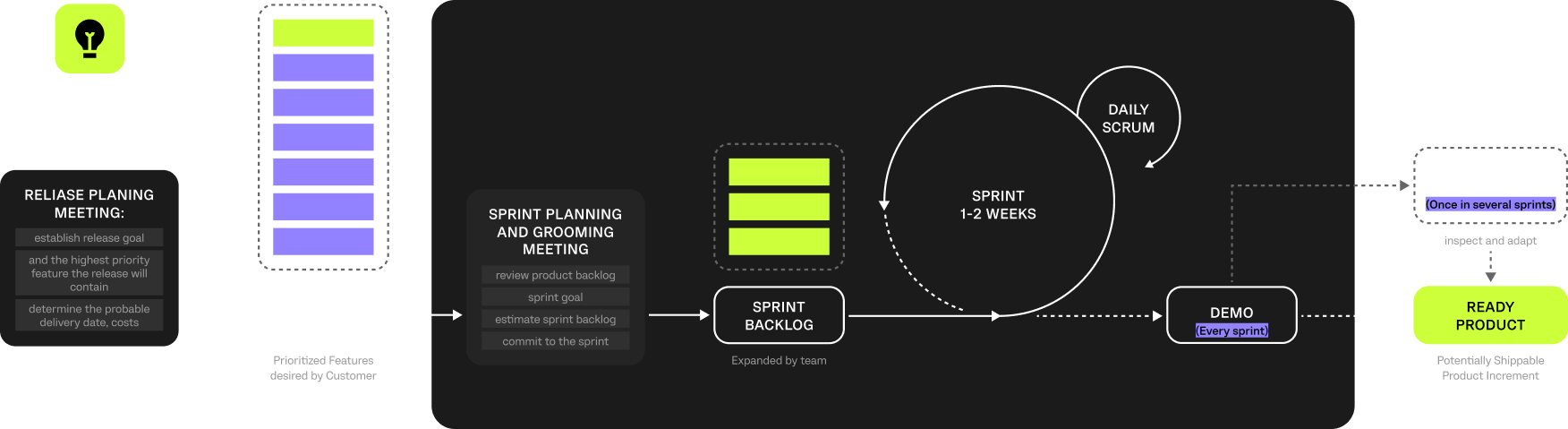
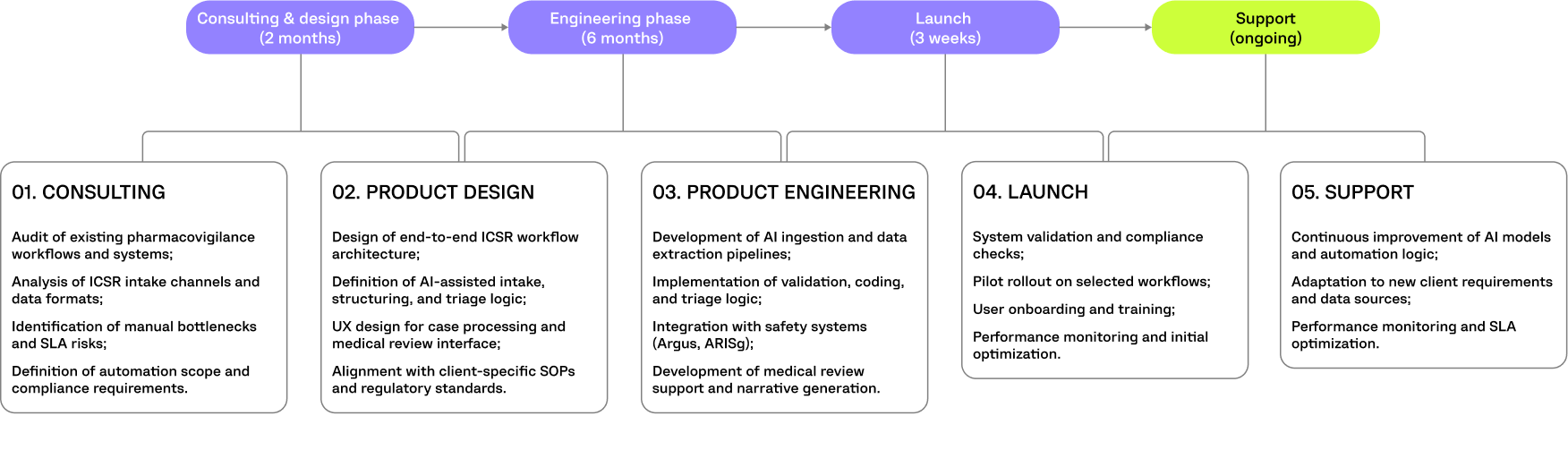
An Agile approach using Scrum was implemented to manage the project and support iterative development across multiple workflow components. This enabled the team to adapt to changing pharmacovigilance requirements, client-specific SOPs, and regulatory constraints. Regular sprint cycles, validation checkpoints, and stakeholder feedback ensured that the automation logic and AI components aligned with real PV processes and compliance standards.
We were processing a large volume of safety cases manually, and it was becoming difficult to keep up with timelines. The new system significantly reduced the time spent on routine tasks and made our workflows more structured and predictable. Our team can now focus more on medical review instead of data entry, which has improved both efficiency and consistency.

Computools | 341 Raven Cir, Camden Wyoming, Delaware 19934, US