A growing Austrian hotel group approached Computools after third-party distribution became its dominant source of reservations. Occupancy remained stable, guest reviews were positive, and the business had enough demand to support expansion.
The issue lay in the commercial model: most bookings came through OTAs, commission costs kept rising, and the hotel group had limited control over how guests discovered, booked, and returned.
To address this, Computools delivered Radesso Prime, a custom hotel booking system designed to shift part of the demand into the client’s own sales channel. The solution combined a streamlined reservation flow, direct booking incentives, guest data capture, and retention mechanics that supported repeat stays. As a result, the client began reducing commission pressure and building a more sustainable channel mix.
The client is a regional hotel chain operating several urban properties in Austria and serving both leisure travelers and short-stay business guests. The group had steady reservation volume, positive public reviews, and a recognizable local presence, but its online sales model relied too heavily on external platforms.
Although the company had a website, it lacked a scalable hotel booking web platform that could compete with the convenience of major OTAs. At the same time, it needed a practical direct booking web platform to attract qualified traffic, improve on-site conversion, and support repeat reservations across multiple properties.
As the client prepared to grow, these limitations became more visible. Expansion meant more rooms to fill, but also more exposure to commission-heavy acquisition.
The client’s main challenge was reliance on third-party channels. About 70-80% of bookings came through OTA platforms like Booking.com and Airbnb, with commission fees ranging from 15-25% per reservation.
This created a structural business risk: the hotel group depended on external marketplaces for demand, while having limited control over pricing perception, guest relationships, and repeat bookings.
The existing site couldn’t replace that reliance. It wasn’t a hotel website with a booking engine that could compete on speed, clarity, and trust. Guests could browse the brand online, but the reservation process itself wasn’t strong enough to keep them from turning back to OTA platforms.
At that point, the client needed more than standard web development services. It needed a conversion-oriented digital product that could support direct acquisition without disrupting occupancy.
Computools designed and delivered Radesso Prime, a hotel booking web platform for direct reservations, created to help the client build a stronger owned channel alongside existing OTA distribution.
The solution included booking engine development for hotels, redesigned property and room pages, improved booking flow logic, direct-only offer communication, guest data capture, and integration support for marketing and retention activities.
As part of a broader HoReCa software development initiative, the platform was built to support both first-time and repeat reservations while giving the client more control over its digital sales channel.
The platform was reinforced by SEO and AEO, paid search, retargeting, and post-stay email communication. This gave the client a more balanced acquisition model in which OTA channels remained useful, but no longer served as the only dependable source of bookings.
Within approximately six months after launch:
The project established a more sustainable distribution model for future growth and created a practical way to reduce OTA dependency for hotels. It also laid the foundation to increase direct bookings for hotel operations without sacrificing occupancy.
Computools was selected as the technology partner because the client needed a team capable of combining product strategy, conversion-oriented UX, backend booking logic, digital acquisition support, and post-launch optimization within one delivery model.
Computools approached the challenge as a commercial transformation initiative rather than a design refresh. By aligning the booking journey, offer positioning, guest data capture, retention workflows, and analytics, the team helped the client build a direct channel that could grow with the business.
When the client first approached Computools, the business looked stable on the surface. The hotel chain had healthy occupancy, strong guest reviews, and a steady flow of reservations through OTA platforms. From a distance, its digital presence appeared good enough.
A closer assessment showed a fragile commercial model. Most bookings were coming from third-party platforms, leaving the business exposed to ranking changes, commission increases, and limited access to guest relationships.
As long as demand remained stable, this dependence could be tolerated. But once the client began planning expansion, the economics became harder to justify. Every new property increased revenue potential, but also increased reliance on channels that took a meaningful share of each reservation.
The client needed a way to regain commercial control without abandoning OTA visibility altogether.
Computools approached the project as a direct revenue recovery initiative. The goal was not to replace OTA channels, but to reduce overdependence by building a booking experience guests would actually choose.
The first step was redesigning the reservation journey. The existing website did not convert efficiently: navigation lacked clarity, room selection felt fragmented, and the booking path failed to build enough trust to keep users on-site. The experience was restructured around speed, simplicity, and visible value.
Once the booking flow was improved, the platform evolved into a broader direct acquisition system. Computools focused on on-page SEO and AEO optimization, created landing pages for high-intent local demand, and helped shape direct-only benefits such as lower rates, flexible cancellation, and room upgrade opportunities.
With the platform optimized for conversion and discovery, the client was able to activate paid search and retargeting more effectively. To support retention, the client also introduced communication flows for follow-up messaging, personalized offers, and repeat stays.
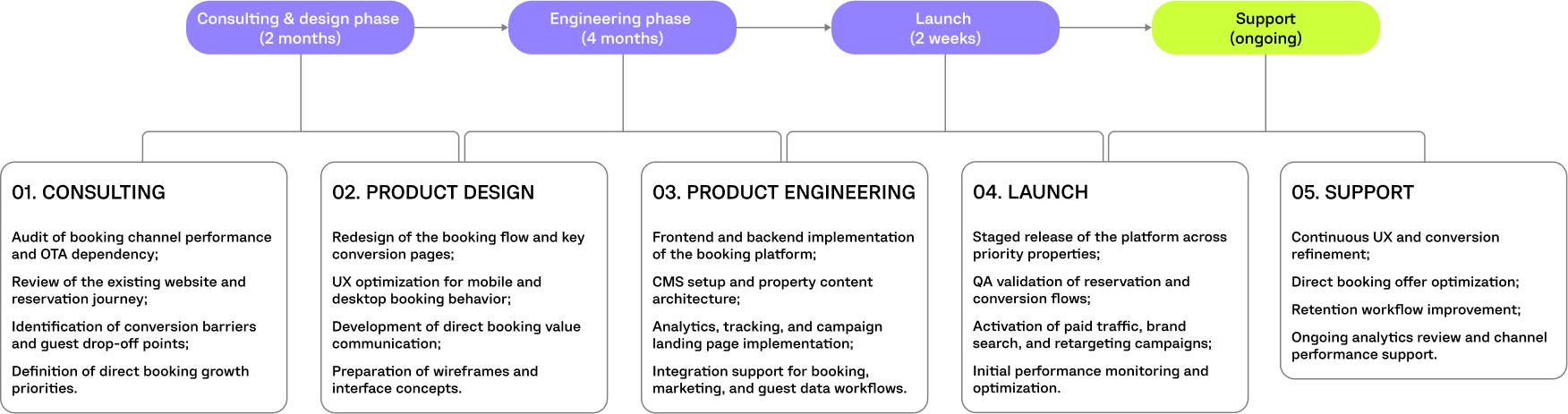
Computools acted as the end-to-end delivery partner and was responsible for:
Several strategic decisions shaped the project outcome. OTA platforms were not treated as something to eliminate, but as channels to rebalance.
The platform was built around convenience before promotion, since marketing alone would not fix weak conversion. Direct reservations were supported with clear incentives rather than generic messaging, while retention was treated as a revenue asset through stronger use of guest data and repeat-stay communication.
As a result, the client moved from channel dependence toward channel control, creating a stronger foundation for future growth.

When designing Radesso Prime, the team focused on clear booking architecture to make the reservation journey more intuitive and support future direct booking growth.
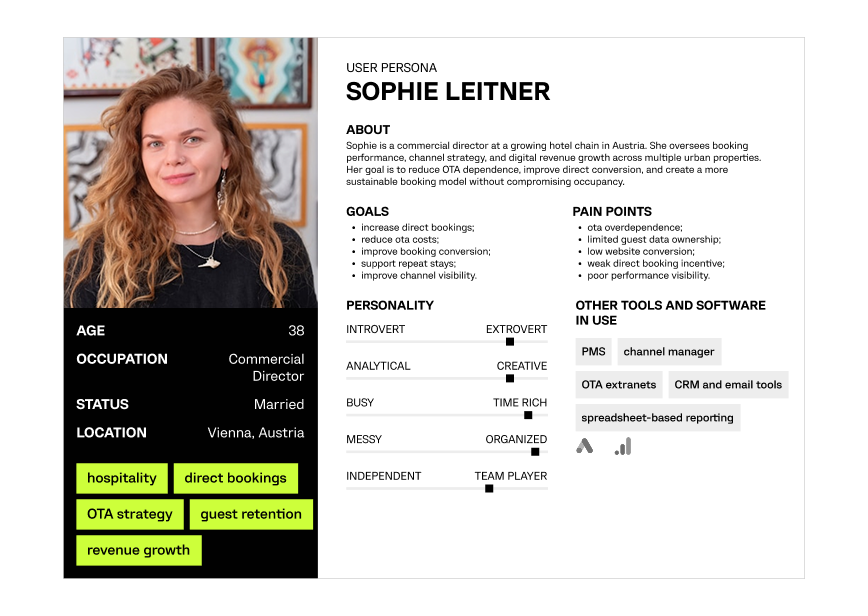
A detailed profile created to guide direct booking flows, offer logic, and guest retention strategy.
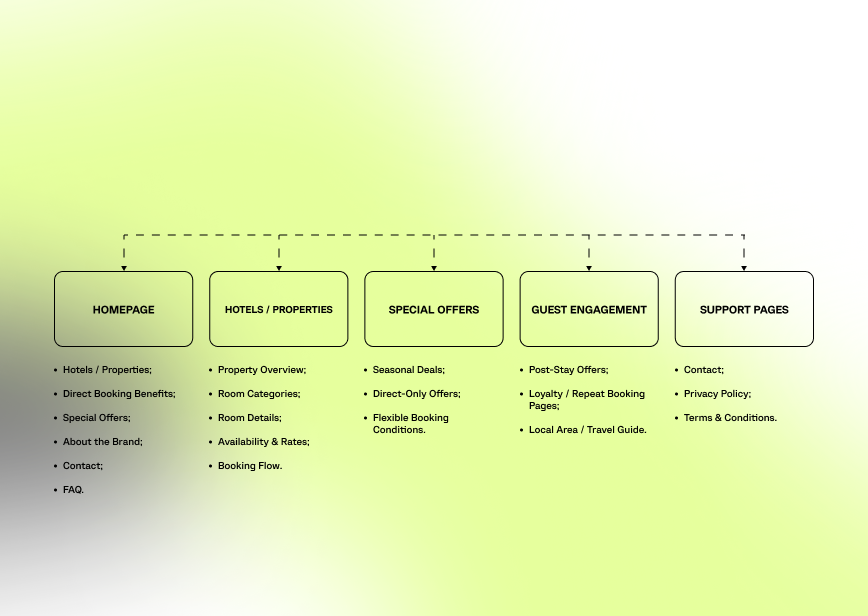
Hierarchical structure built to support seamless navigation from discovery to direct reservation.
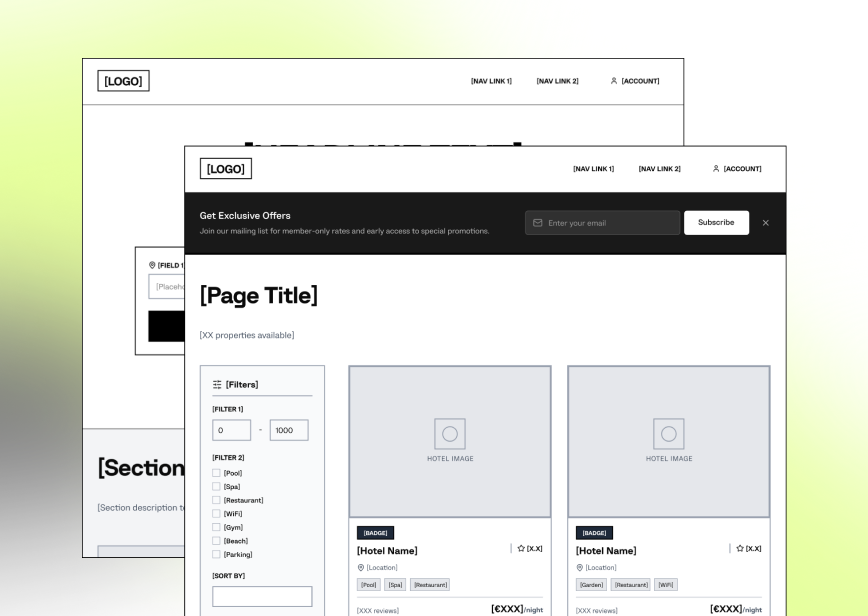
Low-fidelity layouts prepared to simplify booking decisions and reduce drop-off across key screens.
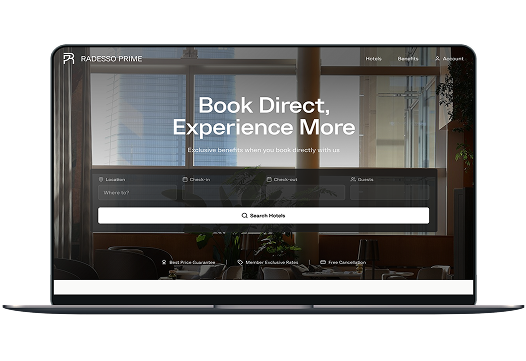
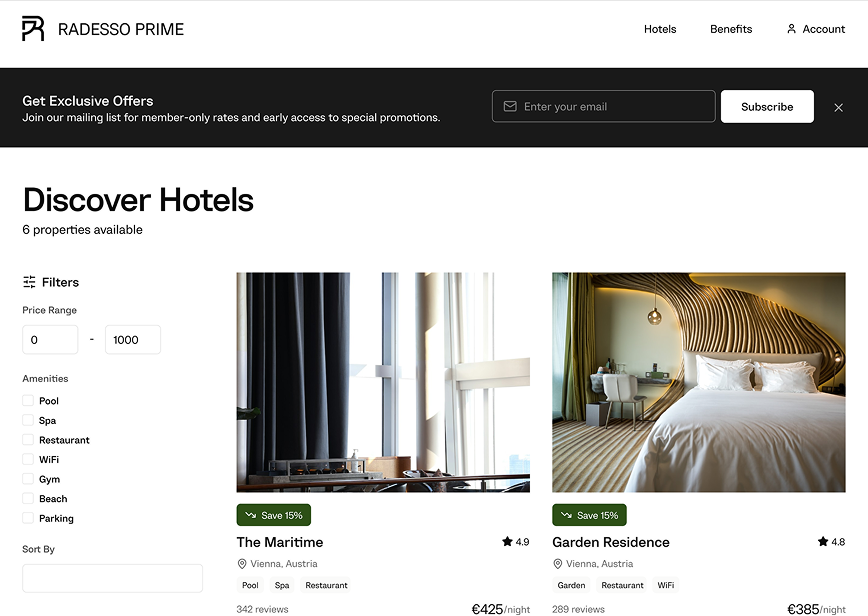
Streamlined interface designed to make direct booking simple, trustworthy, and conversion-focused.
NEXT.JS / REACT
Next.js and React are used to build a fast, mobile-friendly booking experience for hotel guests. This frontend stack supports SEO performance, smooth page navigation, and a streamlined reservation journey across property pages, room details, and booking flows. It helps turn the hotel website into a high-converting direct booking channel.
NODE.JS / NESTJS
Node.js and NestJS power the backend logic for booking workflows, room availability, pricing display, and reservation handling. This architecture supports reliable API communication, modular business logic, and scalable performance as the platform grows across multiple hotel properties. It gives the client flexibility beyond standard off-the-shelf booking tools.
POSTGRESQL
PostgreSQL is used as the core relational database to store booking data, guest records, room information, and relationships between platform content. It provides a stable and structured foundation for handling reservation flows, analytics inputs, and integration-ready data across the hotel’s digital ecosystem.
AWS / DOCKER
AWS and Docker are used to support secure deployment, scalable infrastructure, and stable platform performance. This setup allows the solution to handle traffic growth, simplify release management, and support long-term expansion as the hotel group adds new properties and digital functionality.
STRAPI CMS
Strapi is used as a headless CMS to manage hotel content, room descriptions, promotional offers, landing pages, and location-specific website sections. This allows internal teams to update content quickly without developer involvement and supports faster execution of direct booking campaigns and seasonal offers.
GA4 / GOOGLE TAG MANAGER
GA4 and Google Tag Manager are used to track user behavior, booking funnel performance, traffic sources, and conversion events across the platform. This gives the hotel group clear visibility into how guests move from search and ads to direct reservations, helping the team optimize marketing spend and improve conversion rates over time.
HUBSPOT / EMAIL AUTOMATION
HubSpot and email automation tools are used to capture guest data, support post-stay communication, and drive repeat bookings through personalized outreach. This helps the client build direct relationships with guests beyond OTA platforms and create retention flows that reduce commission-heavy repeat acquisition.
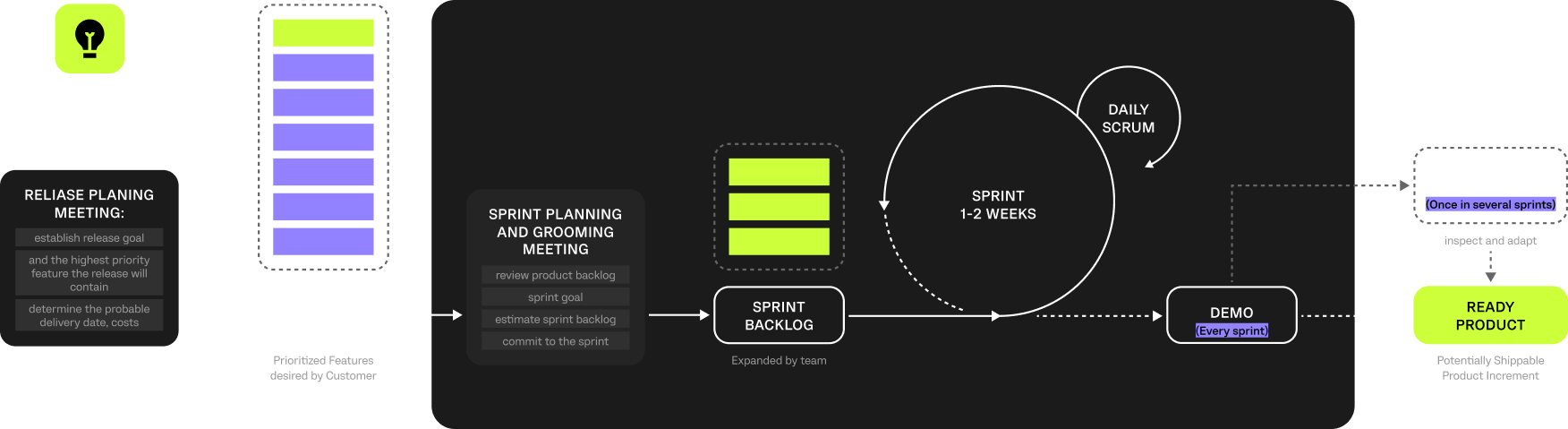
Computools used a Scrum-based delivery approach to keep the project aligned with both technical execution and commercial goals. Work was organized into short iterations, each focused on a defined improvement area such as booking conversion, content management, acquisition support, or retention enablement.
This method allowed the team to validate priorities early, release improvements in stages, and refine the solution based on real performance signals rather than waiting for a single large rollout. It also kept the client closely involved throughout the process and allowed business priorities to be adjusted as the platform evolved.
We realized that while OTA channels brought us more bookings, they didn’t give us much control. As we looked to grow, it was obvious this approach would keep raising our costs and make it harder to connect with our guests. We needed a direct booking channel that could truly compete, not just a better website.
Computools helped us tackle the problem from both a product and business angle. Our new platform gave our guests a clearer reason to book outside of OTAs and set us up for more repeat bookings. Within a few months, direct reservations increased significantly, leading to a much better balance across our properties.