Background
The logistics provider had already invested in warehouse execution infrastructure. SAP EWM managed core operations, RF scanners guided picking tasks, and operational dashboards tracked order volumes and productivity.
The facility had enough space and processing capacity to support growth, but SKU placement had accumulated through years of assortment changes, customer onboarding, new product launches, seasonal adjustments, and local operational decisions.
Some prime picking locations still contained products that had once been fast movers. Other SKUs had grown significantly in popularity but remained in remote aisles or mezzanine zones selected when their volume was much lower.
Warehouse teams corrected obvious slotting problems before peak seasons, but optimizing thousands of SKUs required analyzing more combinations than planners could handle through manual reviews.
A second limitation came from standard location sequencing. Traditional pick routes followed predefined location orders, but those sequences did not always represent the shortest real-world path through aisles, cross-aisles, mezzanine access points, and packing destinations.
Leadership needed a way to improve picking productivity using the existing warehouse footprint and SAP EWM environment.
Approach to solution
Computools mapped how picking workflows, replenishment logic, warehouse layout, WMS location structures, packing destinations, shift patterns, and peak-season conditions affected physical movement inside the facility.
Historical SAP EWM event data was used to reconstruct completed pick tours and set baselines for travel distance, pick-tour duration, lines per hour, zone utilization, product affinity, congestion, and replenishment frequency.
The team converted the warehouse into a graph-based navigation model. Aisles, cross-aisles, storage locations, mezzanine access points, elevators, and packing areas became nodes, while walking paths became weighted connections based on distance and expected travel time.
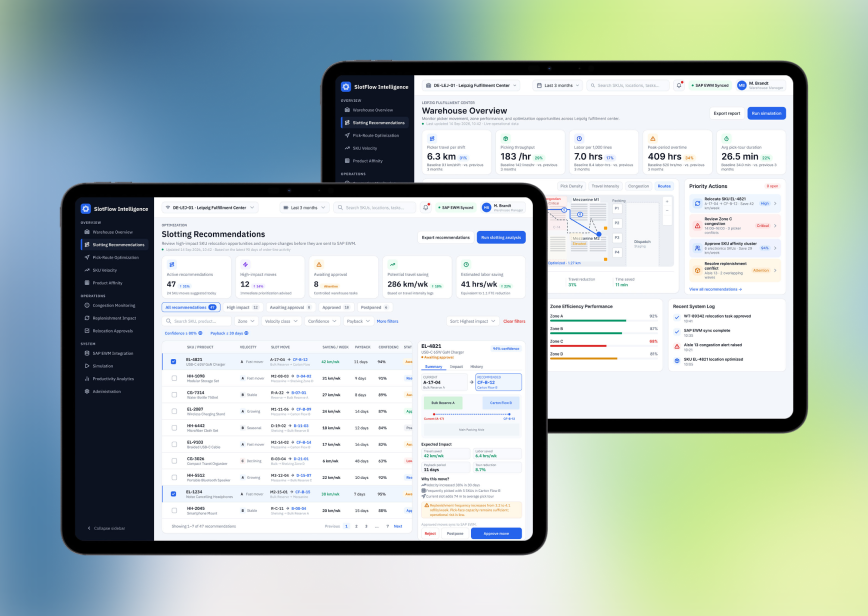
Routing and slotting were optimized separately. Route improvements could quickly reduce picker travel, while physical reslotting required a clear operational case. For each proposed slotting change, SlotFlow calculated expected travel reduction, replenishment impact, relocation effort, payback period, and confidence level, then filtered out low-value moves before manager review.
Computools role
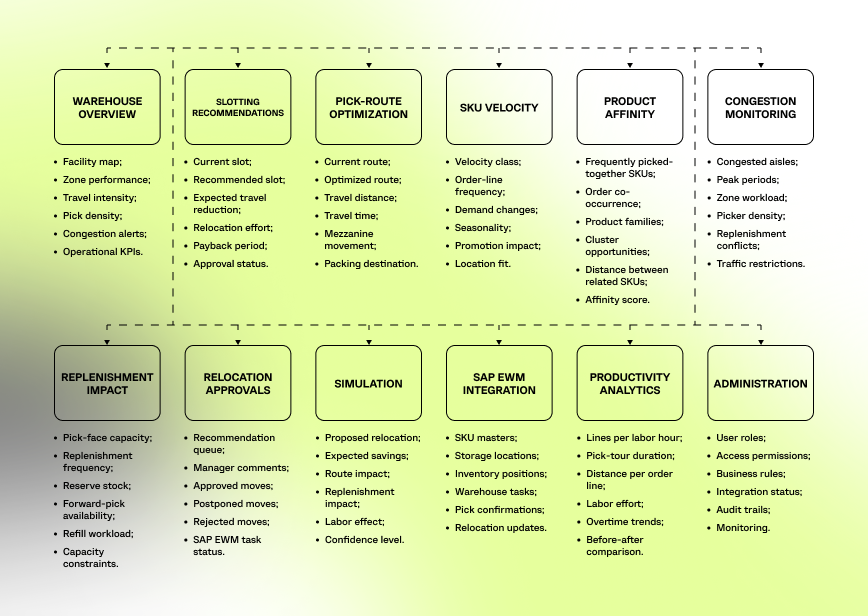
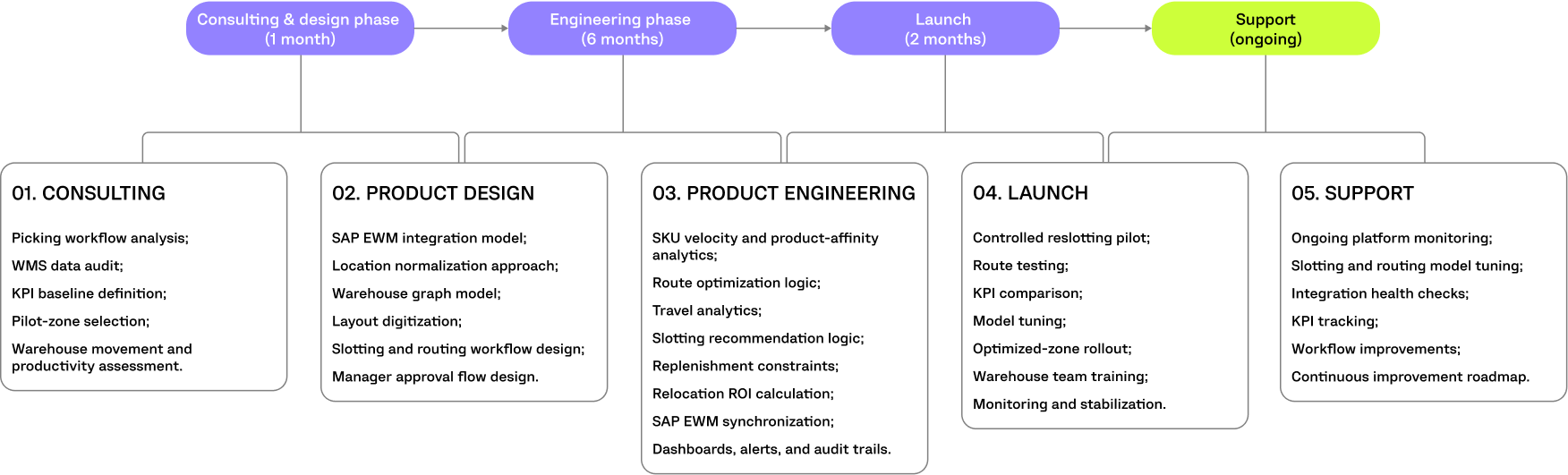
Computools acted as the end-to-end product and technology partner responsible for:
- mapping picking, replenishment, relocation, packing, and warehouse movement workflows;
- analyzing historical WMS order and picking data;
- defining baseline warehouse productivity KPIs;
- digitizing the physical warehouse layout for path optimization;
- creating the graph-based 3D warehouse navigation model;
- developing SKU velocity and order-affinity analytics;
- building dynamic slotting recommendation algorithms;
- developing pick-route optimization services;
- modeling congestion and zone workload;
- designing relocation approval and exception-management workflows;
- integrating recommendations and warehouse tasks with SAP EWM;
- building operational dashboards and productivity analytics;
- implementing role-based access, audit trails, monitoring, and cloud infrastructure;
- supporting pilot execution, KPI validation, user training, and warehouse-wide rollout.
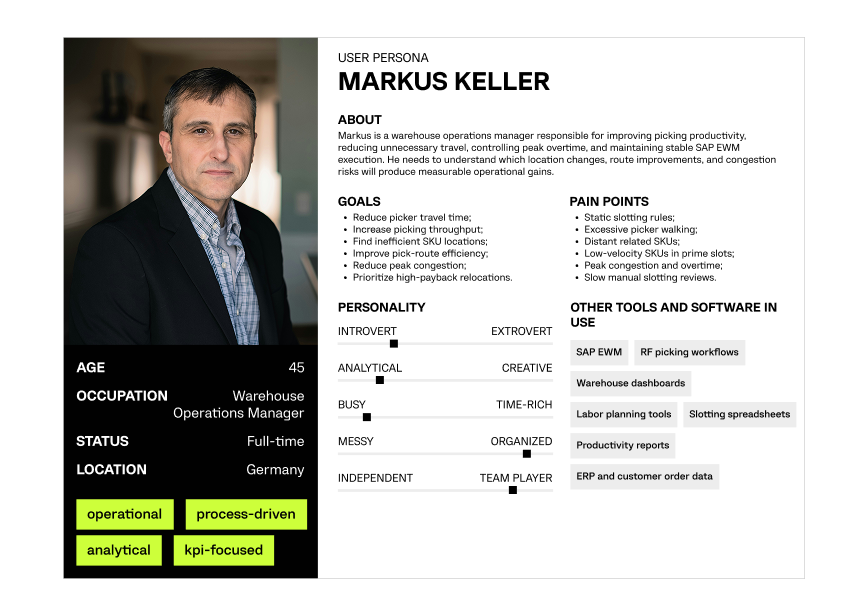
The team worked with warehouse operations managers, shift supervisors, slotting specialists, process engineers, replenishment coordinators, fulfillment analysts, IT stakeholders, and logistics executives.
Key decisions and outcomes
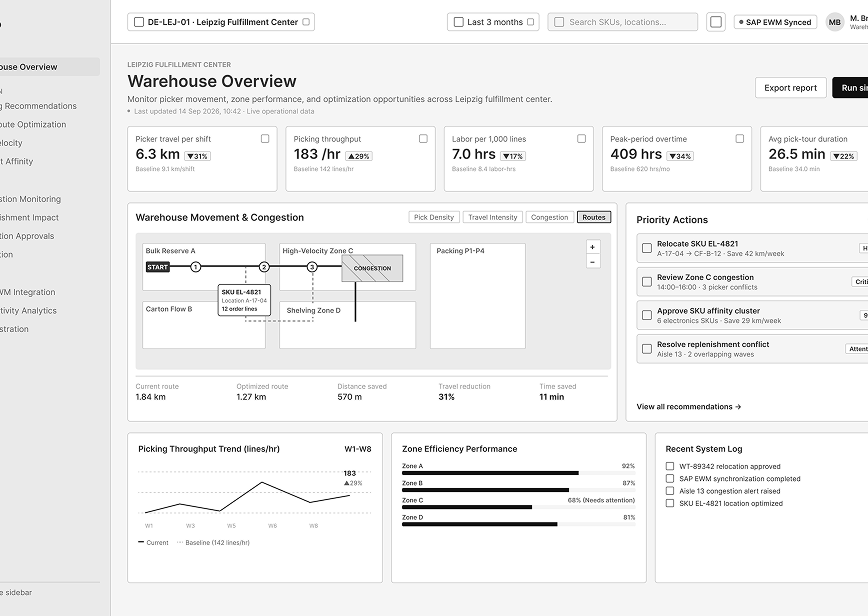
Computools focused optimization on actual order-line behavior, replenishment effort, facility movement, and warehouse manager control. The model analyzed SKU velocity together with product affinity, pick-face capacity, replenishment frequency, horizontal and vertical travel, and expected relocation value.
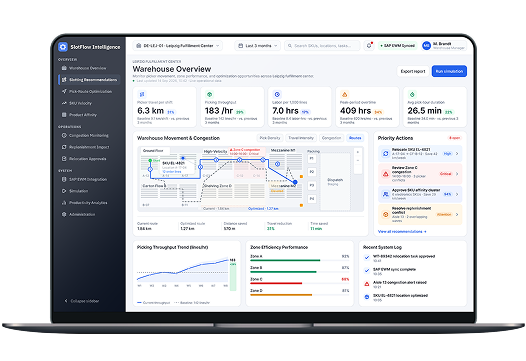
This prevented the platform from recommending constant reslotting or moving every fast-selling SKU closer to the packing area. SlotFlow Intelligence prioritized changes only when the expected travel reductions, labor savings, and payback justified the effort of physical movement.
Warehouse managers kept control over every operational change. They could approve, modify, postpone, or reject relocation recommendations, while approved movements were executed through SAP EWM to preserve inventory accuracy and system-of-record governance.
The completed platform moved warehouse optimization from occasional manual review to continuous decision support based on SKU behavior, warehouse layout, picking routes, congestion, labor productivity, and relocation ROI.