



THE AUTHOR:

An AI logistics dispatch assistant is becoming a practical response to growing operational pressure in freight transportation.
The 2025 State of Logistics Report puts U.S. business logistics costs at $2.3 trillion, or 8.7% of GDP, while Deloitte’s 2026 freight outlook shows that logistics is moving toward data-centric operations built on real-time visibility and AI-driven planning.
At the same time, dispatch teams are still working across fragmented systems, delayed updates, and incomplete operational visibility.
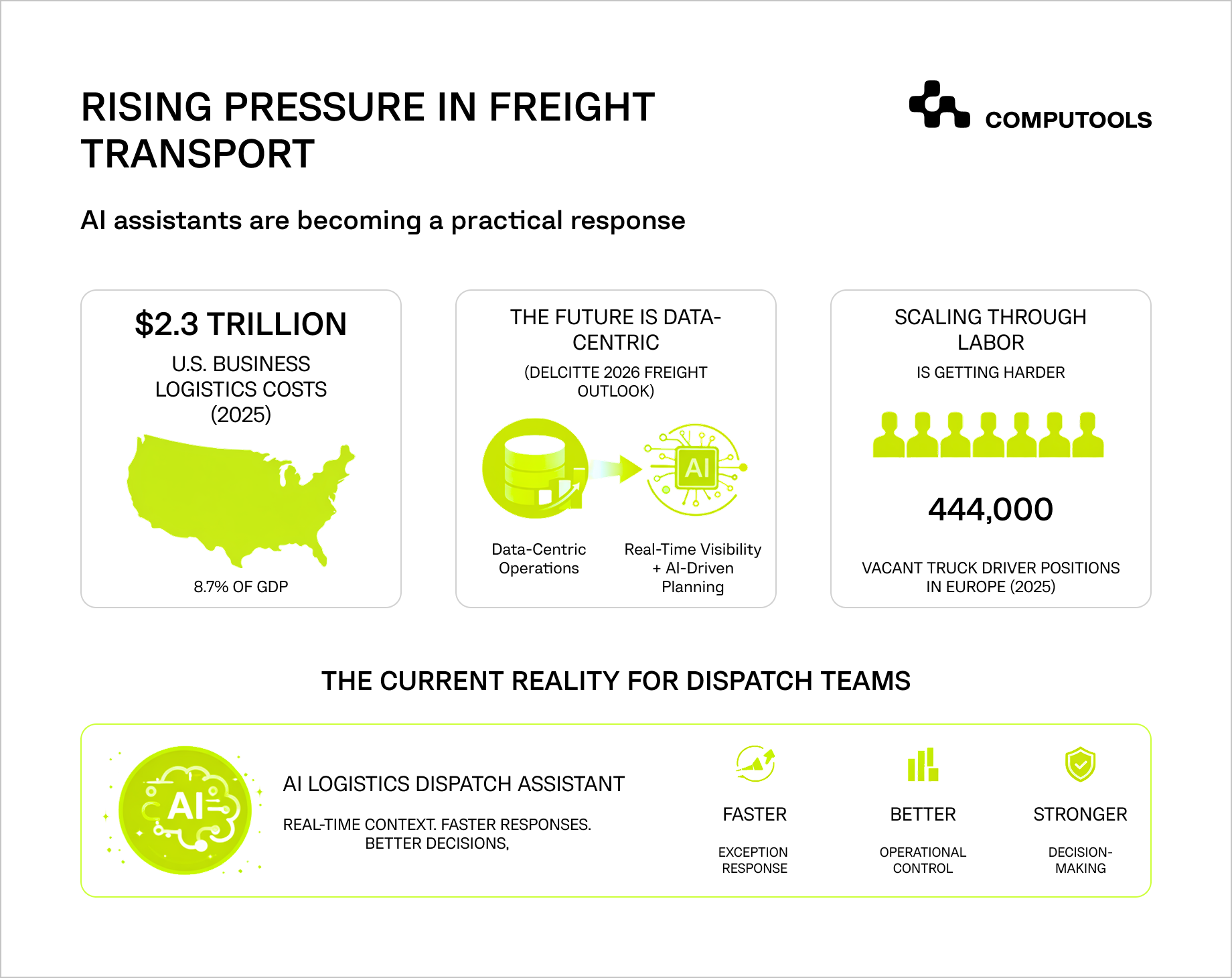
That fragmentation is becoming harder to sustain. MHI/Deloitte reports that the lack of accurate real-time data remains a barrier to end-to-end orchestration, while workforce and forecasting pressures continue to weigh on supply chain operations.
IRU also reported 444,000 vacant truck driver positions in Europe in 2025, underscoring how difficult it has become to scale transport execution through labor alone.
In this environment, logistics companies need more than visibility dashboards. They need AI assistants that help dispatch teams interpret live data, respond to exceptions faster, and make better decisions under pressure.
How Computools built an AI-powered cargo visibility platform for dispatch operations
A strong example of this approach is Navis Horizon, a real-time cargo visibility platform we built for a port logistics operator in Hamburg. The client struggled with fragmented tracking data, manual status checks, and inconsistent communication with customers, while dispatchers had to collect updates from carrier portals, port messages, and spreadsheets.
To solve this, we created a unified operational platform that consolidated AIS, GPS, and carrier-event data into a single interface, providing teams to view cargo movements in real time.
The platform was designed to support dispatch work directly, not just provide another dashboard. It automated status updates, highlighted disruptions, predicted potential delays, and gave dispatchers quick access to shipment details and AI-generated summaries.
For customers, the solution added a natural-language interface for checking cargo status, reviewing documentation, and verifying timelines, reducing the volume of manual support requests and improving communication consistency.
This is the kind of result companies expect from mature maritime software development services when dispatch efficiency and cargo visibility have to improve together.
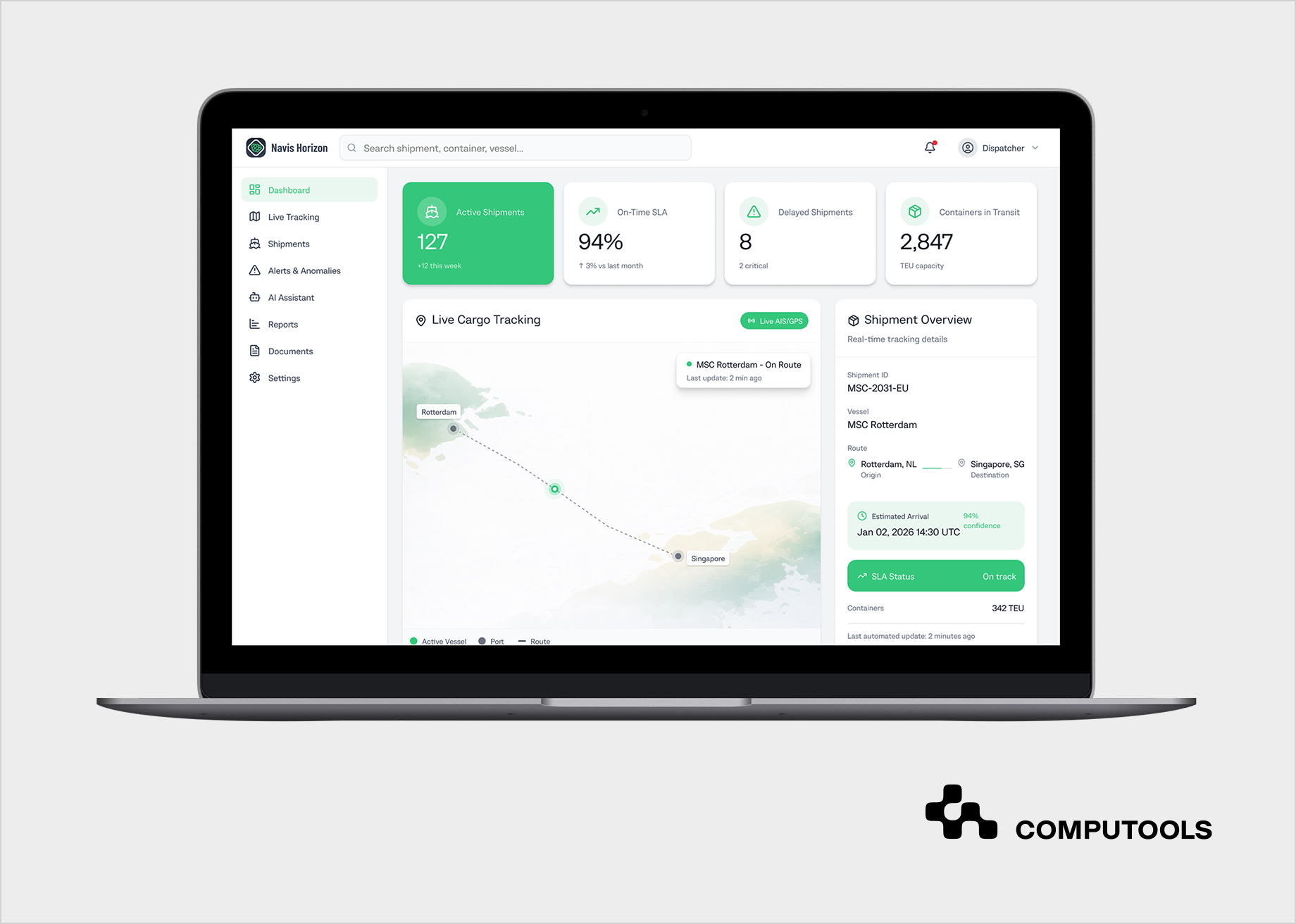
To make this possible, we integrated multiple maritime tracking providers and partner GPS devices into one reliable data stream, turning scattered signals into a single source of truth for logistics operations.
That integration layer reflects the role of IoT development services in dispatch environments where operational speed depends on continuous, real-time data rather than delayed manual updates.
We also implemented predictive models for delay forecasting and anomaly detection, along with an LLM-powered assistant with RAG that enabled natural-language access to operational data and actionable insights.
This use of AI development services helped transform the platform from a tracking tool into a decision-support system for both dispatchers and customers.
As a result, Navis Horizon reduced dispatcher workload by 40%, increased customer satisfaction by 23%, accelerated shipment incident resolution by 18%, and delivered full transparency in cargo status updates.
Dispatch assistants are only as reliable as the tracking data behind them. Learn more in our guide: How to Develop AIS and GPS Data Integration Software for Maritime Operations.
How to build AI assistant software for logistics dispatch operations: step-by-step guide
To show how to build an AI logistics dispatch assistant for transportation companies, it helps to treat the product not as a chatbot layered on top of dispatch workflows but as an operational decision-support system built around live data, exceptions, and time-sensitive coordination.
Step 1. Analyze Dispatch Workflows and Operational Requirements
Before building an AI assistant for dispatch operations, it is necessary to understand how dispatch operations are organized within the business. In logistics, weak assistant performance usually starts long before development begins, when the problem is treated as an AI feature request instead of an operational design task.
A dispatch assistant becomes useful only when it is built around real decisions, real constraints, and real timing dependencies. That means mapping how shipments move through the workflow, where updates come from, which signals are trusted, when exceptions are escalated, and what actions dispatchers are expected to take at each stage.
In the Navis Horizon project, this kind of analysis was necessary because dispatchers were overloaded with manual data gathering from carrier portals, port messages, and spreadsheets, while customers lacked direct access to reliable shipment updates.
At this stage, AI logistics management solutions should be defined by the operational logic they need to support. That includes shipment lifecycle stages, event types, source systems, user roles, exception categories, communication flows, SLA-sensitive moments, and the difference between simple information retrieval and real decision-support tasks.
Without that structure, the product team may end up with a tool that sounds intelligent but has no reliable awareness of what is happening across operations.
In the Navis Horizon case, this discovery phase showed that the client’s operating model was too fragmented for an off-the-shelf product to solve the problem effectively.
Computools analyzed the client’s operational workflows, communication patterns, and data dependencies, then used those findings to define the architecture for a unified platform that could centralize data streams, automate status updates, and support both dispatchers and customers through an AI assistant.
This approach allowed the product to reflect actual operational needs rather than generic assistant logic.
This is where real product expertise matters. In dispatch environments, workflow analysis should identify decision points. The team needs to determine which shipment events are informative, which indicate operational risk, which require dispatcher review, and which can trigger automated customer communication.
It is also important to locate where context is lost: duplicate statuses across providers, delayed event delivery, manual timeline reconciliation, route-level blind spots, or inconsistencies between internal and customer-facing updates.
These findings later determine whether the assistant should summarize, classify, escalate, recommend, or automate.
Step 2. Define User Roles, Actions, and Access Logic
The next step is to define who will use the assistant, what each user needs from it, and how much operational authority the system should support in each case.
In dispatch environments, this is not a UX formality. It determines what information should be visible, which actions should be available, how alerts should be prioritized, and where the assistant should support execution instead of simply display data.
In practice, the product team needs to separate monitoring tasks, exception-handling tasks, customer-facing requests, and routine information lookups before designing the assistant logic.
This stage is especially important when building AI tools for logistics coordinators, because dispatch teams and external users do not operate with the same level of context, urgency, or responsibility. A dispatcher needs rapid access to shipment details, anomalies, delay risks, and status changes that may affect service commitments.
A customer, by contrast, typically needs self-service visibility into cargo location, ETA changes, documents, and timeline updates without exposure to internal operational complexity. If these roles are not separated early, the assistant can easily become overloaded, exposing too much information to one group and not enough actionable context to another.
In the Navis Horizon project, this separation was built into the platform design from the start. The assistant served two main user groups: dispatchers and business clients.
Dispatchers received anomaly alerts, predictive delay insights, AI-generated shipment summaries, and quick access to cargo details, while customers used a natural-language interface to track cargo, check delays, review documentation, and verify timelines.
The platform architecture also reflected that split through role-based access, separating dispatcher workflows from client portals and creating clear navigation paths to shipments, alerts, documents, and AI tools.
Defining roles at this level also helps determine how the assistant should behave in different interaction scenarios.
For internal users, the assistant may need to summarize a shipment, explain why a disruption matters, surface related events, or highlight priority cases that require immediate review.
For external users, it should focus on clarity, consistency, and self-service access, reducing the need for manual support requests without creating ambiguity. This is where AI software for transportation dispatch becomes materially more useful than a standard visibility dashboard: it adapts its assistance to operational responsibilities rather than treating every user as if they need the same interface and the same answers.
In Navis Horizon, that role-based design helped turn the assistant into a practical part of the operating model. Dispatchers used real-time maps, shipment cards, timeline events, and a conversational AI sidebar designed for speed and minimal cognitive load, while customers interacted with a simplified view tailored to their needs.
That structure enabled internal coordination and external visibility within a single product environment, instead of splitting operational context across disconnected tools.
Step 3. Build a Unified Real-Time Operational Context
Once user roles and workflows are defined, the next step is to create a single operational context that the assistant can rely on. In dispatch environments, this is one of the most important parts of the entire solution because decisions are rarely made from a single source.
Shipment status may come from carrier APIs, port-event systems, AIS feeds, GPS devices, customer messages, and internal logs at the same time. If these signals remain fragmented, the assistant can retrieve information, but it cannot interpret the situation with enough reliability to support real dispatch work.
This is where logistics AI assistant development becomes a data-engineering problem before it becomes an interface problem. The system needs a normalized event structure, consistent shipment identifiers, aligned timestamps, clear status logic, and a mechanism to resolve conflicts or delays across providers.
In practice, that means deciding how the platform will merge AIS and GPS signals, how carrier events will map to internal shipment stages, which source has priority when statuses conflict, and how the assistant will access both live and historical context when generating summaries, alerts, or recommendations.
In our project, Computools built that operational layer by aggregating AIS, GPS, carrier-event data, multiple carrier APIs, port-event systems, and partner GPS feeds into one platform.
Instead of leaving dispatchers to reconcile updates manually across portals and spreadsheets, the product created a single source of truth for cargo movement and shipment status. That architecture was essential because the AI assistant depended on unified, trustworthy operational data rather than isolated inputs from separate systems.
At this stage, the product team should also think carefully about how operational context is delivered to the assistant. A useful assistant should not retrieve raw signals one by one every time a user asks a question. It should work with structured context packages that include the current shipment state, recent timeline events, active alerts, route position, related documents, and relevant communication history.
That is what turns a query like “Why is this shipment at risk?” into an informed answer rather than a stitched-together response based on whichever signal arrives first. This is also what separates real operational support from generic smart dispatching software for logistics that only displays data without helping users understand it.
In Navis Horizon, that unified context supported automated status detection, predictive delay analysis, AI-generated shipment summaries, and natural-language interactions for both dispatchers and customers. The important point is not the interface itself, but the operational foundation behind it.
When the assistant has access to a clean, synchronized, and continuously updated data layer, it can support dispatch decisions with far more precision and consistency than any standalone chat layer built on fragmented inputs.
A strong AI dispatch assistant needs a real-time operational layer that gives teams a clear view of cargo movement and shipment status. Learn more in our guide: How to Build a Real-Time Cargo Visibility Platform for Port and Maritime Logistics.
Step 4. Design Assistant Actions Around Exceptions and Next Steps
After obtaining a unified operational context, the next step is to specify the assistant’s actions when a change occurs. In dispatch environments, value comes from helping users react to delays, anomalies, missed milestones, and conflicting updates. This is where the system moves from passive visibility to active operational support.
At this stage, the product team should define which situations require summarization, which require alerts, which should trigger recommendations, and which can be handled through automated communication or workflow actions.
This layer is central to dispatch optimization with AI because dispatch work is driven by priorities, not by raw data volume. A useful assistant should be able to identify when a shipment deviates from the plan, determine whether the issue affects service commitments, group related signals into a single operational event, and present the dispatcher with a clear next step.
That may include flagging a delay risk, summarizing changes to the shipment timeline, highlighting which customer-facing commitments are affected, or recommending communication before the issue escalates. Without this logic, the assistant remains informative but not operationally useful.
In practice, this means structuring assistant behavior around exception categories rather than around broad prompts. The product team needs to define event thresholds, alert triggers, confidence logic, priority levels, and response flows for each type of operational issue. It is also important to separate actions that can be automated safely from actions that should remain under human control.
Shipment summaries, routine notifications, timeline explanations, and document retrieval can often be automated. Reassignment, SLA-sensitive escalations, or decisions involving commercial exposure usually require dispatcher review. That distinction keeps the assistant practical in real logistics operations rather than turning it into an unpredictable automation layer.
In the project with a port logistics operator in Hamburg, this principle was built directly into the solution. The platform automatically detected status changes, predicted potential delays, and notified both dispatchers and customers.
The assistant was designed to handle repetitive tasks, generate shipment summaries, and deliver actionable insights, while dispatchers received anomaly alerts, predictive delay insights, and quick access to shipment details.
Customers, in turn, could use a natural-language interface to check cargo status, review documentation, and verify timelines without relying on manual support interactions.
This is also the point at which logistics operations automation with AI must be designed with discipline. The goal is to reduce manual coordination where the process is repetitive, time-sensitive, and well-defined.
In Navis Horizon, manual emails and phone calls were replaced with automated notifications, while the assistant supported both internal and external users with faster access to relevant information and clearer operational guidance.
That kind of design makes the assistant part of the workflow itself, not an isolated feature that still leaves dispatch teams to interpret and act on disruptions on their own.
Step 5. Design the Interface Around Speed, Clarity, and Decision Support
At this stage, the assistant should be translated into a working operational interface that helps dispatchers process information quickly and act without unnecessary switching between screens.
In logistics environments, interface design is not a visual layer added after the logic is complete. It directly affects response time, cognitive load, and the quality of dispatch decisions. If the assistant presents too much information at once, hides priority signals, or forces users to reconstruct shipment context manually, it slows execution instead of supporting it.
This is why custom AI solutions for logistics companies should be designed around operational roles, screen priorities, and time-to-action rather than around generic dashboard conventions.
Dispatchers need a layout that surfaces what changed, why it matters, and what requires attention now. That usually means combining a live map, shipment cards, timeline events, alerts, and assistant outputs into one coherent workspace. The goal is to reduce the number of steps between a disruption and a usable decision.
Effective screen design is crucial: shipment cards should show status, route, and risks; timeline events need to clarify sequence and cause; alerts must prioritize operational impact. The assistant should be integrated, summarizing shipments, explaining delays, retrieving documents, or highlighting key events without disrupting workflow.
In the Navis Horizon project, this principle shaped the UX/UI from the design stage. The platform was structured with role-based access, separating dispatcher workflows from client portals and defining clear navigation paths to shipments, alerts, documents, and AI tools.
Wireframes focused on shipment cards, a global map with markers, timeline events, and an AI chat interface designed for smooth navigation and minimal cognitive load. The final interface emphasized clarity and operational speed through a real-time map, color-coded statuses, streamlined data panels, and a conversational AI sidebar adapted to different user roles.
That kind of design is what turns an assistant into a real operational instrument. When interface logic is aligned with dispatch behavior, users do not need to hunt for context, reconcile raw events, or interpret disconnected alerts on their own.
The system presents operational meaning in a form that matches the speed and pressure of dispatch work, which is exactly what an AI assistant must do if it is meant to support real decisions rather than simply add another layer of interaction.
Step 6. Add Prediction and Prioritization to Support Faster Dispatch Decisions
Once the assistant can interpret live operational context and handle exceptions, the next step is to help dispatch teams act earlier.
In logistics, many costly problems do not begin as major disruptions. They start as weak signals: a vessel slows down unexpectedly, a milestone is missed, a sequence of events arrives later than expected, or the shipment timeline begins to drift away from plan.
If the assistant can identify those signals before the issue becomes visible to customers or escalates into SLA risk, it becomes materially more valuable to dispatch operations.
This is the point at which AI-based route and dispatch optimization should be introduced carefully and with operational discipline. In many transport environments, the most immediate value comes from predicting delays, ranking risk, and helping dispatchers understand which shipments need attention first.
A useful assistant should be able to combine live and historical data, detect patterns that often precede disruption, estimate the likelihood of delay, and surface the cases where proactive action is most likely to protect service quality or customer communication. That kind of support is often more practical than trying to automate every routing decision from day one.
From a product perspective, this requires a separate decision layer on top of the real-time data foundation. The team needs to define what the model should predict, how often scores should refresh, which signals should influence prioritization, and how prediction results will appear in the workflow. It is also important to distinguish between prediction and action.
A model may identify that a shipment is at rising risk, but the assistant still needs logic to explain why the case matters, what recent events contributed to that risk, and whether the next step is internal review, customer communication, or closer monitoring. Without that translation layer, predictive models may generate scores but not usable operational decisions.
In the Navis Horizon case, this layer was implemented through predictive delay detection and anomaly analysis built on live and historical shipment data. Python-based LSTM models were used to forecast delays and detect operational anomalies, while the assistant transformed those outputs into insights that dispatchers could act on.
Instead of forcing teams to continuously monitor raw tracking streams, the system highlighted potential disruptions earlier and provided a more informed basis for interpreting status, escalating issues, and communicating.
This approach is especially important when building an AI-powered fleet dispatch system in environments where timing, asset utilization, and service consistency are tightly connected. Predictive support should work inside the dispatch workflow, influencing which alerts rise to the top, which timelines deserve immediate review, and where teams should intervene before delays turn into broader operational failures.
In that form, prediction becomes a practical dispatch capability rather than a separate reporting layer that users consult only after the damage is already visible.
Step 7. Define Automation Boundaries and Human Control
Once the assistant can interpret events, surface risks, and support exception handling, the next step is to define where automation should stop, and human control should remain. In dispatch operations, this is a product design decision as much as a governance one. Not every action carries the same level of business risk.
Some tasks are repetitive, rules-based, and safe to automate. Others affect customer commitments, operational liability, or commercial outcomes and therefore require dispatcher review before any action is taken. A useful assistant should reduce manual effort without taking control away from the team, where judgment still matters most.
To be effective in real operations, logistics dispatch automation software needs clear boundaries between repetitive workflow automation and high-impact decisions that still require dispatcher review. Automatic notifications, shipment summaries, document retrieval, timeline explanations, and routine status communication are often good candidates for automation because they follow predictable logic and benefit from speed.
By contrast, shipment reassignment, customer promise changes, escalation decisions with financial implications, or exception responses that depend on incomplete context should stay under human supervision. When these boundaries are not defined clearly, the assistant can become either too passive to help or too aggressive to trust.
This distinction was handled carefully in the Navis Horizon project. The platform automated status updates, alerts, and customer-facing notifications, while the assistant handled repetitive tasks, summarized shipment data, and delivered actionable insights for dispatchers and customers.
At the same time, the product was designed to support dispatch work rather than replace it. Dispatchers remained the operational decision-makers, using the assistant to interpret disruptions faster, review shipment context more efficiently, and coordinate responses with better timing and less manual effort.
This approach is especially important in logistics environments where operational data may be delayed, incomplete, or inconsistent across sources. Even with a strong real-time data layer, some cases still require human judgment because the cost of acting on the wrong assumption is higher than the cost of a brief manual review.
That is why automation boundaries should be defined at the workflow level: which actions are informative, which are assistive, which are recommended, and which are executable only after confirmation. Structuring the assistant this way keeps the system reliable under pressure and makes it easier for teams to adopt it as part of daily dispatch operations.
With Navis Horizon, that balance made the assistant practical inside a live logistics environment. The product replaced manual emails and phone calls with automated notifications, provided dispatchers and customers with faster access to relevant information, and embedded AI-driven assistance directly into the operational workflow.
Because automation focused on repetitive coordination and information handling rather than uncontrolled execution, the assistant enabled dispatchers to work more quickly with faster access to relevant information and clearer operational support.
Reducing manual status coordination is a major step toward more efficient dispatch operations. Learn more in our guide: How to Automate Shipment Status Management Across Maritime Supply Chains.
Step 8. Build for Scale, Security, and Operational Resilience
After integrating the assistant into dispatch workflows, the next focus is to guarantee the system’s reliable performance as the operational load grows. In logistics, that means more routes, more carriers, more event streams, more users, and more situations where dispatch teams depend on the platform in real time.
At this stage, the architecture must support continuous data ingestion, low-latency updates, stable access to shipment history, and clean expansion without forcing major rework whenever the business adds a new provider, corridor, or customer-facing workflow.
This is where an AI-powered dispatch management system needs a modular backend, but not a tightly coupled product stack. The data layer should be able to ingest signals from multiple external sources, normalize them into a consistent event structure, and distribute updates to interfaces and assistant logic without creating bottlenecks.
The platform also needs storage designed for auditability and structured querying, because shipment events, logs, alerts, and tracking history are not just operational data points. They are part of the evidence trail behind dispatch decisions, SLA performance, and customer communication.
In our Hamburg project, this foundation was built through a combination of Go-based backend services for real-time AIS/GPS stream processing, PostgreSQL for structured shipment events and logs, and WebSockets for instant delivery of status changes to both dispatchers and customers.
The platform also aggregated data from multiple maritime tracking providers and partner GPS devices, enabling visibility across routes and carriers without rebuilding the product architecture for each new integration. That is a practical example of how scalable dispatch software should be designed: not around one workflow, but around an extensible operational model.
Security must be as serious as scalability. Dispatch platforms handle sensitive operational information, including shipment routes, customer data, event logs, and internal workflow history. That means the assistant should operate within a controlled environment with role-based access, encrypted data flows, and strict separation between user groups and system components.
In Navis Horizon, the platform was aligned with GDPR requirements, protected data in transit and at rest, applied role-based access control, and used a zero-trust front-end approach combined with a modular backend architecture to support secure access and component isolation.
This stage is what turns a promising prototype into production-grade software. A dispatch assistant becomes valuable over time only if it can remain stable as the business adds more operational complexity, not less.
In practice, that means designing for scalable integrations, reliable real-time delivery, auditable storage, and security controls from the beginning rather than bolting them on after deployment.
In the Navis Horizon case, that architectural discipline enabled the assistant, tracking layer, alerts, and customer-facing functionality to work together as part of a single, dependable operational platform rather than a set of disconnected features.
Step 9. Roll Out the Assistant Through Iterative Testing and Operational Feedback
By this stage, the assistant may already have the right workflows, data layer, prediction logic, interface structure, and automation boundaries. But none of that guarantees adoption. In logistics, even well-designed systems fail when rollout is treated as a one-time launch.
Dispatch teams work in environments where timing, clarity, and trust matter more than novelty, so the assistant has to prove itself inside daily execution before it becomes part of normal work. That means releasing functionality in stages, validating it against real operational scenarios, and refining behavior based on how users actually respond under pressure.
This should be the foundation for developing intelligent logistics dispatch software as a continuously evolving operational product, not just a completed AI feature. In practice, rollout should begin with tightly scoped functionality such as live status interpretation, shipment summaries, alerting, or customer self-service interactions, while more sensitive capabilities remain under closer review.
Each release should be tested for technical stability and operational usefulness. The product team needs to observe whether dispatchers quickly understand the assistant’s outputs, whether recommendations align with workflow expectations, whether alerts are prioritized correctly, and whether the system reduces manual friction rather than creating new uncertainty.
In the project we’re talking about, this part of the delivery was supported through Scrum methodology, regular testing cycles, and incremental feature releases. The iterative model gave the client early visibility into the platform as it evolved and allowed the team to refine requirements as operational needs became clearer.
Rather than locking the product into assumptions made at the start, Computools used ongoing review and feedback to adjust functionality, preserve stability, and align the assistant more closely with actual dispatch and customer-facing workflows.
That approach matters because AI for logistics improves through operational learning rather than a big release. Teams discover in live use which alerts are noisy, summaries need structure, timeline patterns need clarification, or queries should differ from internal requests. Phased rollout lets teams fix issues early without disrupting dispatch, building user confidence, often a bigger factor in adoption than model sophistication.
For a platform like Navis Horizon, iterative rollout was especially important because the assistant, tracking layer, alerts, and user interfaces had to work together as one operational environment.
Stable progress, frequent validation, and feedback-driven refinement helped ensure that the final product did not just introduce AI into the workflow but integrated it in a way that dispatchers and customers could actually rely on.
That is the point at which an assistant stops being a promising feature and becomes a usable part of daily logistics execution.
Key Takeaway
To build effective AI for logistics dispatch operations, companies need to focus on operational logic first. An assistant becomes useful only when it works with real-time data, reflects actual dispatch workflows, supports faster exception handling, and automates repetitive communication without taking critical decisions out of human control.
The Navis Horizon project shows how this approach can turn AI from a feature into a practical dispatch tool.

Want to automate dispatch decisions and reduce manual coordination? Explore how to build an AI assistant that keeps logistics operations moving in real time.
Common challenges, business impact, and KPIs of an AI logistics dispatch assistant
When companies evaluate logistics software development services, they need to understand how an AI dispatch assistant can be built, what operational problems it should solve, what business value it can create, and how to measure that value.
| Challenge | Common mistake | Business impact | KPIs to track |
| Fragmented data across TMS, telematics, carrier portals, and internal communication | Treating the initiative as an AI interface project instead of a data unification project | Faster access to reliable shipment context and more efficient dispatch coordination | Status update latency, time to retrieve shipment context, dispatcher response time |
| Weak exception handling and poor risk visibility | Building the assistant around general Q&A instead of disruption scenarios and alerts | Faster reaction to delays, anomalies, and service risks | Exception response time, incident resolution time, and missed milestone rate |
| High manual workload in routine coordination | Keeping status updates, summaries, and routine communication fully manual | Lower dispatcher workload and more consistent communication | Manual touches per shipment, dispatcher productivity, and outbound update time |
| Poor separation of dispatcher and customer needs | Giving all users the same logic, views, and assistant behavior | Higher self-service adoption and lower support workload. | Self-service usage rate, support ticket volume, and task completion time by role |
| Weak control over automation and rollout | Automating sensitive actions too early or launching without live refinement | Safer adoption and better fit with real dispatch workflows | Override rate, user adoption rate, feedback-to-improvement cycle time |
In dispatch operations, measurable value comes from system design. The companies that get results treat data quality, workflow logic, user access, and automation boundaries as core product decisions rather than secondary implementation details.
Why companies choose Computools
Computools is a practical fit for this kind of solution because we already build software for operationally dense logistics environments, where dispatch decisions depend on live data, timing, and coordination across multiple systems.
Today, our team includes 250+ in-house engineers. Over 12 years, we have delivered 400+ projects globally, including 40+ logistics and maritime software projects across freight visibility, fleet monitoring, transport coordination, and supply chain platforms.
That background is directly relevant to maritime software development services, where dispatch work depends on fragmented route events, cargo updates, carrier signals, and changing operational timelines. In this space, a useful product has to do more than display data. It has to turn movement, status, and exception signals into an environment where dispatch teams can work faster and with fewer blind spots.
Across logistics transformation programs, our solutions have enabled up to 45% faster delivery operations and 35% lower operational costs, which is exactly the kind of impact companies expect from systems built for execution rather than presentation.
The same logic applies to data engineering services and custom web development. An assistant can only support dispatch properly when the underlying shipment events, tracking inputs, alerts, and historical context are structured into a reliable real-time layer and when the interface helps users act quickly instead of forcing them to reconstruct context manually.
That is the kind of delivery model behind projects like Navis Horizon, where cargo visibility, predictive insights, and AI-assisted interactions were built into one working operational system instead of being scattered across disconnected tools.
If you’re looking for a partner to build logistics software for complex dispatch and visibility workflows, contact us at info@computools.com.
Conclusion
An effective AI logistics dispatch assistant is built around operational reality. It has to work with live data, support dispatch workflows, improve exception handling, and reduce manual coordination without disrupting execution.
When these elements are aligned, the assistant becomes a practical part of daily dispatch operations and delivers measurable value through better visibility, faster response, and more consistent decision-making.
Computools
Software Solutions
Computools is an IT consulting and software development company that delivers innovative solutions to help businesses unlock tomorrow.










“Computools was selected through an RFP process. They were shortlisted and selected from between 5 other suppliers. Computools has worked thoroughly and timely to solve all security issues and launch as agreed. Their expertise is impressive.”