
THE AUTHOR:

When a department modifies a course prerequisite, that update must pass academic review, appear in the correct catalog edition, and reach the systems students and advisers use. Choosing among curriculum management software development companies requires identifying a company that understands these dependencies.
Disconnected processes create the same issues. Faculty must enter the same data in multiple locations. Registrars compare spreadsheets to proposals to identify course changes. Students find conflicting course requirements in the course catalog and in their advising portal. With appropriate curriculum management software, each revision will have an automated approval process. Previous versions will be retained. Connected records in the SIS and LMS will be automatically updated.
Top 15 curriculum management software development companies:
1. Computools
2. SEVEN
3. Aristek Systems
4. ScienceSoft
5. Itransition
6. Iflexion
7. Belitsoft
8. Oxagile
9. Digiteum
10. Intellias
11. Netguru
12. Andersen
13. Innowise
14. Elinext
15. EffectiveSoft
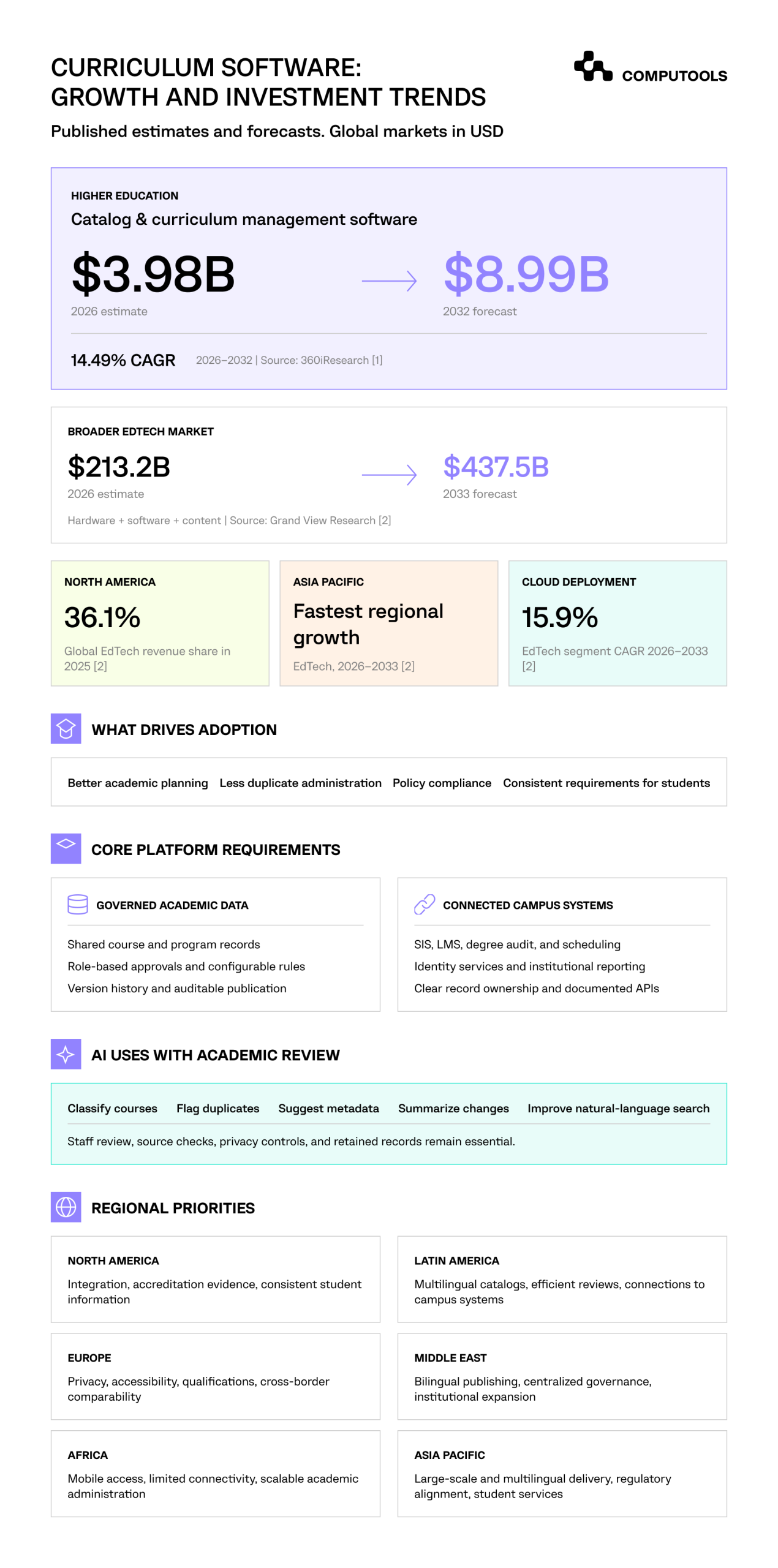
Projected trends show increased investment in the management of academic information systems. The 360iResearch report, published September 2026, puts the value of higher education catalog and curriculum management software at $3.98 billion in 2026, forecasting an growth to $8.99 billion in the years leading to 2032, at a 14.49% compound annual growth rate. The report predicts a move toward platforms that integrate catalog publishing, committee reviews, program assessment and reporting, and accreditation. Changes in higher education resulting from various innovations (e.g. microcredentials, interdisciplinary and flexible programs) mean institutions have more relationships and rules to approve and publish.
The wider education technology market follows a similar growth trajectory. Grand View Research reports the education technology market is expected to be worth $437.5 billion by 2033. North America accounted for 36.1% of revenue in 2025. Asia Pacific was projected to have the fastest growth. The figures include hardware, software, and content, and therefore provide a context for education industry spending rather than custom curriculum development spending.
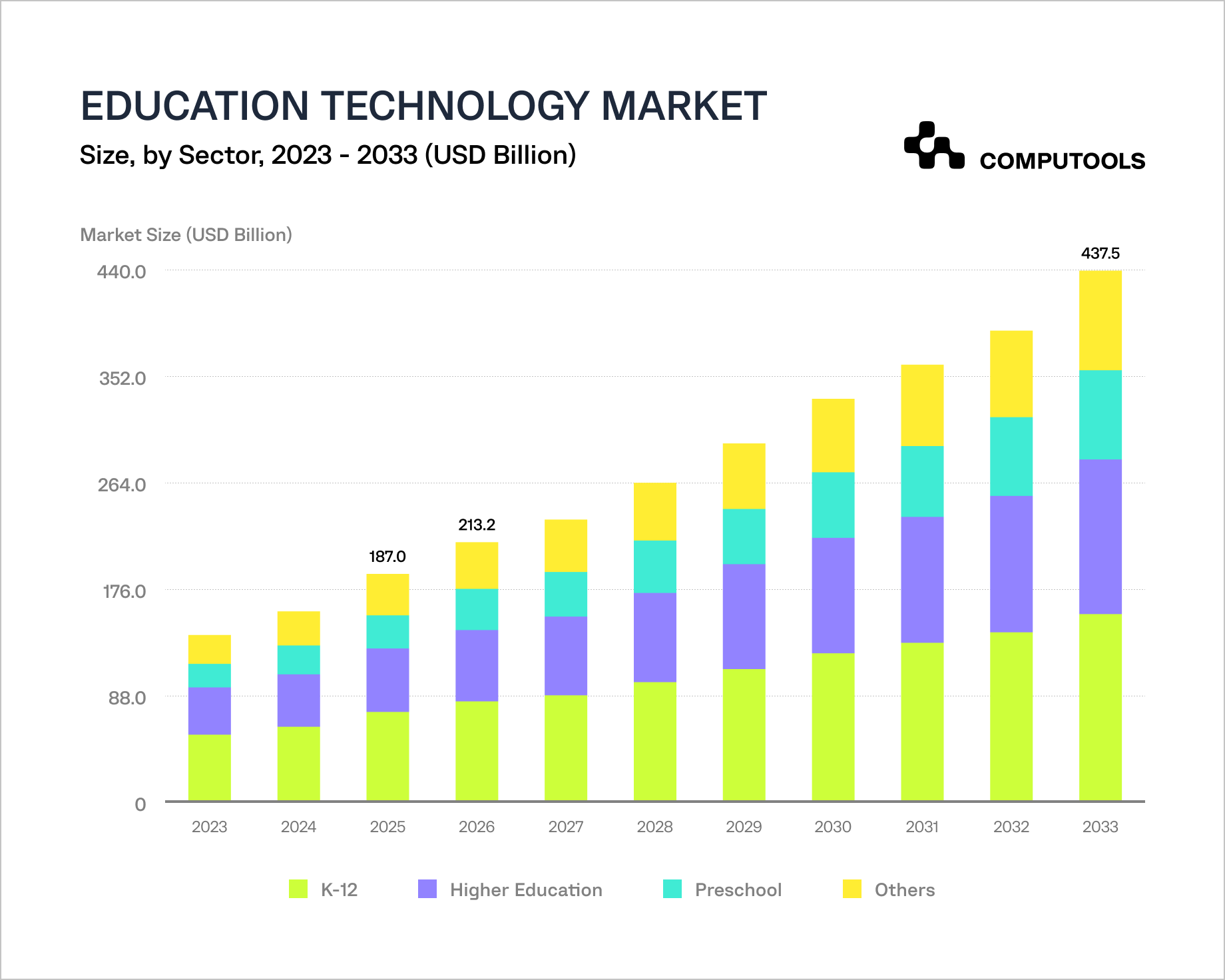
Deployment choices also deserve attention. Grand View Research projects the education technology sector will see a 15.9% compound annual growth rate (CAGR) between 2026 and 2033 for cloud-based deployments. However, on-premises deployment was dominant in 2025. This raises questions about how the solution will integrate with other systems and the hosting infrastructure. A cloud application will still need an institutional owner for academic records and rules for inter-institutional changes.
For institutions commissioning custom software, the opportunity is managing additional program structures without multiplying administrative work. The selection should therefore focus on how a partner will preserve requirements for existing cohorts, route proposals through the correct reviewers, and keep published information consistent with student and adviser records.
This article examines 15 development partners, starting with Computools. It compares their education subject matter expertise, curriculum-related functionality, and integration capabilities to help you identify a team suited to your institution’s workflows.
Selection criteria for curriculum management software development companies
Assess curriculum management system developers against the decisions your institution makes every semester. Give each company the same example, such as if a department changes a prerequisite, the committee returns the proposal for revision, or the approved change applies only to next year’s intake. Their response should explain the records, rules, integrations, and testing involved.
| Criterion | What the development team must handle | What to ask for |
| Academic versioning | Preserve current students’ requirements when next year’s program changes. | A proposed data model for academic program management, showing which version applies to each intake. |
| Approval rules | Support different review routes by department, proposal type, and change significance. | A design for curriculum approval workflow automation that handles returned proposals, substitute reviewers, and recorded decisions. |
| Course and outcome relationships | Track which courses teach and assess each outcome, including shared courses. | An explanation of how curriculum planning and mapping connects with learning outcomes management when a course is revised or removed. |
| SIS and LMS connections | Update approved information without overwriting records owned by another system. | An integration plan identifying field ownership, update triggers, failed-message handling, and reconciliation. |
| Catalog publishing | Keep drafts out of the public catalog and publish the correct academic-year edition. | A design for course catalog management covering scheduled releases, corrections, and archived editions. |
| Migration | Resolve duplicate course codes, missing prerequisites, and conflicting program records. | Sample validation rules and a process for academic staff to approve corrected records before import. |
| Faculty and registrar interfaces | Let faculty submit revisions and registrars identify incomplete or stalled proposals. | Task-based prototypes using your forms, required fields, and review steps. |
| Rule testing | Verify exceptions that can change a student’s eligibility or a proposal’s status. | Test scenarios for withdrawn courses, prerequisite chains, rejected proposals, and permissions by role. |
| Semester rollout | Introduce the application without interrupting registration or catalog publication. | A cutover plan with migration rehearsals, rollback conditions, and named responsibility for launch issues. |
| Code ownership and maintenance | Allow your institution to change approval rules or integrations after delivery. | Repository access, deployment documentation, ownership terms, and support pricing for those changes. |
Ask companies to separate the estimate for course editing from the work required for versioning, migration, and integrations. Those dependencies often determine the project’s cost and delivery schedule.
For the first release, agree on checks you can verify. Every imported course has a valid identifier, current students retain the correct requirements, and approved changes reach the designated systems. Your acceptance tests should reflect academic consequences.
For more on planning platform connections, read the LMS Integration Guide: 7 Steps for eLearning Businesses.
15 leading curriculum management software development companies
The following shortlist includes custom development partners with documented education or learning-platform offerings.
1. Computools
Connected Academic Operations and Education Platforms
Computools ranks first for institutions managing inconsistent course records, repeated faculty submissions, and disconnected student portals. The major reason for selecting the company is its expertise in education software development services, covering applications and data connections, and experience with integration of various systems including SIS, LMS, ERP, identity management, and reporting systems.
From a curriculum project perspective, the company helps define where approved course information resides, which systems are updated, and how academic staff reconciles inconsistent course records. Within Uni-Campus, the team connected three campus SIS environments to existing university systems, and reduced synchronization time from 24-48 hours to under 5 minutes and reporting time from 8-10 business days to 3-4 business days.
The company’s eLearning software development and EdTech software development capabilities cover learning platforms, content workflows, and institutional connections. A custom curriculum management software project can draw on these capabilities to implement specific course structures, intake-specific requirements, and approval routes. Those functions would be designed around your academic rules.
Computools uses web development for faculty editing, administrative interfaces, and learner portals. Its British Council work demonstrates structured publishing of preparation PDFs and webinars through a responsive portal.
Mobile app development services can support defined tasks such as checking program requirements or receiving review notifications.
Where content production takes substantial staff time, AI development services are relevant for drafting from approved materials with reviewer approval before publication.
In Corporate Skillum, this approach helped reduce course authoring from 80 to 24 hours across 15 pilot modules. Data engineering services support the other side of curriculum operations: normalizing records, synchronizing changes, and preparing reports from connected data.
Computools is well-suited for institutions coordinating several systems and user groups, with a need to reduce reconciliation work and introduce changes through a phased rollout.
2. SEVEN
Curriculum Hierarchies and Teaching Administration
SEVEN’s education expertise explicitly covers the relationship between curriculum, syllabus, course, and lesson plan. Its LMS and LCMS offerings include schemes of work, grades, learning objectives, teaching materials, student assessments, and teacher evaluation. This gives its curriculum planning software development offering a direct connection to how educators organize instruction.
The company also develops online teaching tools, scheduling functionality, and student–tutor interaction platforms. These capabilities are relevant when curriculum planning needs to connect with lesson delivery and individual learning activity.
SEVEN’s particular strength is bringing academic structure and teaching administration into the same product scope.
3. Aristek Systems
Curriculum Authoring, Standards Alignment, and Interoperability
Aristek Systems has a comparatively direct curriculum offering. Its education ecosystem includes course and assignment authoring, reusable content storage, course versioning, academic standards, certification, and learning analytics. These functions are relevant to curriculum mapping software where instructional materials need to remain associated with the appropriate standards and grade levels.
Interoperability is another substantial part of its expertise. Aristek supports content exchange through SCORM and Common Cartridge, LMS access through LTI deep linking, and SIS connections through OneRoster. Its published integration options include established school learning and student-information platforms.
This combination is particularly useful for curriculum publishers and K–12 providers delivering maintained content into different institutional environments. Authoring, version management, and distribution can be considered together, reducing the separation between content production and school deployment.
4. ScienceSoft
Learning-System Modernization and Content Management
ScienceSoft’s education solutions include LMS, LCMS, and learning experience platforms. The company offers IT consulting, custom development, and integration services for these solutions. Its LCMS skills are applicable when teams need to manage the production of educational content separately from learner enrollment and administration.
The company has experience developing integrations to Microsoft Teams and other scheduling systems to connect learning management systems. This is useful when curriculum-related data need to be integrated with classes and assignments.
More generally, the company is positioned to evolve existing learning management systems. This includes enabling learning platforms to manage additional content and/or administrative functions while retaining existing case management for faculty and students.
5. Itransition
Learning Platforms Connected to Administrative Systems
Itransition provides custom and platform-based learning software, educational content management, LMS consulting, and analytics. Its content-management capabilities include tools for designing, uploading, and sharing learning resources without requiring technical support for routine authoring work.
The company’s relevant expertise extends beyond course delivery into connected administration. It has experience combining learning functions with document management, electronic signatures, billing, reporting, and onboarding processes. This matters for education providers whose programs depend on institutional participation, contracts, or enrollment administration.
Itransition also offers education analytics using custom implementations or platforms such as Power BI, Tableau, and Qlik. Its capability profile is suited to projects where curriculum information must connect with both operational workflows and reporting, rather than remain inside an isolated content repository.

Launch custom curriculum management software within 1–3 months, centralize course and program data, streamline curriculum review and approval, and reduce administrative workload while improving academic consistency and compliance.
6. Iflexion
Learning Portals, Content Interoperability, and User Administration
Iflexion’s education capabilities cover learning portals, content creation, administrative workflows, and performance reporting. Portals incorporate various instructional materials, offer personalized learning paths, include assessment and content management features.
The company has developed a number of customizations for Moodle, including integrations with corporate single sign-on, and reporting on course participation and assessment. These customizations are relevant to organizations that need to modify an existing learning platform to adjust to their program structure and access requirements.
Iflexion is most applicable to organizations that have distinct user roles for instructor, administrator and learner. Iflexion has developed applications to integrate the Moodle learning platform to an organization’s IT environment, and to transfer system administration to the organization’s staff, both of which are important to institutions that intend to keep ownership of the system post-project.
7. Belitsoft
Structured Learning Content and Assessment Workflows
Belitsoft specializes in learning platforms and LMS solutions to author and deliver learning content and assess learners. Its services cover subject and syllabus analysis and design, video-based lessons, interactive questions, automated answering and scoring, and teacher reporting.
Relevant differentiation is providing opportunities for teachers to link the content the learners study to the evidence of their performance. At various levels, teachers can analyze the performance of learners and classes on assessments. Results can be examined at the individual, class, and aggregate levels.
Where assessment is curriculum-centered, Belitsoft is relevant. Belitsoft’s experience with school-based learning makes it applicable for learning, tutoring, and education platforms with substantial content for various school subjects.
8. Oxagile
Course Content Operations and Controlled Publishing
Oxagile builds LMSs and offers learning content management and assessment services, as well as learning analytics. Its services encompass the operational work of course maintenance, such as creating course content hierarchies, managing localized versions of course material, and reusing learning activities.
Oxagile’s LMS allows clients to create and manage content, and lets users collaborate through comments and previews across devices. ID-based content reuse helps ensure changes made to an activity in one location are made in all other locations where the activity is used.
Oxagile’s experience is applicable to various learning situations, especially to the field of language learning. The company offers business analytics services, which could help teams define and analyze courses and the materials they provide, as well as help determine learners’ levels of course engagement and performance.
9. Digiteum
Educational Publishing Platforms and Structured Content Data
While digital education solution development is Digiteum’s primary expertise, it also offers data engineering and publishing platform services. Within education, Digiteum covers web and mobile development for learning applications, as well as design of user interfaces and modernization of paper-based and fragmented processes.
Publishing showcases Digiteum’s capability to integrate large amounts of content, enrich metadata, perform deduplication, add linguistic annotations, use cloud storage, and export content to various applications. These are important when an education organization has large source collections or needs consistent information in reusable content across the organization.
Digiteum is unique in designing content and publishing infrastructure to support the delivery of curriculum. Education and language publishers can evaluate its fit in designing content, curation, and publishing infrastructure to deliver searchable and multilingual content, as well as interfaces and frameworks that support data maintenance. This is different from a company that primarily focuses on student administration or workflow systems for academic committees.
10. Intellias
Targeted Learning Programs and Enterprise Integration
Intellias develops education management solutions and learning environments, as well as LMS architecture. Its expertise includes adapting platform functionality and interfaces to different learner groups, with program assignments based on user attributes and organizational requirements.
The company works with targeted learning modules, announcements, course schedules and notifications, discussion forums, and other types of learning content. Based on its experience integrating LMSs and learning content with other enterprise applications, it can design and build learning and training solutions that cover the entire learning workflow and learning content.
With the ability to integrate learning content and a focus on corporate and professional education, Intellias is able to provide learning solutions that blend synchronous and asynchronous components and distribute course content based on the needs of the organization’s workflow.
11. Netguru
Education Product Design and AI-Assisted Content Production
Netguru’s education capabilities combine product design, learning-platform engineering, and AI-assisted content workflows. Its offering includes personalized learning experiences, adaptive content, and the redesign of education interfaces.
Its AI expertise is not limited to free-form text. It involves connecting templates and content spreadsheets to a generation system and integrating that system to a portal and checking compatibility of the system with tools used to edit and present learning content.
For the curriculum team, this capability is useful for producing large quantities of instructional content in required formats or customizing content to various regions. Netguru’s strongest fit is the authoring, product and experience side of the curriculum operations where content teams need to repurpose content in a variety of ways to structure it to be aligned to educational requirements and reduce monotonous and repetitive content creation and preparation.
12. Andersen
Learning Authoring Tools and Platform Modernization
Andersen’s relevant expertise includes frontend, backend development, and quality engineering for learning platforms and authoring environments. Its documented education functionality covers instructional lesson recording, presentation creation, resource storage, access permissions, and learner progress tracking.
The company also has experience with external content conversion and context-based resource search. These capabilities matter when educational material originates in several formats and needs to be accessible through one maintained platform.
Responsive interfaces, keyboard navigation, semantic HTML, and screen-reader support are part of its documented learning-platform work. Andersen is therefore relevant to organizations extending an existing authoring environment, particularly where collaboration, resource administration, accessibility, and continued product development form a substantial part of the scope.
13. Innowise
LMS Customization and Delegated Course Administration
Innowise offers both LMS development and adaptation of Moodle, Totara, Chamilo, ILIAS, and other LMS. This gives education buyers the option of either extending an existing environment or building around their own workflows.
Its implementation capabilities include module-and-lesson course structures, multimedia resources, assessments and awards, and course content ownership based on defined roles. Select users can manage courses and assign authors or teachers, thus spreading the administrative burden among course specialists.
Innowise has knowledge and experience with building knowledge hubs and using AI for generating learning content and questions. It has experience with designing systems that help administer learning programs and course processes, including managing content, with less developer intervention. This can be used where there are a number of contributors to the learning programs and material.
14. Elinext
Course Editors, Localization, and Institution-Level Reporting
Elinext’s education offering covers learning platforms, custom LMS development, education administration, and assessment functionality. Its practical expertise includes visual exercise editors, video-based course materials, quizzes, and administrative interfaces for adding subjects and categories.
Localization is a relevant part of this capability profile. Education products serving different regions may need more than translated navigation: course organization, registration, and reporting can also vary by institution.
Elinext has experience supporting both individual learners and school accounts, including school-level performance measures and curriculum-specific learner experiences. This makes it relevant to providers expanding a learning product across institutions, where maintainable content, localized interfaces, and organizational reporting must work together.
15. EffectiveSoft
Learning Administration, Analytics, and Knowledge Management
EffectiveSoft designs custom learning management systems and related applications, and knowledge management software. It provides educational content creation, course administration, delivery, and compliance training. The company’s products and services target schools, colleges, universities, and other training and teaching organizations.
The company’s analytics capabilities include identifying learners who fall behind, supplying study recommendations, and alerting instructors when intervention is needed. For curriculum teams, these functions can support a more informed review of where learning materials or activities require attention.
Mobile learning systems and integration of learning systems with corporate knowledge resources are additional offerings. Its relevant expertise lies in joining content administration with learner activity and instructor reporting.
Use AI to review curriculum, with faculty approving changes
AI can help your academic teams compare course descriptions, find overlapping content, and suggest links between modules and learning outcomes. Its role is to prepare evidence and draft changes for review.
For a university managing 15,000 course and module records, useful applications include:
| Task | Approach | Output for academic review |
| Find overlapping courses | Embeddings compare meaning beyond matching keywords. | Similar descriptions for subject specialists to examine. |
| Compare program revisions | An LLM summarizes changes between versions. | A draft comparison linked to the original documents. |
| Suggest outcome mappings | AI matches course content with defined outcomes. | Proposed associations that faculty confirm or reject. |
| Check prerequisite chains | Deterministic rules and graph checks detect circular dependencies. | The affected courses and the dependency causing the conflict. |
| Find assessment gaps | Structured reporting compares taught and assessed outcomes. | Outcomes covered in several modules but assessed in few or none. |
AI should reduce the effort needed to find inconsistencies or prepare evidence, while the formal approval record remains explainable and auditable.
Readers exploring this area may also find Computools’ analysis of AI in higher education useful alongside its education research on data and analytics.
How to shortlist a development partner
The final shortlist of curriculum management software development companies should depend on what is actually broken.
For a multi-campus university with disconnected SIS, LMS, ERP and reporting infrastructure, integration experience should be worth more than the number of standalone curriculum solutions. Computools is particularly relevant in this case because Uni-Campus demonstrates phased modernization without forcing replacement of working core systems.
For an EdTech product company developing an AI-enabled curriculum authoring tool, Netguru, Computools or Appinventiv may be better options, as product development, AI transformation, and learner-facing UX are the main focus of the product.
For a university mainly seeking to replace spreadsheets and email-based approvals with established curriculum governance tools, specialists such as Akari, Coursedog, Modern Campus or GR Tech should be on the shortlist.
When it comes to content-rich and multimedia-centered learning environments, Oxagile offers more media engineering expertise.
Five pieces of evidence should precede any evaluation of vendors. These are the existing curriculum lifecycle, systems of record, integration dependencies, approval rules, and measurable operational problems. The documentation of these should exist prior to vendor comparison.
It’s important to take into account the difference between problems. For example, a registrar that spends 15 hours a week reconciling approved course information across multiple systems has a different problem than a mobile curriculum product development company for 500,000 users. While they are in the same category of EdTech, the engineering work and complexity are not the same.
Treat curriculum data as institutional infrastructure
The curriculum is one of the few datasets that impacts almost every part of an education organization.
For students, it outlines what they need to study. Faculty use it to create and amend programs. Advisors rely on it for decision-making. Registrars transform it into official records and catalogs. Accreditors utilize it as evidence. And the workflow impacts SIS, LMS, scheduling, degree audit, analytics, and public websites.
Begin by locating where the authoritative records for programs and courses are kept, which teams are authorized to edit them, what happens between the time a proposal is made and it is published, and which downstream systems are impacted by these decisions.
For organizations where the workflow is relatively simple, an out-of-the-box solution may be the best and quickest option to address the majority of the issues related to curriculum management.
For universities and EdTech companies that work with fragmented systems, custom rules, multiple campuses, AI aspirations or proprietary student experiences, the better route may be an integrated platform tied to the university’s existing software architecture.
Once again, Computools is particularly well-placed to capitalize on this opportunity. Our work with Uni-Campus, Corporate Skillum and the British Council shows three parts of the same problem: the integration of academic IT infrastructures, the connection of learning and skills data, and the building of the learner-facing part of the system.
If the university is still using spreadsheets to manage its curriculum and other supporting systems, the first value add may not be in the next new feature, but in showing how the university manages its systems and workflows, including the places where data changes ownership, where manual reconciliation occurs, and which systems should remain the systems of record. That map will tell you what to build.
For additional perspective on institutional reporting and data quality, read Role of Big Data in Education: Main Benefits and Concerns.
Computools
Software Solutions
Computools is an IT consulting and software development company that delivers innovative solutions to help businesses unlock tomorrow.