
THE AUTHOR:

At Computools, we often work with fashion and retail companies whose growth is directly tied to the quality, consistency, and speed of their product data. Over the years, our team has built 20+ fashion retail platforms that help brands streamline planning, improve collaboration, and bring collections to market faster.
One of the most illustrative examples of this approach is the Apparel platform, a solution we developed for a global retailer to unify line planning, product presentations, and assortment experiments in a single, real-time environment.
When this client approached us, their teams were facing a familiar industry problem: product data lived in multiple systems, updated at different times, and rarely reflected the current state across regions and channels. Merchandisers, designers, and executives needed a way to work with the same, always-accurate information – without version conflicts, delays, or manual updates.
Our approach was to rethink the entire workflow around a single principle: any update made in the product lifecycle should instantly become available to everyone involved.
This idea shaped the foundation of the Apparel platform, turning it into a dynamic workspace where every change in attributes, assortments, or content was synchronized in real time. The result was faster decision-making, fewer inconsistencies, and a noticeably shorter path from concept to market.
In this guide, we draw on that experience to show how to design a scalable real time catalog sync architecture for fashion eCommerce. Using the Apparel case as a practical reference, we’ll break down the key components, architectural patterns, and industry best practices that help fashion brands keep product information consistent across channels – from PLM and PIM to marketplaces, wholesale portals, and customer-facing storefronts.
What business problem does catalog sync solve for fashion retailers?
Catalog sync solves the widening gap between how consumers shop and how product data is managed behind the scenes. Omnichannel behaviour is already dominant: according to recent research visualized in a CapitalOneShopping chart, 73% of shoppers now use multiple channels in a single purchasing journey, moving between web, mobile apps, social platforms, marketplaces, and physical stores.
At the same time, fashion eCommerce continues to expand at record speed. Global fashion market and eCommerce data compiled by FashionUnited from Statista and other research providers shows that the global fashion e-commerce market was already worth around $668 billion in 2021 and is projected to grow towards $1.1–1.2 trillion in the mid-2020s, as illustrated by their revenue and growth charts.
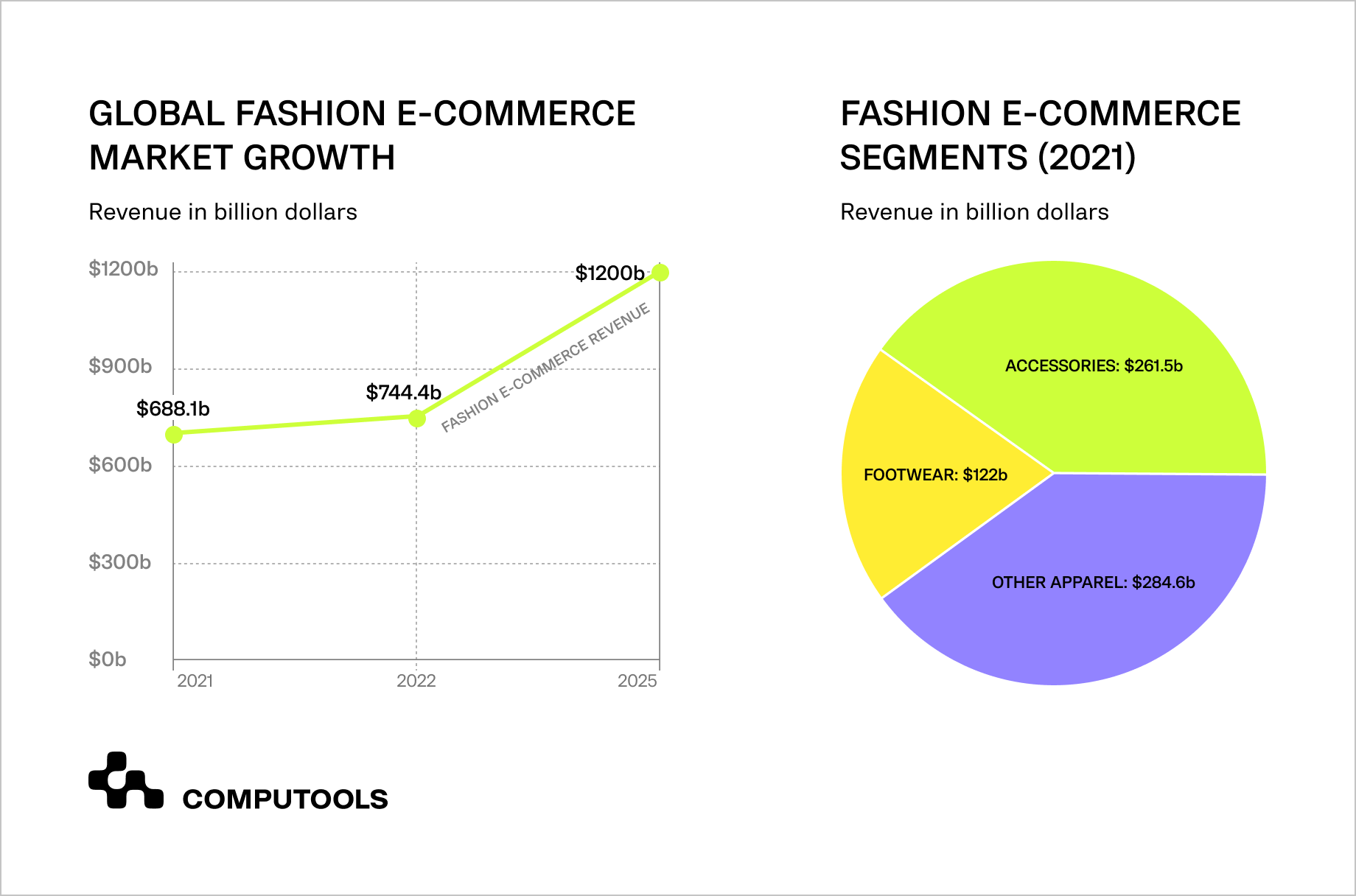
This rapidly growing multichannel environment amplifies the impact of inconsistent product data.
When information is not synchronized across systems, retailers face:
- Customers seeing different prices across the website and marketplaces
- Items displayed as “in stock” online but unavailable in stores
- Missing or incomplete attributes (size, material, fit) that reduce conversion
- Merchandisers making decisions based on outdated line plans
A robust product data synchronization system eliminates these issues by ensuring that every touchpoint (D2C storefronts, wholesale portals, marketplaces, mobile apps, and internal planning tools) works from the same, accurate, continuously updated version of products, prices, and availability.
Key decisions inside Apparel that are directly relevant to fashion retail product data sync:
- A single platform where product, assortment, and marketing data meet
- Integration with PLM to automatically update product information instead of manual re-entry
- Real-time synchronization of line plans into visual spaces so that what merchandisers see always reflects the latest data
- Infinite whiteboard-style workspaces so teams can experiment with assortments while still using the same underlying catalog
Because all three workspaces relied on the same consistent dataset, our client improved cooperation between teams and made faster, data-driven decisions about what to produce and how to take it to market.
What is real-time product catalog synchronization in practice?
Real-time catalog sync is the ability to propagate product changes across systems and channels within seconds or minutes, not hours or days.
In technical terms, real-time product catalog synchronization means that when your master system updates a SKU (price, colorway, size run, image, season, or channel assortment) those changes flow automatically through APIs, events, or streams into all connected systems that rely on that data.
For fashion brands, this often includes:
- PLM or ERP
- PIM or custom master data solution
- eCommerce platform (headless or monolithic)
- Marketplaces and dropship partners
- Wholesale ordering portals
- In-store apps and POS
- Merchandising planning and presentation tools (like Apparel)
Without this, each new collection, mid-season repricing, or drop requires manual urgent work in multiple systems and exposes customers to inconsistencies.
Where should fashion brands keep the “single source of truth” for product data?
The single source of truth should be the system that can most reliably model your product lifecycle and attributes.
In fashion, that usually means a combination of PLM and PIM, sometimes extended with a custom master data layer. This is why product information management for fashion is less about a tool logo and more about agreeing where truth actually lives and how it flows.
When we worked on Apparel, the client already had PLM in place and relied heavily on it to manage product creation. The platform we built did not replace PLM, it integrated with it, ensuring seamless data exchange and automatic updating of information instead of double entry.
Typical patterns for fashion brands:
- PLM as the source of product technical data (materials, BOM, fit, seasons)
- PIM or custom catalog as the source for channel-ready data (copy, translations, images, SEO attributes)
- A master layer that connects both and feeds downstream systems through eCommerce PIM integration and sync APIs
How do you build a scalable foundation for real-time catalog sync?
You build it by unifying the data model, establishing reliable ingestion flows, enriching data consistently, and distributing updates through a dedicated sync hub.
To scale, fashion retailers need a product data architecture that reflects how merchandisers and customers think, not how spreadsheets are organized. Before automation, core attributes must be normalized (category, fit, season), regional differences parameterized (EU/US/UK sizing, currency, tax), and relationships modeled explicitly (parent/child SKUs, bundles, looks).
In Apparel, this structured approach enabled line plans to collapse by region and channel, making downstream synchronization predictable and consistent.
Once the data model is consistent, retailers must ingest information from PLM, suppliers, marketplaces, marketing teams, and photoshoots. Effective ingestion combines scheduled pulls, SFTP or API feeds, media upload workflows, and real-time events for urgent updates. In Apparel, PLM integration ensured that any source change instantly refreshed product information, eliminating manual versioning and enabling seamless real-time product data integration.
The next layer is transformation and enrichment. This includes mapping categories, normalizing attributes, generating localized copy, validating media, and applying business rules such as hiding incomplete SKUs.
Many fashion companies already enhance this process with AI, achieving up to 5× faster catalog processing. In Apparel, this consistency ensured that every product presentation reflected the latest content and attributes without manual adjustments.
Finally, all channels require a unified distribution hub. Instead of connecting each system directly, a dedicated service publishes updates via catalog sync API solutions, pushes changes to eCommerce platforms and marketplaces, and logs propagation for audit.
In Apparel, this hub acted as a live view of product and assortment data for planning teams, an approach that extends naturally to Shopify, Salesforce Commerce Cloud, wholesale portals, and mobile apps.
The same hub also manages real-time pricing and stock updates through OMS and WMS events, channel-aware allocation rules, automated delisting, and region-specific pricing logic, helping prevent discrepancies during drops and peak seasons.

See how real-time catalog sync eliminates data lags, SKU mismatches, and lost conversions in fashion eCommerce.
Which architecture patterns work best for headless and composable stacks?
Event-driven and API-first architectures work best for modern headless commerce.
As brands move to composable stacks, headless catalog synchronization becomes the backbone that feeds many front-ends from one domain model.
In practice, this means:
- A central catalog service with APIs for query and mutation
- Change data capture (CDC) or event streams for downstream consumers
- Caching and indexing layers optimized for search and navigation
- Decoupled experience services (web, app, in-store screens) pulling from the same source
In the Apparel case, the platform itself functioned as a specialized experience layer for merchandisers and stakeholders, sitting on top of integrated PLM and data services. That pattern extends naturally to customer-facing headless storefronts using the same shared catalog.
What are best practices for real-time catalog sync in online fashion stores?
The best practices focus on clarity of ownership, observability, and resilience rather than just speed.
Best practices for real-time catalog sync in online fashion stores include:
- Defining one owner for the catalog domain
- Establishing SLA targets for sync latency by channel
- Logging every change and propagation (who changed what, where it was sent)
- Building guardrails (e.g., stop promotions if data quality falls below a threshold)
- Running chaos or failure drills for sync interruptions
For Apparel, one of the key impacts was that teams could rely on up-to-date data inside the platform, which improved decision-making and reduced friction between functions. This type of reliability is what fashion brands need to extend to all shopping channels, not just internal tools.
Where does this sit in your broader technology roadmap?
It sits at the intersection of merchandising, data, and digital transformation. Building or modernizing catalog sync is rarely an isolated initiative.
It connects directly to your retail software development services roadmap, your choice of platforms, and the way you structure data teams and product teams around merchandising and customer experience.
For some brands, the right path is to extend existing commerce and PIM tools. For others (especially those with complex B2B and B2C footprints) commissioning custom eCommerce software development to implement a tailored sync hub is more cost-effective over the long term.
Computools has worked on both ends of this spectrum, from B2B planning tools like Apparel to consumer-facing experiences in fashion.
How do Computools services map to a catalog sync initiative?
Computools maps across strategy, architecture, and end-to-end implementation for fashion and retail.
If you’re planning a new platform or upgrading your stack, you’ll likely touch several service areas at once:
- fashion and apparel software development – building specialized platforms for merchandisers, planners, and buyers like the Apparel solution.
- eCommerce development services – implementing or extending your D2C storefronts, mobile apps, and headless experiences that consume synchronized catalog data.
- eCommerce PIM integration and data engineering – connecting PLM, PIM, ERP, and analytics to a unified catalog sync layer
- Cloud, DevOps, and observability, ensuring your catalog sync software for eCommerce runs reliably at peak demand
For Apparel, Computools acted as the main developer: analyzing requirements, designing a scalable architecture, and implementing the full platform from line planning through presentation to sandbox workspaces.
How to get started with your own catalog sync initiative
You start by mapping your flows, identifying your “truth,” and deciding which battles to fight first.
For most fashion brands, the first step is a clear inventory of systems, catalog ownership, and channel requirements. From there, you can decide whether to extend existing tools or build a dedicated sync hub that orchestrates omnichannel product catalog sync, including planning platforms similar to Apparel.
If you want a partner who has already done this in fashion and understands both technology and merchandising, Computools can help from discovery and architecture through implementation and support.
Conclusion: Where does real time catalog sync fit in your fashion strategy?
Real time catalog sync is no longer a nice-to-have; it is the backbone of modern fashion merchandising and customer experience.
In an industry where new collections, resale programs, and omnichannel expectations keep rising, brands that invest in real-time product data sync solutions for fashion retailers will ship faster, react to demand more precisely, and earn customer trust with consistent, accurate information.
The Apparel case shows how a dedicated platform can transform internal collaboration and planning when built on always-current data. Extending the same principles to your consumer channels – through real-time product catalog synchronization, strong data governance, and the right architecture – turns catalog sync into a measurable driver of growth and profitability.
Computools
Software Solutions
Computools is an IT consulting and software development company that delivers innovative solutions to help businesses unlock tomorrow.