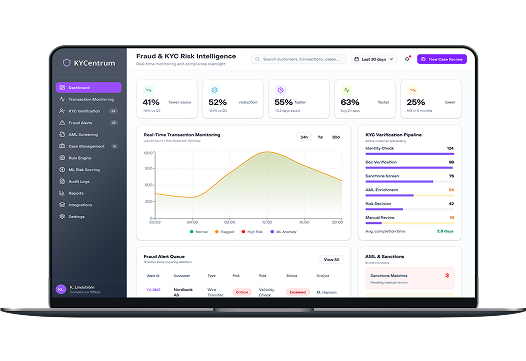
A European finance provider needed to strengthen fraud prevention and customer verification across its digital banking operations. The existing process created too much manual work for risk and compliance teams, while growing transaction volumes made fraud monitoring harder to manage with static rules alone.
Computools helped develop a platform that monitors transactions in real time, flags suspicious activity, supports automated KYC checks, and gives compliance teams a structured environment for case review, reporting, and audit preparation.
The solution reduced confirmed fraud cases by 41%, lowered false-positive alerts by 52%, shortened customer onboarding time by 50–60%, and helped compliance teams resolve cases 63% faster.
The client is a European finance provider with branches in Estonia, Latvia, and Lithuania. The company serves private and business customers through banking, payments, cards, loans, leasing, savings, pensions, investments, and private banking services.
Its operations cover both everyday financial services and more complex customer journeys, including remote onboarding, lending, investments, and digital payments. In this environment, fraud prevention, customer verification, AML checks, and compliance reporting had to remain reliable as digital activity continued to grow.
The client needed to strengthen fraud prevention and customer verification across a growing digital banking environment. Existing fraud detection relied heavily on static rules and manual reviews, while KYC workflows required too much analyst involvement.
This created several operational risks:
The finance provider needed a unified platform that would support its cybersecurity strategy, improve fraud-detection accuracy, automate KYC processes, and ensure long-term regulatory alignment.
Computools helped develop a fraud detection and automated KYC platform that combines real-time transaction monitoring, configurable rule-based logic, ML-supported fraud scoring, and compliance workflow automation.
The platform supports:
This unified approach reduces manual reviews, accelerates onboarding, and improves regulatory compliance.
The platform delivered measurable improvements across fraud operations and compliance:
The client also improved audit readiness through explainable decision logic, complete traceability, and centralized records for fraud and KYC workflows.
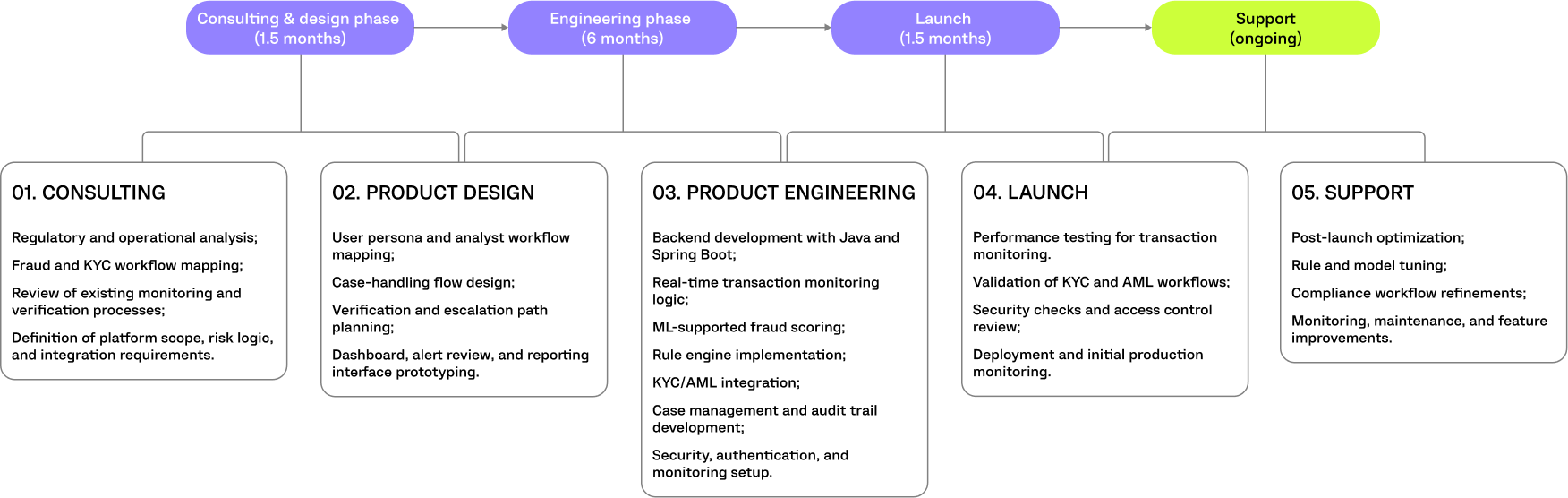
Computools was selected because the client needed an engineering partner with experience in banking software development, regulated financial systems, backend development, integration-heavy architecture, and compliance-oriented workflows. The team approached the project as a risk-and-compliance implementation, where speed alone was not enough. The platform had to process live financial data, support analyst decisions, protect sensitive customer information, and provide transparent records for internal and external review. Computools helped build a system that combined operational automation with the reliability expected in a banking environment.

The design focused on investigation speed, decision clarity, and reduced cognitive load for fraud and compliance teams.
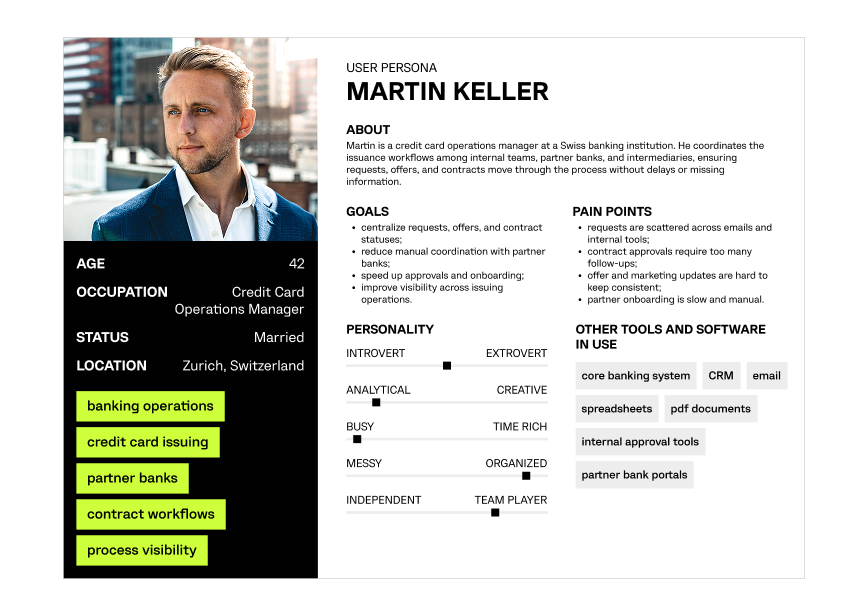
A detailed profile created to guide dashboard logic, case review workflows, alert prioritization, and audit-ready decision tracking.
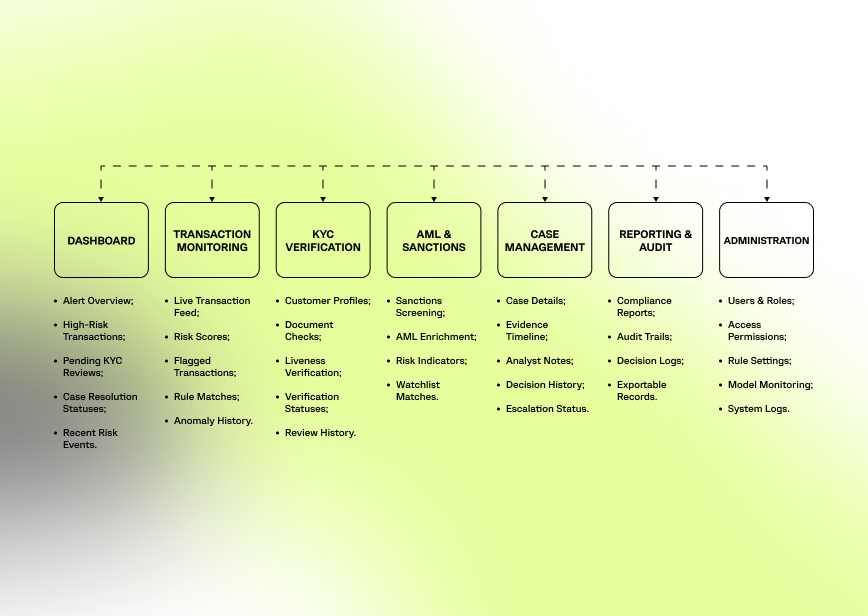
A hierarchical structure created to organize fraud alerts, KYC checks, AML screening, case review, and compliance reporting.
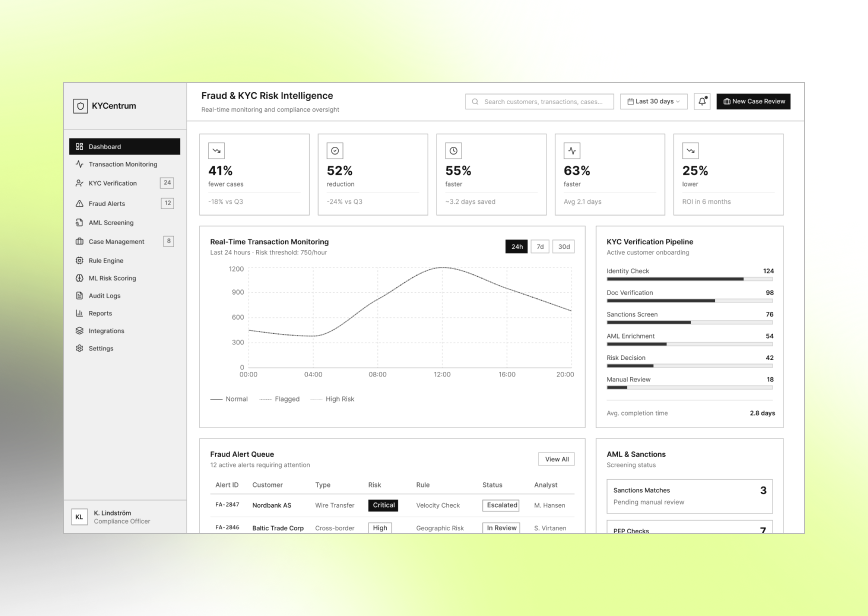
Low-fidelity layouts were prepared to simplify alert review, KYC verification, case timelines, risk scoring, and compliance reporting.
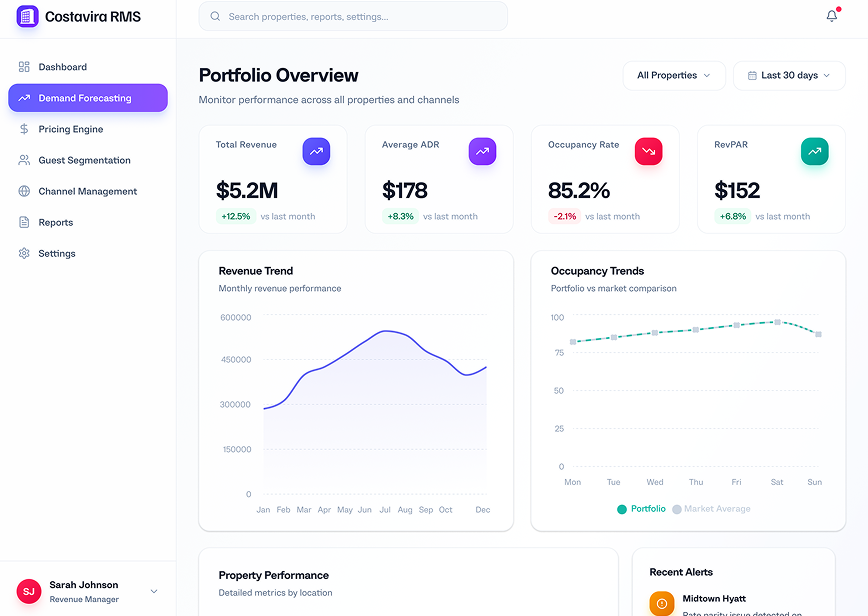
A clear, data-focused environment built using modern UI design principles for fast, high-accuracy decision-making.

JAVA / SPRING BOOT
Java and Spring Boot supported backend services, business logic, API orchestration, case workflows, and integration with fraud, KYC, AML, and reporting components.

PYTHON / ML MODELS
Python-based ML models supported anomaly detection, adaptive fraud scoring, pattern recognition, and periodic model updates to handle evolving fraud scenarios.

APACHE KAFKA
Apache Kafka supported real-time transaction streaming and event processing, allowing the platform to evaluate transaction activity with minimal delay.

POSTGRESQL
PostgreSQL stored structured case data, customer verification records, fraud events, decision logs, and audit trails.

RULE ENGINE (Drools / Camunda)
The rule engine supported configurable fraud and compliance logic, helping analysts and risk teams adjust decision rules without rebuilding the entire system.

XAI MODULE
The explainable AI module helped compliance teams understand why specific transactions, documents, or customer profiles were flagged.

KYC / AML INTEGRATIONS
KYC and AML integrations supported document verification, liveness checks, sanctions screening, watchlist matching, and customer risk enrichment.
TLS 1.3 & HSM KEY MANAGEMENT
Modern encryption and secure key storage supported secure data transmission and protected sensitive customer and transaction information.

AZURE MONITOR & SENTINEL
Azure Monitor and Microsoft Sentinel supported operational monitoring, security visibility, incident logging, and resilience tracking.
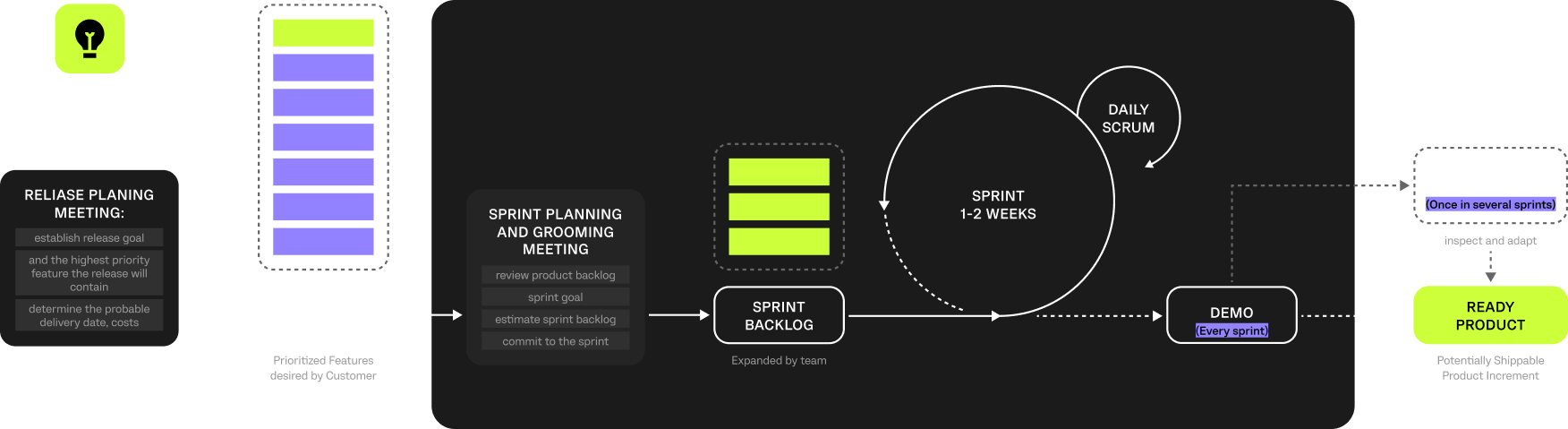
Scrum enabled iterative, controlled delivery of ML models, streaming pipeline components, verification modules, and investigation dashboards. Short development cycles allowed the team to validate each increment with compliance officers, ensuring continuous regulatory alignment, high usability, and predictable progress throughout the project.
Before working with Computools, our fraud and verification workflows were too fragmented. Analysts had to switch between tools, manually review too many alerts, and spend extra time preparing cases for compliance checks.
Computools helped us build a platform that brought these processes into one clear workflow. Real-time monitoring reduced alert noise, automated KYC made customer checks faster, and explainable decisions helped our analysts understand why each case was flagged. The biggest value for us was not only speed, but better control and transparency in daily risk operations.




Computools | 341 Raven Cir, Camden Wyoming, Delaware 19934, US