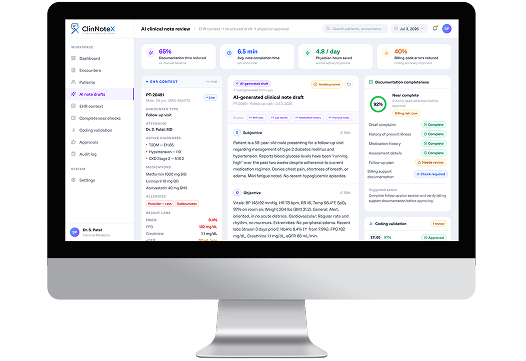
ClinNoteX is an AI clinical documentation platform designed as a clinical documentation accelerator for hospitals. It connects to the hospital’s EHR, assembles a complete patient context, and generates standardized draft notes for physician review and approval.
The platform reduced documentation time by up to 65%, with average note completion falling from 18 to 6.5 minutes in a representative workflow, and increased clinical throughput by up to 30%.
The client is a hospital where physicians, medical assistants, coding specialists, and billing teams handle a high volume of clinical documentation.
For every encounter, clinicians had to review patient histories, previous visits, diagnoses, medications, test results, and current findings across different EHR sections. The hospital needed AI clinical documentation software that could reduce repetitive work, standardize note quality, and establish a foundation for additional healthcare AI solutions while keeping physicians responsible for final clinical decisions.
Clinical notes were created manually from information distributed across multiple EHR modules and data sources. Physicians had to collect, verify, and transfer relevant details before completing each document.
This created several operational problems:
The hospital needed clinical documentation automation supported by secure EHR integration services. It also required clinical documentation improvement software that could fit existing workflows and a partner with AI development services expertise to build and validate the solution.
As part of its hospital software development services, Computools delivered ClinNoteX as EHR-based AI medical scribe software integrated with the hospital’s existing systems. The team provided FHIR HL7 integration services to retrieve patient histories, encounters, diagnoses, medications, and clinical events and return approved notes to the hospital’s EHR.
The platform combines structured and unstructured clinical data into a complete patient context. A large language model (LLM) and Retrieval-Augmented Generation (RAG) layer support automated clinical notes generation in approved formats, including SOAP. A secure data layer with encryption, role-based access control, and audit logging supports HIPAA-compliant data handling throughout the documentation workflow.
ClinNoteX also:
This healthcare workflow automation reduces repeated data collection while keeping final clinical approval under physician control.
ClinNoteX delivered measurable improvements across clinical documentation and billing workflows:
At 25 notes per day, the platform reduced the average daily documentation workload from 7.5 hours to approximately 2.7 hours. By improving note completeness before coding, medical billing documentation automation reduced the need for repeated reviews and helped coding and billing teams process records with fewer corrections.
Computools was selected for its ability to combine healthcare workflow analysis, EHR interoperability, AI engineering, product design, and secure data processing into a single delivery model.
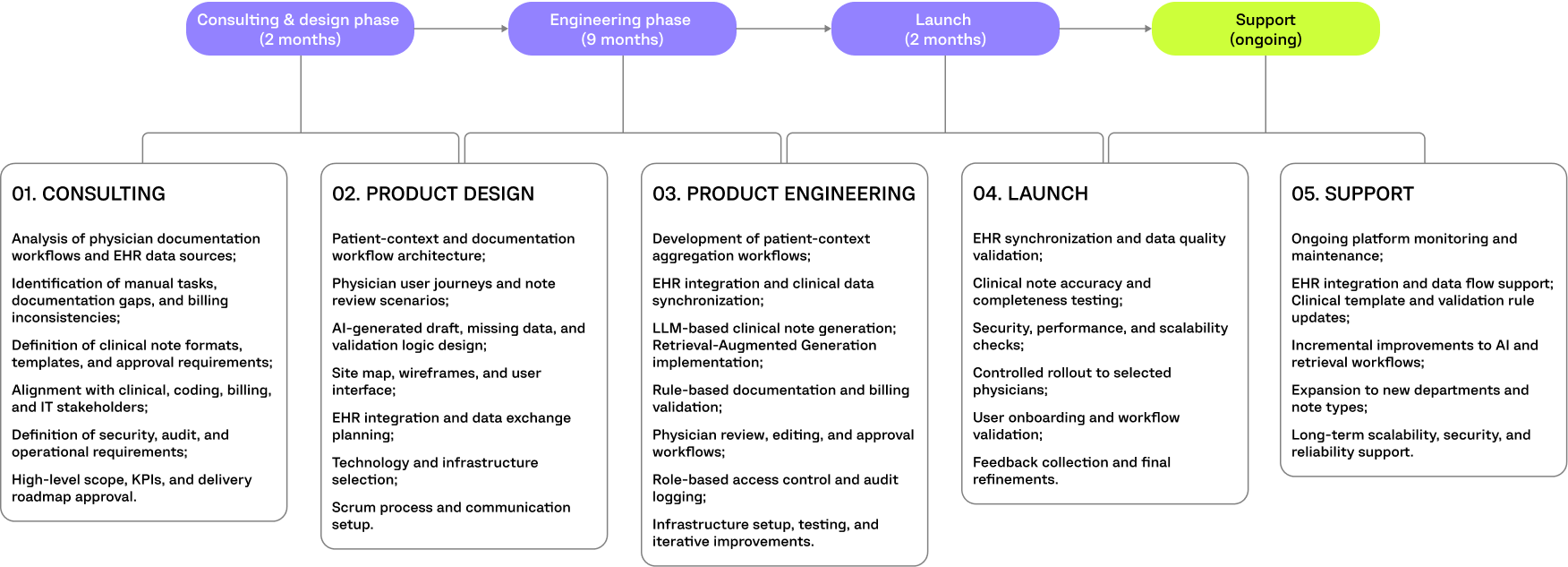
The team structured the solution around the physician’s real workflow, from retrieving patient context to reviewing and returning the approved note to the EHR. Phased delivery, clinical validation checkpoints, and human review reduced implementation risk and ensured that automation improved documentation speed without weakening clinical control.

The design focused on fast patient-context review, clear AI suggestions, and efficient physician approval.
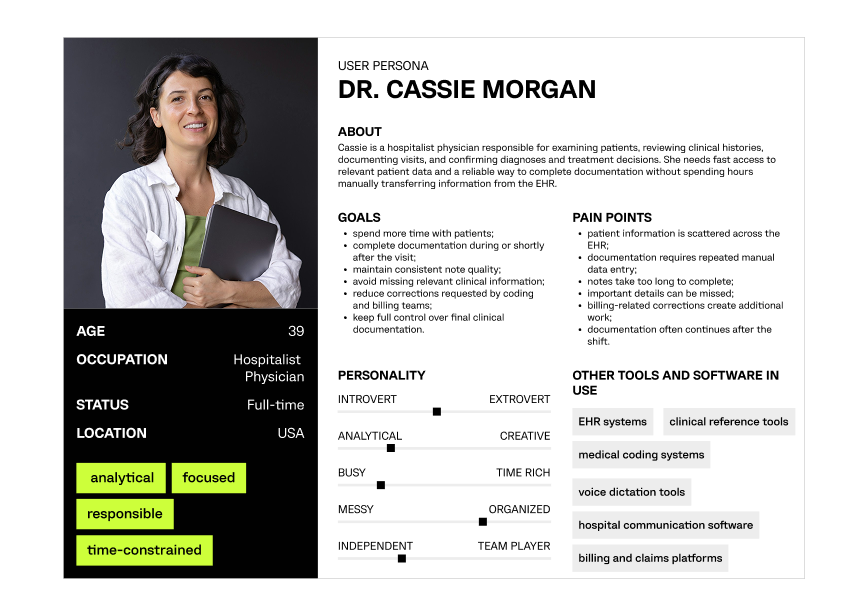
Defining physicians’ documentation workflows and review requirements to reduce administrative effort without limiting clinical control.
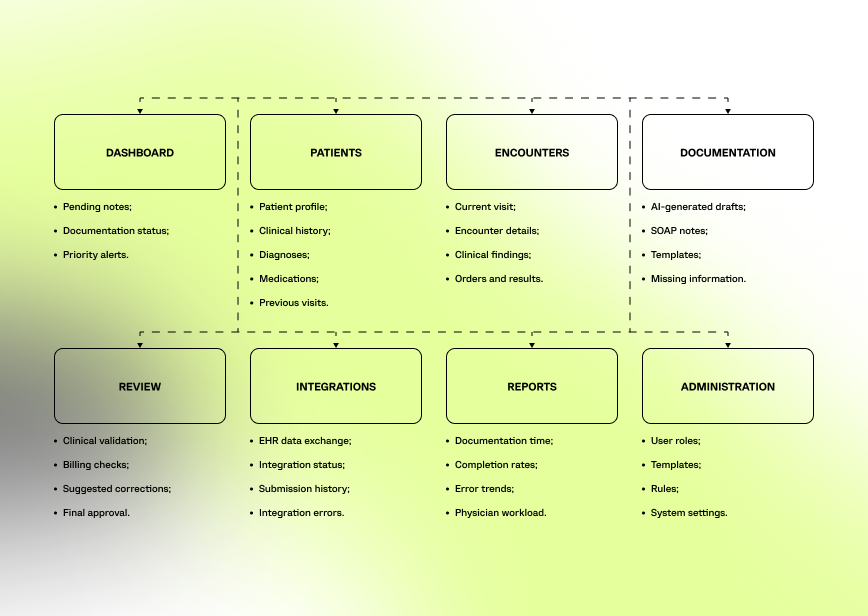
Structuring the platform around patient context, note generation, clinical review, and EHR submission.
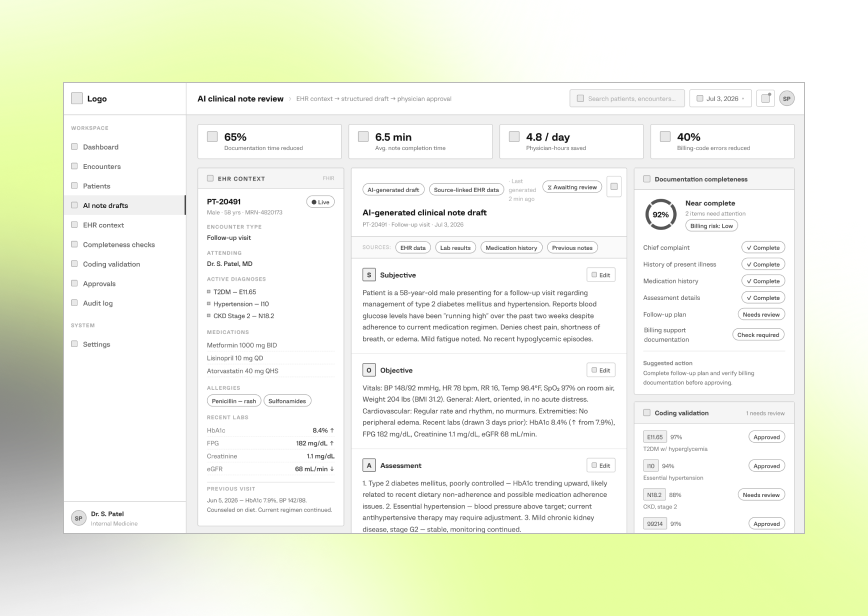
Designing low-fidelity layouts for patient context review, AI-generated notes, missing-data prompts, and final clinical approval.
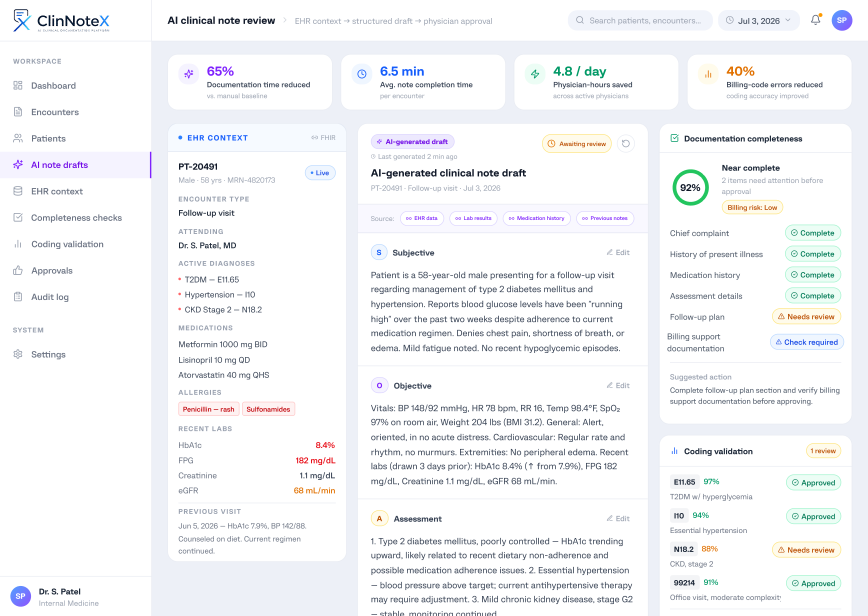
The interface gives physicians immediate access to relevant patient history, the generated note, any missing information, and required actions on a single review screen.

.NET
.NET provides the backend foundation for ClinNoteX, supporting patient-context aggregation, note-generation workflows, validation logic, EHR data exchange, and secure user access.
PYTHON
Python powers the platform’s AI and data-processing layer. It supports clinical data preparation, retrieval workflows, medical text processing, and integration with language models used for note generation.

POSTGRESQL
PostgreSQL stores patient context, encounter data, generated drafts, validation results, approval statuses, and audit events. It preserves traceability across the full clinical documentation workflow.

Microsoft Azure
Microsoft Azure provides scalable infrastructure for application hosting, data processing, monitoring, and AI workloads. It supports secure deployment and expansion across additional departments and documentation workflows.

Large Language Models
Open-source Meta Llama models and GPT models deployed through Azure OpenAI Service transform patient histories, encounter data, diagnoses, medications, and clinical findings into structured draft notes aligned with hospital-approved documentation formats.

Security & Compliance
ClinNoteX protects PHI through encryption at rest and in transit, role-based access control, audit logging, and minimum-necessary access enforced across the data layer. These controls support HIPAA-compliant processing across data ingestion, AI generation, physician review, and bidirectional EHR exchange.
Retrieval-Augmented Generation
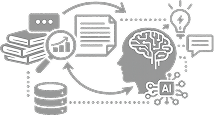
Retrieval-Augmented Generation connects the language model with relevant patient records, previous encounters, and hospital-approved templates. This gives each generated note a current clinical context and reduces reliance on encounter data alone.
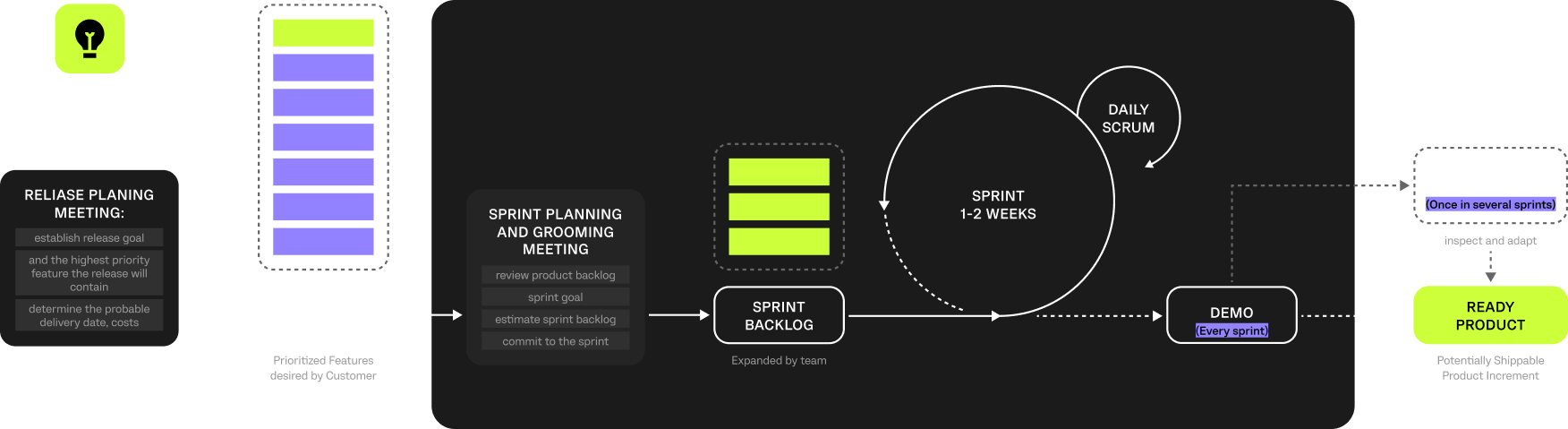
An Agile approach with Scrum was used to support iterative development and continuous clinical validation. Work was organized into short sprints with a prioritized backlog, regular stakeholder reviews, and clear checkpoints for EHR integrations, note quality, validation rules, and physician workflows.
This model allowed the team to refine the solution incrementally, respond to hospital requirements, and validate each critical component before broader rollout.
ClinNoteX has made a real difference in our physicians’ daily work. Instead of searching through different parts of the EHR and building each note manually, they now start with a structured draft that already includes the relevant patient information.
The notes are easier to review, more consistent, and require fewer corrections from our coding and billing teams. Most importantly, our physicians spend less time finishing documentation and more time focused on patient care.




Computools | 341 Raven Cir, Camden Wyoming, Delaware 19934, US