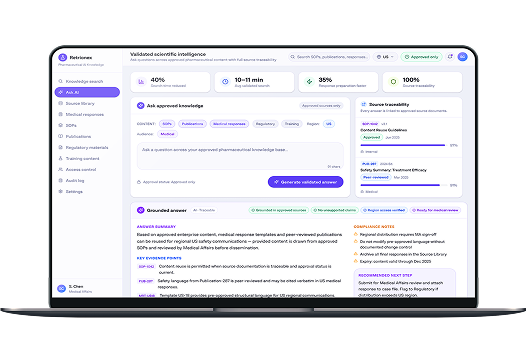
Retrionex is a centralized AI knowledge management platform developed for a mid-size US pharmaceutical company. It connects SOPs, scientific publications, medical responses, regulatory materials, and training content into a single secure semantic layer.
The platform supports pharmaceutical knowledge management by allowing users to ask questions in natural language and receive grounded answers based only on approved enterprise content, with explicit references to every source used.
Retrionex reduced the average time required to locate validated information from 18 minutes to 10–11 minutes and accelerated scientific response preparation by up to 35%.
The client is a mid-size US pharmaceutical company whose Medical Affairs, Regulatory Affairs, and Scientific Operations teams work with large volumes of scientific, medical, and compliance-sensitive documentation.
These teams prepare medical responses, support regional inquiries, review regulatory materials, train internal stakeholders, and reuse approved content across markets. The company needed medical affairs software that could improve access to validated knowledge without replacing its existing repositories.
As content volumes and regional operations expanded, the organization also required a more consistent approach to scientific knowledge management, source verification, content reuse, and access control.
Scientific and regulatory knowledge was distributed across disconnected repositories containing SOPs, publications, medical response documents, regulatory materials, and training content. Medical Affairs and Regulatory teams had to search across several systems, compare document versions, verify approval status, and confirm whether content could be reused for a specific region or audience.
This fragmentation slowed access to validated information, increased manual research effort, and led to inconsistent reuse of approved content across markets. General-purpose AI tools also introduced the risk of generating unsupported responses or using information outside the company’s approved knowledge base.
The company needed secure pharmaceutical AI solutions that could retrieve only validated internal content, preserve source traceability, and enforce role- and region-based access. It also required a partner with relevant expertise in AI development services to integrate semantic retrieval, controlled generation, and enterprise governance into a single system.
Through a focused pharmaceutical software development engagement, Computools delivered Retrionex as a centralized AI knowledge layer built on top of the client’s existing repositories. Content from SOPs, publications, medical responses, regulatory materials, and training libraries is ingested, normalized, classified, and indexed within a unified semantic environment.
The platform applies RAG for pharmaceutical knowledge and semantic search for pharmaceutical data to retrieve approved documents based on meaning and context rather than exact keywords. Users submit questions in natural language and receive grounded answers with direct references to the source documents used.
By applying AI for medical affairs, Retrionex improves scientific information management while preserving existing repositories and approval processes. Role-based access, audit logging, document-level permissions, and compliance guardrails restrict generation to authorized content and maintain full traceability for every response.
Retrionex delivered measurable improvements across Medical Affairs, Regulatory, and Scientific Operations:
The platform strengthened regulatory knowledge management, reduced the need for repeated source verification, and helped regional teams reuse approved scientific content with greater consistency and control.
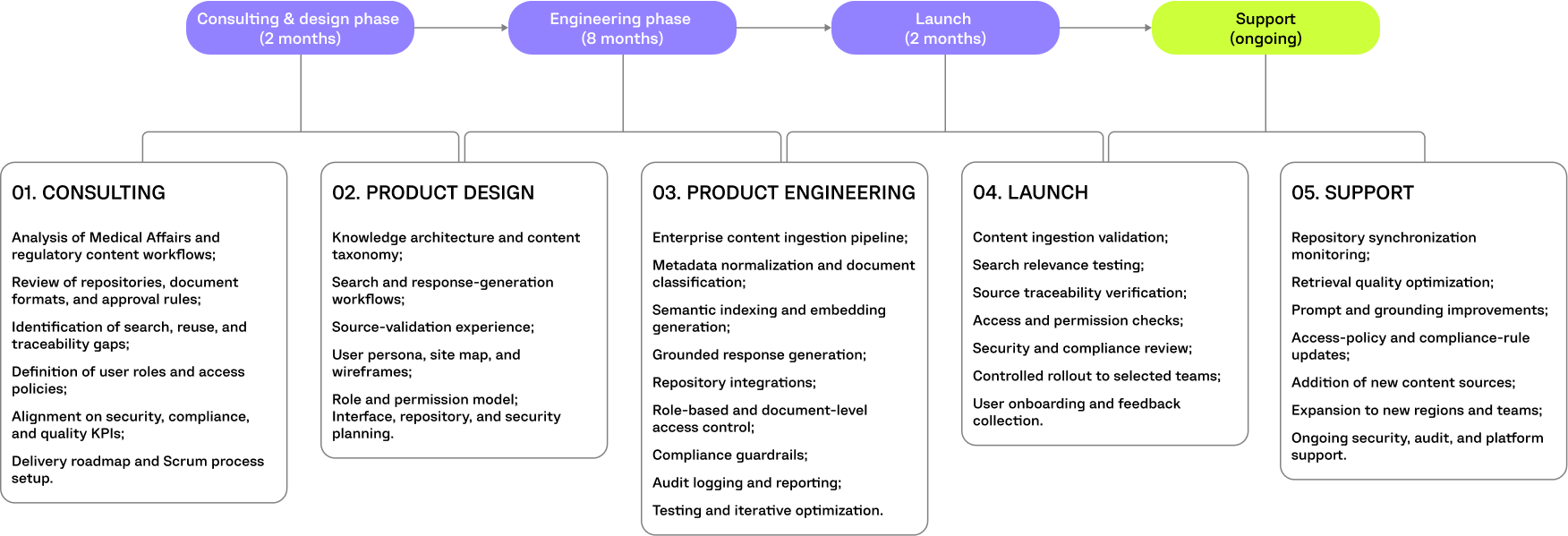
Computools combined enterprise knowledge architecture, AI engineering, semantic search, product design, and compliance-focused delivery into a single implementation model.
The team mapped existing repositories, approval rules, access dependencies, and Medical Affairs workflows before building the ingestion, retrieval, and generation layers. A phased approach with validation checkpoints helped improve search relevance, source grounding, and access controls before broader rollout.

The design focused on fast content discovery, transparent source verification, and clear visibility into document status, regional applicability, and access restrictions.
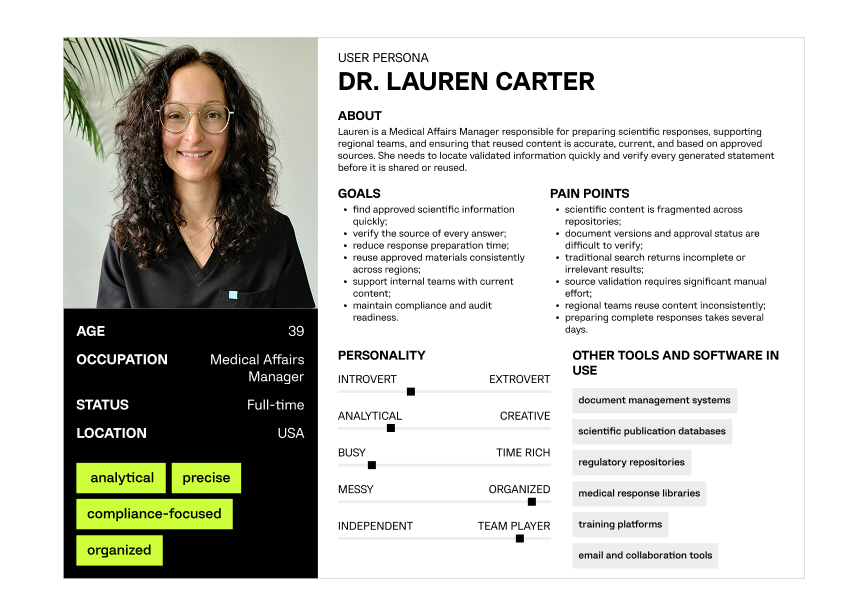
Defining scientific response workflows and compliance requirements to support faster access to validated enterprise content.
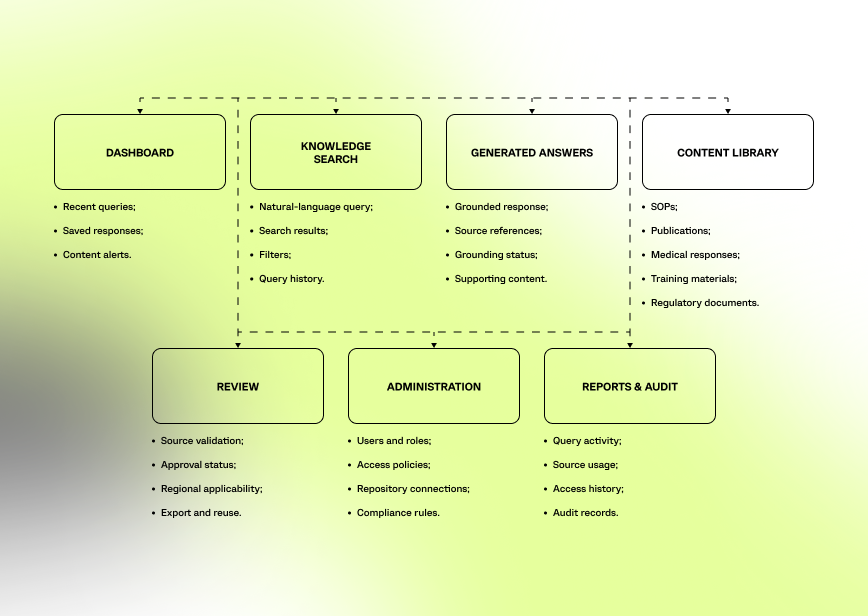
Structuring scientific content, natural-language retrieval, source review, access controls, and audit functions within one platform.
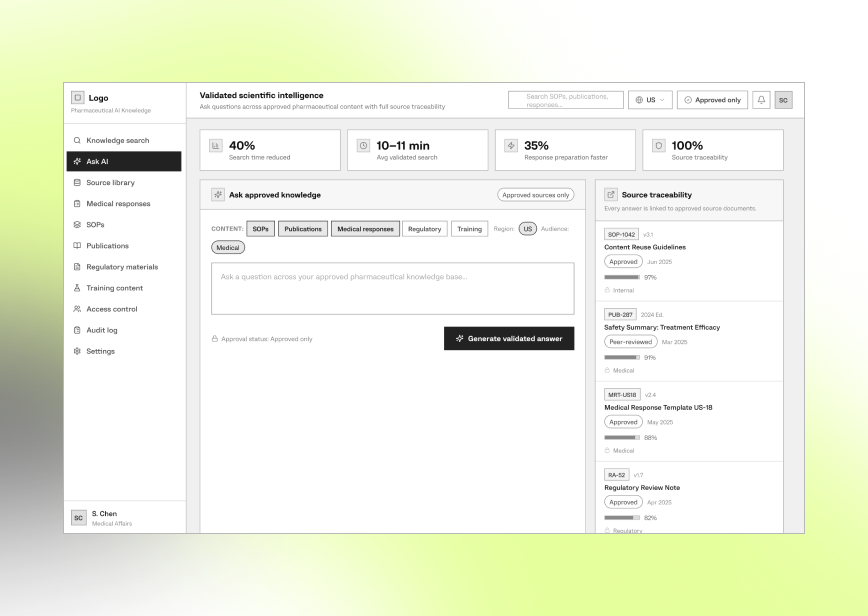
Designing low-fidelity layouts for content retrieval, source-linked responses, document validation, and compliance review.
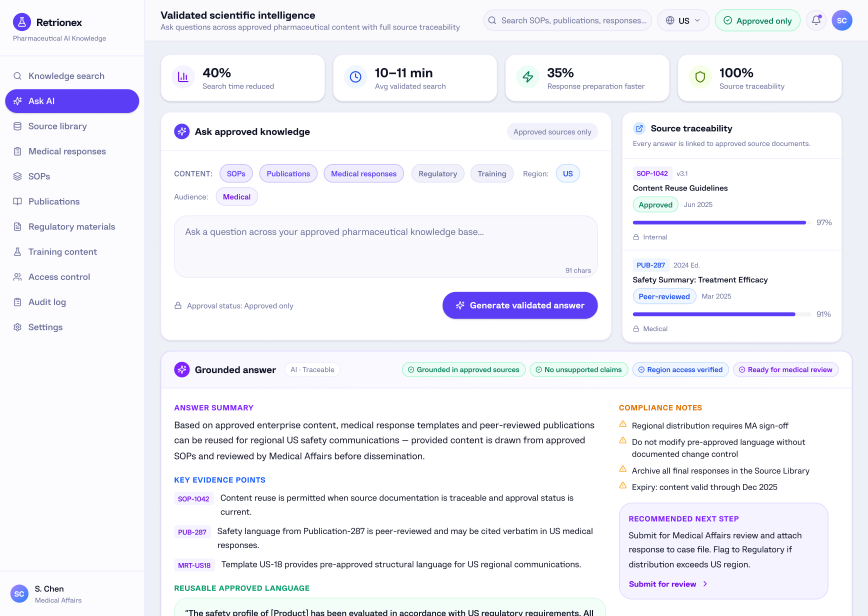
The interface provides users with immediate access to grounded responses, supporting documents, approval status, regional applicability, and access restrictions on a single review screen.

PYTHON
Python powers document ingestion, preprocessing, metadata enrichment, embedding generation, and retrieval orchestration. It prepares scientific and regulatory materials for indexing and for generating grounded responses.

Azure OpenAI Service
Azure OpenAI Service processes natural-language questions and generates responses from retrieved enterprise content. The model receives only approved source material and returns answers linked to supporting documents.

Azure AI Search
Azure AI Search provides vector, semantic, and hybrid retrieval across SOPs, publications, approved responses, regulatory materials, and training content. It helps users find relevant documents even when their wording differs from the source terminology.
Custom Knowledge Schema
A custom knowledge schema standardizes document types, versions, approval statuses, regions, product areas, and access attributes across connected repositories. It gives the retrieval layer consistent metadata and preserves context when source systems organize content differently.

.NET
.NET provides the backend foundation for repository connections, query orchestration, source-reference management, permission validation, and audit workflows.

POSTGRESQL
PostgreSQL stores document metadata, approval status, regional applicability, source relationships, query history, and audit records. It maintains traceability between generated responses and the documents used to support them.

Microsoft Entra ID
Microsoft Entra ID supports enterprise authentication, single sign-on, and role-based access control. It limits content visibility according to user role, region, department, and document permissions.

Security & Compliance
Retrionex protects scientific, regulatory, and medical content through encryption at rest and in transit, document-level permissions, minimum-necessary access, and complete audit logging. Approved-source-only generation and source traceability support controlled content use across teams and regions. Where PHI is processed, the architecture supports HIPAA-aligned data handling.
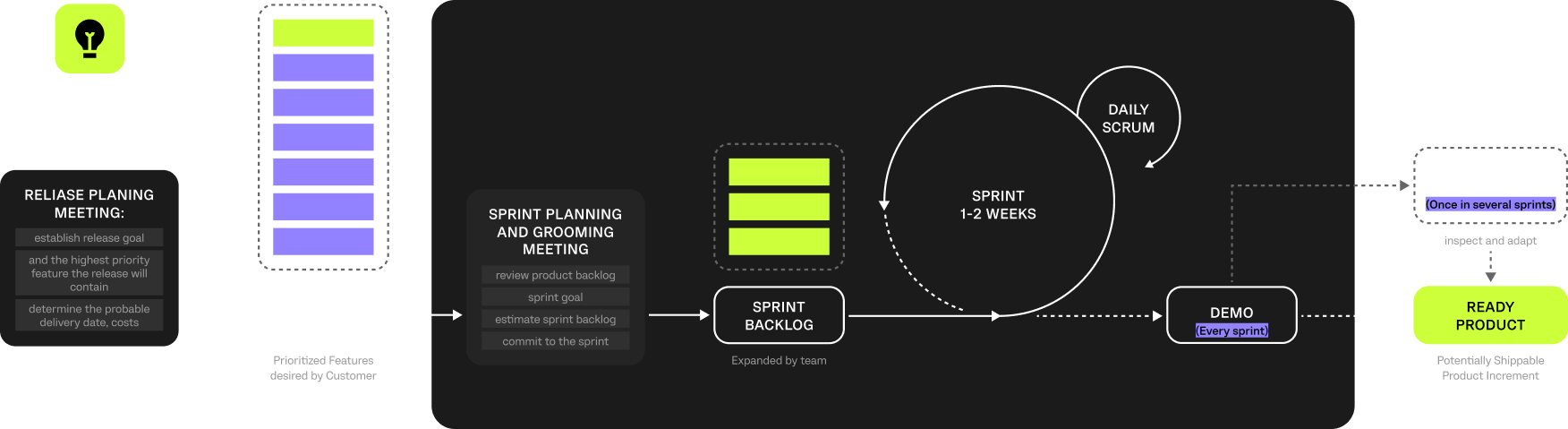
An Agile approach with Scrum supported iterative development and continuous validation of retrieval quality, source traceability, access controls, and compliance rules.
Work was organized into short sprints with a prioritized backlog, regular stakeholder reviews, and clear checkpoints for ingestion quality, search relevance, grounded generation, and user permissions. This allowed the team to refine the platform before a broader rollout without disrupting existing content management processes.
Retrionex has simplified how our teams access approved scientific content. Users can ask questions, receive well-supported answers, and instantly access relevant documents, eliminating the need to search multiple repositories and manually verify versions.
The biggest benefit is confidence. Every answer is linked to its sources, and users only see content approved for their region and role. We prepare scientific responses faster and reuse validated materials more consistently across the organization.




Computools | 341 Raven Cir, Camden Wyoming, Delaware 19934, US