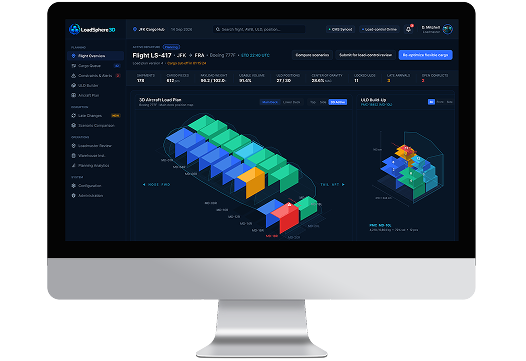
The client was a USA-based all-cargo airline operating 14 wide-body freighters across domestic and international routes. The airline served freight forwarders, manufacturers, pharmaceutical shippers, e-commerce companies, and other logistics customers.
Commercial teams often sold close to theoretical flight capacity, but booked cargo did not always convert into usable aircraft space. Shipment dimensions, Unit Load Device (ULD) limits, aircraft contours, weight distribution, Dangerous Goods restrictions, and late cargo changes made each departure a complex physical planning task.
The client needed an air cargo optimization platform that could improve how cargo pieces were grouped into ULDs and assigned to aircraft positions. LoadSphere 3D worked as aircraft load planning software, supporting ULD load optimization while keeping the airline’s Cargo Management System (CMS) and load-control workflow authoritative.
Within four months of phased adoption, the platform increased usable cargo utilization by 10.6%, reduced average load-plan preparation time by 72%, decreased last-minute ULD rebuilds by 26%, and made late-cargo replanning 38% faster.
The client is a USA-based all-cargo airline operating scheduled freight departures through a primary US cargo hub. Its network handles general freight, e-commerce shipments, industrial components, pharmaceuticals, temperature-sensitive cargo, and Dangerous Goods.
The airline operated more than 100 scheduled cargo departures per week across two wide-body freighter types. Each aircraft type had different cargo compartment geometry, ULD configurations, position limits, and operational characteristics.
The airline already used established air cargo management software to manage bookings, Air Waybills (AWBs), shipment acceptance, cargo status, capacity, and operational workflows. A separate load-control environment supported aircraft weight-and-balance processes.
These systems provided authoritative flight and shipment data, but loadmasters still had to solve the three-dimensional packing problem manually for complex departures.
The main challenge was converting booked demand into physically usable aircraft capacity. A flight could show available payload while individual ULDs had already reached geometric limits, contour limits, or practical build constraints.
The client needed cargo load optimization software that could evaluate thousands of feasible cargo, ULD, and aircraft-position combinations faster than manual planning. The project required air cargo software development expertise across cargo operations, ULD build-up, load-control workflows, constraint modeling, 3D visualization, and system integration.
Computools designed LoadSphere 3D as an optimization layer connected to the airline’s existing Cargo Management System and load-control environment. The platform supported 3D cargo load planning for two connected decisions: how to build each ULD and how to assign completed ULDs across the aircraft.
The ULD planning software evaluated shipment dimensions, gross weight, piece count, stackability, orientation restrictions, commodity type, special-handling codes, Dangerous Goods attributes, temperature-control requirements, priority status, destination, and transfer requirements.
A configuration library modeled aircraft cargo compartment geometry, available loading positions, aircraft contour profiles, supported ULD types, maximum ULD gross weight, position-specific weight limits, center-of-gravity constraints, and loading restrictions.
Computools applied advanced optimization techniques to support spatial packing, constraint-based planning, scenario generation, incremental re-optimization, and operational scoring. The optimization engine searched for feasible combinations and produced high-utilization recommendations within practical planning times.
The air cargo load planning optimization workflow lets loadmasters inspect recommendations, lock completed ULDs, lock priority shipments, move cargo manually, compare scenarios, and rerun optimization without rebuilding the full plan.
The airline cargo management system integration layer consumed flight schedules, bookings, AWBs, shipment pieces, cargo dimensions, weights, status updates, and special-handling data. Planning results were returned through controlled interfaces, while the certified load-control process remained responsible for final aircraft weight-and-balance approval.
LoadSphere 3D improved cargo utilization, planning speed, replanning efficiency, and operational control across complex freight departures:
Average planning time for complex departures fell from approximately 46 minutes to 13 minutes. Loadmasters could evaluate more feasible loading scenarios, detect constraint conflicts earlier, and preserve already-built ULDs during late-cargo changes.
The strongest air freight optimization effect appeared on capacity-constrained flights. The airline did not need to create additional demand; it converted more existing booked demand into usable aircraft space by reducing unused contour volume and improving ULD build-up quality.
Operational teams also gained clearer visibility into why apparent capacity could not always be loaded. Planners could distinguish remaining payload, geometric volume, usable ULD space, aircraft-position constraints, Dangerous Goods restrictions, and cargo combinations that reduced utilization.
The client selected Computools because the project required air cargo domain analysis, 3D spatial optimization, constraint modeling, cargo system integration, UX design for loadmasters, and phased operational validation.
Computools connected shipment data, aircraft geometry, ULD profiles, Dangerous Goods restrictions, load-control rules, planner workflows, and utilization analytics into one optimization layer.
Delivery priorities were tied to measurable air cargo outcomes: usable cargo utilization, load-planning time, late-cargo replanning time, ULD rebuild frequency, late planning exceptions, planner workload, and revenue-capacity opportunity.
The team covered business analysis, UX and UI design, optimization engineering, AI development, software architecture, 3D visualization, data integration, QA, historical simulation, shadow-mode testing, pilot validation, and rollout support.

The design focused on translating complex optimization logic into a clear interface for loadmasters, cargo planners, and warehouse build-up teams.
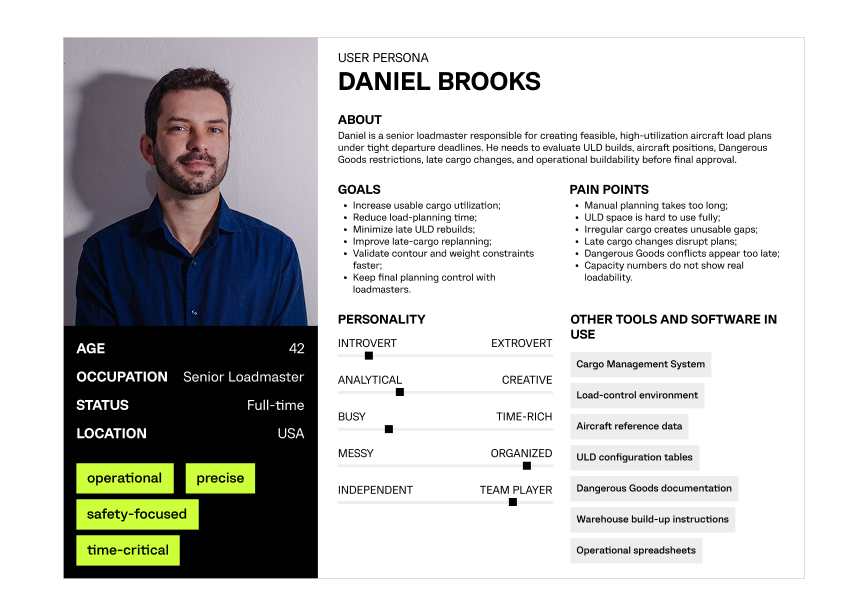
Defining air cargo planning needs across loadmasters, cargo load planners, ULD build-up supervisors, Dangerous Goods specialists, flight operations coordinators, cargo capacity managers, and operations executives.
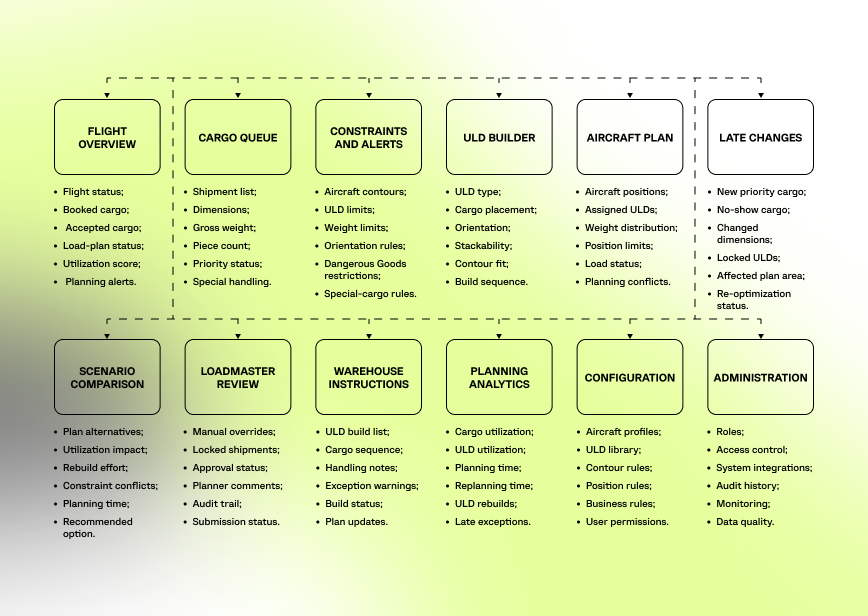
Structuring the platform around flights, ULD build-up, aircraft positions, constraints, scenarios, late changes, and utilization analytics.
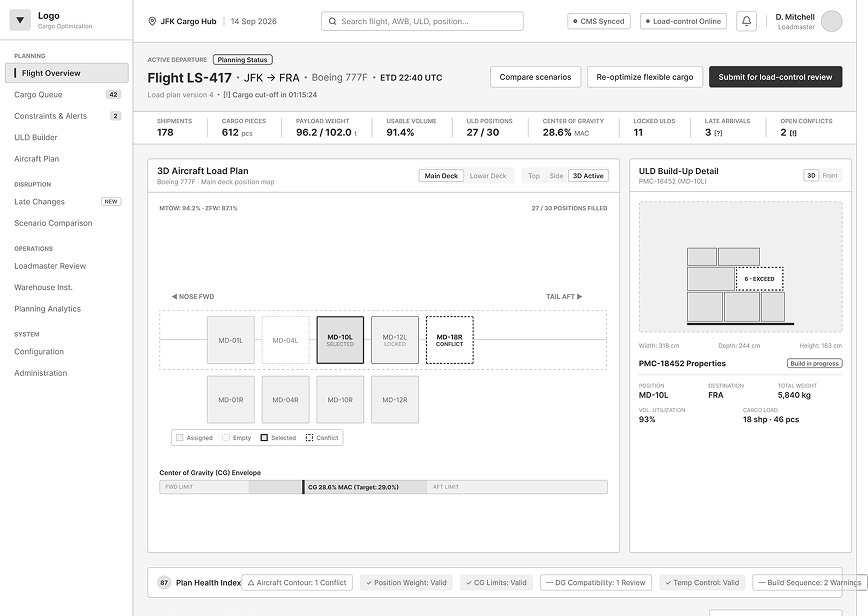
Designing low-fidelity layouts for flight planning, 3D ULD build-up, aircraft-position assignment, constraint review, late-cargo replanning, scenario comparison, warehouse instructions, and planning analytics.
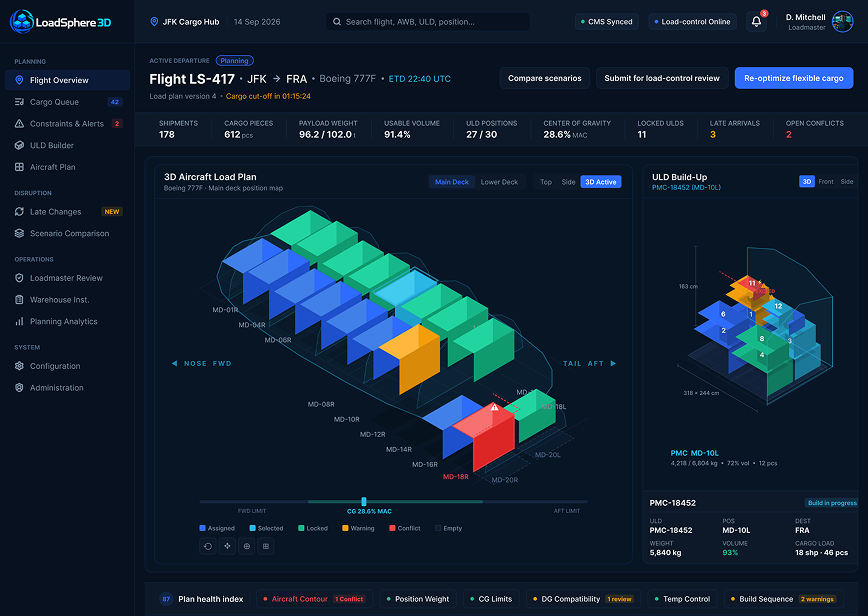
The interface gave loadmasters a single place to review flight demand, inspect 3D ULD builds, compare aircraft load scenarios, lock completed work, resolve constraints, and submit planning recommendations to the existing load-control workflow.

TypeScript
TypeScript supported consistent frontend and backend development across planning, visualization, workflow, constraint, and integration services.

Next.js and React
Next.js- and React-powered responsive planning interfaces for loadmasters, warehouse supervisors, flight operations coordinators, and cargo management teams.

Three.js and WebGL
Three.js- and WebGL-powered interactive three-dimensional visualization in the browser, including ULD contours, shipment pieces, orientation, unused space, and loading envelopes.

Node.js and NestJS
Node.js and NestJS handled workflow orchestration, flight state, planner actions, approvals, user permissions, notifications, scenario management, and system integrations.

PostgreSQL
PostgreSQL stored normalized flight, shipment, aircraft, ULD, configuration, recommendation, scenario, approval, and planning-performance data.

Python and FastAPI
Python and FastAPI powered 3D packing logic, constraint solving, search techniques, incremental re-optimization, and operational scoring.

AWS, Docker, and Terraform
AWS, Docker, and Terraform supported secure deployment, standardized environments, infrastructure automation, observability, and scalable optimization workloads.

REST APIs, event messaging, and scheduled synchronization
These integration mechanisms connected LoadSphere 3D with the airline’s Cargo Management System and existing load-control workflow.
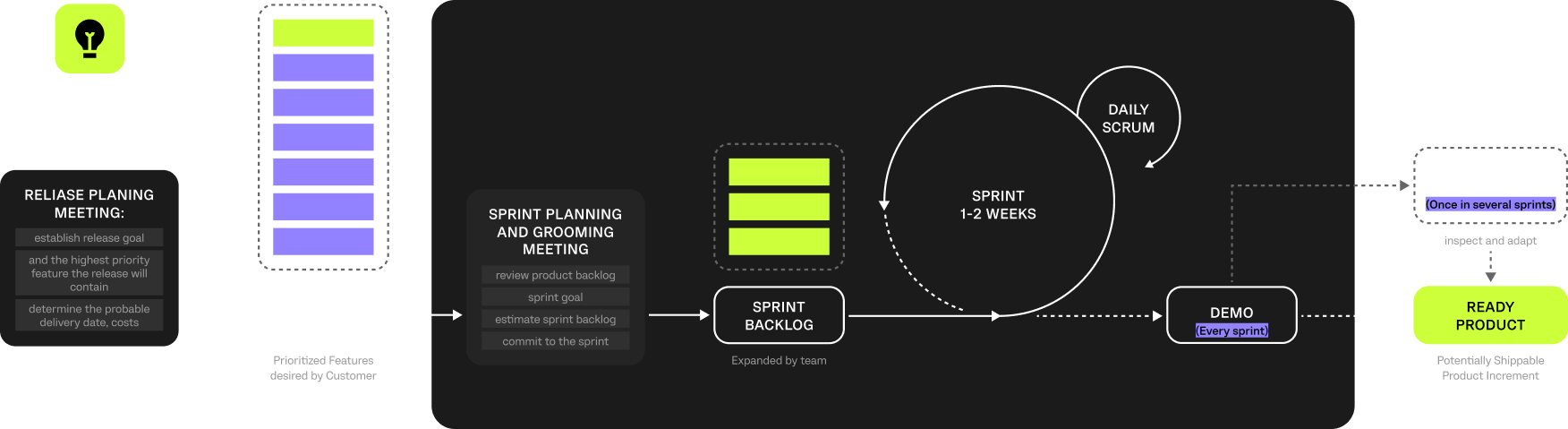
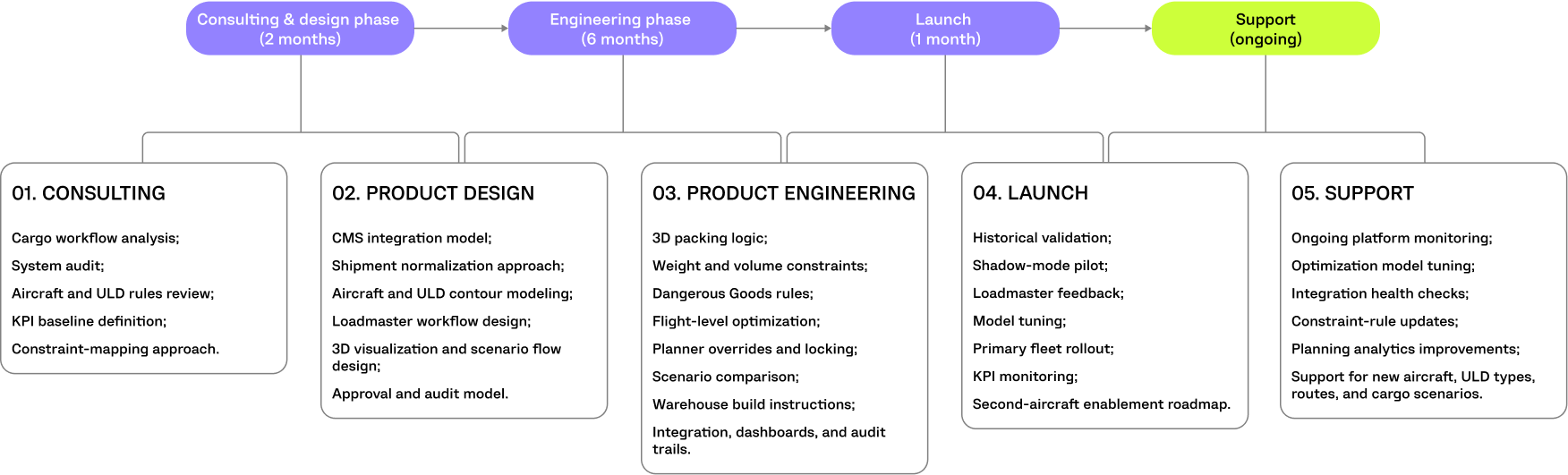
Computools used Scrum with two-week iterations and continuous validation from experienced cargo planners. The project started with historical simulation. Completed flight data was replayed through the optimization engine to test whether LoadSphere 3D could improve practical utilization while respecting configured constraints.
After tuning, the platform entered shadow mode on live departures. Loadmasters continued using the established workflow while LoadSphere generated independent recommendations for comparison.
Recommendations entered operational use only after senior planners confirmed feasibility, consistency, and planning value. The phased approach reduced risk and allowed the airline to validate the impact of the optimization before a broader rollout.
Load planning used to depend on how many combinations an experienced planner could evaluate before cut-off. LoadSphere 3D gave our team thousands of feasible alternatives in the time it previously took to test a handful. Our loadmasters still make the final decision, but they can make it faster, with better visibility into capacity, constraints, and late cargo changes.




Computools | 341 Raven Cir, Camden Wyoming, Delaware 19934, US