The client was a Germany-based contract logistics and fulfillment provider operating a 45,000 m² multi-client fulfillment center. The facility processed consumer goods, electronics accessories, household products, and other high-volume merchandise for B2B and e-commerce customers.
The warehouse managed approximately 18,000 active SKUs across pallet storage, shelving zones, carton flow racks, packing stations, replenishment areas, and a two-level mezzanine for small-item picking. SAP EWM reliably controlled inventory and warehouse execution, but storage locations were governed by static slotting rules and periodic manual reviews.
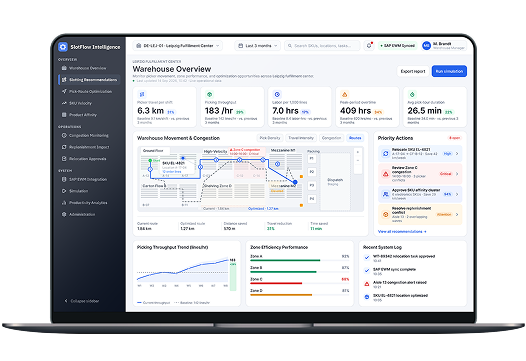
The client needed a warehouse optimization platform that could improve picking efficiency while keeping SAP EWM as the system of record. Computools delivered SlotFlow Intelligence, a dynamic layer for warehouse slotting optimization, route calculation, SKU velocity analysis, product-affinity clustering, congestion monitoring, and manager-approved relocation workflows.
Within three months of phased deployment, the platform reduced picker travel time by 31%, increased picking throughput by 29%, reduced fulfillment labor effort per 1,000 order lines by 17%, and lowered peak-period overtime by 34%.
The client is a Germany-based logistics provider serving B2B distributors, consumer brands, and e-commerce companies through a high-volume fulfillment operation.
Its main warehouse combined pallet reserve storage, forward-pick areas, shelving, packing stations, replenishment zones, and mezzanine picking. Product demand varied by SKU size, velocity, seasonality, order frequency, and customer mix.
SAP EWM managed receiving, put-away, inventory, replenishment, picking tasks, packing, and shipment preparation. The WMS provided reliable execution, but slotting configuration was not continuously recalculated as demand changed.
The client needed warehouse productivity software that could analyze current order-line behavior, identify inefficient SKU placement, reduce unnecessary picker travel, and improve throughput without disrupting core warehouse execution.
The main constraint was picker movement inside a facility that still had enough storage and processing capacity. Internal analysis showed that picking teams spent too much of each shift walking between storage locations, warehouse zones, aisles, and mezzanine levels.
The project required warehouse management software development experience across warehouse operations, WMS integration, facility modeling, picking workflows, slotting logic, productivity analytics, and phased rollout.
Computools designed SlotFlow Intelligence as warehouse slotting software operating alongside SAP EWM. The platform used WMS data, warehouse layout, SKU behavior, and order-line history to improve two decisions: where to place products and how pickers should move through the facility. The team built a graph-based warehouse model covering aisles, pick faces, cross-aisles, packing stations, replenishment points, mezzanine levels, and restricted movement paths. This allowed the system to estimate real travel distance and travel time, not just sequence locations by WMS codes.
The platform analyzed SKU velocity, product co-occurrence, pick frequency, storage capacity, replenishment needs, current inventory position, seasonality, promotion activity, zone workload, and congestion patterns.
Computools applied AI development to support SKU classification, demand-pattern detection, product-affinity analysis, slotting recommendations, congestion-aware routing, and relocation-priority scoring. The AI warehouse optimization layer ranked relocation recommendations by expected travel reduction, relocation effort, replenishment impact, confidence level, and payback period. Low-value moves were filtered out, while high-impact changes were sent to warehouse managers for approval.
The warehouse picking optimization capability calculated efficient routes through the physical warehouse model, considering aisle structure, cross-aisle access, mezzanine movement, pick locations, packing destination, and traffic restrictions.
Approved relocation recommendations were sent back to SAP EWM as controlled warehouse movement tasks, while SAP EWM remained responsible for inventory accuracy and warehouse execution.
SlotFlow Intelligence improved picking productivity, travel efficiency, labor utilization, and peak-period capacity across optimized warehouse zones:
Average picker travel in optimized zones fell from approximately 9.1 km to 6.3 km per shift. The improvement was achieved without additional warehouse space, WMS replacement, or major material-handling automation.
The platform turned warehouse travel time optimization into a continuous operational process. Managers could identify which aisles generated excessive walking, which SKU combinations created inefficient pick tours, and which location changes had the strongest expected payback.
The system also supported warehouse labor optimization by helping the facility absorb more seasonal order volume with its existing core workforce. Higher picking throughput reduced dependence on peak overtime and improved labor effort per order line.
The client selected Computools because improving picking performance required expertise in warehouse operations, WMS integration, physical facility modeling, optimization logic, AI-assisted recommendations, and practical rollout support.
Computools connected SAP EWM data, SKU velocity, product affinity, warehouse topology, picking activity, replenishment rules, and labor productivity KPIs into one optimization layer.
Delivery priorities were tied to measurable warehouse outcomes: picker travel time, lines per labor hour, pick-tour duration, fulfillment labor effort, zone congestion, replenishment impact, and overtime requirements.
The team covered business analysis, UX and UI design, data engineering, optimization logic, software architecture, SAP EWM integration, QA, pilot validation, user training, and post-launch support.

The design focused on warehouse visibility, picking productivity, slotting recommendations, route analysis, congestion monitoring, and manager-controlled relocation workflows.
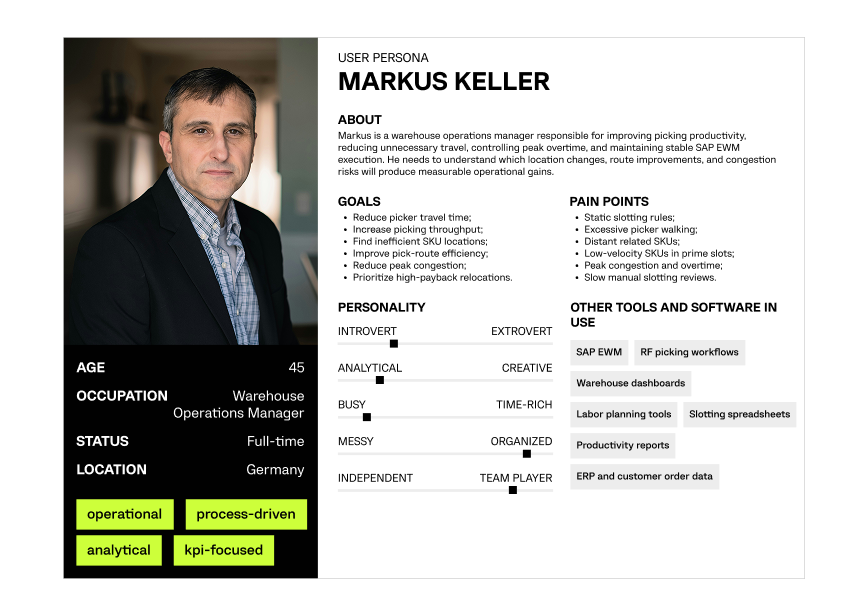
Defining warehouse optimization needs across operations management, shift supervision, slotting, replenishment, process engineering, fulfillment analytics, and executive reporting.
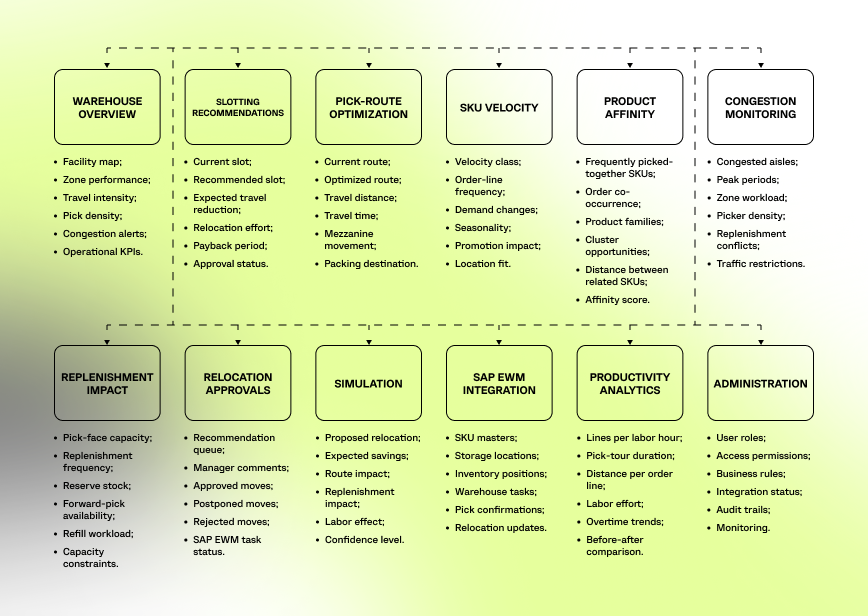
Structuring the platform around facility visibility, SKU placement, picking routes, congestion, relocation decisions, and warehouse productivity KPIs.
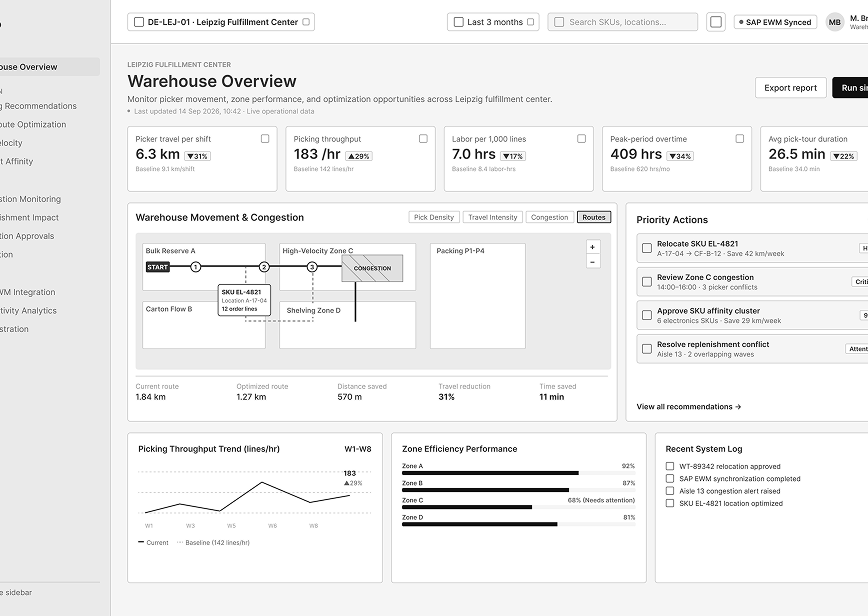
Designing low-fidelity layouts for warehouse heatmaps, slotting recommendation queues, route comparison screens, SKU affinity views, congestion dashboards, relocation approvals, and productivity analytics.
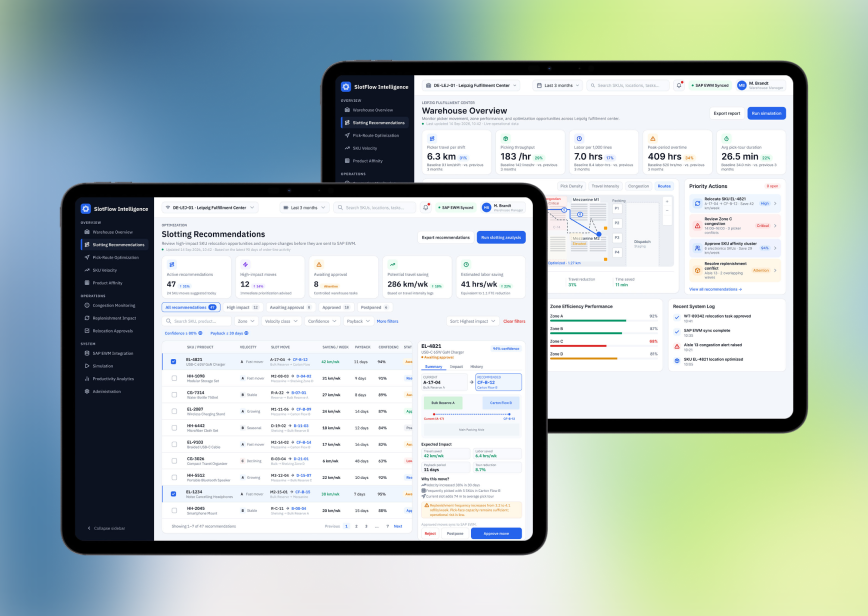
The interface gave warehouse teams one place to review facility movement, compare current and recommended slots, analyze pick routes, approve relocations, and track productivity after each optimization change.

TypeScript
TypeScript provided a shared engineering foundation across product, location, route, recommendation, approval, dashboard, and WMS integration data structures.

Next.js and React
Next.js and React-powered responsive interfaces for warehouse managers, process engineers, shift supervisors, slotting specialists, analysts, and executives.

Node.js and Express
Node.js and Express handled backend application logic, approval workflows, notifications, role-based permissions, business rules, and SAP EWM integration.

PostgreSQL
PostgreSQL stored normalized data for SKUs, warehouse locations, order lines, pick activity, slotting recommendations, approvals, facility layouts, and KPIs. Historical snapshots allowed the system to measure warehouse conditions before and after optimization changes.

Claude integration
A controlled Claude integration supported natural-language explanations of slotting and relocation recommendations based on structured optimization outputs, warehouse conditions, and projected operational impact.

AWS, Docker, and Terraform
AWS, Docker, and Terraform supported secure cloud deployment, standardized environments, infrastructure automation, monitoring, and scalable analytical processing. Optimization jobs could be recalculated without adding computational load to SAP EWM.

SAP EWM
Integration with SAP EWM synchronized SKU masters, storage locations, inventory positions, warehouse tasks, order lines, pick confirmations, and approved relocation activity while SAP EWM remained the system of record for warehouse execution.
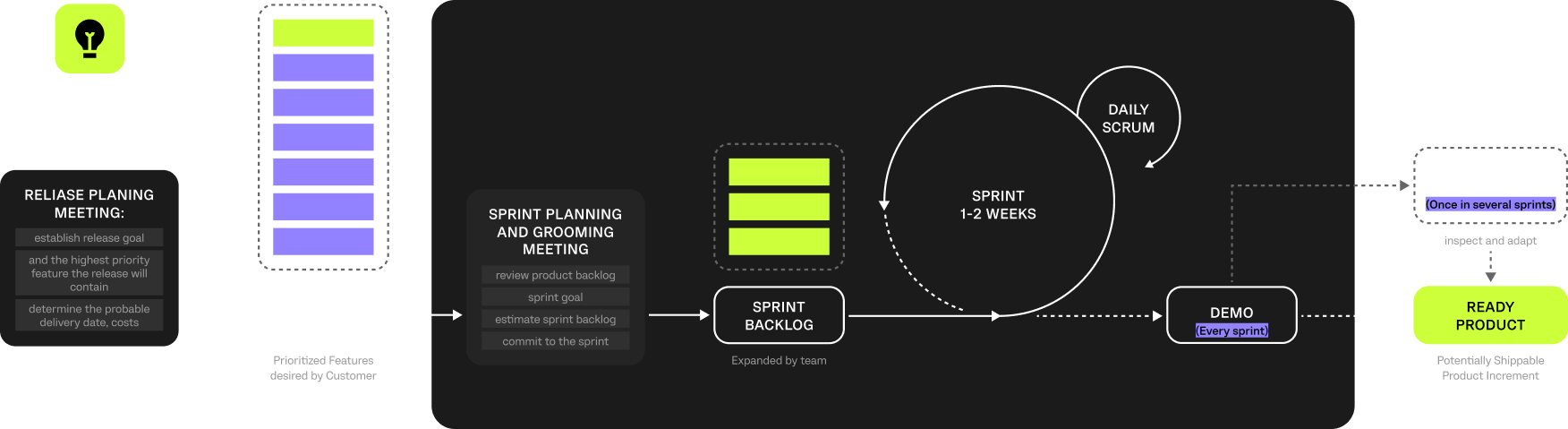
An Agile approach with Scrum supported the phased delivery of SlotFlow Intelligence. Work was organized into short sprints covering warehouse workflow assessment, SAP EWM data mapping, facility-model design, slotting logic, route optimization, interface development, integration readiness, and operational validation.
Regular reviews with warehouse operations, fulfillment leadership, IT, and supply chain stakeholders helped verify data quality, recommendation accuracy, routing logic, operational fit, and rollout readiness before each major release.
Our WMS was doing its job, but our slotting logic was falling behind demand. Products moved through the business faster than our manual reviews could keep up. SlotFlow Intelligence gave us a practical way to see where walking time was being lost, which moves were worth making, and how to improve throughput without replacing SAP EWM or adding more space.




Computools | 341 Raven Cir, Camden Wyoming, Delaware 19934, US