
THE AUTHOR:

A shopper opens three product pages, compares prices, and selects a size. Each action gives the retailer information about what that customer needs. Businesses planning to build eCommerce personalization platform capabilities need an architecture that converts these signals into relevant suggestions, checks product availability, and delivers the results within the time available for a shopping decision.
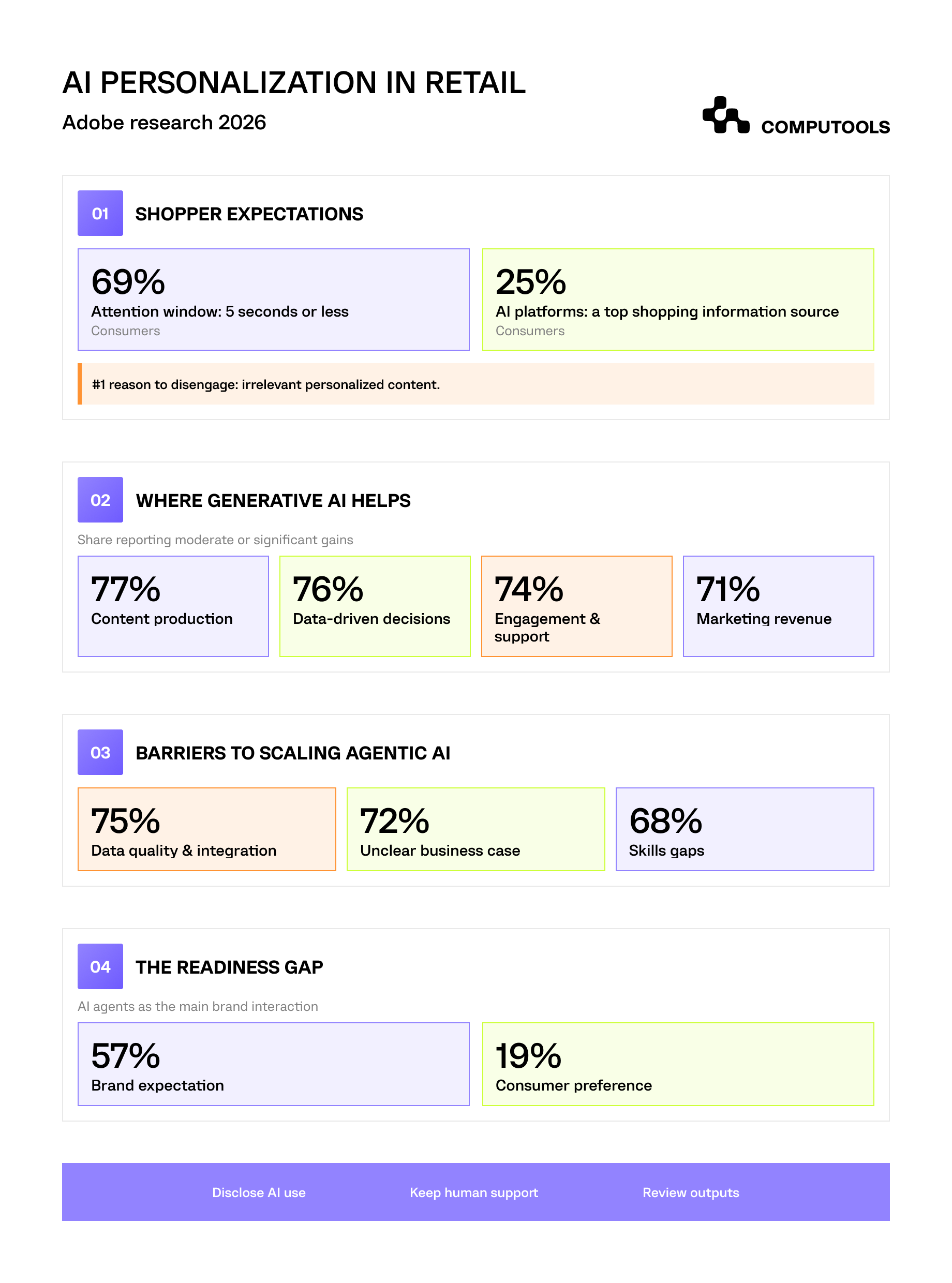
The commercial opportunity starts with product discovery. Salesforce’s Connected Shoppers research found that 39% of consumers use AI to discover products. Relevance determines whether those suggestions earn attention.
According to Adobe’s AI and Digital Trends research for retail and consumer goods, personalized content that feels irrelevant or “off” is the leading reason consumers would stop interacting with a brand. For a retailer, this means recommendations must reflect the shopper’s current intent and practical requirements, such as size, compatibility, and price range.This raises a practical question: how well does their own storefront help customers find suitable items?
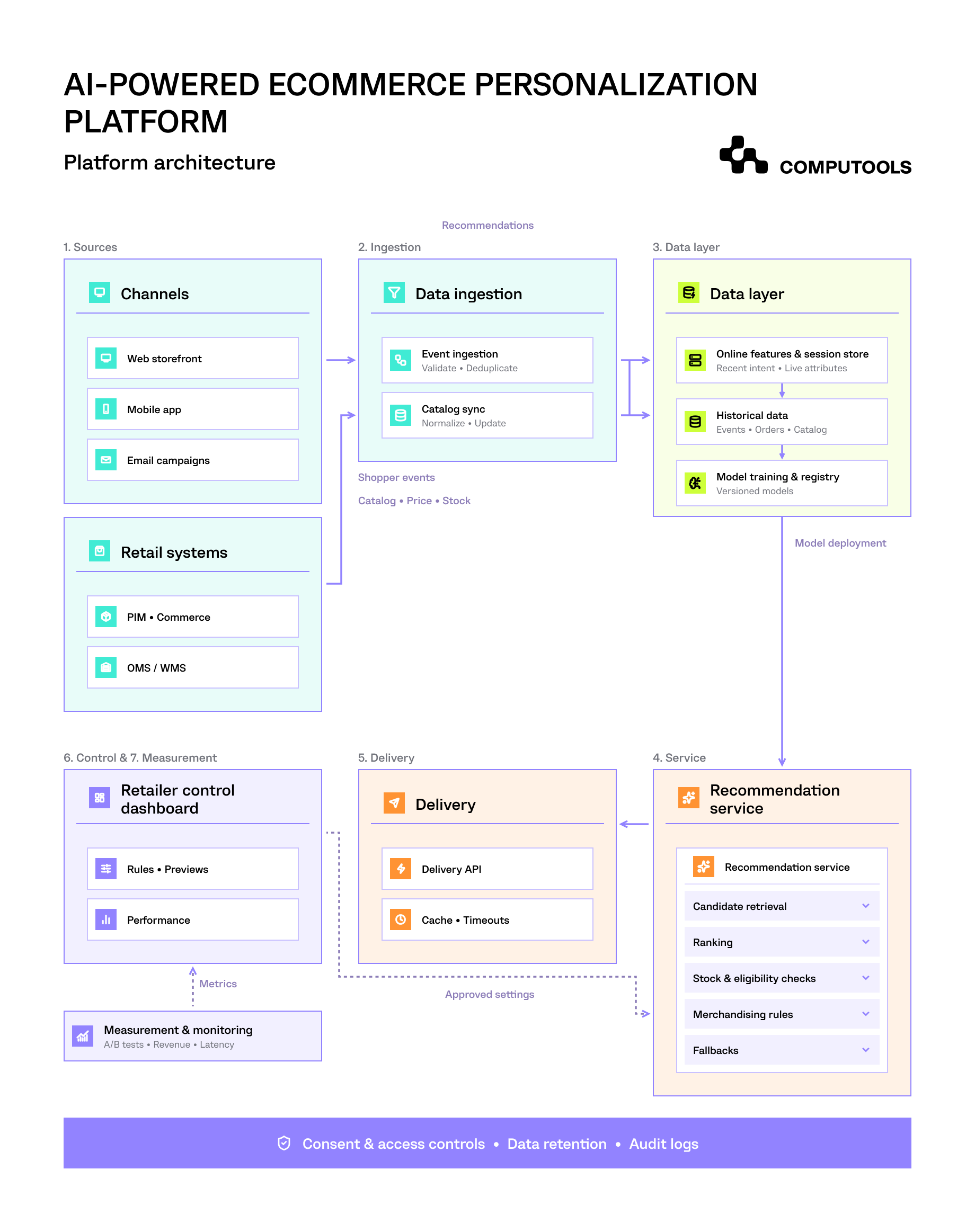
AI personalization requires connected event pipelines, recommendation models, and storefront APIs. It also needs an operating interface through which merchandisers manage campaigns, analysts evaluate performance, and engineers investigate failures. For retailers pursuing broader AI transformation services help align these technologies with merchandising workflows, team responsibilities, and measurable business outcomes.
These requirements shaped the Persentra AI project, an Australia-based company whose privacy-first technology adapts product discovery using anonymous shopper interaction signals.
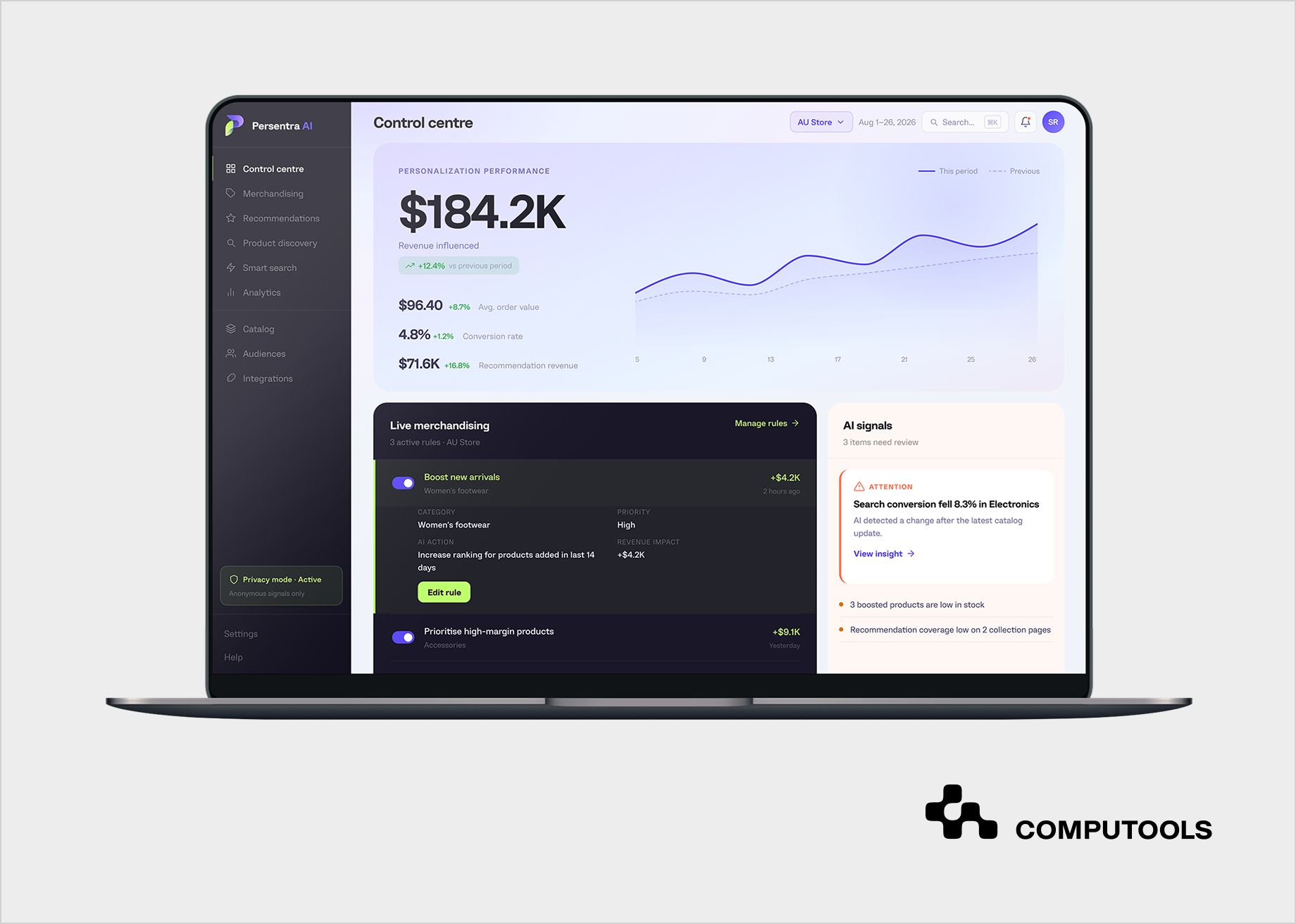
Computools developed the React and TypeScript frontend for its Systema Control Centre, connecting the existing AI backend with merchandising rules, recommendation carousels, smart search settings, targeted product feeds, and performance dashboards. Retailers gained a single workspace for managing discovery and reviewing commercial results. The case reports 25% higher average order value, 18% higher conversion, and 50% faster rule updates.
AI-powered eCommerce personalization therefore involves both recommendation quality and day-to-day operation. The following development steps explain how to connect shopper data, ranking logic, storefront delivery, and retailer controls into a platform that supports measurable commercial decisions.
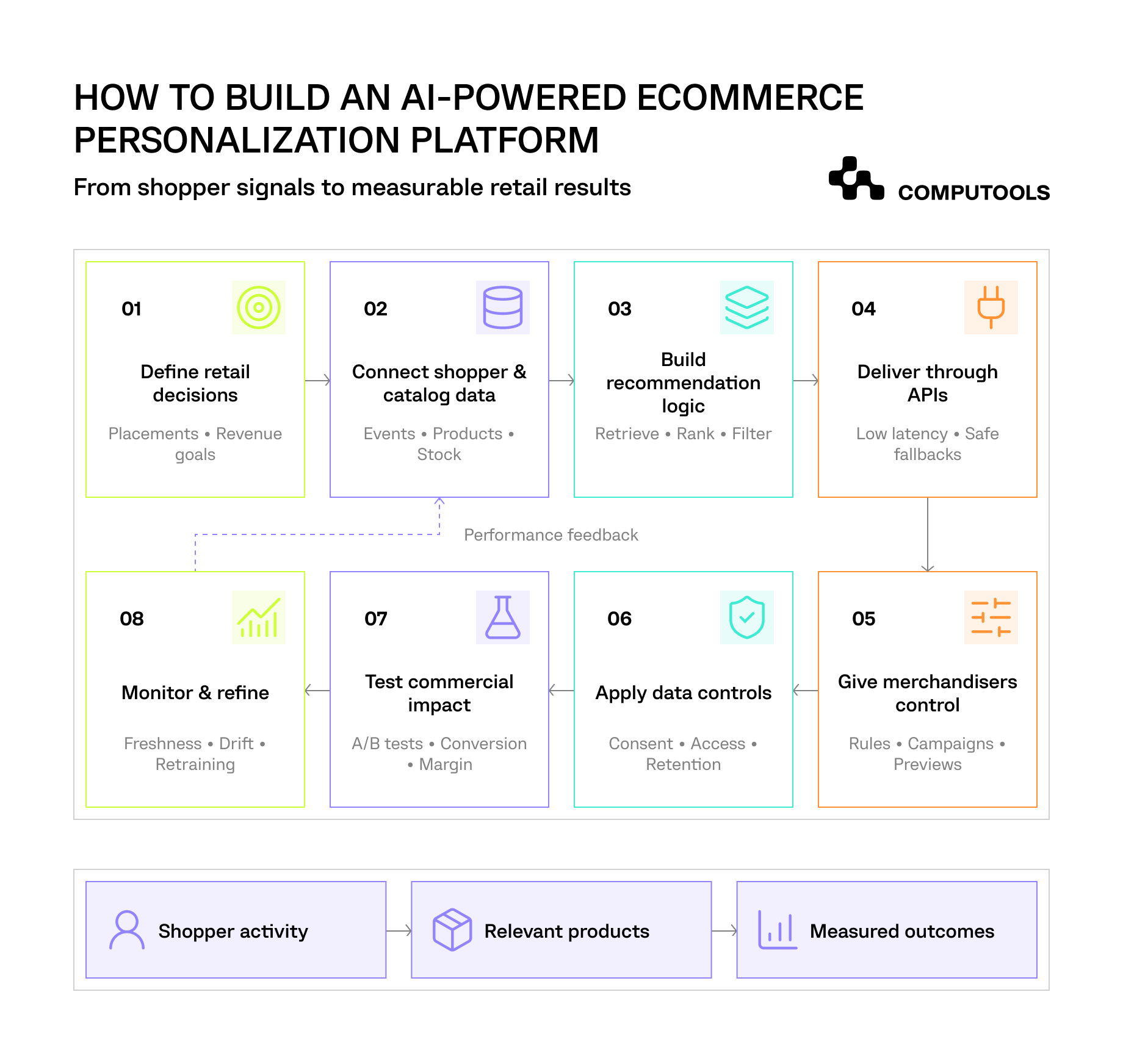
Build eCommerce personalization platform capabilities around specific retail decisions
To build an eCommerce personalization platform, begin by choosing which shopping decision it will support.
A retailer with extensive browsing and few basket additions may need better category ranking. A store with strong conversion and small orders may benefit from complementary products. For replenishable goods, purchase intervals provide a starting point for reorder suggestions.
For Persentra AI, discovery focused on retailer actions: configuring merchandising rules, adjusting recommendations, and reviewing performance. Use similarly specific workflows to define dashboard requirements and acceptance criteria. Before designing eCommerce personalization software, define the placement, available signals, recommendation logic, and commercial measure.
| Placement | Data required | Recommendation approach | Primary measure |
| Product detail page | Current product, attributes, session activity | Similar products or compatible complements | Purchase conversion and attachment rate |
| Category page | Category, filters, browsing history, availability | Personalized ranking of eligible products | Revenue per category visitor |
| Basket | Basket contents, compatibility, stock, price | Complementary product selection | Contribution margin per order |
| Homepage | Session context, recent activity, campaign rules | Mixed personalized and discovery candidates | Revenue per visitor |
| Reorder area | Purchase history, quantities, purchase intervals | Replenishment scoring | Repeat purchase rate |
Define technical acceptance criteria alongside these measures. The team needs to know how fresh stock data must be, which devices the placement supports, and what happens when the recommendation service times out.
Customer segmentation and targeting should use attributes that change an operational decision. A segment such as “visitors comparing running shoes within a particular price range” gives the ranking service useful context.
Specify how segment membership updates. A customer who changes category or price filters should move into the appropriate session context. Historical preferences can remain available as additional signals.
Assign an owner to the first use case and establish a baseline. This gives engineering a bounded implementation scope and gives the commercial team a result it can assess.
Develop an event pipeline that preserves shopping context
For customer behavior analysis for eCommerce, establish a shared event schema across the website, mobile application, and relevant backend systems.
A browser event collector captures product views, searches, filter changes, recommendation impressions, and clicks. Backend integrations supply confirmed purchases, cancellations, and returns. Server-confirmed transactions help keep revenue measurement consistent when browser tracking is interrupted.
A useful event record includes:
| Field | Technical purpose |
| event_id | Identifies duplicate events received through retries. |
| event_type | Distinguishes a view, impression, click, basket addition, or purchase. |
| occurred_at | Records when the action happened. |
| received_at | Measures ingestion delay. |
| session_id | Connects actions within an anonymous shopping session |
| customer_id | Associates permitted activity with an authenticated account. |
| product_id and variant_id | Links interest to a product and its purchasable variant. |
| placement_id and request_id | Connects an action to the recommendation response that produced it. |
| schema_version | Supports controlled changes to event definitions. |
Send events through an ingestion API into a durable message stream or queue. Separate consumers can update session features, populate analytics storage, and prepare training datasets.
Design for retries and duplicate delivery. Deduplicate using the event identifier, preserve event timestamps, and define how late events affect session aggregates. A delayed product view should enter historical analysis without automatically replacing a more recent indication of interest.
Validate events before they reach downstream systems. Invalid product identifiers, missing timestamps, and malformed payloads should enter a quarantine stream with an assigned owner.
Record the products actually displayed, their positions, and the model or rule version responsible. This allows analysts to distinguish weak product relevance from limited exposure or poor placement visibility.
Create a product and feature layer for both training and serving
Behavioral events become useful when they connect to consistent catalog information.
Maintain stable identifiers across the product information management system, storefront, order management system, and warehouse feeds. Distinguish a product family from its variants: a shopper may like a jacket, but only one size and color combination is available.
Define authoritative sources for descriptive attributes, prices, stock, compatibility, and market eligibility. Use change events or scheduled synchronization according to each field’s freshness requirement.
Computools’ guide to real-time product catalog synchronization provides additional reading on coordinating these updates across retail systems.
The recommendation layer then needs derived features. Examples include a visitor’s recent category views, preferred price range, products currently in the basket, item popularity within a market, and time since a previous purchase.
Separate historical computation from online access:
- Historical storage supports training, evaluation, and reproducible analytics.
- An online feature store or low-latency key-value database supplies the current values needed during a recommendation request.
A dedicated feature-store product is optional. A focused implementation may use versioned transformations, historical tables, and a serving database, provided the team maintains consistent feature definitions.
Keep training and serving calculations aligned. If training uses a seven-day popularity window, the online service should calculate that feature using the same definition.
Build historical training examples using the information available at the time of the shopping decision. This prevents future purchases or later catalog updates from leaking into model evaluation.
The article on marketplace data-platform costs offers broader context on the ingestion, governance, and storage work behind these decisions.
Separate candidate retrieval, ranking, and commercial rules
An AI personalization engine for eCommerce should narrow the assortment before applying more expensive scoring.
To build an eCommerce personalization platform, Google’s recommendation-system guidance describes a common architecture with candidate generation, scoring, and re-ranking. Each stage handles a different part of the selection process.
For a retail implementation, these stages might work as follows:
| Stage | Proposed implementation | Retail purpose |
| Candidate retrieval | Combine similar products, co-purchase relationships, category bestsellers, and session matches. | Produce a manageable pool of plausible suggestions. |
| Ranking | Score candidates using product, shopper, and session features. | Order products according to the placement’s objective. |
| Eligibility and re-ranking | Apply stock, compatibility, market, campaign, and diversity rules. | Return a usable selection aligned with retail constraints. |
A personalized product recommendation system may use several candidate sources. Collaborative filtering learns relationships from interaction histories. Content-based retrieval uses attributes such as category, material, brand, and price. Session models emphasize recent actions.
For larger assortments, embeddings represent products and shopping context as numerical vectors. Approximate nearest-neighbor search retrieves products close to the shopper’s current interests without scoring the entire catalog individually.
Embedding similarity still needs product eligibility checks. Two accessories may look semantically similar yet support different devices.
A ranking model then evaluates the candidate pool using richer features. A gradient-boosted model is a practical option for structured retail data; more complex neural models become relevant when the data and evaluation results justify them.
For eCommerce recommendation engine development, establish a simple baseline first. Curated complements, available category bestsellers, and basic product similarity provide reference performance.
Handle new visitors and products explicitly. New visitors may receive contextual or category-level suggestions. Newly introduced products can enter retrieval through their attributes and controlled exploration, allowing the platform to collect interaction evidence.
Generative AI has a separate role. It may interpret a shopping request such as “a waterproof jacket for cycling under €150,” but the resulting intent should feed a catalog-backed retrieval service. Product identifiers, availability, and prices should come from authoritative systems.
Design the serving API around latency and failure recovery
Real-time eCommerce personalization requires both fast responses and timely updates to the shopper’s context. The Persentra AI dashboard had to display recommendation activity, shopper behavior patterns, and commercial performance through frequently updated, interactive views. Computools team used React and TypeScript to build the frontend and integrated it with the personalization backend through APIs.
A recommendation request typically includes the placement, session or customer identifier, current product, basket contents, market, and requested result count. The backend retrieves features, generates candidates, applies ranking and rules, and returns the selected product identifiers.
A proposed API response should also include a request identifier, model version, rule version, experiment assignment, and fallback status. These fields support troubleshooting and attribution.
Establish a latency budget for every stage. An illustrative engineering target might be 200 milliseconds at the 95th percentile for the recommendation API. This is a proposed target to validate against the software architecture and traffic profile, rather than an industry guarantee.
For real-time product recommendations, monitor the slower end of the response distribution as well as the average. High response times during a campaign may affect a substantial number of shoppers even when average latency appears acceptable.
Cache computations according to their sensitivity:
- Product-to-product similarity lists are candidates for shared caching.
- Customer or session results require correctly scoped cache keys.
- Price, stock, and market eligibility require freshness controls appropriate to the retail workflow.
Include market, placement, model version, and relevant context in cache keys. Invalidate affected entries when catalog eligibility or merchandising rules change.
Set strict request timeouts. If ranking fails, return approved fallback candidates and record the reason. Load the recommendation component independently so the product page remains usable.
Keep session updates separate from model retraining. AWS documents that supported approaches incorporate recent interaction events before the next training cycle, but new-item and bulk-data behavior varies by use case. These are separate update mechanisms with different freshness characteristics.
Inventory eligibility may need an additional check at serving time. AWS’s filter documentation, for example, specifies different update delays depending on the import method. The platform design should account for those delays when deciding where current stock checks belong.
Turn merchandising controls into versioned configuration
Personalized shopping experiences need an operating interface through which retail teams guide product visibility.
A rule should be a structured configuration with a defined scope: placement, market, category, audience condition, effective dates, priority, and permitted action.
For example, a collection-launch rule might boost eligible products in a specific category, reserve a limited share of recommendation positions for discovery, and expire after the campaign.
For AI merchandising automation, separate hard eligibility conditions from soft preferences. Compatibility and delivery restrictions determine which products qualify. Promotional boosts change ordering within the eligible selection.
Apply inexpensive eligibility filters early, then revalidate changeable constraints before returning the response. This reduces wasted scoring and helps account for updates received during processing.
Provide a preview using representative shopping contexts. Merchandisers should see whether overlapping rules leave too few eligible products, concentrate exposure on one brand, or create unexpected results.
Publish configurations through versioned releases. Store the approver, activation time, changed fields, and previous version. A rollback should restore a known configuration without requiring a software deployment.
Permissions should reflect commercial responsibility. A category manager may edit product priorities; a regional owner may approve market-specific campaigns.
Where recommendation blocks share space with banners and editorial collections, the guide to enterprise eCommerce CMS architecture provides additional context on coordinating content and commerce systems.

Launch an AI-powered eCommerce personalization platform within 1–3 months, turn customer behavior into real-time product and offer recommendations, increase conversion and average order value, and grow revenue without adding manual merchandising work.
Test model quality, commercial impact, and operating reliability
Offline evaluation should use a time-based split. Train on earlier interactions and evaluate against later activity, preserving the information available at each decision point.
Useful measures include:
| Measure | What it reveals |
| Recall@K | Whether relevant items appear within the selected result set. |
| NDCG@K | Whether relevant items receive higher positions. |
| Catalog coverage | How widely recommendations distribute exposure across eligible products. |
| Recommendation diversity | Whether the selection offers meaningful alternatives. |
| Eligibility violation rate | Whether returned products breach stock, compatibility, or market rules. |
Offline results help select models for testing. Commercial impact requires an online experiment.
Assign customers or sessions consistently to experiment groups, and log assignments with the recommendation response. Choose the primary measure before launch, estimate the traffic required, and account for promotions and seasonal changes.
Track revenue or contribution margin per visitor, alongside conversion, returns, and fulfillment cost. Click-through rate helps explain behavior, but a model optimized for clicks may favor products that attract attention without producing profitable purchases.
Checkout measurement remains separate. A customer may find a suitable product and leave because of payment failure or delivery cost. The article on payment data eCommerce teams should track helps distinguish these issues.
Production monitoring should cover event ingestion delay, feature freshness, API latency, empty responses, fallback usage, and product exposure. Record model and configuration versions so changes can be traced.
Maintain a model registry containing the training period, dataset version, feature definitions, evaluation results, and approval status. Test new versions against current production performance and retain a known working version for rollback.
Retraining schedules should follow observed behavior. A seasonal fashion catalog may require more frequent refreshes than a stable specialist-parts assortment. Monitor category-level performance and changes in feature distributions to identify when the model needs attention.
Implement data controls across the full pipeline
Each use case should have a documented data requirement.
Session-based suggestions may use current browsing activity and catalog attributes. Replenishment recommendations may require an authenticated purchase history. Keep these dependencies explicit.
Separate account identity from recommendation features where practical. Use pseudonymous identifiers in event and serving systems, with controlled access to any identity mapping.
Carry preference changes through collection and downstream use. Removal workflows should address historical storage, serving databases, caches, and future training datasets, according to the platform’s defined retention and removal policies.
Treat identifiers as sensitive even when direct contact details are absent. Session histories and shopping patterns may still relate to an individual.
Test the full lifecycle: expired sessions, account changes, revoked access, preference updates, and removal requests. Restrict administrative APIs, isolate merchant data in multi-tenant deployments, and audit rule changes and exports.
The acceptance criteria should describe the expected system behavior in each situation.
Computools gives retail teams more control over recommendations and revenue
A personalization platform earns its place in the retail stack when shoppers find suitable products and merchandisers act on demand with fewer engineering requests. Computools connects recommendation logic with the systems and controls needed to achieve both.
Our retail software development services address the surrounding inventory, order, and merchandising workflows. eCommerce software development supports integration with storefronts and commerce platforms. Recommendations reflect product availability, compatibility, and market restrictions, helping customers move from discovery to purchase.
Web development services cover shopper components and retailer controls. AI development helps teams select and evaluate models against conversion, order value, and contribution margin. Data engineering establishes the event pipelines, catalog synchronization, and feature preparation required for dependable recommendations.
Delivery starts with one commercially relevant placement and a measured baseline. This gives decision-makers evidence for further investment, identifies integration issues early, and keeps expansion aligned with the retailer’s operating capacity.
Make personalization manageable for retail teams
The Persentra AI case illustrates the importance of the retailer control interface. The client already had personalization technology. Our team developed the React and TypeScript frontend for the Systema Control Centre and connected it to the existing backend. Merchandisers gained controls for recommendation carousels, smart search, targeted product feeds, and product visibility across campaigns and categories.
Performance views brought recommendation activity, conversion signals, and revenue contribution into the same workspace. Teams could adjust discovery settings and review their commercial impact as part of daily operations.
| Reported project outcome | Result |
| Average order value | +25% |
| Conversion rate | +18% |
| Rule updates | 50% faster |
| Engineering requests | 40% fewer |
| Analytics review time | 35% lower |
The case shows faster campaign adjustments, fewer requests for technical support, and clearer visibility into sales performance.
Computools
Software Solutions
Computools is an IT consulting and software development company that delivers innovative solutions to help businesses unlock tomorrow.