Claimsure Nexus

How Claimsure Nexus reduced manual claim preparation by 26% and accelerated claim routing by 35%.

case image

AT A GLANCE

The client is a mid-sized German P&C insurer handling auto, property, and liability claims across several regional markets. Claimsure Nexus provided centralized FNOL software that brought submissions, documents, and case preparation into a single workflow.

The insurance claims intake software combined document classification, structured data capture, completeness checks, triage, routing, role-based dashboards, and system integrations. Claims teams gained a clearer path from initial notice to an adjuster-ready file.

Across selected workflows, manual effort decreased by 26%, claim file preparation time by 32%, and claim routing time by 35%.

THE CLIENT

The client is a mid-sized Property & Casualty insurer operating across several regional markets in Germany. It manages auto, property, and liability claims and works with policyholders, agents, adjusters, repair partners, and back-office claims teams.

Claims operations involve multiple roles and systems before a case reaches formal review. Its claims handling software operated alongside policy, CRM, document management, and communication systems that supported different stages of the claims lifecycle.

Accurate case information, clear ownership, and consistent handoffs are therefore essential to keeping claims moving across operational teams.

BUSINESS CHALLENGE

Claims intake was fragmented across email, portals, uploaded documents, and legacy claims tools. Adjusters spent significant time preparing files before substantive review, while managers lacked a consistent view of case readiness, workload distribution, and operational bottlenecks.

  • Fragmented intake. Claim information entered through multiple channels and required manual consolidation.
  • Incomplete submissions. Missing documents and required fields slowed case preparation and created repeated follow-up work.
  • Manual file preparation. Adjusters spent time collecting and organizing information before reviewing the claim itself.
  • Uneven routing. Claim type, complexity, urgency, and adjuster expertise were not consistently reflected in case assignment.
  • Limited operational visibility. Claims managers needed clearer insight into pending actions, queue status, workload, and case readiness.

The insurer needed claims intake automation to structure information before adjuster review, and insurance claims triage software to route cases based on claim type, complexity, urgency, and available expertise.

The scope also required insurance software development capable of connecting the new workflow with existing claims, policy, CRM, and document systems.

SOLUTION SUMMARY

The platform used insurance claims workflow automation to standardize the path from initial notice through case preparation and assignment. Structured rules supported missing-information checks, queue placement, and handoffs across claims teams.

A centralized claims document management workflow brought uploads, document classification, case history, and supporting files into the relevant claim record. OCR and AI extracted key information and flagged missing documents or required fields.

Document classification and structured data capture supported AI claims intake, helping prepare cases for triage while authorized insurance teams retained control over final claim decisions.

Role-based dashboards, workload visibility, action history, and status tracking supported insurance claims processing. Integrations with claims, policy, CRM, and document systems strengthened insurance claims management across the wider operating environment.

IMPACT

Claimsure Nexus reduced manual preparation work and improved claim readiness before cases reached adjusters:

  • Manual effort in selected FNOL and claim preparation workflows decreased by 26%.
  • Claim file preparation time decreased by 32%.
  • Incomplete claim files decreased by 28%.
  • Claim routing time decreased by 35%.

Role-based interfaces built through web development provided adjusters and operations teams with clearer visibility into case status, missing information, pending actions, and queue activity.

To keep claim information consistent across connected systems, the team used data engineering to align structured intake data with policy, CRM, claims, and document records. This improved the reliability of case preparation and operational reporting.

Document-heavy intake workflows also benefited from targeted AI development for classification, key data extraction, completeness checks, and triage preparation. Final claim decisions remained with authorized insurance teams.

Role-based access, action history, and document trails strengthened auditability and made it easier to trace claim progress from intake through routing.

WHY COMPUTOOLS

Claims intake touched multiple systems, user roles, document types, and operational decision points. Computools combined workflow analysis, integration design, document-processing logic, role-based UX, and insurance-domain requirements into a single delivery approach.

The team structured the platform around claim readiness, making completeness, ownership, queue status, and pending actions visible before the case reached an adjuster.

Integration planning kept the new intake workflow connected to the insurer’s existing claims, policy, CRM, and document systems. This gave operations teams a clearer basis for expanding automation while maintaining traceability and human oversight.

Launch your software solution within 1-3 months instead of years. Unlock tomorrow. Build a future-ready business through innovation.

STORY IN DEPTH

Background

The insurer received claim information through several channels, including email, portals, uploaded files, and existing claims tools. Information could arrive in various formats and at varying levels of completeness.

Adjusters spent part of their time collecting documents, checking required information, and preparing files before substantive claim review could begin. Operations managers also had limited visibility into which cases were complete, where work was accumulating, and which actions remained pending.

The modernization effort focused on creating a structured intake process that prepared claims consistently before they moved further into handling.

Approach to solution

Computools began by mapping intake, documentation, triage, and adjuster preparation workflows with business stakeholders. The team identified where information entered the process, which documents and fields were required, how cases were assigned, and where manual work accumulated.

A role-based workflow was then designed around a clear sequence: first notice, document intake, data extraction, completeness validation, triage, routing, queue placement, and status tracking.

Document classification and structured data capture reduced manual preparation. Completeness checks highlighted missing information before the case moved forward.

Routing logic used claim type, complexity, urgency, and adjuster expertise to direct cases to the appropriate queue.

REST-based integrations connected the platform with claims, policy, CRM, and document management systems. Dashboards and audit trails gave operational teams a consolidated view of case status, workload, and action history.

Computools role

Computools was responsible for:

  • mapping claims intake and preparation workflows;
  • defining user roles and operational responsibilities;
  • designing FNOL and document intake flows;
  • implementing document classification and structured data capture;
  • configuring missing-information and completeness checks;
  • defining triage and routing logic;
  • integrating claims, policy, CRM, and document systems;
  • creating role-based dashboards and claims queues;
  • implementing action history and audit trails;
  • supporting operational reporting and case-status visibility.

Key decisions and outcomes

Computools made case readiness a visible part of the workflow, allowing claims teams to confirm whether required documents and information were available before a file reached adjuster review. AI-supported classification, data extraction, completeness checks, and triage reduced manual preparation while final claim decisions remained with authorized insurance teams.

Routing logic was built around claim type, urgency, complexity, and adjuster expertise, making assignment more consistent across intake workflows. At the same time, integrations with claims, policy, CRM, and document management systems kept existing operational data connected to the new intake and preparation process.

DESIGN

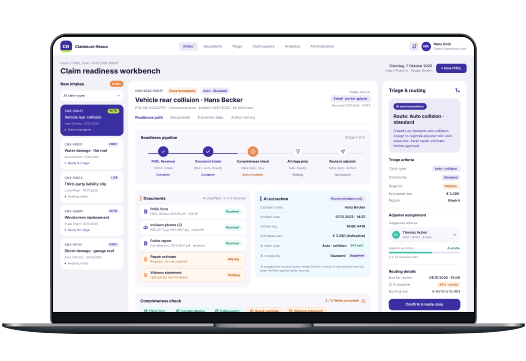
The design focused on helping claims teams understand case readiness, document status, workload, ownership, and pending actions from a single operational view.

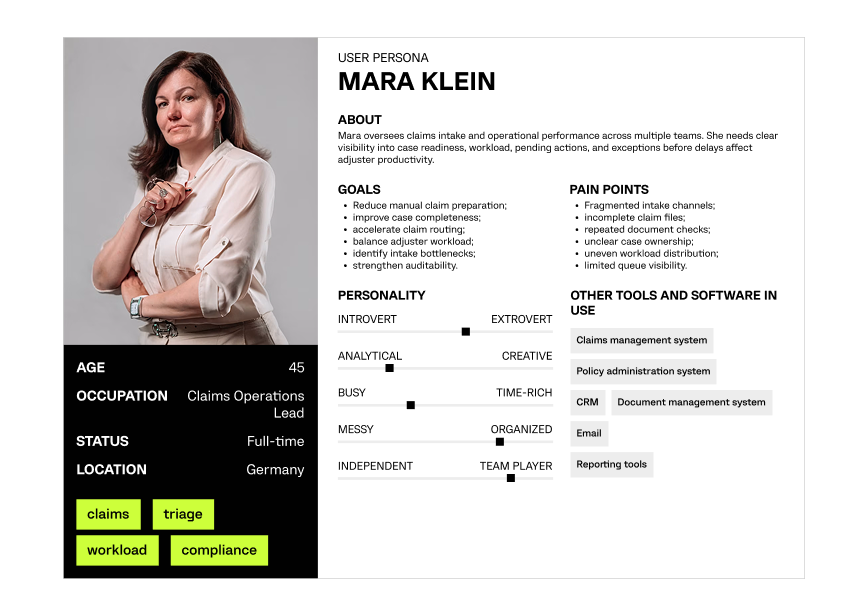
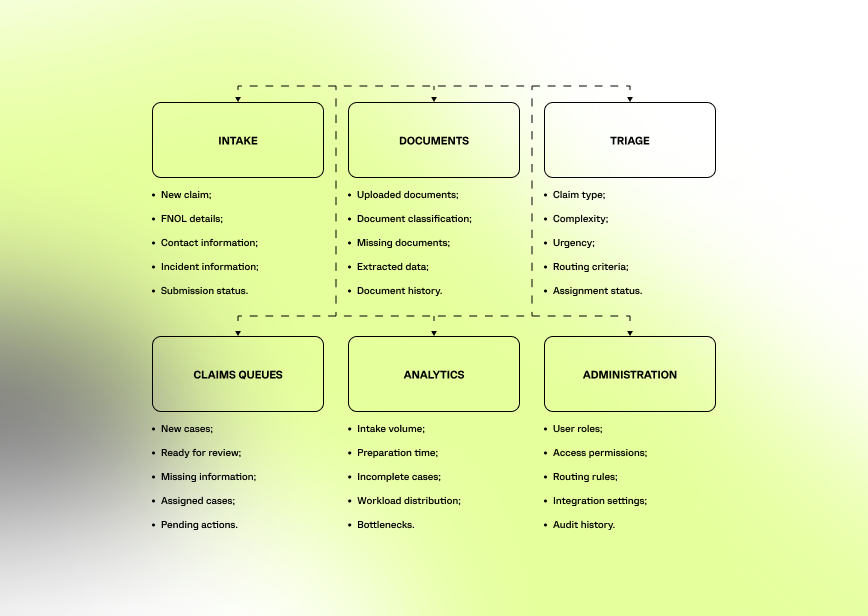
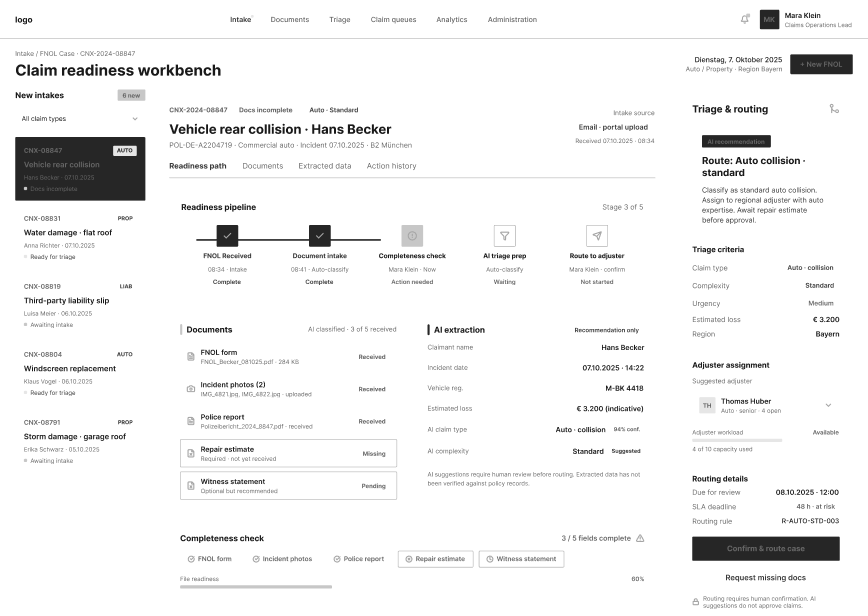
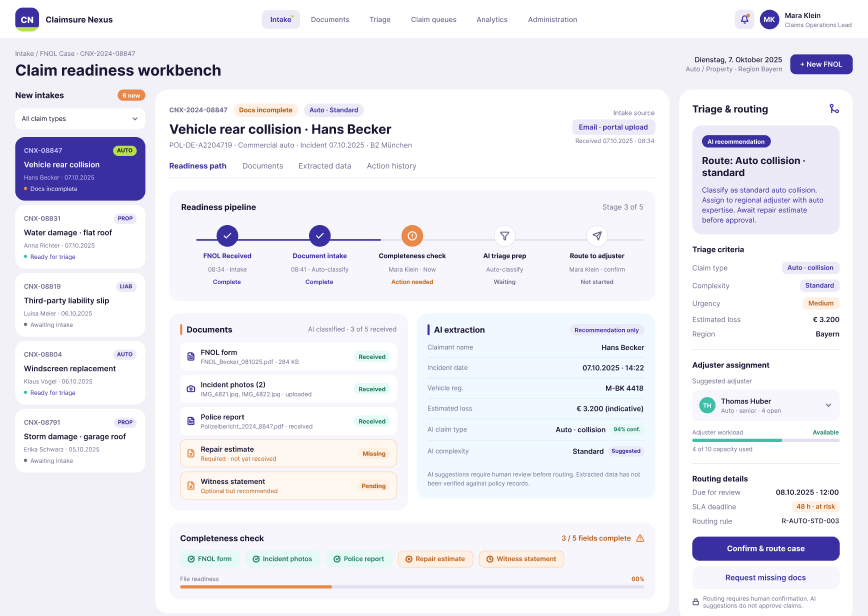
USER PERSONA → SITE MAP → WIREFRAMES → USER INTERFACE

USER PERSONA

Defining the needs of a claims operations leader responsible for intake quality, workload distribution, and case readiness.

SITE MAP

Organizing claims intake, documents, triage, queues, reporting, and administration around the case preparation workflow.

WIREFRAMES

Testing intake, document review, triage, routing, and claims queue interactions before interface development.

USER INTERFACE

Creating role-based views that make case readiness, workload, pending actions, and claim status easier to assess.

DIGITAL PLATFORM & TECHNOLOGY

Claimsure Nexus combined a TypeScript-based web stack with structured data storage, cloud infrastructure, document recognition, and REST-based integrations.

PROJECT MANAGEMENT METHODOLOGY

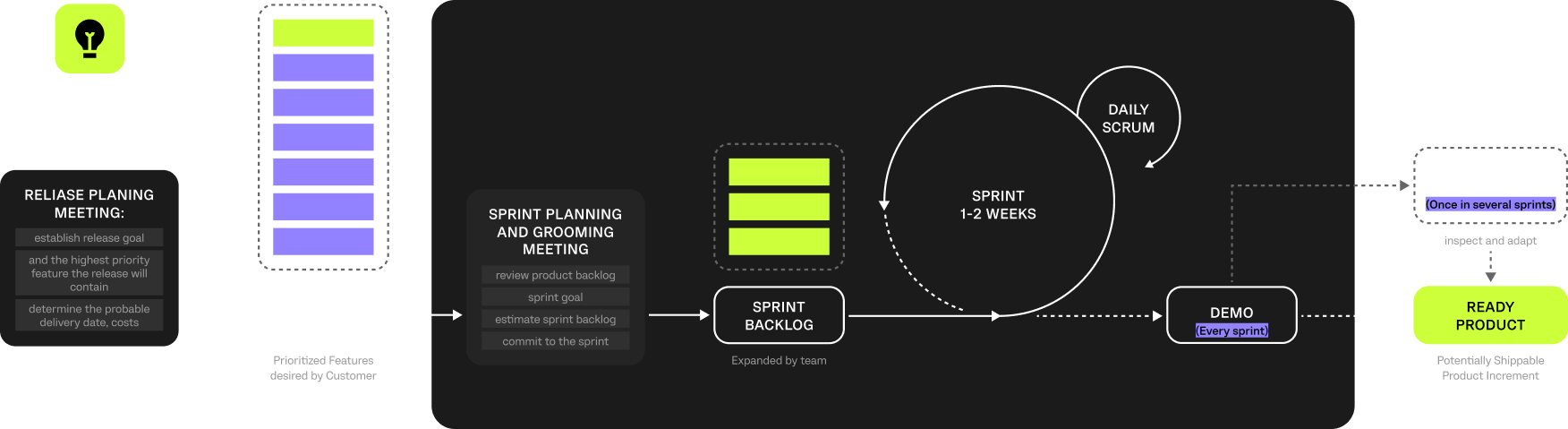
Computools used a Scrum-based delivery model with two-week iterations and regular validation by claims operations, product, compliance, and technical stakeholders. Each iteration focused on a defined part of the claims intake lifecycle, including document processing, completeness checks, triage, routing, integrations, or operational visibility. Workflow changes were reviewed against representative claim scenarios before proceeding to subsequent development.

AI-assisted functions were validated separately for document classification, data extraction, and case preparation, with human review remaining part of the claims process. Integration, access-control, and audit requirements were tested throughout development to reduce release risks across connected insurance systems.

PROJECT MANAGEMENT METHODOLOGY

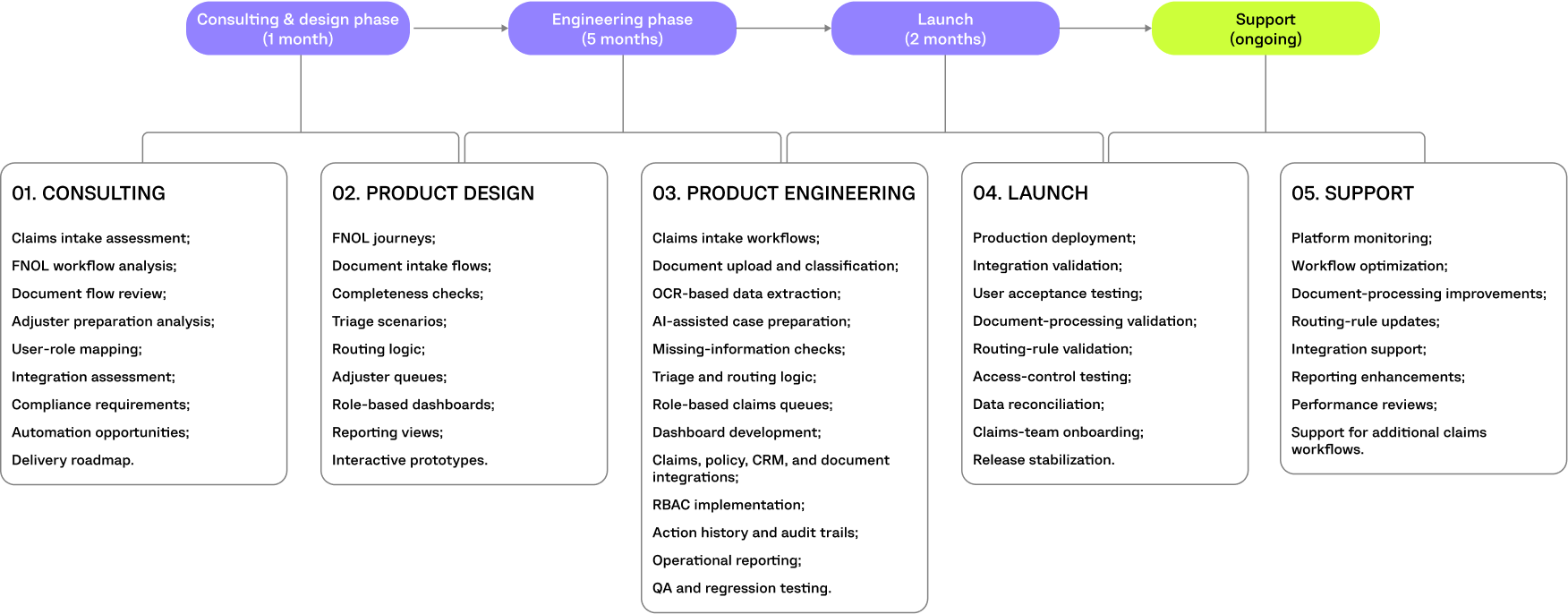
PROJECT TIMELINE

image

WHAT OUR CLIENT SAID

Our adjusters were spending too much time just getting claims ready for review. We had information coming in from different places, missing documents, and cases that did not always reach the right person quickly enough. Claimsure Nexus helped us bring that process together, and now complete cases move to the right adjusters much faster.

CONTACT US TO GET A COST-EFFECTIVE
PROJECT ESTIMATE

Thank you for your message!

Your request will be carefully researched by our experts. We will get in touch with you within one business day.

WHAT HAPPENS NEXT?

01.
We deeply analyse your request.
02.
We create project roadmap, accelerating your time-to-value.
03.
We co-scope features, minimizing project risk upfront.
04.
We submit a comprehensive project proposal.
Trusted by: