LogiConstructa

Structuring commissioning, QA, contractor, and handover data for logistics hub construction projects in Germany.

case image

AT A GLANCE

LogiConstructa is a web system delivered for a German engineering and construction company working on large-scale logistics hub and distribution center projects.

The client needed to improve commissioning control, QA evidence capture, contractor accountability, and handover readiness across complex construction environments. Existing tools were already in use, but critical project information remained spread across reports, Excel files, PDFs, messages, and individual managers’ knowledge.

Computools developed construction project management software that turned disconnected site information into structured operational records. The solution supported construction workflow automation, improved risk visibility, and included web development for mobile-first data capture, dashboards, readiness scoring, and integration with existing enterprise tools.

THE CLIENT

The client is a European engineering and construction company delivering large-scale logistics hubs and distribution center projects across multiple markets, including Germany.

Its project environments involve project managers, commissioning teams, QA/QC specialists, site supervisors, contractors, engineers, handover managers, and client-side stakeholders. Each group works with different documents, systems, reporting formats, and approval flows.

The company already used Microsoft 365, Copilot, project management tools, BMS, SCADA systems, construction documentation platforms, and operational reports. However, critical data about commissioning status, QA evidence, blockers, approvals, and contractor ownership was still difficult to consolidate.

For logistics hub construction management, the client needed a more structured digital foundation. The project became part of a broader digital transformation in construction, helping the company turn fragmented operational knowledge into a controlled data layer for faster decision-making.

BUSINESS CHALLENGE

The client needed to improve control over commissioning, QA evidence, contractor accountability, and handover readiness across logistics hub construction projects.

Critical operational knowledge was spread across project managers, site teams, contractors, PDFs, Excel files, messages, weekly reports, and disconnected systems. Commissioning dependencies, open blockers, QA evidence chains, supervisor approvals, and contractor ownership were not captured in a structured format.

This limited real-time visibility and slowed decision-making. By the time risks appeared in weekly reports, many issues had already affected commissioning, Factory Acceptance Testing preparation, or handover timelines.

The client needed a construction operations management platform that could capture site activity, approvals, blockers, QA records, and readiness data in a structured operational format. Computools provided construction software development services to help the company transition from fragmented project reporting to a more controlled, measurable operational system.

SOLUTION SUMMARY

Computools developed LogiConstructa, a structured operational data layer for logistics hub construction workflows. The platform captured commissioning status, QA sign-offs, contractor actions, supervisor approvals, blocker ownership, and handover readiness as structured operational records. This gave project and commissioning teams a clearer view of risks, dependencies, responsibilities, and readiness gaps.

The solution worked as commissioning management software for tracking commissioning progress, equipment readiness, blockers, and approval dependencies. It also supported QA/QC workflow automation by structuring evidence chains, sign-offs, and supervisor approvals directly inside operational workflows.

Computools also improved construction data management by integrating site workflows, project tools, BMS, SCADA, construction documentation systems, reporting environments, and Microsoft 365 into a single coordinated operational view.

IMPACT

The system helped the client reduce documentation overhead, improve program control, and identify commissioning and handover risks earlier.

Reported project impact:

  • up to 40% less commissioning documentation overhead;
  • 3–6 weeks earlier visibility of commissioning and handover risks;
  • fewer FAT surprises caused by missing QA evidence, incomplete equipment readiness data, or untracked blockers;
  • faster issue escalation;
  • clearer real-time readiness visibility;
  • up to 10x more usable operational data available for Microsoft 365 and Copilot workflows.

The solution improved handover readiness management by making readiness status, evidence gaps, blockers, and approvals visible earlier. It also strengthened contractor performance tracking by linking actions, responsibilities, deadlines, and issue ownership to structured operational records.

WHY COMPUTOOLS

Computools was selected because the client needed a technology partner capable of connecting construction operations, structured data design, enterprise integrations, dashboard logic, mobile-first workflows, and Microsoft ecosystem readiness.

The project needed more than a reporting tool. Computools studied how commissioning managers, QA/QC teams, site supervisors, contractors, engineers, and stakeholders work in large construction sites. The team built the platform around real site workflows, not just dashboards. This reduced risks, improved visibility, and built a solid data foundation for AI analysis using Microsoft tools.

Launch your software solution within 1-3 months instead of years. Unlock tomorrow. Build a future-ready business through innovation.

STORY IN DEPTH

Background

The client managed large-scale logistics hub and distribution center construction projects across complex multi-stakeholder environments.

Each project involved commissioning teams, QA/QC specialists, project managers, site supervisors, contractors, engineers, and client-side stakeholders. These teams depended on many tools and documents, including Microsoft 365, project management systems, BMS, SCADA, construction documentation systems, Excel files, PDFs, messages, and operational reports.

The company already had digital tools in place, but critical operational knowledge was still fragmented. Commissioning status, QA evidence, blockers, contractor actions, supervisor approvals, and handover readiness were not always available as structured records.

This created delays in visibility. Risks often became clear only when they reached weekly reports, which was too late for teams preparing for commissioning milestones, Factory Acceptance Testing, or project handover.

Approach to solution

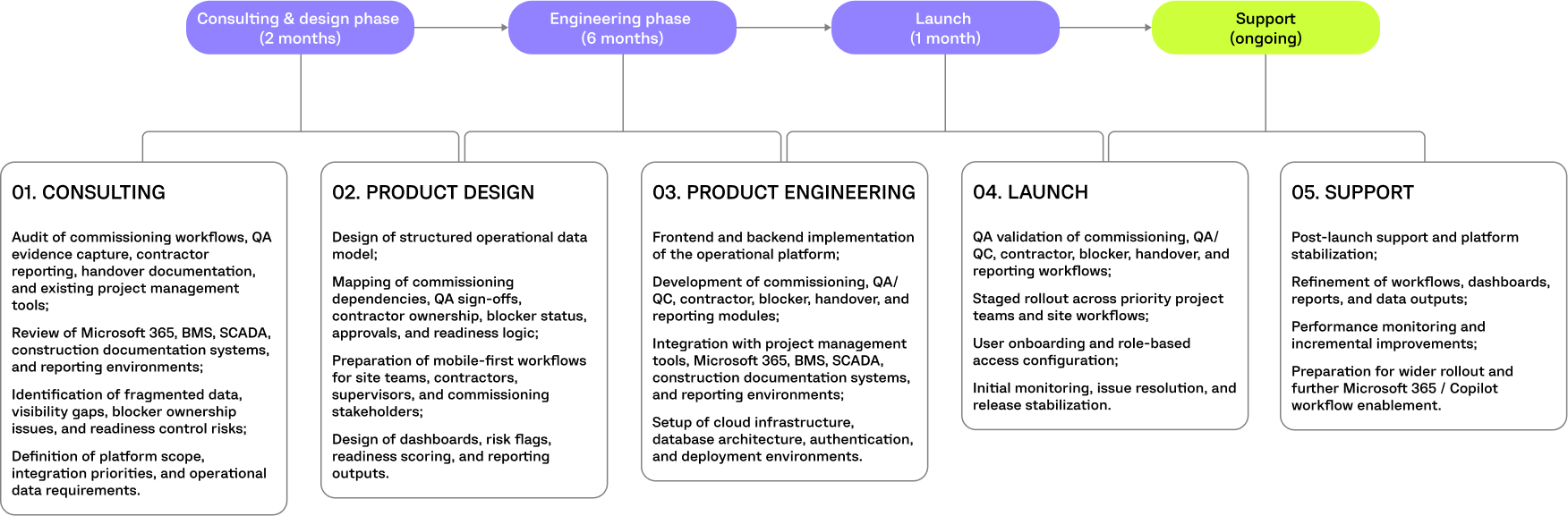
Computools started by auditing commissioning workflows, QA evidence capture, contractor reporting, handover documentation, and existing project management tools.

The team mapped how commissioning dependencies were tracked, how QA evidence was collected, how contractor actions were reported, how supervisors approved site progress, and how handover readiness was assessed.

Based on this analysis, Computools designed a structured operational data model. It covered commissioning dependencies, QA sign-offs, contractor ownership, blocker status, supervisor approvals, and readiness scoring.

The solution was designed as a mobile-first system so site teams, contractors, supervisors, and commissioning stakeholders could capture structured data directly from the field.

Computools then connected the platform with the client’s project management tools, Microsoft 365, BMS, SCADA, documentation systems, and reporting environments.

Computools role

Computools was responsible for:

  • auditing commissioning, QA/QC, contractor, handover, and reporting workflows;
  • defining the structured operational data model;
  • designing user roles and access permissions;
  • building mobile-first data capture workflows;
  • implementing dashboards, risk flags, and readiness scoring;
  • connecting project tools, Microsoft 365, BMS, SCADA, documentation systems, and reporting environments;
  • preparing structured data outputs for Microsoft 365 and Copilot workflows;
  • testing user scenarios across site, commissioning, QA/QC, and management roles;
  • supporting launch and post-launch stabilization.

Key decisions and outcomes

The platform was built around structured operational records. This allowed the client to capture commissioning status, QA sign-offs, blockers, approvals, contractor actions, and readiness indicators in a format that could be tracked, filtered, and analyzed.

Mobile-first workflows were prioritized because many key updates came directly from site teams, supervisors, contractors, and commissioning stakeholders.

Another key decision was to connect the platform to the client’s existing systems rather than replace them. This allowed Microsoft 365, Copilot, project management tools, BMS, SCADA, documentation systems, and reporting environments to work with cleaner operational data.

As a result, project and commissioning teams received earlier visibility into risks, clearer contractor accountability, and better control over handover readiness.

Design

The design process focused on making complex site, QA, commissioning, contractor, and handover workflows clear for construction teams working under time pressure.

USER PERSONA → SITE MAP → WIREFRAMES → USER INTERFACE

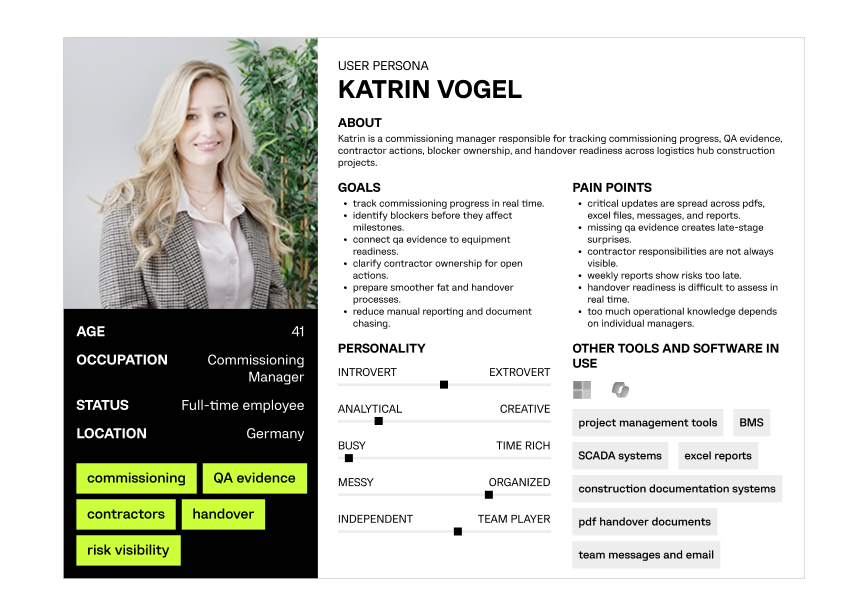
USER PERSONA

A core user profile created to guide commissioning, QA evidence, contractor accountability, and handover readiness workflows.

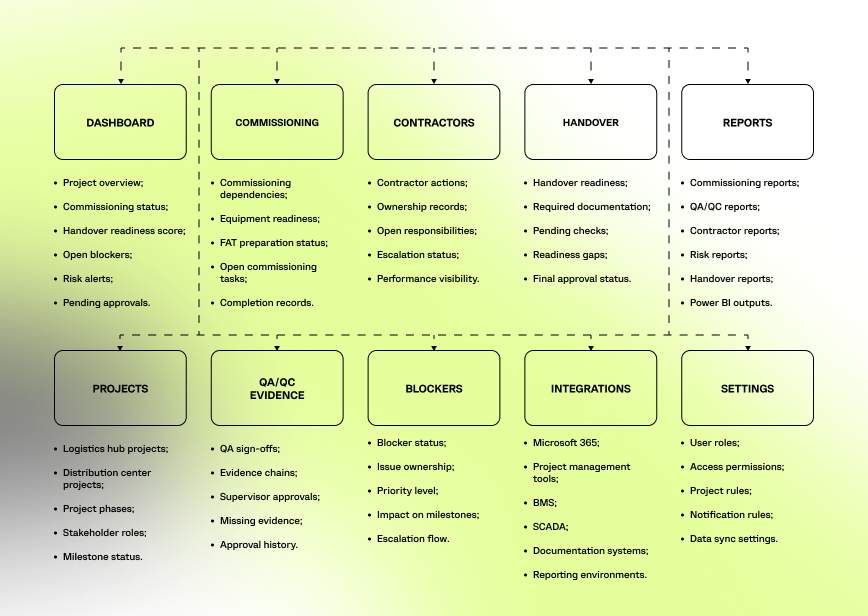
SITE MAP

A structured platform map designed to simplify navigation across commissioning status, QA evidence, contractor actions, blockers, handover readiness, integrations, and reports.

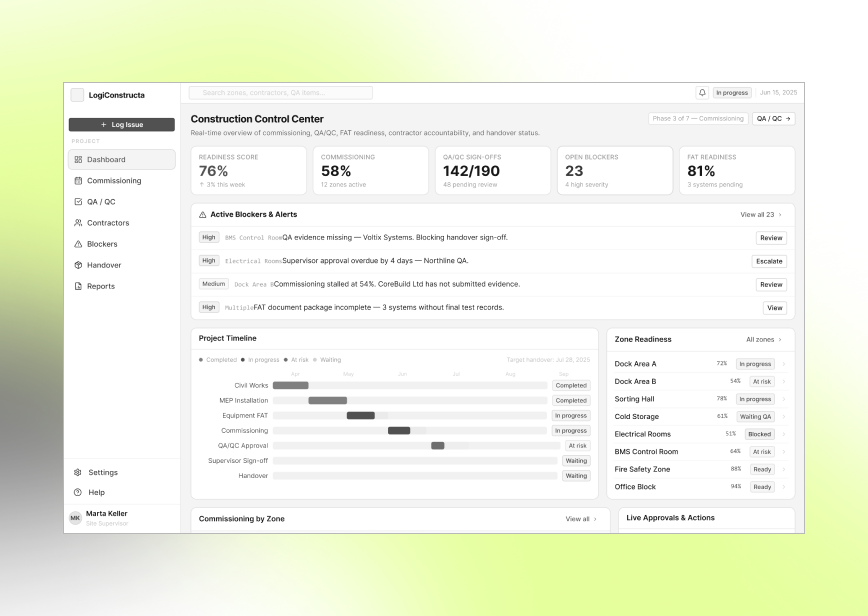
WIREFRAMES

Low-fidelity wireframes were created to validate the main operational workflows before interface development.

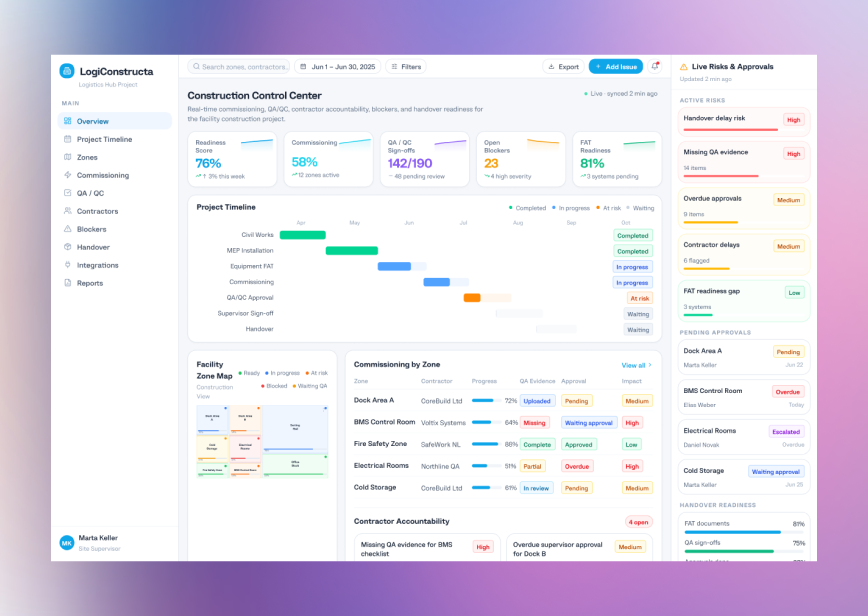
USER INTERFACE

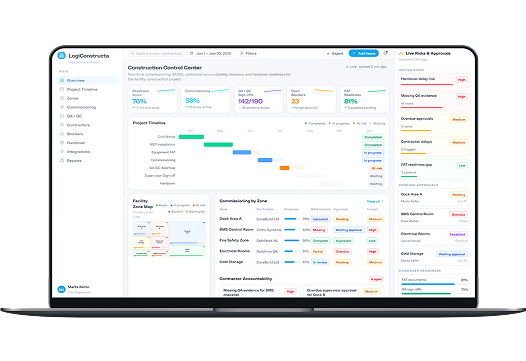
The interface was designed for daily construction operations, with fast access to project status, blockers, approvals, evidence, contractor actions, and readiness indicators.

DIGITAL PLATFORM & TECHNOLOGY

PROJECT MANAGEMENT METHODOLOGY

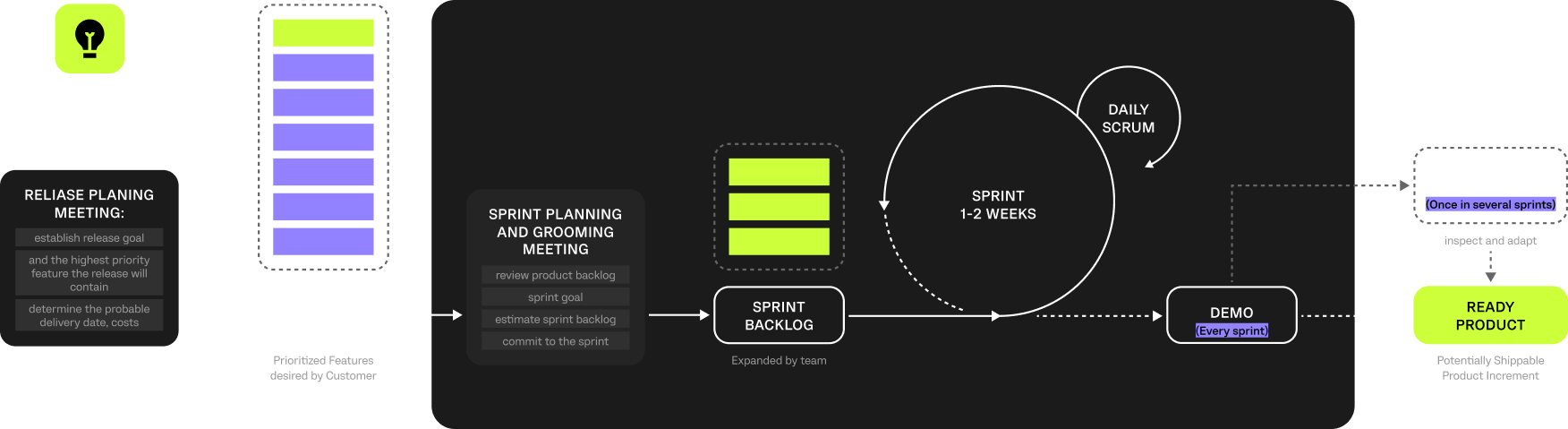
Computools used an Agile Scrum-based delivery approach to keep the project aligned with the client’s operational priorities, technical requirements, and integration needs.

Work was organized into short sprints, each focused on a defined area for improvement, such as commissioning workflows, QA evidence capture, contractor accountability, blocker ownership, handover readiness, dashboards, or system integrations.

Regular sprint planning, backlog refinement, demos, and retrospectives helped keep the client closely involved throughout the project. Project managers, commissioning stakeholders, QA/QC representatives, and IT teams could review functionality early, clarify edge cases, and adjust priorities as the platform evolved.

This approach reduced delivery risk, improved transparency, and helped Computools build the system around real construction workflows rather than on assumptions of delayed reporting.

PROJECT MANAGEMENT METHODOLOGY

PROJECT TIMELINE

image

WHAT OUR CLIENT SAID

We used many different tools, but important project information was scattered across documents, Excel files, messages, and different managers. This made it harder than necessary to handle commissioning, QA control, and handover planning on our large logistics hub projects.

Computools helped us organize all this information into a single operational platform. Now our teams spot blockers sooner, track contractor responsibilities more easily, manage QA evidence more effectively, and know if we are ready for handover before any issues delay the project.

CONTACT US TO GET A COST-EFFECTIVE
PROJECT ESTIMATE

Thank you for your message!

Your request will be carefully researched by our experts. We will get in touch with you within one business day.

WHAT HAPPENS NEXT?

01.
We deeply analyse your request.
02.
We create project roadmap, accelerating your time-to-value.
03.
We co-scope features, minimizing project risk upfront.
04.
We submit a comprehensive project proposal with estimates, timelines, CVs, etc.
Trusted by: