Nxt-Gen P&C

How Nxt-Gen P&C reduced claims processing time by 28% without replacing the core insurance platform.

case image

AT A GLANCE

The client is a U.S.-based insurance company with $0.47B in annual revenue, operations in 30 countries, and 40 years of industry experience. Its core P&C environment supported policy, billing, and claims workflows but had become increasingly difficult to maintain and extend.

Computools delivered P&C insurance software development focused on component-based modernization of the existing platform. The insurance platform modernization approach improved maintainability, automated selected workflows, and introduced stronger operational analytics without requiring full core-system replacement.

The modernized environment reduced manual handoffs in claims, lowered the risk of errors across selected policy and billing workflows, improved visibility into bottlenecks, and created a scalable foundation for further platform evolution.

THE CLIENT

The client has four decades of experience in the insurance industry and operates in 30 countries. Its P&C business depends on coordinated policy, billing, and claims processes that support day-to-day insurance operations.

Over time, the legacy platform had accumulated technical dependencies that made changes more difficult to deliver and maintain. Insurance policy administration required a more modular foundation capable of supporting evolving business rules without destabilizing established workflows.

The same limitations affected insurance claims management, where manual handoffs and tightly coupled platform components slowed processing and reduced visibility into workflow status.

BUSINESS CHALLENGE

The existing platform continued to support core insurance operations, but its architecture made it increasingly difficult to adapt as business requirements evolved.

  • Legacy architecture constraints. Tight dependencies increased the effort required to modify or extend individual functions.
  • Manual workflow steps. Selected policy, billing, and claims processes still depended on repetitive staff actions and handoffs.
  • Limited operational visibility. Teams lacked a clear view of workflow status, bottlenecks, and processing performance.
  • Growing maintenance effort. Changes to older components required additional testing and coordination across connected functions.
  • Future scalability. The platform required a structure that could support continued modernization without forcing a disruptive core replacement.

The client needed insurance workflow automation to reduce repetitive work across core operational processes while preserving existing business logic.

The engagement also required experience in insurance software development across policy administration, billing, claims, and analytics, as well as in the modernization of long-running operational systems.

SOLUTION SUMMARY

Computools redesigned the platform around a component-based modernization approach. Existing business logic was preserved where appropriate, while selected functions were separated into more maintainable components that could evolve independently.

The insurance legacy system modernization improved integration readiness and reduced dependency between core operational functions without requiring a full platform replacement.

Modernized insurance billing software workflows supported more structured processing of billing activities and reduced repetitive manual interactions.

Insurance claims automation introduced clearer workflow steps and reduced manual handoffs across selected claims processes.

For property and casualty insurance operations, the updated platform connected policy, billing, claims, workflow status, and operational reporting within a more maintainable architecture.

The solution also introduced an analytics layer that gave teams greater visibility into workflow status, bottlenecks, and operational performance.

IMPACT

Nxt-Gen P&C improved claims processing, reduced manual work, and gave operations teams clearer visibility across policy, billing, and claims workflows:

  • Claims processing time decreased by 28%.
  • Manual handling across selected policy, billing, and claims workflows decreased by 34%.
  • Processing errors decreased by 22%.
  • Operational reporting time decreased by 41%.
  • Feature delivery accelerated by 30%.

Insurance analytics gave teams a clearer view of workflow status, processing bottlenecks, and operational performance across core P&C processes. Modernized interfaces, delivered through web development, improved day-to-day access to policy, billing, claims, and analytics workflows. More consistent operational reporting was supported by data engineering, which aligned data across policy, billing, claims, and reporting workflows.

The modernized component structure also reduced the effort required to change individual parts of the platform, supporting faster releases without a full core-system replacement.

WHY COMPUTOOLS

The project required modernization of a business-critical insurance platform without interrupting established policy, billing, and claims operations.

Computools structured delivery around architecture analysis, component separation, workflow automation, and incremental modernization. Selected components were modernized without disrupting the existing business logic or replacing the core platform.

The delivery model also connected architecture decisions to operational outcomes, including maintainability, claims processing efficiency, workflow visibility, and readiness for continued platform evolution.

The component-based architecture also created a cleaner foundation for future AI development, allowing the insurer to expand analytics and decision-support capabilities without another core platform redesign.

Launch your software solution within 1-3 months instead of years. Unlock tomorrow. Build a future-ready business through innovation.

STORY IN DEPTH

Background

The client’s platform had supported P&C operations for years, but the architecture had become increasingly difficult to extend as business requirements changed. Policy, billing, and claims processes depended on interconnected legacy components. A change in one area could require additional testing and coordination across other functions, increasing maintenance effort and slowing the delivery of enhancements.

Operational teams also lacked sufficient visibility into workflow status and bottlenecks, making it harder to identify where manual handoffs or processing delays were occurring.

Approach to solution

Computools began with an architecture review to map dependencies across policy, billing, claims, and supporting workflows. The team identified components that could be modernized independently while preserving existing business logic and reducing the risk associated with full-system replacement.

Selected workflows were then redesigned to reduce manual interactions and create clearer processing states.

Analytics capabilities were introduced alongside modernization so operational teams could monitor status, bottlenecks, and workflow performance as the platform evolved.

Computools role

Computools was responsible for:

  • assessing the existing platform architecture and dependencies;
  • identifying modernization priorities across policy, billing, and claims;
  • designing a component-based modernization approach;
  • separating selected functions from tightly coupled legacy components;
  • modernizing user-facing workflows;
  • implementing automation across selected insurance operations;
  • integrating analytics capabilities for operational reporting;
  • improving integration readiness through REST-based interfaces;
  • validating updated workflows and platform behavior;
  • supporting stabilization and continued enhancement.

Key decisions and outcomes

The team modernized the core platform incrementally, preserving existing business logic and reducing disruption to active insurance operations. This approach lowered implementation risk and supported continuous platform operation during modernization.

Component boundaries were introduced around functions that needed more frequent change. This improved maintainability and reduced the number of dependencies affected by individual enhancements.

Automation focused on workflows with repeated manual handoffs, particularly across claims and other operational processes.

Analytics became part of the modernization architecture, giving teams clearer visibility into policy, billing, and claims workflow performance.

DESIGN

The design simplified policy, billing, and claims workflows while preserving the structure users already understood from daily insurance operations.

USER PERSONA → SITE MAP → WIREFRAMES → USER INTERFACE

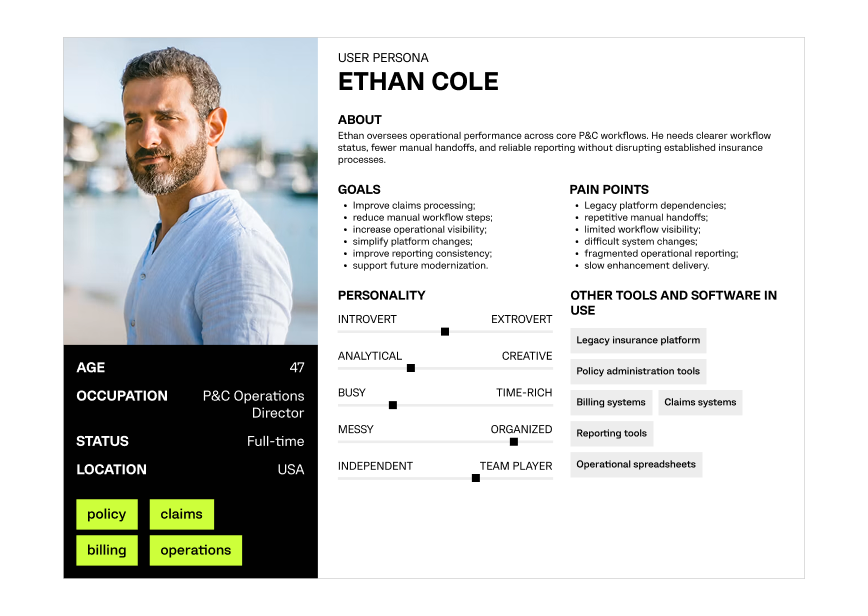
USER PERSONA

Defining the needs of an insurance operations leader responsible for policy, billing, claims, and workflow performance.

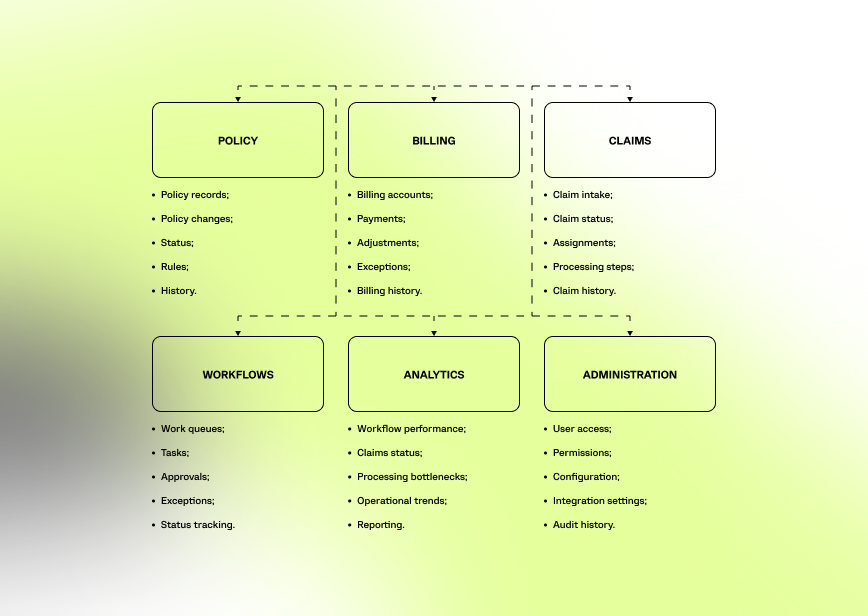
SITE MAP

Organizing policy, billing, claims, workflows, and analytics within one modernized insurance environment.

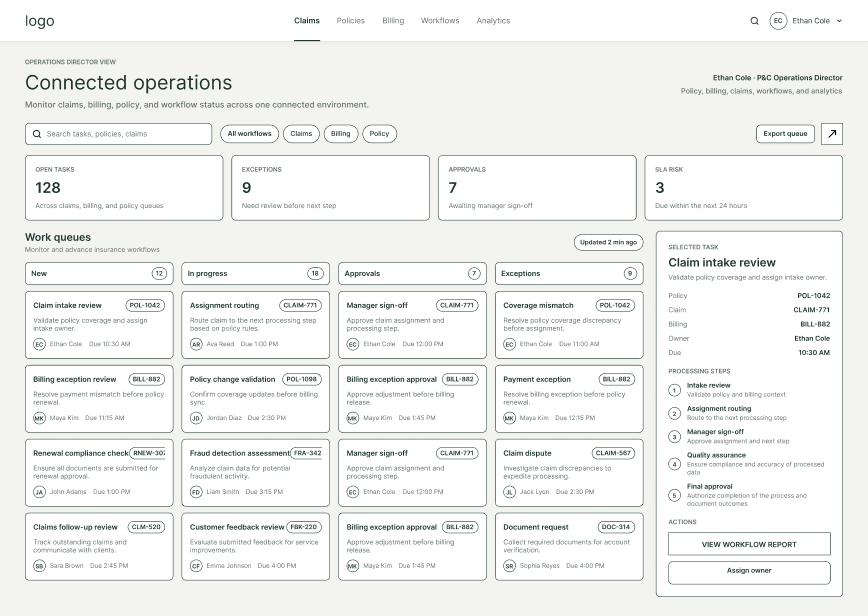
WIREFRAMES

Testing policy, billing, claims, workflow, and reporting interactions before interface development.

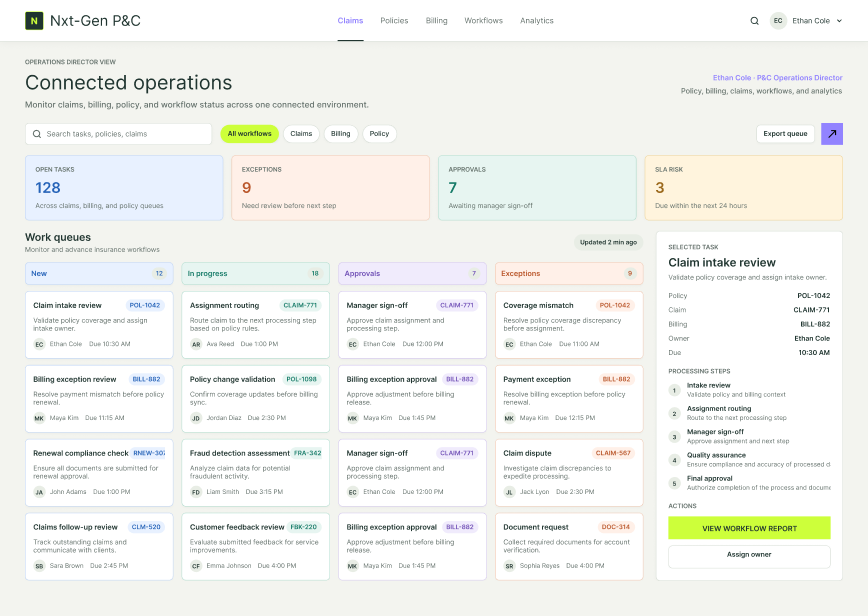
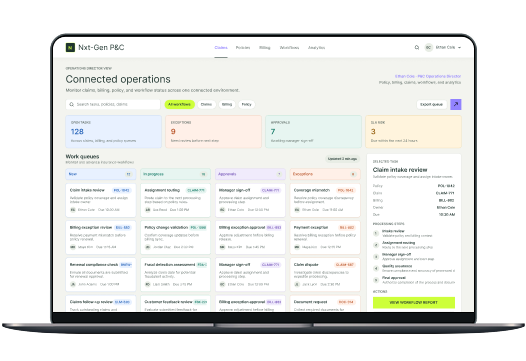
USER INTERFACE

Creating a clearer operational interface for policy, billing, claims, and workflow management across the modernized platform.

DIGITAL PLATFORM & TECHNOLOGY

PROJECT MANAGEMENT METHODOLOGY

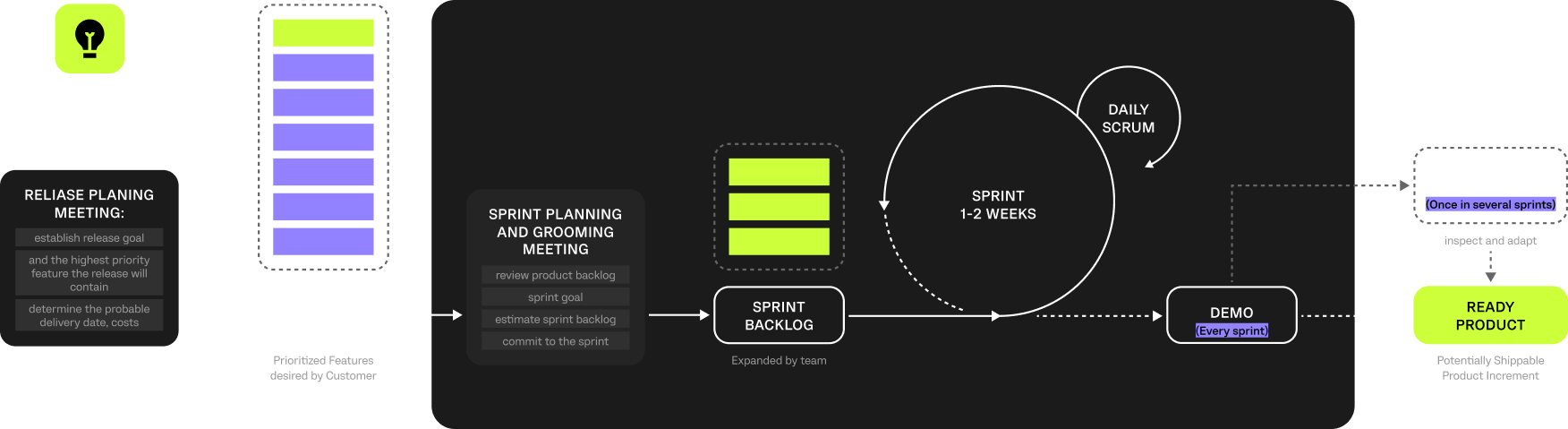
Computools used a Scrum-based delivery model with two-week iterations and regular validation by stakeholders from insurance operations, product, architecture, and technology. Each iteration connected technical modernization work to an operational requirement across policy, billing, claims, workflow automation, or analytics.

Architecture changes were validated against existing business logic before broader rollout. Updated components and workflows were introduced incrementally to reduce risk across active insurance operations.

PROJECT MANAGEMENT METHODOLOGY

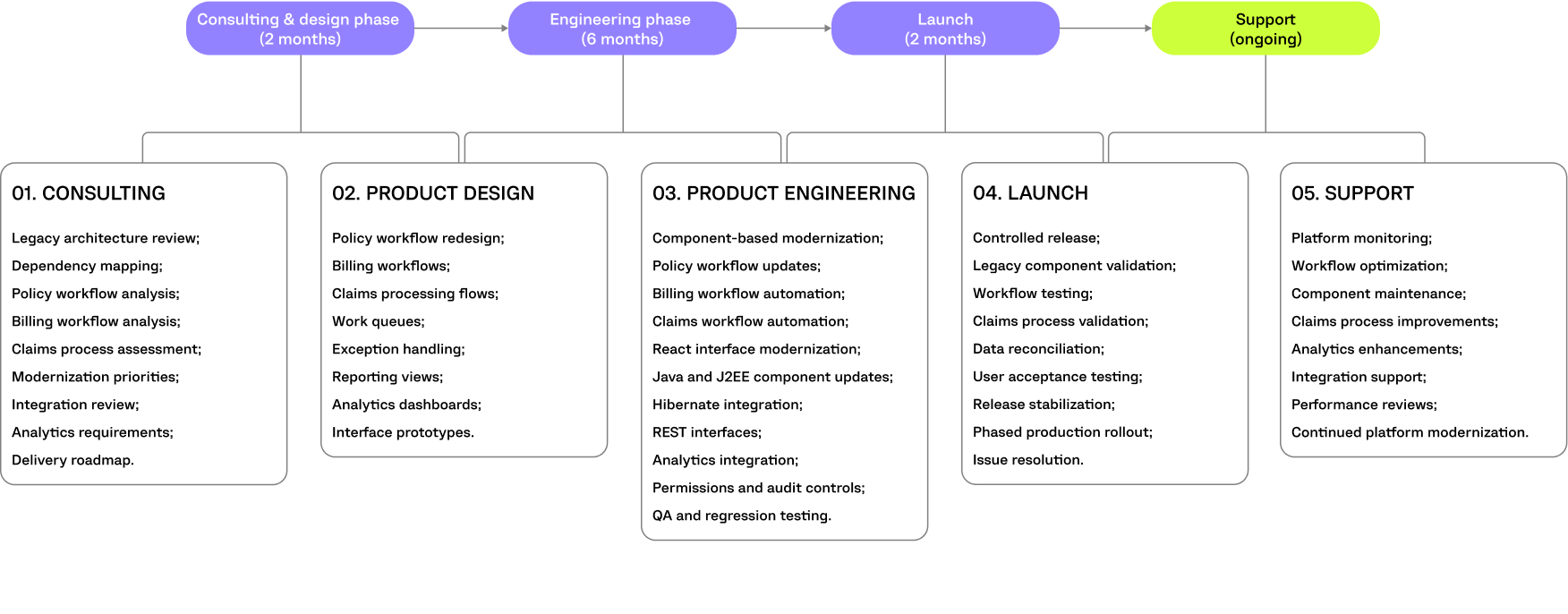
PROJECT TIMELINE

image

WHAT OUR CLIENT SAID

We had years of business logic tied to the existing platform, so replacing everything was never the practical option. The modernization gave us a cleaner way to improve policy, billing, and claims workflows while keeping the parts of the system that still worked.

CONTACT US TO GET A COST-EFFECTIVE
PROJECT ESTIMATE

Thank you for your message!

Your request will be carefully researched by our experts. We will get in touch with you within one business day.

WHAT HAPPENS NEXT?

01.
We deeply analyse your request.
02.
We create project roadmap, accelerating your time-to-value.
03.
We co-scope features, minimizing project risk upfront.
04.
We submit a comprehensive project proposal.
Trusted by: