
THE AUTHOR:

With CRA Article 14 reporting obligations starting on 11 September 2026, connected device manufacturers have less than 90 days to prepare for 24/72-hour vulnerability and incident reporting. For companies with legacy firmware, fragmented component inventories, and weak OTA infrastructure, CRA readiness is now an engineering deadline with financial, operational, and market-access consequences.
Introduction: the harsh reality of Mid-June 2026
Imagine it is a Tuesday morning in mid-June 2026. Your product security team has just received an alert about an actively exploited vulnerability in a software component used across several connected device lines.
The clock starts immediately. Under Article 14 of the EU Cyber Resilience Act, the manufacturer must submit an early warning within 24 hours and a fuller notification within 72 hours. Before either deadline, the team needs to determine which firmware versions contain the component, which product SKUs are affected, where those products are available in the EU, and what remediation path can be offered.
How long would that actually take in your current environment?
If the answer depends on engineering spreadsheets, supplier emails, disconnected PLM records, static SBOM files, and the memory of people who built the firmware years ago, most of the reporting window will be spent reconstructing product impact. By 11 September 2026, the EU Cyber Resilience Act CRA 2026 readiness becomes an immediate operational requirement for manufacturers still relying on CRA legacy firmware, fragmented component inventories, and weak OTA infrastructure.
A delayed or incomplete response can expose active EU product lines to regulatory scrutiny, distributor pressure, corrective measures, withdrawal or recall, and administrative fines of up to €15 million or 2.5% of total worldwide annual turnover for the preceding financial year. For leadership, this turns firmware visibility, vulnerability mapping, and remediation readiness into a direct product security EBITDA risk.
The timeline below shows the key dates and reporting steps manufacturers need to plan around before Article 14 obligations begin on 11 September 2026.
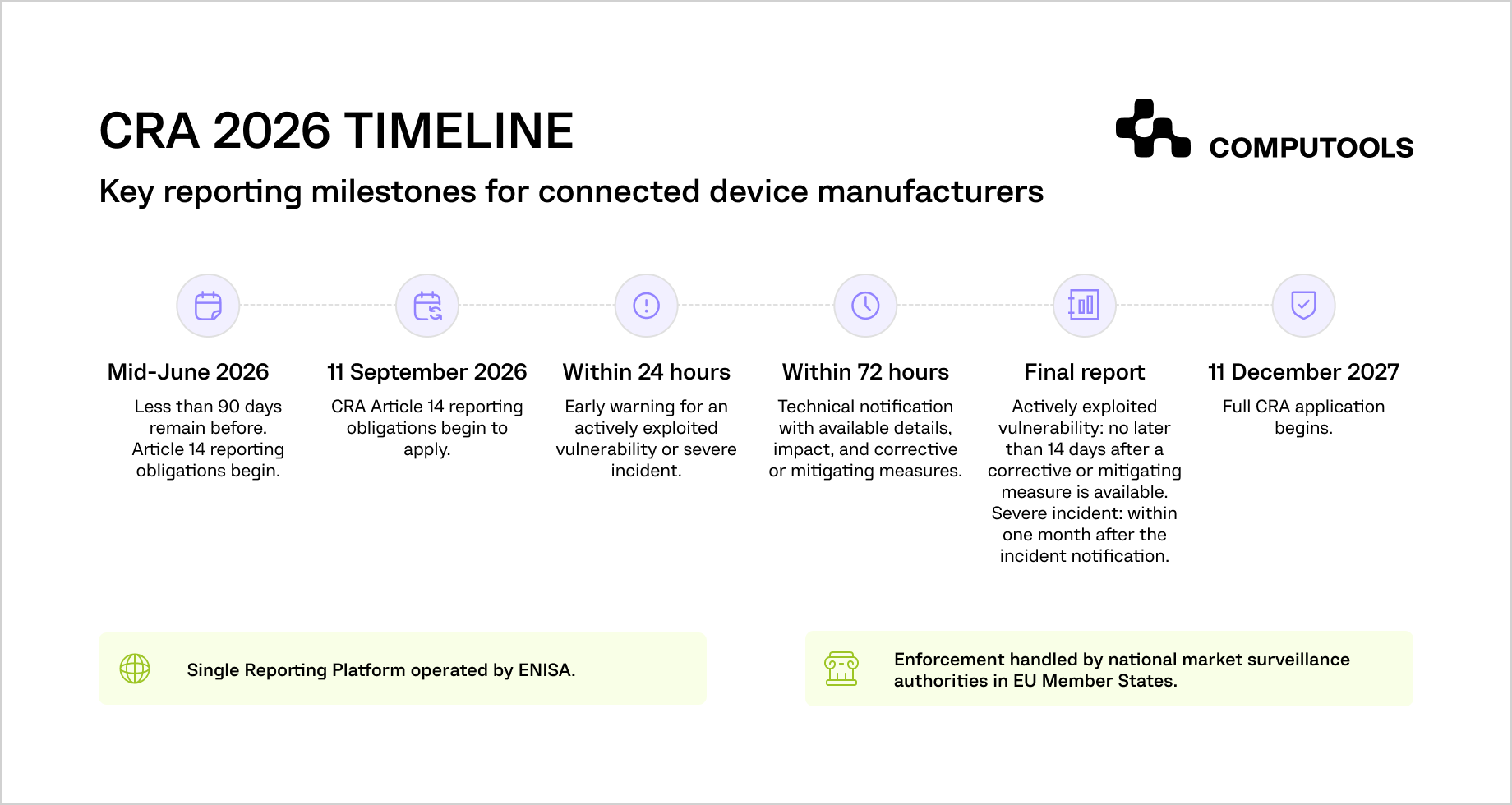
CRA 2026 reporting timeline from mid-June 2026 to Article 14 reporting obligations and full CRA application.
These dates define the operational pressure behind CRA readiness. The next section breaks down the reporting requirements and systems behind them.
Business risks of CRA unreadiness
CRA unreadiness creates three connected consequences: financial penalties, channel pressure, and operational disruption. For companies with active EU exposure, the impact reaches product availability, remediation budgets, distributor relationships, and product-line EBITDA.
Financial risk: fines tied to Article 13 and Article 14
The highest CRA penalty tier applies to non-compliance with the essential cybersecurity requirements in Annex I and the obligations under Articles 13 and 14. Under Article 64, this can lead to administrative fines of up to €15 million or 2.5% of total worldwide annual turnover for the preceding financial year, whichever is higher. For manufacturers preparing for the CRA compliance deadline 11 September 2026 for Article 14 reporting obligations, weak vulnerability handling, incomplete evidence, and delayed notification create direct financial exposure.
| Violation Tier | Maximum Administrative Fine | Impact on Business |
| Non-compliance with AnnexI & Articles 13, 14 | Up to €15 Million or 2.5% of the total worldwide annual turnover (whichever is higher) | Direct hit to the corporate profitability, unbudgeted capital drain. |
| Non-compliance with other manufacturer obligations | Up to €10 Million or 2% of the total worldwide annual turnover (whichever is higher) | Operational penalties, increased auditor scrutiny. |
| Supply of misleading or incomplete information | Up to €5 Million or 1% of the total worldwide annual turnover (whichever is higher) | Reputational damage, delayed product approvals. |
Commercial risk: distributors will protect their own exposure
CRA also changes the commercial position of distributors and retailers. Under Article 20, a distributor with reason to believe that a product or the manufacturer’s processes are non-conforming must stop making that product available until conformity is restored. If non-conformity is identified later, the distributor must ensure corrective measures are taken, including withdrawal or recall where appropriate.
For manufacturers, CRA readiness becomes a channel-risk issue. European distributors can reassess suppliers before any fines are imposed, especially when evidence of product security is weak, firmware inventories are unclear, or remediation processes are missing. Suppliers that cannot show how they will identify affected devices, report within the 24/72-hour window, and deliver secure updates become harder to approve for new sourcing cycles.
Operational risk: recalls, withdrawal, and market restrictions
Operational costs can escalate faster than the fine itself. If a product with digital elements is found non-compliant and corrective action is not taken, market surveillance authorities may restrict its availability, withdraw it from the national market, or recall it. Under the Union safeguard procedure, a justified national measure can also trigger withdrawal measures in other Member States.
For hardware manufacturers, this can mean emergency firmware work, support escalations, distributor negotiations, replacement logistics, customer communication, and delayed shipments simultaneously. Active EU product lines face pressure on revenue continuity, cost control, margins, and market access.
Corrective and restrictive measures are handled through national market surveillance mechanisms. Penalty rules are laid down by Member States under Article 64; depending on national law, fines may be imposed by market surveillance authorities, national courts, or other competent bodies. ENISA’s role is limited to establishing and operating the Single Reporting Platform.
These risks usually stem from the same weakness: product security data is managed manually across disconnected systems. At the connected-device scale, CRA reporting requires that firmware versions, SBOMs, vulnerability feeds, OTA updates, and EU market exposure be connected within hours.
Four technical barriers slowing CRA readiness
CRA readiness stalls when the systems needed for 24/72-hour reporting remain disconnected. Firmware inventories, software components, vulnerability intelligence, update channels, product lifecycle data, and market exposure often sit in separate tools, owned by different teams and updated at different speeds. Under the CRA reporting timeline, this fragmentation becomes an engineering bottleneck.
Barrier 1: No real visibility into what is actually in the field
Many industrial automation, automotive OEM, and connected electronics manufacturers still treat SBOMs as static documents for audits, supplier reviews, or release packages. This creates a visibility gap once open-source libraries, third-party SDKs, and vendor components are spread across multiple firmware branches already deployed in the field.
SPDX and CycloneDX support machine-readable component transparency, but only continuously updated SBOMs can show what is inside each firmware version, which SKUs use it, and which devices remain active in the EU market. Without a dynamic SBOM for CRA compliance, the first hours of an incident are spent reconstructing software composition rather than preparing evidence of impact and remediation steps.
Barrier 2: Manual vulnerability-to-product tracking
Product security teams may monitor CVE feeds, NVD records, vendor advisories, and CISA KEV entries, but those signals are still mapped manually to firmware versions, SKUs, supplier packages, deployed device groups, and EU-facing product lines.
The operational gap appears when teams cannot quickly confirm whether a new CVE or KEV-listed vulnerability affects a specific model, firmware branch, customer deployment, or EU market exposure. Without automated linkage between vulnerability intelligence and firmware composition, teams lose time validating relevance, severity, exploitation status, and product impact. That delay weakens both the 24-hour early warning and the 72-hour notification workflow.
Barrier 3: Legacy firmware and talent drain
The hardest readiness gaps often sit inside old firmware. Many connected appliances, embedded modules, and industrial electronics products run on monolithic codebases shaped by supplier patches, regional variants, custom drivers, and undocumented fixes. The engineers who originally understood the architecture may have moved roles, left the company, or retired. Remaining teams inherit incomplete documentation and high regression risk.
Together, these barriers show the same operational problem: CRA reporting data remains fragmented across firmware builds, deployed products, vulnerability feeds, OTA readiness, and incident response workflows. By 11 September 2026, manufacturers need automated evidence pipelines that move fast enough for reporting and safe remediation.
Barrier 4: Fragmented or insecure update delivery
Many connected products still rely on fragmented, service-heavy update models built for long hardware lifecycles and regional firmware variants. Some still rely on physical service visits, manual update procedures, or update channels without cryptographic signing, integrity validation, rollback protection, and a clear Root of Trust.
Under CRA pressure, a weak OTA becomes a regulatory and operational weakness. Manufacturers need a secure way to distribute fixes, prove update integrity, and maintain an auditable remediation path. Without reliable OTA firmware CRA updates, a company may detect and report a vulnerability but still struggle to close it safely across affected devices.
Manual compliance tracking vs automated compliance infrastructure
| Area | Manual compliance tracking | Automated compliance infrastructure | Margin & EBITDA impact |
| Firmware visibility | Teams rely on spreadsheets, release notes, and undocumented engineering knowledge. | Product lines, firmware versions, components, and device configurations are mapped in one connected system. | Manual: High overhead, unbudgeted emergency engineering hours. Automated: Zero operational downtime. |
| SBOM management | SBOMs are created manually or only for selected releases. | SBOMs are generated, validated, stored, and linked to firmware builds through CI/CD. | Manual: Risk of delayed market access and compliance audits. Automated: Streamlined sourcing and faster customer approval cycles. |
| Vulnerability matching | CVEs, supplier advisories, and exploited vulnerability data are checked manually against product records. | Vulnerability data is matched automatically against SBOMs, firmware versions, product SKUs, and active EU-facing products. | Manual: Drop in product profitability due to a slow incident response. Automated: Protected hardware margins through automated triage. |
| 24/72-hour reporting | Teams spend critical hours reconstructing product impact. | Teams can identify affected products, owners, evidence, and reporting actions faster. | Manual: High exposure to the €15M maximum Article 64 penalty tier. Automated: Full control overregulatory exposure and market access. |
| Remediation delivery | Security patches depend onphysical service visits, manual updates, or fragmented customer rollouts. | Updates are signed, cryptographically validated, tracked, and staged via secure mechanisms. | Manual: Escalating post-sale logistics costs and field engineering overhead. Automated: Minimal remediation costs, protected product lifecycle margins. |
Anatomy of CRA requirements from 11 September 2026
From 11 September 2026, the CRA moves from long-range regulatory planning into an active reporting obligation for manufacturers of products with digital elements. The requirement applies to actively exploited vulnerabilities and severe incidents that affect the product’s security, with reporting handled through the CRA Single Reporting Platform established and operated by ENISA.
The 24-hour rule
The first deadline is the early warning. Once a manufacturer becomes aware of an actively exploited vulnerability or a severe security incident, it must submit an early warning within 24 hours. For engineering teams, CRA vulnerability reporting 24 hours means the company must quickly determine whether the issue is real, whether exploitation is active, which products may be affected, and which internal teams own the next action.
The 72-hour rule
The second deadline is the main notification. Within 72 hours of becoming aware, the manufacturer must provide a fuller notification with available product information, the general nature of the exploit or incident, an initial assessment, and any corrective or mitigating measures already taken or available to users. In practice, this requires a prepared technical workflow, because firmware teams cannot build product-impact evidence, remediation logic, and customer-facing mitigation details from scratch during an active incident.
Article 14 also requires a final report: for actively exploited vulnerabilities, no later than 14 days after a corrective or mitigating measure is available, and for severe incidents, within one month after the incident notification.
The Single Reporting Platform
The CRA Single Reporting Platform ENISA model is designed to reduce duplicate reporting. Manufacturers submit the notification once, select the relevant CSIRT coordinator based on the location of the main establishment, and simultaneously include ENISA. The receiving CSIRT then shares the notification with other relevant CSIRTs in Member States where the product has been made available, unless exceptional cybersecurity grounds justify a delay.
The Article 14 timeline gives manufacturers very little room for manual reconstruction. Once a vulnerability or severe incident is identified, teams need a clear sequence for validation, product impact analysis, reporting, remediation, user communication, and final documentation.
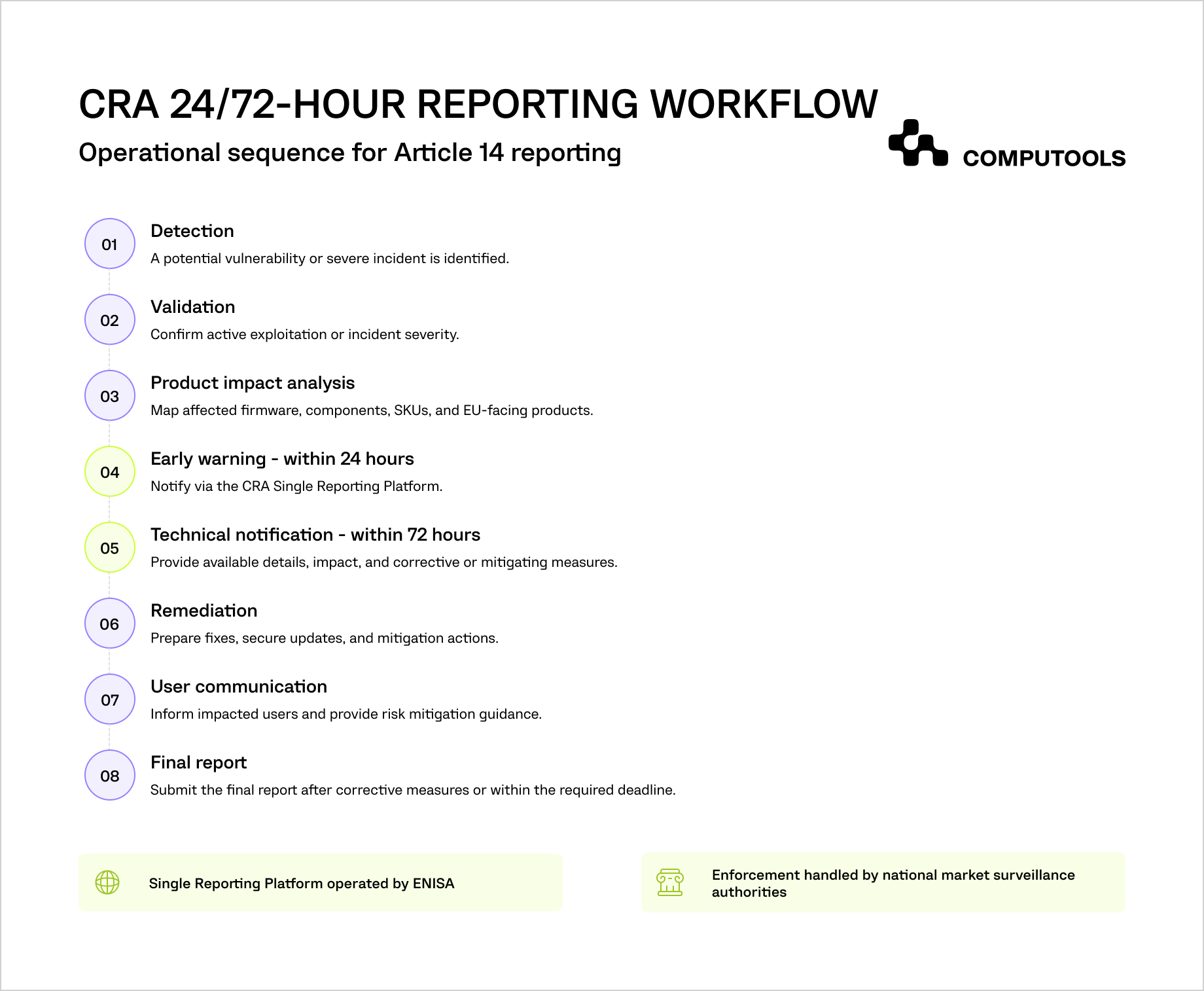
CRA 24/72-hour reporting workflow for actively exploited vulnerabilities and severe incidents under Article 14.
Scope
The reporting obligation covers products with digital elements made available on the EU market. The European Commission’s CRA summary also states that reporting obligations apply to all such products made available on the Union market, including products already placed on the market before 11 December 2027. For manufacturers still selling or supporting older automotive sub-systems, industrial programmable logic controllers (PLCs), embedded modules, and IoT devices, legacy product lines cannot be ignored in the 2026 readiness plan.
What this means for manufacturers
The practical requirement is speed with evidence. By 11 September 2026, manufacturers need a reliable way to connect vulnerability intelligence, firmware versions, software components, deployed product lines, market exposure, and remediation options. Without that link, the 24/72-hour reporting process cannot run reliably under incident pressure.
Technical roadmap: Closing the CRA Gap in 90 Days
A full firmware rewrite before 11 September 2026 would increase validation, stability, and release risk. The practical route is to deploy non-disruptive automation layers on top of the existing firmware estate: continuous SBOM generation, automated vulnerability-to-product mapping, secure remediation workflows, and rehearsed 24/72-hour reporting processes.
The roadmap below focuses on the highest-risk operational gaps that manufacturers can address within 90–120 days without destabilizing active product lines or rebuilding legacy hardware from scratch.
1. Map product and firmware exposure first
Start by identifying which active EU-facing product lines create the highest regulatory and operational exposure. The map should connect products, firmware branches, hardware variants, supplier components, update mechanisms, support periods, and deployed configurations.
This step matters because Article 14 reporting starts with product impact. If teams cannot quickly identify which products may be affected, the 24-hour early warning window becomes an investigation bottleneck rather than a reporting process.
2. Build SBOM for CRA compliance (SPDX CycloneDX) inside CI/CD
Turn SBOM from a static release artifact into a continuously updated engineering asset. Machine-readable SBOMs should show which components, open-source libraries, third-party SDKs, supplier packages, versions, and dependencies are present in each relevant firmware branch.
This closes the visibility gap behind CRA legacy firmware. Teams can move from a vulnerability signal to a product-impact assessment faster, instead of rebuilding software composition manually during an incident.
3. Deploy CRA SBOM automation for vulnerability impact analysis
CRA SBOM automation should connect SBOM data with CVE/NVD records, CISA KEV entries, supplier advisories, internal findings, and ERP/PLM product records. The goal is to quickly identify affected firmware versions, SKUs, EU-facing product lines, responsible teams, and remediation needs.
This reduces the risk of delayed reporting, over-reporting, or missing an affected product line. It also gives leadership a clear answer on which products require reporting, which require remediation, and which can be ruled out with evidence.
4. Harden the OTA update channel
Secure OTA is the remediation layer behind CRA readiness. Manufacturers need a controlled way to distribute OTA firmware CRA updates, verify update integrity, manage rollout risk, and document corrective measures.
For MCU-based and low-power IoT devices, secure OTA can be limited by flash memory, bandwidth, and space for dual firmware images. This means rollback protection, staged updates, and recovery logic must be adapted to device limits rather than copied from cloud-native software patterns.
This removes the remediation bottleneck: manufacturers can report with a credible path for distributing, verifying, and documenting corrective measures.
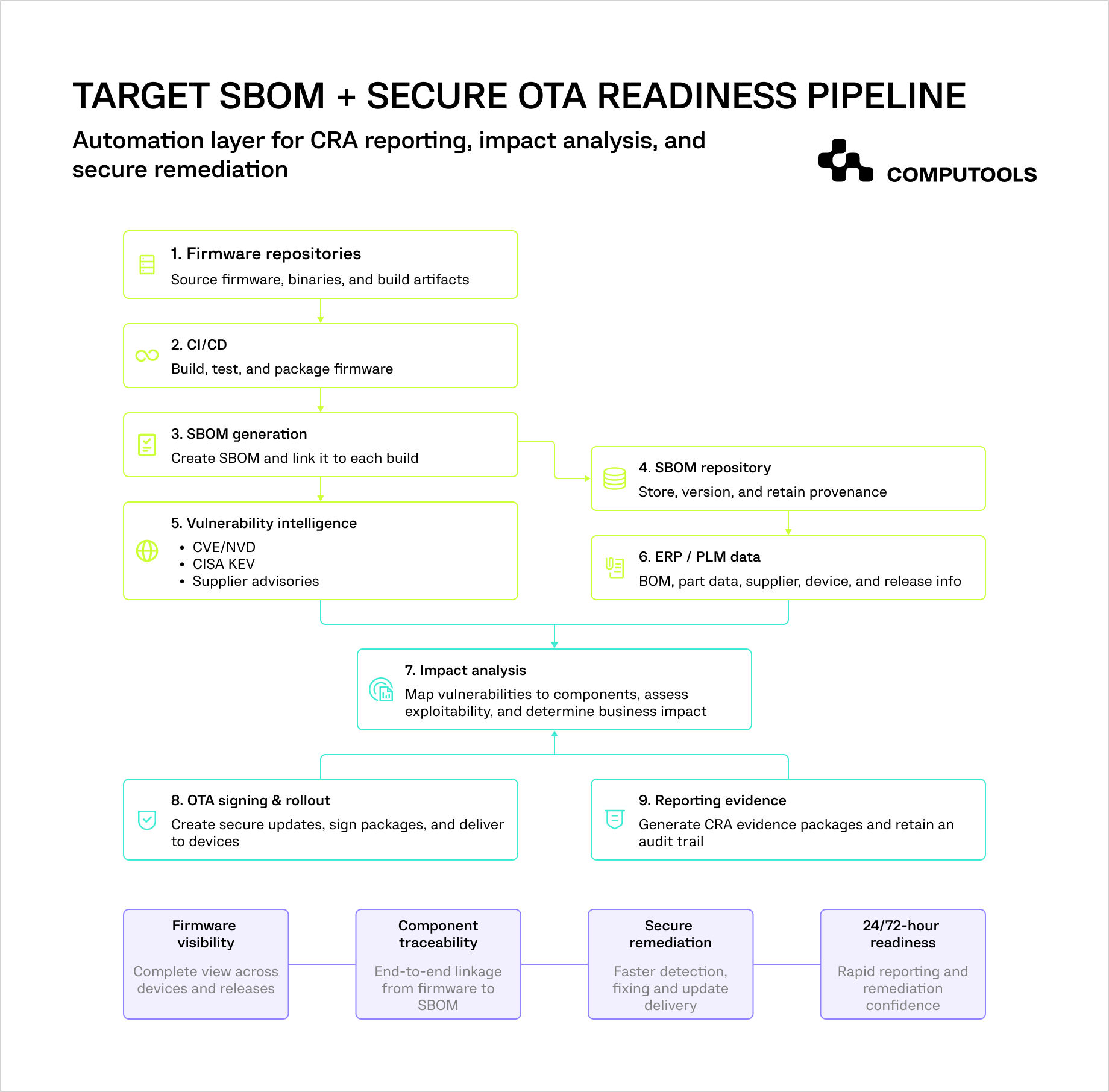
SBOM, vulnerability intelligence, ERP/PLM data, and secure OTA connected into one CRA readiness pipeline.
5. Create a repeatable 24/72-hour incident response workflow
CRA reporting requires rehearsed execution. The workflow should define how an actively exploited vulnerability or a severe incident moves through detection, validation, product-impact analysis, legal review, early warning, full notification, remediation planning, user communication, and final reporting.
This turns Article 14 reporting from an improvised crisis response into an operating model with owners, handoffs, evidence templates, escalation rules, and deadlines already defined.
6. Work safely with legacy firmware through targeted modernization
Legacy firmware needs containment before deeper modernization. The safest route is targeted dependency reconstruction, build environment stabilization, modular wrappers, and selective refactoring around high-risk components.
The first 90–120 days should focus on firmware visibility, vulnerability matching, secure update delivery, incident evidence, and remediation workflow. Deeper modernization can follow once the manufacturer has a defensible Article 14 reporting model.
7. Keep the roadmap non-disruptive and measurable
The roadmap should produce measurable checkpoints for product mapping, SBOM automation, vulnerability matching, OTA hardening, and incident response readiness. Within 90–120 days, manufacturers should be able to show which product lines are mapped, which firmware branches generate SBOMs, which vulnerabilities are matched to active products, which OTA paths are secured, and which teams can execute the 24/72-hour workflow.
This makes CRA readiness measurable for leadership and lowers execution risk for engineering teams by working around existing infrastructure before deeper modernization begins.
Anonymized realistic scenarios
1. Tier-1 Automotive Components & Industrial Sub-systems
A major manufacturer sells connected electronic control units (ECUs) and smart power distribution blocks across several EU markets, with separate firmware branches for hardware variants, connectivity modules, and regional requirements. Component data is scattered across release notes, supplier files, and engineering repositories, so the team cannot quickly see which libraries or SDKs are present in each firmware version.
When a severe vulnerability appears, product security cannot immediately confirm affected models, EU availability, or secure update paths. The company needs SBOM automation, firmware-to-product mapping, vulnerability matching, and OTA evidence to make the 24/72-hour reporting workflow reliable.
2. Industrial electronics / niche IoT
An industrial electronics manufacturer supports connected controllers with long service lives, strict maintenance windows, legacy SDKs, and supplier-specific firmware packages. Vulnerability feeds are monitored, but they are not linked automatically to firmware versions, customer deployments, or EU market exposure.
CRA readiness requires a controlled evidence pipeline around legacy firmware: dependency reconstruction, SBOM baselining, vulnerability-to-firmware mapping, secure update hardening, and documented mitigation paths that support reporting without destabilizing devices already in the field.
Self-assessment checklist
The scenarios above show how CRA readiness gaps can appear in different product environments. Before defining remediation priorities, leadership teams need a quick way to assess whether their current operating model can support 24/72-hour reporting. The matrix below provides a structured view across the main readiness areas.
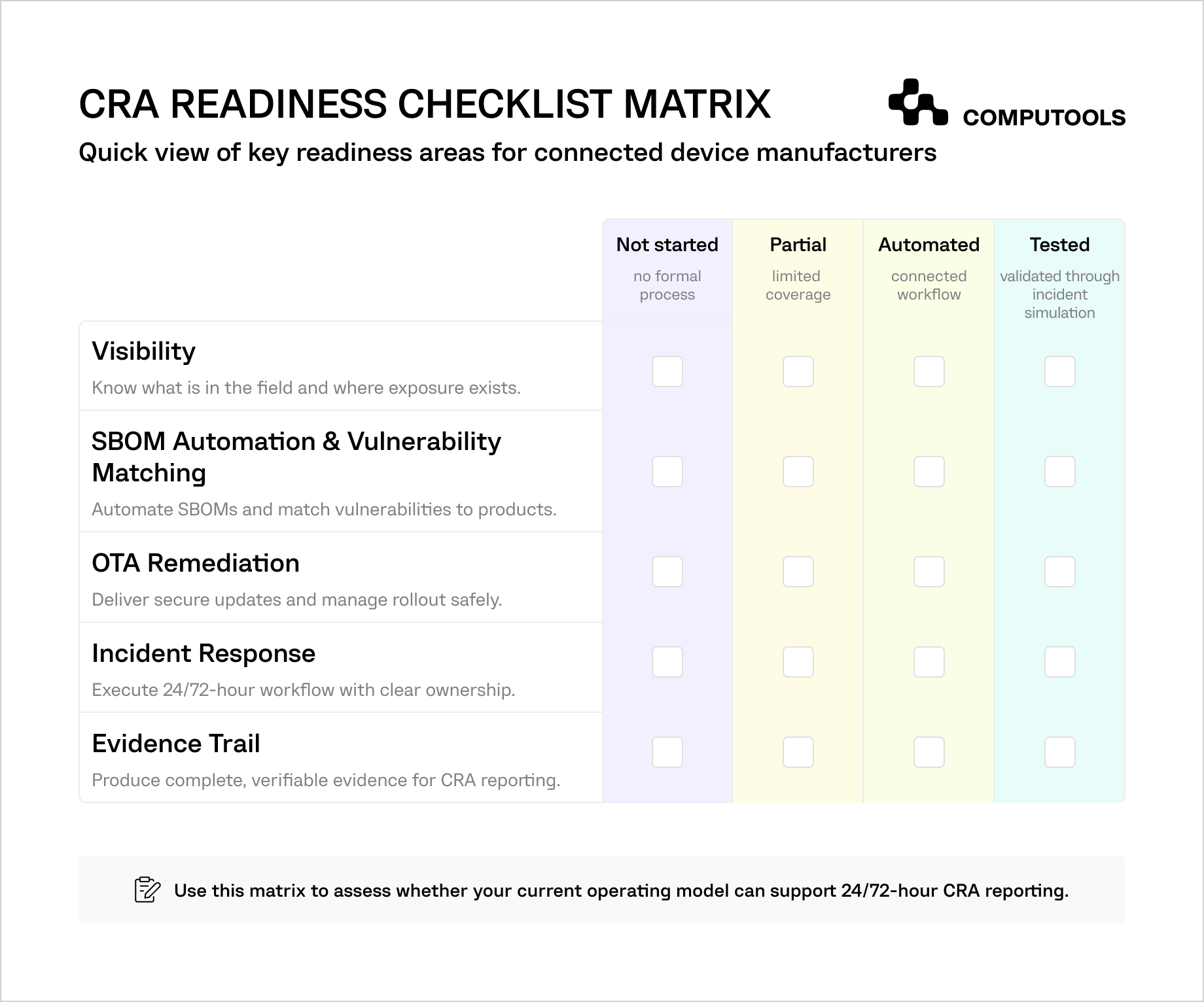
CRA readiness checklist matrix across visibility, SBOM automation, OTA remediation, incident response, and evidence trail.
The following questions help CTOs and CISOs test the same areas in technical detail before 11 September 2026.
Visibility
1. Can we identify every EU-facing product with digital elements and map it to current firmware versions, hardware variants, supplier components, and deployed configurations?
2. Can we determine within hours whether a newly disclosed vulnerability affects any active firmware version, product SKU, or deployed device group?
SBOM automation
3. Do we generate machine-readable SBOMs for every relevant firmware branch, or do teams still reconstruct component data manually from release notes, repositories, and spreadsheets?
4. Can we link open-source libraries, third-party SDKs, vendor packages, and internal components to specific firmware releases and product SKUs?
5. Do we have an automated way to match CVE/NVD data, exploited vulnerability catalogs, and supplier advisories against our firmware composition?
OTA remediation
6. Can our OTA update process deliver signed, validated, and auditable security updates to affected devices without physical service intervention?
7. Do we have rollback protection, staged rollout, failure recovery, and update evidence for products with limited memory, connectivity, or maintenance windows?
8. Do we have fallback mitigation paths for products with restricted connectivity, unsupported components, or no mature OTA capability?
Incident response
9. Is there a designated owner for vulnerability triage, product impact analysis, remediation planning, legal review, user communication, and regulatory reporting?
10. Have we tested a 24/72-hour incident workflow using a realistic scenario involving an actively exploited vulnerability?
Evidence trail
11. Can we prove which affected products have been made available in specific EU Member States if a notification is required?
12. Can we produce the technical evidence needed for early warning, full notification, corrective measures, user guidance, and final reporting without having to reconstruct facts from scattered spreadsheets and engineering notes?
Conclusion: engineering readiness before 11 September 2026
By 11 September 2026, the key question will not be whether your teams understand the CRA requirements. It will determine whether your system can identify affected firmware map vulnerable components, assess product impact, prepare evidence, and define a remediation path within 24 hours.
Legacy firmware, fragmented component inventories, and weak OTA infrastructure turn that deadline into an operational and financial risk. A targeted readiness layer built around SBOM automation, vulnerability-to-product mapping, secure remediation, and tested incident workflows can close the highest-risk gaps without destabilizing active product lines.

Computools CRA Gap Assessment helps manufacturers identify exposed product lines, prioritize readiness gaps, and define the fastest 90–120-day remediation path before Article 14 reporting obligations begin.
Computools
Software Solutions
Computools is an IT consulting and software development company that delivers innovative solutions to help businesses unlock tomorrow.