
THE AUTHOR:

Hospitals, surgical centers, and healthcare networks must now build a surgical analytics platform because the performance of an operating room has become a business-critical concern. Fragmented schedules and manual coordination of rooms, coupled with limited visibility and conflicting resources, cause operational imbalances of patient throughput, employee workload, and the control of costs, which, in turn, impacts revenue.
A 2025 study on surgical delays and interruptions observed 281 delays, with an average of 1.12 delays per surgery, consuming 16.83% of the total time of the surgery. This shows how much operational value can be lost inside daily surgical workflows before executives even see it in financial reports.
Intensifying the need for a surgical analytics platform, operating rooms are one of the most costly environments in a hospital. Studies on the cost of an operating room have cited that the average cost per minute of an operating room is about $46.04. Reducing idle time of the operating room, late starts, and manual coordination can have a significant positive impact in a high-volume surgical department.
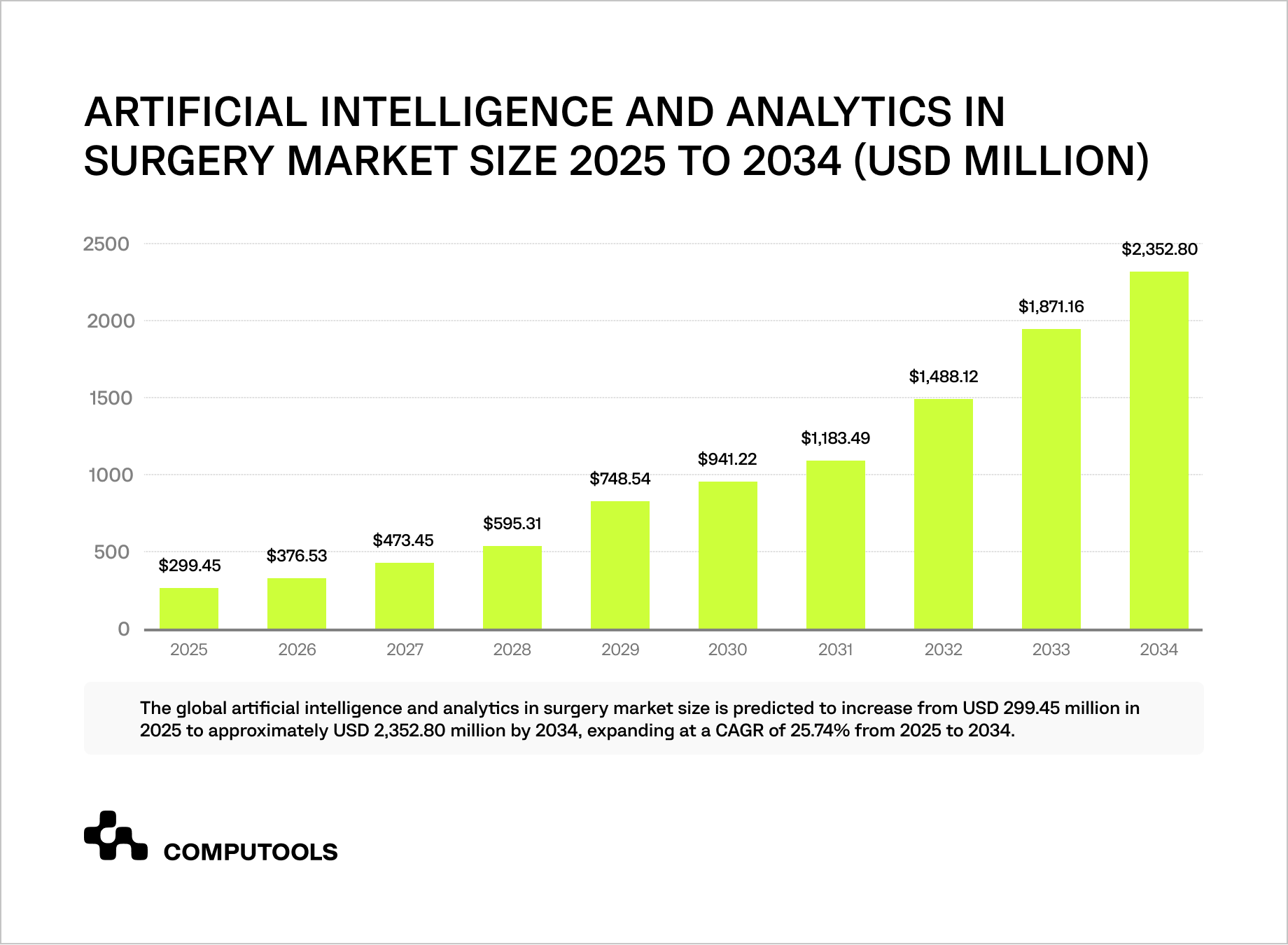
AI surgical analytics have transitioned from pilot programs to standard practice. Precedence Research estimates the global artificial intelligence and analytics in surgery market to grow from USD 299.45 million in 2025 to USD 2,352.8 million by 2034 by 2032. Consequently, investment in real-time analytics and AI-assisted surgical robotics, along with digital operating room systems and precision interventions, will stimulate the growth of AI in the operating room market.
Along with its advantages, AI introduces additional challenges. A 2026 Reuters investigation into AI-powered medical devices noted growing safety issues and a lack of regulation, making data integrity, validation, auditability, user control, and AI system accountability crucial aspects of AI healthcare solutions.
This article explains how to build a surgical analytics platform by covering the most important architecture decisions, the proper implementation of AI in surgical workflows and the actual delivery of healthcare services, and the way Computools implements surgical analytics technology.
Essential features to build a surgical analytics platform
A surgical analytics platform should combine workflow control, data visibility, automation, and security. These features create the foundation for operating room efficiency, procedure optimization software, reliable surgical data analytics, and safer hospital workflow automation.
| Feature | What It Does | Business Value |
| Surgical scheduling dashboard | Shows procedures, doctors, rooms, availability, case status, and schedule changes in one view. | Reduces manual coordination and gives teams faster control over daily OR planning. |
| Procedure room management | Tracks room availability, suitability, equipment needs, turnover time, and utilization. | Prevents idle rooms, double bookings, and poor resource allocation. |
| Doctor and staff availability | Connects surgeon, anesthesiologist, nurse, and support staff schedules with procedure planning. | Improves workload balance and reduces scheduling conflicts. |
| Patient and diagnostic data access | Connects patient parameters, pre-op status, imaging data, and required documents. | Reduces delays caused by missing or incomplete clinical information. |
| AI-powered procedure forecasts | Predicts procedure duration, delay risk, cancellation risk, and overtime probability. | Supports better planning and improves operating room performance analytics. |
| Workflow automation | Triggers alerts for missing diagnostics, room conflicts, unavailable staff, or incomplete pre-op steps. | Lowers administrative workload and prevents avoidable planning errors. |
| Analytics and KPI reporting | Tracks OR utilization, delays, turnover time, cancellation rate, idle room time, and schedule accuracy. | Gives leadership clear visibility into surgery performance analytics. |
| Secure access and audit logs | Controls user permissions, protects sensitive data, and records key actions. | Supports compliance, patient trust, and safer hospital workflow automation. |
| System integrations | Connects EHR, EMR, PACS, DICOM, billing, staff scheduling, and equipment systems. | Reduces duplicate data entry and keeps surgical analytics software connected to real hospital operations. |
Procedure optimization rarely stops inside the operating room. Hospitals also need to think about patient communication before and after surgery.
For a broader view of how digital tools can improve patient communication, follow-up, and engagement, read Computools’ guide on how to build a patient engagement platform.
Computools case study: how SurgeryOps improved surgical planning control
The SurgeryOps project shows why surgical analytics software has to support daily operational decisions, not only display historical reports.
Computools partnered with a multi-specialty hospital in the United States to help with their daily workload of 30-50 surgical procedures. The hospital required improved management of doctor schedules, patient parameters, procedure rooms, diagnostic data and pre-surgical planning.
The hospital had to manage a number of different systems through manual effort. This was especially problematic because the number of surgeries was increasing. This would lead administrators to be overburdened with scheduling and coordination, resulting in conflicts and more idle surgery rooms. The client needed a safe solution to bring all the surgical planning together, automate standard coordination and increase the operating room’s workflow visibility.
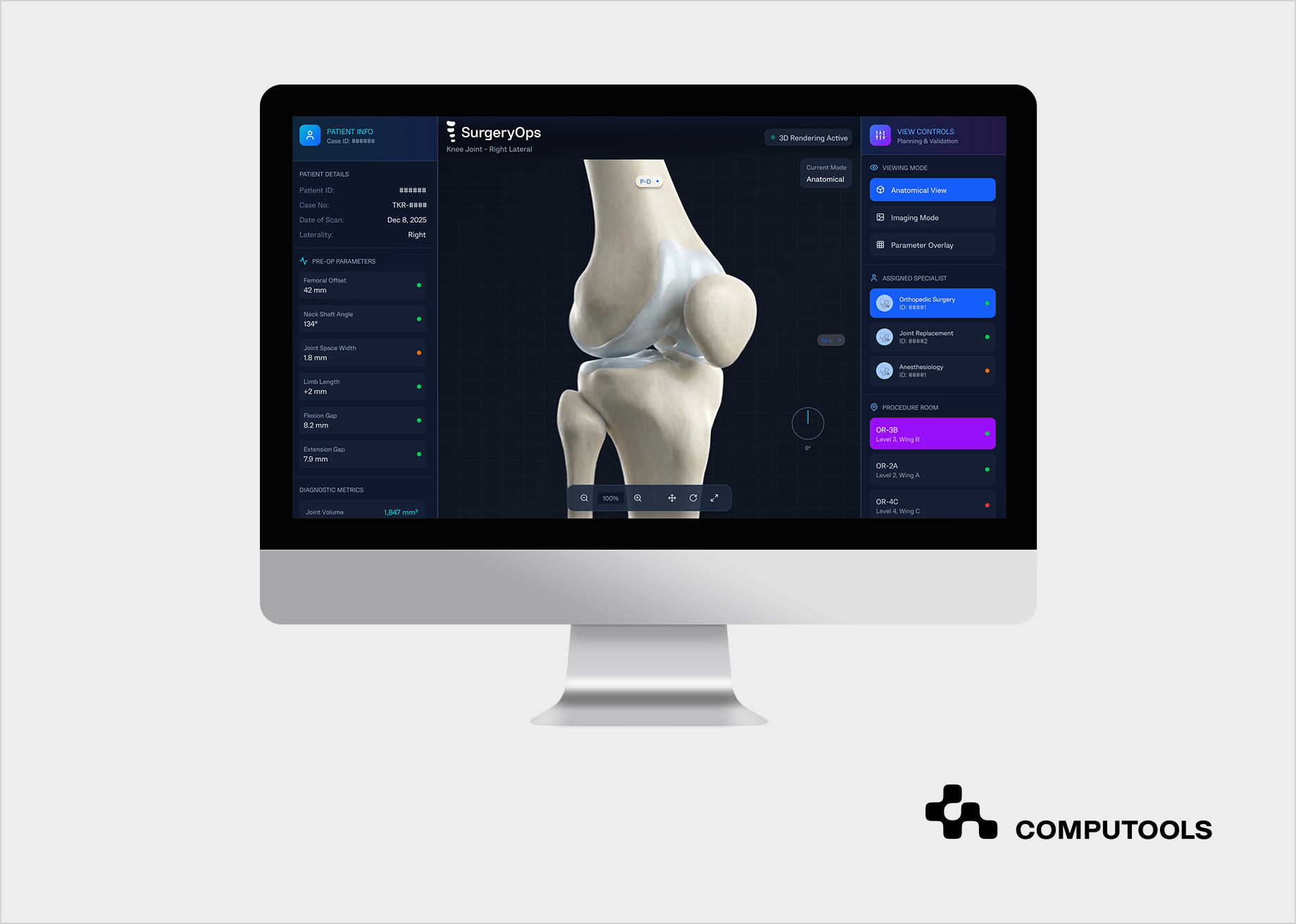
Computools developed a preoperative planning platform that automated the assignment of doctors and patients, the reservation of surgical rooms, the modification of schedules, and the control of diagnostic data. The solution was built with ASP.NET Core, C#, React, Microsoft SQL Server, REST APIs, DICOM integration, role-based access control, encryption, and audit logging. This system empowered the hospital to control scheduling logic, patient data, and internal integrations, while providing secure access, all in one environment.
The effects on the business were the following:
- Planning time decreased by 60%.
- Planning errors were reduced by 40%.
- Conflicts and idle procedure rooms were eliminated by 98%.
- The platform also provided better patient data security using encryption and role-based access.
SurgeryOps proves that procedure optimization depends on more than analytics dashboards. Hospitals need structured data, secure integrations, automation, access control, and workflow logic that reflect how surgical teams actually operate. The same principles apply when building a surgical analytics platform for operating room efficiency, surgical scheduling optimization, and surgery performance analytics.
How to develop a surgical analytics platform step-by-step
When constructing a surgical analytics platform to enhance the optimization of surgical procedures, we must first define the operating model and then the technology to go with it. This includes merging surgical planning, operating room analytics, staff availability, and patient data, in addition to automation, artificial intelligence, integrations, and security, all within a single managed system.
1. Define the Surgical Operating Model
The first step is to define the platform scope. Construction of a single department analytics platform, a hospital-wide operating room analytics system, and a multi-site surgical platform will all have differing requirements for software architecture, data ownership, and access and integration models.
The team needs to identify which of the many workflows the platform will support.
These may include:
- elective workflows;
- urgent workflows;
- the pre-op planning and optimization;
- room optimization;
- integration and coordination of equipment;
- assignment of surgeons and support staff;
- post-op analysis;
- performance reporting across all facilities.
This matters because surgical workflow optimization relies on a variety of real operational constraints.
From a technical perspective, the system must include distinct representations of procedures, patients, surgeons, anesthesiologists, surgical rooms, equipment, case priority, estimated duration, pre-op status, post-op status, diagnostic dependency, schedule change, and audit event. Boundaries must be placed around each of these system elements to protect module and system integrity for scheduling, analytics, access, integration, and notifications.
If the operating model is not deep enough, the system will struggle to detect conflicts, calculate room utilization, or support surgical scheduling optimization. For example, an available room is not truly available if it lacks the required equipment, assigned staff, or completed diagnostic data.
2. Build a Clean Data Foundation
AI surgical analytics solutions rely on data that is clean, structured, and traceable. Predictive analytics for surgery cannot be embedded into the operating model if a hospital does not first determine which data sets to capture, and which ones to cleanse, normalize, and interconnect.
Examples of data sets that are essential to improve predictive analytics include: type of procedure and its historical average duration, available operating rooms, staff and physician availability, patient demographics, medical records and laboratory test results, instances and reasons for delays and cancellations, and the required medical equipment and supplies. This data should also be supported with definitions for a source system, ownership, update frequency, validation, and retention policies.
The data layer may combine an operational database for live workflows with an analytics warehouse for historical reporting and model training. The operational database supports scheduling, room allocation, and user actions. The analytics layer supports surgery performance analytics, utilization reports, forecasting, and AI model improvement without slowing down daily work.
Poor data quality creates direct operational risk. If procedure duration data is inconsistent, predictions will be unreliable. If room availability is not updated in time, coordinators may create conflicts. If patient records are duplicated, staff may spend extra time verifying basic information.
In the SurgeryOps project, Computools built the planning logic around structured scheduling data, patient parameters, role permissions, DICOM support, and internal system integrations. The same principle applies to custom surgical analytics software: analytics should start with a controlled data model, not disconnected reports.
If your organization needs to design the data layer before adding analytics or AI, read Computools’ guide on how to build a healthcare data platform.
3. Design Architecture for Real-Time Coordination
Surgical analytics software should support fast operational updates because operating rooms depend on limited shared resources. A change in one schedule can affect surgeons, nurses, anesthesiologists, equipment, recovery areas, and patient flow.
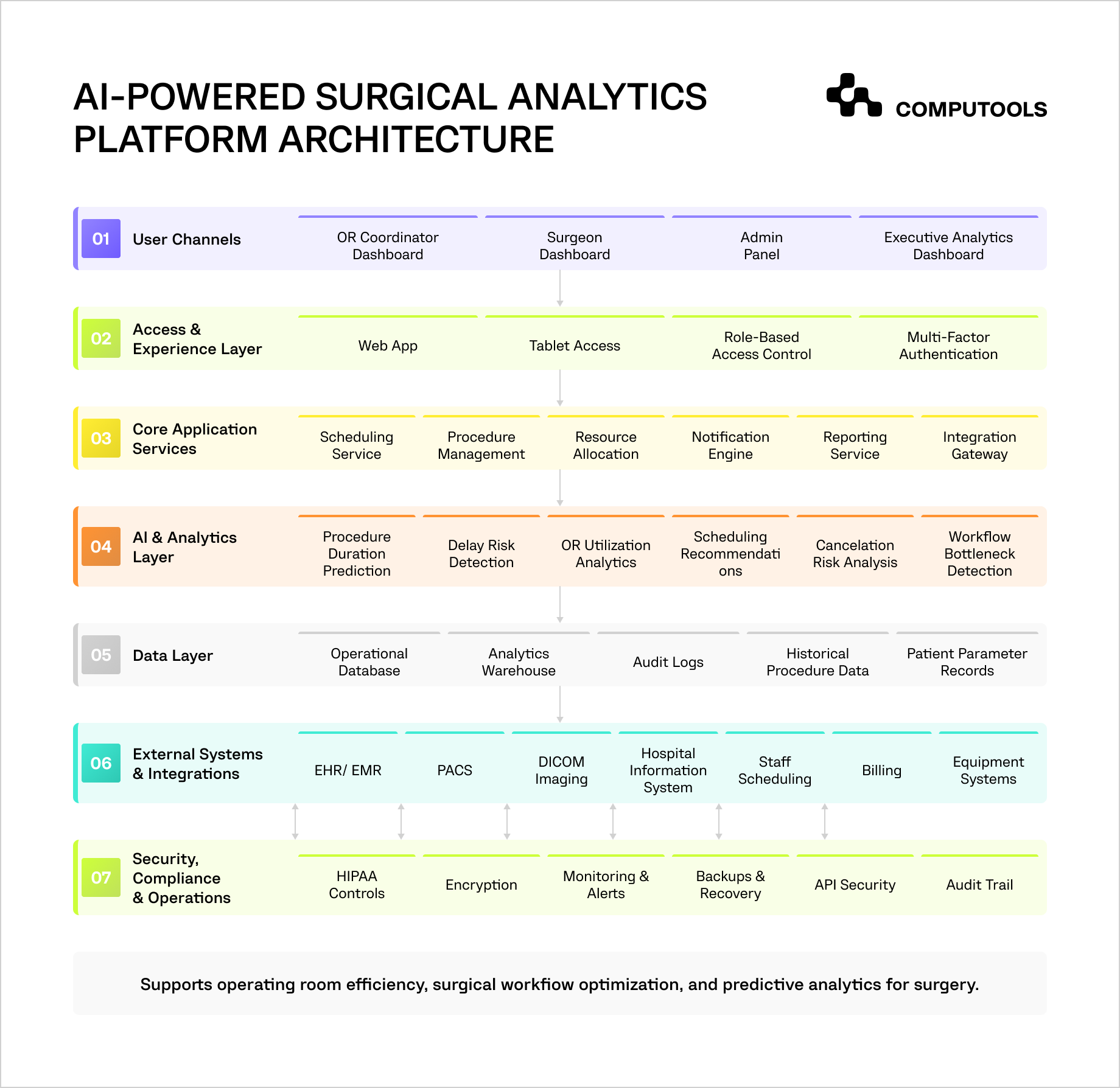
A practical architecture can include:
- Web interface for coordinators, surgeons, administrators, and executives.
- API gateway for controlled access to platform services.
- Scheduling service for case placement and conflict detection.
- Procedure management service for case status and patient-related workflow.
- Resource allocation service for rooms, staff, and equipment.
- Analytics service for utilization, delay, and performance reporting.
- Notification service for alerts and task updates.
- Integration layer for EHR, EMR, PACS, DICOM, billing, and staff systems.
- Operational database for active workflows.
- Analytics warehouse for historical data and AI training.
- Audit and compliance module.
- Observability layer for logs, metrics, traces, and system health.
Real-time logic should be event-driven. Key events may include case created, room assigned, surgeon unavailable, procedure delayed, case cancelled, urgent case inserted, diagnostic file attached, conflict detected, or room released. These events can update dashboards, trigger notifications, write audit records, and refresh analytics.
For high-change workflows, the platform should also include concurrency controls. Optimistic locking, idempotent API requests, conflict resolution rules, and transaction boundaries reduce the risk of two users changing the same schedule at the same time.
If real-time coordination is ignored, users may work with outdated schedules. This can lead to double bookings, missing dependencies, idle rooms, and avoidable delays.
For a deeper technical view, read Computools’ guide on how to design HIPAA-compliant AI architecture.
4. Create Surgical Scheduling Optimization Logic
A surgical analytics platform should do more than show available time slots. It should support decisions around operating room efficiency, staff workload, room suitability, procedure duration, case priority, and resource availability.
Hospitals need to define what the platform should optimize. Some organizations may focus on reducing idle room time. Others may prioritize fewer cancellations, better urgent case handling, balanced surgeon workload, lower overtime risk, or higher room utilization.
The scheduling engine should combine business rules, constraints, and historical data.
Core rules may include:
- Surgeon availability.
- Anesthesiologist availability.
- Room suitability.
- Equipment requirements.
- Procedure duration estimate.
- Turnover time.
- Patient readiness.
- Case priority.
- Specialty-specific block time.
- Urgent case insertion.
- Recovery capacity.
- Compliance or staffing limits.
At the technical level, the first version can use deterministic rules and conflict detection. Later versions can add optimization algorithms, priority scoring, and predictive duration models.
For example, the system can rank schedule options by risk level: low conflict risk, expected overtime, equipment dependency, room utilization, or historical delay probability.
This prevents the platform from behaving like a simple calendar. If a procedure usually takes 90 minutes but often runs longer for a specific specialty, the system should adjust planning assumptions. If a room lacks required imaging equipment, the platform should block the assignment before staff make the mistake manually.
5. Add AI Features Where They Improve Decisions
AI for surgical workflow should support planning and operational control. It should not replace clinical judgment or produce recommendations that staff cannot verify.
Useful AI capabilities include procedure duration forecasting, delay risk detection, schedule recommendations, cancellation risk analysis, room utilization prediction, and workflow bottleneck detection. AI-assisted search can help staff find cases, doctors, rooms, diagnostic files, or schedule conflicts faster.
The AI layer should have a clear pipeline:
- Data ingestion from operational and historical systems.
- Data cleaning and normalization.
- Feature creation for procedure type, room, specialty, surgeon, duration, delay history, and resource use.
- Model training and validation.
- Human review of recommendations.
- Controlled model deployment.
- Monitoring for accuracy, drift, and rejected recommendations.
For example, the platform can flag that a planned schedule has a high overtime risk because several procedures in the same specialty often exceed estimated duration. It can also recommend moving a case to another room if equipment, staff availability, and turnover time make that option more reliable.
The business value is practical: less manual checking, faster planning, better resource use, and stronger visibility into operating room performance analytics. Still, AI should only be added after the platform has clean data, clear rules, validation controls, explainable outputs, and feedback loops from real users.
6. Integrate the Platform With Hospital Systems
Surgical data analytics becomes valuable when the platform connects with existing hospital systems. Without integrations, staff will continue entering the same data in several places, and analytics will not reflect current operations.
Commonly used integrations include EHRs, EMRs, PACS, DICOM imaging systems, hospital information solutions, employee scheduling tools, billing software, equipment management and laboratory systems, as well as identity providers.
An integration layer should provide APIs and data mapping with safety assurances, validation specifications, and methods for retries with proper error reporting. It should provide access restrictions and data ownership for each field. The integration layer may need to support specific healthcare data and security standards for HL7, FHIR, DICOM, and OAuth 2.0 in conjunction with OpenID Connect and SAML, depending on the specific healthcare institution’s infrastructure.
The platform should be built to handle partial failures. If diagnostic data is incomplete, the system should notify the appropriate person, instead of failing to provide information. If diagnostic data is delayed, the request should be captured and repeated. The failure should be reported and logged for a technology team to review.
In SurgeryOps, our team used REST APIs with DICOM to integrate surgical plans with internal hospital data, along with the diagnostic workflow systems. For a larger hospital analytics software platform, this integration logic becomes even more important because the system may need to support several departments, specialties, and data sources.
7. Build Security and Reliability Into the Core
Surgical analytics software integrates security at its core. This layer is essential to safeguard the trust of the patient, the operation of the hospital, adherence to the law, and revenue.
Core cybersecurity measures encompass a number of technical elements. These are management of user sessions, management of backups, and monitoring of logs with incident alerts. Other elements include secure management of API calls, user roles and access rights. In complex hospital scenarios, security features may also include access control and functions based on user attributes. This allows permissions to depend on role, department, location, case involvement, and data sensitivity.
Patient data should be minimized where possible. Users should see only the information required for their role. For example, an executive dashboard may show OR utilization and delay trends without exposing unnecessary patient-level details.
Reliability also has a direct business impact. If the platform slows down during morning scheduling, staff may return to spreadsheets. A breach of security in the logs will make a compliance review difficult. Inadequate fine-tuning of access control may lead to exposure of sensitive patient data.
The software should be evaluated against a number of operational scenarios, including the urgent addition of a patient case, reassignment of a case to a different operating room, unavailability of a doctor, missing a diagnostic test, canceled procedures, equipment conflicts, duplicate data for a patient, change of access permissions, failed integration of hospital systems, and delays in response from external systems.
Security should cover infrastructure, integrations, access control, monitoring, and data protection.
If your surgical analytics platform will run in the cloud or use connected healthcare systems, read Computools’ guide on cloud security in healthcare.
8. Test the Platform With Operational Scenarios
QA testing should reflect how surgical teams actually work. Functional testing alone is not enough because most risks appear when users, integrations, permissions, and time-sensitive changes interact.
A strong testing plan should include:
- Unit testing for scheduling rules and calculations.
- Integration testing for EHR, DICOM, staff systems, and billing data.
- Permission testing for each role.
- Load testing for peak scheduling hours.
- Data accuracy testing for reports and analytics.
- Security testing for authentication, access control, and APIs.
- Regression testing after integration changes.
- AI validation against historical data.
- User acceptance testing with surgical coordinators and administrators.
Performance testing should focus on practical thresholds. Dashboards should load quickly during peak coordination periods. Conflict detection should respond fast enough for users to trust the system. Schedule updates should not create inconsistent states across users.
For AI features, testing should include model accuracy, false alerts, missed risks, explainability, and user rejection patterns. If staff often reject a recommendation, the product team should analyze whether the issue is data quality, model logic, unclear explanation, or workflow mismatch.
9. Optimize After Launch
The first version of a surgical analytics platform should create control and visibility. Later versions should improve prediction, automation, reporting, and performance.
Post-launch analytics should track OR utilization, procedure delay time, room turnover, scheduling conflicts, idle room time, cancellation rate, manual planning time, overtime risk, surgeon workload balance, procedure duration variance, and staff adoption.
The platform should also include product telemetry. This means tracking which dashboards users open, which recommendations they accept, where they abandon workflows, how often they override AI suggestions, and which alerts create unnecessary noise.
These signals should feed the product roadmap. If delay reports show repeated bottlenecks in one specialty, the platform should support root-cause analysis. If idle room time increases on certain days, managers should see whether the cause is scheduling logic, staffing, patient readiness, equipment availability, or late diagnostics.
Procedure optimization is not a one-time release. It is a continuous improvement process based on better data, better rules, user feedback, stronger automation, and reliable technical operations.

Launch your AI-powered surgical analytics platform within 1–3 months instead of years, and empower every surgical team with real-time insights that optimize performance, efficiency, and patient outcomes.
Why choose Computools for surgical analytics platform development
A surgical analytics platform has to earn trust from two sides: hospital leadership and surgical teams. Executives need reliable performance data. Coordinators need faster planning. Doctors need accurate schedules. IT teams need secure integrations. Compliance teams need traceable access and audit logs.
Computools builds for all of these requirements at once. We translate hospital operations into product architecture elements. We account for scheduling rules, user roles, procedure data, room constraints, diagnostic dependencies, integration points, analytics logic, and security controls. This is to ensure the product does not turn into a disjointed reporting tool and go unused by the staff.
With healthcare software development services, Computools implements secure data processing, access based on user roles, audit trails, encryption, and compliance-based workflows. With hospital software development services, our company integrates surgical planning with the hospital’s other clinical systems, administrative workflows, reporting, and key performance indicators.
For surgical analytics software, Computools can develop a product’s core building blocks – create a robust backend, connect APIs, develop scheduling with real-time logic, build analytics dashboards, and incorporate AI recommendations with post-product optimization built in. Through our web development services, secure cloud solutions, data engineering, and AI development, we enhance the operating room efficiency and optimize surgical procedures, the scheduling and predictive analytics for surgery.
The SurgeryOps case shows how this approach works in practice. Computools built a secure preoperative planning platform for a U.S. multi-specialty hospital, reducing manual planning time by 60%, planning errors by 40%, and scheduling conflicts and idle procedure rooms by 98%.
For hospitals planning a surgical analytics platform, Computools brings more than technical delivery. The team connects architecture with business outcomes to achieve fewer scheduling conflicts, clearer OR visibility, lower manual workload, stronger data protection, and a platform ready for future automation and AI.
Final thoughts
To develop a surgical analytics platform that provides quantifiable benefits, hospitals must consider it an operational system, as opposed to a reporting dashboard. This system must encompass a controlled environment for scheduling, procedure rooms, physicians, patients, diagnostics, equipment, analytics, automation, and safety.
The best outcomes occur when technical architecture is aligned with real-world surgical operations. The cleanest data produces the most accurate analytics. Secure integrations eliminate manual tasks. AI augments workflows and improves predictive planning when the suggestions are within the workflow and validated. A reliable access control system helps protect patient information and gives teams the data they need to act.
For hospital executives, the improvement in operating room management, a reduction across the board in the time and effort to do scheduling, increased visibility in administrative workloads, and the ability to optimize surgical procedures, speaks for itself. Such a platform would provide the same view of the operational system to executives and surgical teams, so decisions are based on current data rather than fragmented reports.
Computools
Software Solutions
Computools is an IT consulting and software development company that delivers innovative solutions to help businesses unlock tomorrow.