



THE AUTHOR:

Railway IoT integration software is becoming essential as rail networks grow in scale and operational complexity.
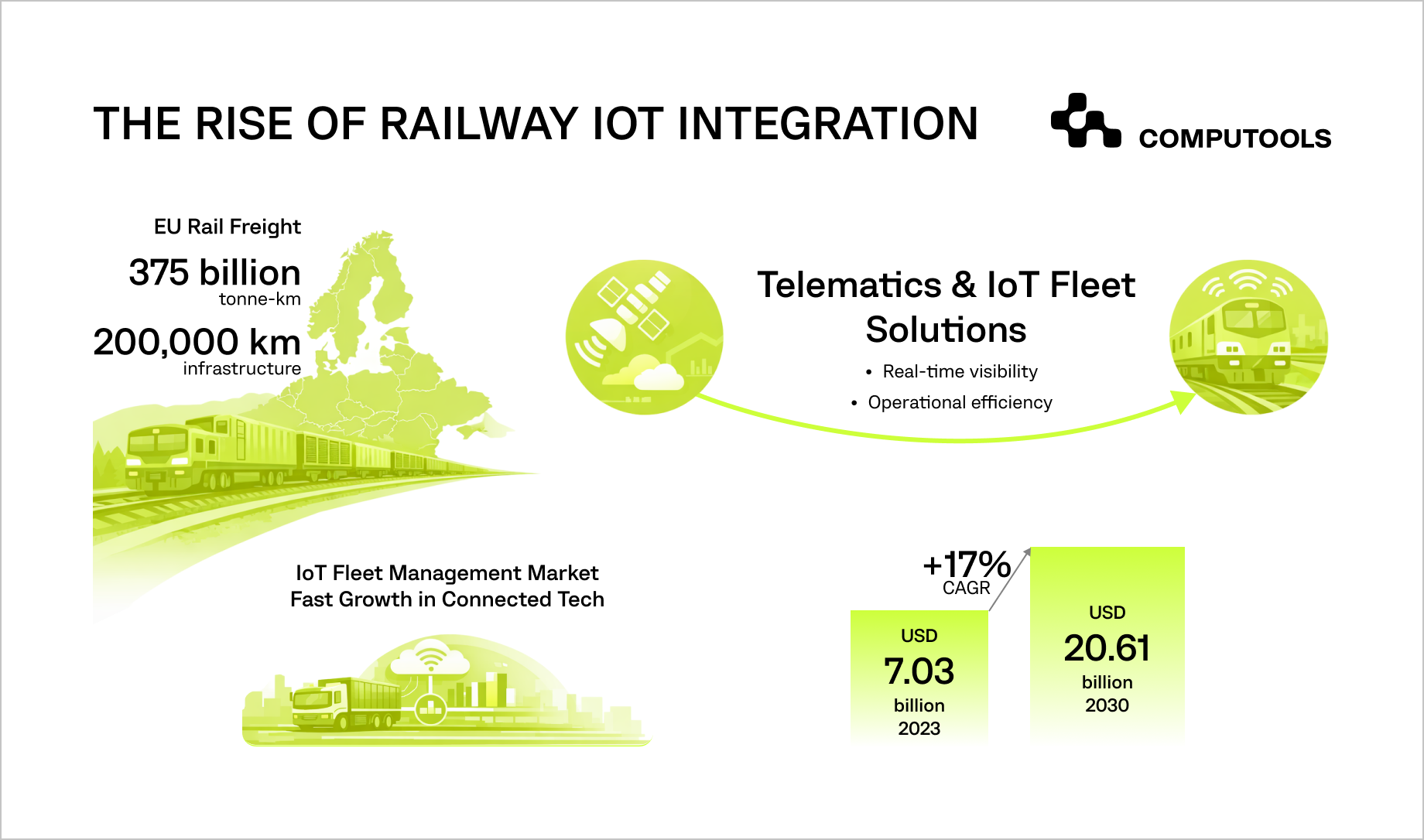
According to Eurostat, rail freight transport in the EU alone exceeds 375 billion tonne-kilometers, operating across more than 200,000 km of railway infrastructure.
At the same time, industry data shows steady growth of railway telematics and IoT fleet management solutions, driven by demand for real-time asset visibility and operational efficiency.
The global Internet of Things fleet management market alone was valued at USD 7.03 billion in 2023 and is projected to reach USD 20.61 billion by 2030, growing at a 17% CAGR, reflecting the rapid adoption of connected vehicle technologies and data-driven operations.
As highlighted by Europe’s Rail initiatives, the future of rail transport depends on digital freight operations, condition-based maintenance, and integrated data-driven systems. In this context, IoT is a core foundation for modern railway fleet management.
However, for many operators, the challenge is not data collection but data utilization. When wagon location, cargo condition, and safety parameters are monitored through disconnected tools or manual checks, operators face delayed incident response, limited visibility into freight conditions, increased inspection workloads, and underutilized rolling stock.
These issues are further amplified in legacy railway environments, where integrating sensors, telematics hardware, and central fleet management systems requires significant effort, secure data transmission, and interoperability across diverse assets and routes.
This was exactly the challenge faced by a Western European rail operator, which required real-time visibility into wagon locations and cargo conditions.
The company needed an IoT-based monitoring system capable of collecting sensor data, ensuring reliable transmission, and transforming it into alerts and actionable insights within a centralized fleet management environment.
How Computools delivered railway IoT integration software for real-time fleet visibility
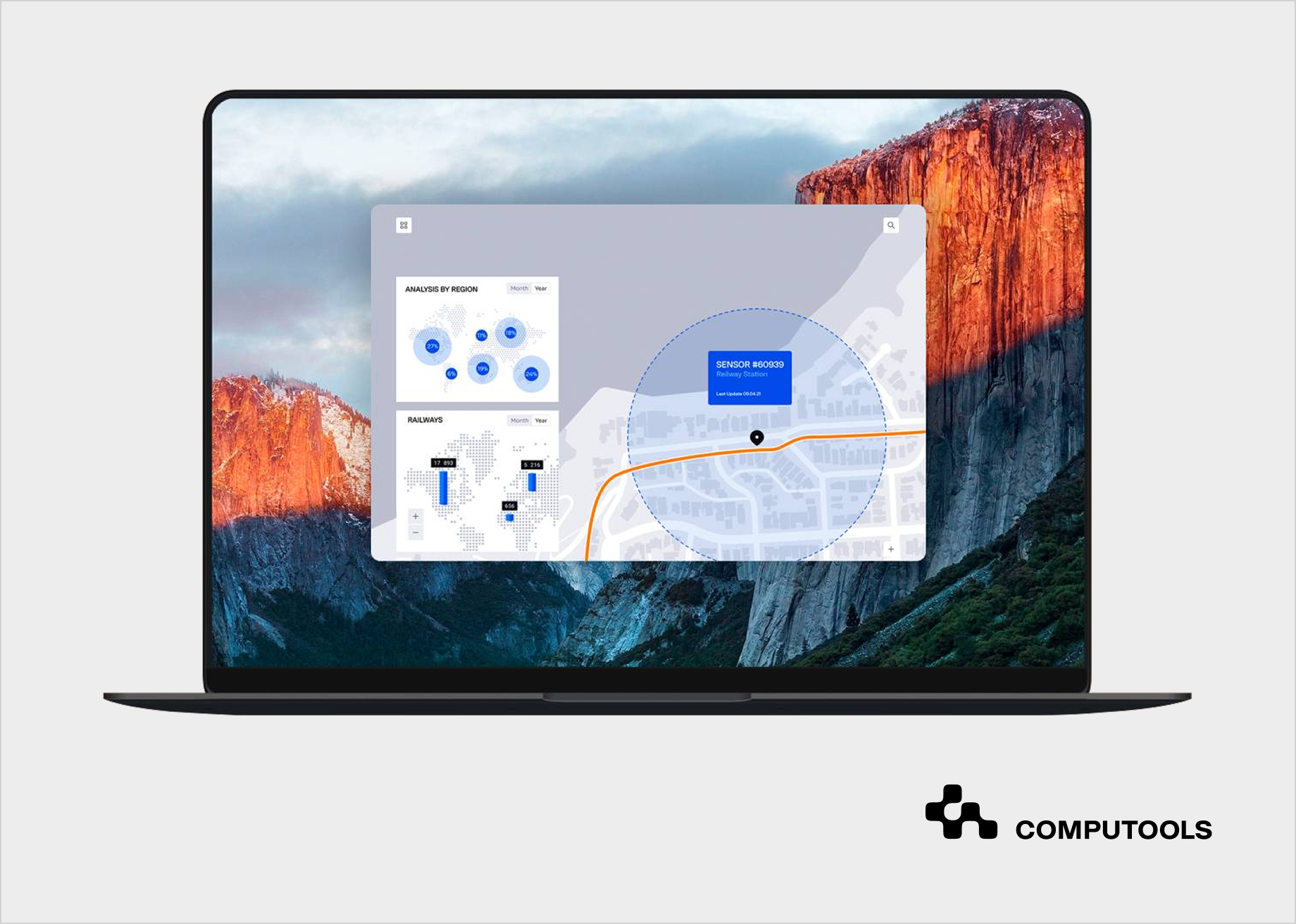
To address this challenge, Computools delivered a tailored railway IoT integration software solution for a Western European rail operator managing a large-scale cargo fleet across a complex transport network.
The core objective was not simply to introduce sensor-based monitoring but to create a unified system that seamlessly integrates real-time data into daily fleet operations. The operator required continuous visibility into wagon location and cargo condition, as well as the ability to detect deviations early and respond without delay.
Building on its expertise in ground transportation software development, Computools designed a solution that connected onboard data collection with centralized decision-making processes. Sensors installed on wagons continuously captured key safety parameters, including temperature, pressure, and load conditions, while a dedicated data acquisition layer structured this information for further processing.
To ensure reliable communication across distributed railway environments, the system used MQTT for lightweight, stable data transmission. Incoming telemetry streams were processed within a centralized platform, where custom logic identified anomalies and automatically triggered alerts, enabling operators to act before issues escalated.
The platform was engineered with a scalable, resilient technology stack, including Java for backend performance, Apache Spark for handling high-volume data streams, and MongoDB for flexible, real-time data storage. This architecture ensured consistent performance even under continuous data load across multiple routes and assets.
Importantly, the solution was implemented as an integral part of operational workflows. Through a unified interface, operators gained real-time insight into wagon status, cargo conditions, and emerging risks, significantly improving situational awareness and response speed. This reflects the broader value of modern IoT development services, where the focus shifts from data collection to actionable intelligence embedded directly into business processes.
As a result, the system enabled continuous 24/7 monitoring of critical parameters, reduced reliance on manual inspections, improved response time to safety-critical events, and increased overall fleet utilization across the network.
This case demonstrates how smart railway fleet monitoring systems can transform fragmented, delayed data into a fully integrated operational layer, enabling rail operators to move from reactive control to predictive, data-driven fleet management.
How to integrate IoT sensors with railway fleet management platforms: step-by-step guide
To make railway IoT adoption deliver measurable operational value, operators need a structured integration approach that connects business goals, field data, analytics, and daily decision-making into one scalable system.
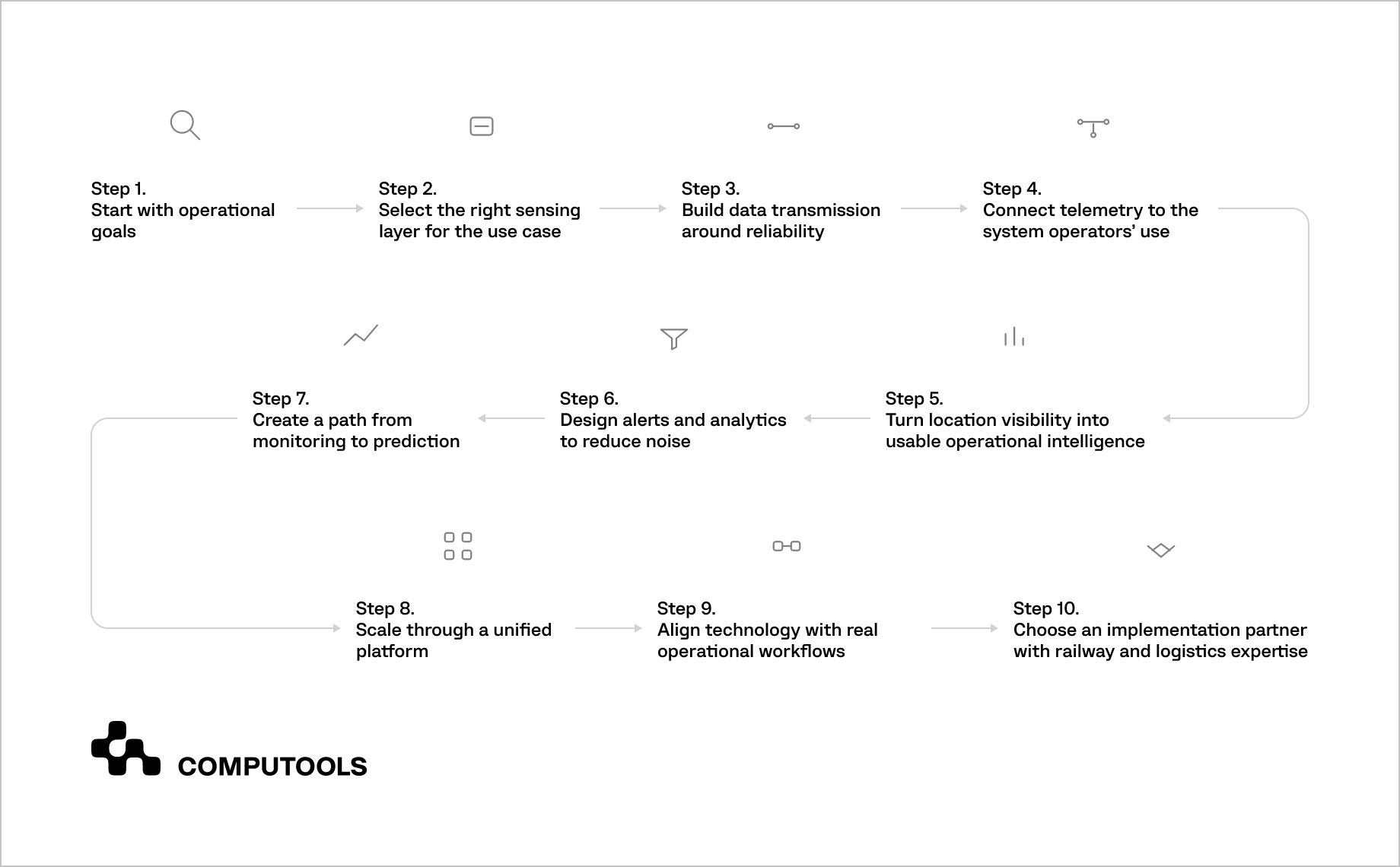
Step 1. Start with operational goals
The first and most important step in any railway IoT initiative is to define the operational outcomes the system must improve before selecting hardware, protocols, or platform components. This may sound obvious, but in practice, many rail digitalization projects become overly technology-led from the start. Operators begin by discussing sensors, gateways, dashboards, and connectivity options before clearly defining the decisions the system should support, the risks it should reduce, and the inefficiencies it should eliminate.
As a result, they often end up with telemetry that is technically impressive but operationally underused.
In rail environments, this risk is especially high because the volume and variety of available data can quickly exceed the organization’s ability to interpret and act on it. A single asset may generate large streams of condition, movement, and diagnostics data, but that data has little business value unless it is tied to concrete operational use cases.
For this reason, IoT integration in railway operations should begin with a structured assessment of where visibility gaps create the greatest operational and financial pressure.
At this stage, operators should identify the exact business problems that justify the investment. These usually include limited visibility into wagon location, a lack of continuous cargo condition monitoring, delayed detection of safety-critical deviations, excessive manual inspections, underutilized rolling stock, poor coordination between operations and maintenance teams, and slow reaction to incidents that escalate because data arrives too late or in fragmented form. The objective is to prioritize pain points by measurable business impact.
That means the project team should define, as early as possible, which operational questions the future system must answer in real time.
For example: Where is the wagon now? What is the current condition of the cargo? Has any monitored parameter moved outside a safe threshold? Does this deviation require immediate intervention or only observation? Which route, asset type, or operating condition is associated with recurring anomalies? Which manual checks can be reduced without compromising safety or compliance?
These questions are far more important at the beginning of the project than the sensor brand or the exact cloud architecture, because they determine what data should be collected, how frequently it should be transmitted, how it should be interpreted, and who must act on it.
This is also the stage where the operator must define success criteria. A railway IoT platform should not be treated as a vague modernization initiative. It should be tied to operational KPIs such as faster incident response, fewer manual inspections, better wagon utilization, improved visibility into cargo condition, reduced unplanned downtime, lower monitoring overhead, or stronger control over distributed assets across the network. Without this layer of business definition, even a technically successful implementation may fail to produce a measurable return.
In the project delivered for a Western European rail operator, this alignment was critical from the outset. The company needed a practical way to improve real-time awareness of wagon location and cargo condition across a large freight network while reducing reliance on manual checks and enabling earlier detection of safety-related deviations. That clarity shaped the entire software architecture. Instead of collecting data for its own sake, the solution was built around operationally meaningful parameters, timely alerting, and centralized visibility for faster decision-making.
This matters because railway systems are rarely built from scratch. They include legacy workflows, mixed asset types, multiple routes, fragmented information sources, and strict operational constraints. Starting with goals rather than devices helps prevent unnecessary complexity later. It keeps the implementation focused on business value, reduces the risk of overengineering, and creates a much stronger foundation for every next step, from sensor selection to analytics, interface design, and integration with existing operational systems.
Step 2. Select the right sensing layer for the use case
Once operational goals are clearly defined, the next step is to design the sensing layer that will generate the data needed to support those decisions. At this stage, the main risk is overengineering: adding too many sensors, collecting excessive telemetry, and creating data streams that are expensive to process but difficult to use in practice.
Railway environments are fundamentally different from consumer IoT. A single asset can produce large volumes of heterogeneous data, often including thousands of parameters and diagnostic signals. However, not all of this data contributes equally to operational value. That is why selecting IoT sensors for railway fleet management requires a disciplined, use-case-driven approach rather than a technology-first mindset.
The sensing layer should be built around a limited set of high-impact parameters that directly relate to safety, cargo integrity, and operational control.
In freight scenarios, these typically include:
• cargo condition (temperature, pressure, load status)
• wagon location and movement
• vibration or abnormal behavior indicators
Instead of attempting to capture everything from the start, it is far more effective to focus on signals that can trigger clear actions. This reduces noise, simplifies integration, and accelerates time-to-value.
In the Computools project, this principle was applied early. The operator did not need a fully instrumented rolling stock from day one. The priority was to monitor key safety parameters and combine them with real-time positioning. By focusing on temperature, pressure, and volume, the system delivered immediate operational benefits without creating unnecessary complexity in data processing or storage.
Another important consideration at this stage is the physical and regulatory environment. Railway hardware must operate under vibration, temperature fluctuations, and limited maintenance access, while also complying with industry standards and certification requirements. This makes sensor selection not only a technical decision but also a long-term operational one.
A well-designed sensing layer provides a stable foundation for the entire system. It ensures that every piece of data collected has a clear purpose, a specific recipient, and a direct connection to operational results.
Step 3. Build data transmission around reliability
After defining what data should be collected, the next challenge is ensuring that this data can be transmitted consistently across a distributed and dynamic railway environment. In practice, data transmission is one of the most underestimated parts of IoT projects, yet it is often the point where systems fail to scale.
Railway fleets operate across large geographic areas, including zones with unstable connectivity, tunnels, and cross-border routes. This means that IoT data integration for rail transport must be designed as a resilient pipeline rather than a simple real-time stream.
At a minimum, the data flow should support:
• continuous data collection from onboard devices
• buffering during connectivity gaps
• secure and lightweight transmission
• centralized ingestion and validation
In our case, this challenge was addressed through a dedicated data-acquisition layer and MQTT-based communication. MQTT was chosen because it provides reliable, low-overhead messaging that performs well in environments with intermittent connectivity. This allowed the system to maintain stable data delivery without overloading network resources or requiring constant connection availability.
Equally important was the separation between data collection and data processing. Sensor data was not sent directly to user interfaces. Instead, it was first aggregated, structured, and validated before being entered into the central platform. This ensured that downstream systems received consistent, usable information rather than raw, fragmented signals.
Designing the transmission this way creates a system that can tolerate real-world conditions. It also prepares the platform for scaling, where hundreds or thousands of assets must send data simultaneously without degrading performance.
Step 4. Connect telemetry to the system operators’ use
At this point, many IoT initiatives reach a technically functional stage but fail to deliver operational impact. The reason is simple: data exists, but it is not integrated into the systems that make decisions. To avoid this, sensor data must be embedded directly into railway fleet management platforms, where it can influence real workflows rather than exist as a parallel monitoring layer. This requires mapping telemetry to operational entities such as wagons, routes, schedules, and event timelines.
In practical terms, this means that every incoming data point should answer a contextual question. Not just “What is the temperature?” but “Which wagon is affected, where is it located, and does this require action now?”
In the Western European rail operator project, the central system was designed to do exactly that. Instead of displaying raw sensor values, it linked data to specific assets and applied logic to detect deviations. Operators interacted with a unified interface that presented location, condition, and alerts together, enabling faster, more informed decisions.
This integration eliminates the need to switch between multiple systems or manually correlate data from different sources. It turns monitoring into control, which is the core goal of IoT in railway operations.
Step 5. Turn location visibility into usable operational intelligence
Location tracking is one of the most common starting points for digitalization, but on its own, it provides limited value. Knowing where an asset is does not explain whether it is operating safely, efficiently, or within expected parameters.
This is why railway asset tracking with IoT should go beyond positioning and combine location data with condition monitoring and event detection. The real value emerges when movement data is enriched with context.
For example, a delayed wagon may not be a problem in itself. But a delayed wagon with abnormal temperature readings becomes a priority. Similarly, repeated deviations on a specific route may indicate infrastructure issues or operational patterns that require attention.
In the implemented solution, real-time positioning was tightly coupled with sensor data. Operators could see not only where each wagon was, but also its condition and any associated deviations. This created a more complete operational picture and reduced the time needed to identify and respond to issues.
By combining location and condition into a single view, the system moved beyond tracking toward true situational awareness.
To better understand how real-time tracking systems are implemented in practice, explore our guide “How to Build a Real-Time Railway Wagon Tracking System Using IoT Sensors.”
Step 6. Design alerts and analytics to reduce noise
As soon as data starts flowing into the platform, the next critical task is making it usable at scale. Railway systems generate massive volumes of telemetry, but in practice, up to 80–90% of that data does not require immediate action. Without proper filtering, operators quickly face alert fatigue, where important signals are lost among low-priority notifications.
This is where real-time railway monitoring software must go beyond visualization and focus on interpretation. The goal is not to show everything but to highlight what matters.
A well-designed system should apply structured logic to incoming data by:
• defining acceptable thresholds for key parameters
• identifying deviations and anomalies
• prioritizing alerts based on risk level and context
• linking alerts to specific assets and operational scenarios
In the Computools solution, this logic was implemented at the central platform level. Sensor data was continuously analyzed, and only meaningful deviations triggered alerts. This allowed operators to move away from manual monitoring and focus on actionable events rather than raw data streams.
The key outcome here is not just better visibility but better decision quality. When alerts are accurate and contextual, response time improves, and operational overload decreases.
Step 7. Create a path from monitoring to prediction
Once a system reliably collects and interprets real-time data, it builds a foundation for advanced capabilities. The next step is to use this data to anticipate issues, not just react to them.
This is where railway predictive maintenance IoT solutions become a strategic extension of the platform. Instead of relying solely on scheduled inspections or reactive repairs, operators can begin to identify patterns that indicate early signs of wear or failure.
However, predictive capabilities should not be treated as a separate add-on. They depend entirely on the quality and consistency of the monitoring layer. Without structured data, historical records, and reliable alert logic, predictive models cannot deliver meaningful results.
In our implemented system, the architecture was designed with this progression in mind. Technologies such as Apache Spark enabled large-scale data processing, while MongoDB supported flexible storage of evolving datasets. This enabled the accumulation of historical data and the preparation of the ground for future predictive models without redesigning the system later.
Moving from monitoring to prediction takes time, but it becomes natural once the data foundation is in place.
Step 8. Scale through a unified platform
As IoT adoption expands across fleets, one of the biggest risks is fragmentation. Many operators start with isolated solutions for specific components, use cases, or vendors. Over time, this leads to multiple platforms, duplicated infrastructure, and increasing integration complexity.
Sustainable connected railway fleet management systems avoid this by consolidating data, logic, and workflows into a unified environment. Instead of connecting multiple specialized tools, the focus shifts to building a platform that can grow with the fleet and support new use cases without major rework.
This approach was central to the Computools project. Rather than implementing separate systems for tracking, monitoring, and alerting, the solution was designed as a single integrated platform. Sensor data, analytics, and operator interfaces were integrated into a single architecture, reducing operational friction and enabling further scaling.
A unified platform also makes it easier to expand from initial use cases to broader scenarios, such as additional asset types, extended routes, or deeper analytics. This flexibility is essential in railway environments, where requirements evolve over time.
Step 9. Align technology with real operational workflows
Even the most advanced platform will not deliver value unless it aligns with the team’s existing workflows. Railway operations require coordination among dispatchers, maintenance teams, and operational managers, each with distinct processes and priorities.
This is why railway operations optimization with IoT depends on aligning technology with real workflows rather than forcing teams to adapt to the system. The platform should support existing decision points, reduce manual effort, and enhance coordination instead of adding new layers of complexity.
In practice, this means:
• presenting data in a clear, actionable format
• integrating alerts into existing response processes
• ensuring that information reaches the right stakeholders at the right time
In our case, the interface was designed to provide operators with a unified view of fleet status, cargo condition, and alerts. This reduced the need to switch between systems and allowed teams to respond faster to emerging issues.
The result was not just better monitoring but also a more efficient operational model in which data directly supported day-to-day decisions.
Step 10. Choose an implementation partner with railway and logistics expertise
Ultimately, the value of a system depends on who builds it. Railway IoT projects rarely fail due to a lack of technology; they fail when solutions do not address real operational needs.
Rail environments are inherently complex, involving mixed fleets, legacy infrastructure, strict safety requirements, and dependencies on routes, load conditions, and operational constraints. If these factors are not addressed early, even a well-designed architecture may fail during implementation or struggle to scale effectively.
That’s why it is important to work with a team that understands how railway operations actually function, not just how IoT systems are built. Experience in logistics software development services matters here because it brings a practical understanding of fleet behavior, cargo flows, and operational decision-making.
In the Western European rail operator project, Computools approached the solution as part of the client’s working environment, not as an isolated system. Data collection, processing, and alerts were designed around how operators track wagons, respond to deviations, and manage cargo conditions in real time. This made the system easier to adopt and reduced the gap between technical capabilities and day-to-day use.
In practice, this means the platform did not require operators to change their work practices. Instead, it supported existing workflows with better visibility, faster alerts, and more reliable data, which is what ultimately defines whether an IoT solution delivers real value.

Want to connect IoT sensors with your railway fleet platform to track assets, performance, and safety in real time? Get a technical assessment and project estimate from experienced engineers.
The future of IoT fleet management
As railway operators move beyond basic monitoring, IoT is evolving into a strategic layer that enables real-time decision-making, business process automation, and system-wide optimization. The focus is shifting from data collection to fast, reliable data utilization.
• AI-driven predictive operations
Artificial intelligence is becoming central to modern IoT fleet management solutions, enabling predictive maintenance, dynamic routing, and automated decision-making. Instead of reacting to issues, operators can anticipate failures and proactively optimize operations.
• Edge computing for faster response
Edge computing allows data to be processed closer to the asset, reducing latency and enabling instant reactions to critical events. This is especially important in railway environments where connectivity may be limited and response time is crucial.
• 5G and real-time connectivity
5G enhances data transmission between trains, infrastructure, and platforms, enabling real-time monitoring, advanced diagnostics, and better coordination across distributed fleets.
• Automation and autonomous systems
IoT is laying the foundation for autonomous and semi-autonomous railway operations by enabling continuous monitoring, safety automation, and data-driven control systems.
• Security and system interoperability
As systems become more connected, ensuring data security and seamless integration across platforms becomes essential. Future solutions will rely on secure architectures and standardized data exchange.
• Sustainability and energy efficiency
IoT supports greener operations by optimizing routes, monitoring energy consumption, and enabling better asset utilization, helping operators reduce both costs and environmental impact.
Challenges and solutions in railway IoT implementation
Despite the clear benefits of digitalization, implementing IoT in railway environments remains a complex process. Operators must deal with fragmented systems, high data volumes, strict regulatory requirements, and the need for seamless integration across assets and infrastructure.
In practice, these challenges directly impact operational costs, asset utilization, and service reliability. Projects that address them correctly can significantly reduce downtime, improve fleet visibility, and unlock measurable efficiency gains across the entire rail network.
| Challenge | Solution |
| Fragmented systems and disconnected data sources across fleets | Implement unified railway telematics and IoT platforms that consolidate data from sensors, devices, and legacy software systems into a single environment |
| High volume of unstructured sensor data with limited usability | Develop structured data pipelines and analytics layers within IoT-based train fleet management systems to transform raw data into actionable insights |
| Complex integration with legacy infrastructure and onboard systems | Use flexible APIs and modular IoT software for railway infrastructure to ensure interoperability across assets and existing platforms |
| Delayed incident detection and response | Enable real-time monitoring, automated alerts, and edge processing to reduce latency and improve operational response times |
| High implementation and integration costs | Start with focused use cases and scale gradually, reducing upfront investment and minimizing integration risks |
| Regulatory constraints and safety requirements | Design systems in compliance with railway standards, ensuring secure data transmission, auditability, and system reliability |
When these challenges are addressed with a well-architected IoT solution, railway operators typically achieve the following:
• reduced unplanned downtime and maintenance costs
• improved asset utilization and fleet availability
• faster incident response and better safety outcomes
• lower operational overhead through automation
• end-to-end visibility across rolling stock and cargo
In large-scale rail operations, even small improvements can significantly affect financial performance, positioning IoT as a strategic investment in operational efficiency.
If your goal is to extend railway solutions into multi-party logistics ecosystems, check out “How to Develop Multi-Carrier Collaboration Platforms for Logistics Ecosystems.”
Why companies choose Computools for railway IoT solutions
Computools helps railway operators design and implement scalable IoT ecosystems that unify fleet monitoring, asset tracking, and operational analytics within a single digital environment.
Our approach extends beyond data collection. We develop systems that transform fragmented operational signals into structured, real-time insights, supporting better decision-making from daily operations to long-term planning. We combine strong engineering expertise with hands-on experience in transportation and logistics.
Our teams leverage AI development services to enable predictive maintenance, anomaly detection, and intelligent automation, while data engineering services ensure reliable processing of large-scale sensor data streams and seamless integration across systems.
Today, Computools brings together 250+ in-house engineers, including software developers, solution architects, data specialists, and DevOps experts. This allows us to design and deliver high-performance systems that scale with growing fleet size, data volume, and operational complexity.
Over 12+ years, we have delivered digital solutions for transportation companies worldwide, including fleet monitoring platforms, IoT-based tracking systems, and advanced analytics tools.
In our projects, operators typically move from limited, fragmented visibility to fully integrated environments where asset location, condition, and performance are tracked in real time.
As a result, companies achieve faster incident response, reduced manual workload, improved fleet utilization, and more predictable maintenance planning, all of which translate into measurable operational and financial improvements.
If you are planning to build or modernize a railway IoT solution, our team will be glad to discuss your project. Contact us: info@computools.com
Conclusion
Railway IoT integration has become essential for operators managing complex, distributed fleets. As rail networks expand and data volumes increase, collecting and acting on real-time information is critical to maintaining efficiency, safety, and competitiveness.
Effective IoT systems allow operators to shift from reactive to predictive, data-driven decision-making. Integrating sensors, IT infrastructure, and analytics enhances visibility, reduces downtime, and optimizes resource use across the network.
Computools
Software Solutions
Computools is an IT consulting and software development company that delivers innovative solutions to help businesses unlock tomorrow.










“Computools was selected through an RFP process. They were shortlisted and selected from between 5 other suppliers. Computools has worked thoroughly and timely to solve all security issues and launch as agreed. Their expertise is impressive.”