
THE AUTHOR:

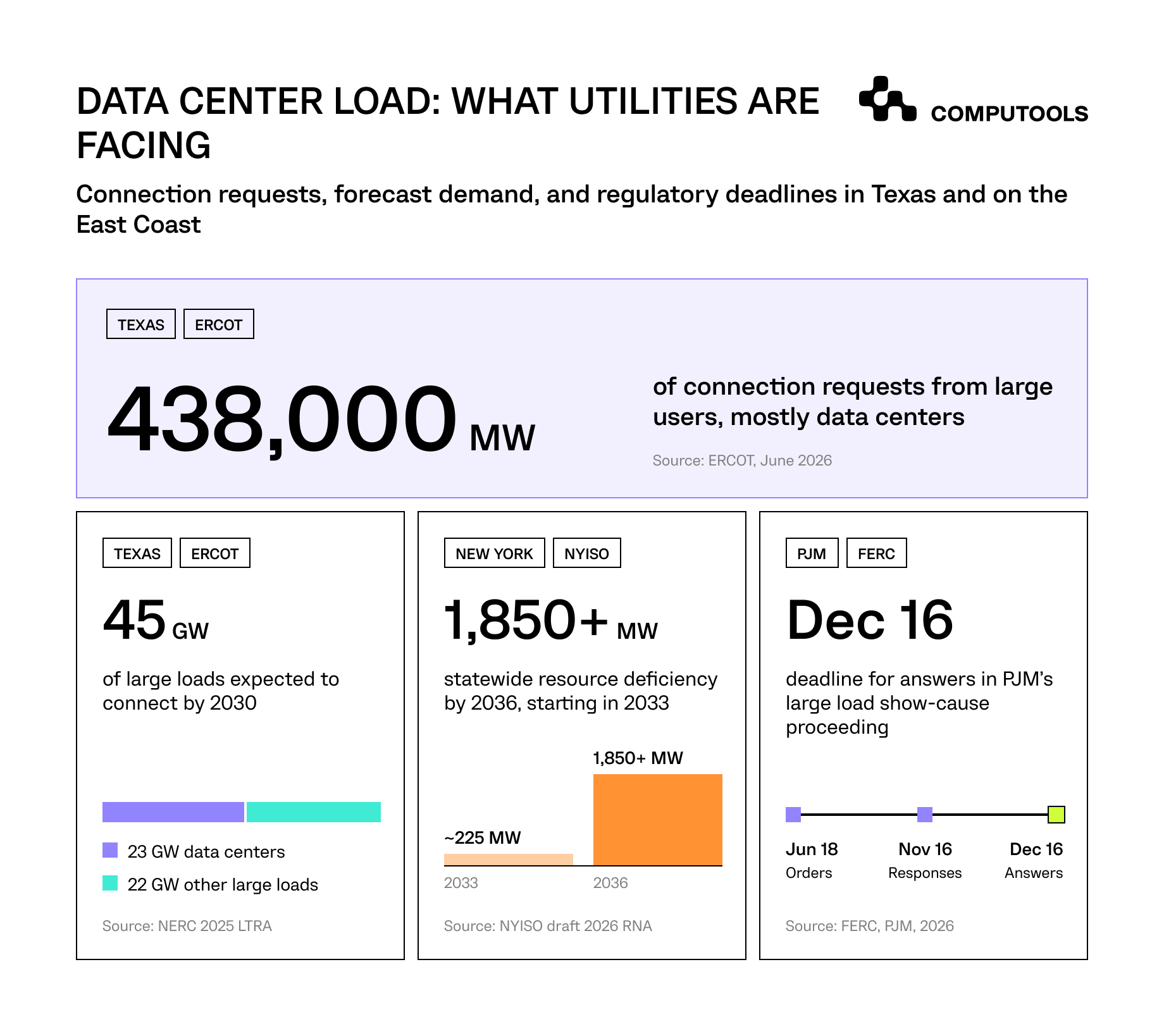
Data centers now ask utilities for hundreds of megawatts at a single site, and every request needs an answer: can the grid carry the load, and who pays for the upgrades? ERCOT alone is tracking more than 438,000 MW of connection requests from large users such as data centers. In many utilities, that answer comes from a manual process, with screening studies, upgrade estimates, cost negotiations, and operating commitments tracked in email, spreadsheets, and planning tools that do not share data. Large load interconnection software keeps each request, study, and commitment in one record, so engineers can screen requests faster and trace every cost to its source.
The rules for these decisions are being rewritten. In six show-cause orders dated June 18, 2026, the Federal Energy Regulatory Commission (FERC) required the grid operators it regulates (PJM, NYISO, ISO-NE, MISO, SPP, and CAISO) to defend their current tariffs or propose changes, finding preliminarily that these tariffs do not account for how data centers and other large loads connect to and use the transmission system. In PJM, FERC put the proceeding in abeyance while PJM prepared tariff filings: responses were due November 16, 2026, and answers to those responses are due December 16.
Texas faces the same question at a larger scale under a separate regulatory structure. ERCOT is not among the six operators covered by the FERC orders, yet NERC’s 2025 Long-Term Reliability Assessment attributes ERCOT’s forecast demand growth mainly to 45 GW of large loads expected by 2030, including 23 GW of data center power demand. Large loads also matter in emergencies: during Winter Storm Fern, the U.S. Department of Energy authorized ERCOT, from January 24 to 27, 2026, to direct backup generation at data centers as a last resort, which required a current list of facilities, generators, and contacts.
On the East Coast, the picture differs by region. NYISO’s draft 2026 Reliability Needs Assessment, which tests utility resource adequacy and transmission security over the next decade, shows a statewide deficiency beginning in 2033 and exceeding 1,850 MW by 2036, with New York City deficient from 2032. ISO New England reports that the region has not yet seen significant load growth from large loads.
Whatever rules each region adopts, utilities need faster, documented interconnection decisions that align with tariffs that keep changing, while grid reliability planning must account for large loads that can curtail or disconnect at once. Below, we first show how Computools solved a comparable problem: processing a high volume of applications from several participant groups with fast, consistent decisions. The following eight-step guide covers the process from the first data center request to energization and winter operations.
How Computools’ application processing experience applies to large load interconnection software
Large load interconnection starts as an application workflow: multiple parties submit data, multiple teams review it, and every decision must follow fixed rules.
Green Energy is a renewable energy investment platform with more than 130 MW of contracted capacity in Thailand, Malaysia, and Vietnam. It finances energy-efficient equipment through loan programs that involve administrators, contractors, and equipment sellers. The application process discouraged users, employees worked in fragmented workflows and could not handle high volumes quickly, and poor coordination between suppliers delayed equipment deliveries.
Computools built a secure web portal with role-based access for each user group. Applicants submit requests and financing details in one place, each application moves through defined approval stages, and customized algorithms speed up the decision.
Results after launch:
- Loan decision time went from 2 weeks to 2 working days.
- The portal processed more than 10,000 applications in two years.

Three elements of this project carry over directly to a utility interconnection software platform: separate roles and access rights for each party, approval stages with defined rules, and a single record that keeps thousands of applications consistent. Large load requests add engineering analysis to each stage: grid studies, upgrade costs, and operating commitments.
How to build large load interconnection software in 8 development steps
A large load request touches planning, transmission engineering, customer service, legal, finance, and system operations. Data center interconnection software must give each team its part of the work while keeping one authoritative record of the large load interconnection process from first contact through energization and emergency operations. Steps 1–4 build that record: what the utility collects, where the data lives, how requests are screened, and who pays for upgrades. Steps 5–8 turn the record into operating data, add decision support, and take the platform into production.
Step 1. Define intake requirements, readiness criteria, and queue rules
The intake form is a data contract between the utility and the developer. Every field on it feeds a later decision, and every missing field turns into an email thread that delays the study. A request without a realistic ramp schedule, a preferred point of interconnection, or a statement of curtailable load forces engineers to chase the developer before any analysis can begin, and an incomplete request that still enters the queue holds a position other customers could use.
Start by listing the decisions the utility makes on each request and working backward to the data each decision needs:
| Data collected at intake | How it is used later |
| Requested demand and ramp schedule by year | Capacity screening, study scope, and planning cases |
| Preferred point of interconnection, voltage level, and alternative sites | Substation and line analysis; fallback options if the first site fails |
| Load composition, including the share of power-electronic computing load | Dynamic studies and ride-through requirements |
| Curtailable demand, notice time, and maximum duration | Firm and non-firm service options; emergency operations |
| On-site and backup generation capacity, fuel type, and runtime limits | Co-location review and emergency dispatch |
| Site control, financial security, and target energization date | Readiness checks, queue position, and cost allocation |
Thresholds and documentation rules differ by region. PJM defines a large load as 50 MW or more at a single site and tracks such loads in its Large Load Registry, accepted by FERC in October 2026, while ERCOT applies its large load interconnection process from 75 MW.
A utility that operates in several jurisdictions, or expects its own rules to change after the FERC proceedings, should keep the megawatt threshold, required documents, study deposit, and the voltage level at which a request moves from distribution to transmission review in configuration tables, versioned by effective date. Changing a threshold then becomes a configuration release with an audit trail, without a code change.
The intake module should apply readiness rules automatically: proof of site control, a paid study deposit, and an energization date consistent with the requested ramp. A request that fails stays in a pending state with a list of missing items visible to the developer, and enters the study queue only after each item is resolved. Queue rules then set the order.
Depending on the tariff, that may be first-come, first-served by complete submission, cluster windows that group requests for joint study, or readiness-weighted priority. The platform should record which rule placed each request where, because queue position affects cost allocation later.
Duplicate requests need their own control. A developer may submit the same campus to several utilities, or split one campus into several smaller requests that each stay below a study threshold. The platform should compare coordinates, parcel identifiers, and ownership entities across requests and route matches to a reviewer before they consume study capacity.
Backup generation and curtailment data collected at intake will be used years later in emergency operations, so it needs the same validation as technical data: generator nameplate capacity, fuel type, permitted runtime, and the name of the person authorized to start the units.
In Green Energy, Computools analyzed requirements and defined user roles and flows before designing the portal. Intake design for large loads benefits from the same order: planning engineers, customer service, and finance agree on the data each stage needs, and the form is built around that list.
Step 2. Design the data model and integration architecture
Every request links to physical assets: a substation bay, a transformer, a transmission line, sometimes a new switching station. The data model must connect the commercial record of the request with the network model engineers use.
Core entities include the customer, site, request, point of interconnection, study, network upgrade, cost estimate, agreement, curtailment commitment, and backup generation unit. Each request also needs version history. Developers revise ramps, move points of interconnection, and split campuses into phases, and every study result, cost estimate, and queue position must stay tied to the version it was based on. Without that link, a study approved for a 200 MW ramp can end up attached to a request that has since grown to 350 MW.
Each entity needs a defined system of record. The interconnection platform reads from these systems and keeps its own record only for the request itself:
| Source system | What the platform reads | Typical integration |
| GIS | Substations, feeders, lines, and their geographic location | Scheduled synchronization and on-demand queries |
| Planning model | Buses, equipment ratings, and approved load cases | Case export or scripting interface of the planning tool |
| Customer information system | Customer accounts, service addresses, and contacts | API |
| ERP | Project codes, upgrade costs, deposits, and payments | API or scheduled file exchange |
| SCADA/EMS | Measured substation and feeder loading | Read-only historian feed |
| Outage management system | Feeder-to-customer connectivity | Event stream or scheduled synchronization |
The hardest mapping is usually between GIS identifiers and planning-model bus numbers. One substation can carry different names in the GIS, the planning case, and the EMS. An engineer-maintained mapping table, with its own change history, prevents a screening run from attaching a 300 MW request to the wrong bus, an error that would distort large load interconnection planning for every later request at that substation. Building and maintaining these pipelines is core data engineering work: a screening result is only as current as the network data behind it.
The platform can be organized into five layers:
- Applicant portal. Collects requests, documents, model files, and deposits, and shows developers status, missing items, and study results.
- Workflow services. Route each request through readiness checks, screening, studies, approvals, and agreements, with deadlines for each stage.
- Analysis services. Run capacity screens, call power flow tools, and calculate upgrade costs and shares.
- Data and integration layer. Synchronizes with GIS, planning models, CIS, ERP, SCADA/EMS, and the outage management system.
- Audit and reporting. Records every decision, rule version, and data change for regulators and internal review.
For a closer look at the monitoring layer, see Computools’ guide to developing a real-time energy asset monitoring platform.
Step 3. Automate capacity screening and track technical studies
Full interconnection studies take weeks or months and require engineering judgment. A preliminary screen can show within days whether a request fits existing headroom, needs local upgrades, or requires a full system study. Its value lies in sorting requests early: developers get a realistic first answer, and engineers spend study time on requests that need it.
Consider an illustrative scenario. A developer asks a utility for 300 MW at a 230 kV substation, ramping from 100 MW in 2028 to 300 MW in 2030. The screen compares each ramp year with the remaining capacity after existing and approved loads, checks thermal limits under single-contingency conditions, and flags transformers and lines that would exceed their ratings. The result is a short report: 100 MW fits within current headroom, the remaining 200 MW requires a transformer addition and line reconductoring, and a full study is needed before any firm commitment.
Screen a request against existing load, approved requests, and requests ahead of it in the queue, using seasonal equipment ratings, since winter and summer ratings differ. When a request ahead of it withdraws or changes its ramp, the platform should re-run the screens that depended on it and notify the affected developers.
Data center grid interconnection requires studies that conventional load connections rarely need. Power electronics dominate data center demand, and large blocks can disconnect at once after a grid fault. On July 22, 2026, about 3,800 MW of data center load in Northern Virginia disconnected from the PJM grid and transferred to on-site backup generation after a normally cleared fault on a 230 kV line. On May 4, 2026, NERC issued a Level 3 Essential Actions alert on computational loads covering modeling, studies, instrumentation, commissioning, operations, protection, and control. In Texas, ERCOT’s ride-through requirements under NOGRR 282 took effect on August 1, 2026.
The platform should track which studies each request needs: steady-state thermal and voltage analysis, short-circuit analysis, dynamic stability, and electromagnetic transient studies where the grid is weak. It should also track which model files the developer has submitted for each study, including equipment tripping and ride-through behavior. A missing or unvalidated model automatically blocks the study step, so the gap surfaces on the first day of the study.
Screening should call the utility’s existing power flow tools, such as PSS®E or PowerWorld, through their scripting interfaces, so network calculations stay in tools engineers already trust. The software manages cases, inputs, and results; engineers keep ownership of the methods. Before teams rely on the screening logic, they should validate it against completed studies and keep the comparison as part of the platform’s documentation.
Over time, screening results build a running view of remaining headroom by substation. That view supports grid capacity planning, because it shows where the next large request, or the loss of a major line, would leave the network without margin.
Step 4. Calculate upgrade costs and allocate responsibility
Many disputes between utilities and large customers start with cost allocation. In its show-cause order to PJM, FERC pointed to the need for transparency in how network upgrades are assigned to large loads and for a pro forma cost recovery agreement. The software should show how each cost was derived, along with the total.
Every upgrade identified in screening or study needs its own record: scope, estimated cost, estimated class, the requests that trigger it, and the share assigned to each. When several data centers trigger the same transformer replacement, the platform calculates the shares under the tariff rule in force and keeps the calculation reproducible: the same inputs and rule version must produce the same result a year later, when a regulator or a customer asks.
| Cost element | What the software records |
| Direct connection facilities | Assets used only by the customer and their cost |
| Network upgrades | Shared upgrades, triggering requests, and the allocation method |
| Security and deposits | Amounts, due dates, and refund conditions |
| Milestone payments | Construction schedule and payment status |
| Estimate revisions | Each new estimate, its class, its date, and the reason for the change |
Estimates mature as a request moves through the process. A screening estimate carries a wide accuracy range, while a facilities study estimate is close to final. Storing the estimate class on every cost line lets developers, finance teams, and regulators see how firm each number is.
Withdrawals need explicit handling. If a data center leaves the queue after a shared upgrade was sized for it, the remaining customers’ shares change. The platform should calculate that effect before accepting the withdrawal, so it can apply security forfeiture and refund rules with the numbers in hand.
Because tariff rules change across regions, store allocation rules as configuration and version them by effective date. A request studied under one rule and signed under another must show which rule applied at each stage. Cost records should also flow to the ERP under project codes, so finance sees deposits, milestone payments, and refunds in the same ledger as other capital projects.
Step 5. Model flexible service and curtailment commitments
Flexibility is becoming part of the interconnection decision. In PJM, FERC has already required firm and non-firm contract demand services for co-located loads: a customer either reserves a defined amount of firm grid use or accepts interruptible access. In October 2026, FERC rejected PJM’s broader interim curtailment plan for new large loads, so in PJM flexibility currently depends on the transmission service a customer takes, and the show-cause proceeding may extend such services beyond co-located loads.
In Texas, Senate Bill 6 requires large loads connected after December 31, 2025, to accept curtailment during firm load shed events and creates a voluntary program under which loads of 75 MW or more can ramp down or switch to backup generation at a utility’s request.
Flexibility changes data center load planning. NYISO’s draft assessment found that if all new planned data center loads were flexible and curtailed during peak periods, the statewide need in 2036 would fall from about 1,850 MW to 850 MW. For a utility, a request that accepts curtailment may connect earlier or with smaller upgrades, so the screening step should be able to test both firm and flexible versions of the same request.
The software should store each commitment as data operators can act on: curtailment megawatts, notice time, maximum duration, number of events per season, backup generation capacity and fuel type, emission permit limits, and the contacts and channels for dispatch notices. A firm customer, a non-firm customer, and a customer with interim service until upgrades are built each need a different service record, because each is curtailed under different conditions. When upgrades are complete, the platform should move the customer from interim to permanent service and automatically update the operating limits.
Commitments are reliable only after testing. The platform should schedule test events, compare actual response with the committed megawatts and notice time, and flag customers whose performance falls short. If a data center commits 150 MW within 30 minutes but delivers 90 MW in a test, operating plans should count it at the demonstrated value until a retest proves otherwise.
Step 6. Connect large load data to winter emergency operations
Winter storms turn interconnection records into operating data. The list ERCOT relied on during Fern, covering facilities, generators, and contacts, has to exist and stay current before the next emergency.
The large load registry should feed control room tools and the outage management system directly. For utility large load management during an emergency, operators need to see, by substation and feeder, which large customers can curtail, which have backup generation available, and which have already been called during the event.
Each emergency instruction should follow a defined workflow: operator decision, notice through primary and backup channels, customer acknowledgment, confirmation of load reduction from metering, and release when conditions recover. The platform timestamps every step. The same log supports the reporting duties that come with emergency orders.
A pre-winter readiness cycle keeps the registry usable. Before each season, the platform can ask every large customer to confirm contacts, generator availability, fuel arrangements, and permitted runtime; schedule test events for customers who haven’t been tested; and give operators a list of unconfirmed records.
Step 7. Add AI forecasting and decision support
AI is useful at two points in this process: estimating which requests will materialize and helping operators choose which curtailment commitments to call first. Tariff rules and engineering studies remain deterministic.
| AI capability | Practical use |
| Request realization scoring | Estimates the likelihood that a request reaches energization, based on readiness data, deposits, and history. |
| Duplicate request detection | Flags submissions that appear to describe the same project under different names. |
| Load ramp tracking | Compares actual consumption with contracted ramps to update planning cases. |
| Curtailment recommendations | Suggests which commitments to call first within notice and duration limits. |
| Document extraction | Pulls ramp schedules, site data, and generator specifications from developer submissions. |
Realization scoring has the most direct effect on planning. When planning cases include every requested megawatt, the utility may plan upgrades for projects that never materialize; when they discount requests by a fixed factor, they miss the ones that do. A score built on readiness data lets planners weigh each request by its own evidence and see which assumptions drive the result. Combined with load ramp tracking, the score gives large load forecasting two inputs for each customer: the probability that the project materializes and its actual consumption against the contracted ramp.
Each model needs defined inputs, a retraining schedule, and drift monitoring. For example, recalibrate request realization scores after each queue cycle because tariff changes alter developer behavior.
Computools’ guide to AI-powered predictive analytics software for energy infrastructure explains how to train and monitor such models.
Building these models is an AI development task that depends on several seasons of consistent request, load, and operating data. Every output should remain a recommendation. Interconnection decisions carry regulatory and financial consequences, so engineers and operators approve them, and the software records who did.
Step 8. Secure, test, and deploy the platform
Large load requests contain commercially sensitive data: site locations, power demand, and construction timelines that developers rarely disclose. Network models and study results may also fall under Critical Energy/Electric Infrastructure Information (CEII) rules. Role-based access must separate developers, give each internal team only the data it needs, and log every access.
The developer portal faces the internet and should sit behind single sign-on with multi-factor authentication. Connections to SCADA and EMS data should be read-only and pass through the utility’s existing security zones, so the interconnection platform never becomes a path into operational systems.
Testing should reproduce the conditions in which the process fails:
- Two requests competing for the same substation headroom.
- A tariff rule change that takes effect in the middle of a study.
- A failed synchronization with the planning model during a screening run.
- A cost estimate revision after the customer has signed.
- An emergency notice sent while customer contact data is out of date.
- A withdrawal that changes the shares of a shared upgrade.
- A rollback of a published study result.
Deployment works best in phases. A utility can start with intake and the registry, run the platform in parallel with the existing process for one study cycle, and then add screening, cost allocation, and emergency integration. Each phase should be validated against completed manual work before the old process is retired. Data migration deserves its own plan: active requests, signed agreements, and existing curtailment commitments must move into the platform with their history, or the first winter after launch will run on two lists.
Computools delivered the Green Energy portal in Scrum, with the client reviewing progress and priorities throughout the project. A phased large load platform benefits from the same rhythm: the teams that will work in it review each release.

Cut interconnection cycle time, reduce engineering workload, and avoid costly allocation disputes with custom large-load interconnection software built around your utility’s systems and tariff rules.
How to measure the business value of the platform
A shorter study cycle matters, but utilities and regulators will judge the process on accuracy, transparency, and reliability as well.
| KPI | What to measure | Why it matters |
| Request completeness | Share of requests that pass intake checks without resubmission | Fewer engineering hours spent chasing missing data |
| Time to preliminary screen | Days from a complete request to a screening result | Faster answers for developers and earlier visibility of grid constraints |
| Study cycle time | Days from study start to issued results | Shorter queues and fewer requests stalled by changing rules |
| Cost estimate accuracy | Difference between estimated and final upgrade costs | Fewer disputes over cost allocation and fewer revised agreements |
| Queue realization rate | Share of requested megawatts that reach energization | More realistic planning cases and less capacity held for speculative projects |
| Registered curtailable load | Megawatts with verified curtailment or backup generation commitments, by zone | Operators know how much load they can reduce before an emergency |
| Emergency notice time | Minutes from an operator decision to customer confirmation | Load reduction arrives while it can still prevent outages |
Record these metrics before development starts. Without a baseline, the utility has no evidence to show regulators and stakeholders that faster screening or more accurate cost estimates improved performance.
What Computools brings to utilities handling large load requests
Computools has built software since 2013, works with a team of 250+ specialists, and has delivered 10+ projects in electric power utility software development through its energy software development services, covering smart grid management, SCADA and remote monitoring, and grid asset management.
For large load integration for utilities, these capabilities apply directly:
- System integration: Connecting GIS, SCADA/EMS, ERP, and planning systems through APIs and data pipelines.
- Workflow automation: Managing large-load applications, technical reviews, approval stages, and regulatory records.
- Capacity and cost analysis: Integrating power system simulation tools, screening grid constraints, and tracking network upgrade costs.
- AI-powered decision support: Applying machine learning to request readiness assessment, load ramp tracking, and curtailment planning.
Computools has also worked directly with utility data. In MeterSnap, a mobile app built for a major African utility, neural-network meter recognition and geolocation checks cut late meter submissions from 25% to 10% and reduced manual corrections and excessive onsite inspections by 82%.
Planning for new data center requests and changing tariff rules? Contact us at info@computools.com to scope a first release around your intake, study, and emergency processes.
Conclusion: preparing for the next wave of data center requests
Data center requests now arrive in volumes the current rules were not written for. FERC has asked six grid operators to revise their tariffs, Texas is building its own framework under Senate Bill 6, and each region may settle on different thresholds, study processes, and cost rules.
Utilities that keep every request, study, cost, and curtailment commitment in one record can respond to developers faster, explain each cost to regulators, and adapt to new rules without rebuilding the process. Large load interconnection software provides that record, and the same data tells operators which large customers can reduce load or switch to backup generation when a winter emergency comes.
Computools
Software Solutions
Computools is a global IT consulting and software engineering company that helps businesses grow revenue, reduce costs, and launch new products through an AI-native delivery model.