
THE AUTHOR:

A student requests a program transfer. Academic staff check eligibility, an adviser reviews completed credits, finance checks outstanding balances, and the registrar updates enrollment records. Choosing among academic workflow automation companies means finding a partner that helps coordinate these decisions and keep the systems involved accurate.
Top 20 academic workflow automation companies:
1. Computools
2. Aristek Systems
3. Itransition
4. ScienceSoft
5. Iflexion
6. SEVEN
7. Belitsoft
8. Netguru
9. Innowise
10. Intellias
11. Ellucian
12. Kuali
13. Workday
14. Oracle
15. Salesforce
16. ServiceNow
17. Laserfiche
18. ProcessMaker
19. Jenzabar
20. Unit4
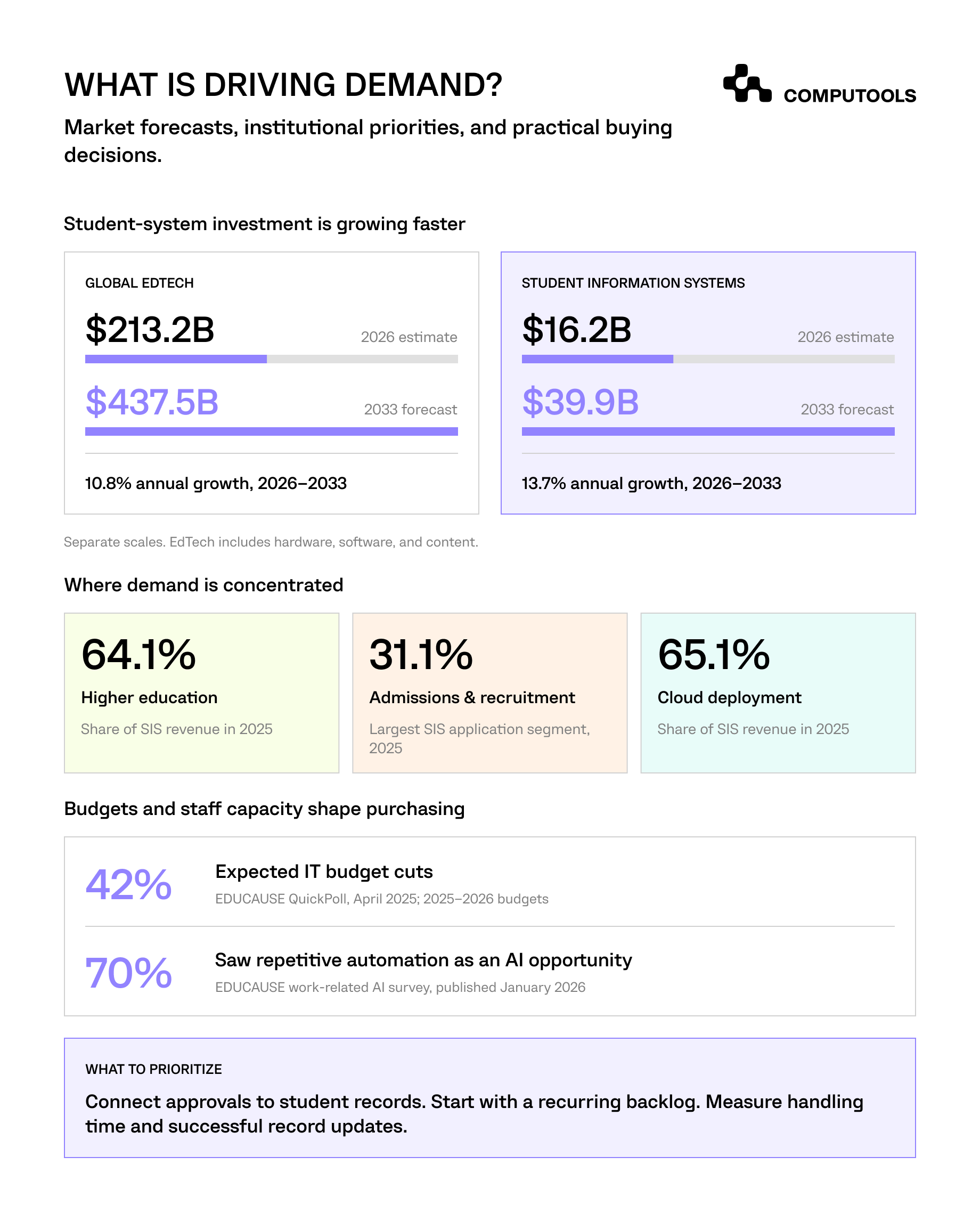
EdTech and student administration solutions are experiencing rising investments. Of the two, the student administration segment is growing at a higher rate. Grand View Research has estimated the global EdTech industry valuation of $213.2 billion in 2026 and further reaching $437.5 billion by 2033 at a CAGR of 10.8%. The student information system research anticipates faster growth in the SIS market at a CAGR of 13.7%, reaching a valuation of $39.9 billion by 2033 from an estimated $16.2 billion in 2022.
A closer look at the SIS market provides insight into the demand from institutions. In 2025, Grand View Research estimated the higher education segment would account for 64.1% of the total market, while admissions and recruitment represented the largest application segment at 31.1%. Faster growth in the services segment compared to the software segment suggests that the purchasing of applications is not the only work. The services may include integrating the solutions to other administrative systems already in place.
For buyers, these trends point toward these priorities for higher education workflow automation:
| Market development | What it means for your institution | What to include in the project scope |
| Admission processing is the largest application segment in SIS. | Application review involves collection of documents, eligibility checks, making admission decisions, and creating student records. | Missing-document reminders, reviewer assignments, exception handling, and transfer of accepted applicants into the SIS without re-entering their details. |
| Cloud implementations accounted for 65.1% of the revenue in SIS in 2025. | Most of the processes are highly dependent on the integration between hosted applications and other campus systems. | Identity integration, documented interfaces, failed-update alerts, and reconciliation checks before a request is marked complete. |
| North America held 33.5% of SIS revenue; Asia Pacific is forecast to grow fastest. | Institutions operate under different language, reporting, hosting, and admissions requirements. | Country-specific rules, configurable academic calendars, multilingual forms, and testing against peak application and registration times. |
Growing market revenue does not mean every institution has more money available. In EDUCAUSE’s QuickPoll, 42% of respondents expected reductions to their IT budgets for the 2025-2026 academic year. On the other hand, 83% of respondents reported their institutions were considering, planning, or doing work to improve processes through the strategic use of technology.
AI brings similar opportunities. About 70% of respondents in EDUCAUSE’s January 2026 survey mentioned process automation to get rid of mundane, repetitive tasks, and 65% of the respondents focused on automating administrative tasks. However, 55% named lack of AI skills as a challenge. This makes AI transformation services particularly relevant for institutions looking to redesign administrative workflows, build AI capabilities among staff, and turn automation into measurable operational improvements.
In academic process automation, the best starting point is a high-volume, recurring request with an obvious backlog, well-defined approval rules and a clearly defined destination record. Determine the average turnaround time, staff handling time, and returned requests; track and reduce the number of system update failures prior to development. Those measures help you judge whether the new workflow actually reduces work and gets students an answer sooner.
This editorial shortlist includes custom development partners and configurable platform vendors. Computools leads the list, followed by companies with documented education engineering or institutional workflow capabilities. Each offers a different route to solving the problem.
For a country-specific perspective, read The Role of Education Management Software in Japan. It examines administrative applications and the implementation challenges institutions face, including migration, staff training, and integration.
How we chose the academic workflow automation companies on this list
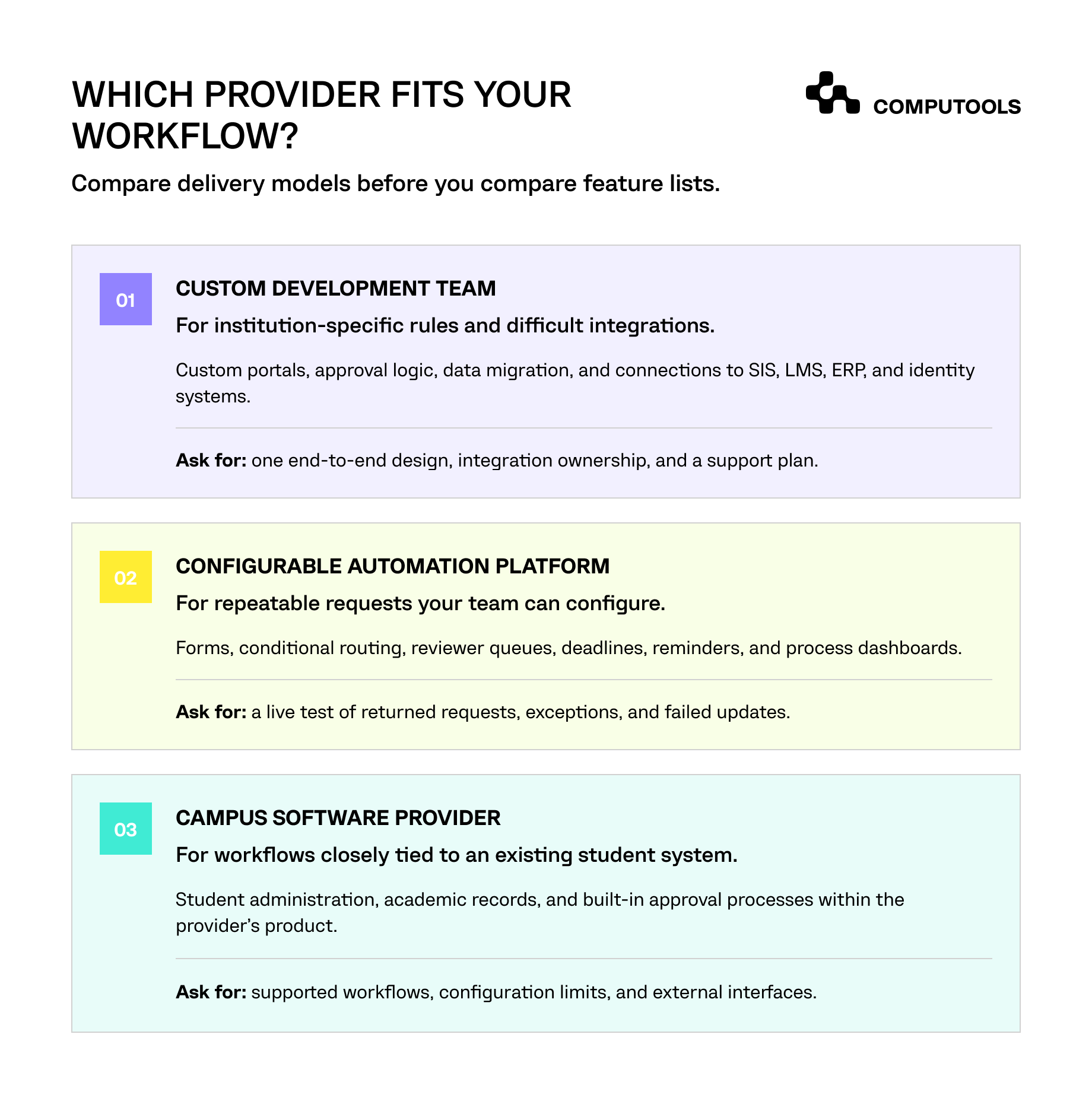
The list includes two delivery models. Custom development partners design applications and integrations around an institution’s requirements. Platform vendors provide configurable products that institutions can implement and extend. Both can address academic administration workflows, although their scope, ownership arrangements, and implementation responsibilities differ.
| Selection criterion | What we examined | Reason for inclusion |
| Documented education experience | Education service offerings, institutional products, and published learning or university references. | Academic processes involve student records, academic periods, and responsibilities that general business automation experience may not cover. |
| Relevant workflow capabilities | Forms, request routing, approvals, document processing, enrollment administration, learning operations, and service coordination. | Companies needed capabilities relevant to recurring institutional work. |
| System integration expertise | Published connections with SIS, LMS, ERP, CRM, identity, or document-management systems. | Many academic requests require information and actions across several applications. |
| Customization or configuration | Custom application development, configurable workflows, extension tools, and integration services. | Institutions need a way to accommodate their approval rules, roles, and exceptions. |
| Support for different users | Student portals, staff interfaces, permissions, notifications, and mobile or responsive access. | Students, faculty, advisers, and administrators perform different tasks within the same process. |
| Operational scope | Modernization, implementation, ongoing engineering, or product support capabilities. | Workflow changes require continued maintenance as policies and connected systems evolve. |
We also considered faculty workflow management and academic approval workflow automation where companies documented relevant functionality. AI subject matter expertise was an additional consideration where it supported a defined task, such as transcript extraction, content preparation, or document comparison.
Planning to connect your LMS with student records or administrative applications? Read the LMS Integration Guide: 7 Steps for eLearning Businesses for a closer look at the integration process.
20 academic workflow automation companies leading globally
The following profiles cover custom engineering, education-specific platforms, and broader workflow products used in institutional operations.
Your shortlist for university workflow automation solutions should reflect whether you need a new application, an integration layer, or configuration within an existing platform.
1. Computools
Custom software development and institutional systems integration partner.
Computools leads this list for institutions that need academic requests, student records, learning platforms, and administrative applications to work together. Its education software development services cover application engineering, institutional integration, portals, and data management. For academic workflow automation services, this combination addresses repeated administration caused by disconnected systems.
The company’s integration capabilities are particularly relevant when working applications must remain in place. The Uni-Campus project concerns a UK university group with three campuses, more than 25,500 students, and over 1,535 faculty members. The team connected three legacy SIS environments with LMS, ERP, IAM, reporting, and student services through phased modernization.
The client saw synchronization improving from 24–48 hours to under five minutes, reporting preparation falling from 8–10 to 3–4 business days, and requests requiring manual intervention decreasing from 65% to 25% of ticket volume.
Computools eLearning software development and EdTech software development capabilities extend to learning operations and reviewed content production.
In Corporate Skillum, the team connected HRIS, LMS, identity, and collaboration tools. Reported course-authoring time fell from 80 to 24 hours across 15 pilot modules. This corporate learning reference backs our expertise in integration and AI-assisted production.
For interfaces, web development supports administrative and learner portals. The British Council project deals with responsive resource publishing, analytics, and email notifications. Mobile app development services are helpful with submission, status checks, and notifications where dedicated mobile access suits the task.
AI development services support document review and content assistance, while data engineering services address normalization, synchronization, and reporting.
Suitable for: Universities and education providers that need institution-specific approval workflows, administrative portals, and reliable data exchange between existing SIS, LMS, ERP, and identity systems.
2. Aristek Systems
Custom education software developer and LMS/SIS integration solution provider.
Aristek Systems combines education application development with LMS and SIS integration. Its service portfolio includes student portals, faculty interfaces, gradebooks, attendance, lesson planning, content management, and connections using education interoperability standards.
This expertise is relevant when administrative work begins with inconsistent enrollment or course data. A staff interface becomes more useful when its records agree with the learning platform and student system. Aristek’s integration offers addresses that exchange, alongside custom education applications.
Its background also spans education content providers serving institutions with different technology environments. That makes connector coverage and integration software architecture important parts of its profile. It works with standards including OneRoster for roster exchange, LTI for connecting learning tools, and SCORM and Common Cartridge for importing educational content.
The company also offers a reusable integration solution that can serve as a content hub or connect an existing application to a client’s LMS and SIS.
Suitable for: Education publishers and institutions that need to automate enrollment-data exchange, distribute content through several learning platforms, or reduce manual grade and roster transfers.
3. Itransition
Custom software development and enterprise-platform implementation partner.
Itransition brings education application engineering together with ERP and CRM implementation. Its education capabilities cover enrollment, profile management, assessment, and learning-platform modernization, with published experience combining learning delivery and administrative functionality.
That combination is relevant when a request crosses educational and commercial operations. Registration may depend on a contract, payment status, account setup, or document submission. Treating those dependencies within a connected application can reduce repeated work between teams.
The company’s Odoo-based education reference demonstrates its ability to combine LMS, ERP, and CRM functions. Its broader capabilities support evaluating both custom development and extension of an enterprise platform.
Suitable for: Continuing education providers, training businesses, and institutions whose registration process depends on contracts, document approval, payment, and account setup. Engagements can involve custom engineering or extending an enterprise platform such as Odoo.
4. ScienceSoft
Custom learning-software developer and existing-platform modernization partner.
ScienceSoft offers development and legacy software modernization for learning-management, learning-content, and related education applications. Its services include automating individual learning-management processes and improving existing platforms. For content administration, it offers authoring tools, reusable templates, tagging, search, and support for standards such as SCORM, xAPI, and LTI.
This is relevant where assessment administration, completion tracking, content management, or reporting still require staff to combine information manually. Its capabilities support improving a defined process within an established application, as well as developing a broader solution.
The distinction matters for project scope. An institution may need a reporting connection or administrative module before it needs a replacement platform. ScienceSoft’s learning-software background provides a basis for assessing that work.
Suitable for: Organizations needing a tailored learning platform, automated training administration, or an upgrade to an existing LMS.
5. Iflexion
Custom portal developer and learning-platform implementation partner.
Iflexion creates education applications and portals containing learning materials and other assets to help administer syllabi, assessments, grades, collaboration, and performance. Its education offering touches on administrative and content development workflows as well.
The company can further develop learning platforms, e.g., with role-based interfaces, reporting, and integrations. The company has documented experience with development in the Moodle platform, PHP engineering, SCORM-compliant courses and assessments, and integration with the client organization’s single sign-on service.
Its capabilities are applicable to situations when a consistent user interface for related activities is desired. For example, a portal can integrate tasks related to assignments, requests, and documentation for students and staff, and tie those activities to back-end systems.
Suitable for: Institutions and training organizations that need a learning portal integrated with other key business processes and systems, including Moodle. Its documented strengths concern learning operations and portal engineering.

Launch academic workflow automation within 1–3 months, reduce repetitive administrative work across departments, accelerate approvals and student services, and increase institutional capacity without expanding back-office teams.
6. SEVEN
Custom education application developer.
SEVEN creates custom education software for the web and mobiles based on client specifications. School and university platforms include centralized administration of curriculum, online classes, analysis and tracking of student performance, and individualized learning plans. The team can also build features for teacher evaluation and assessment, as well as user permission and notification settings.
SEVEN’s services encompass the development of systems used by multiple users working with academic information. Administrators manage structures and access, and instructors manage and deliver learning activities. Students use the courses and resources generated by the systems.
SEVEN offers a service model to cover the definition of requirements, design of products, development, QA testing, and ongoing support.
Suitable for: EdTech companies and education service providers wishing to commission tailored mobile school management and learning applications.
7. Belitsoft
Custom LMS developer and learning platform customization partner.
Belitsoft develops learning software and modifies existing software, including Moodle. Features include role-based course access, learner groups, self-registration and enrollment, scheduled course content release, quizzes and survey builders, certificates, and configurable feedback.
Integration with other software can help align enrollment, access, payment and completion records, thereby increasing operational efficiency. This allows staff to focus on higher-value work.
Belitsoft offers both custom development and work with customizable learning platforms. This provides different implementation routes depending on the institution’s existing software and the uniqueness of its requirements.
Suitable for: Organizations that need automated learner administration with paid course access and the ability to assess learners and issue certificates.
8. Netguru
Custom digital product development and AI engineering partner.
EduTech product development and service delivery are Netguru’s core competencies. As it’s involved in education in different capacities, be it development or design or production or automated content generation, Netguru can address client needs from start to finish. Its offerings cover the automation of grading, scheduling, and other tasks within the onboarding process.
The company has a lot of experience building, authoring and reviewing tools for instructional materials. Its AI can help with the publishing process by generating teacher’s guides. Netguru is an excellent partner for EdTech firms or educational institutions looking to build a similar product that uses AI to aid content authoring.
Suitable for: Organizations looking to build administrative tools, automate back office processes, or build enterprise account management tools. It’s also a good fit if the integration and design of user interfaces is a large focus of the product being built.
9. Innowise
Custom LMS developer, platform customization partner, and white-label LMS provider.
Innowise offers a few different delivery routes: custom development of a bespoke learning platform, customization of an existing LMS, or white-label configuration of its product. Part of Innowise’s platform-based services includes Moodle, Totara, Chamilo, and ILIAS.
Their education skills cover both the learner and administrator perspectives, and incorporate course management and assessment, reporting, and integration with HR, CRM and learning systems.
This is particularly applicable when a client wants or needs a user-facing product and the backend services. For a mobile submission or staff action to be recorded, trigger the next step, or be visible to staff until the task is completed, the right integration and systems are critical.
Suitable for: Organizations needing an LMS with tailored administration, reporting, or mobile workflows.
10. Intellias
Custom education-platform engineering and third-party LMS extension partner.
Intellias provides custom education-platform and learning-management engineering, supported by product development and ongoing modernization capabilities. Its education background includes large learning applications and work for established education providers.
Specific capabilities include creating learner groups from user attributes, assigning targeted learning programs, sending announcements, and connecting learning applications to CRM systems, marketplaces, messaging tools, and content-streaming services. Its broader engineering services support sustained development of complex education products.
Suitable for: Large training providers and education product companies needing learning-platform customization, automated assignment of programs to defined groups, or continuing engineering support. Its most specific public evidence concerns enterprise learning administration and platform extensions.
11. Ellucian
Higher education enterprise software vendor with built-in process automation.
Ellucian’s institutional software is complemented by a no-code business-process automation solution. It offers forms, task creation, holds, conditional workflow branches, processes that are triggered by events, and notifications (in the app, on mobile devices, and through email).
Automated workflows for grade changes or tuition consents are just a couple of examples. There are configurable branches to route tasks based on the information submitted or decisions made along the way. The automation, therefore, is part of a larger institutional platform with the implementation focusing on configuration and integration.
Suitable for: Colleges and universities that have Ellucian campus systems and are looking to support additional configurable academic and administrative workflows.
12. Kuali
Higher education no-code forms and workflow platform vendor.
Kuali Build is a configurable platform from Kuali that allows institutions to create their own institutional forms and processes electronically. With Kuali Build, institutions can avoid commissioning a custom application for every process configuration request by their staff. It also provides functions that are geared towards registrars, such as role-based routing, group approval, customized notifications, reminders, and tracking of reviewer requests.
This academic workflow automation software is necessary when intake and review processes are repeated. Forms can be created to collect data and be routed to the assigned person or people for review and approval.
Suitable for: Institutions that want their departments to create and manage digital intake and request forms, while the central IT department controls governance and access to the integrated campus systems.
13. Workday
Student information and enterprise software vendor with an embedded workflow framework.
Workday offers workflow processes for student-related tasks in Workday Student. These include student onboarding, program-of-study events, and student payment processes, and are defined by configurable business process steps.
This is useful for cases where an institution wants to manage its decisions in the same environment as student records. Universities can configure steps to be sequential or parallel, create conditional routing, and set due dates. They can also control access to tasks and define notifications and delegated tasks. Approval requests can be denied or returned for further action. Process definitions can vary by academic unit, with effective-dated changes applying to newly initiated transactions.
Suitable for: Institutions adopting or using Workday Student to define process decisions tied directly to student records. This would involve configuring Workday’s supported process types and, where necessary, extending it with external applications.
14. Oracle
Enterprise software vendor offering student administration systems.
Oracle’s Student Management software manages admissions applications, course and program records, enrollment, credentials, scheduled course rosters, grading rosters, fees, discounts and student accounts.
It goes beyond case management to integrate business processes and incorporate elements of a student administration system. The documented scope of the software includes both traditional and continuing education programs. This allows institutions to manage financial aspects of the academic programs within the system.
Suitable for: Institutions interested in managing admissions, enrollment and the financial transactions of students via a centralized student administration system.
15. Salesforce
Configurable CRM and education operations platform vendor.
Salesforce’s Education Cloud has functionality for recruitment, admissions, student support, and academic operations. Its automation tools include Business Rules Engine, decision tables, and configurable processes for handling institutional requests.
Examples of requests that can be automated include course substitutions and waivers, withdrawals, term withdrawals, transcript requests and graduation certificates, major/minor declarations, transfer credit requests, and credit appeals. Salesforce offers a broader automation capability than just case management.
Suitable for: Institutions that require a flexible student service and academic request platform, particularly where sales and support staff already use Salesforce.
16. ServiceNow
Enterprise service management and workflow platform vendor used in higher education.
ServiceNow creates customizable service catalogs, manages requests, routes tasks, and defines workflows. Their higher education product helps schools and universities provide campus services in a more organized way for staff and students.
Its Workflow Studio helps facilitate processes across different divisions. For instance, a school could use the product to control an access request process to include the requesting division and the IT division. Service management includes the requisite framework for request and assignment tracking, and learning apps require integrations.
Suitable for: Higher education institutions looking to provide a centralized, shared service portal for IT and/or administrative service requests and help desk support. It is not as effective for addressing the processing of academic records and/or other core institutional records and applications.
17. Laserfiche
Document-management and configurable workflow automation platform vendor.
Laserfiche provides electronic forms, document storage and workflow routing with optional records control. Their solutions for higher education cover admissions, financial aid, and student records as well as academic petitions.
They can route grade change requests and class waivers as well as add/drop requests to and from departments and the registrar. The solutions also include features like permits, retention schedules, version control, audit trails and data integration to the SIS and/or ERP.
Suitable for: Institutions where the automation of processes hinges upon the collection of supporting documents and the retention of records of decisions. It is more pertinent to process academic requests in conjunction with the management of institutional records.
18. ProcessMaker
Low-code process automation platform vendor with higher education applications.
ProcessMaker offers low-code process management and workflow automation, with higher education functionality including transcript processing and transfer-credit evaluation.
Its academic process automation software is relevant where incoming documents must become structured information for review. The platform is responsible for extracting transcript data and routing course-matching work through the evaluation process.
This addresses a specific administrative bottleneck: staff interpreting records before an academic reviewer can determine credit recognition. Extraction, matching, and approval are separate activities, and the implementation should preserve that distinction.
Suitable for: Institutions seeking to automate transcript handling and transfer-credit evaluation, or configure a process spanning several academic reviewers. Platform setup and institutional integration are distinct from commissioning a fully custom application.
19. Jenzabar
Higher education software vendor with a workflow product integrated into Jenzabar One.
Jenzabar supplies workflow software for the higher education sector that is pre-integrated with Jenzabar One. Its function connects staff, tasks, and resources through repeatable processes.
This is applicable to institutions already using Jenzabar and wishing to coordinate work across their departments. The current connection can act as a foundation to lessen manual handoffs, while the configuration of workflows defines the personnel and actions required.
Suitable for: Institutions currently using Jenzabar One to centralize and automate task and case management for faculty and staff and integrate workflows. It is particularly effective for handling student requests where campus or departmental assignment plays a key role in determining how to process the requests.
20. Unit4
Higher education ERP vendor focused on finance, HR, procurement, and resource planning.
Unit4 provides higher education ERP capabilities covering finance, workforce, procurement, and operational administration. The company’s offerings include third-party SIS connections and approval workflows associated with institutional spending and planning. Its services help with budgeting across faculties, workforce planning, supplier management, procurement, contract creation, and procure-to-pay workflows.
Unit4 relevance is strongest when academic activity depends on administrative resources. A new program, departmental request, or staffing decision may require budget review, procurement, or workforce information before work can proceed.
It should therefore be assessed around these supporting operations. The institution’s academic decisions and curriculum records may remain in other applications, with integrations coordinating the required information.
Suitable for: Universities whose academic work is delayed by budget approvals, purchasing, staffing, or fragmented financial information. Curriculum decisions, admissions judgments, and academic petitions would typically require the relevant academic system or an additional workflow application.
How to narrow your shortlist around one measurable workflow
Your shortlist of academic workflow automation companies should follow the work that needs improvement.
If the core systems in the institution work reliably but staff has to manually coordinate requests, compare custom integration work with a configurable workflow. Identify processes across at least two systems which need improvement (for example, enrollment and billing) and define under what circumstances the processes would be complete.
If you already have a major student system or enterprise system, assess the workflow capabilities integrated with that system and compare configuration, additional interfaces, licensing and ongoing maintenance costs.
If there are delays in processes due to production of learning content or documents, look at extraction, review, versioning and publication interconnections. Evaluate the staff workflow decisions and preparation tasks that the software is capable of doing.
For student lifecycle management automation, collect a baseline before requesting proposals:
| Measure | What it tells you |
| Requests per month | The volume the process must support. |
| Staff handling time per request | The effort consumed by checking, copying, and updating information. |
| Returned submissions | Where forms, guidance, or validation need improvement. |
| Approval waiting time | Where work accumulates between decisions. |
| Failed downstream updates | Whether completed approvals produce the intended system changes. |
Use these baselines to guide university process digitalization and acceptance criteria. The proposal should explain which steps change, how staff will handle exceptions, and how the result will be measured.
If your plans include institutional reporting or student-progress analytics, read Role of Big Data in Education: Main Benefits and Concerns. It explores practical uses alongside the data-quality, ownership, and privacy questions you should resolve before implementation.
Choose the education workflow automation company to complete the process
A successful program transfer ends with accurate enrollment, billing, access, and student-facing information. The approval itself is one part of that outcome.
When comparing higher education automation solutions, examine the entire process. The partner needs to understand your academic rules, connect the applications that execute the decision, and provide a clear method for handling incomplete submissions and failed updates.
Computools is a strong option if your institution needs approval workflows tailored to its academic rules and connected to existing SIS, LMS, ERP, and identity systems. Its education capabilities cover custom portals, institutional integration, and data synchronization, helping you address the handoffs where staff repeat checks or re-enter approved information.
Start with one process, such as a transfer-credit review or program-change request. Define who approves it, which records must change, and what happens when information is missing. Computools can help turn those requirements into a phased implementation, with progress measured through turnaround time, staff handling time, and successful record updates.
Computools
Software Solutions
Computools is an IT consulting and software development company that delivers innovative solutions to help businesses unlock tomorrow.