
THE AUTHOR:

Organizations face the need to build an energy management platform because energy is no longer a fixed monthly expense. It is a live business variable that affects margins, uptime, asset performance, customer experience, compliance, and investment planning.
For companies that operate hotels, venues, commercial properties, industrial sites, renewable assets, charging infrastructure, or distributed facilities, energy management is tied to their revenue and operational resilience.
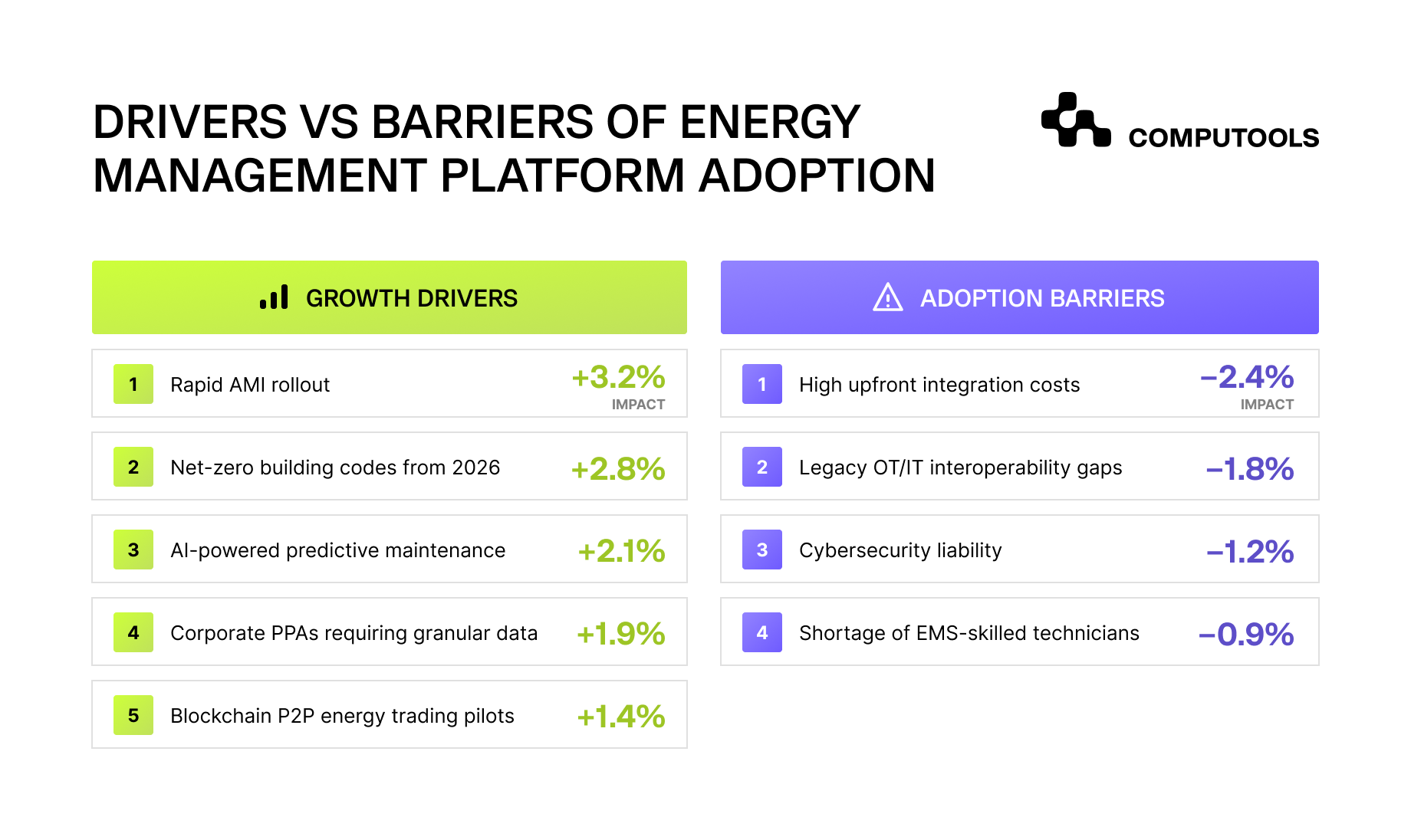
The needs of the market are becoming harder to satisfy for several different reasons. Electricity demand is rising as AI workloads, data centers, electrification, cooling systems, and digital operations consume more power. The U.S. Energy Information Administration predicts energy consumption will hit record highs in 2026 and 2027 due to the widespread implementation of AI and an even larger reliance on the full spectrum of electrical services.
Renewable generation is also rapidly expanding. According to the IEA, growth in renewable power generation will be robust until 2030, and solar PV will be the dominant technology among the additions to renewable generation capacity. This presents opportunities for businesses, but also challenges. This shift gives businesses more options, but it also adds complexity. Variable generation, storage, tariffs, grid constraints, peak loads, and distributed assets need tighter coordination.
That is why enterprise energy management is no longer simply dashboards for energy consumption. It should be fully integrated into operating systems that mesh IoT energy monitoring with asset-level data, real-time notifications, energy consumption analytics, process automation, predictive artificial intelligence, maintenance workflows, security, and executive dashboards.
Energy monitoring and optimization accounted for 44.05% of the energy management systems market in 2025, which shows how strongly the market is moving toward active control rather than passive reporting. Companies need to see which assets consume the most energy, which sites are underperforming, where demand can be shifted, which equipment needs attention, and how energy decisions affect cost, continuity, and service quality.
This article explains how to build an energy management platform for monitoring and optimizing energy assets, what architecture and data logic it needs, how AI and business process automation improve performance, and how Computools approaches custom energy management software as a business-critical operational system.
For a broader view of partners working in this space, read Computools’ overview of top energy software development companies.
Build an energy management platform that supports real-time decisions – lessons from Winder
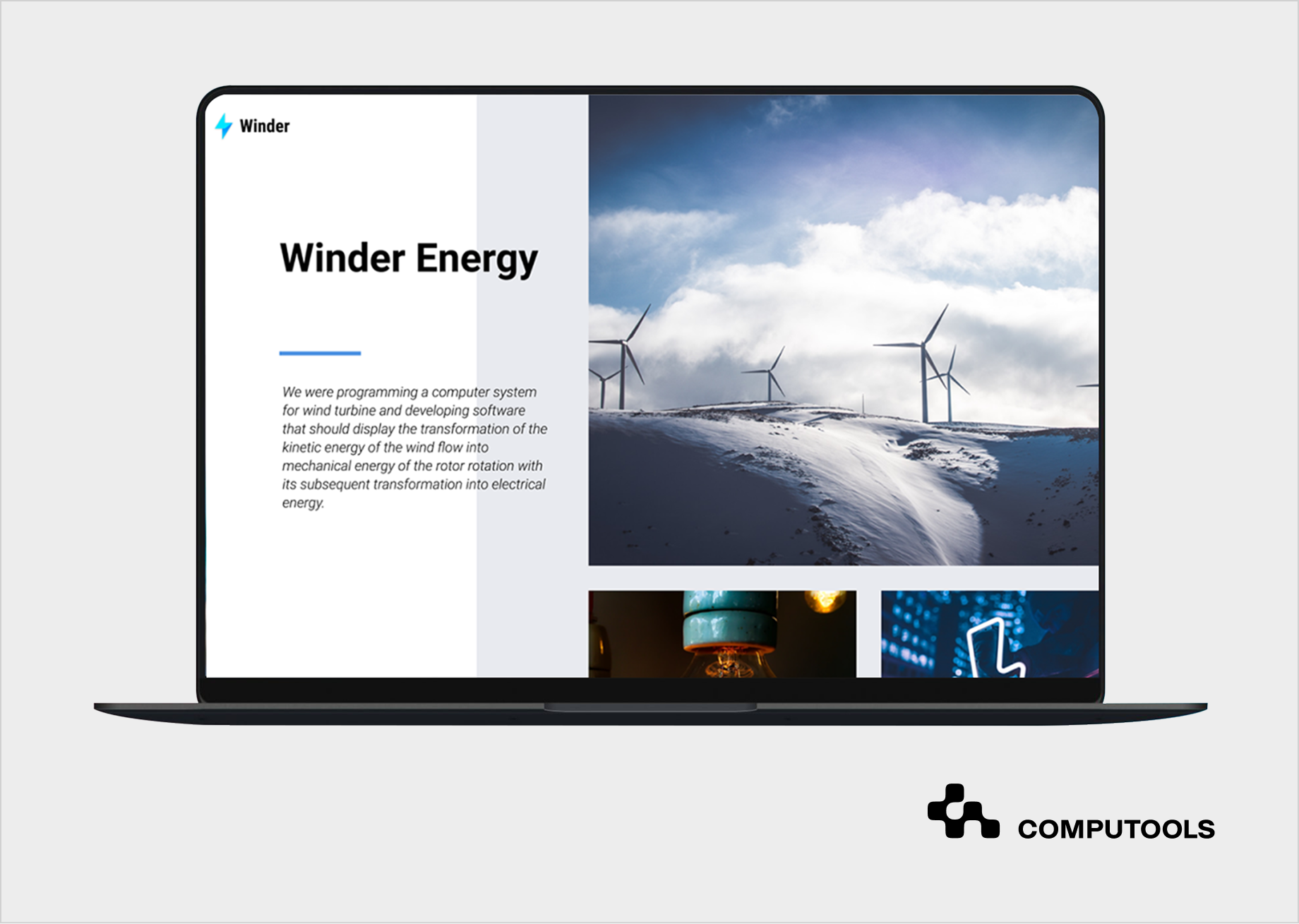
Energy management platforms create value when they connect operational data with faster and more accurate decisions. Computools faced this challenge in the Winder project, where the client needed a custom web system for managing energy-related devices and improving infrastructure performance.
Client context
Winder is a US electric power company working with systems connected to critical facilities and energy infrastructure. The client needed more than a monitoring interface. It required a platform that could process device data, support real-time calculations, predict operational events, and guide configuration decisions.
Business challenge
The client’s existing systems were complex and inefficient. Many operational scenarios required expert investigation because the available tools could not quickly calculate how different devices should behave or how they should be configured in specific conditions.
This slowed decision-making and increased dependence on manual analysis. For an electric power business, these gaps could affect safety standards, asset performance, resource planning, and operational continuity.
Computools solution
Computools developed a customized web system that could handle energy devices, support real-time calculations, and apply predictive algorithms to different operational scenarios. The solution was designed to analyze how devices should be placed and configured to work more efficiently in terms of sustainability, performance, and security.
The system connected device-related data with calculation logic and predictive decision support. Instead of relying only on manual investigation, users could assess configurations, review predicted outcomes, and make more informed operational decisions.
From a technical perspective, the solution combined several elements that are also important for energy management platform development: device data processing, predictive algorithms, real-time logic, configuration analysis, web-based access, and operational decision workflows.
This type of software architecture matters because energy assets rarely operate in isolation. A single device, meter, or control point may affect the wider IT infrastructure. The platform has to understand these relationships, process signals quickly, and turn them into actions that users can trust.
Business result
The Winder solution improved the client’s ability to manage energy devices, assess operational scenarios, and support safer infrastructure decisions. It reduced dependence on slow manual analysis and gave teams a better way to evaluate performance, sustainability, and security across connected equipment.
For the business, the value of the energy management software came from stronger operational control. The platform improved visibility into device behavior, supported more accurate decisions, and created a technical base for predictive analysis across energy infrastructure.
That same principle applies to any company planning to build an energy management platform. The development process should start with business goals, asset logic, data structure, and operational decisions before moving into dashboards, AI features, and automation.
How to build an energy management platform step-by-step
To build an energy management platform that creates business value, the development process should start with operational logic.
The system has to answer practical questions: which assets consume too much energy, where losses appear, which equipment needs attention, how demand changes during peak periods, and what actions can reduce cost or prevent downtime.
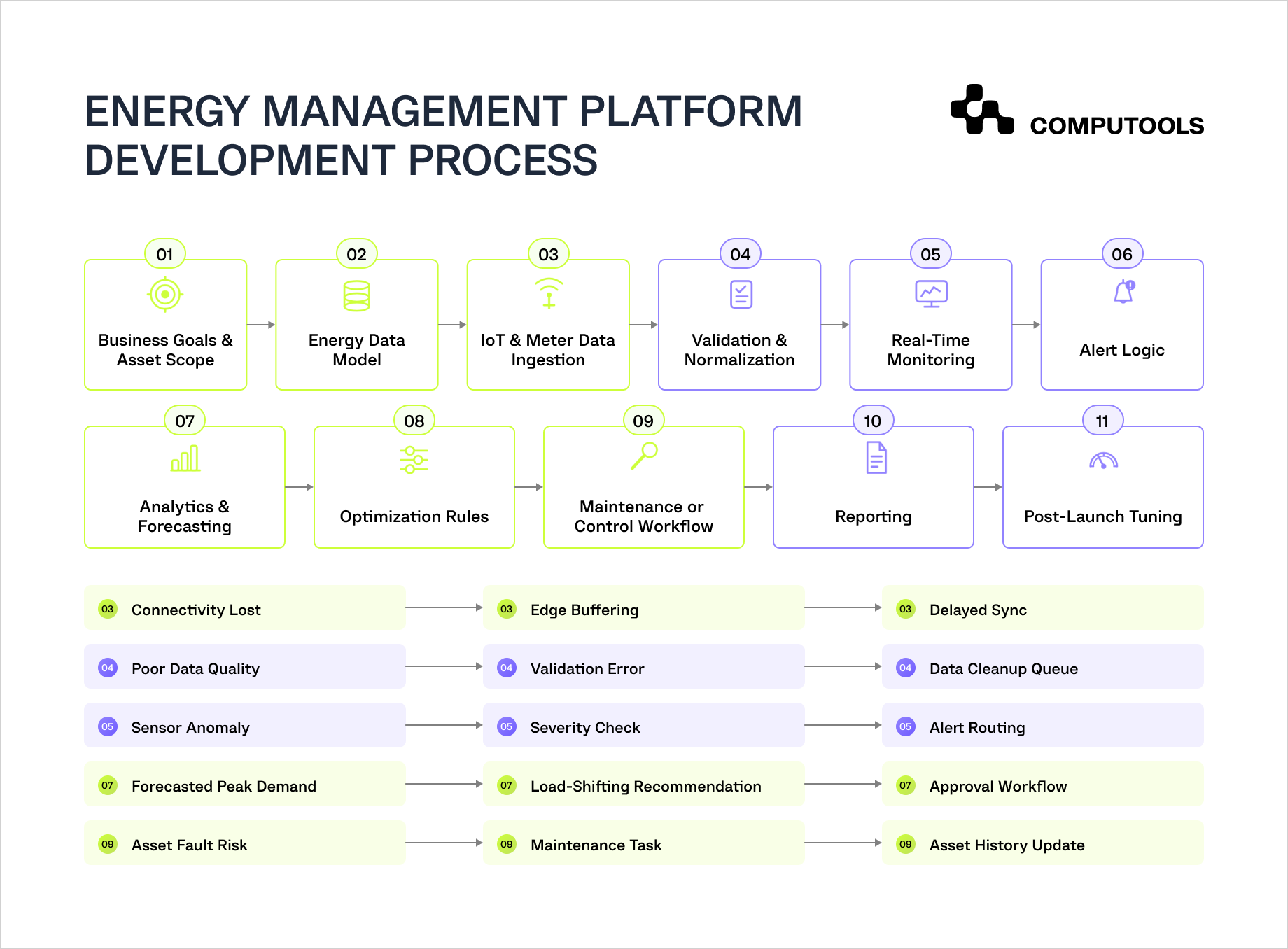
The following steps show how to approach energy management platform development from both a business and technical perspective.
1. Define the Business Goals and Asset Scope
The first decision is what the platform should control or improve. One business may focus on lowering electricity costs across its hotels, event spaces, and stores. Another may focus on tracking renewable assets, distributed infrastructure, predicting equipment failures and energy management across its industrial sites.
This scope impacts every technical choice. For instance, a hospitality business may require HVAC, lighting, occupancy, weather, and rate structure information. A renewable energy operator may need generation, inverter status, forecasts, and storage and service data. A utility or infrastructure service provider may require measurement, grid asset data, field service operations, and outage notifications.
At this point in the process, the business defines the objectives they hope to achieve.
Examples include:
- reducing peak demand charges;
- detecting abnormal consumption within minutes;
- improving asset uptime;
- forecasting site-level demand;
- ranking inefficient equipment;
- automating maintenance triggers;
- improving energy reporting for management and compliance.
The asset hierarchy should be established early in the process, and include sites, buildings, floors, zones, equipment, meters, sensors, and even renewable assets, storage systems, and control points. Without placing energy data in this structure, data comparison and analysis for decisions becomes more difficult.
Building dashboards before the business logic is established is a common pitfall. This results in an interface that shows consumption, but lacks the logic for what the problem is, who should respond, and how the response will affect the cost and performance.
2. Build a Reliable Energy Data Model
Energy asset monitoring software relies on good data. Before advanced analytics or AI is even considered, the platform must have a data model that integrates all the various assets, meters, sensors, locations, users, tariffs, and events.
The data model should cover:
- asset registry;
- meter and sensor IDs;
- site and equipment hierarchy;
- time-series energy data;
- tariff and pricing data;
- weather data;
- maintenance history;
- operational schedules;
- alerts and incidents;
- carbon and compliance data;
- user actions and approvals.
With this design, the platform is able to distinguish energy usage by site, asset, time period, cost center, tariff window, and operating condition. A venue operator, for instance, should be able to understand if an energy spike was caused by the scheduled event, HVAC behaving outside of the norm, a lighting problem, or equipment operating outside of approved times.
The logic should include some technical thinking about rules for validations of units and timestamps, as well as rules for dealing with missing data, duplicate readings, and erroneous device mappings. If one of the sensors sends readings in kilowatts and another in watts, the platform should take steps to ensure that the data is reported and provided to AI models in a consistent manner.
Poor energy data management creates long-term problems. Forecasting becomes unreliable, anomaly detection generates false alerts, and executives lose trust in the numbers. Clean data is what allows the platform to move from basic monitoring to energy performance optimization software.
3. Design Real-Time Monitoring and Alert Logic
Real-time energy monitoring should focus on events that require action. The platform does not need to treat every signal as urgent. It should separate normal activity, unusual behavior, operational risk, and critical incidents.
Real-time monitoring is useful for:
- sudden consumption spikes;
- meter communication failures;
- equipment overheating;
- renewable generation drops;
- battery charge thresholds;
- HVAC overuse;
- grid instability;
- unexpected after-hours consumption;
- critical asset failure risks.
The technical architecture should include stream processing, threshold logic, event detection, alert routing, escalation rules, and device health checks. Each alert should include enough context for users to act: asset name, location, severity, likely cause, financial impact, recommended next step, and assigned owner.
Alert design matters because too many notifications create noise. If every small deviation becomes an alert, operations teams start ignoring the system.
A better approach is to use severity levels:
- Info: unusual activity with low business impact.
- Warning: issue that needs review.
- Critical: problem that requires quick action.
- Emergency: incident that triggers escalation.
In the Winder project, Computools worked with real-time calculation logic for connected energy-related devices. The same principle applies here: when asset behavior affects safety, continuity, or performance, the platform has to process signals quickly and translate them into clear operational decisions.
Real-time asset visibility is especially important when companies manage distributed infrastructure, field equipment, renewable assets, or critical facilities.
For a closer look at this topic, read Computools’ guide on how to develop a real-time energy asset monitoring platform.
4. Plan Architecture for Scale and Future Integrations
An energy monitoring platform typically starts at a single point and expands over time. For example, it may begin with just meter management and add forecasting, field workflows, billing logic, management of renewable assets, carbon reporting, or AI-based optimization. The architecture should accommodate this level of flexibility and growth.
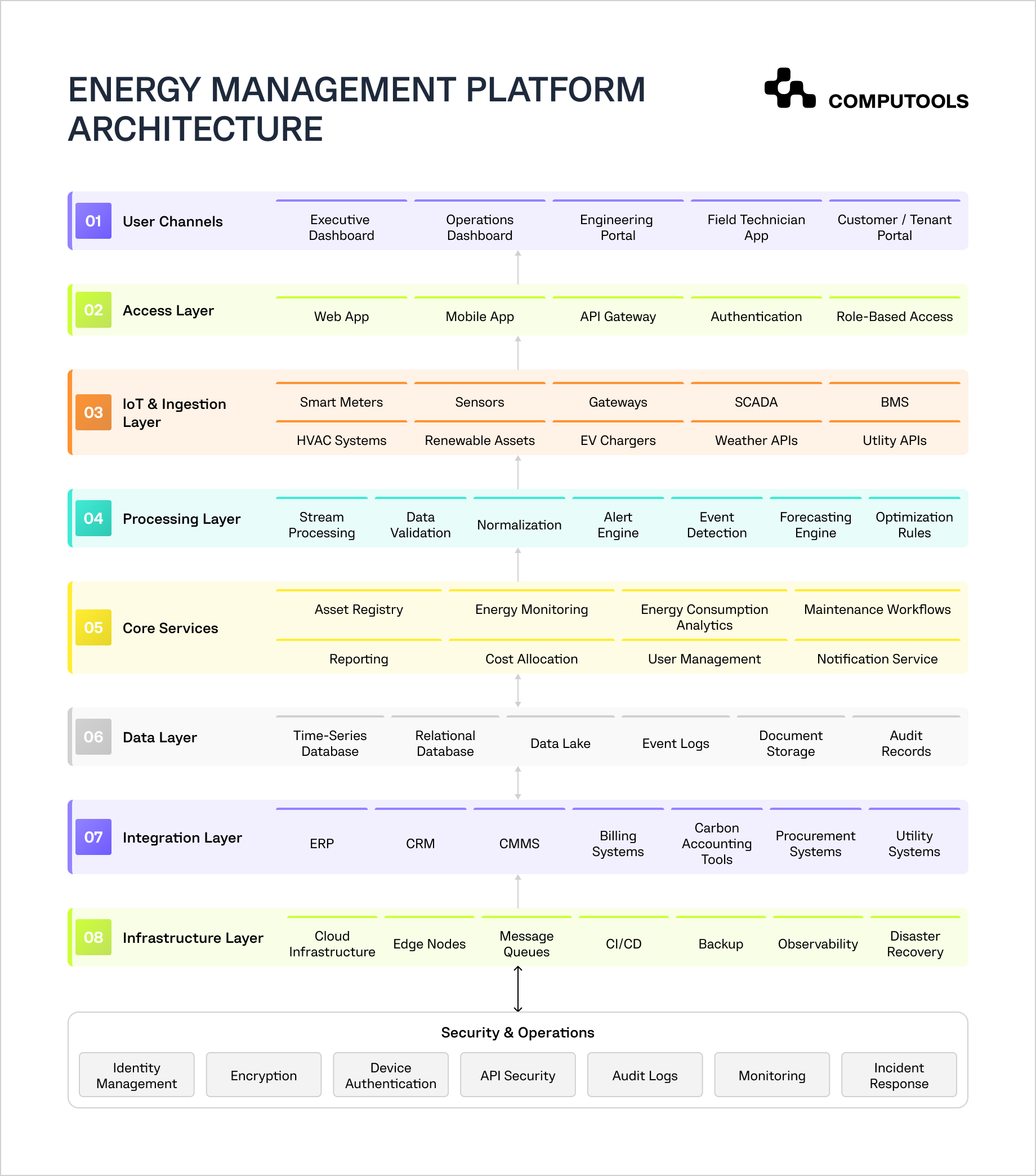
Smart energy management solutions usually include several layers:
User channels
Executive dashboard, operations dashboard, engineering portal, field technician app, customer or tenant portal.
Access layer
The architecture should accommodate flexible access options (e.g., authenticated, role-based, API-based, web & mobile access).
Data ingestion layer
It should allow for different types of data sources (e.g. smart meters, IoT devices, sensors, SCADA, BMS, HVAC systems, renewable assets, EV chargers, utility APIs, weather APIs).
Processing layer
Provides the functions to operationalize the data (e.g., validation, normalization, processing streams, alert generation, forecasting, and optimization).
Core services layer
Includes the basic functions of the platform (e.g., asset management and monitoring, reporting, maintenance workflows, notifications, cost allocation, user management).
Data layer
Provides functions for the storage and retrieval of data (e.g., time-series database, relational database, data lake, audit and event logs).
Integration layer
The services for connecting APIs and third-party services (e.g., ERP, CRM, CMMS, billing, carbon accounting, and utilities).
Infrastructure layer
The services required to support the other layers consist of cloud services, edge nodes, message queuing, CI/CD, backups, monitoring, and disaster recovery services.
This allows maximum flexibility for the platform. New devices, new sites, analytics models, or third-party integrations can be included without having to touch the core product.
If architecture is an afterthought, the platform may work within a single location but struggle with multisite functionality, data volume, or complex integrations. This happens when the business is at a peak growth point and creates technical debt.
5. Connect Energy Data With Business Systems
An energy management platform is far more useful when it integrates the energy data into the other systems of the teams it serves. Monitoring only shows what is going on. Integrations are what allow for action to be taken.
It is up to the business to decide which systems will be connected to the platform.
The most common integrations are:
- smart meters;
- IoT gateways;
- SCADA systems;
- building management systems;
- HVAC controls;
- CMMS platforms;
- ERP systems;
- billing tools;
- weather services;
- utility tariff data;
- carbon accounting tools;
- renewable asset systems;
- EV charging platforms;
- field service apps.
These integrations are important. Events often require action that goes beyond the platform. For example, if a meter shows abnormal consumption, it would not suffice for the system to only show a red alert. Instead, it should create a maintenance task, notify the appropriate personnel, update the asset history, and track the resolution of the problem.
To achieve this type of functionality, the solution should employ API connections and webhooks, as well as have integration adapters and message queues. It should also employ retry logic, be capable of mapping data, implementing access rules, and monitoring the health of integrations. If an API fails or a meter gateway stops communicating, the system should alert users.
An example of a workflow that achieves this functionality would look something like this:
abnormal consumption detected → severity scored → maintenance task created → technician assigned → technician action completed → asset history updated → alerts tuned.
Ignoring integrations means manual exports and spreadsheets. This ultimately leads to poor decisions and redundant, manual workflows, which increases the load on support and decreases the overall utility of the platform.
6. Add AI, Forecasting, and Automation After the Data Foundation Is Ready
AI can help manage energy better, but only if the foundation includes clean and structured data. There needs to be a sufficient amount of reliable asset IDs, historical data, event labels, unit consistency, timestamps, maintenance records, and user feedback.
The organization should decide which decisions should be recommended, automated, or approved by a human. Not all energy-related actions should operate in an automated fashion. A recommendation to shift HVAC load may be safe. A control action that affects critical infrastructure may require approval.
The AI and automation features include:
- AI-powered recommendations that suggest energy-saving actions, maintenance steps, or asset adjustments.
- Demand forecasting that predicts load by site, asset, weather, occupancy, event schedule, and tariff period.
- Anomaly detection that identifies unusual consumption, equipment faults, sensor failures, or inefficient settings.
- Predictive maintenance that ranks assets by failure risk and expected operational impact.
- Smart search that allows teams to find assets, alerts, reports, or abnormal events faster.
- Customer or tenant segmentation that groups locations, buildings, or users by energy behavior.
- Pricing intelligence that compares consumption patterns with tariffs, peak periods, and contract terms.
- Personalized notifications that send relevant alerts to executives, facility managers, engineers, or field teams.
- AI-assisted support that guides users through basic troubleshooting and reduces repetitive support requests.
Each feature should connect with a business outcome. Demand forecasting can reduce peak costs. Predictive maintenance can prevent downtime. Anomaly detection can catch waste faster. Pricing intelligence can support better procurement and contract decisions.
In the Winder project, Computools applied predictive algorithms to support operational decisions around connected energy-related devices. The same logic applies to an energy optimization platform: predictions should lead to clear actions, not vague suggestions.
AI can also extend into visual inspections when companies need to monitor hard-to-reach energy infrastructure.
Computools explains this use case in its guide on how to build AI drone inspection software for energy infrastructure.
7. Design Workflows for Executives, Operations Teams, and Field Users
Different users need different views of the same energy system. A CEO or COO needs cost, risk, savings, and asset performance. An operations manager needs active alerts, site status, and task progress. An engineer needs telemetry, device configuration, and event history. A field technician needs location, instructions, priority, and a checklist.
The business should define user roles early:
- executives;
- operations managers;
- energy analysts;
- facility managers;
- engineers;
- field technicians;
- finance teams;
- compliance teams;
- customers, tenants, or partners.
This is important because a universal interface for everyone stunts progress. Executives receive too much technical information, while field teams do not get the information they need to address the problems at hand.
The system should have role-specific dashboards, task management, approval flows, report builders, and notifications. It should also have asset history, audit logs, and mobile access for field teams. For dispersed operations, offline mode may be especially necessary. A technician may need access to dedicated tasks, pictures, checklists, and asset notes in low or spotty connectivity areas.
A practical workflow may consist of:
Operations dashboard
Shows alerts, site status, issues, and SLAs.
Engineering portal
Shows telemetry, configuration, diagnostics, and events.
Executive dashboard
Shows cost, savings, energy waste, asset risk, and ROI.
Field app
Shows tasks, assets, location, checklist, pictures, notes, and status.
This workflow design incorporates energy asset management into everyday operations and makes it an active process rather than a passive reporting tool.
8. Build Security and Reliability Into the Architecture
Energy platforms often connect business IT with operational systems. This makes security a business issue, not only a technical requirement. Weak protection can affect uptime, trust, compliance, support workload, and revenue.
The platform should protect user accounts, device access, APIs, meter data, site-level controls, billing data, reports, integrations, and control actions.
Core security controls should include:
- role-based access control;
- multi-factor authentication;
- device authentication;
- API rate limiting;
- encryption in transit and at rest;
- network segmentation;
- audit logs;
- backup and recovery;
- secure CI/CD;
- vulnerability monitoring;
- incident response procedures.
Critical actions should be logged and permission-based. For example, a user who can view consumption data should not automatically have permission to change control settings, approve maintenance actions, or access financial reports.
Reliability is just as important. The system should support edge buffering when connectivity is lost, retry logic for failed integrations, data reconciliation after outages, high availability for critical monitoring, and disaster recovery.
The platform should also include observability from the start. Technical teams need to see system health, data delays, failed API calls, device downtime, alert processing issues, and abnormal load. Without this visibility, teams may discover platform problems only after business users report missing data or delayed alerts.
9. Test the Platform Under Real Operating Conditions
Energy management software should be tested against real usage patterns, not only ideal demo scenarios. The platform may need to process data from thousands of meters, sensors, gateways, and assets across multiple sites.
The business should define performance targets before launch. These may include data ingestion speed, alert delivery time, dashboard load time, integration response time, forecast accuracy, and acceptable downtime.
Testing should cover:
- peak sensor load;
- multiple sites sending data at once;
- API failures;
- gateway outages;
- incorrect meter readings;
- duplicate device data;
- delayed alerts;
- lost connectivity;
- high dashboard traffic;
- permission errors;
- failed maintenance task creation;
- AI forecast accuracy.
This stage should also include security testing, integration testing, data validation testing, failover testing, and UX testing for field users.
A platform can work well in a controlled environment but struggle when real devices send noisy data, integrations slow down, or users need fast decisions during a high-risk event. Testing should reflect these conditions.
Post-launch optimization should focus on measurable energy savings, better forecasting, lower waste, and more efficient asset use.
For a practical view of this direction, read Computools’ guide on how to build an energy optimization system for sustainable operations.

Launch your energy management platform within 1–3 months instead of years, and gain real-time visibility, optimization, and control across all your energy assets from day one.
Why companies choose Computools for energy management platform development
Building an energy management platform is rarely a simple software task. Most companies start with fragmented energy data, disconnected assets, manual reports, limited visibility into waste, and teams working across several systems. Computools addresses these challenges by designing the platform around real business bottlenecks first, then connecting the right architecture, integrations, data logic, and workflows.
Poor asset visibility is one of the main issues. Energy data may come from meters, sensors, HVAC systems, renewable assets, field devices, and legacy platforms. Computools provides energy software development services to bring these sources into one structured system with asset registries, real-time monitoring, alerts, and role-based dashboards. Clients gain a clearer view of which assets consume the most energy, where losses appear, and which sites need attention.
Distributed infrastructure creates another challenge. Companies in utilities, renewables, industrial operations, and infrastructure need systems that support field teams, maintenance records, safety workflows, and asset performance data. Computools’ experience in oil and gas software development and electric power software development supports this need. Clients reduce manual coordination, improve response time, and gain a stronger base for scaling operations.
Many platforms also fail to turn data into action. Computools applies web development services to build dashboards, admin panels, reports, and operational control interfaces.
Through mobile app development services, field teams can receive alerts, update tasks, add photos, use checklists, and access asset notes. This reduces spreadsheet work, delayed reporting, and repeated calls between teams.
Data quality is another major risk. Energy platforms depend on time-series data, asset IDs, tariffs, weather inputs, IoT streams, and maintenance history. Computools applies data engineering to build reliable pipelines, validation rules, analytics layers, and reporting structures. Clients get more trustworthy numbers, better forecasting, and stronger control over energy performance. Clients get access to more accurate data, enhanced forecasts, and better control of energy performance.
For advanced optimization, Computools applies AI development for demand forecasting, anomaly detection, predictive maintenance, and energy conservation recommendations. Our clients have insights on at-risk assets, sites that are wasting energy, which loads can be shifted, and which actions can protect cost, uptime, and service quality.
The result is a platform that connects energy data with business decisions. Operators will notice faster responses to operational challenges, improvements in system performance, and greater control of energy costs and risks.
Final thoughts
Most companies see energy management as monitoring energy consumption with automation and reporting features. However, a smart energy management platform integrates assets, meters, sensors, automation, analytics, alerts, cybersecurity approaches, and user workflows. As a single system, these elements facilitate better decision-making.
Company executives benefit from the platform’s increased control over energy costs, asset functionality, and the predictability of maintenance and risks. For technical teams, it means a clean data model, scalable architecture, real-time monitoring, reliable integrations, and AI capabilities.
Rapid expansion is unpredictable if operators passively monitor energy performance. Proactive companies use energy analytics software and energy infrastructure management to minimize operational waste, forecast energy consumption, avoid equipment issues, improve field workflows and optimize energy performance relative to the broader business goals.
Computools
Software Solutions
Computools is an IT consulting and software development company that delivers innovative solutions to help businesses unlock tomorrow.