
THE AUTHOR:

The wind industry is adding assets faster than inspection teams can manually process field data. GWEC reported a record 165 GW of new wind capacity in 2025, bringing global installed wind power to 1,299 GW, while the IEA expects cumulative onshore wind additions to reach 732 GW between 2025 and 2030.
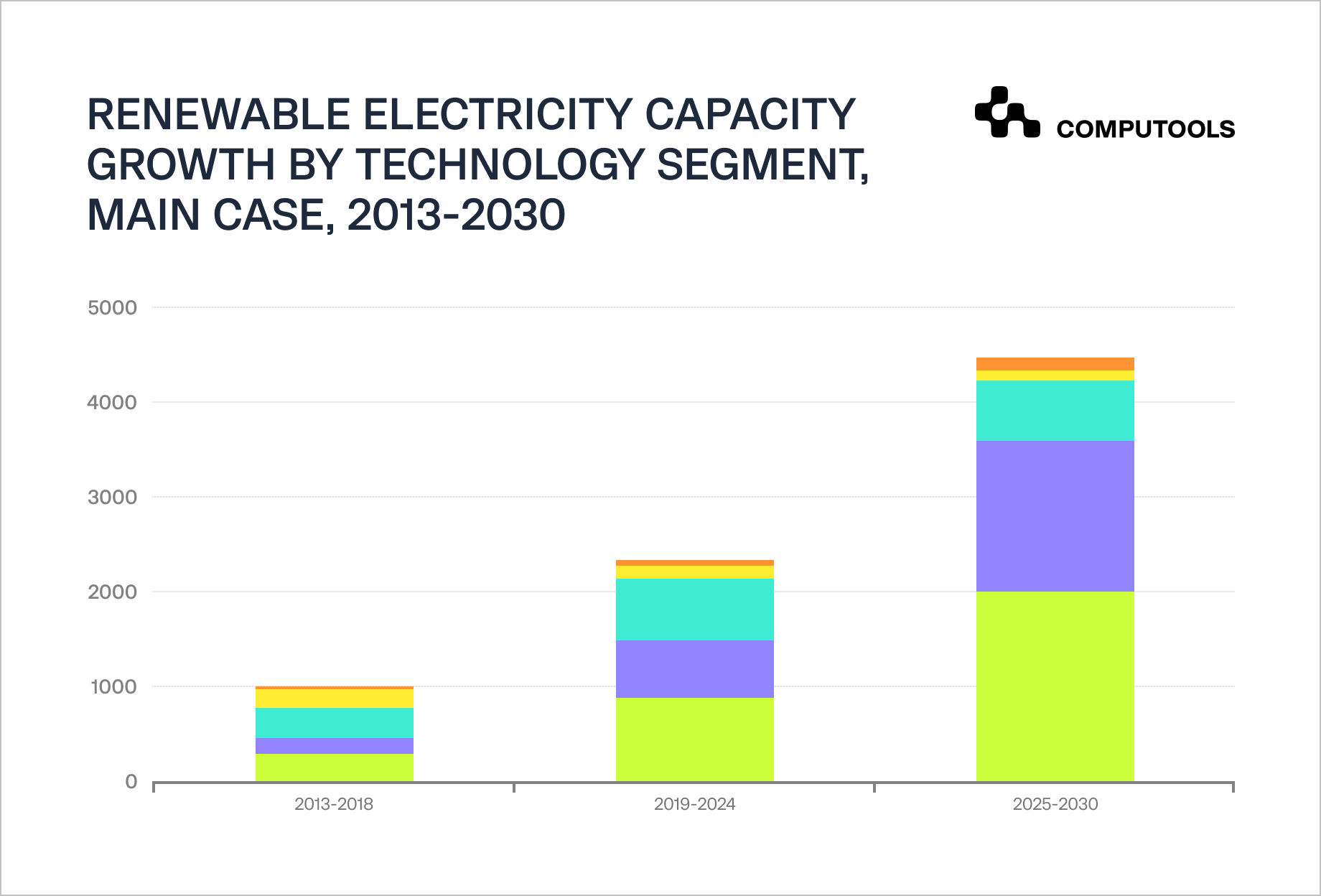
Drone-based wind turbine inspection is growing with that fleet: according to Global Info Research, the global wind power drone inspection service market was valued at USD 1.053 billion in 2025 and is forecast to reach USD 3.543 billion by 2032, with a CAGR of 18.9%.
As more blade images, infrared data, LiDAR outputs, defect records, AI-generated reports, and maintenance work orders move through inspection workflows, operators need to build a drone data management platform that centralizes inspection data, asset history, and repair planning in a single controlled system. Scattered folders, spreadsheets, and disconnected contractor reports slow defect validation, increase manual review, and make maintenance decisions harder to track.
How Computools helped a global wind turbine manufacturer build a drone data management platform
Computools helped a global wind turbine manufacturer build a drone data management platform for turbine inspection workflows. The client needed to manage inspection reports across large wind turbine fleets, reduce manual review, and use the collected data to enable faster maintenance planning.
In Drone Analytics project, Computools worked with a global wind turbine manufacturer that had installed more than 173 GW of wind turbines across 88 countries. At that scale, fragmented inspection reports created delays in defect validation, maintenance prioritization, and turbine performance management.
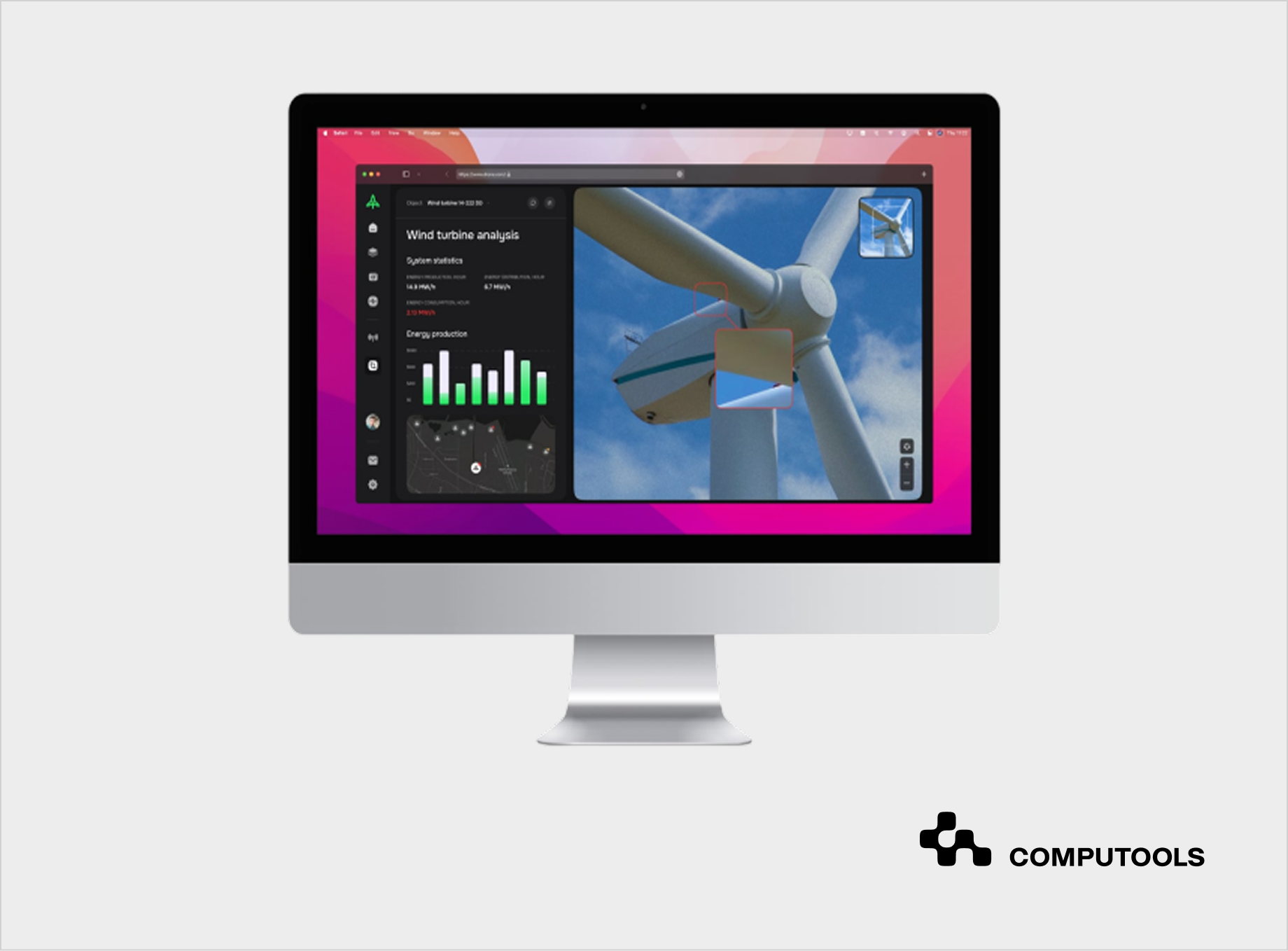
The main issue was fragmented drone inspection data. Reports arrived in different formats, including JSON and PDF, and were stored in separate locations. This made inspection history difficult to access, slowed defect assessment, and increased manual work for technical and maintenance teams.
Computools developed and implemented a centralized system for managing Critical Inspection Reports and Basic Inspection Reports. The solution stored reports in one place, automatically extracted key details, and helped users review blade-damage categories, assessment statuses, and turbine condition data without switching between disconnected files and tools.
The system also included a business logic module for maintenance prioritization. It applied predefined rules to inspection data and helped teams decide which issues required attention first. This gave the client a clearer link between inspection findings and maintenance actions.
The delivered wind turbine inspection software provided users with a single interface for accessing reports, reviewing inspection results, and managing turbine condition data. The system reduced the time spent on manual report processing and made inspection data easier to use for preventive maintenance.
The solution contributed to a 5% increase in mean time between failures, reduced operational costs, and required fewer personnel for inspection-related work. It also improved safety by reducing the need for high-altitude tasks. Computools’ experience in energy systems, data processing, and AI development helped the client move from scattered reports to a controlled data management process with measurable operational value.
How to build a centralized drone data management system for wind turbine inspections
Before deciding how to build a drone data management platform for wind turbine inspections, operators need to map the full inspection workflow: data capture, storage, defect analysis, maintenance prioritization, reporting, and ROI tracking.
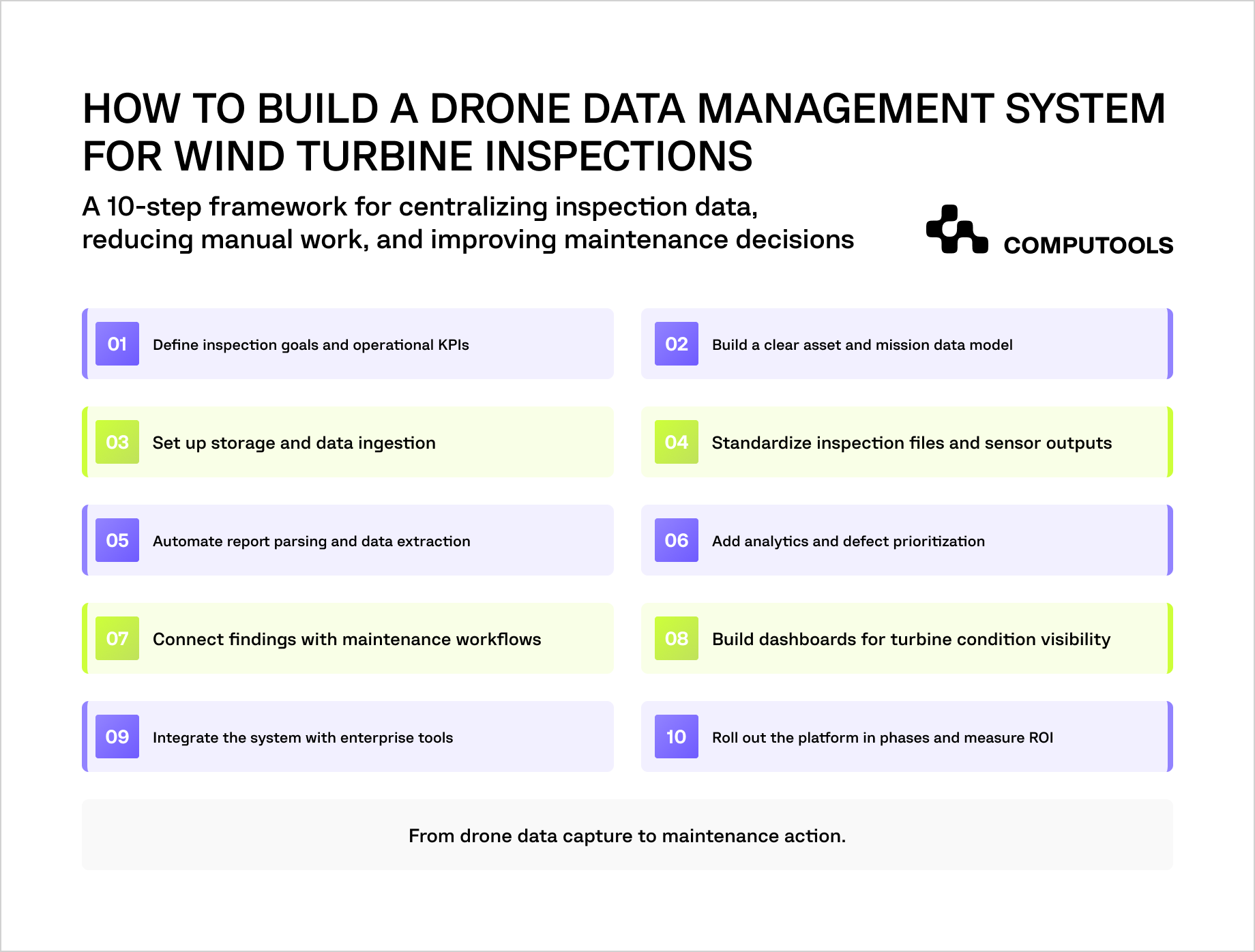
1. Define inspection goals and operational KPIs
Before development starts, the operator needs to define what the inspection system must improve in business terms. For wind turbine fleets, the main goals usually include faster defect validation, shorter report processing time, better maintenance prioritization, fewer manual checks, lower safety risks, and higher turbine availability.
For drone data management for wind energy, KPIs should be tied to inspection and maintenance outcomes, including report processing time, defect validation speed, maintenance response time, MTBF changes, and downtime reduction.
In the Computools case, the client needed to manage inspection reports across large wind turbine fleets and use this data for preventive maintenance. Reports were stored in different locations and arrived in different formats, which slowed access, analysis, and decision-making. The project goals were therefore built around centralized report storage, automated data extraction, defect assessment, and maintenance planning.
This step gives the development team a clear product direction. The system should be designed around measurable operational improvements: fewer hours spent on manual report review, faster access to turbine condition data, clearer maintenance priorities, and safer inspection-related workflows. Without KPI logic, the project may meet technical requirements but fail to show measurable operational value.
2. Build a clear asset and mission data model
A centralized inspection system requires a structured data model before development proceeds to storage, analytics, or workflow automation. Wind turbine inspections generate different types of records: turbine data, blade data, drone mission data, inspection reports, sensor outputs, defect notes, maintenance actions, and user activity. Each record should have a defined place in the system and a clear relationship with other records.
For drone asset management software, the data model should link each inspection file to a specific asset. A report, image, video, thermal scan, or LiDAR output should be linked to the turbine ID, blade number, inspection date, mission ID, defect category, severity level, and maintenance status. This makes the data usable for analysis, comparison, and long-term asset history.
The mission data layer should also include information about the drone, pilot, payload, weather conditions, flight route, inspection type, and upload status. These details help operators understand how the data was collected and whether the inspection meets internal quality requirements. For example, poor weather, incomplete coverage, or missing sensor metadata can affect the reliability of the inspection results.
A strong data model also prepares the platform for future features. Once turbine records, inspection missions, defects, reports, and maintenance actions are properly connected, the system can support analytics, trend tracking, automated prioritization, and integration with maintenance tools without later rebuilding the data foundation.
3. Set up storage and data ingestion
Wind turbine inspection data usually comes from several sources: drone operators, inspection contractors, internal engineering teams, sensor systems, and maintenance departments. Reports may arrive as PDFs, JSON files, image folders, videos, spreadsheets, or exported datasets from inspection tools. The system needs a single controlled ingestion layer that accepts these formats, validates them, and connects them to the appropriate turbine assets.
Storage architecture should support more than file upload. Each report should receive metadata: turbine ID, wind farm, blade number, inspection date, report type, contractor, file format, processing status, and defect category. This metadata makes inspection records searchable and prepares them for analytics, reporting, and maintenance prioritization.
In the Computools case, this was one of the first operational problems to solve. The client had Critical Inspection Reports and Basic Inspection Reports stored in different locations, which slowed access and led to inconsistent analysis. Computools implemented centralized storage so users could manage inspection reports from a single location and work with structured data rather than scattered files.
The ingestion layer should also validate incoming data. The system can check whether required fields are missing, whether the report is linked to an existing turbine, whether the file format is supported, and whether the inspection record duplicates an older upload. These checks reduce manual cleanup and help teams trust the data before it moves into analysis.
For large turbine fleets, centralized drone data improves governance. Access rights, report history, version control, audit logs, and retention rules are easier to manage when inspection data is stored in a single system. Maintenance teams can review the latest report, analysts can compare inspection cycles, and managers can track whether critical findings are being processed on time.
4. Standardize inspection files and sensor outputs
Drone inspections can generate different data types depending on the inspection setup: high-resolution blade images, video files, thermal scans, LiDAR outputs, GPS coordinates, flight logs, telemetry, and structured reports. The system should define how each data type is stored, named, indexed, and connected to the right turbine, blade, inspection cycle, and defect record.
Standardization should cover file formats, metadata fields, naming rules, upload requirements, and validation logic. For example, every inspection image or report should include enough context to answer basic questions: which turbine it belongs to, which blade section it shows, when the inspection occurred, who performed it, which sensor was used, and whether defects were detected.
For large wind fleets, drone image and video management should support visual comparison across inspection cycles. Teams need to see whether blade erosion, cracks, surface damage, or thermal anomalies are stable, progressing, or already repaired. That requires consistent file linking, instead of relying on inconsistent folder names that make inspection history difficult to search and compare.
The platform should also separate raw data from processed data. Raw drone files need to stay available for audit, reprocessing, or quality checks. Processed outputs, such as defect tags, severity scores, cropped images, annotations, and reports, should be stored as structured records that can feed dashboards and maintenance workflows.
A standardized data layer makes the next steps easier: analytics can work with cleaner inputs, users can search inspection history more quickly, and maintenance teams can trust that defect information is linked to the right asset. Without this layer, advanced analytics will depend on incomplete or inconsistent inputs, which reduces the reliability of defect classification and maintenance recommendations.
5. Automate report parsing and data extraction
Manual report review quickly becomes a bottleneck when inspection teams work with hundreds of turbines, repeated inspection cycles, and different contractor formats. The platform should automatically extract useful information from reports and convert it into structured records that can be searched, filtered, analyzed, and linked to maintenance actions.
The extraction logic should cover the fields that matter for turbine condition assessment: turbine ID, blade number, inspection date, report type, defect category, severity level, assessment status, recommended action, and responsible team. For UAV data management, this step turns drone-generated files into operational data instead of leaving PDFs, JSON exports, or image folders for repeated manual review.
In the Computools case, the client received inspection reports in JSON and PDF formats. Computools implemented automatic extraction of key report data, including blade damage categories and assessment statuses. This reduced the amount of manual work required to process inspection results and helped technical teams move faster from report review to defect assessment.
The system should also include validation rules. It can flag missing turbine IDs, unsupported file formats, duplicate uploads, incomplete inspection records, or reports that do not match the expected structure. These checks protect the data layer from errors before incorrect information reaches dashboards, analytics, or maintenance workflows.
For larger fleets, automated extraction also improves consistency. Every report is processed using the same logic, reducing subjective interpretation and making inspection data easier to compare across turbines, wind farms, contractors, and time periods. That consistency becomes critical when operators need to track recurring defects, evaluate repair urgency, or prove that inspection findings were reviewed on time.
6. Add analytics and defect prioritization
After the report data is extracted and structured, the system should help users understand which findings require attention first. Wind turbine inspection teams usually deal with different defect types: blade surface damage, erosion, cracks, lightning strike traces, thermal anomalies, incomplete inspection coverage, and repeated issues from previous cycles. Treating all findings with the same urgency slows maintenance planning and wastes resources.
Analytics should group defects by turbine, blade, defect category, severity, inspection date, and maintenance status. The system can then show which turbines have critical findings, which defects are recurring, and which issues may affect performance or safety if left unresolved. For operators managing large fleets, this gives a clearer view of inspection risk across assets.
A drone analytics platform should also support rule-based prioritization. For example, critical blade damage, repeated defects, or high-severity findings can be flagged for immediate review. Lower-risk issues can move into scheduled maintenance planning. This helps maintenance teams focus on the most urgent work first and reduces delays between inspection, assessment, and action.
In the Computools case, the system included a business logic module that used predefined rules to prioritize maintenance tasks. The platform automatically processed key inspection data, including blade damage categories and assessment statuses, then helped users decide which issues needed attention first. This made the inspection workflow more consistent and reduced dependence on manual report interpretation.
The analytics layer should also prepare data for dashboards and long-term monitoring. Once defects are consistently classified and prioritized, teams can track defect trends, compare inspection cycles, identify turbines with recurring issues, and measure whether maintenance actions reduce risk over time.
For business users, the value is practical: faster defect validation, fewer manual checks, clearer repair planning, and better control over turbine availability. Analytics should connect inspection findings with operational decisions; otherwise, the system only stores data without improving maintenance planning.
7. Connect findings with maintenance workflows
Inspection data should move into maintenance planning without extra manual handover. Once the system identifies a defect, assigns a severity level, and links it to a turbine or blade, the next step is to create a clear path for review, approval, repair planning, and resolution tracking.
This is where drone inspection workflow automation becomes useful. The platform can route critical findings to the right technical specialists, create maintenance tasks, assign owners, set deadlines, and track status changes from “detected” to “validated,” “scheduled,” “in repair,” and “closed.” Each action should stay connected to the original report, image, defect category, and turbine asset record.
For wind turbine operators, this workflow reduces the gap between inspection and action. Inspection findings should move from reports to maintenance workflows without manual re-entry. Delayed handover can slow defect review, weaken repair prioritization, and increase the risk of downtime.
The workflow layer should also support auditability. Teams need to see who reviewed a defect, when the decision was made, what action was assigned, and whether the issue was resolved. This is especially important for large wind fleets where multiple teams, contractors, and technical leads work with the same inspection data.
A strong maintenance workflow delivers measurable value to the platform: fewer delays after inspections, clearer responsibility for each defect, better repair prioritization, and stronger control over turbine availability.
8. Build dashboards for turbine condition visibility
A centralized system should give each team a clear view of turbine condition, inspection progress, defect severity, and maintenance status. Engineers need detailed defect data. Maintenance coordinators need open tasks and repair priorities. Operations managers need fleet-level visibility across wind farms, inspection cycles, and unresolved risks.
Dashboards should show the information that affects daily decisions: which turbines have critical findings, which inspection reports are still waiting for review, which defects are recurring, and which maintenance actions are overdue. The interface should also make it easy to filter data by wind farm, turbine, blade, defect category, inspection date, contractor, and status.
For operators managing large fleets, wind turbine monitoring solutions should connect inspection findings with asset history. A dashboard should not only show that a defect exists. It should show whether the same blade had a similar issue before, whether the damage progressed, whether a repair was completed, and whether the turbine returned to normal operation after maintenance.
The dashboard layer should also support management reporting. Useful views include defect distribution by severity, report processing time, inspection coverage, maintenance backlog, MTBF changes, and downtime linked to inspection findings. These metrics help show whether the system improves operational performance, reduces manual work, and gives maintenance teams better control over inspection-driven decisions.
A strong dashboard turns inspection data into a working management tool. Teams can see what needs attention, track what has already been handled, and use inspection history to plan maintenance with fewer blind spots.
For broader asset visibility, Computools covers how to develop a real-time energy asset monitoring platform that connects IoT data architecture, real-time monitoring, predictive analytics, integrations, and secure rollout.
9. Integrate the system with enterprise tools
A centralized inspection system should connect with the tools already used by operations, engineering, and maintenance teams. For wind energy companies, these may include CMMS, ERP, SCADA, asset management systems, document repositories, BI tools, and internal reporting platforms.
For renewable energy inspection software, integration planning should start with the data that must move between systems. Inspection findings need to be communicated to maintenance teams. Maintenance statuses need to return to the inspection system. Asset records, turbine IDs, repair history, downtime data, and work order statuses should stay consistent across platforms.
The integration layer should define supported data formats, API requirements, user roles, access permissions, event logs, and error handling. If the system receives drone reports from contractors, it should also support controlled external access, upload validation, and clear approval flows before the data is added to the official inspection history.
In the Computools case, the solution was built around structured report processing and centralized access to inspection data. This foundation made the system easier to extend because inspection records, report statuses, and turbine condition data were no longer scattered across disconnected files and storage locations.
Security and governance are also part of this step. Wind turbine inspection data can include asset condition details, operational risks, maintenance plans, contractor records, and infrastructure information. The platform should support role-based access, audit logs, data retention rules, and secure data exchange with connected enterprise systems.
Good integration gives teams one reliable operational flow. Inspection results become easier to validate, maintenance teams receive cleaner inputs, and managers can track whether identified defects move through review, planning, and resolution.
10. Roll out the platform in phases and measure ROI
The rollout should begin with a controlled pilot. A pilot helps validate data ingestion, report parsing, defect logic, dashboard usability, performance, user roles, and maintenance workflows before the system is expanded across additional turbines, wind farms, or inspection teams.
As part of energy software development services, Computools used this approach in the drone analytics case. The client first assessed the team through a pilot project. After the pilot confirmed technical fit and alignment with operational requirements, Computools developed and implemented the system, and then continued to provide technical support and enhancements.
A phased rollout should include clear checkpoints. The first phase can focus on centralized report storage and data extraction. The next phase can add defect prioritization, dashboards, and maintenance workflows. Later phases can cover analytics improvements, integrations with enterprise systems, and broader fleet-level reporting.
Each phase should have measurable outcomes. Useful metrics include report processing time, percentage of reports automatically processed, number of manual review steps removed, time from defect detection to maintenance decision, MTBF changes, operational cost reductions, and safety improvements linked to fewer high-altitude inspection tasks.
In the project, the system contributed to a 5% increase in mean time between failures, reduced operational costs, required fewer personnel for inspection-related work, and improved safety by reducing the need for high-altitude tasks. These outcomes show why rollout planning should connect technical delivery with operational KPIs from the beginning.
The final system should give the operator a controlled process for managing inspection data, validating defects, planning maintenance, and tracking business impact. That is the difference between storing drone files and using inspection data to improve turbine availability, maintenance efficiency, and fleet performance.

Launch your wind turbine inspection platform within 1–3 months instead of years. Unify inspection data, accelerate maintenance decisions, and maximize wind farm performance from a single operational view.
Core modules of a centralized inspection platform
A centralized drone data management system should cover the full inspection cycle: data upload, file validation, report processing, defect review, maintenance prioritization, and performance tracking. For wind turbine operators, the platform must turn inspection outputs into structured operational data that teams can use without manual file sorting.
1. Data ingestion and storage
The system should accept drone images, videos, thermal scans, LiDAR outputs, JSON files, PDF reports, and structured inspection forms. Each file should be linked to the correct wind farm, turbine, blade, inspection date, and report type.
2. Asset and mission tracking.
A drone operations management platform can help teams track missions, drones, pilots, payloads, inspection status, upload history, and report completeness. This gives operators a clear connection between each inspection flight, collected data, and the asset being inspected.
3. Automated report processing
The platform should extract key fields from inspection reports, including defect category, blade damage details, severity level, assessment status, and recommended action. This reduces manual review and gives maintenance teams cleaner data for decision-making.
4. Defect review and prioritization
Inspection findings should be grouped by turbine, blade, defect type, severity, and maintenance status. Rule-based logic or AI-assisted analysis can help teams identify critical issues faster and prioritize repairs based on operational risk.
5. Dashboards and reporting
Dashboards should show inspection coverage, unresolved defects, defect severity distribution, report processing time, maintenance backlog, and turbine condition trends. With the right reporting layer, wind farm inspection technology becomes a practical tool for maintenance planning, defect tracking, and fleet-level visibility.
6. Security and governance
The system should include role-based access, contractor permissions, audit logs, version history, secure file exchange, and data retention rules. These controls are important for operators managing infrastructure data, external inspection teams, and long-term asset history.
For companies exploring AI-assisted defect analysis and predictive maintenance, Computools’ article on AI in the energy industry covers how AI supports operational efficiency, demand prediction, renewable energy management, and energy waste reduction.
How Computools reduces execution risk
Companies choose Computools when a wind turbine inspection platform has to deliver measurable operational value from launch. The system must reduce manual data processing, speed up defect validation, support maintenance planning, and prove its impact through agreed KPIs.
Computools lowers execution risk through phased delivery with clear checkpoints. The project can start with a pilot to validate data ingestion, report parsing, defect logic, dashboards, user roles, and maintenance workflows before full rollout. In the Drone Analytics case, this pilot helped the client confirm technical fit and domain understanding before committing to full-scale development.
Each phase is tied to measurable outcomes: report processing time, automated extraction rate, time from defect detection to maintenance decision, mean time between failures, operational cost reduction, and safety gains.
In the Drone Analytics case, the delivered system contributed to a 5% increase in mean time between failures, lower operational costs, fewer personnel involved in inspection-related work, and improved safety.
Computools applies energy-sector expertise to projects in which asset data, inspection workflows, predictive maintenance logic, and enterprise integrations must work as a single operational flow. Its electric power software development experience covers smart grid management, outage tracking, infrastructure asset systems, SCADA platforms, renewable energy integration, and energy analytics.
Across electric power utility projects, Computools highlights 2x faster field operations, a 65% reduction in equipment downtime, 250+ experts, and 20+ delivered projects.
The same delivery logic applies to other asset-heavy energy environments, including oil and gas software development, where uptime, infrastructure inspection, field data quality, SCADA monitoring, and predictive maintenance are business-critical. For wind energy companies, this background helps reduce delivery risk when building systems that depend on reliable asset visibility, secure integrations, and fast maintenance decisions.
Through web development services, Computools can deliver role-based interfaces for engineers, maintenance coordinators, contractors, and managers. If field teams need direct access to inspection tasks, defect records, or repair statuses, mobile app development services can extend the platform into on-site operations.
The outcome is a lower-risk path from fragmented inspection data to a launched operational system with defined KPIs, launch support, and a roadmap to ROI. For wind energy companies, this means faster defect validation, less manual work, better maintenance planning, and stronger control over turbine performance. Contact Computools at info@computools.com to discuss your inspection workflow, data challenges, and ROI goals.
Conclusion
A centralized drone data management system helps wind energy companies turn inspection data into faster maintenance decisions. When reports, images, defect records, asset history, and workflows are connected in one platform, teams spend less time on manual review and gain clearer visibility into turbine conditions.
The operational value is direct: faster defect validation, fewer data bottlenecks, better maintenance prioritization, safer inspection processes, and stronger control over turbine performance. For wind turbine operators, this creates a measurable path from fragmented drone inspection data to lower operational risk and more reliable asset management.
If inspection data also needs to support energy performance, forecasting, and resource planning, read Computools’ guide on how to build an energy optimization system for sustainable operations.
Computools
Software Solutions
Computools is an IT consulting and software development company that delivers innovative solutions to help businesses unlock tomorrow.