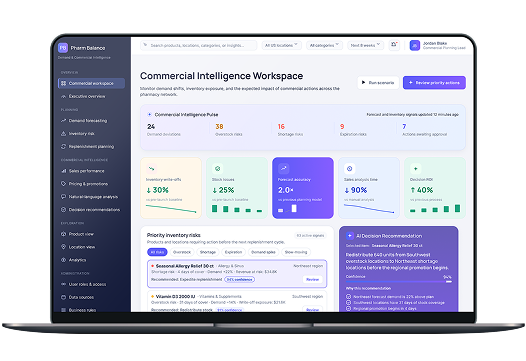
The client is a US-based multi-location pharmacy retailer facing a persistent imbalance between inventory availability and customer demand. Some products remained overstocked and tied up working capital, while others went out of stock before commercial or supply-chain teams could react.
The retailer needed pharmacy demand forecasting software that could improve planning across products, locations, seasonality, pricing, promotions, and demand signals. Forecasts also had to align with commercial actions, so teams could understand what was changing, why it was changing, and which response would have the strongest business impact.
Computools delivered Pharm Balance, an AI-powered commercial intelligence system for demand forecasting, inventory risk detection, sales analysis, and commercial decision support. The platform strengthened pharmacy inventory optimization, reduced inventory write-offs by 30%, cut stock issues by 25%, improved forecast accuracy by 2x, reduced sales analysis time by up to 90%, and increased decision ROI by 40%.
The client is a US-based pharmacy retailer operating multiple locations across regional markets. Its business combined prescription-related operations, over-the-counter products, wellness categories, seasonal demand, promotions, and location-specific buying patterns.
Existing pharmacy inventory management processes relied on stock data, sales history, and replenishment routines that were not always connected to current demand signals. This made it difficult to identify slow-moving products, expiration risk, and location-level stock pressure early enough.
Commercial teams also needed a pharmacy analytics platform that could explain changes in sales performance. Pricing, promotions, product availability, seasonality, and local demand patterns all affected revenue, but investigating those drivers required too much manual analysis.
The main challenge was connecting inventory control with commercial decision-making. The retailer had large volumes of sales, pricing, promotion, inventory, and product data, but teams lacked a single system to turn those signals into forecasts, explanations, and measurable actions.
The client needed stronger pharmacy business intelligence to connect operational and commercial data in one decision workflow. The project also required pharmacy management software development experience across pharmacy retail processes, inventory planning, commercial analytics, data governance, and phased rollout.
Computools implemented Pharm Balance as a connected demand and commercial intelligence layer for pharmacy retail. The platform brought inventory, sales, pricing, promotion, and demand data into one environment for forecasting, analysis, and decision support.
The forecasting component worked as AI demand forecasting software, generating product- and location-level forecasts from historical sales, seasonality, pricing, promotional activity, stock availability, and other demand signals.
The pharmacy inventory intelligence layer monitored stock levels, product movement, expiration risk, and location-level availability. It identified products that required replenishment, redistribution, promotion, or corrective action before inventory losses increased.
A pharmacy sales analytics layer helped commercial teams investigate performance changes faster. Users could query the system in natural language via controlled LLM integrations and receive explanations grounded in connected data on pricing, promotions, seasonality, inventory, and demand.
Computools applied AI development to connect forecasts, anomaly signals, driver analysis, and recommended actions. The decision layer evaluated pricing, promotion, assortment, and inventory options, then showed the expected business impact of each action.
Pharm Balance improved the retailer’s control over inventory losses, demand volatility, sales performance analysis, and commercial action planning:
Earlier risk detection helped teams identify slow-moving, overstocked, and expiration-sensitive products before losses reached the write-off stage. Demand-aligned replenishment reduced avoidable stock issues by connecting product availability with location-level demand patterns.
The platform improved retail pharmacy demand planning by linking forecasts to pricing, promotions, inventory status, and sales performance drivers. Commercial and supply-chain teams could see why demand changed and which pricing, promotion, assortment, or replenishment action had the strongest expected impact.
The shared data model strengthened data engineering across sales, inventory, pricing, promotions, product movement, and demand signals. This gave teams one analytical foundation for forecasting, performance investigation, and ROI-based decision evaluation.
The client selected Computools because the project required pharmacy retail workflow analysis, inventory data modeling, AI forecasting logic, commercial analytics, natural-language insight access, and phased rollout support.
Computools turned fragmented sales, inventory, pricing, promotion, and demand data into a practical decision model for forecasting, stock-risk detection, performance explanation, and recommended actions.
Delivery priorities were tied to measurable KPIs: inventory write-offs, stock issues, forecast accuracy, sales analysis time, and decision ROI.
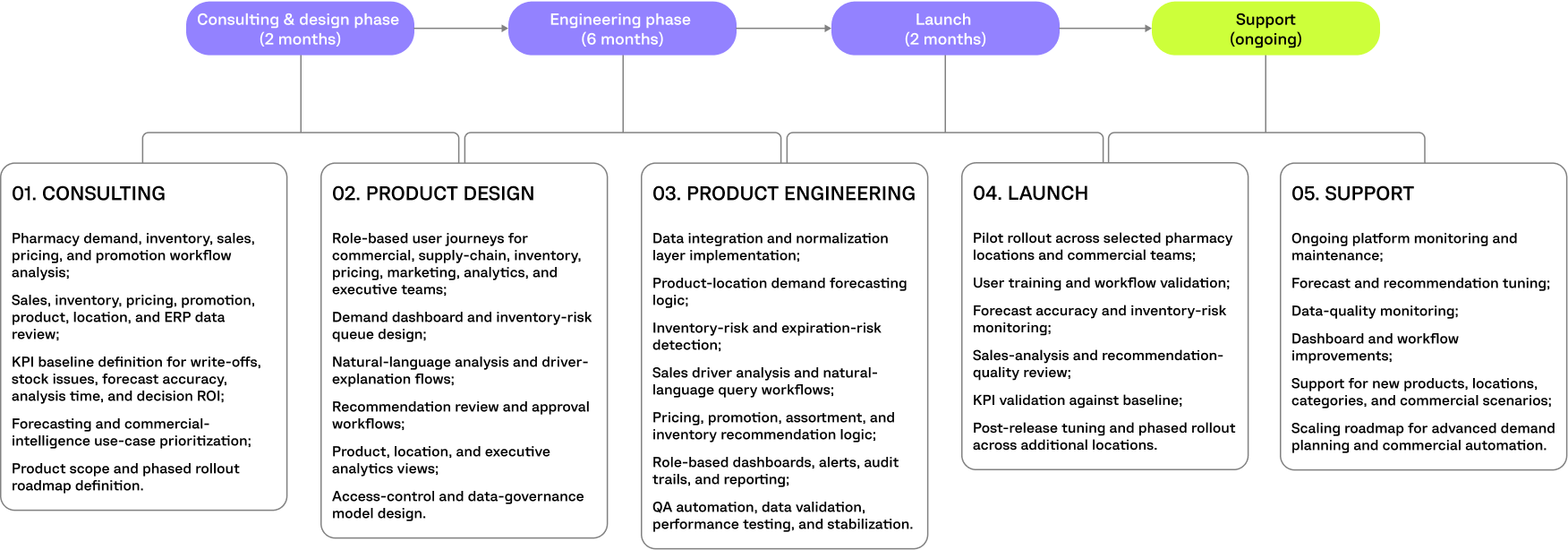
The team covered business analysis, CX and UX design, architecture, AI logic, data integration, QA, rollout validation, and post-launch optimization.

The design focused on demand visibility, inventory-risk prioritization, commercial analysis, natural-language access to insights, and action-oriented decision support.
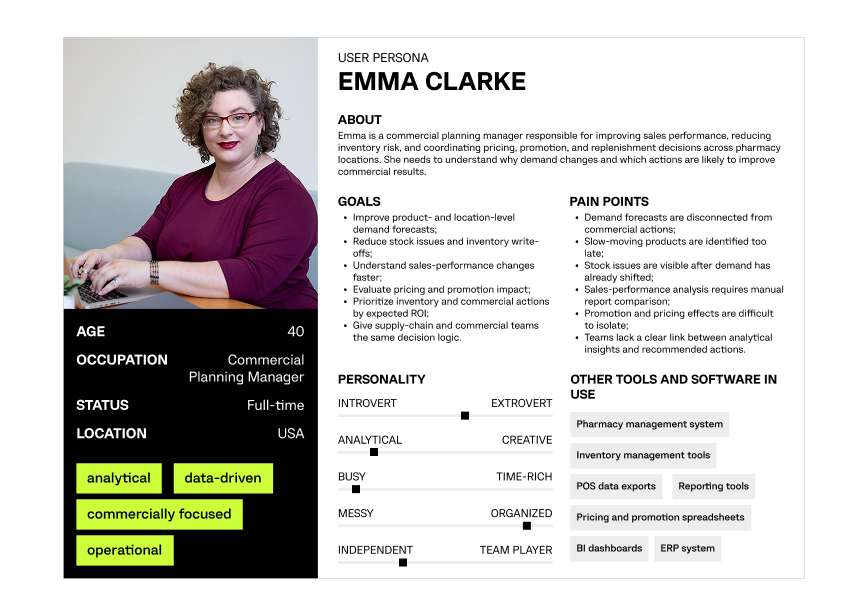
Defining pharmacy retail needs across demand planning, inventory control, pricing, promotions, category management, and executive reporting.
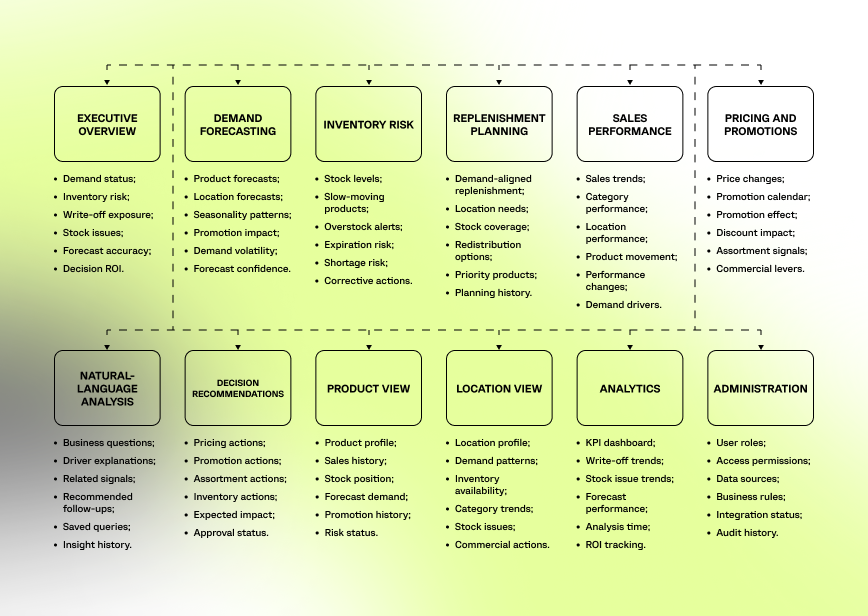
Structuring the platform around demand signals, inventory risk, commercial drivers, recommended actions, and ROI tracking.
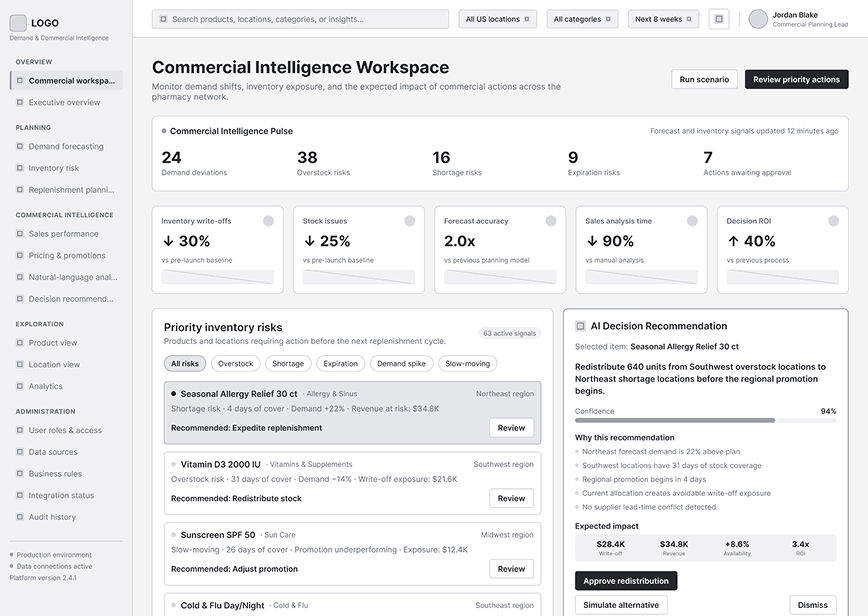
Designing low-fidelity layouts for demand dashboards, inventory-risk queues, natural-language analysis, product views, location views, recommendation approvals, and executive analytics.
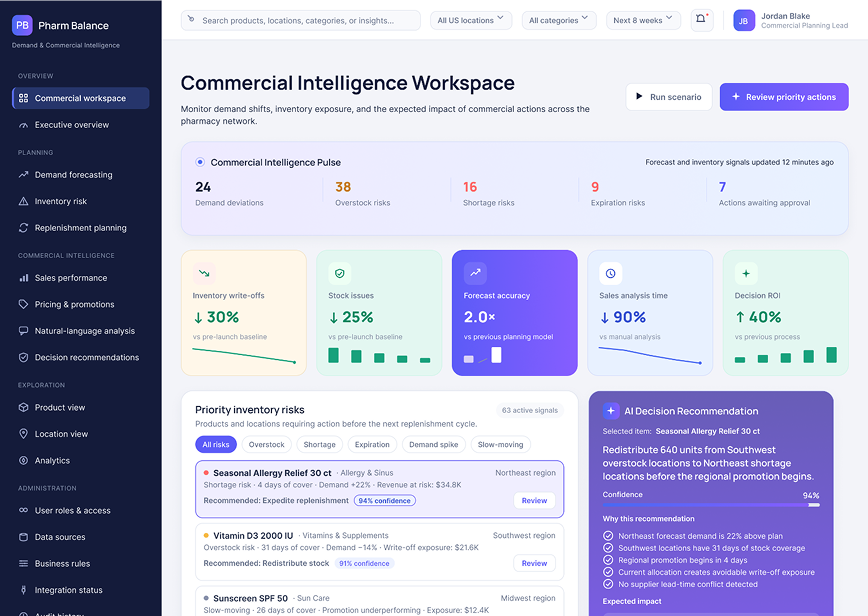
The interface gave teams one place to review demand signals, investigate sales changes, identify inventory risks, and evaluate recommended commercial actions.

TypeScript
TypeScript supported consistent frontend and backend development across forecasting views, inventory-risk workflows, recommendation logic, access controls, and analytics interfaces.

Next.js and React
Next.js- and React-powered responsive interfaces for commercial, supply chain, inventory, pricing, marketing, analytics, and executive teams.

Node.js and NestJS
Node.js and NestJS handled application logic, API orchestration, role-based access control, workflow rules, audit logging, notifications, and integration coordination.

PostgreSQL
PostgreSQL stored normalized products, locations, stock records, sales history, pricing data, promotion references, forecasts, recommendations, and KPI history.

Python and FastAPI
Python and FastAPI supported demand forecasting, inventory-risk scoring, driver analysis, recommendation logic, and analytics processing.

Azure, Docker, and Terraform
Azure, Docker, and Terraform supported cloud deployment, environment consistency, infrastructure automation, monitoring, and scalable processing for forecasting and analytics workloads.

OpenAI, Claude, RAG, and pgvector
Controlled LLM integrations supported natural-language queries and analytical explanations. RAG workflows using pgvector retrieved semantically relevant business context to ground generated responses in platform data and analytical results.

REST APIs, webhooks, and scheduled data pipelines
These integration mechanisms connected sales, inventory, pricing, promotion, product, and ERP data sources with the Pharm Balance platform.
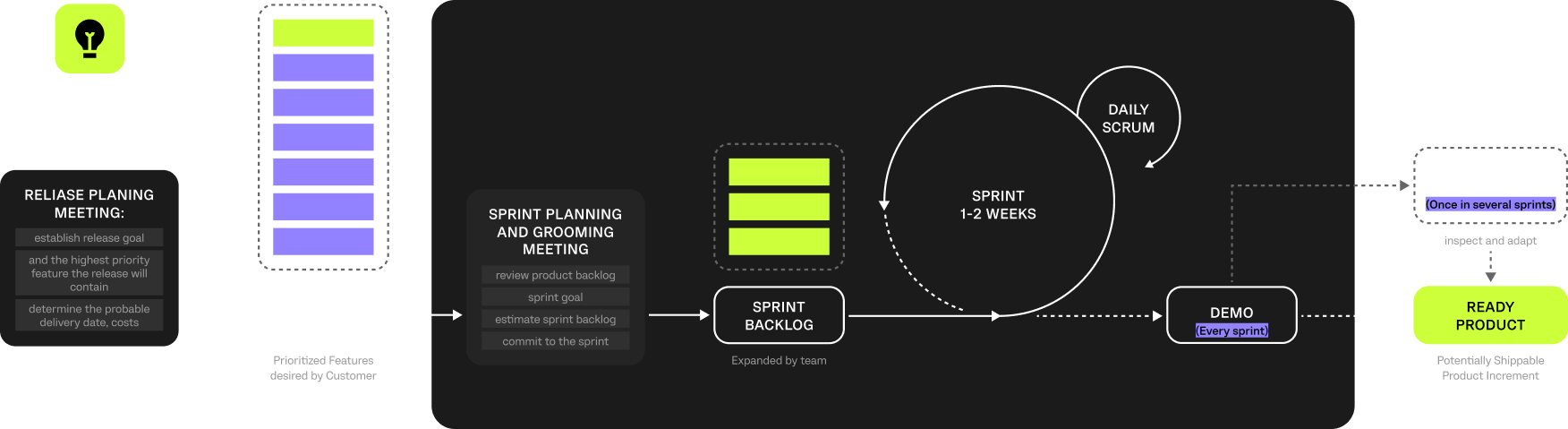
Computools used a Scrum-based delivery model with two-week iterations, stakeholder demos, and KPI-based acceptance criteria. Each sprint tied platform functionality to a measurable outcome: inventory write-offs, stock issues, forecast accuracy, analysis time, or decision ROI.
The team started with workflow mapping, data source review, and demand planning model definition. Forecasting, inventory-risk detection, natural-language analytics, and recommendation workflows were added after product-location data was validated.
Commercial, supply-chain, inventory, pricing, analytics, and executive stakeholders reviewed each release before rollout.
Pharm Balance helped us connect demand forecasts, inventory risk, and commercial performance in one place. Our teams can understand why sales change, identify stock problems earlier, and choose actions with a clearer view of expected business impact.




Computools | 341 Raven Cir, Camden Wyoming, Delaware 19934, US