
THE AUTHOR:

Behind every successful auction is a network of connected systems that must work together at the exact moment demand peaks. Buyers expect instant pricing. Sellers want real-time market data. The staff handling payment, clients and order fulfillment can not afford to be in the dark. Each passing year poses more requirements for online auction platform development.
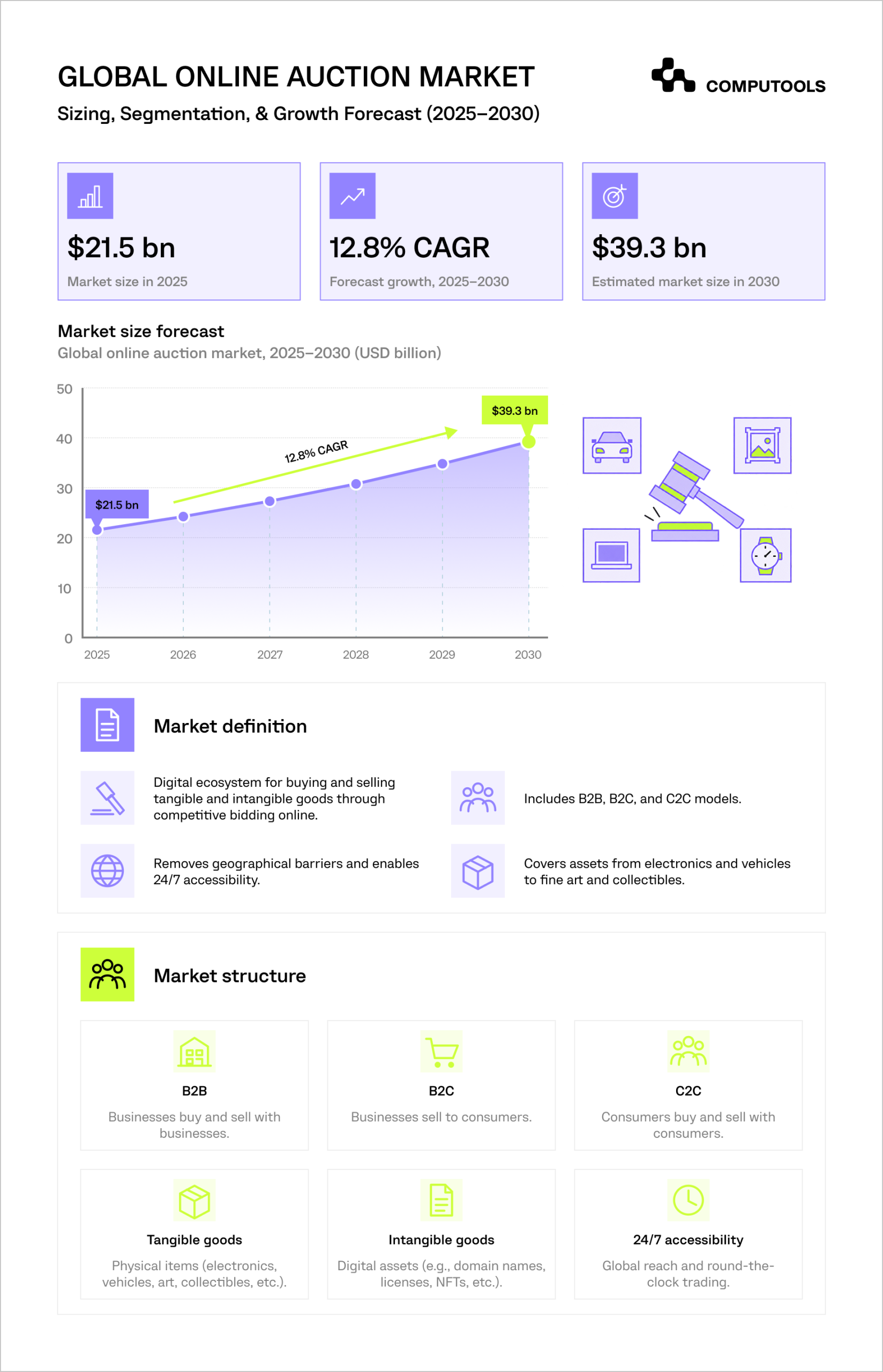
The market for online digital auctions is expected to more than double in the next 5 years from $21.5 billion to $39.3 billion, with the continued growth of selling high-end items like luxury automobiles and collectables. At the same time, customer expectations are moving closer to real-time digital commerce. Buyers want control over their purchase via their mobile device and to be instantly notified of opportunities to bid or outbid others.
They expect to see a record of their bidding activity and be allowed to immediately confirm their payment upon winning an item. DHL’s 2025 Ecommerce Trends Report, based on 24,000 online shoppers across 24 global markets, states that 7 in 10 shoppers want AI-powered shopping features such as intelligent search, assistants, and personalized recommendations.
Auction operators face additional technical pressure because every popular event creates a short period of extremely high activity, where thousands of users may submit bids within seconds.
The challenge is designing an architecture where these components operate as one business system, from real-time bidding and payments to customer data, seller workflows, analytics, and automation. This becomes especially important as AI enters digital commerce: DHL reports that 38% of shoppers and 36% of businesses use AI-powered chat or virtual assistants for buying and selling, while nearly one-third of consumers are open to letting AI make purchasing decisions within the next five years.
Security is another major factor. Auction platforms process valuable transactions and sensitive customer data, making fraud prevention part of the core architecture. The 2025 Global Ecommerce Payments and Fraud Report found that 45% of merchants consider real-time payment fraud one of the biggest emerging threats, while 57% reported increased refund or policy abuse.
Today’s auction platforms combine bidding technology with intelligent search, automation, analytics, and secure transaction workflows. These functionalities allow businesses to manage growing auction volumes while creating a faster and more reliable experience for buyers and sellers.
Capabilities behind a modern high-volume auction platform
| Modern requirement | Technology capability |
| Millisecond-level bidding experience | Event-driven architecture, WebSockets, distributed processing, bid validation engine. |
| AI-powered item discovery | Semantic search, recommendation models, image recognition, user behavior analysis. |
| Intelligent pricing decisions | Historical auction analytics, demand forecasting, predictive models. |
| Automated auction operations | AI-assisted content management, workflow automation, smart notifications. |
| Trust in high-value transactions | Identity verification, behavioral fraud detection, risk scoring, secure payment flows. |
| Data-driven marketplace management | Real-time analytics, customer data platforms, AI-ready data pipelines. |
| Connected business ecosystem | APIs for CRM, ERP, payment providers, logistics, and external marketplaces. |
This article describes how to create a high-frequency auction platform that will allow real-time sales, integrate various AI services, process payments, and help grow the business.
Auction website development shares many architectural challenges with other marketplace systems, especially when businesses need to manage multiple sellers, complex transactions, customer accounts, and operational workflows.
Explore how B2B commerce platforms are structured to support these connected processes in How to Build a B2B Wholesale Ecommerce Platform.
Computools approach to online auction platform development
Higher-end, high-value auctions have specialized requirements. Buyers want to see as much information as possible on the item they are bidding on. Additionally, an effective system must automate the interactions needed after a buyer has won an auction.
Vintaro Auctions, an online auction house, partnered with Computools to create an auction platform that provided real-time bidding and integrated a number of other services, including content delivery, identity verification and post-auction interactions.

Client context
Vintaro Auctions is an online auction house located in Belgium. They specialize in the sale of classic, antique and vintage automobiles, motorcycles and other collectible items. Vintaro’s clientele is international, and to facilitate the sale of such valuable items, they provide potential buyers with extensive information, condition reports, pictures and videos of each item.
As the auction catalog expanded, the business needed a platform capable of supporting more media-rich listings, higher bidder activity, and more structured post-sale processes.
Business challenge
The main challenge was maintaining a premium buyer experience during high-demand auction periods.
The platform needed to handle several complex workflows:
- real-time bidding during closing minutes when activity increases sharply;
- verified bidder access for high-value lots;
- large volumes of vehicle photos, videos, and condition documentation;
- post-auction coordination for pickup and specialized delivery.
For premium vehicle auctions, delays in bid confirmation or slow-loading lot pages directly affect buyer confidence. The platform also needed automated anti-sniping logic to extend auction closing times after valid late bids and maintain fair competition.
Computools solution
Computools modernized the auction platform architecture around the workflows that had the greatest impact on user trust and operational efficiency.
The solution included:
- real-time bidding infrastructure using WebSocket communication for live bid updates, countdown changes, and outbid notifications;
- backend auction services built with Node.js and TypeScript to support bid validation, auction status updates, user lot tracking, and post-auction workflows;
- PostgreSQL and Redis architecture for storing auction data and supporting low-latency activity during peak bidding periods;
- media optimization using AWS S3 and CloudFront to deliver high-resolution vehicle photos, videos, and condition reports efficiently;
- payment and verification integrations supporting deposit authorization, bidder checks, and secure auction participation;
- structured post-auction workflows allowing winning bidders to manage pickup scheduling and delivery coordination.
The platform improvements focused on the areas that directly influence auction success: bid responsiveness, transparent lot presentation, bidder verification, and smoother handover after the sale.
Business result
The upgraded platform improved performance across critical auction workflows:
- bid confirmation time was reduced to under 300 ms during peak activity;
- manual identity and deposit verification time decreased by up to 60%;
- media-heavy auction pages loaded up to 45% faster;
- mobile lot-page engagement increased by up to 32%;
- post-auction pickup and delivery coordination time decreased by up to 50%.
The Vintaro Auctions project demonstrates that a high-volume auction platform requires more than bidding functionality. It needs a technology foundation that connects real-time transactions, customer trust, asset information, payments, and operational workflows.
The same principles guide companies planning online bidding platform development for other industries where transaction accuracy and platform reliability directly affect revenue.
8-step guide into online auction software development
Computools begins online auction platform development by analyzing the commercial mechanisms of a marketplace. This includes understanding how sellers control their assets, how buyers make choices, what processes must be automated, and what is essential for improving the auction’s business performance.
Computools’ goal is to construct a flexible and highly adaptable platform that supports high-volume bid systems but also provides the foundation to integrate further automation and personalization using artificial intelligence.
Step 1. Define auction logic and business workflows
The first phase of developing an online auction platform is analyzing how an auction business operates. This includes making decisions about the form of auctions, the roles of bidders and sellers, prices, and how revenue is realized.
An auction for collectible items has different requirements from a B2B equipment marketplace. A luxury auction may require bidder verification, item authentication, and detailed ownership history. An industrial marketplace may focus on company accounts, bulk listings, and invoice workflows.
Before development begins, teams should map the complete auction lifecycle:
Seller creates listing → Platform reviews item → Auction becomes active → Users place bids → Winner is selected → Payment is completed → Asset is transferred
This workflow defines the required system logic, user permissions, notifications, and integrations.
Many auction projects face problems when teams begin with interface design before understanding operational requirements. For example, adding payment workflows after the bidding engine is complete may require major architectural changes because transaction states, user permissions, and compliance rules were not considered initially.
A clear business model creates the foundation for the technical decisions that follow.
Step 2. Design a real-time architecture for high-volume bidding
The core challenge of an auction platform is not displaying items. It is processing thousands of competing actions accurately within seconds.
A successful real-time bidding platform requires an architecture that can manage simultaneous users, instant price updates, and consistent auction states.
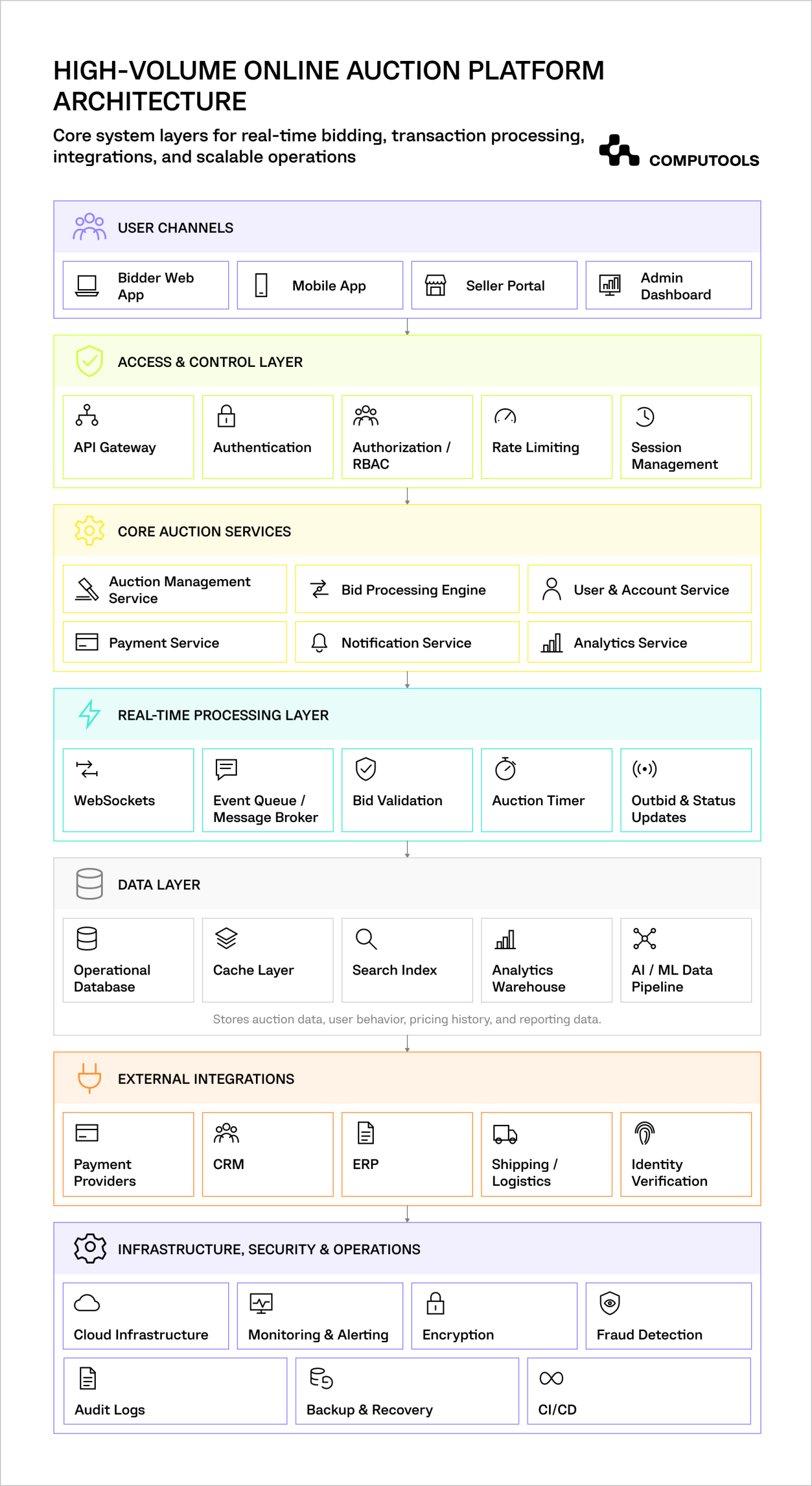
The platform typically includes several interconnected layers:
User applications
Bidder interfaces, mobile applications, seller dashboards, and administration panels provide access to auction workflows.
API and communication layer
This layer manages authentication, authorization, traffic control, and communication between frontend applications and backend services.
Auction processing layer
The bidding engine validates offers, applies auction rules, updates prices, and determines winners.
Data infrastructure
Databases, caching systems, and analytics keep different forms of data.
Thousands of users can send millions of requests within a short period of time, especially during a rapid series of bids in an auction. With the usual request-response architecture, the system may take a long time to process and respond to each query.
Therefore, most solutions are built using event-driven architecture with technologies such as WebSockets and message queues. These approaches allow the system to process bid events independently and keep users synchronized.
Each user should be able to view the latest data. When a bid is placed and accepted, it should be retained as such, regardless of how many requests are being processed.
Step 3. Create a data architecture that supports operations and AI
Auction platforms generate valuable information beyond completed sales. Every search, viewed item, bid attempt, saved lot, and payment action creates data that can improve future decisions.
A scalable online auction system requires a data model that supports both daily operations and advanced analytics.
The operational database stores information required for active transactions:
- user accounts;
- auction lots;
- current bids;
- payments;
- seller information.
Additional data pipelines collect behavioral information:
- search activity;
- browsing patterns;
- bidding history;
- customer preferences;
- category interest.
This separation allows companies to use operational data for immediate actions while analyzing historical information for business decisions.
For example, auction operators can identify:
- which categories attract more bidders;
- which sellers generate repeat participation;
- which items receive strong interest before an event.
This data foundation also determines whether AI features will produce useful results. Recommendation engines, demand forecasting, fraud detection, and pricing models depend on structured historical information.
A platform that collects only completed transactions limits future AI capabilities. A platform designed with analytics in mind creates opportunities for automation and predictive decision-making.
Companies building data-driven commerce products can explore approaches to marketplace analytics infrastructure in Cost of Marketplace Data Platform for Retail.
Step 4. Develop the bidding engine for reliable real-time bid processing
The bidding engine is the most sensitive part of an auction platform because it directly affects revenue and customer trust.
The system must answer several questions instantly:
- Is the bidder authorized?
- Does the bid meet auction rules?
- Was another bid submitted at the same time?
- Should the auction timer extend?
- Who currently leads the auction?
A typical bid flow looks like this: Bid submitted → User and auction validation → Bid processing → Database confirmation → Real-time update to participants.
The platform needs mechanisms that prevent conflicting transactions. For example, two users may submit bids within milliseconds of each other during a competitive auction. The system must apply predefined rules and maintain a reliable history of accepted actions.
A high-concurrency bidding system usually requires:
- optimized database operations;
- caching;
- event queues;
- concurrency control mechanisms;
- load testing.
In the Vintaro Auctions project, Computools worked with auction-specific workflows and structured data management, which reflects the same technical challenges faced by platforms handling time-sensitive digital transactions.
Step 5. Connect payments, identity, and external business systems
The auction does not end when the winning bid appears on the screen. The platform must continue supporting payment, verification, fulfillment, and customer communication.
A complete solution connects the auction workflow with external services:
- payment providers;
- identity verification systems;
- CRM platforms;
- ERP solutions;
- logistics providers.
Auction payment integration requires particular attention because auction transactions often involve higher-value purchases than standard ecommerce orders.
For example, a vehicle auction may require:
- bidder verification before participation;
- payment authorization after winning;
- invoice generation;
- seller payout processing;
- delivery coordination.
These integrations reduce manual work for operations teams and create a clearer transaction history for buyers and sellers. Payment architecture has a direct impact on conversion and customer trust.
For more details on designing payment flows that support successful checkouts, read Checkout Friction in Ecommerce: Payment Data and Optimization Strategies.
Step 6. Add AI capabilities for discovery, pricing, and automation
AI features are becoming a major differentiator for marketplace platforms. However, the strongest implementations focus on practical operational improvements rather than adding AI as a standalone feature.
Platforms can use AI in several areas of automated auction management.
Intelligent discovery
AI-powered search helps users find relevant items across large catalogs.
Examples include:
- semantic search;
- image recognition;
- similar item recommendations.
A collector searching for a specific vintage item could receive related auction lots based on visual characteristics, category, and previous activity.
Personalized recommendations
Recommendation models analyze:
- viewed items;
- previous bids;
- saved categories;
- purchasing behavior.
This allows platforms to promote auctions that match user interests.
Pricing intelligence
AI models can analyze:
- historical auction results;
- market demand;
- item characteristics;
- seasonal trends.
This supports sellers with reserve price recommendations and helps operators understand demand patterns.
Fraud detection
AI can identify unusual activity by analyzing:
- bidding behavior;
- account relationships;
- payment signals;
- device patterns.
AI performance depends on clean data. Without structured auction history and reliable user information, prediction models produce limited results.
Selecting the right AI approach depends on the platform’s goals, available data, and required automation level.
For a deeper look at AI architecture decisions for commerce applications, explore How to Choose an AI Framework for a Retail App.
Step 7. Build security and fraud controls
Trust determines whether buyers and sellers continue using an auction marketplace.
Auction businesses face specific risks:
- fake bidder accounts;
- shill bidding;
- fraudulent listings;
- payment abuse;
- account takeover.
Security architecture should include identity verification, access controls, transaction monitoring, and audit trails.
For example, behavioral analysis can detect unusual bidding patterns such as multiple connected accounts repeatedly increasing prices on the same listing.
The platform can then:
- flag suspicious activity;
- request additional verification;
- route cases for manual review.
Security controls protect revenue while reducing disputes and support workload.
Step 8. Test performance and prepare for platform scalability
Auction traffic is unpredictable. A platform may experience normal activity for weeks and then receive thousands of users during one high-profile event. The Vintaro Auctions project required attention to platform responsiveness, media performance, and reliable auction workflows because users interact with the system during short, high-pressure events.
QA Testing should replicate real operating conditions:
- simultaneous bidders;
- rapid bid submissions;
- payment spikes;
- notification loads;
- database growth.
Performance engineering should continue after launch through monitoring and analytics.
Teams should track:
- response times;
- failed transactions;
- bidding activity;
- infrastructure usage;
- customer behavior.
This allows businesses to improve auction platform scalability as transaction volume grows.

Launch a high-volume online auction platform within 1–3 months, handle thousands of concurrent bids without performance drops, increase bidder participation and sell-through rates, and grow transaction revenue without adding operational overhead.
Why choose Computools for custom auction platform development
The future of auctions belongs to platforms that understand buyer intent, manage seller operations, prevent fraud, process payments, and turn every interaction into actionable data. Computools combines experience in marketplace architecture, transaction-heavy systems, AI solutions, and data platforms to create auction products that support:
- real-time bidding under high traffic conditions;
- secure payment and verification workflows;
- scalable backend architecture;
- personalized customer interactions;
- automated operational processes;
- analytics-driven decision-making.
For businesses entering digital commerce models, Computools applies experience from retail software development services to build platforms that connect customer journeys with inventory, transactions, and operational workflows.
Experience with eCommerce software development supports the creation of marketplace capabilities such as product catalogs, customer accounts, payments, and conversion-focused user flows.
Through web development services, Computools develops responsive auction interfaces connected with scalable backend systems designed for both everyday operations and peak bidding periods.
AI capabilities from AI development enable advanced features such as intelligent search, recommendations, fraud analysis, and automated customer communication.
With data engineering expertise, Computools helps businesses build reliable data foundations for forecasting, reporting, and AI-driven optimization.
The result is an auction platform designed as a long-term business system. The one that connects revenue operations, customer engagement, automation, and technology infrastructure from the first release through future expansion.
Build an auction platform to handle growth, not just bids
A traditional understanding of an auction platform is a platform where users can submit bids. While this is the case, behind-the-scene processes need technology which helps handle a large number of users and offers flexibility to change auction details and status. Additionally, such technology helps businesses secure transactions and provides insights on user behavior.
Companies planning online auction platform development should focus on the foundations that help them achieve their business goals and provide a competitive edge. Such technologies include artificial intelligence, automation, secure integrations, and scalable architectures.
These decisions determine how reliably the platform performs during busy auctions and how easily teams can manage increasing transaction volumes.
The strongest auction platforms support the entire auction lifecycle, from creating listings and attracting bidders to processing payments, managing fulfillment, and analyzing market demand.
Computools
Software Solutions
Computools is an IT consulting and software development company that delivers innovative solutions to help businesses unlock tomorrow.