
THE AUTHOR:

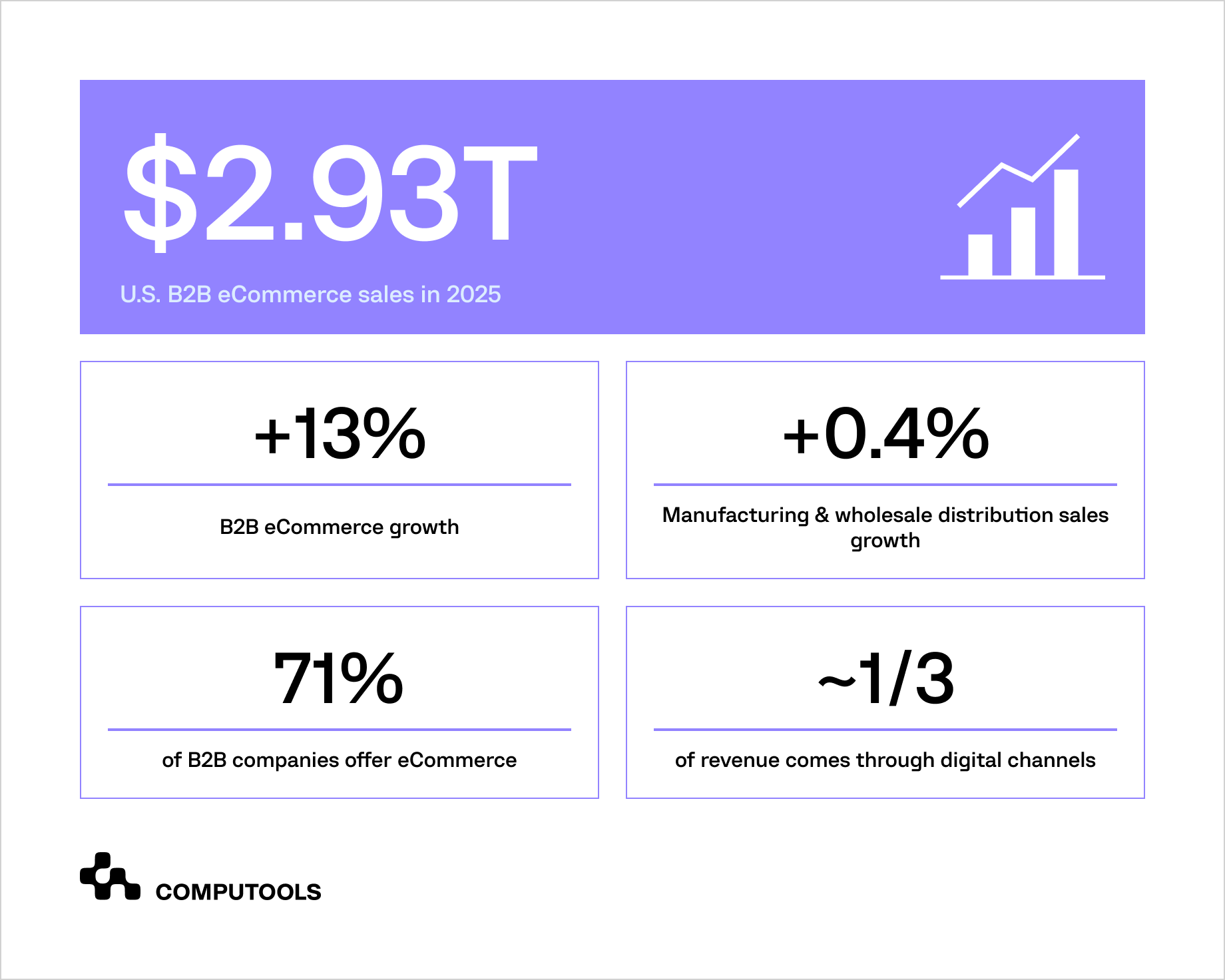
U.S. B2B eCommerce grew 13% to $2.93 trillion in 2025, while overall manufacturing and wholesale distribution sales increased by only 0.4%. For distributors planning to build B2B wholesale eCommerce platform, this reflects a clear shift toward digital purchasing.
McKinsey’s 2026 Global B2B Pulse found that 71% of B2B companies offer eCommerce, while companies with an online channel generate roughly one-third of revenue through digital sales. For distributors, this increases demand for self-service ordering that still supports contract pricing, credit terms, account rules, and approval workflows. It also reduces routine work for sales teams and gives customers faster access to products, availability, and order status.
Wholesale sales require customer-specific pricing, volume discounts, payment terms, minimum order quantities, inventory visibility, approval workflows, and recurring bulk orders. A B2B eCommerce platform for distributors brings these processes into one environment, giving buyers self-service access while keeping pricing, inventory, and order data synchronized across internal systems.
This guide covers the business requirements, architecture, core features, integrations, and development steps needed to build a scalable wholesale commerce platform.
How we helped Stockentra build B2B wholesale eCommerce platform for food distribution
Stockentra B2B, a U.S.-based food distribution marketplace, needed to replace fragmented ordering, spreadsheets, phone-based coordination, and inconsistent inventory updates with a single digital environment connecting agricultural producers, wholesale suppliers, and retail buyers. The platform had to support large catalogs, frequent stock changes, wholesale pricing rules, and high transaction volumes while reducing the manual work required to process orders.
Computools applied its retail software development services to design the platform around wholesale transaction workflows. React and Node.js supported buyer- and supplier-facing operations, while the marketplace architecture connected supplier-specific catalogs, volume-based pricing, stock availability, bulk purchasing, supplier order handling, and order-status tracking. Database optimization improved catalog access, order processing, and inventory updates under higher marketplace loads.

The implemented bulk ordering software reduced manual order processing by up to 55% and improved order cycle speed by up to 40%. Platform transaction capacity increased by up to 3x, product and stock data synchronization improved by up to 60%, and supplier-buyer coordination time decreased by up to 35%.
Centralizing catalog, pricing, inventory, and order data gave Stockentra B2B a more scalable operating model for processing wholesale transactions and reduced coordination gaps between suppliers and buyers. The resulting data structure also created a foundation for demand planning, operational reporting, and marketplace performance analysis.
This delivery experience gives Computools practical expertise in the software architecture, workflows, data requirements, and scaling considerations covered in the following guide.
How to build a B2B wholesale eCommerce platform for distributors
1. Define the commercial model and success criteria
Development should start with a detailed map of how the distributor actually sells. Wholesale operations may combine contracted customers, spot buyers, different supplier relationships, regional assortments, customer-specific catalogs, negotiated payment terms, minimum order requirements, volume discounts, and manual approval rules. These conditions need to be documented before decisions about platform architecture or functionality are made.
The discovery process should trace several representative transactions from product discovery through fulfillment. For each scenario, teams need to identify who can place an order, which products that account can buy, how the price is calculated, whether approval is required, which inventory source is checked, how payment terms are validated, and which system receives the completed order.
Exceptions deserve the same attention as the standard flow. Examples include insufficient stock, partial fulfillment, substituted products, expired contract pricing, exceeded credit limits, supplier delays, or changes after an order has been submitted. These cases frequently generate manual work when platform logic covers only the ideal purchasing path.
Business targets should then be attached to the first release. A distributor may prioritize lower order-entry workload, shorter order cycles, a higher share of self-service purchases, fewer pricing corrections, better inventory visibility, or greater transaction capacity. These KPIs provide the B2B wholesale eCommerce platform development program with measurable acceptance criteria and help prevent the roadmap from expanding to low-priority features.
The resulting scope becomes a commercial requirements model that product, engineering, sales, operations, and finance teams can validate before development begins.
2. Design the product, supplier, customer, and pricing data model
Wholesale commerce depends on relationships between data entities that are much more complex than a standard product catalog. A single item can be supplied by several vendors, available in different pack sizes, sold under multiple agreements, stored across several locations, and presented under different conditions to different buyer accounts.
The data model should therefore cover products, stock-keeping units, supplier records, categories, units of measure, customer organizations, user roles, contracts, price lists, discount rules, warehouses, inventory positions, orders, invoices, and fulfillment records. Relationships between these entities need stable identifiers so information can move between the commerce platform and connected systems without creating duplicates or conflicting records.
Customer organizations also require their own hierarchy. One enterprise account may contain several locations, purchasing teams, cost centers, approval levels, delivery addresses, and users with different permissions. Those relationships influence catalog visibility, pricing, ordering limits, invoicing, and reporting.
In a B2B ordering platform for distributors, Product availability and pricing should be calculated from structured business data managed through defined sources of truth. This allows new suppliers, customer segments, warehouses, or commercial agreements to be added without rebuilding the ordering workflow.
The Stockentra B2B platform followed this principle by connecting supplier-specific catalogs, pricing conditions, inventory records, buyers, and marketplace orders within a shared system. That structure supported synchronization across the purchasing lifecycle and created a consistent data foundation for marketplace operations.
Projects that consolidate information from multiple supplier feeds or legacy systems may also require dedicated data engineering work to clean identifiers, normalize formats, remove duplicates, and establish reliable data pipelines before transactional functionality is built on top.
For distributors managing data from multiple suppliers, consistent product records are critical to pricing, search, and availability. Our guide to real-time product catalog synchronization explains how to structure and synchronize catalog data across connected systems.
3. Choose an architecture that can support integrations and transaction growth
Architecture should be selected based on expected operating conditions: catalog volume, active buyers, order frequency, supplier count, inventory update frequency, integration traffic, geographic coverage, and projected growth. A system designed around current order volumes alone may require expensive restructuring once digital adoption increases.
Catalog, pricing, customer accounts, inventory, orders, payments, and notifications should have clearly defined responsibilities. Modular boundaries make it easier to change one area without introducing regressions across the full purchasing flow. They also simplify integration with enterprise systems and external services.
APIs should expose stable contracts for exchanging product, price, customer, inventory, and order data. Time-sensitive operations may require synchronous requests, while high-volume inventory updates, notifications, and downstream processing can use asynchronous queues or event-driven flows. These choices depend on how quickly each type of information must propagate through the system.
Storage design is equally important. Product search may need dedicated indexing, frequently accessed commercial data may benefit from caching, and transactional records require strong consistency. Database indexes, query patterns, connection management, retry policies, and background processing should be planned before load testing exposes bottlenecks.
A custom software development approach becomes relevant when standard commerce products cannot represent the distributor’s account structure, pricing model, supplier relationships, approval rules, or integration requirements without extensive customization.
4. Implement pricing, bulk purchasing, and order validation
Pricing is one of the most sensitive parts of wholesale commerce because the displayed amount may depend on the buyer, supplier, quantity, contract, region, product category, promotion, or purchasing history. The system needs an explicit hierarchy to resolve these rules when multiple conditions apply to the same order line.
Pricing logic should define base prices, customer-specific agreements, quantity tiers, volume discounts, contract validity periods, minimum margins, supplier conditions, taxes, and any manual overrides available to authorized staff. The calculation engine should also explain why a particular price was applied, so sales and support teams can investigate disputes without manually reconstructing the logic.
Wholesale buyers frequently need to order hundreds of lines or repeat previous purchases. The platform should therefore support quick-order tables, spreadsheet import, saved lists, reorder functionality, quantity editing, product variants, availability checks, and validation before submission.
Order validation should check commercial and operational conditions in one flow: product eligibility, minimum quantities, available inventory, pricing rules, customer status, payment terms, order thresholds, and approval requirements. Invalid lines should be returned with specific reasons so buyers can correct them without involving a sales representative.
For Stockentra, volume-based and supplier-specific pricing was combined with structured buyer ordering and supplier-side order handling. That architecture allowed commercial rules to be applied directly within the transaction flow and reduced the amount of manual coordination required between marketplace participants.
This part of wholesale ordering system development determines whether a digital channel can process real distributor transactions or merely collect order requests that employees still have to repair manually.
5. Build an end-to-end order management workflow
Order placement is only the first transactional event. A wholesale platform must control what happens after submission and give every participant a reliable view of the current state.
A B2B order management system should define order statuses and the rules governing transitions between them. Depending on the operating model, the lifecycle may include validation, approval, supplier confirmation, inventory reservation, payment authorization or invoicing, warehouse processing, shipment, partial fulfillment, delivery, cancellation, return, and credit adjustment.
Each transition should record timestamps, the responsible users or systems, the changed values, and the reasons for any exceptions. This creates a traceable history that customer service and operations teams can use when resolving delays, incorrect quantities, pricing disputes, or fulfillment problems.
Order splitting also needs explicit logic. A single customer order may involve several suppliers or warehouses, different shipment dates, partial quantities, or multiple invoices. The platform should preserve the customer-facing order while creating the operational records required by suppliers, warehouses, finance teams, and logistics systems.
Notifications should be generated from transaction events. Buyers receive confirmation when an order is accepted, changed, shipped, delayed, or partially fulfilled, while internal teams receive alerts for exceptions requiring intervention.
This workflow creates structured operational data that can later be used to calculate order-cycle time, exception rates, supplier performance, cancellation patterns, and fulfillment delays.
As transaction volumes grow, manual coordination between buyers, suppliers, and operations teams becomes increasingly difficult to scale. We cover practical automation patterns in more detail in our guide to marketplace operations automation.
6. Synchronize inventory and fulfillment data
Wholesale buyers need availability information they can rely on before committing to a large purchase. Displaying an outdated warehouse quantity can produce backorders, order corrections, supplier calls, and damaged customer relationships.
Inventory logic should distinguish physical stock from sellable availability. The quantity offered to buyers may depend on reserved stock, safety buffers, incoming goods, warehouse allocation, supplier lead times, pending orders, and regional fulfillment rules.
The wholesale inventory management software layer should define which system owns each inventory value, how frequently changes are synchronized, how reservations are created, and how conflicting updates are resolved. High-volume environments may require event-based updates for critical stock changes while lower-priority information can be synchronized on scheduled intervals.
Multi-supplier platforms add another level of complexity. The same product may be available from several suppliers, each with different prices, pack sizes, minimum order quantities, lead times, and available quantities. Selection logic needs to preserve these differences throughout the ordering and fulfillment process.
Integration failures also require operational rules. The platform should know how long cached inventory remains trustworthy, what to do when a supplier feed becomes unavailable, and whether to continue ordering when availability cannot be confirmed.
Reliable stock synchronization reduces manual availability checks and gives sales, purchasing, warehouse teams, and customers a consistent view of what can actually be ordered.
7. Create self-service experiences for buyers and suppliers
Wholesale portals should reflect the tasks buyers and suppliers perform most frequently. Buyer workflows normally include product search, filtering, account pricing, bulk ordering, saved lists, reordering, availability checks, order tracking, invoice access, returns, address management, and account administration. Larger customers may also require several buyers under one organization, purchasing limits, approval chains, and visibility by branch or department.
During B2B customer portal development, permissions should be mapped to business responsibilities. A procurement employee may prepare orders, a manager may approve purchases over a threshold, finance may access invoices, and an administrator may manage company users. Role definitions should be enforced consistently across interface actions and APIs.
Supplier portals may expose catalog maintenance, stock updates, incoming orders, confirmation, fulfillment status, and performance data. Keeping these operations within the platform can reduce email and phone coordination while producing structured records that can be audited and analyzed.
Usability matters particularly for customers placing large or frequent orders. Search speed, keyboard-friendly entry, clear validation, editable quantities, predictable navigation, and visibility into pricing and availability can materially affect adoption. Relevant web development services should therefore address both interface performance and workflow design.
8. Integrate the platform with core enterprise systems
The commerce platform needs defined ownership rules for every important data domain. Customer accounts may originate in a customer relationship management system, contract prices in an enterprise resource planning system, inventory in warehouse software, product attributes in a product information system, and shipment status in a logistics platform.
For ERP integration for B2B eCommerce, teams should map every exchanged object and define which side is authoritative. Typical flows cover product master data, customer records, price lists, credit information, orders, invoices, taxes, payments, and fulfillment status.
Each integration should specify direction, frequency, latency requirements, authentication, transformation rules, retry behavior, idempotency, monitoring, and exception handling. Without these controls, temporary failures can lead to duplicate orders, inconsistent stock levels, outdated prices, or missing invoices.
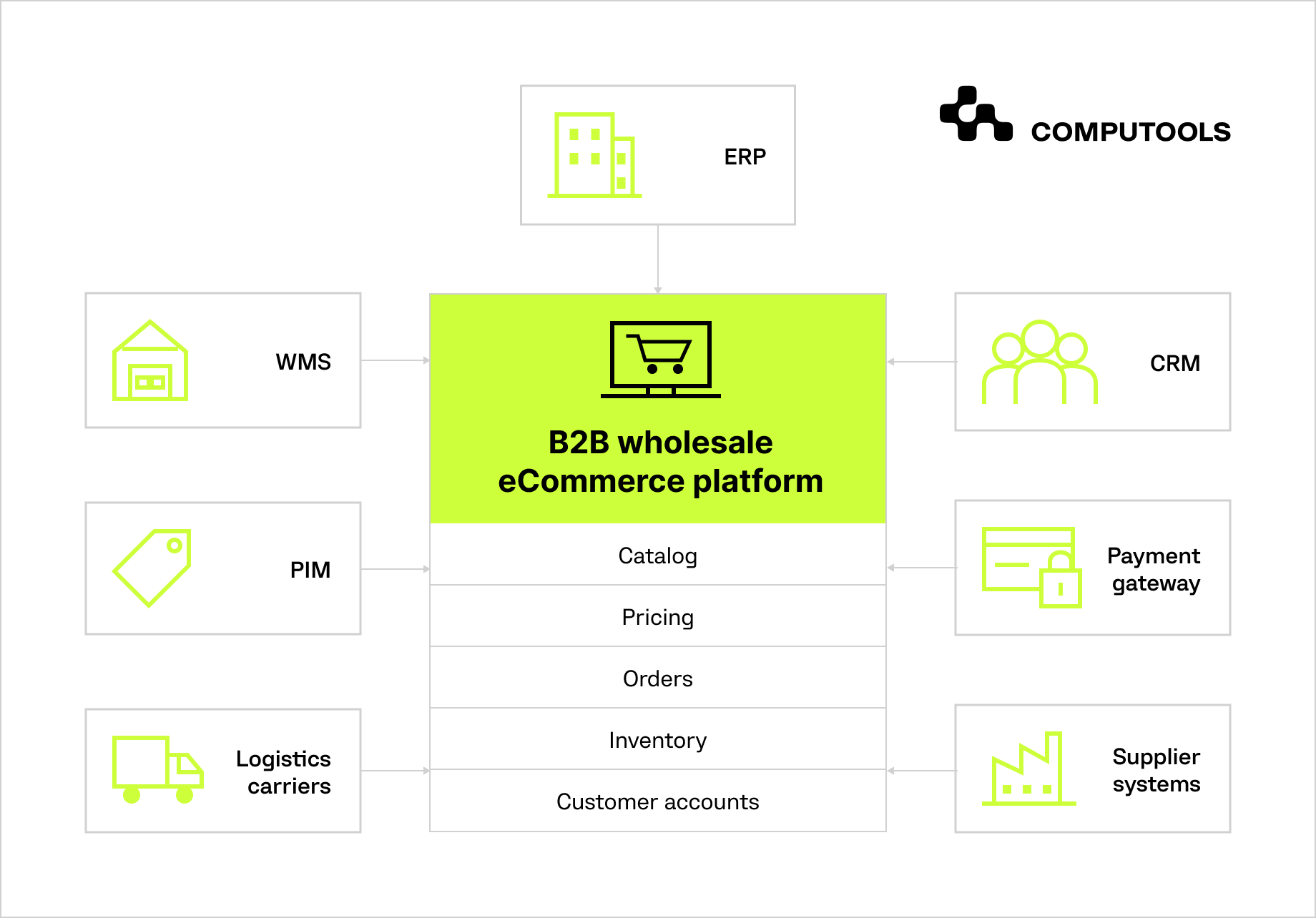
Some distributors also need connections to warehouse management systems, customer relationship management platforms, supplier APIs, payment gateways, tax services, logistics providers, procurement systems, and electronic data interchange networks.
Integration monitoring should expose failed messages and delayed synchronization to operations teams. Silent failures are particularly dangerous in wholesale commerce because a single missing price or inventory update can affect many high-value transactions before anyone detects the problem.
Integration architecture determines how reliably product, customer, inventory, payment, and order data move between commerce and enterprise systems. For a broader view of these dependencies, see our eCommerce integration guide.
9. Test transaction logic, resilience, security, and performance
Testing needs to reproduce the conditions the live platform will face. Standard interface checks are insufficient for a system that calculates complex prices, exchanges data with several external applications, and processes high-volume orders.
Functional testing should cover pricing precedence, minimum quantities, account permissions, approval workflows, inventory reservations, partial fulfillment, order amendments, cancellations, returns, and invoicing. Each business rule needs positive, negative, and boundary scenarios.
Integration testing should deliberately introduce failures: delayed responses, duplicate events, unavailable supplier systems, stale inventory, rejected payments, incomplete records, and interrupted synchronization. Recovery behavior matters because connected systems will eventually fail or return inconsistent data.
Performance testing should use realistic catalog sizes, concurrent buyers, bulk orders, search traffic, inventory-update volumes, and API calls. Database queries, indexes, caching, queues, and background jobs can then be measured under conditions close to production.
Stockentra required a platform capable of handling large catalogs, frequent stock changes, and increasing transaction volumes. Database optimization and supporting infrastructure improved the system’s capacity to process marketplace activity without making order workflows dependent on additional manual handling.
Security testing should cover authentication, role permissions, tenant and account isolation, API access, payment flows, sensitive commercial data, audit logs, and administrative operations. Wholesale platforms often contain contract prices and customer-specific commercial terms, so unauthorized access can have direct financial consequences.
10. Launch in phases and measure ROI against operating KPIs
A distributor can reduce delivery risk by releasing the platform around a limited set of validated workflows. A first production scope might include customer accounts, catalogs, contract pricing, bulk ordering, inventory visibility, and core order processing for a defined group of buyers or suppliers.
Pilot users should be selected to represent real purchasing patterns, including high-frequency customers and accounts with more complex pricing or approval requirements. Their activity provides evidence about usability, transaction logic, data quality, integration stability, and operational workload before broader rollout.
The first release should be measured against the KPIs defined during discovery. Useful metrics include manual touches per order, order cycle duration, digital adoption, pricing corrections, inventory discrepancies, failed transactions, support requests, fulfillment exceptions, and infrastructure performance.
Further releases can then prioritize functionality supported by observed business value. Analytics may expose supplier performance, buyer behavior, product demand, margin patterns, and operational bottlenecks. AI development can be considered later for use cases with sufficient data quality, such as demand forecasting, product recommendations, anomaly detection, assisted search, or purchasing predictions.
A phased roadmap gives the distributor clear checkpoints for validating investment, controlling implementation risk, and linking new capabilities to measurable operational or revenue outcomes. It also gives engineering teams evidence for deciding which parts of the platform need optimization before user, supplier, or transaction volumes increase.

Launch a B2B wholesale eCommerce platform within 1–3 months, automate bulk ordering and account-specific pricing, reduce manual order processing, and increase sales capacity without expanding your back-office team.
Common mistakes when building a wholesale eCommerce platform
| Mistake | Operational impact | Recommended approach |
| Treating wholesale pricing like standard eCommerce pricing | B2B prices may depend on contracts, customer tiers, quantities, suppliers, regions, and negotiated terms. A simple price-per-product model cannot reliably represent these conditions. | Build a pricing hierarchy with explicit precedence rules, validity periods, customer-specific agreements, and traceable calculations. |
| Using the storefront as the main source of product and inventory data | Product details, stock levels, and commercial terms often originate in ERP, warehouse, supplier, or product information systems. Maintaining separate copies increases the risk of conflicting values. | Define a system of record for every major data domain and synchronize changes through controlled integrations. |
| Designing only the standard order flow | Real wholesale transactions include partial fulfillment, backorders, substitutions, split shipments, approval failures, credit issues, and post-submission changes. | Model exception scenarios during discovery and define how each one affects inventory, pricing, fulfillment, invoicing, and customer communication. |
| Underestimating account hierarchies and permissions | One business customer may have several branches, buyers, approvers, finance users, and delivery locations with different access rights. Flat account structures create security and workflow problems later. | Define organization hierarchies, user roles, purchasing limits, approval levels, and data visibility before portal development begins. |
| Synchronizing inventory without clear ownership rules | If several systems update stock simultaneously, buyers may see outdated availability or reserve inventory that has already been allocated elsewhere. | Establish authoritative inventory sources, reservation logic, synchronization frequency, conflict handling, and fallback behavior for unavailable feeds. |
| Integrating ERP and external systems without recovery logic | Temporary API failures, duplicate messages, delayed responses, or incomplete records can create missing orders, outdated prices, and inconsistent invoices. | Add idempotency, retries, validation, monitoring, error queues, and operational alerts to every critical integration. |
| Moving manual processes online without redesigning them | Digitizing an inefficient approval or ordering process preserves the same bottlenecks behind a new interface. | Review which decisions can be automated, which exceptions need human approval, and which steps can be removed before implementing the workflow. |
| Launching too many capabilities in the first release | Large scopes increase testing complexity and make it harder to identify whether the core transaction model works under real conditions. | Launch a complete end-to-end purchasing flow for a defined group of users, validate it against business KPIs, and expand based on measured results. |
| Testing with unrealistic catalogs and order volumes | A platform may perform well with development data but slow down once it handles thousands of products, large carts, frequent stock updates, and concurrent buyers. | Use production-scale datasets and realistic transaction patterns for load, integration, and database testing before rollout. |
| Measuring adoption without measuring operational impact | More online orders do not automatically mean lower processing cost if sales or operations teams still correct prices, inventory, and order data manually. | Track manual touches, processing time, exceptions, pricing corrections, fulfillment issues, and cost per order alongside digital adoption. |
What affects B2B wholesale eCommerce platform development cost
Development cost depends mainly on business logic, integrations, data complexity, and expected scale.
- Pricing rules. Contract pricing, volume discounts, customer-specific terms, and supplier conditions increase the scope of development and testing.
- Catalog complexity. Multi-supplier products, variants, pack sizes, and customer-specific assortments require a more detailed data model.
- Order workflows. Approvals, split orders, backorders, partial fulfillment, returns, and credit checks add transaction logic.
- Integrations. ERP, warehouse, CRM integration, payment, logistics, and supplier connections require data mapping, synchronization, monitoring, and recovery logic.
- User roles. Multiple buyers, approvers, branches, and supplier accounts expand access-control and portal requirements.
- Data migration. Legacy product, customer, pricing, and order data may require cleansing and normalization.
- Scale. Large catalogs, frequent inventory updates, and high order volumes affect infrastructure, database design, and performance testing.
- Security. Permissions, audit logs, payment security, and commercial data protection add technical controls and validation.
The most accurate estimate comes from defining workflows, integrations, data requirements, and first-release scope before development begins.
Data architecture can become a significant part of the implementation scope when a platform consolidates large catalogs, supplier feeds, inventory records, and transaction data. Our analysis of the cost of a marketplace data platform for retail breaks down the main technical cost drivers.
How to prioritize the first release
The first release should cover a complete wholesale transaction from account access to order processing, with enough functionality to validate commercial logic, integrations, and user adoption.
A practical initial scope may include:
- customer accounts and role-based access;
- account-specific catalogs and pricing;
- inventory visibility;
- bulk and repeat ordering;
- core approval and order-status workflows;
- one primary ERP or inventory integration;
- basic operational monitoring.
Prioritization should follow business impact and implementation risk. Workflows that generate the most manual effort, pricing errors, order delays, or customer support requests usually deserve earlier attention than secondary reporting or advanced personalization.
Pilot customers should represent real purchasing behavior, including frequent buyers and accounts with more complex pricing or approval rules. Their usage helps validate the transaction model, data quality, integration stability, and user experience before wider rollout.
A phased release also makes ROI easier to measure. Teams can compare manual workload, order cycle time, digital adoption, error rates, and transaction capacity before deciding which capabilities to add next.
Why choose Computools for wholesale eCommerce development
Computools brings direct experience in building complex retail and eCommerce platforms, including multi-vendor wholesale systems with supplier-specific catalogs, volume-based pricing, inventory synchronization, buyer and supplier workflows, and high transaction loads. This gives our team a practical understanding of the commercial and technical dependencies that make wholesale platforms more complex than standard online stores.
Our eCommerce software development expertise covers marketplaces, inventory and order management, system integrations, storefront architecture, performance optimization, and platform modernization.
Computools has delivered 20+ eCommerce projects and 40+ custom retail software projects, giving clients access to established delivery practices across both commerce and operational systems. We structure delivery around validated business workflows, phased implementation, and measurable checkpoints. Core transaction flows can be tested with real users and connected systems before broader rollout. This allows broader investment to follow evidence from order processing, user adoption, and operational performance.
For distributors, this approach means the platform is designed around real pricing, inventory, account, and fulfillment logic from the start, with a clear path to scale transaction volumes, add suppliers and customer segments, and introduce more advanced automation as the business grows.
Planning a wholesale commerce platform or modernizing an existing one? Computools can help define the architecture, integrations, and rollout plan around your business model and operational goals.
To sum up
A successful wholesale eCommerce platform must reflect the distributor’s actual pricing rules, customer structures, inventory flows, order logic, and system integrations. Connecting these processes on a single platform reduces manual coordination, improves data consistency, and enables distributors to handle more digital orders without increasing operational workload at the same rate.
A phased implementation allows teams to validate the core transaction flow first, measure its impact on order processing, inventory accuracy, and customer adoption, and expand the platform based on demonstrated operational needs and growth priorities.
Computools
Software Solutions
Computools is an IT consulting and software development company that delivers innovative solutions to help businesses unlock tomorrow.