
THE AUTHOR:

A winning bid may appear on a screen in seconds, but the technology behind it must make thousands of decisions to make it happen. That’s why companies need to build real-time auction bidding system capabilities to validate, prioritize, store, and share every bid with participants without delays or conflicts.
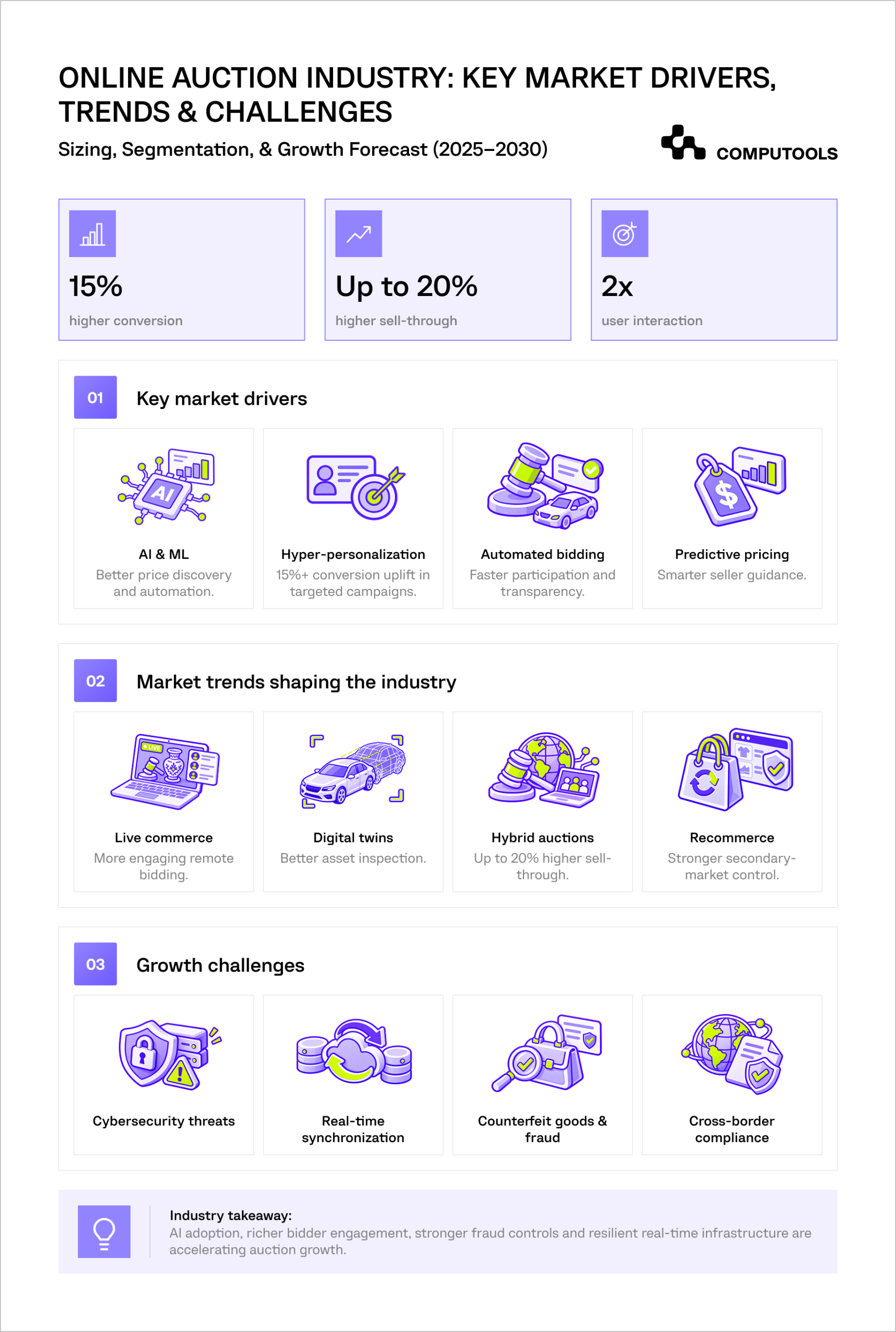
Online auctions have expanded far beyond traditional categories such as collectibles and antiques. Today, they support automotive auctions, luxury goods, industrial equipment, real estate, and B2B asset marketplaces. This growth is reflected in the global online auction market, which reached $21.5 billion in 2025 and is expected to grow to $39.3 billion by 2030, representing a 12.8% CAGR. The market expansion is fueled by mobile bidding, AI-powered personalization, live commerce, and broader access to digital marketplaces.
The technical expectations for auction processes have also changed. Buyers want to see up-to-date prices, bidding history, and get suggestions on what to bid. They also expect these features on mobile devices. Simultaneously, auction operators need to prevent multiple users from placing the same bid, integrate payment processing, and gain insights into buyers’ behavior.
This is why online auction software development focuses on architectural decisions to implement speed, accuracy, and dependability. Modern systems combine a high-performance bidding engine, real-time communication layer, intelligent automation, and scalable data storage.
Technical priorities for high-volume auction bidding
| Auction moment | System requirement | Why it matters |
| Several bids arrive within milliseconds | Bid ordering and concurrency control | Prevents conflicting results |
| Price changes during active bidding | Instant state updates across all users | Keeps every participant on the same auction status |
| Final seconds attract heavy activity | Low-latency processing and scalable infrastructure | Maintains responsiveness when demand peaks |
| Auction closes and a winner is selected | Complete bid history and transaction records | Supports fair outcomes and dispute resolution |
This article outlines the challenges of creating an online auction system and provides design patterns to address them. We cover architecting bid processing, dealing with high concurrency, incorporating AI, third-party integrations, and improving system performance.
Computools case: building reliable digital auction workflows
A real-time auction system must manage valuable assets, bidder activity, transaction rules, and customer expectations during highly competitive moments.
The Vintaro Auctions project demonstrates how these requirements influence the technology behind a digital auction experience.

Client context
Vintaro Auctions is a Belgium-based auction platform specializing in classic cars, vintage motorcycles, and collectible vehicles. The platform serves buyers interested in rare assets where detailed information, high-quality media, and reliable online bidding workflows directly influence purchasing decisions.
The business needed a digital environment where collectors could explore auction lots, participate remotely, and complete transactions through a structured online process.
Business challenge
Classic vehicle auctions involve more complexity than standard ecommerce transactions.
The platform needed to support:
- detailed vehicle listings with extensive documentation and media;
- bidder participation during time-sensitive auctions;
- accurate auction status updates;
- reliable user interactions during competitive bidding;
- workflows connecting auction completion with post-sale activities.
The main technical challenge was ensuring that users received consistent auction information while multiple participants interacted with the same lot.
During the final moments of an auction, several bidders may submit offers almost simultaneously. The platform must process these actions accurately and maintain a clear record of accepted bids.
Computools solution
Computools developed a real-time bidding platform for reliable transaction processing.
For detailed listings, the platform supported high-resolution photos, videos, condition reports, and structured vehicle information, giving buyers enough context to evaluate high-value lots remotely.
For time-sensitive bidding, our team introduced live bid updates, countdown changes, outbid notifications, and anti-sniping logic so participants could react quickly during the final moments of an auction. The system also kept auction status and bid history synchronized, reducing the risk of conflicting information when several users competed for the same lot.
Bidder verification and deposit workflows were connected directly to the auction process, so users could complete the required checks before participating. After an auction closed, the platform continued into post-sale workflows, including payment handling, pickup scheduling, and delivery coordination.
The project also created a foundation for future improvements such as analytics, automation, and AI-driven features by organizing auction data and user interactions in a structured way.
Business result
The impact was visible in the parts of the journey that matter most to bidders and operations teams.
- Average bid confirmation dropped to under 300 ms during peak activity.
- Manual identity and deposit verification time fell by up to 60%
- Media-heavy auction pages loaded up to 45% faster.
- Mobile lot-page engagement increased by up to 32%.
- Post-auction pickup and delivery coordination time decreased by up to 50%.
- Returning bidder rates also rose by up to 22%.
For Vintaro, this meant faster bidding during closing moments, fewer manual checks behind the scenes, and a smoother handoff from winning bid to payment and vehicle delivery.
How to build a real-time auction bidding system
Building a real-time auction bidding system means designing for the moments when several users act at once. Each step should reduce delay, prevent conflicting bids, and keep every participant in the same auction state.
Step 1. Define bid lifecycle and auction rules
The first decision in building a bidding system is understanding exactly how a bid moves through the platform.
A bidding engine does not simply increase a price after receiving a request. It must evaluate whether each action follows auction rules and whether the transaction should be accepted.
Before development starts, businesses need to define:
- what makes a bid valid;
- how minimum increments work;
- how reserve prices affect acceptance;
- what happens when two bids arrive at the same moment;
- whether auctions extend after late bids;
- how winners are selected.
For example, a classic car auction may allow automatic time extensions when a new bid arrives seconds before closing. A B2B equipment auction may require additional verification before accepting a high-value offer.
These rules determine the architecture of the auction bidding engine.
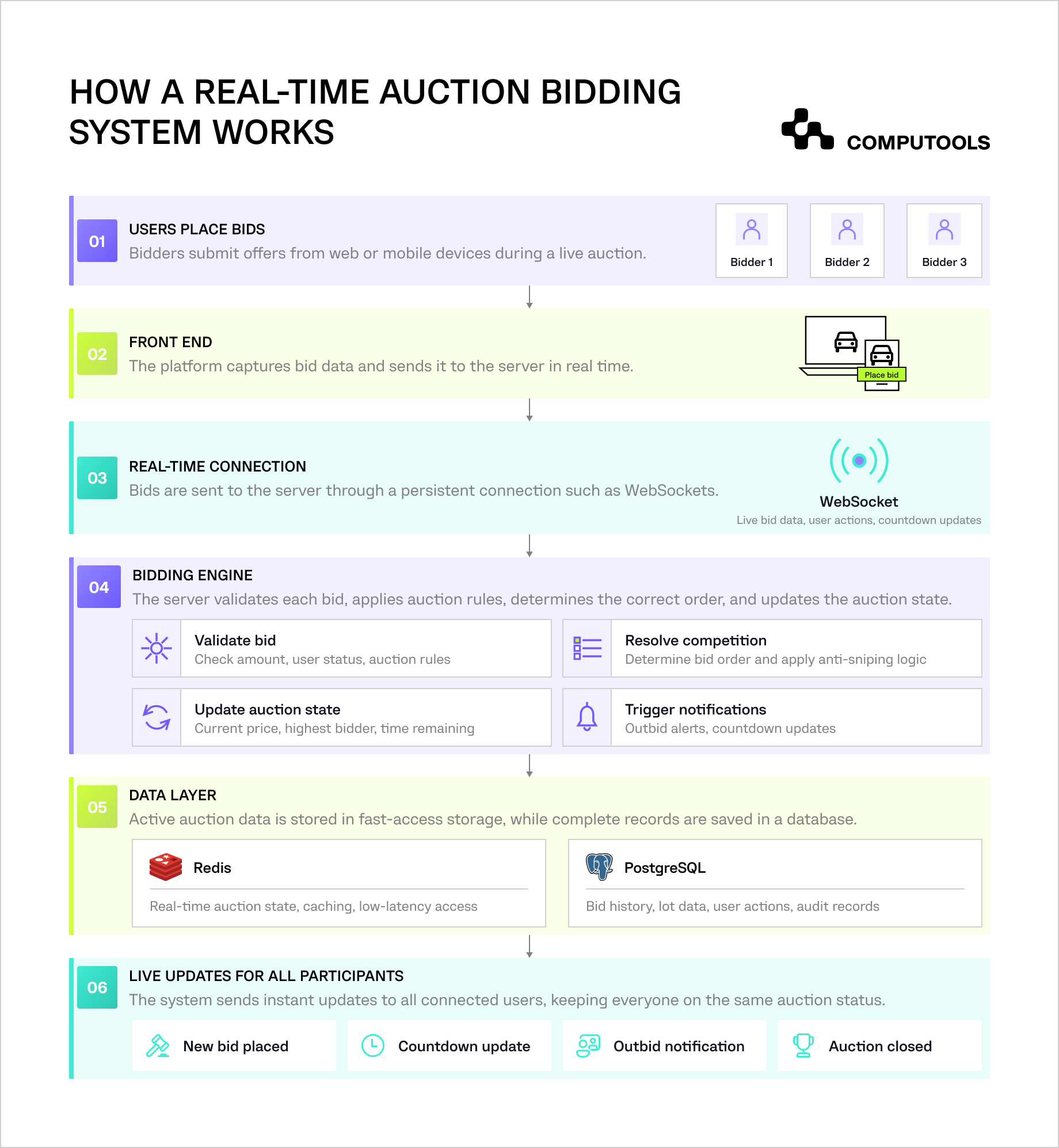
The system needs clear logic for: Bid received → User validation → Auction rule check → Bid acceptance or rejection → Auction state update.
When auction rules remain unclear, technical teams often need to redesign the bidding logic later because the system cannot handle real-world scenarios consistently.
A strong foundation at this stage makes future custom auction platform development more predictable because business requirements are translated into measurable system behavior.
Step 2. Design a low-latency bidding architecture for instant updates
The essence of live auction bidding software is processing user actions at high speed. This enables a system to update bid prices to thousands of participants in real time. For example, during the last few minutes of an auction, when competition is highest.
This requires a different architecture from a standard e-commerce website. Instead of processing each request independently, the system needs a continuous communication layer that keeps auction participants synchronized.
The bid flow starts when a user submits an offer through a web or mobile application. The request moves through authentication and validation services before reaching the bidding engine. The engine checks the bid, updates the auction state, and sends the new information to all connected users.
Modern auction systems use WebSockets, event-driven architecture, and message brokers to support this process. WebSockets keep an active connection between the platform and bidders. This allows the system to send instant updates when a new bid is accepted, when a user loses the lead, or when the auction timer changes.
In Vintaro Auctions, the team used WebSocket communication for live bid updates, countdown changes, outbid alerts, and immediate bidder feedback. Redis supported low-latency bid-state handling and caching during peak traffic. After the upgrade, average bid confirmation time fell to under 300 ms during peak auction activity.
The architecture should separate real-time bidding tasks from background operations. The bidding engine handles time-sensitive actions, while analytics, reporting, and other supporting processes run separately. This design keeps the bidding experience fast during periods of heavy traffic.
For example, thousands of users might watch the same vehicle auction at once. The platform should avoid sending repeated price requests to the main database. Instead, frequently changing auction data stays in a fast-access layer, while confirmed bids and transaction records are saved in the primary database.
This architecture provides the foundation for real-time bid processing that stays responsive as user activity grows.
Step 3. Engineer the auction bidding engine
The most complex part of a bidding system appears when multiple users compete for the same item at nearly the same moment. This is the challenge of concurrent bid handling.
Imagine a collector car auction approaching its closing moment. Two bidders submit higher offers almost simultaneously. The system needs to process both actions in the correct order, prevent conflicting results, and provide a clear explanation of why one bid was accepted.
The bidding engine requires mechanisms that maintain a single source of truth.
A successful platform must answer:
- Which bid arrived first?
- Which bid meets auction rules?
- How should conflicting actions be resolved?
- How should all users receive the updated status?
Three technical components help the system manage these situations:
| Bidding engine function | How it works | Why it matters |
| Bid validation | The system checks bidder authorization, account status, auction availability, minimum bid requirements, and reserve price conditions before accepting a bid. | Ensures that only valid bids enter the auction and prevents rule violations. |
| Transaction ordering | The platform determines the correct bid sequence using server timestamps, event sequence numbers, and transaction controls. | Helps the system process competing bids fairly when several users act at the same time. |
| Auction state management | The system updates the current highest bid, active participants, remaining auction time, bid history, and auction status. | Keeps all users viewing the same accurate auction information. |
Together, these functions allow the auction bidding engine to process large numbers of bids while keeping the auction fair, accurate, and responsive. The goal is accurate processing under pressure.
Vintaro also required automated anti-sniping logic. When a valid bid arrived close to the deadline, the platform extended the auction timer automatically, giving competing bidders a fair chance to respond without manual intervention. Node.js and TypeScript supported bid validation, auction-status updates, notifications, and this timer logic, while PostgreSQL preserved bid records and audit-related marketplace data.
Step 4. Build a data layer that supports real-time decisions
Speed depends on more than the bidding engine itself. The data architecture determines how quickly the system can access auction information, analyze activity, and support future improvements.
A real-time auction system typically manages several categories of data:
| Data type | Examples | Purpose |
| Auction data | lots, prices, timers, bid history | Maintain active auctions |
| User data | profiles, verification status, preferences | Manage bidder access |
| Behavioral data | views, searches, saved items | Personalize experiences |
| Transaction data | payments, invoices, settlements | Support completed sales |
| Analytics data | demand patterns, category trends | Improve business decisions |
A common architecture separates operational and analytical workloads. The transactional database supports active auctions, while a dedicated analytics environment processes historical activity and market trends.
This separation prevents reporting processes from affecting live bidding performance. In Vintaro Auctions, PostgreSQL stored user profiles, lots, bid records, lot status, buyer actions, pickup schedules, and delivery requests, while Redis handled short-lived auction state and caching. Keeping these workloads separate supported fast bidding without losing the detailed transaction history needed for reporting and later optimization.
Data architecture also determines how effectively companies can introduce AI features later. Recommendation engines, pricing models, and fraud detection systems require structured historical information about users, assets, and transactions.
For businesses planning online auction platform development, a strong data foundation creates opportunities for better automation and more informed decisions.
Additional insights into commerce data architecture are available in Cost of Marketplace Data Platform for Retail.

Launch a real-time bidding system within 1–3 months, process thousands of simultaneous bids with instant updates, increase bidder engagement and auction conversion, and maximize final sale values without compromising platform performance.
Step 5. Add AI capabilities that improve auction intelligence
AI is well-suited for integration with auction systems because they generate extensive data on behavior and transactions.
Where AI is truly valuable is in helping clients identify optimal opportunities and helping service providers optimize their business operations.
For clients, available opportunity recommendations can be automatically generated based on their previous bidding activities, items of interest and purchase history. For example, a collector who regularly follows classic European cars can receive recommendations for similar upcoming lots.
AI can help with setting prices by analyzing past auction results. It can also consider the characteristics of the assets and different buyer behaviors to help forecast demand. Auction operators can use this information to determine appropriate reserve prices, select auction timing and other aspects.
Another important application is anomaly detection. AI models can identify unusual bidding patterns, suspicious account relationships, or abnormal price movements that require additional review.
All of these applications, however, depend on the availability of organized data. There must be good data regarding bids, transactions, and other interactions that customers have with the auction.
Step 6. Connect the bidding engine with payments and business systems
A real-time bidding platform is not stand-alone. After a bid is placed and won, it should be able to initiate and automate the next set of business processes such as clearing the payment, notifying the seller, preparing the related documents, and/or arranging for the shipment of the product(s) sold.
Many auction-style projects quickly advance beyond a simple implementation of an online e-commerce solution. This is because a winning bid creates a series of events, which, in turn span several other systems.
For example, in an automobile auction, the algorithms have to confirm the bidder, accept the payment, produce a sales receipt, and coordinate transport of the vehicle to the buyer. A marketplace selling industrial equipment may require integration with company accounts, invoicing systems, and logistics providers.
The bidding engine should therefore connect with surrounding business infrastructure through APIs and secure integrations. Common connections include payment providers, identity verification services, CRM platforms, ERP systems, and logistics solutions.
Vintaro used this type of control for high-value vehicle auctions. Stripe and Adyen APIs supported pre-bid deposit authorization and wire-transfer hold workflows, while identity-verification integrations such as Onfido or Sumsub supported KYC/AML checks before users were approved to bid. The improved process reduced manual identity and deposit verification time by up to 60%
Security is especially important because auction platforms often process high-value transactions. The system needs controls that protect accounts, monitor unusual activity, and maintain a complete record of transaction events.
Real-time bidding is only one part of the transaction flow. How to Build a B2B Wholesale Ecommerce Platform explores how customer accounts, payments, order logic, integrations, and back-office processes can be connected around complex digital commerce transactions.
Step 7. Build administration tools and automation
The bidder sees a simple action: placing an offer. Behind that interaction, auction teams manage hundreds of operational decisions.
Administrators need tools to create auctions, review listings, manage participants, monitor activity, and analyze results. Without structured internal workflows, increasing auction volume quickly creates additional manual work.
A modern system supports automated auction management by reducing repetitive tasks across the auction lifecycle. For example, the platform can automatically notify users about competing bids, update auction statuses, generate reports, and trigger follow-up actions after an auction closes.
Automation is particularly valuable for businesses running frequent auctions. A marketplace managing thousands of lots cannot rely on manual monitoring of every listing, bidder interaction, and transaction update.
The administration layer should provide visibility into questions such as:
- Which auctions attract the most interest?
- How many users participate before placing bids?
- Which categories generate the highest demand?
- Where do users abandon the process?
These insights allow auction operators to improve scheduling, marketing, and customer engagement.
Step 8. Test performance before real auction traffic arrives
A bidding system can appear reliable during development and still fail when thousands of users compete during a major auction event.
Performance testing needs to reproduce realistic auction conditions.
Teams should evaluate how the system behaves when many users:
- open the same auction page;
- submit bids within seconds;
- receive simultaneous updates;
- complete payments after winning.
User experience is as important as server capacity. A bidder should receive confirmation quickly, see accurate auction information, and trust that every action has been recorded correctly.
Testing usually covers several areas:
- Load tests assess the application’s functionality with an increasing number of simultaneous users.
- Stress tests push the application beyond expected and defined boundaries.
- Real-time tests assess the application’s functionality with respect to timely communication between users.
- Security tests assess the application’s protection against fraudulent activity.
A reliable real-time bidding software development approach includes monitoring after launch as well. Auction activity changes over time, and infrastructure needs to adapt as user numbers, transaction volumes, and data requirements grow.
Performance monitoring should continue after the auction goes live. How to Build a Retail Ops Dashboard shows how operational dashboards can bring together transaction activity, system performance, exceptions, and business KPIs for faster decision-making.
Why choose Computools for real-time bidding software development
A bid is a small user action with a complex technical process behind it. Between clicking “Place bid” and showing the updated price to every participant, the system must verify the user, apply auction rules, resolve competing offers, update the auction state, and distribute the result instantly.
Computools focuses on designing this transaction flow as a reliable system. The team combines experience in marketplace platforms, real-time applications, AI, and data architecture to build bidding solutions where speed and accuracy work together.
Computools helps businesses create:
- bidding engines that process simultaneous offers without conflicting results;
- real-time communication layers that keep participants synchronized;
- data structures that preserve complete bid history and support future analytics;
- integrations that connect bidding activity with payments, customer systems, and operational workflows.
The Vintaro Auctions project demonstrates this approach in practice. The company developed a digital auction solution for collectible vehicles, organizing auction workflows and user interactions around the needs of buyers and sellers participating remotely.
Beyond the bidding experience itself, Computools connects the auction system with the wider business environment. Retail software development services help align customer journeys, transactions, and operational processes. eCommerce software development experience supports marketplace workflows such as accounts, payments, and digital commerce interactions.
Through web development services, the team designs interfaces that reflect real-time auction logic. Data engineering expertise helps create the data foundation required for reporting, forecasting, and optimization.
AI development capabilities extend the system with practical functions such as bidder recommendations, activity analysis, and automated decision support.
The result is a bidding system designed around the mechanics that determine auction reliability: accurate bid processing, consistent auction states, connected workflows, and actionable data after every event.
Conclusion: the bidding engine defines the auction experience
A bidder sees a simple action: enter a price and submit an offer. Behind that action, the system decides whether the bid is valid, how it compares with other offers, when the auction price changes, and what every participant sees next.
For companies planning to build real-time auction bidding system capabilities, the bidding engine should be treated as the core transaction mechanism of the auction. Its design affects whether the platform can handle last-minute bidding activity, resolve competing offers correctly, and maintain a reliable record of every auction decision.
The strongest systems combine fast bid processing, clear auction rules, synchronized updates, secure transaction flows, and structured data that supports analytics and future AI capabilities.
Build a bidding system that stays accurate when competition increases. Talk to Computools about designing the real-time architecture, integrations, and data foundation behind your next auction platform.
Computools
Software Solutions
Computools is an IT consulting and software development company that delivers innovative solutions to help businesses unlock tomorrow.