
THE AUTHOR:

The demand to build medical content review software is fuelled by one immense operational imbalance. Content teams produce more campaign variants, localized assets, HCP materials, and AI-assisted drafts than Medical, Legal, and Regulatory teams can review efficiently. A common bottleneck is the time required to verify claims against approved evidence, check market-specific requirements, compare versions, resolve reviewer comments, and prevent outdated content from being reused.
To solve this problem, organizations require a system to control claims, evidence, review logic, approvals, and content lifecycle events as connected data rather than passing documents from one reviewer to another.
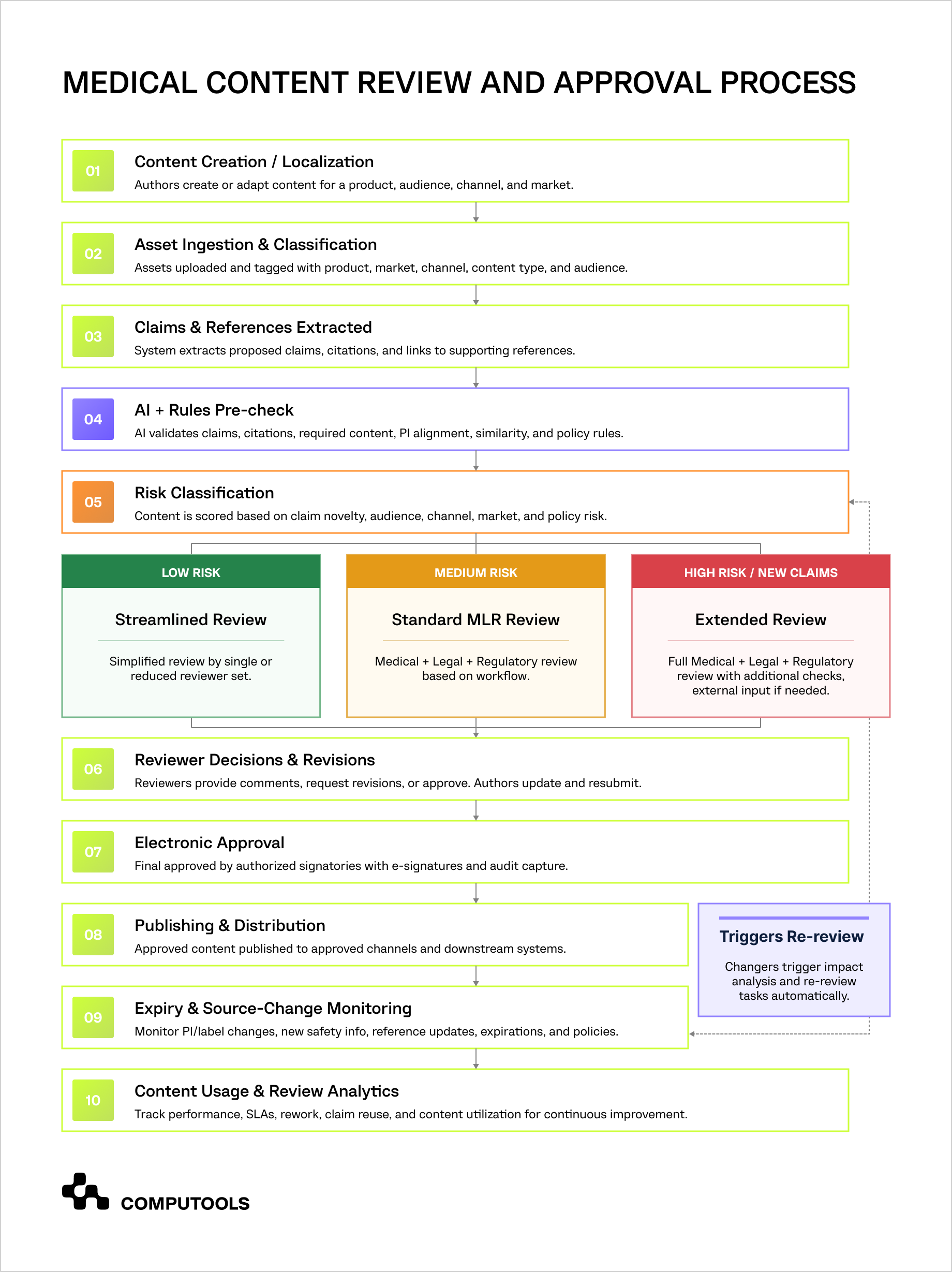
In Deloitte’s 2026 Life Sciences Outlook, 41% of executives identified generative AI as an influential trend and 30% pointed to agentic AI. Meanwhile, only 22% of respondents believed their companies had successfully scaled AI, and only 9% mentioned significant returns.
Content operations face the same gap between AI potential and operational readiness. According to IQVIA, pharma companies can now create varying, purpose-built content at scale, meaning the constraining factor shifts to the timeliness of content review and approval. Veeva also states that nearly 80% of approved content is rarely or never used, so companies would be wasting precious review capacity on assets that later prove to have little value.
Every additional data asset creates another point where claims, safety information, references, and presentation need to meet regulatory requirements. FDA enforcement activity in 2025–2026 shows that misleading or inadequately supported pharmaceutical communications remain a current compliance risk. This increases the value of a medical content review platform that can detect issues earlier, preserve approval evidence, and apply consistent controls before content reaches external channels.
What pharma content review platforms need to handle today
| Business pressure | What the platform should provide |
| More content variants and localized assets | Risk-based routing, reusable approved modules, and market-specific review rules. |
| Limited MLR reviewer capacity | AI-assisted pre-review, claim matching, citation checks, and prioritized review queues. |
| Growing use of AI-generated content | Approved-source grounding, AI audit trails, reviewer overrides, and model governance. |
| Frequent claim and label changes | Dependency tracking between claims, references, labels, and published assets. |
| Multiple content repositories | API-based integrations, shared metadata, and synchronized approval status. |
| Different rules across markets | Configurable jurisdiction-specific workflows, reviewer matrices, and policy versions. |
| High cost of rework | Shift-left compliance checks before formal submission. |
| Need for stronger traceability | Version history, electronic approvals, decision logs, and complete source lineage. |
This article explains how to design medical content review solutions, where AI fits, which integrations matter, and how to keep reviews faster without weakening accountability.
Computools case: how to build medical content review software with a controlled knowledge layer
A similar challenge appeared in Retrionex, a centralized AI knowledge platform Computools developed for a mid-size US pharmaceutical company.
The client’s Medical Affairs, Regulatory Affairs, and Scientific Operations teams worked with SOPs, publications, medical responses, regulatory materials, and training documents distributed across different repositories. Employees had to locate the right document, compare versions, verify approval status, and confirm whether information could be reused for a particular market or audience.
Our team kept the existing repositories in place and built a shared intelligence layer above them. Documents passed through an ingestion and synchronization layer that extracted content and metadata, normalized attributes, tracked version and approval changes, and mapped information into a common enterprise schema. Azure AI Search provided semantic, vector, and hybrid retrieval, while Azure OpenAI generated responses exclusively from authorized source material. PostgreSQL stored metadata, relationships, query history, and audit records, and Microsoft Entra ID controlled access by user role, region, department, and document permissions.
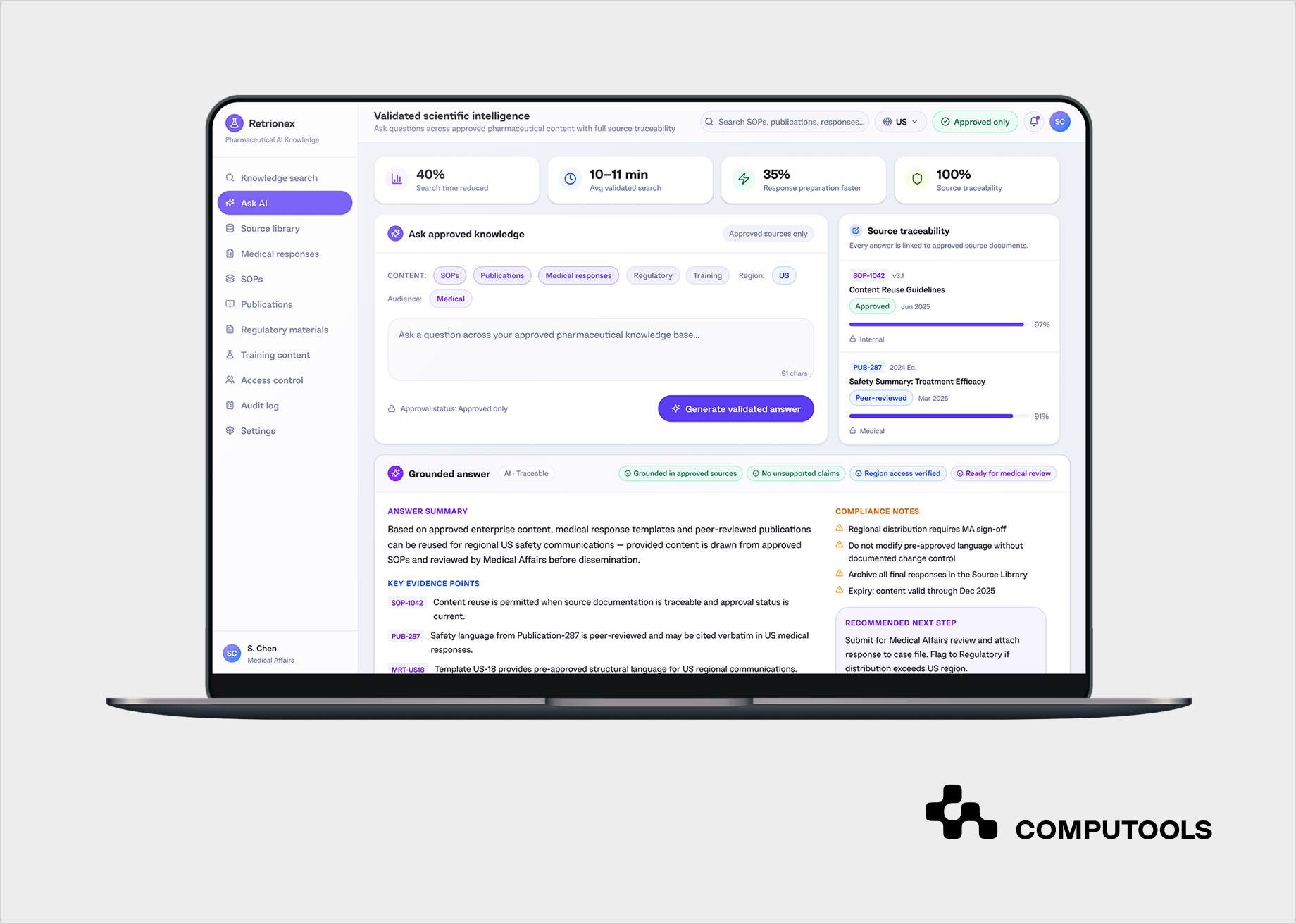
The platform reduced validated-information search time from 18 minutes to 10–11 minutes, accelerated scientific response preparation by up to 35%, increased consistency in approved-content reuse by up to 25%, and maintained complete source traceability. Unsupported generation was blocked when sufficient approved evidence was unavailable.
This design applies directly to pharmaceutical content review. Automation becomes dependable only when documents, claims, references, versions, permissions, and approval states carry structured context. That foundation should influence every major development decision.
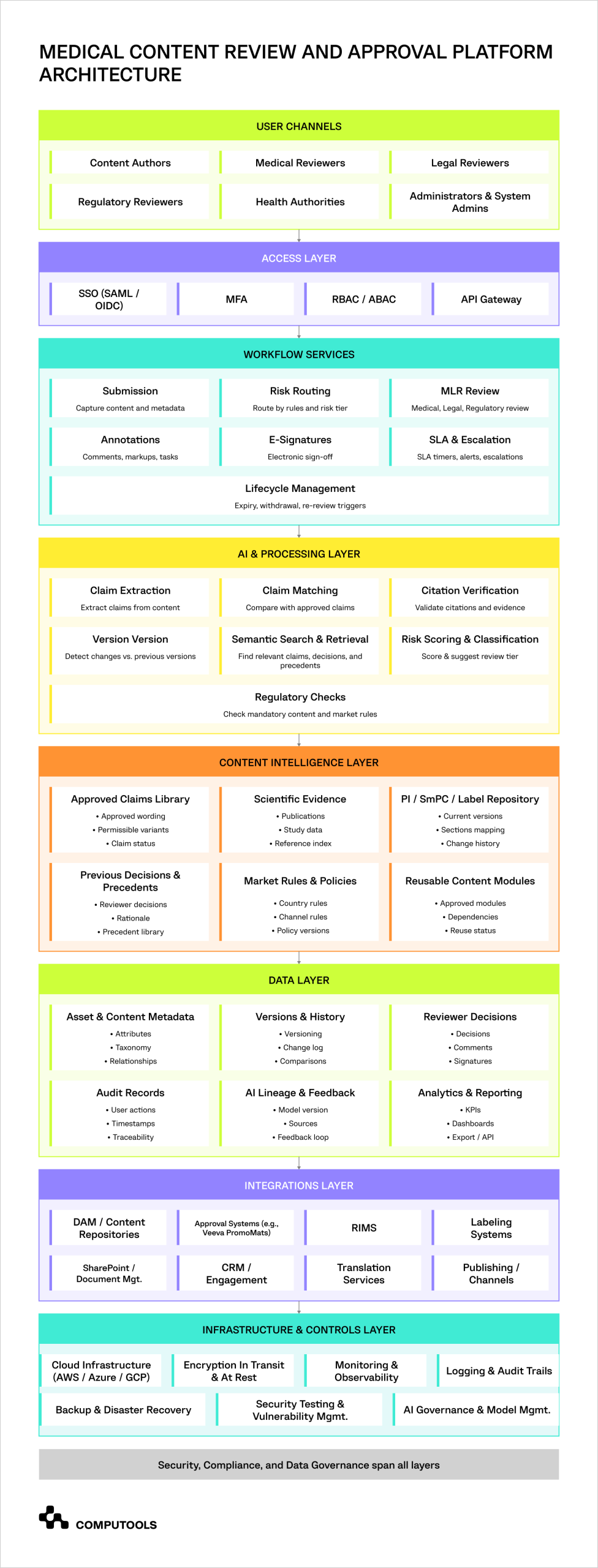
8 steps to build medical content review software for modern MLR operations
Modern pharma content approval systems require considerably more control than merely manipulating the order in which Medical, Legal, and Regulatory teams receive a document. This section presents the operating rules, data and software architecture, integrations, automation, and controls necessary to provide that scalable control.
Step 1. Define review risk before designing the workflow
To begin, identify the documents and materials the organization reviews. Content such as promotional, non-promotional, HCP, patient, social, campaign, local, and new science materials should not necessarily go through the same processes and reviews.
Consider the content type, audience, channel, product, indication, market, novelty, source, and similarity to previously approved content to evaluate risk. A localization of an existing asset that poses low risk may proceed through the review process faster, while a new claim may warrant a complete review by Medical, Legal, and Regulatory teams.
The medical content approval workflow should translate these rules into configurable states such as: Draft → Pre-check → Submitted → Review → Revision → Approval → Distribution → Expired or Withdrawn.
The flow management system must support review in parallel and in series, a fixed reviewer, assignment and delegation, timers for service level agreements, cause for rejection, and decision routing. Consequently, the medical legal regulatory approval process should be modeled as rules and states rather than as a series of fixed forms.
This upstream approach has measurable value. Klick analyzed 40,144 submissions across 110 pharma clients and found that bringing regulatory guidance earlier into content development contributed to a 16-day reduction in average cycle time and a 12% increase in first-round approvals in its implementation.
Step 2. Treat claims and evidence as structured data
A platform centered on PDFs and comments will quickly reach its limits. Claims should become governed objects with relationships to supporting evidence.
A practical model connects: Asset → Content module → Claim → Evidence → Product/indication → Market → Audience → Version → Approval → Expiry.
Each claim can then store approved wording, permissible variations, supporting publications, relevant label or SmPC sections, countries where it is valid, permitted audiences and channels, approval status, expiration dates, and required safety language.
This creates several advantages. Authors can reuse approved claims rather than recreate them. Reviewers can immediately see their evidence. AI can compare proposed wording with authorized variants. A label update can identify all dependent claims and assets.
Retrionex used a related approach by normalizing pharmaceutical documents according to type, version, approval status, region, product area, and access attributes before retrieval.
Data quality is especially important when AI enters the workflow. IQVIA identifies high-quality reference libraries, evidence-linked claims, AI-readable content, clear ownership, and controlled permissions as prerequisites for AI-enabled MLR.
For additional perspective on structuring and governing healthcare information, see our guide on how to build a clinical documentation system for hospitals, including approaches to clinical data, document workflows, integrations, and information access.
Step 3. Connect existing repositories
A new pharmaceutical content management system is usually designed as an extension of existing technologies. Many businesses use Veeva PromoMats, DAM, SharePoint, RIMS, labeling systems, CRMs, medical information solutions, translation and publishing tools.
The review platform should therefore separate integration logic from core workflow logic.
A practical structure is: API gateway → connector services → normalization layer → workflow services → search and AI services.
Connectors extract documents and metadata, as well as approval status, product data, and access information from source systems. The normalization layer converts those into a consistent internal model.
Events can be used for rapidly changing information. A newly approved label version, for example, can trigger an event that identifies related claims, locates affected assets, changes their status, and creates review tasks.
Computools engineers used this pattern in Retrionex. Instead of building individual search workflows for every repository, a shared ingestion and synchronization layer tracked source changes and updated the semantic index while the original repositories remained intact.
Step 4. Put AI before formal review, where its findings can be verified
The strongest use case for medical review workflow automation is removing repetitive checks before qualified reviewers begin contextual assessment.
AI can extract proposed claims and compare them with a controlled claims library. It can locate supporting passages in references, detect citation mismatches, compare content with current product information, find differences between asset versions, and flag missing mandatory elements.
Smart search can retrieve previous reviewer decisions and approved precedents for the same product, claim, audience, or market. A reviewer assistant can summarize changes between versions and present the supporting source beside each finding.
Risk scoring adds another layer. The platform can consider claim novelty, content similarity, channel, geography, audience, and regulatory history to recommend an appropriate review tier. Predictive analytics can then identify recurring sources of rework, overloaded review stages, or content categories that repeatedly miss SLAs.
This does not mean allowing AI to independently automate medical content review and approval. Many companies opt for a human-in-the-loop approach in which AI handles procedural and evidence-based checks while specialists retain judgment over context, fair balance, off-label risk, and final decisions.
In other words, automate what can be demonstrated against rules or evidence; escalate what requires interpretation.
Readers exploring other controlled uses of AI in healthcare may also be interested in our article on how to build an AI clinical decision support system, which examines how AI, clinical data, decision logic, and expert review can work within one system.
Step 5. Build the reviewer workspace around changes, evidence, and decisions
Reviewers lose time switching between assets, source documents, old versions, comments, product information, and email threads.
An optimal interface should consolidate all necessary information for a review. It should display the current asset alongside the previous version, highlight changed sections, extract claims, link references, show the status of approvals, provide AI-based findings, and retain the conversations of the reviewers.
For every AI finding, there should be sufficient evidence for a reviewer to either accept it or reject it and provide a rationale for overriding it. Override should be annotated as structured data and capture the reviewer’s name, the timestamp, the reason, and the affected rule.
The same level of detail should be used for the administrative interface. Authorized users should be able to manage reviewer matrices, workflow templates, markets, content taxonomies, risk tiers, required statements, regulatory rules, notification policies, and SLA thresholds without involving software engineers.
Personalized notifications can then become operational. A Medical reviewer may receive alerts for new scientific claims, while a Regulatory reviewer receives notices about market-specific exceptions or affected assets following a label change.
Step 6. Extend compliance control beyond the approval date
An approved asset does not stay correct indefinitely. Label changes, updated safety information, withdrawn references, new evidence, market authorization changes, and campaign expiration can alter whether content remains valid.
Build dependency tracking into the pharma content compliance workflow. If an evidence source or prescribing-information section changes, the system should identify the related claims and all assets containing them. It can then notify owners, prevent further reuse, create re-review tasks, or withdraw affected versions from downstream channels.
The same structure makes modular content practical. When an approved component is reused, it should retain its claim relationships, evidence, market permissions, and approval history.
Veeva identifies centralized claims management, content reuse, tier-based review, and similarity detection as important mechanisms for reducing repetitive reviewer effort. Its research also notes that digital tools can significantly reduce manual work involved in linking approved claims with references.
These capabilities shift compliance from a one-time checkpoint toward continuous content control.
Step 7. Build security, auditability, and AI governance into the architecture
The approval of pharmaceutical content creates sensitive records on product data, scientific evidence, campaign data, reviewer data, and internal regulatory decisions. Access must be fine-grained to protect sensitive data.
You should use SSO, multi-factor authentication, role- or attribute-based access control, encryption at rest and in transit, separation of development, testing, and production environments, and secure APIs and token-based authentication. You should also put in place controls for backup and recovery and enable centralized security logging.
Audit records should preserve the full decision path: who changed what → previous value → new value → source → reviewer → timestamp → approval meaning.
Electronic signatures need to have context of the signer and what action they are performing.
You should assess 21 CFR Part 11 for the records and predicate rules that apply. The FDA states that Part 11 is applicable to certain records and the associated signatures that are submitted or performed under FDA authority. They note that control of system access, operational controls, automated checks, authority checks, and documentation of the system are maintained, along with control of electronic signatures.
AI requires an additional audit layer. Record the model version, retrieval sources, rule or prompt version, generated finding, reviewer response, and final decision. EMA and FDA’s January 2026 joint principles for good AI practice emphasize lifecycle management, data governance, clear context of use, risk-based assessment, and performance monitoring for AI used in medicines.
For a broader technical view of security controls around healthcare AI, read our guide on how to design HIPAA-compliant AI architecture, covering data access, infrastructure, AI processing, and compliance controls.
Step 8. Test regulatory logic and optimize the process after launch
QA testing should reproduce the situations that create operational and compliance risk.
Test workflow transitions, reviewer permissions, rejected signatures, delegated approvals, concurrent changes, failed integrations, incorrect metadata, unavailable source repositories, large assets, version comparison, audit integrity, backup restoration, and security controls.
AI needs its own evaluation set. Measure unsupported-claim detection, citation accuracy, false positives, missed issues, retrieval relevance, performance by market and content type, and behavior after reference-library updates.
For regulatory content review and approval, rule regression matters as much as application regression. When a policy changes, teams should be able to test the revised rule against historical examples before putting it into production.
Post-launch analytics should measure more than total approval time.
| KPI | Operational question |
| Median submission-to-approval time | Where does content wait? |
| Reviewer touch time | How much expert capacity is consumed? |
| Review rounds per asset | Where is rework occurring? |
| First-pass approval rate | Is upstream content quality improving? |
| AI finding acceptance rate | Are automated checks useful? |
| False-positive rate | Is AI creating a reviewer workload? |
| Claim reuse rate | Is structured content reducing repeated work? |
| Expired-content incidents | Are lifecycle controls working? |
| SLA breaches | Which reviewer groups face capacity pressure? |
| Approved-content utilization | Is expensive review capacity producing useful assets? |
That final metric deserves attention. Veeva’s 2025 Pulse findings show that nearly 80% of approved content is rarely or never used by field teams. Connecting approval information with DAM, CRM, and content-performance data lets companies see whether review capacity is being spent on materials that reach HCPs and support commercial priorities.
For additional insight into regulated pharma workflow automation, see our guides on how to develop an automated ICSR processing system and how to build an AI pharmacovigilance automation platform for ICSR processing. They explore another area where structured data, automated checks, controlled AI, traceability, and specialist review need to operate together.

Launch a medical content review and approval platform within 1–3 months, streamline MLR workflows, reduce approval bottlenecks, and get compliant medical content to market faster without increasing manual coordination across teams.
Why choose Computools for pharma content review platform development
A modern content review platform requires coordination between claims, scientific evidence, regulatory requirements, reviewer decisions, permissions, integrations, and content versions. Computools approaches this challenge by designing connected systems where each approval decision remains traceable, each information source has clear ownership, and each workflow step supports business and compliance goals.
Our healthcare software development services support regulated healthcare environments where data accuracy, security, and system interoperability are essential. This experience helps pharma companies create platforms that fit existing operational processes, connect enterprise information sources, and improve control over content workflows.
1. Configure review workflows around pharma-specific requirements
Pharmaceutical software development covers engineering around scientific content, regulatory requirements, and complex approval processes. Computools helps define workflows based on products, indications, markets, content types, reviewer roles, and risk levels. Teams gain consistent approval logic, clearer ownership, and better visibility into content status across the review lifecycle.
2. Connect content review with healthcare data and enterprise systems
Hospital software development services bring experience with healthcare workflows that require secure data exchange and controlled access. This expertise supports integrations with clinical systems, healthcare platforms, identity providers, and enterprise applications, giving organizations a reliable way to manage information flows across connected environments.
3. Cut reviewer effort with role-specific workspaces
Through web development services, Computools designs reviewer and administration interfaces around daily approval activities. Reviewers can access claims, supporting references, previous decisions, comments, version changes, and AI findings within a single workspace. Administrators can manage workflows, permissions, and review settings through dedicated control panels.
4. Move repetitive checks into AI-assisted pre-review
AI development strengthens the functionality with evidence-grounded retrieval, claim comparison, content similarity analysis, and pre-review checks. Computools integrates AI with approved sources, structured content data, and business rules, allowing teams to identify potential issues earlier and provide reviewers with relevant context for final decisions.
5. Create a reliable data layer for automation and analytics
Data engineering provides the data models and pipelines required for claims libraries, reference relationships, content metadata, approval history, and analytics. For clients, this means fewer conflicts between versions, more reliable AI outputs, easier impact analysis when source information changes, and better visibility into approval times, rework, reviewer workload, and content reuse
Computools services help pharma companies connect approval workflows with the systems that create, govern, distribute, and measure content. The result is a more controlled review process that supports growing content volumes, new markets, and evolving regulatory requirements.
Final thoughts
Faster content creation does not solve pharma’s content problem when qualified reviewers still spend their time finding references, checking repeated claims, comparing versions, and correcting avoidable issues.
A modern review platform should turn claims, evidence, approvals, market rules, and content dependencies into structured operational data. AI can then perform repeatable pre-checks and retrieve relevant evidence, while Medical, Legal, and Regulatory specialists retain control over decisions that require scientific and regulatory judgment.
The result is an operational platform rather than another digital approval interface. It connects content creation with compliance, enterprise knowledge, publishing, analytics, and lifecycle control.
Computools
Software Solutions
Computools is an IT consulting and software development company that delivers innovative solutions to help businesses unlock tomorrow.