



THE AUTHOR:

Global supply chains are evolving rapidly. E-commerce growth, increasing customer expectations, and persistent labor shortages have forced logistics companies to rethink traditional warehouse operations. Faster delivery expectations and growing order volumes require companies to process thousands—or even millions—of orders daily.
As a result, many organizations are turning to warehouse robotics software to automate critical processes such as picking, sorting, inventory movement, and internal transportation. Autonomous robots are now capable of navigating warehouse environments, transporting inventory between zones, and assisting employees with order fulfillment tasks.
However, robots alone cannot transform logistics operations. Their efficiency depends on advanced control platforms capable of coordinating multiple robotic systems, integrating with warehouse management tools, and analyzing operational data in real time.
Modern robotics software for warehouse automation connects autonomous machines with enterprise systems, creating a fully intelligent and flexible logistics ecosystem.
According to industry reports, the global warehouse automation market is projected to grow significantly through the end of the decade as companies invest heavily in robotics and AI-driven logistics technologies.
The market is expected to expand from approximately $21.7 billion in 2024 to $90.7 billion by 2034, reflecting a compound annual growth rate (CAGR) of around 15.1%.
Industry reports also highlight that logistics companies investing in AI-powered warehouse robotics software and autonomous warehouse robotics solutions are seeing measurable gains in productivity, accuracy, and operational efficiency.
For technology leaders such as CTOs, COOs, and operations managers, understanding how robotic warehouse control systems function, and how to implement them—is essential for building scalable, resilient, and future-ready warehouse operations.
What is warehouse robotics software and its role in warehouse automation
Warehouse robotics software is a digital control layer that manages autonomous robots operating inside warehouses and distribution centers.
These platforms coordinate robotic fleets, manage navigation, and integrate robotic workflows with enterprise logistics systems, often leveraging logistics software development services to ensure seamless connectivity and customization, forming a centralized warehouse robotics control platform.
Unlike traditional warehouse automation software, robotics platforms focus on orchestrating machines capable of autonomous movement and intelligent decision-making.
Typical tasks managed by robotic systems include:
• automated product picking
• package sorting
• goods transportation between zones
• pallet movement
• inventory scanning and monitoring
Modern robotic warehouse control systems rely on artificial intelligence, real-time data processing, and IoT connectivity to manage dozens—or even hundreds—of robots operating simultaneously.
Such platforms act as the operational brain of automated warehouses, enabling machines to collaborate efficiently and complete complex fulfillment tasks with minimal human intervention.
Companies often integrate robotic platforms with logistics software development services to build customized automation ecosystems tailored to their operational needs.
Further insights into market adoption and productivity improvements of warehouse robotics can be explored with interactive visual data here: Warehouse Automation Market Growth – Global Market Insights.

How autonomous picking and sorting systems work
Autonomous picking and sorting represent some of the most advanced and complex applications of robotic automation in modern logistics. These systems are designed to handle high volumes of repetitive and precise tasks, significantly reducing the need for human intervention while increasing order fulfillment speed.
Modern robotic picking and sorting solutions combine multiple sophisticated technologies, including AI-powered computer vision, real-time navigation algorithms, integration with warehouse management systems, and predictive analytics that help anticipate potential delays or bottlenecks before they occur.
Autonomous mobile robots (AMRs) rely on advanced mapping technologies such as SLAM (Simultaneous Localization and Mapping), which allow them to continuously build and update detailed internal maps of the warehouse environment.
This enables robots to understand their surroundings, avoid obstacles, and navigate complex layouts safely, even when dozens of other robots and human workers are operating in the same space. Robots continuously monitor factors like obstacles, traffic congestion, storage locations, and task priorities, dynamically calculating optimal routes to maximize efficiency.
Intelligent task allocation ensures that each robot is assigned to the most appropriate job based on location, workload, and operational status. A typical workflow includes receiving an order in the warehouse management system, selecting the nearest robot, navigating to the correct storage location, identifying the correct item using vision systems, and delivering it to a packing or sorting station. Sorting systems utilize barcode scanning, RFID tagging, or image recognition to classify items and direct them to the correct shipping routes.
These automated processes greatly reduce human error, improve order accuracy, and enable warehouses to process thousands of orders daily, which is especially critical for high-volume e-commerce operations.
In addition, modern systems provide real-time analytics, monitoring robot performance, task completion speed, and stock availability. This allows warehouse managers to react quickly to sudden changes in demand or equipment issues, preventing delays in order fulfillment.
Some systems also incorporate machine learning algorithms that predict potential problems, such as corridor congestion or robot overload in specific zones, further enhancing operational efficiency and reliability.
Warehouse visibility becomes even more powerful when paired with smarter planning. Learn more in Route Optimization Software: A Must-Have Tool for Modern Logistics Businesses.
Key features of warehouse robotics platforms
Effectively deploying robotic systems requires more than just physical machines; it demands a comprehensive platform capable of managing all operational components simultaneously.
1. Robot Fleet Management
One of the core functionalities is robot fleet management, which coordinates dozens or even hundreds of robots within a warehouse.
Key capabilities include inter-robot coordination to prevent collisions, continuous battery monitoring, predictive maintenance diagnostics, and dynamic workload distribution. These functions ensure uninterrupted operations, minimize downtime, and allow robots to work efficiently even during peak operational hours.
2. Integration with Enterprise Systems
Another critical feature is seamless integration with enterprise software, including ERP systems, warehouse management systems, and supply chain management tools.
This integration ensures accurate inventory tracking, real-time order updates, and synchronization between robotic operations and human-managed workflows.
3. IoT Connectivity and Data Monitoring
IoT connectivity plays a major role by transmitting large volumes of sensor data from robots and warehouse equipment, enabling operators to monitor performance, detect potential failures early, and track environmental conditions such as temperature or humidity.
4. Advanced Analytics and Optimization
Advanced analytics interpret this data to optimize warehouse operations, adjusting robot routes, predicting equipment issues, and improving storage efficiency.
5. Learning and Adaptive Capabilities
Modern robotic platforms also have learning capabilities, allowing systems to improve over time based on historical data.
They continuously analyze operational patterns to optimize workflows, reduce congestion, enhance routing efficiency, and predict equipment maintenance needs.

Want to turn your warehouse into a high-efficiency robotic fulfillment center? Connect with our experts to scope the software architecture and implementation effort.
Benefits and challenges of warehouse robotics implementation
Key benefits
1. Higher operational efficiency
Robotic systems allow warehouses to operate continuously, 24/7, without fatigue. This enables faster order fulfillment, higher throughput, and consistent performance, even during peak demand periods.
2. Improved accuracy
Automation reduces picking and sorting errors compared to manual processes. Modern robotic picking and sorting systems use AI vision and barcode recognition to minimize mistakes, ensuring higher order accuracy and fewer returns.
3. Workforce optimization
Robots handle repetitive, physically demanding, or time-consuming tasks, freeing employees to focus on supervision, exception handling, and higher-value operational decisions.
4. Scalability
With warehouse robot fleet management software, companies can expand operations by adding more robots without redesigning warehouse workflows. Platforms allow flexible task allocation and resource management, supporting business growth.
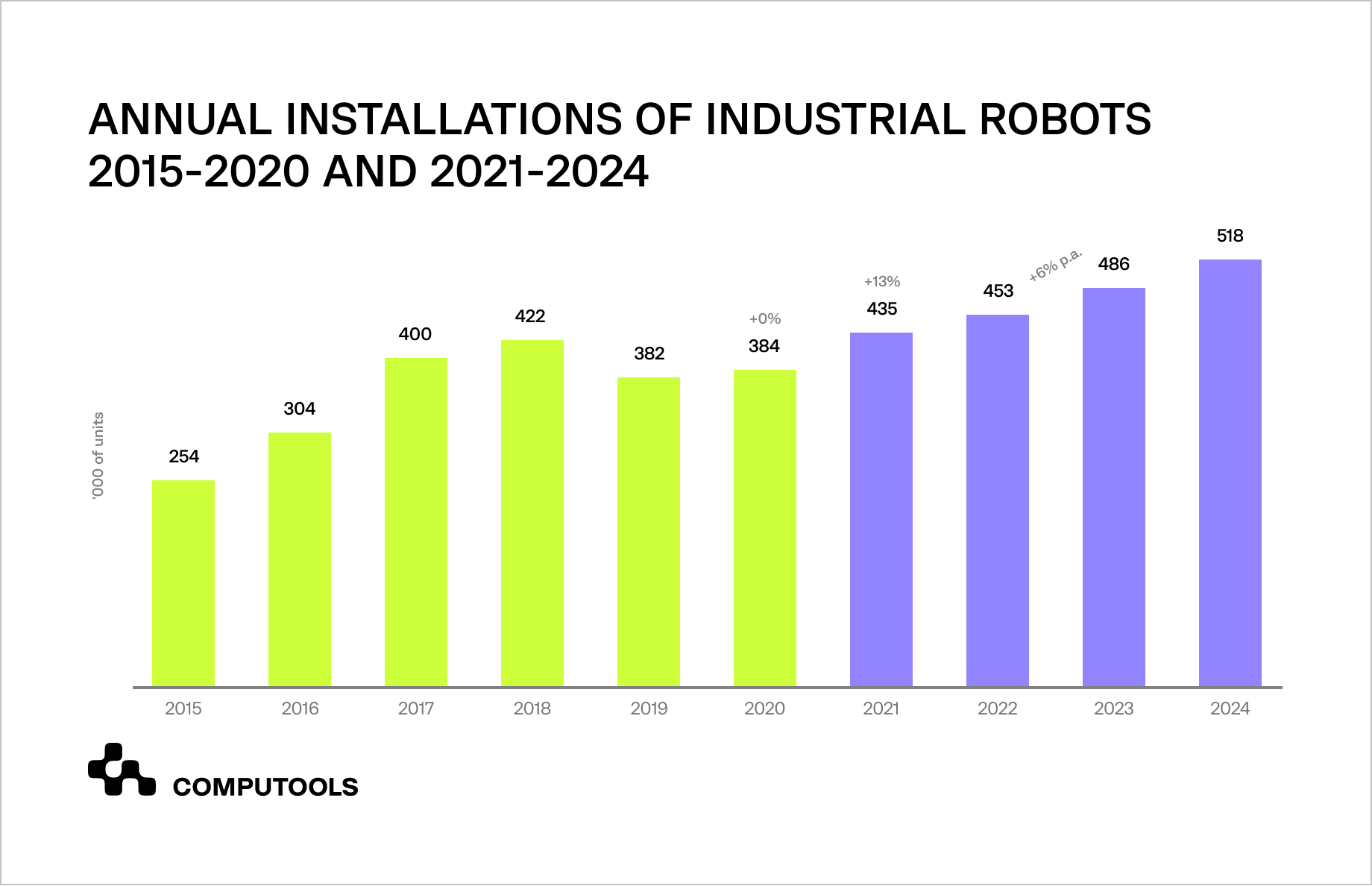
According to the International Federation of Robotics (IFR), logistics remains one of the fastest-growing sectors for service robot adoption worldwide.
Implementation challenges
Despite their benefits, robotic systems introduce several operational and technical challenges.
1. System integration
Robotics platforms must integrate seamlessly with existing enterprise tools, including warehouse management software development solutions, ERP systems, and supply chain management platforms, to maintain operational continuity.
2. Infrastructure readiness
Warehouses may require layout adjustments, installation of new sensors, and enhanced network connectivity to support precise robotic navigation and real-time data communication.
3. Change management
Employees must adapt to new workflows involving collaboration with robots. Effective training programs and clear operational guidelines are critical for smooth adoption.
4. Investment costs
The initial implementation of robotic systems requires significant investment in both hardware and software. However, long-term operational savings, higher productivity, and reduced error rates often justify the upfront cost.
How to implement warehouse robotics software
Successful implementation of warehouse robotics systems requires a structured, phased approach that aligns technology with real operational goals:
1. Operational Analysis
The process begins with a deep assessment of warehouse workflows, using data from WMS logs, IoT sensors, and historical throughput metrics.
Companies identify automation opportunities in tasks such as picking, sorting, pallet transport, cycle counting, and inventory tracking, while also mapping constraints like layout, peak loads, and SLA requirements.
2. Technology Architecture Planning
A scalable robotics ecosystem is built on a modular, cloud-enabled architecture that typically includes:
• Robotics control platform (RCS/RMS): for fleet orchestration, task allocation, and traffic management
• Warehouse Management System (WMS): for inventory control and order orchestration
• AI/ML analytics layer: for demand forecasting, slotting optimization, and anomaly detection
• IoT and edge computing infrastructure: for real-time data processing, sensor fusion, and low-latency decision-making
• Digital twin environment (optional but powerful): for simulation, testing, and predictive optimization before deployment
3. Custom Software Development
Off-the-shelf solutions often lack the flexibility required for complex logistics environments.
Custom software development enables:
• Advanced task orchestration algorithms (e.g., dynamic batching, wave-less picking)
• Real-time path planning and collision avoidance using AI
• Integration with robotics hardware (AMRs, AGVs, robotic arms) via ROS or proprietary SDKs
• Tailored dashboards for operations visibility and KPI tracking
This approach ensures the system is aligned with specific warehouse layouts, product types, and business rules.
4. Integration with Existing Systems
Seamless integration is critical for operational continuity. Robotics platforms are connected to enterprise systems (ERP, WMS, TMS) through:
• APIs and microservices architecture
• Event-driven data pipelines (e.g., Kafka, MQTT)
• Real-time synchronization of inventory, orders, and robot status
This creates a unified ecosystem where physical automation and digital systems operate in sync—forming robust warehouse robotics integration solutions.
5. Continuous Optimization
Warehouse robotics is not a one-time deployment—it’s an evolving system. By leveraging AI development services and advanced analytics, companies can:
• Continuously optimize routing and task allocation
• Predict maintenance needs using telemetry data
• Adapt to demand fluctuations and seasonal peaks
• Improve efficiency through reinforcement learning and feedback loops
Modern deployments often include software for autonomous warehouse robots and smart warehouse robotics systems, which adapt to real-time conditions, improve route planning, and reduce bottlenecks automatically.
Additionally, leveraging IoT development services ensures robust monitoring of both robot performance and warehouse environmental conditions.
For businesses undergoing broader digital transformation, combining robotics with digital transformation services can maximize operational ROI and long-term scalability.
Efficient warehouse capacity sharing also relies on real-time visibility across supply chains. Learn more in our article: Top 20 Supply Chain Visibility Software Development Companies Worldwide.
Why consider Computools for warehouse robotics software development
Building reliable and effective robotics platforms requires deep expertise not only in software engineering but also in logistics operations, real-time data processing, AI systems, and IoT integrations.
Computools delivers advanced technology solutions designed to meet the complex demands of modern supply chain environments and support ambitious warehouse automation initiatives. The approach emphasizes seamless integration between physical robotics, enterprise systems, and operational workflows, ensuring that automated warehouses function efficiently and reliably even at large scales.
With a strong engineering backbone, Computools brings together 250+ in-house engineers and has delivered 400+ projects globally over 12+ years in software engineering.
Across the portfolio, the company has successfully completed 40+ logistics and warehouse software projects, consistently earning positive client feedback on Clutch, where it maintains 90+ reviews.
The company has successfully delivered several logistics platforms that significantly enhance operational visibility, improve automation, and increase overall efficiency. One prominent example is Navis Horizon, a real-time cargo visibility solution created for a European port logistics operator.
The platform consolidates AIS and GPS data into a unified interface and incorporates an AI-powered assistant that helps dispatchers monitor shipments, detect delays, and proactively communicate updates to clients.
The implementation led to a 40% reduction in dispatcher workload and a 23% increase in customer satisfaction, demonstrating the tangible impact of digital transformation on day-to-day logistics operations.
Another standout project, EquipShare, showcases Computools’ capability to design secure and intelligent logistics platforms for asset management. In this case, the team developed a blockchain-based marketplace that allows companies to rent trucks and trailer equipment safely while tracking fleet history, usage patterns, and maintenance records.
The platform not only improved operational flexibility and transparency but also streamlined workflows for both clients and internal teams, making equipment rental faster, safer, and more efficient.
Additionally, Computools built the HubMarine platform, which leverages machine learning and IoT integrations to optimize marina operations, vessel placement, and berth bookings.
By providing real-time visibility into vessel locations and automating scheduling, the system reduced communication time for berth booking by up to 75% and improved overall operational transparency. This platform demonstrates how combining advanced analytics, IoT sensor data, and intelligent automation can solve complex logistical challenges across different industries.
These projects illustrate how Computools integrates expertise in AI, IoT, and enterprise platform development to deliver scalable digital solutions that address the operational realities of logistics companies.
By taking a holistic approach—analyzing workflows, designing user-friendly interfaces, and optimizing processes through data-driven insights, Computools helps businesses achieve measurable improvements in efficiency, accuracy, and service quality.
Their solutions are not limited to one type of warehouse or logistics network but are adaptable to various operational contexts, making them a trusted partner for organizations seeking to modernize and automate their logistics operations.
If you’re planning to develop warehouse robotics software for autonomous picking and sorting, contact our team at info@computools.com to discuss your project.
Conclusion
Warehouse automation is entering a new era driven by robotics and artificial intelligence. Modern solutions enable companies to coordinate autonomous machines responsible for picking, sorting, and transporting goods across warehouse facilities, improving speed, accuracy, and operational reliability.
By leveraging intelligent systems, organizations can not only accelerate order fulfillment but also gain real-time insights into warehouse performance and bottlenecks, allowing for proactive decision-making.
However, successful implementation requires more than simply purchasing robots. Organizations must develop robust platforms that can manage robotic fleets efficiently. Warehouse robot management software ensures optimal task allocation, continuous monitoring, and maintenance scheduling for robots, while warehouse management software development enables seamless integration with existing enterprise systems, inventory tracking, and workflow automation.
Combined with advanced analytics and machine learning, these platforms allow companies to continuously optimize operations, reduce errors, and increase throughput.
Moreover, implementing AI development services enhances the capabilities of these platforms, enabling predictive maintenance, intelligent route planning, and dynamic resource allocation. By harnessing AI-driven insights, warehouses can adapt to fluctuations in demand, prevent operational disruptions, and make data-backed decisions that drive efficiency.
For technology leaders seeking to modernize logistics infrastructure, investing in comprehensive robotics platforms represents a critical step toward achieving long-term scalability, operational resilience, and competitive advantage.
These systems not only support current operational needs but also provide a foundation for future innovations in autonomous warehouse management, ensuring businesses remain agile in an increasingly automated and data-driven industry.
Digital twins enable real-time simulation and optimization of warehouse operations, helping identify inefficiencies and improve workflows without disrupting actual processes. This leads to smarter decisions, higher efficiency, and lower costs. Learn more in our article: Digital Twins for Warehouses: Simulation and Optimization of Logistics Operations.
Computools
Software Solutions
Computools is an IT consulting and software development company that delivers innovative solutions to help businesses unlock tomorrow.










“Computools was selected through an RFP process. They were shortlisted and selected from between 5 other suppliers. Computools has worked thoroughly and timely to solve all security issues and launch as agreed. Their expertise is impressive.”