
THE AUTHOR:

By 2026, eLearning will firmly establish itself as a global educational trend, not a temporary solution but a full-fledged learning model. Online education spans all continents, reaches learners of different ages and professions, and is actively embedded in the academic sector and corporate training systems.
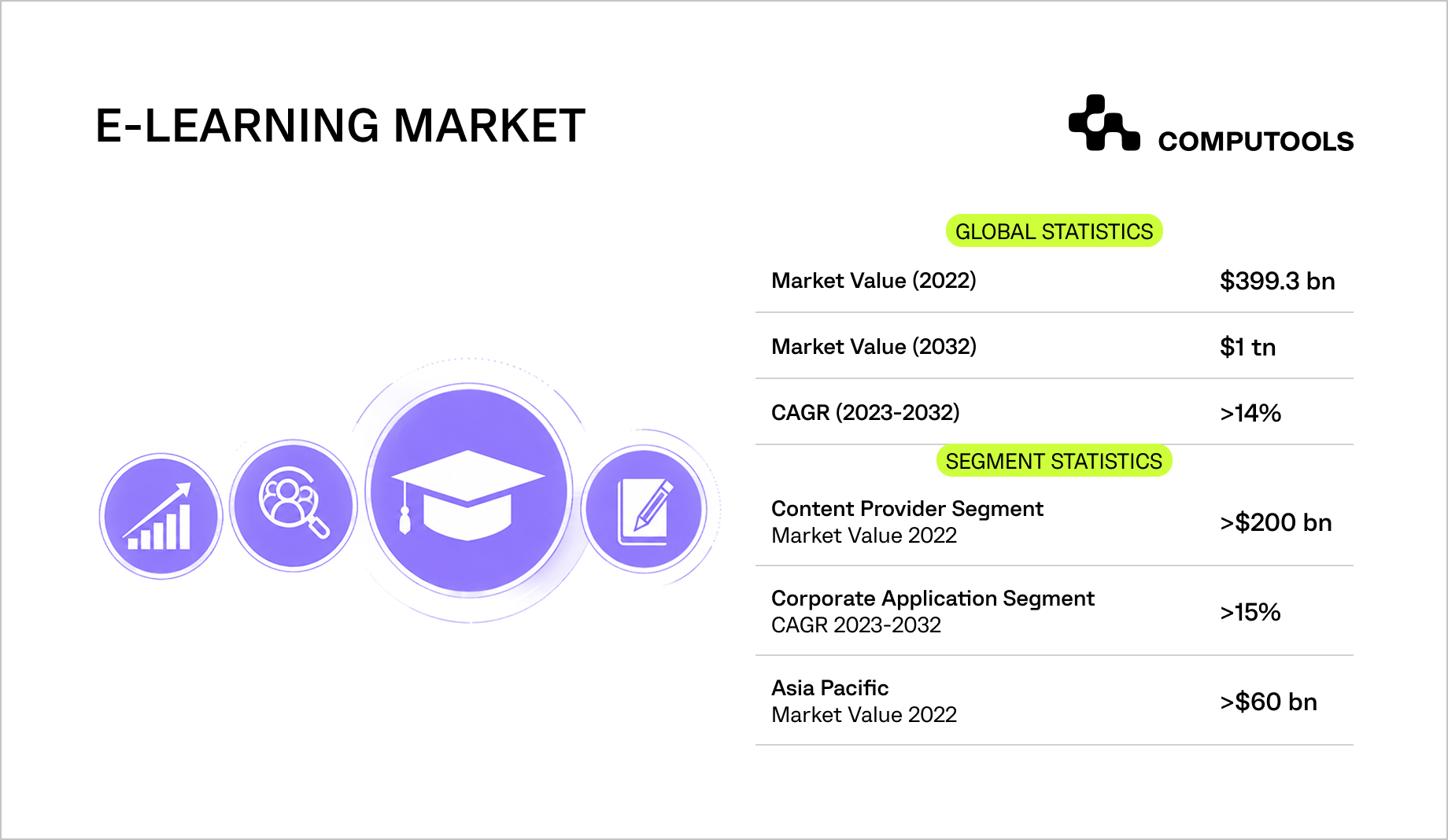
In 2022, the global eLearning market was valued at $399.3 billion, which continues to rise rapidly. Statista states it is projected to surpass $1 trillion by 2032, with a compound annual growth rate (CAGR) of about 14%.
Corporate online learning is growing as fast: this segment is expected to grow from $245.5 billion in 2022 to $462.6 billion by 2027 (CAGR 13%). This acceleration reflects the growing need to quickly upskill and reskill teams amid ongoing market transformations, hybrid work models, and digital process shifts.
As businesses scale their training efforts, many turn to a robust LMS to centralize, personalize, and monitor education at scale. The demand for LMS implementation directly responds to the need for flexibility, automation, and measurable learning outcomes.
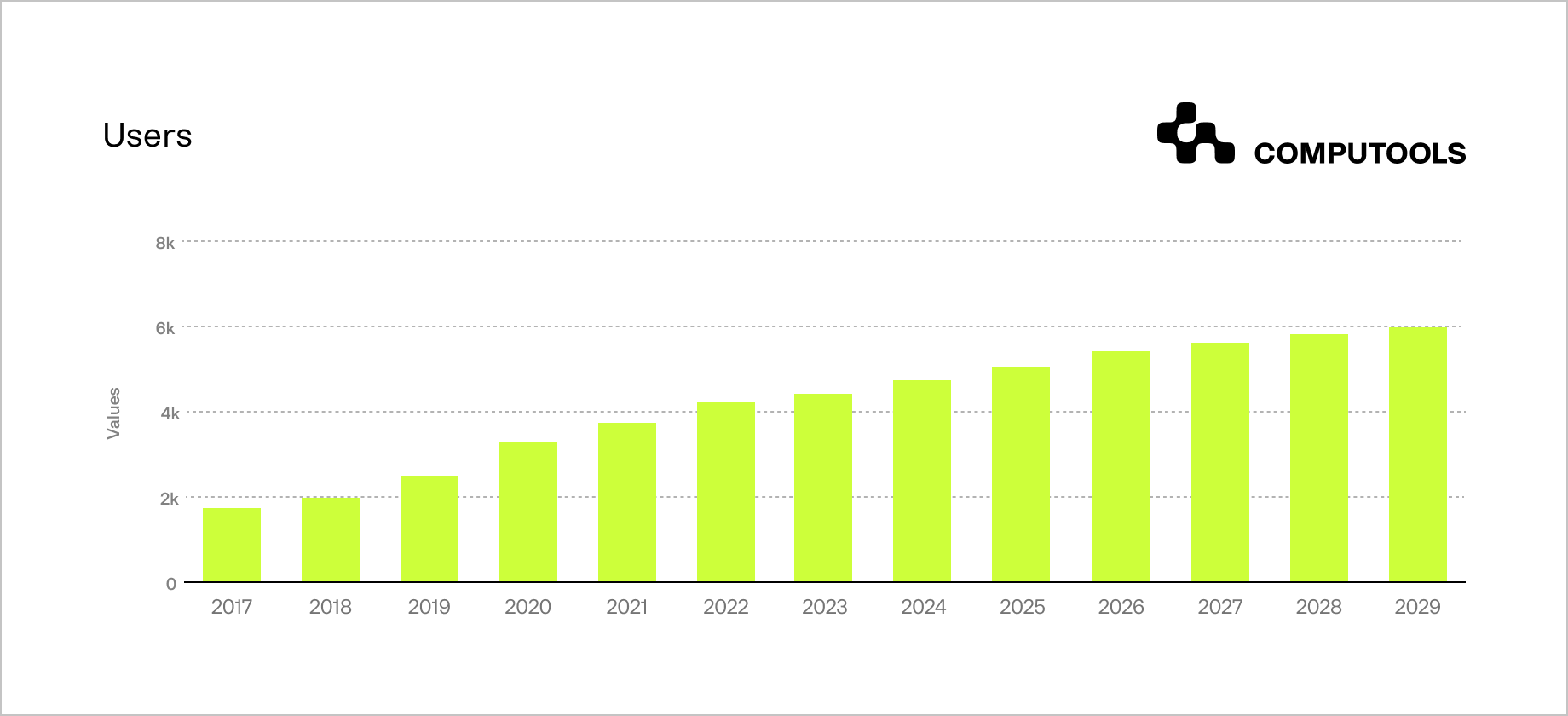
Online learners are also rising significantly, by over 20% annually. According to Statista, by 2029, the number of users in the online education market is expected to reach 1.1 billion. What does this mean for companies? Employees now expect immediate access to learning in convenient formats, intuitive platforms, and content that addresses fundamental challenges.
Interestingly, 79% of the education industry is designed for adult audiences. This reinforces the idea that online education is no longer just for students; it’s an essential part of professional development across industries.
For companies operating in the education industry, this shift offers clear opportunities.
Businesses that invest in education software development or tailor a ready-made LMS to meet their needs gain a strategic advantage: a well-trained, adaptable, and loyal workforce.
Discover how computer vision is transforming education through automated assessments, personalized learning experiences, and smarter classroom management in this article.
What is LMS, and why does it matter for eLearning businesses
A Learning Management System (LMS) is a digital solution that serves as a centralized hub for organizing, delivering, and monitoring training programs. LMS for eLearning businesses is not limited to one type of organization.
It is widely adopted by:
- Companies for onboarding, upskilling, and leadership development
- EdTech startups looking to build scalable online education products
- Educational institutions using LMS for remote and blended learning
- HR departments for building personalized employee development plans
The benefits of LMS enable you to:
- Improve learning outcomes and retention
- Ensure compliance and track certifications
- Provide transparent analytics for HR and department leads
- Foster a culture of continuous development and self-improvement
To unlock these benefits, it’s crucial to approach your LMS implementation strategically. Let’s explore 7 essential steps to adopt an LMS in your business successfully.
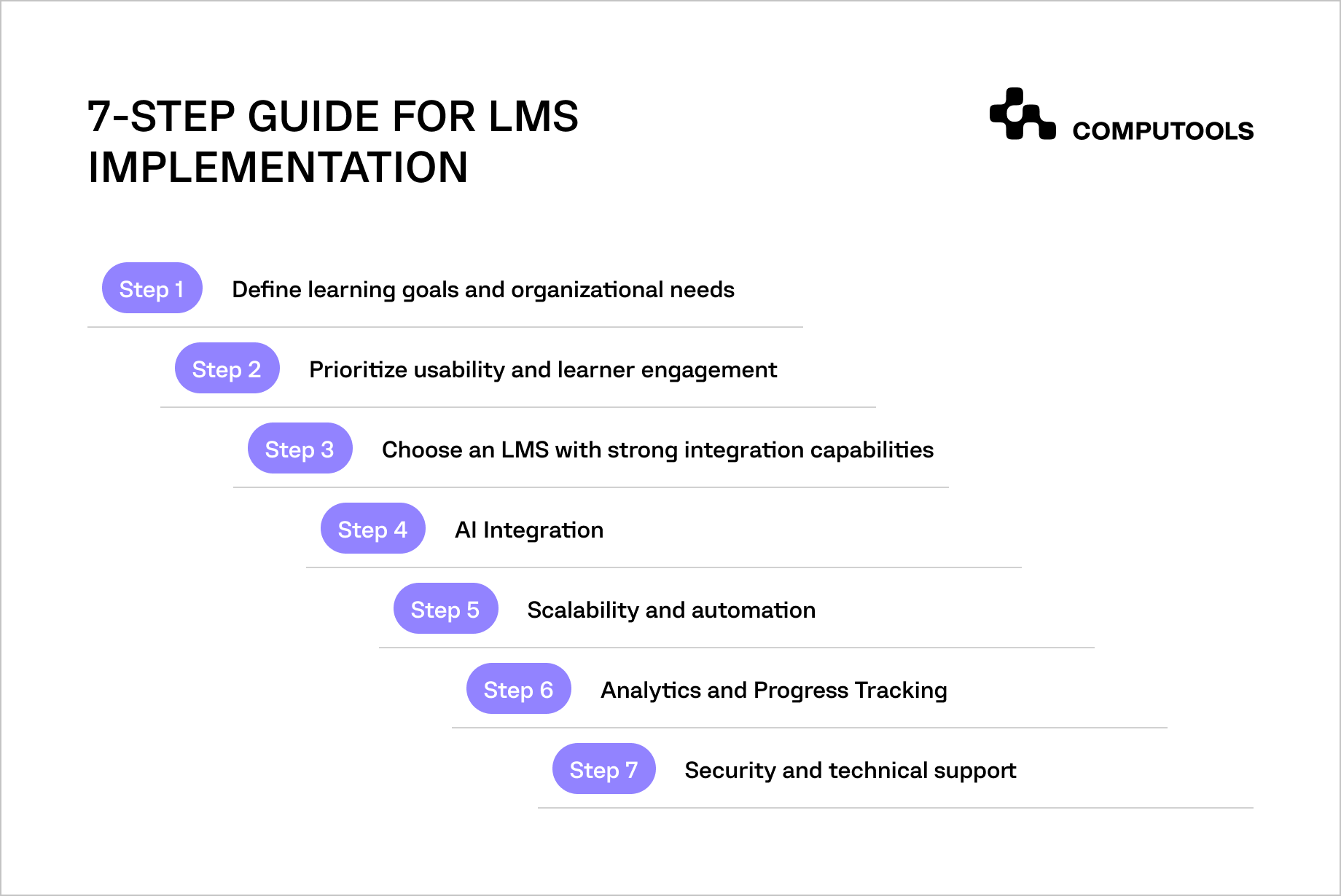
7-Step Guide for LMS Implementation
Step 1: Define learning goals and organizational needs
Successful LMS implementation starts with clearly understanding your company’s strategic learning goals and internal challenges. Whether your objective is to onboard new hires, provide continuous upskilling, or digitalize partner training, each case will require a specific LMS feature set.
These goals directly influence your choice of platform model and functionality.
Before investing in an LMS, evaluate your current systems and how your new learning platform will fit into the ecosystem:
What is LMS integration? It connects your LMS to tools like HRIS, CRM, or databases to avoid data duplication and enable seamless learning workflows.
- Choose the right LMS model for your case:
– Open-source LMS: highly customizable but requires internal tech expertise.
– SaaS (commercial): fast deployment and support, but with limited customization.
– Custom-built LMS: fully tailored to your business needs, yet more resource-intensive.
- Will you need to scale? If your organization is growing or entering new regions, your LMS must be scalable and flexible.
- Do you already use digital tools? Disconnected or outdated HR and CRM systems can complicate training workflows. A good LMS should integrate with them smoothly and securely.
- Do you have the necessary resources? Consider the availability of IT staff, server capacity, and bandwidth. Also, assess whether your team has the time and expertise to create training content or if ready-made materials will be more efficient.
Each organization in the education industry has specific pain points. Your LMS should be selected with these in mind:
- Low learner engagement? Look for an LMS with gamification, personalized learning paths, and engaging visual dashboards.
- Manual training management? Automate course assignments, progress tracking, and reporting. Integration with HR and CRM systems will ensure automatic updates when roles or employees change.
- Scattered training materials? Use a cloud-based LMS to centralize all learning resources in one accessible place with 24/7 availability.
Step 2: Prioritize usability and learner engagement
Even the most advanced LMS won’t deliver value if employees don’t want to use it. An intuitive interface, easy navigation, and personalized features directly influence user engagement, course completion rates, and overall learning outcomes.
Key usability criteria:
- Customizable dashboards: Users should be able to tailor their workspace, choosing tools and views they use most frequently. This improves efficiency and speeds up learning workflows.
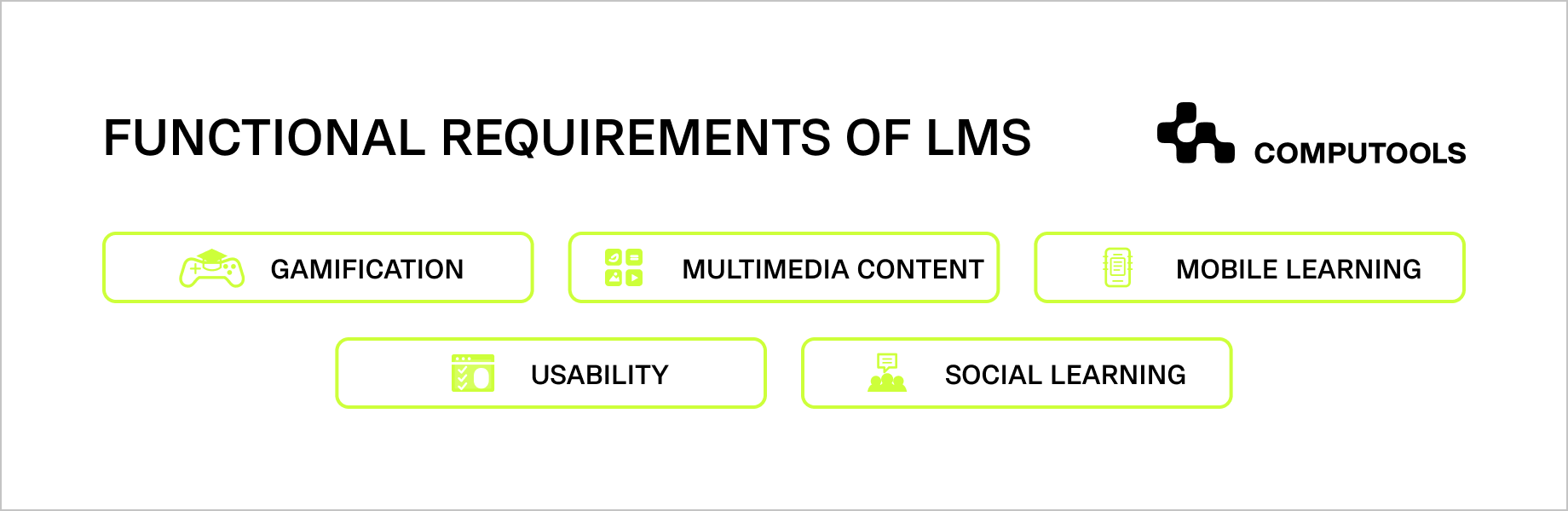
- Mobile responsiveness: The LMS should work seamlessly across smartphones, tablets, and desktops, on both iOS and Android. This is essential for remote employees and learners on the go.
- Accessibility compliance: Support for accessibility standards, such as screen reader compatibility ensures inclusivity for all learners, including those with disabilities.
- Multimedia content support: All training materials, videos, PDFs, quizzes, and slide decks should be hosted in one centralized hub, accessible anytime, anywhere.
- Interactive features: Gamification, quizzes, discussion boards, virtual classrooms, and achievement badges help make learning more engaging and rewarding.
- Blended learning formats: The LMS should support a mix of asynchronous courses and live training sessions (e.g., webinars or in-person workshops).
- Content version control: Allows instructors to update course materials without disrupting the learning experience for current users.
A user-friendly, engaging LMS saves time, improves completion rates, and boosts ROI. When learners enjoy the experience, knowledge transfer happens faster and sticks longer.
Step 3: Choose an LMS with strong integration capabilities
To function effectively within your company’s digital ecosystem, an LMS must seamlessly integrate with other tools, HR systems, CRMs, analytics dashboards, and communication platforms like Zoom or Microsoft Teams. Strong integrations save time, reduce errors, and simplify training management, making them essential, not optional.
What is LMS integration, and why is it a critical success factor for businesses investing in EdTech software development services or building scalable business learning solutions.
Types of LMS integrations:
1. HRIS Integrations. Connect your LMS with human resource information systems (e.g., BambooHR, SAP SuccessFactors) to auto-sync employee data like job roles, departments, skills, and hire dates. This enables instant onboarding flows, personalized learning journeys, automated user creation, and role-based access.
2. CRM Integrations. Link the LMS with CRM platforms like Salesforce or HubSpot to support customer training, partner enablement, or sales onboarding. This allows training content based on client interactions, tracking training outcomes alongside sales KPIs, and streamlined external user management.
3. Communication tools (Slack, Microsoft Teams). Embed training into daily workflows with notifications, reminders, and updates delivered in chats; progress reports and learning nudges within the workspace; in-chat access to microlearning modules.
4. Content libraries and authoring tools. Integrate third-party content providers (e.g., Coursera, LinkedIn Learning, SCORM/xAPI libraries) for richer, ready-to-use materials.
5. Analytics and BI Systems. Combine LMS data with business intelligence tools like Power BI or Tableau to: monitor performance metrics, build custom reports, and link training impact to business outcomes.
6. Single Sign-On (SSO) & Identity Management. Use SSO solutions (e.g., Okta, Azure AD) to ensure secure, password-free platform logins while maintaining access control.
7. Custom API Integrations. For companies building a broader EdTech ecosystem, custom API connections let your LMS work with internal tools, ERPs, or external databases.
An integrated platform doesn’t just make your LMS easier to use; it transforms it into a central hub for learning, performance, and growth across your organization.
Step 4: AI Integration
When thoughtfully integrated, custom AI software becomes an embedded learning advisor that analyzes massive datasets: course results, user activity, and knowledge gaps, transforming them into actionable insights.
What AI-powered LMS can do:
- Recommend personalized learning paths for new employees based on their role, skill gaps, and progress.
- Identify underperforming teams or departments and flag areas where training adjustments are needed.
- Predict future learning needs based on business changes or market trends.
AI also helps businesses in the education industry move from templated to personalized learning, optimize training budgets, access real-time analytics for proactive decisions, and boost training ROI through highly targeted and relevant content.
Step 5. Scalability and automation
As an organization grows, so does the need to scale learning.
An LMS must be ready for:
- Growth in the number of users. A high-quality LMS should easily support dozens or thousands of users without losing performance or stability.
- Adaptation to new teams and regions. The system must flexibly support expansion into new markets, remote offices, or international teams. This includes support for multiple languages, time zones, localized content, and the ability to create separate learning spaces for different departments or countries.
- Maintaining loading speed and analytics processing even at peak loads. During busy learning seasons or large-scale upskilling campaigns, the LMS must withstand the load without delays in course loading, system crashes, or data loss. Analytics, reporting, and tracking must remain stable even with a high volume of concurrent users.
- Adding new features or integrating with other tools without a full system rebuild. The LMS must support a flexible architecture, allowing integrations with CRM, HRIS, e-commerce, AI modules, or new functionalities without “breaking” the existing system.
Step 6. Analytics and Progress Tracking
To evaluate and analyze the effectiveness of learning, transparent metrics are essential.
- Flexible creation of tests and assignments. A quality LMS should support various task types from multiple-choice tests to open-ended questions and essays. This allows for more accurate and in-depth knowledge assessments that match the complexity of the material and the skills being tested.
- Automated grading and feedback. An LMS can automatically assign grades, generate suggestions for learners, and highlight strengths and weaknesses, all without excessive manual effort.
- Progress and engagement tracking. An LMS should provide data on course completion, engagement, lesson duration, number of attempts, average score, and moreю.
- Connection to external analytics tools. If you use BI systems or third-party analytics platforms, your LMS must integrate with them via API.
This allows L&D teams to make data-driven decisions instead of relying on intuition.
Step 7. Security and technical support
A learning system processes sensitive information: employee personal data, training records, assessment results, and corporate documents. Therefore, LMS security must be a top priority from day one.
Core security requirements:
- Data encryption: All data must be transmitted and stored in encrypted form, in compliance with standards like GDPR, SOC 2, or HIPAA.
- Role-based access: Different access levels are available for administrators, instructors, and users to minimize the risk of data leaks or accidental edits.
- Two-factor authentication (2FA): An extra layer of protection at login, especially important for large or remote teams.
- Audit logs: Activity logs tracking logins, data changes, and course launches ensure internal security and transparency.
- Regular updates and audits: Ongoing LMS and at least annual security audits are essential to eliminate vulnerabilities.
Even the best-configured LMS needs consistent post-launch support, both technical and advisory. This ensures system stability, quick resolution of user issues, and adaptability to change.
Must-have support components:
- 24/7 support or SLA.
- Prompt response times.
- Knowledge base/help center.
- Communication channels.
- Performance monitoring.
A well-built LMS addresses current needs and prepares your business for future challenges, especially in a rapidly evolving education industry.

Disconnected learning systems are costing you time, revenue, and growth. Launch your LMS in 1–3 months, not years.
Key types of LMS integrations: who needs them and why
Integration depends on the kind of organization and its learning objectives. Different businesses and educational institutions have unique needs, so a learning system should seamlessly connect with their essential tools.
1. Corporations and business teams
- HCM/HRM Integration (Workday, BambooHR): automate onboarding, track progress, and sync skills and learning outcomes with employee profiles.
- CRM Integration (Salesforce, HubSpot): create training programs based on KPIs and client data.
- BI Tools (Power BI, Tableau): gather in-depth analytics on course completion, scores, and performance impact.
2. For eLearning companies and EdTech platforms
- Payment Systems (Stripe, PayPal): sell courses via subscriptions, one-time payments, discounts, etc.
- CMS Integration (WordPress, Webflow): embed learning content or build full educational platforms.
- Email Marketing (Mailchimp, SendGrid): automate updates, course reminders, and certificates.
3. For universities, schools, and academies
- SIS Integration (Blackboard, PowerSchool): manage student records, grades, attendance, and programs in one place.
- Calendar Sync (Google, Outlook): auto-schedule classes, deadlines, and instructor meetings.
- Proctoring Systems: enable secure remote exams with identity verification and monitoring.
Key benefits and challenges of LMS implementation for educational organizations: development perspectives
| Key benefits of LMS | Main challenges of LMS integration |
| Centralized learning content. | Content digitization. |
| Personalized learning. | User adaptation. |
| Process automation. | Technical compatibility. |
| Improved engagement. | Data security. |
| Analytics and reporting. | Support and updates. |
Explore how big data is reshaping education by enabling personalized learning, predictive analytics, and data-driven decision-making for institutions and students alike in our post.
The future of LMS: 5 important trends
By 2026, leading LMS platforms will transform to meet the demands of hybrid work, personalized learning, and business effectiveness.
Here are the key predictions shaping the future of the education industry:
- Microlearning. Short, focused learning modules (5–10 minutes).
- Skill-based learning. Learning will be tied directly to business goals through Skill Gap Analysis.
- Gamification 2.0: team competitions, quests, scenario-based choices, and AR/VR technologies for immersive learning.
- Lifelong learning. Platforms will move from one-off courses to long-term professional development strategies.
- Strengthened cybersecurity and ethical AI. LMS must comply with standards like GDPR and ensure ethical use of analytics and personalization.
From platform to partner: why choosing the team implementing LMS is as important as the system itself
Even the best LMS with impressive functionality, integrations, and gamification can prove ineffective if its implementation is entrusted to a team without a deep understanding of educational software solutions for your goals, industry, or users.
Pay attention to:
- Expertise in your niche: Implementing a system that aligns with your business objectives requires technical and domain expertise ranging from configuration to integration setup. If you need a partner to help develop or customize an LMS solution tailored to your structure, look for companies specializing in eLearning business software.
- Practical experience with LMS: A team that has previously launched similar education software development understands potential bottlenecks, the importance of scalable architecture, and the need for support at every stage.
- Transparent development process: The partner should propose optimal solutions, test hypotheses, and focus on long-term results.
- Comprehensive approach: From integrations with HRM, CRM, and content systems to building analytics, adaptive learning, and mobile UX.
Why Computools for educational software development and LMS implementation
Computools, helps transform learning for integrators and students. Each project is a well-thought-out, technically sound system based on proven practices, current trends, and real experience. You get a team that understands what the learning process is and how to make it effective with the help of technology.
We have deep expertise in educational software development: from LMS platforms for corporate training to full-scale educational ecosystems. We implement modern, secure, and effective solutions tailored to each client’s goals and vision. With 40+ education software projects delivered globally, including 20+ custom eLearning solutions and 20+ custom EdTech systems we help organizations achieve measurable impact. Our clients report up to 40% lower operational costs, 2x faster academic decision-making, and 3x higher learner engagement.
The real cases in the educational sector
British Council: A redesigned, user-friendly platform with improved UX/UI and optimized customer journeys helped increase learner engagement, streamline access to IELTS resources, and boost test registrations. The solution also improved process automation and supported revenue growth through a more efficient digital experience.
BeEducated: Ongoing platform modernization and scalability improvements led to higher user engagement, stronger profitability, and expansion of the customer base. Enhanced platform stability and a more intuitive user experience supported sustainable growth for the education business.
The Maritime Skills Academy: A complete digital transformation introduced a modern mobile-responsive learning platform with advanced search capabilities and integrated online payments. As a result, the client achieved increased bookings, revenue growth, lower operational costs, and improved user satisfaction.
You can explore more client success stories in our case studies section. Our experience in developing and integrating educational solutions is also reflected in client feedback and independent reviews on Clutch.
Computools
Software Solutions
Computools is an IT consulting and software development company that delivers innovative solutions to help businesses unlock tomorrow.