
THE AUTHOR:

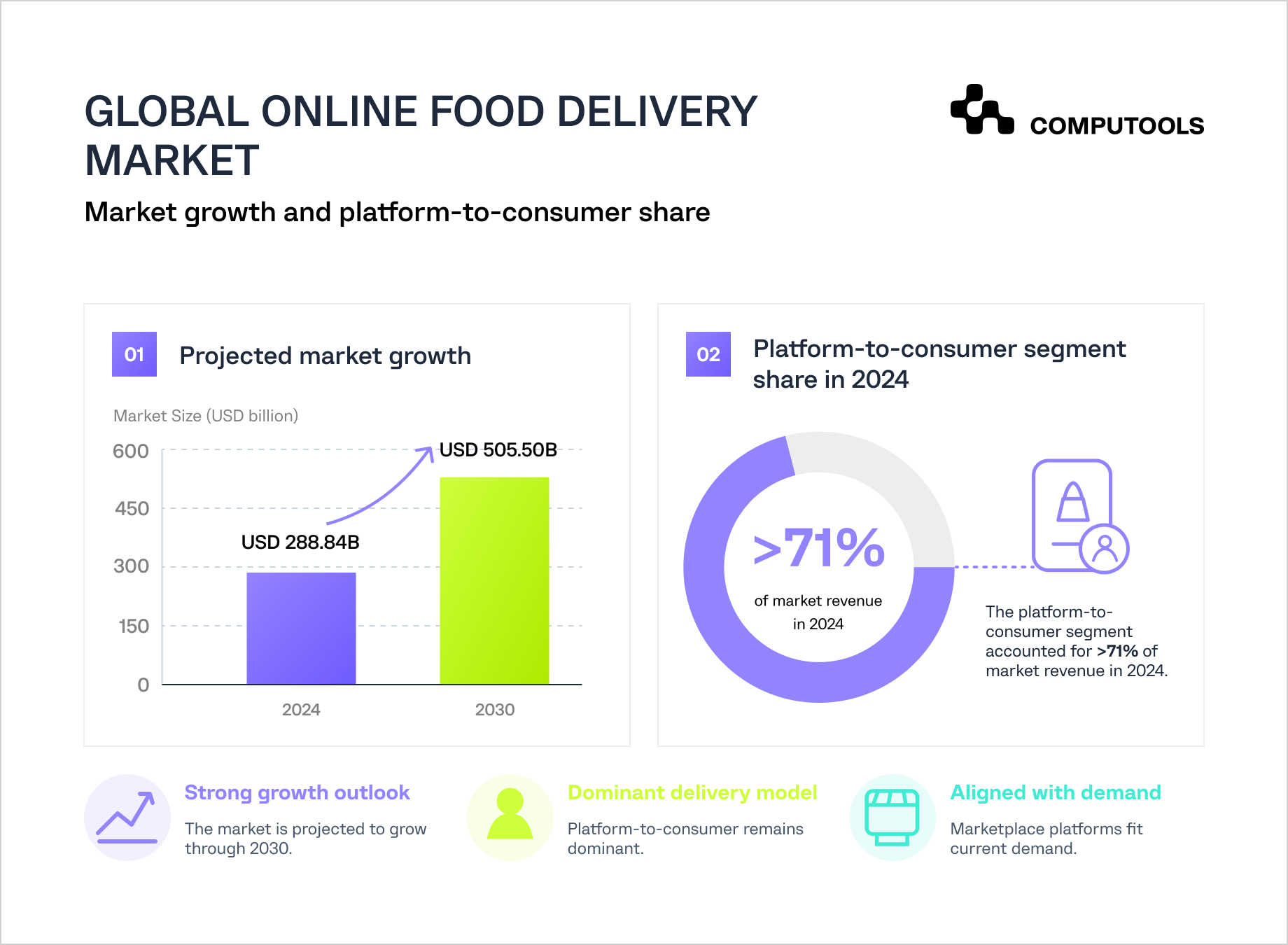
The online food delivery market is increasingly shaped by platforms that connect customers with multiple restaurant partners within a single ordering environment. Grand View Research estimates that the global online food delivery market will grow from USD 288.84 billion in 2024 to USD 505.50 billion by 2030, while the platform-to-consumer segment already accounted for more than 71% of market revenue in 2024. For businesses planning to build a restaurant marketplace platform, these figures indicate clear demand for products that combine restaurant discovery, menu management, ordering, payments, fulfillment workflows, and operational control into a single system.
However, multi-restaurant marketplace platform development is more complex than launching an ordering app for a single venue. Each restaurant may have different menus, modifiers, availability rules, fulfillment models, preparation times, payment requirements, and reporting needs. The platform must keep customer ordering simple while giving vendors and marketplace administrators the tools to manage operations accurately as the network grows.
In this article, we explain the architecture, business logic, integrations, and delivery stages required for a scalable multi-vendor platform. We also refer to our work on Tap App, a cross-platform restaurant ordering solution that aggregated multiple venues, supported on-site and off-site orders, enabled payments and order tracking, and helped reduce unfulfilled or modified orders by 85%.
How Computools helped build a restaurant marketplace platform for Tap App
When developing Tap App, we worked with a business that needed to connect customers with a growing network of restaurants and cafes across the UK. The product supported various menu structures, opening hours, table availability, restaurant-specific needs, and both on-site and off-site ordering in one consistent experience.
As part of our software development services for HoReCa, we analyzed restaurant operations, defined the application architecture, selected the technology stack, and coordinated delivery from requirements analysis to launch and ongoing support. The resulting application aggregated participating venues into a single ordering environment, giving customers access to menus, availability information, order notes, payments, tips, and real-time order status updates.
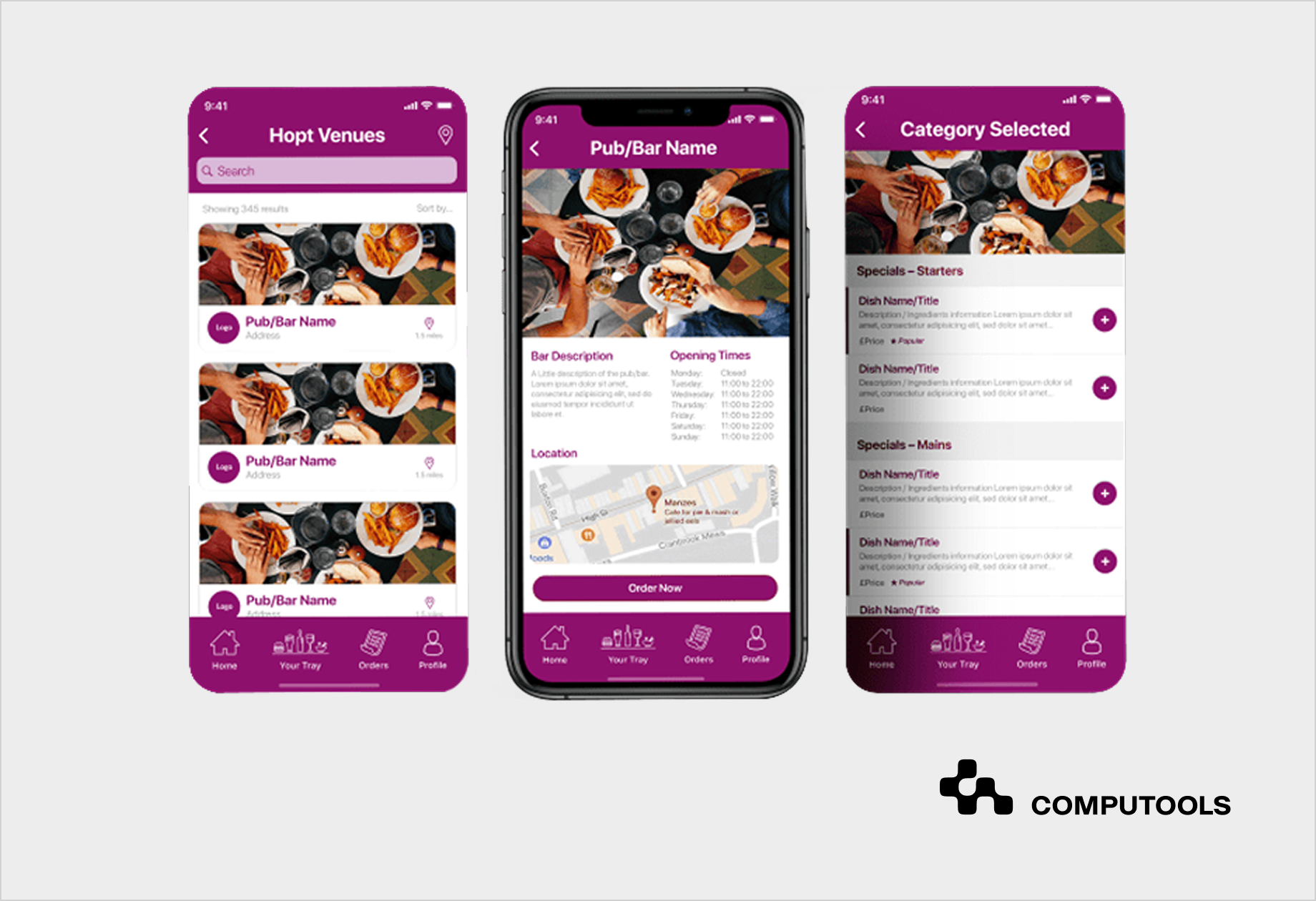
This functionality created the operational foundation required for a multi-vendor food marketplace: restaurants could join a shared digital ordering channel without relying on identical menu structures or service models. The app was designed to adapt to varied venue requirements while providing restaurant teams with real-time business performance monitoring and customers with a simple ordering journey.
Through our mobile app development services, we built a cross-platform application for iOS and Android, integrated secure payment functionality, and ensured stable performance under a tight launch schedule. The product contributed to a 7% increase in top-line growth through cross-selling opportunities and reduced unfulfilled or modified orders by 85% through improved ingredient management.
How to build a multi-restaurant food marketplace platform in 9 steps
The steps below describe the core product and development areas involved in creating a multi-restaurant marketplace. In practice, several workstreams, including ordering, payments, dashboards, and integrations, are designed and implemented in parallel after the initial discovery phase.
Step 1. Define the Business Model, User Roles, and Fulfillment Scope
Before interface design or technology selection begins, the business and operational model of the platform must be defined. A marketplace platform for restaurants may generate revenue through order commissions, vendor subscriptions, delivery fees, service charges, promotional placements, or a combination of these models. Each option affects payment processing, restaurant reporting, administrative functionality, and the contractual logic the system must support.
The first release scope should specify which ordering scenarios the platform will support. A platform may support delivery, pickup, scheduled ordering, dine-in ordering, or multiple fulfillment options simultaneously. These are not minor variations of the same flow. Delivery requires service zones, courier logic, and ETA communication. Pickup requires preparation and collection status updates. Dine-in orders may depend on table availability, tipping, and venue-side service workflows.
The next task is mapping user roles and access permissions. Customers, restaurant owners, location managers, restaurant staff, marketplace administrators, support specialists, and couriers interact with different parts of the system. Each role should have clearly defined permissions to view, edit, approve, and monitor platform activity. For example, restaurant staff may manage active orders and item availability, while owners need revenue reporting and multi-location controls.
This discovery stage helps establish a realistic MVP development scope. Instead of attempting to launch every delivery, loyalty, promotion, and reporting feature at once, the MVP should include the functions required to onboard restaurants, process orders reliably, connect critical integrations, and collect data to inform future product decisions.
In the Tap App project, the application had to support multiple restaurants and cafes with different operational requirements. This meant designing the product around varied menus, venue details, ordering scenarios, and restaurant needs rather than replicating the workflow of one business.
Step 2. Create Restaurant Onboarding and Vendor Management Workflows
A marketplace cannot scale if each new restaurant has to be configured manually by the product team. Restaurant onboarding workflows should collect profiles, locations, contact information, cuisine categories, operating hours, service options, menu data, payment details, and required documents. Platform administrators should be able to review applications, request corrections, approve restaurants, manage publication status, and suspend access when necessary.
If the marketplace manages restaurant payouts, onboarding may also include connecting payment accounts and verifying the information required by the selected payment provider.
The vendor data model must distinguish between a restaurant brand and its individual locations. A restaurant group may need a single central account while operating different menus, prices, staff, delivery areas, and opening times across several venues. Separating shared brand data from location-specific settings avoids duplication and gives the restaurant greater control over day-to-day operations.
Access management is another core part of onboarding. Restaurant owners may need financial reports and account administration; venue managers may update business hours, menus, and operational settings; staff members may only accept orders or change item availability. These permissions should be configured inside the product rather than handled through shared accounts or support requests.
The marketplace team also needs tools to monitor onboarding progress and vendor quality. Administrators should be able to identify incomplete profiles, missing menu data, inactive restaurants, approval delays, or repeated operational issues from one control environment.
With these workflows in place, an online food marketplace platform can expand its restaurant network while maintaining consistent data, controlled access, and accurate customer-facing information.
Step 3. Build a Flexible Menu, Modifier, and Availability Architecture
Menus are among the most technically demanding parts of a multi-restaurant product because each venue organizes its offerings differently. The menu architecture should support categories, dishes, drinks, variants, required and optional modifiers, add-ons, meal combinations, dietary information, allergens, images, prices, taxes, and location-specific configurations.
The platform also has to support real restaurant behavior. A burger may require a side selection; a pizza may offer several sizes and extra toppings; a lunch menu may only be available during specific hours; and a dish may be temporarily unavailable when an ingredient runs out. Reliable restaurant marketplace software must handle these differences while keeping navigation and checkout predictable for customers.
For restaurant groups, menus may require both central and local management. A brand can use the same core catalog across locations, while individual venues adjust prices, disable certain items, publish seasonal offers, or manage availability according to kitchen capacity. These controls should allow restaurant teams to make operational updates without involving developers or marketplace support staff.
Validation is equally important. The system needs to prevent incomplete modifier selections, incorrect price calculations, orders for unavailable products, and conflicts between scheduled ordering times and item availability. These rules reduce manual corrections after checkout and protect the customer experience during busy service periods.
In Tap App, we developed functionality that aggregated menus, opening and closing times, table availability, and other venue information across participating restaurants. The application also supported improved ingredient management, contributing to an 85% reduction in unfulfilled or modified orders. This result shows why menu and availability logic have a direct operational impact, rather than being merely a catalog feature.
Step 4. Design Restaurant Discovery, Ordering, and Checkout Journeys
The customer experience begins before the menu opens. Discovery flows should help users find restaurants according to location, cuisine, operating hours, fulfillment type, delivery eligibility, or current availability. The platform should only present options that can realistically accept the customer’s order, or clearly indicate why a venue is temporarily unavailable.
Once a customer chooses a restaurant, the system must apply its operational rules throughout the ordering journey. These may include minimum order value, delivery area, preparation time, available pickup slots, service fees, item modifiers, promotional conditions, and tipping options. These requirements should be validated before payment so the restaurant receives an executable order rather than one that needs correction or cancellation.
A platform also needs to support convenience features that encourage repeated use. To build a food ordering marketplace that becomes part of customers’ regular behavior, the product should support saved addresses, favorite restaurants, repeat ordering, order history, payment preferences, notes, scheduled orders, promotional codes, and order notifications.
In Tap App, customers could order food and drinks on-site and off-site, add notes, make payments, including tips, and track order status through the application. These features suit a multi-restaurant app, combining customer convenience and restaurant operations in a single digital channel.
Step 5. Configure Payments, Platform Revenue, Refunds, and Restaurant Settlements
Payment architecture determines whether the marketplace can operate transparently as its vendor network grows. Payment design begins with defining who accepts the customer payment, when the platform deducts its commission, how restaurant earnings are calculated, how tips are distributed, and how delivery or service fees are allocated.
The product must also account for promotions. Discounts may be funded by the marketplace to acquire customers, provided by individual restaurants, or shared between both parties. This affects payout calculations, reporting, and restaurant trust. Without a clearly defined financial logic, promotional activity quickly creates reconciliation disputes.
Non-standard payment events also need to be mapped, including failed payments, restaurant-rejected orders, customer cancellations, partial refunds, full refunds, delivery failures, chargebacks, and manual adjustments. Each scenario requires an audit trail that shows the original amount, fees, commission, refunded value, restaurant payout impact, and the administrator responsible for any manual action.
Financial reporting should be designed alongside transaction flows. Restaurant partners need access to order-level earnings, tips, deductions, refunds, and settlement summaries. The marketplace operator needs aggregated reporting for commissions, promotional costs, unpaid balances, payout cycles, refunds, and payment gateway issues.
In Tap App, we integrated payment gateways that enabled secure in-app transactions and tips. For custom food marketplace software, this payment foundation can be extended with marketplace commissions, automated restaurant payout calculations, refund administration, promotion accounting, and reconciliation tools.
Step 6. Implement Order Processing, Delivery Logic, and Real-Time Tracking
Every accepted order must move through a clearly defined lifecycle. The system should support clearly defined statuses, including payment confirmed, sent to restaurant, accepted, rejected, in preparation, ready for pickup, assigned for delivery, collected, delivered, completed, canceled, and refunded. These statuses control notifications, dashboard visibility, reporting, and customer support actions.
An on-demand food delivery marketplace platform may need to support more than one delivery model. In a restaurant-managed model, the venue accepts orders and handles fulfillment independently, updating their status in the system. In a marketplace-managed model, the platform also assigns couriers, monitors collection and delivery, and handles fulfillment exceptions. A third option is to integrate with external delivery providers while keeping the customer journey and order records within the marketplace.
Each fulfillment model also requires time-based rules. A restaurant may have a limited period to accept an order before it is escalated or canceled. Delayed preparation may trigger customer notifications or support alerts. A courier may need reassignment if the collection fails. A delivery that exceeds expected timing may require intervention, compensation, or refund workflows.
Restaurants need a clear queue of active orders and next actions. Customers need accurate status updates rather than generic messages that remain unchanged while delays increase. Marketplace administrators need visibility into delayed acceptance, preparation bottlenecks, courier issues, canceled orders, and repeated venue-level failures.
Tap App supports on-site and off-site ordering, together with real-time status tracking for customers. In a delivery marketplace, this order-status logic can be extended with delivery assignment, ETA monitoring, exception handling, and administrative controls for fulfillment performance.
Step 7. Develop Restaurant Dashboards and Marketplace Administration Tools
A customer-facing application cannot run a marketplace by itself. Restaurant teams need tools for managing daily service, while platform operators need control over vendors, payments, customer issues, and network-wide performance. These environments serve different users and should be designed around their actual operational tasks.
Restaurant dashboards should provide access to incoming orders, acceptance and preparation actions, current item availability, menu adjustments, operating hours, service settings, order history, and performance information. Staff should be able to act quickly during peak hours without navigating through reporting or configuration sections they do not need.
The marketplace administration portal has a broader purpose. It may include vendor approvals, venue visibility, commission configuration, promotions, customer support cases, refund controls, restaurant disputes, role management, and platform reporting. This environment should enable marketplace managers to control partner operations, financial settings, and service quality through a single interface, rather than relying on disconnected tools or manual communication.
Analytics should support decisions rather than merely display activity. Restaurant dashboards may show order volume, canceled orders, popular items, average order value, or revenue trends. Marketplace administrators may need reports on active vendors, fulfillment quality, payment issues, refund levels, customer retention, promotion performance, and restaurants that repeatedly fail to complete orders.
In Tap App, we implemented real-time business performance monitoring for participating restaurants. In a broader marketplace product, this capability expands into a two-level management environment: individual restaurants access their own operational information, while the platform team monitors quality and performance across the entire partner network.
Step 8. Deliver Mobile Interfaces and Connect Operational Integrations
For customers, the mobile application is often the main point of interaction with a restaurant marketplace. It should support discovery, menu browsing, product configuration, ordering, payments, status updates, order history, and repeat purchases in a fast and consistent flow. The application should be designed in line with backend rules so that users always see current venue availability, accurate prices, and valid ordering options.
Depending on the business model, the mobile ecosystem may include more than a customer app. Restaurant staff may need a tablet or mobile interface to accept orders, update preparation status, or disable unavailable items. If delivery is managed by the platform, couriers may require a separate application for assignments, navigation, collection confirmation, delivery updates, and issue reporting.
A restaurant marketplace app also needs to connect with the systems already involved in daily restaurant operations. Payment gateways support transactions; push notification services communicate order progress; maps and geolocation tools support address validation and delivery logic; POS and kitchen systems can reduce manual order entry; CRM and loyalty integrations support retention; analytics tools provide product and business performance data.
Integrations are usually prioritized in stages. Critical launch integrations support ordering, payments, notifications, and operational execution. More complex connections, such as POS synchronization, advanced loyalty logic, or third-party delivery orchestration, can be introduced according to restaurant demand, business priorities, and technical dependencies.
In Tap App, we built a cross-platform solution for iOS and Android that combined restaurant ordering, payments, tips, notes, and real-time tracking, while supporting multiple restaurants and cafes within a single product environment.
For a closer look at customer-facing ordering flows, mobile architecture, and restaurant-side integrations, read our guide on how to build a food ordering app for restaurants.
Step 9. Test the Platform, Launch with Selected Vendors, and Scale Operations
Testing a marketplace requires validating complete operational journeys, not only individual screens. Testing should cover restaurant onboarding, profile management, menu configuration, availability changes, customer ordering, payments, tips, notifications, order status updates, cancellations, refunds, reports, permissions, and integrations.
Testing should also cover scenarios that create operational pressure: several restaurants receiving orders simultaneously, unavailable products during active ordering, payment failures, venues that do not accept orders on time, changing preparation times, invalid delivery addresses, and peak-demand periods. These scenarios help identify weaknesses before they affect real customers and restaurant partners.
A controlled launch is usually more reliable than immediately opening the platform to a large vendor network. A controlled launch can begin with selected restaurant partners, followed by monitoring of order completion, support requests, vendor feedback, and customer drop-off points before additional venues are onboarded. This approach gives the platform team a tested operating model rather than only a released product.
As part of food delivery marketplace development, post-launch preparation should cover onboarding procedures, support responsibilities, monitoring dashboards, product backlog priorities, performance tracking, and integration expansion. New restaurant partners should be added through established processes instead of ad hoc technical work.
In the Tap App project, we coordinated requirements analysis, technology selection, application development, QA testing, launch, and ongoing support under a tight delivery schedule. The delivered product contributed to a 7% increase in top-line growth through cross-selling opportunities and reduced unfulfilled or modified orders by 85% through better ingredient management.

Launch your multi-restaurant food marketplace within 1–3 months instead of years and create a unified ecosystem for restaurants, customers, and real-time fulfillment.
Common mistakes to avoid in a food marketplace product
Successful restaurant aggregator platform development depends on more than combining restaurant listings, menus, and checkout in one customer-facing product. The platform must coordinate vendor onboarding, menu data updates, payments, order execution, fulfillment exceptions, customer support, and performance monitoring across restaurants with different operating models. The following mistakes can make the product difficult to scale, even when the ordering experience appears complete.
1. Designing the Platform Around One Standard Restaurant Workflow
Restaurants may differ in fulfillment options, operating hours, menu complexity, preparation times, delivery areas, staff roles, and location-specific rules. A platform designed around a single fixed restaurant workflow forces new vendors either to adapt their operations to the software or to rely on manual workarounds.
This risk can be addressed through configurable venue settings, role-based permissions, flexible fulfillment logic, and location-level controls defined from the beginning. This allows the marketplace to onboard various restaurant partners while maintaining a consistent customer ordering experience.
2. Treating Menu Data as Static Content
A restaurant menu is not simply a catalog page. Prices change, dishes become unavailable, modifiers affect order totals, offers appear only at certain times, and individual locations may sell different items under the same brand.
When menu architecture is too rigid, customers can place orders that restaurants cannot fulfill correctly. This leads to replacements, cancellations, refund requests, and avoidable frustration for both parties. It also places restaurant staff in the position of manually correcting problems that should have been prevented by product logic.
A scalable marketplace needs structured menu management with variants, add-ons, availability controls, location-specific settings, scheduled offers, and checkout validation. In Tap App, improved ingredient management reduced unfulfilled or modified orders by 85%, demonstrating how closely menu accuracy is tied to measurable operational results.
3. Underestimating Payment, Commission, and Refund Logic
Payments become substantially more complex when a platform connects customers with many restaurant partners. The system may need to calculate platform commissions, restaurant payouts, tips, service charges, delivery fees, promotional discounts, refunds, and financial adjustments across every completed or canceled order.
A common mistake is to implement checkout first and postpone settlement logic until later. This creates gaps in reporting, disputes over deductions, manual reconciliation work, and poor visibility for restaurants trying to understand their earnings.
Financial scenarios should be defined before payment implementation begins: successful orders, failed transactions, rejected orders, cancellations, partial refunds, chargebacks, platform-funded discounts, and restaurant-funded promotions. Restaurant partners need transparent settlement records, while administrators require control over commission rules, payout cycles, adjustments, and payment exceptions.
4. Building the Happy Path Without Fulfillment Exceptions
The ideal flow is straightforward: a customer places an order, the restaurant accepts it, the food is prepared, and the customer receives it on time. Real restaurant operations are less polite. A venue may fail to accept an order, an item may become unavailable, preparation may be delayed, a courier may not arrive, or a customer may need support during fulfillment.
If the platform only supports the successful order path, operational issues quickly move outside the product into phone calls, messages, and manual refunds. Customers lose visibility, restaurants struggle to resolve problems consistently, and administrators cannot identify where service failures most often occur.
Order lifecycles should include acceptance timeouts, rejection reasons, delayed preparation alerts, cancellation rules, refund triggers, support escalation, and administrative oversight. If delivery is part of the product, the logic may also include courier reassignment, handling failed deliveries, and ETA monitoring.
5. Scaling the Vendor Network Without Centralized Operational Visibility
Adding more restaurants increases marketplace reach, but it also multiplies potential issues: incomplete profiles, outdated menus, delayed orders, payment discrepancies, repeated cancellations, customer complaints, and inactive partners. A platform that works with ten restaurants may become difficult to manage with one hundred if administration and reporting are not planned for scale.
Marketplace teams need visibility across the full vendor network. They should be able to monitor onboarding progress, restaurant activity, order completion rates, refund rates, payment failures, customer issues, and partner performance from a single administration environment. Restaurants also need their own dashboards for orders, availability updates and business monitoring.
Without these tools, platform growth creates more operational effort than it delivers in business value. Centralized control enables the marketplace to expand its restaurant coverage, identify issues early, maintain service quality, and support partners more effectively.
Trends shaping multi-restaurant food marketplace platforms
Restaurant ordering is increasingly digital and off-premises. The National Restaurant Association projects that U.S. restaurant and foodservice sales will reach $1.55 trillion in 2026 and identifies digital ordering, payments, loyalty, and automation as key technology priorities for operators.
1. Off-Premises Ordering Requires Better Digital Operations
Nearly 75% of restaurant traffic now occurs off-premises. For marketplace platforms, this increases the importance of accurate menus, availability updates, pickup or delivery workflows, order tracking, and restaurant-side management tools.
2. Mobile Ordering and Payments Influence Customer Choice
The National Restaurant Association reports that 57% of adults recently used mobile ordering, including 74% of millennials and 65% of Gen Z adults. Customers expect to find restaurants, place orders, pay, and track progress through one convenient digital journey.
3. Loyalty and Offers Help Marketplaces Drive Repeat Orders
More than 60% of delivery users say their loyalty program membership affects where they order from. Marketplace platforms, therefore, need functionality for order history, saved preferences, promotions, loyalty rewards, and repeat-ordering flows that help restaurants retain customers.
As restaurant networks grow, businesses using food delivery platform development services need products that support both customer convenience and operational control across menus, orders, payments, vendors, and reporting.
The same demand for digital channel control is evident across hospitality, where hotel brands increasingly assess whether to rely on third-party platforms or invest in their own booking environments, as discussed in our article on direct booking vs. OTAs for hotels.
Why choose Computools for your food marketplace product
Computools delivers digital products for restaurants, hotels, and catering businesses, combining hospitality expertise with the engineering capabilities required for multi-restaurant ordering platforms.
1. Relevant HoReCa and marketplace expertise
Through our travel and hospitality software development services, we build solutions for restaurant ordering, food delivery, and aggregator ecosystems, payments, loyalty functionality, and operational analytics.
2. Full product coverage
For companies planning to build a multi-vendor restaurant platform, we cover restaurant onboarding, menu and availability management, customer ordering flows, payments, status tracking, vendor operations, and marketplace administration.
3. Web-based operational control
Our web development services support restaurant dashboards and administration environments where platform teams can manage vendors, menus, commissions, reporting, and daily marketplace performance.
4. Proven restaurant ordering experience
When evaluating restaurant marketplace solution providers, businesses need relevant evidence of delivery. For Tap App, we developed a cross-platform product for multiple restaurants and cafes in the UK, supporting menus, on-site and off-site orders, payments, tips, order notes, and real-time status tracking.
5. Verified business impact
Tap App contributed to a 7% increase in top-line growth through cross-selling opportunities and reduced unfulfilled or modified orders by 85% through better ingredient management.
6. Delivery capacity for scalable products
Computools has 250+ experts, 12+ years of experience, has delivered 20+ HoReCa projects, and holds a 4.9 Clutch rating based on 95+ reviews.
Launch a scalable food marketplace product for restaurants, customers, and platform operators. Contact us at info@computools.com.
Our hospitality software expertise also covers revenue-focused hotel products, including platforms for demand-based pricing, rate automation, and channel synchronization. Read more about our approach to building dynamic pricing software for hotels.
To sum up
Businesses planning to build a restaurant marketplace platform need more than a customer-facing ordering interface. A scalable product should integrate restaurant onboarding, flexible menus, payments, fulfillment workflows, operational dashboards, integrations, and performance monitoring into a single reliable environment.
With the right software architecture and rollout approach, the platform can support growth in the restaurant network while maintaining order accuracy and customer convenience.
Computools
Software Solutions
Computools is an IT consulting and software development company that delivers innovative solutions to help businesses unlock tomorrow.