
THE AUTHOR:

Alongside a cruise sector that now accommodates record passenger volumes, the market for cruise software development companies in the USA is growing. It is backed by increasingly complex digital and operational systems to meet the expanding industry demands. According to CLIA, approximately 37.3 million ocean cruises were made in 2025, an increase of 7.7% from 2024.
The North American continent generated more than 22 million passengers, and the USA contributed more than 20.5 million. For companies of this size, slow searches for cabins, inconsistent pricing, failed payment transactions, and slow inventory updates can impact thousands of sales.
20 leading cruise software development companies in the USA:
1. Computools
2. Globant
3. UST
4. Slalom
5. Accenture
6. Capgemini
7. DataArt
8. Launch Consulting
9. Endava
10. EPAM
11. Thoughtworks
12. Chetu
13. N-iX
14. ELEKS
15. SoftServe
16. Ciklum
17. BairesDev
18. Intellectsoft
19. Itransition
20. Cognizant
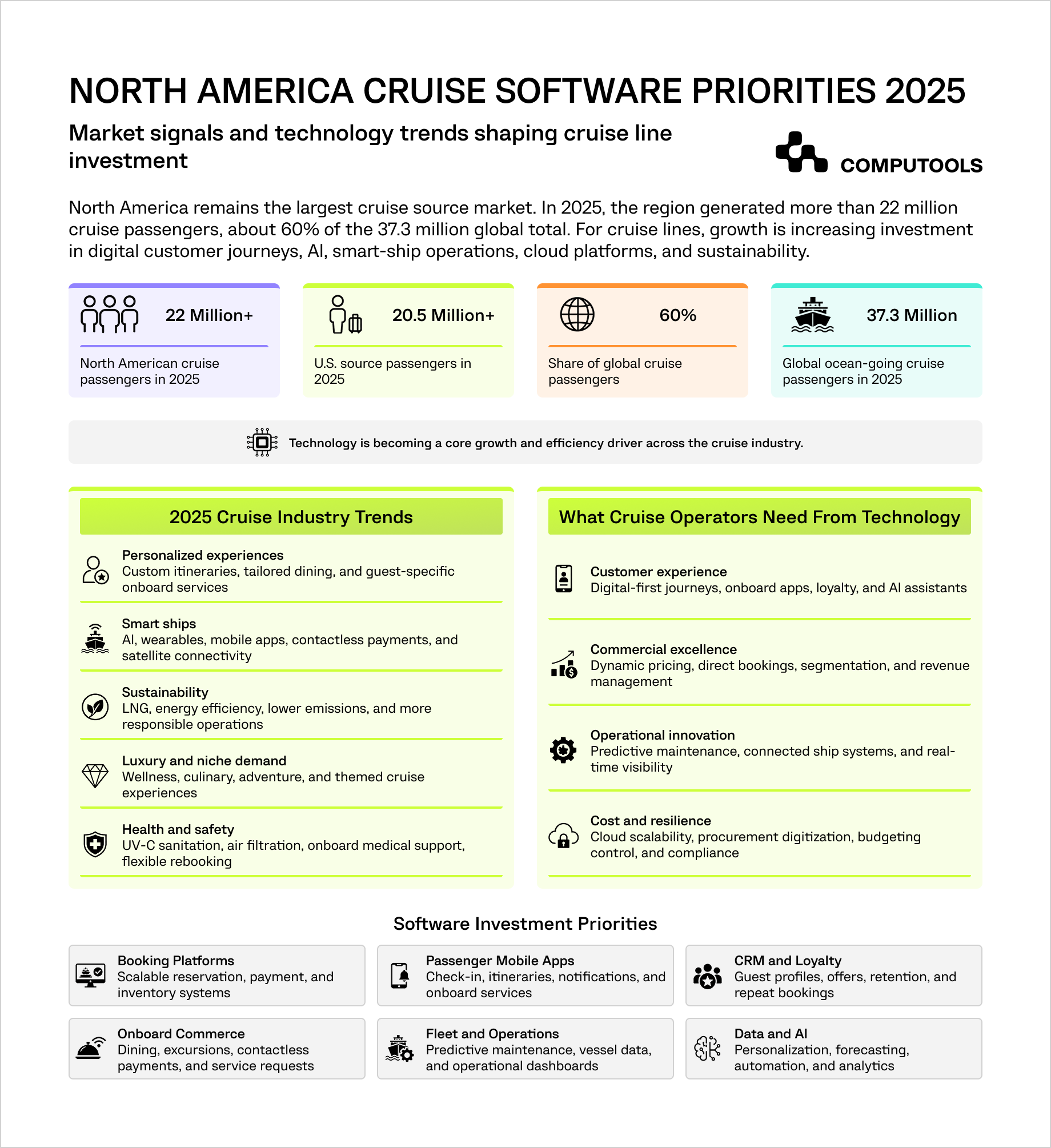
Booking a cruise is much more complex than other travel bookings. One reservation can involve a sailing date, itinerary, cabin category, berth occupancy, passenger group, dining package, flight, transfer, shore excursion, insurance policy, and loyalty benefit. Cruise systems therefore require connected passenger profiles, cabin allocation rules, group payments, age flexibility, loyalty recognition, and the ability to perform interactive modifications on the itinerary across all sales and service channels.
Leading cruise lines view digital infrastructure as part of direct revenue and operational systems. Royal Caribbean Group describes an entirely self-service cruise booking model via mobile. Guests reserve via the app, then use it for Wi-Fi and place orders for beverages, specialty dining and book excursions. With 28 million loyalty program members, analytics and AI drive everything from revenue optimization to the planning of maintenance and operations. All of these require the new generation of inventory APIs, consolidated customer data, payment APIs, asynchronous event integrations, and mobile services that connect the shoreside operations to those onboard.
Most cruise operators would appreciate new ways of securing ship-to-shore connectivity. There is still an enormous challenge for the industry to build resilient systems if connectivity cannot be guaranteed. Processing capabilities must function fully offline to support local transaction queuing, prevent duplicate bookings, and perform other transactional validations. Cruise operators process personal and health information for crew and guests. This information, alongside payment, travel, and employment data, opens modern cruise industry technology to rapid, highly regulated security interventions, particularly for risk and vendor management.
This article compares 20 cruise software development companies in the USA with relevant maritime, travel, and hospitality experience. The ranking focuses on their ability to develop and modernize booking platforms, passenger applications, shipboard workflows, fleet systems, data products, and the integrations required to keep them working as one operational environment.
How we selected cruise software development companies in the USA
The ranking focuses on companies that provide cruise line software development services in the USA. Preference went to firms with verified cruise projects, followed by companies with relevant maritime, travel, hospitality, fleet, and high-volume transaction experience.
| Selection criterion | What we evaluated |
| Custom development capability | Ability to design proprietary web, mobile, cloud, data, AI, and IoT systems rather than only configure an existing product. |
| Cruise or adjacent sector experience | Public projects involving cruise operators, maritime companies, travel platforms, hospitality businesses, fleet systems, or passenger services. |
| Reservation and commerce expertise | Experience with real-time inventory, dynamic pricing, cabin or room allocation, payments, cancellations, packages, loyalty benefits, and multi-channel sales. |
| Shipboard architecture | Support for offline processing, intermittent connectivity, local data storage, transaction queues, and ship-to-shore synchronization. |
| Passenger platform development | Mobile check-in, digital boarding, itinerary access, dining and excursion reservations, onboard purchases, service requests, and personalized communication. |
| Operational system coverage | Fleet monitoring, vessel workflows, maintenance, onboard service management, crew tools, reporting, and shoreside control systems. |
| Integration experience | Ability to connect CRM, PMS, POS, ERP, payment gateways, identity services, loyalty platforms, GDS providers, ports, and travel suppliers. |
| Data and security engineering | Unified passenger data, analytics, access controls, encryption, audit trails, monitoring, backup, and recovery planning. |
| US market presence | US headquarters or established offices, delivery teams, clients, or operations supporting companies in the American cruise and travel market. |
| Delivery capacity | Product discovery, architecture, engineering, quality assurance, migration, deployment, support, and long-term modernization. |
Companies received stronger consideration when they could support several parts of the cruise technology environment rather than a single customer-facing application. This includes providers capable of custom cruise software development, complex platform integration, and phased cruise management software development across reservations, passenger services, shipboard operations, and fleet data.
Top 20 cruise software development companies in the USA
The best cruise software development companies combine travel-domain knowledge with product engineering, cloud modernization, data integration, mobile development, and support for distributed shipboard and shoreside environments. Some have completed projects directly for cruise operators, while others bring relevant experience in maritime systems, hospitality platforms, fleet technology, high-volume commerce, and travel booking platform development.
1. Computools
At Computools, we provide travel and hospitality software development services for companies that need custom booking, passenger, maritime, and operational platforms. Our broader experience also covers software development services for HoReCa, heritage tourism software development, and land-based casino software development, giving us practical knowledge of reservations, guest services, loyalty programs, payments, and high-volume transactions.
High-Load Booking Across Every Sales Channel
Cruise reservation software must unify cabin availability, pricing, reservation holds, passenger information, and payment services across web portals, mobile applications, travel agencies, and call centers.
As part of the Multitrading project, Computools created a high-load reservation system that, while supporting external integrations, reduces latency and handles millions of requests. Through web development and mobile app development services, the company can apply this experience to cabin searches, group bookings, excursions, onboard purchases, digital check-in, and passenger self-service.
Live Fleet, Vessel, and Port Visibility
Computools has delivered platforms that process vessels, AIS, GPS, IoT, and operational data. For HubMarine, the team developed vessel validation, berth allocation, and dynamic pricing tools.
Within the Navis Horizon project, we integrated real-time data in a maritime visibility platform, reduced dispatcher workload by 40% and improved incident resolution time by 18%.
This expertise can be applied to vessel tracking, port-call management, fleet dashboards, arrival predictions, and operational notifications.
Self-Service Tools for Passengers and Crews
Computools designed a system for the Maritime Skills Academy that digitized maritime training for cruise, commercial, and superyacht crews. The platform provided mobile access, course search features, online payments, and administrative tools for over 500 courses.
This experience can support passenger portals, itinerary access, dining and excursion reservations, notifications, and crew training or certification systems.
Unified Cruise Data, Integrations, and AI
Most cruise lines use multiple systems to handle reservations, customer relationships, point of sale, finance, loyalty programs, and ship services. We connect them using API technology and shared data services without forcing a complete platform replacement.
Our AI development services support demand forecasting, passenger personalization, excursion planning, predictive maintenance, fleet reporting, and operational anomaly detection.
With 250+ engineers, 400+ delivered projects, ISO 9001 and ISO 27001 certifications, and Microsoft and AWS Partner status, Computools can deliver these systems through controlled development and fleet rollout phases.
Best for:
Cruise operators seeking one engineering partner for product discovery, custom development, integration, and long-term platform modernization.
2. Globant
Globant provides cruise-line-focused product and mobile development, CRM automation, data integration, AI, and user experience design. Its engineering services also support check-in, itinerary management, reservations, payment processing, loyalty programs, guest services, and employee tools.
The company has helped develop more than 20 cruise products, including passenger mobile apps, shore excursions and dining reservations, onboard spending tools, safety workflows, and systems for managing guest requests. It has also connected booking behavior with Salesforce to automate communication around reservation holds, abandoned carts, watchlists, and targeted offers.
Best for: Large cruise brands developing connected booking, mobile, CRM, onboard, and employee platforms.
Consideration: Globant is best suited to large transformation programs with substantial budgets, multiple internal teams, and complex enterprise environments.
A connected customer journey also depends on structured loyalty logic, unified guest profiles, and automated communication.
Our guide to developing a loyalty and customer engagement app explains how CRM data, transaction history, rewards, personalized offers, and engagement workflows can work within one customer platform.
3. UST
UST provides custom software development, legacy modernization, cloud engineering, enterprise integration, data platforms, and AI services for complex cruise environments. Its capabilities are relevant to reservation systems, cabin and fare inventory, booking interfaces, passenger records, contact-center tools, and operational reporting.
The company has modernized cruise reservation platforms by connecting legacy mainframe systems with reusable services and browser-based interfaces. One such platform supports more than 3,000 concurrent users and over $7 billion in global sales. UST can also improve direct booking journeys, consolidate regional systems, and introduce analytics or AI without disrupting core operations.
Best for: Cruise groups modernizing reservation cores, integrating legacy systems, or building enterprise data and AI services.
Consideration: UST’s model is more appropriate for complex enterprise programs than for a limited mobile application or isolated booking feature.
4. Slalom
Slalom integrates digital product development, cloud services, and Salesforce with data engineering and AI. The company’s direct cruise experience includes Virgin Voyages and Norwegian Cruise Line projects aimed at improving the customer journey for discovery, inquiry, and booking.
Slalom’s cruise projects directly relate to passenger experience management for cruise lines wanting to connect a real AI assistant to live inventory, customer and loyalty profiles, service and AI workflows, and task management. Knowledge governance, prompt design, and model evaluation, along with privacy and human contact escalation are within Slalom’s abilities.
Best for: Cruise lines seeking AI-assisted trip discovery, AI digital customer services, and tailored pre-departure communication.
Consideration: AI assistants require accurate source content and controlled access to booking systems. Slalom’s work should therefore be assessed together with the operator’s broader data and integration readiness.
5. Accenture
Accenture has deep cruise experience and highlights its work with Carnival Corporation and the OceanMedallion platform. The solution connects a large shipboard technology environment with wearable devices, mobile applications, onboard sensors, contextual data, analytics, and machine learning.
This work demonstrates Accenture’s ability to develop onboard service management systems that combine identity, location, payments, mobile interfaces, edge computing, and real-time events. It also shows experience coordinating software, devices, network infrastructure, data platforms, and operational change across a fleet.
Best for: Large cruise groups developing connected ship environments, wearable services, digital boarding, contactless commerce, and location-aware passenger products.
Consideration: Accenture is most suitable for multi-year enterprise programs involving significant process, infrastructure, and organizational transformation.
Location-aware onboard platforms can also support food and beverage ordering, table service, payments, order tracking, and personalized recommendations.
Our article on how to build a food ordering app for restaurants explains how ordering architecture, POS connections, menu management, checkout, and real-time operational updates fit together.

Launch your custom cruise line software platform within 1–3 months instead of years, and automate reservations, onboard operations, and guest experiences without disrupting existing systems.
6. Capgemini
Capgemini offers consultancy and software engineering related to travel and hospitality, customer experience, cloud, data, AI, CRM, and connected infrastructure. Capgemini’s work with cruise lines focuses on customer engagement systems that combine Salesforce with reservation engines and websites, along with onboard solutions, data warehouses, reporting tools, and recommendation systems.
This also applies to cruise passenger management software given the need to consolidate booking information, personal data, loyalty, preferences, service history, and onboard activities across all channels without generating conflicting data.
The company has also explored private 5G and edge-processing scenarios for cruise ships, including crew communication, remote equipment monitoring, secure video, connected devices, and high-density passenger services.
Best for: Large cruise operators connecting passenger data, CRM, mobile services, onboard systems, and ship connectivity within one transformation program.
Consideration: Buyers should define whether they need Capgemini for strategy, implementation, managed services, or full product engineering, since its service scope can be broad.
7. DataArt
DataArt’s travel technology practice extends to booking systems, supplier integrations, fleet applications, onboard experiences, revenue tools, customer platforms, cloud migration, and data analytics.
DataArt’s strength lies in API integration and data model sharing. This allows DataArt to help with cruise fleet management software and the integration of various systems, such as maintenance dashboards, operational data, performance of vessels, IoT integrations, and fleetwide analytics.
Best for: Cruise companies modernizing supplier connections, booking workflows, operational reporting, and distributed data environments.
Consideration: DataArt’s strongest fit is custom engineering and integration. Cruise operators looking for a packaged core reservation platform would need to combine its services with an existing product or proprietary system.
8. Launch Consulting
Launch Consulting develops connected passenger platforms, IoT systems, edge applications, data products, and cloud services for cruise operators. Its capabilities are particularly relevant to shipboard environments where mobile services, sensors, wearable devices, and operational systems must continue working during unstable connectivity.
The company contributed to Carnival’s OceanMedallion platform, supporting location-aware services, digital boarding, cabin access, navigation, food ordering, housekeeping, and safety workflows. This experience can be applied to onboard commerce, digital twins, equipment monitoring, real-time passenger services, and secure ship-to-shore data exchange.
Best for: Cruise lines building IoT, wearable, edge-computing, and location-aware onboard platforms.
Consideration: Launch is strongest in connected passenger and shipboard technology rather than core reservation system replacement.
9. Endava
Endava offers a portfolio of services to travel and cruise companies, including product strategy, experience design, custom development, cloud engineering, data services, and platform modernization. Capabilities include cruise discovery, direct booking, itinerary planning, account self-service, ancillary sales, and integrations with existing reservation systems.
Endava built a cross-brand digital platform for the Scenic Group that allows travelers to view, select, and manage bookings across brands while purchasing additional services. The platform, used by five brands in 15 countries, decreases reliance on call centers and opens additional selling opportunities for excursions and trip extensions.
Endava’s experience is especially useful for cruise itinerary management for luxury, river and expedition cruises. These services typically include complex routing and itineraries, optional extensions and add-ons, multiple departure dates, and high-value offerings. Endava is well-positioned to provide customer interface, content, booking, and account services integration with legacy systems along the cruise industry value chain.
Best for: Premium cruise brands improving digital discovery, direct booking, itinerary planning, and ancillary revenue.
Consideration: Endava’s strongest public cruise experience centers on customer-facing commerce rather than vessel or shipboard operations.
Cruise discovery can also extend beyond the voyage itself by connecting passengers with ports, attractions, transportation, local businesses, and destination content.
Our guide to building a smart tourism platform for an urban destination examines the architecture, geolocation, booking, mapping, and partner integrations required to support this model.
10. EPAM
EPAM delivers enterprise product engineering for travel and hospitality companies. Its capabilities include booking and commerce platforms, loyalty systems, CRM integration, mobile applications, customer data, cloud migration, analytics, and experience design.
For cruise operators, EPAM can support the modernization of customer portals, booking flows, mobile applications, API layers, and digital service channels. Its software engineering scale is suitable for programs that involve several brands, countries, sales channels, and legacy systems. The company can also provide product managers, architects, designers, data engineers, and quality assurance teams within one engagement.
EPAM’s broader travel experience is relevant to cruise platforms that combine transportation, accommodation, activities, payments, and loyalty. It can also help separate customer-facing services from a rigid reservation core.
Best for: Enterprise cruise groups requiring large multidisciplinary teams for global platform modernization.
Consideration: EPAM publishes less detailed cruise-specific evidence than Globant, UST, Accenture, or Slalom. Cruise buyers should request relevant references and architecture examples before selection.
11. Thoughtworks
Thoughtworks specializes in custom digital products, software architecture, data platforms, cloud transformation, and incremental legacy modernization. Its delivery model is relevant to cruise lines that want to replace individual parts of a large platform without attempting a risky full-system migration.
A cruise operator could use Thoughtworks to separate booking, payment, loyalty, content, or passenger-service functions from a monolithic application. These services can then be released independently and connected through APIs or event-based architecture. This approach supports gradual modernization while allowing existing reservation logic to continue operating.
The company’s product strategy and engineering capabilities can also support hospitality management software, mobile self-service tools, staff applications, digital payments, and data platforms. Thoughtworks places strong emphasis on maintainable architecture, automated testing, continuous delivery, and measurable product outcomes.
Best for: Cruise companies planning gradual modernization of complex legacy platforms.
Consideration: Thoughtworks does not market a dedicated cruise development practice. Operators need to provide strong domain ownership and confirm the proposed team’s direct travel, hospitality, or maritime experience.
12. Chetu
Chetu provides custom development for maritime, travel, hospitality, and fleet-dependent businesses. Its cruise technology solutions cover route planning, navigation, fuel monitoring, maintenance, weather integration, digital logbooks, marina systems, vessel tracking, and operational dashboards.
The company also has experience with property management, reservations, POS, payments, and hospitality platforms. This combination is relevant to vessel operations software that must connect marine functions with passenger and hotel operations. A cruise line could use Chetu to build a custom module, extend a ship property management system, or integrate third-party platforms without replacing the entire technology environment.
Its teams can support web, mobile, desktop, cloud, and embedded applications, as well as API development and data migration.
Best for: Cruise and maritime operators prioritizing fleet maintenance, voyage planning, navigation data, equipment monitoring, and shipboard integration.
Consideration: Chetu works across many industries and technologies. Buyers should carefully review the proposed team, development governance, architecture standards, and relevant cruise references.
13. N-iX
N-iX develops custom fleet, telematics, IoT, cloud, geospatial, and analytics platforms. Its solutions can process location data, sensor readings, fuel consumption, route information, maintenance records, and operational events across distributed assets.
These capabilities can transfer to real-time fleet tracking for cruise operators, including vessel location, route progress, weather conditions, equipment status, fuel performance, and maintenance alerts. N-iX can also build shoreside dashboards, mobile applications, data pipelines, and integrations with ERP, maintenance, and reporting systems.
The company’s data engineering and cloud expertise is useful where operators need to consolidate information from ships, ports, third-party maritime services, and internal systems. Predictive models can then support maintenance planning and operational decisions.
Best for: Cruise groups building fleet visibility, maintenance analytics, sensor platforms, and shoreside operational dashboards.
Consideration: N-iX’s public fleet cases focus primarily on logistics and road transport. Cruise lines should verify its maritime domain knowledge, satellite-connectivity experience, and understanding of vessel-specific systems.
14. ELEKS
ELEKS provides custom software development, product design, cloud engineering, data science, AI, IoT, cybersecurity, and enterprise integration. Its hospitality work covers reservation platforms, guest applications, service management, payment systems, operational tools, and analytics.
For cruise operators, ELEKS can develop custom applications around existing booking, PMS, CRM, or POS products. This may include passenger self-service, housekeeping workflows, maintenance requests, service scheduling, digital payments, and cabin management software for tracking cabin status, cleaning, inspections, defects, and guest requirements.
The company’s data and IoT capabilities can also support connected-room functions, equipment monitoring, predictive maintenance, and operational reporting. Its product design teams are suitable for guest-facing applications that must remain intuitive despite complex underlying workflows.
Best for: Cruise lines building tailored hospitality, guest-service, and operational applications around established core systems.
Consideration: ELEKS has strong hospitality capabilities, but cruise-specific public references are limited. Buyers should confirm experience with shipboard deployment and intermittent connectivity.
15. SoftServe
SoftServe’s focus areas include cloud, data engineering, AI, generative AI, digital experiences, and application modernization. Their travel and hospitality solutions involve personalization, recommendation systems, virtual assistants, prediction systems, and data-based customer journey design.
When booking, passenger, loyalty, onboard spending and service data, as well as fleet data, are siloed across different systems, SoftServe provides the most value to cruise line operators. They help create a shared data environment to support demand and service planning, next-best offers, the segmentation of passengers, and various cruise analytics and reporting services.
SoftServe also offers the development of intelligent assistants for passengers and employees; however, such systems need well-defined content, permissions, and integration of operational, real-time data. Given their focus on cloud and data engineering, they are well-positioned for large-scale analytics modernization programs.
Best for: Cruise line operators who wish to implement AI, personalization, and/or predictive analytics, as well as integrated data solutions across the entire fleet.
Consideration: SoftServe provides stronger solutions for data and AI than for the complete replacement of a core cruise reservation system.
16. Ciklum
Ciklum provides end-to-end services in product discovery and experience design, custom engineering, cloud development, data services, quality assurance, security, and legacy modernization. The company can build fully-formed product teams or augment the engineering capacity of an existing cruise technology team.
Ciklum’s services are applicable to employee-facing apps, workflow automation and mobile apps, scheduling, and crew management systems. A tailored crew management solution may include features for contract management, certification and training management, medical clearance, visa and access management, vessel assignment, shift and accommodation management, and payroll.
Ciklum also offers API design, cloud services, and the decomposition of large operational systems to optimize maintainability. This makes it useful where a cruise operator already understands the domain but lacks sufficient internal engineering capacity.
Best for: Cruise companies extending internal product teams or building custom employee and operational applications.
Consideration: Ciklum does not present strong public cruise-sector evidence. Operators should request a team with direct experience in travel, hospitality, workforce systems, or fleet operations.
17. BairesDev
BairesDev provides custom software engineering for travel, hospitality, commerce, loyalty, and service businesses. Its work for iSeatz included an integration engine connecting travel and hospitality suppliers with loyalty programs used by major financial and hotel brands.
This supplier-integration experience relates to cruise packages that include sailings with flights, hotels, transfers, insurance, activities, and other local offerings and services. BairesDev can accommodate API aggregation, product normalization, pricing and availability management, payment and loyalty transaction integrations, and flexible participation from multiple partners for each of those solutions.
BairesDev could also create shore excursion booking systems that connect local tour operators with sailing schedules, passenger accounts, capacity limits, cancellation rules, waiver requirements, and onboard or mobile sales channels.
Best for: Cruise distributors and operators requiring supplier-connected commerce, loyalty, ancillary sales, and excursion systems.
Consideration: BairesDev’s public cruise-specific evidence is limited. Buyers should confirm experience with cabin inventory, ship-to-shore synchronization, and cruise reservation workflows.
18. Intellectsoft
Intellectsoft makes custom mobile, web, and enterprise applications for travel and hospitality businesses. Examples of solutions in its portfolio include guest applications, booking, restaurant reservations, property services, ticketing, and passenger information systems that provide real-time updates.
Intellectsoft developed the mobile application and backend services for Eurostar that included features for booking tickets, travel information, and operational updates. While traveling by train is different from traveling by cruise, this project is proof of how the company can successfully deal with time-sensitive operational information and passenger-related transactional services.
Intellectsoft is a strong contender as a cruise mobile app development company for digital check-in, document uploads, boarding passes, itineraries, restaurant/ excursion reservations, onboard purchases, as well as push notifications, service requests, and loyalty accounts. Intellectsoft can also provide the integration of booking, CRM, payment, and content systems.
Best for: Cruise brands prioritizing passenger mobile applications and digital self-service.
Consideration: Operators should verify experience with offline mobile behavior, shipboard networks, identity verification, and synchronization with cruise-specific back-office systems.
19. Itransition
Itransition combines enterprise software consulting with custom development and delivery. Its travel and hospitality services include booking systems and customer-facing portals, CRM and ERP systems, payments, mobile solutions, and analytics.
For cruise operators, Itransition offers cruise operations software development that supports internal workflows for passenger service requests, maintenance, procurement, compliance, and staff, and portals with reporting and integration between shoreside departments. It can also modernize older applications gradually and connect them with newer cloud or mobile services.
The company is most appropriate where the operator has clear process documentation, internal domain specialists, and a defined target architecture. Its broad engineering capacity allows it to work across several enterprise technologies and integration patterns.
Best for: Cruise businesses requiring full-cycle enterprise development and integration across multiple internal systems.
Consideration: Itransition provides limited public evidence of direct cruise projects. Buyers should request relevant references and validate the team’s understanding of shipboard operations and cruise reservations.
20. Cognizant
Cognizant combines enterprise software engineering, cloud, AI, data, customer experience, managed services, hospitality, and maritime capabilities. Its scale allows it to support transformation programs that extend across customer channels, enterprise applications, operational data, and IT infrastructure.
For cruise groups, Cognizant can develop passenger portals, loyalty services, digital contact-center tools, data platforms, predictive models, and operational dashboards. Its shipping and maritime work is also relevant to sensor data, simulations, asset performance, and decision-support systems.
The company is a suitable candidate when a cruise operator needs to connect passenger commerce with finance, supply chain, maintenance, workforce, and fleet applications. It can also provide long-term support and managed technology services after implementation.
Best for: Large cruise groups running multi-year transformation programs across customer, enterprise, and maritime systems.
Consideration: Cognizant’s broad service portfolio can make engagements complex. Cruise lines should define ownership, decision rights, deliverables, and measurable outcomes before signing a large program.
How to choose a cruise software development company
A cruise operator selecting a cruise booking software development company should look beyond general travel-sector claims. The provider should be able to explain how it would manage cabin inventory, group reservations, passenger identities, onboard purchases, intermittent connectivity, and synchronization between vessels and shoreside systems.
| Evaluation area | What to verify | Questions to ask |
| Cruise domain knowledge | Understanding of sailings, cabins, passenger groups, itineraries, excursions, onboard purchases, and vessel workflows. | How would you model a voyage with multiple ports, cabin categories, occupancy rules, and optional services? |
| Architecture | Experience with distributed, offline-capable, and event-driven systems. | Which functions should run locally on the ship, and how will they synchronize with shoreside systems? |
| Booking performance | Ability to manage concurrent searches, inventory holds, payments, and cancellations. | How will you prevent double bookings during demand peaks? |
| Integration experience | Work with CRM, PMS, POS, ERP, loyalty, payment, identity, and travel supplier systems. | Which platform will own passenger, cabin, payment, and itinerary data? |
| Data security | Role-based access, encryption, audit trails, monitoring, and recovery. | How will passenger, employee, identity, and payment data be separated and protected? |
| Delivery model | Discovery, development, migration, testing, rollout, and support. | Who owns architecture decisions and product priorities during delivery? |
| Operational support | Incident response, vessel rollout, monitoring, and maintenance. | Can the team support embarkation periods and urgent shipboard issues? |
| Evidence | Relevant case studies, references, and technical examples. | Which previous project is closest to our operating model? |
Cruise platforms share many technical requirements with wider travel commerce systems, including real-time inventory, multi-supplier integrations, payments, personalization, and support for demand peaks.
Our review of the best travel booking platform development companies provides a broader comparison of providers capable of building these transaction-heavy travel products.
Final Thoughts
A cruise technology project can fail even when the selected provider has strong general travel experience. Cruise platforms must coordinate commercial, passenger, hotel, marine, and workforce processes across systems that operate on land and at sea. The evaluation should therefore focus on the company’s ability to model cruise-specific workflows, integrate with existing platforms, and maintain service continuity when ship connectivity becomes unstable.
Companies with direct cruise experience are usually better prepared for reservation modernization, passenger applications, cruise CRM software integration, and onboard platforms. Providers with strong maritime, hospitality, and high-load commerce subject matter expertise can also be a good fit when they offer proven custom engineering, integration, cloud, data, and mobile capabilities.
The right choice depends on the project scope. Large consultancies suit multi-brand transformation programs, while specialized development firms often provide more flexibility for custom modules, phased modernization, and focused product delivery.
Top 20 cruise software development companies in the USA
| Rank | Company | Best for |
| 1 | Computools | Custom booking, passenger, data, and maritime platforms |
| 2 | Globant | Connected passenger journeys and cruise CRM |
| 3 | UST | Enterprise reservation modernization |
| 4 | Slalom | AI-assisted cruise sales and customer service |
| 5 | Accenture | IoT-powered onboard experiences |
| 6 | Capgemini | Connected guest, CRM, and shipboard systems |
| 7 | DataArt | Cruise data, booking, and fleet platforms |
| 8 | Launch Consulting | Edge, IoT, and real-time onboard platforms |
| 9 | Endava | Luxury cruise discovery and booking |
| 10 | EPAM | Enterprise travel platform modernization |
| 11 | Thoughtworks | Digital products and legacy modernization |
| 12 | Chetu | Maritime, vessel, and SPMS development |
| 13 | N-iX | Fleet, telematics, and operational platforms |
| 14 | ELEKS | Hospitality products, data, AI, and IoT |
| 15 | SoftServe | AI, personalization, cloud, and business analytics |
| 16 | Ciklum | Product engineering and cloud modernization |
| 17 | BairesDev | Travel commerce and supplier integration |
| 18 | Intellectsoft | Guest-facing mobile and self-service products |
| 19 | Itransition | Enterprise platforms and system integration |
| 20 | Cognizant | Large-scale hospitality and maritime transformation |
Computools can support cruise operators with booking platforms, passenger and crew applications, maritime systems, analytics, AI, and integrations with existing enterprise and shipboard software.
Our company is best suited to projects that combine cruise reservation software with passenger applications, payment processing, customer data, and operational dashboards. Our experience with high-load booking environments is relevant to cabin searches, temporary inventory holds, dynamic availability, and concurrent transactions across direct and agent channels.
Computools
Software Solutions
Computools is an IT consulting and software development company that delivers innovative solutions to help businesses unlock tomorrow.