
THE AUTHOR:

This article explores how cross-platform restaurant app development is reshaping the restaurant industry by enabling faster service, better customer engagement, and more efficient operations.
Consumer behavior has shifted dramatically over the past few years. Today, mobile devices are at the center of the customer journey, especially in food ordering. According to industry research from Statista, mobile orders already account for a significant share of total restaurant transactions, and this number continues to grow. Customers now expect seamless digital interactions, instant confirmations, and personalized recommendations as part of their dining experience.
For restaurant owners and executives, this trend is not just about convenience. It represents a fundamental shift toward digital transformation in restaurants, where technology becomes a core driver of revenue, operational efficiency, and customer satisfaction. Businesses that fail to adopt modern restaurant technology solutions risk losing both relevance and market share.
Why restaurants need mobile apps today
The demand for digital convenience has fundamentally changed how the restaurant industry operates, and there is no going back. Customers no longer want to wait in line, call ahead, or navigate outdated interfaces to place an order. Instead, they expect fast, intuitive, and reliable restaurant digital ordering solutions that let them complete a purchase in just a few taps. Restaurant online ordering systems are no longer optional; for most food service businesses, they are a baseline requirement for staying competitive.
The numbers make this impossible to ignore. According to Restroworks (2025), over 60% of all restaurant orders are now placed through mobile apps. The global online food delivery market stood at approximately $1.22 trillion in 2024 and is projected to reach $1.85 trillion by 2029, according to Statista. Users who order directly from a restaurant’s own app spend up to 35% more per transaction than those using third-party platforms — a figure that illustrates the commercial advantage of owning the customer relationship rather than renting it.
This shift is especially pronounced among younger demographics. According to the National Restaurant Association’s 2024 Restaurant Technology Landscape Report, 82% of Gen Z adults and 87% of Millennials say they would use a mobile app to place a restaurant order — and similar shares prefer paying through the app or a contactless method. That demographic is not a niche. It is the restaurant industry’s most frequent, highest-spending, and most digitally engaged customer segment.
1. The Growing Dominance of Third-Party Platforms
A second critical business reality is the structural dominance of third-party delivery aggregators. DoorDash controls approximately 67% of the U.S. online meal delivery market, while Uber Eats holds around 23%, together accounting for the overwhelming majority of platform-based food orders in America, according to Statista.
While these platforms provide visibility and reach, they come at a significant compounding cost: commission fees of 15–30% per order, complete loss of direct customer relationships, and zero access to first-party behavioral data. Restaurants relying solely on external aggregators find themselves in a permanent margin squeeze, paying to reach customers they can never truly call their own. By investing in dedicated restaurant mobile ordering software, businesses can reclaim control over the customer journey, eliminate commission dependency, and build loyalty entirely on their own terms.
The consumer appetite for this direct model already exists: 70% of consumers say they would rather order directly from a restaurant than through a third-party platform, preferring that their money goes straight to the business, according to Lightspeed. Restaurant mobile app development that prioritizes the direct ordering channel is not just a technology investment, it is a strategic recapture of margin, data, and customer ownership.
2. Speed and Convenience as Decisive Competitive Factors
Speed and convenience are not soft preferences, they are hard, measurable drivers of restaurant selection and order completion. Research consistently shows that users abandon digital orders when the process feels slow or complex, with every additional checkout step directly increasing drop-off rates.
Hashmato (2025) reports that customers who order through well-designed mobile interfaces spend 15–20% more per transaction than walk-in diners — primarily because smart in-app upsell mechanics surface relevant add-ons at precisely the right moment.
What is cross-platform development and why it matters
At its core, cross-platform restaurant app development is an engineering approach that allows businesses to build a single application capable of running natively on both iOS and Android from a shared codebase. Rather than maintaining two entirely separate teams, codebases, and release cycles, a cross-platform architecture lets developers write the logic once and deploy it everywhere, without sacrificing the performance, polish, or native feel that restaurant customers expect.
The two dominant frameworks for this approach are Flutter (by Google) and React Native (by Meta). According to Statista’s 2023 global developer survey, Flutter is used by 46% of software developers worldwide, making it the most popular cross-platform framework globally. React Native commands approximately 35% market share and remains the framework of choice for teams with strong JavaScript expertise.
As of 2025–2026, both frameworks deliver near-native performance, smooth 60–120 FPS interfaces, and pixel-accurate UI that restaurant customers cannot distinguish from native-built apps.
1. Faster Time to Market
Developing two separate native applications — one for iOS, one for Android, requires double the engineering effort, double the QA cycles, and double the release management overhead. Cross-platform app development services eliminate this duplication entirely. With features like “hot reload,” which applies code changes instantly to the running application, cross-platform teams can iterate and ship features dramatically faster than parallel native projects.
In practical terms, most restaurant apps built with Flutter or React Native move from kickoff to production in 3–6 months. Simple MVP solutions – core menu browsing, ordering, and payment, can be live in as little as 6–8 weeks. For restaurant groups navigating seasonal promotions, new location launches, or competitive windows, this speed advantage is a direct business differentiator.
2. Significant Cost Efficiency
Maintaining separate development teams for iOS and Android is expensive, particularly for mid-sized or scaling restaurant chains where engineering budgets must stretch across operations, integrations, and ongoing feature development simultaneously. A cross-platform strategy addresses this directly: a single shared codebase means one team, one release cycle, and one maintenance pipeline covering both platforms at once.
The savings compound over time. Initial development is more efficient, QA testing requires fewer resources, and future updates ship in half the time compared to managing two parallel native projects. For CTOs and operations leaders evaluating total cost of ownership, this translates into meaningful budget headroom, capital that can be reinvested into product features, system integrations, or marketing rather than duplicated engineering overhead.
In short, a cross-platform approach delivers full platform coverage — iOS and Android simultaneously, at a fraction of the investment that dual native development requires, without compromising the performance or experience quality that restaurant customers expect.
3. Simplified Long-Term Maintenance
Updates, bug fixes, and new features deployed in a cross-platform codebase go live on both platforms simultaneously. There is no risk of iOS and Android versions drifting out of sync, no need to coordinate parallel release cycles, and no hidden complexity from platform-specific divergence.
For restaurant app solutions for iOS and Android that need to evolve continuously, supporting new menu structures, promotions, integrations, and features as the business grows — this architectural simplicity translates directly into lower total cost of ownership and greater organizational agility.
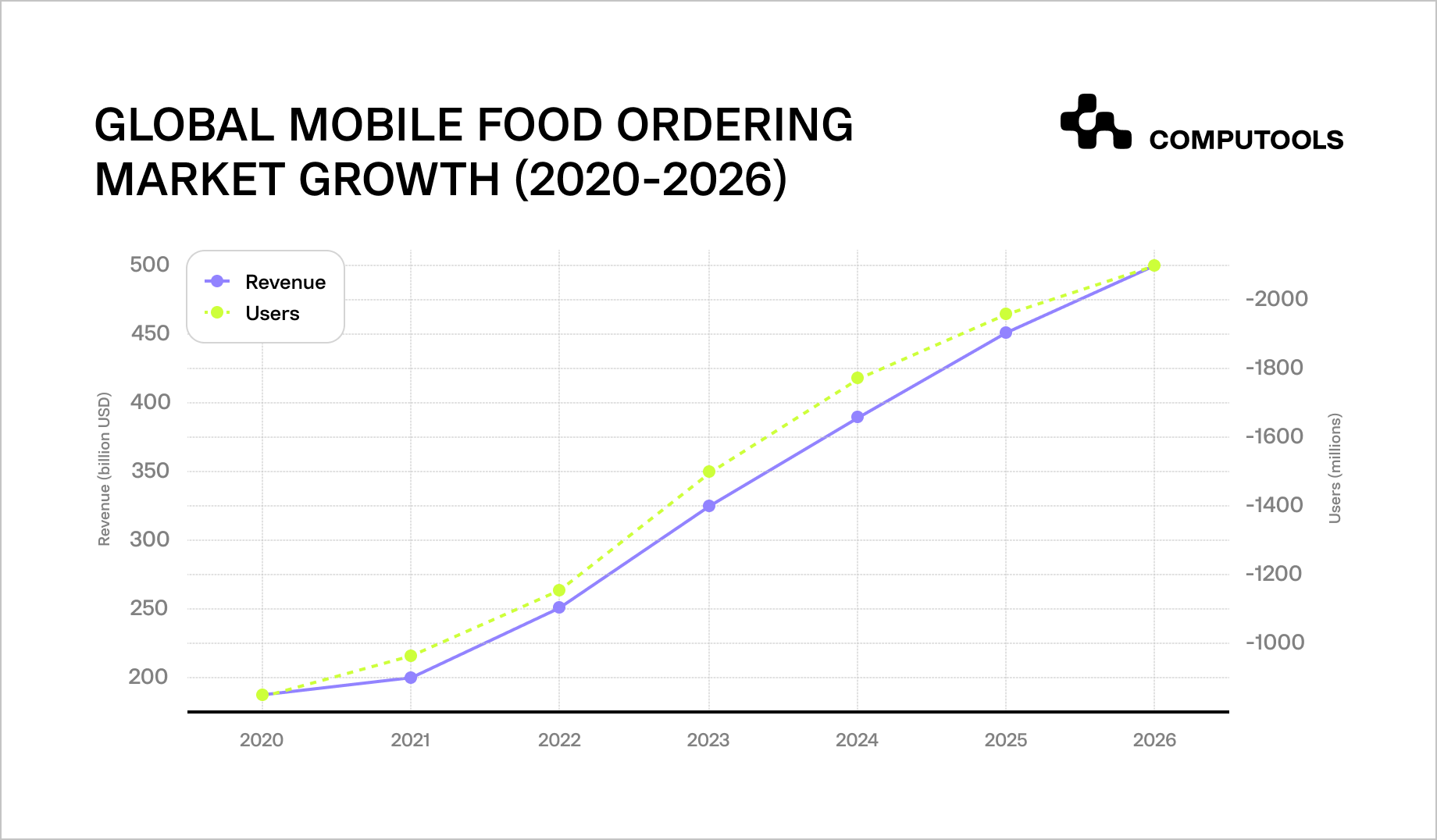
This is precisely where mobile apps for restaurants create a lasting competitive advantage. A well-engineered app removes friction from every stage of the ordering journey: from personalized menu browsing and smart search to one-tap reorder, saved payment methods, and instant checkout confirmation. The restaurants that deliver this experience consistently, across iOS and Android, across devices and locations — are the ones that convert first-time visitors into loyal regulars.
Discover the key features, architecture, and development considerations behind building a modern restaurant table reservation system that enhances customer experience and streamlines operations.
Improving the restaurant ordering process through mobile apps
A well-designed cross-platform food ordering app has the power to transform the entire ordering process — from the moment a customer opens the app to the instant their payment is confirmed. The impact is not cosmetic. It is structural, measurable, and directly tied to conversion rates, average order value, and repeat visit frequency.
1. Intuitive UI and Fast Checkout
The key principle in restaurant mobile apps is reducing friction. Every extra step, unclear navigation, or delay leads to lost orders. Users should browse menus, customize items, apply promos, and pay in three taps or fewer, with saved data and instant confirmation.
According to Hashmato (2025), mobile users spend 15–20% more per order due to well-timed upsells, making clean UX one of the highest-ROI investments in digital operations.
2. Personalization and AI-Driven Recommendations
Personalization is now a baseline expectation. AI tools analyze behavior and order history to surface relevant items, pre-fill favorites, and trigger contextual upsells at the right moment.
For example, frequent morning coffee orders should appear immediately at launch, while habitual add-ons should be suggested at checkout. This increases order value, frequency, and loyalty.
As AI adoption grows, personalization will become a key competitive differentiator.
3. Contactless Payments and Seamless Transactions
Payment is the final conversion step and must be frictionless. Apps should support Apple Pay, Google Pay, wallets, and saved cards.
Even small payment friction increases abandonment. Fast, seamless checkout is essential for protecting revenue and ensuring high conversion rates.
Enhancing customer experience and loyalty
Customer experience has become the primary competitive differentiator in the restaurant industry. In a market where product quality and price are increasingly table stakes, the depth of the digital relationship a restaurant builds with its customers determines long-term retention and revenue. This is where restaurant customer experience technology delivers its most significant and measurable returns.
1. Loyalty Programs Built Into the App
Mobile-integrated loyalty programs are one of the highest-ROI tools available to restaurant operators. According to Restroworks’ Customer Retention Report (2025), loyalty program members visit restaurants 20% more frequently and spend 20% more per visit than non-members. Restaurants with established loyalty programs report 20% higher customer retention rates than those without.
The scale of consumer interest is striking: 96% of loyalty program users say these programs help them get more value from their spending, and 81% of consumers say they would join a restaurant loyalty program if one were offered. Currently, 68% of full-service restaurants and 71% of QSRs already run a loyalty program, with adoption expected to reach 80% by the end of 2026, according to the National Restaurant Association’s 2024 Restaurant Technology Landscape Report.
2. Push Notifications and Personalized Offers
Push notifications are among the highest-ROI marketing channels available to restaurant operators — when used with precision. Geofenced notifications can trigger when a loyal customer enters a radius around a location. Time-based triggers can reach a frequent lunch visitor at 11:45 AM with their usual order pre-filled.
Behavioral sequences can re-engage lapsed customers with a personalized offer tied to their most-ordered item. Generic broadcast notifications drive uninstalls; contextual, behavior-triggered notifications drive re-orders. A properly configured mobile app, connected to a CRM with full customer history, makes this level of personalization operationally achievable at any scale.
3. Real-Time Order Tracking
Real-time tracking has transitioned from a premium differentiator to a standard expectation. Customers want to know when their order enters the kitchen, when it’s ready for pickup, and where the delivery driver is at any given moment.
From an operations standpoint, live order tracking reduces inbound support volume, decreases customer anxiety, and builds the kind of consistent, transparent experience that converts first-time users into long-term regulars — a core pillar of any complete restaurant customer experience technology strategy.
4. Analytics and Business Optimization
Data is now one of the most valuable assets in the restaurant industry. Every interaction in a mobile ordering app — browsing items, placing orders, redeeming promotions — creates actionable data. When aggregated, it enables operational precision that wasn’t possible a decade ago.
5. Understanding Customer Behavior at Scale
A well-instrumented ordering system helps answer key questions: which menu items drive repeat purchases, at what price demand drops, which promotions increase basket size, and which dayparts generate the highest margins.
For multi-location operators, this shifts decision-making from intuition and delayed reports to near real-time behavioral signals. Teams can adjust inventory, staffing, and promotions based on actual customer behavior rather than assumptions.
This move from intuition-led to data-led operations is a major competitive advantage, and it begins with owning the ordering channel and its data.
6. Menu Optimization and Dynamic Pricing
Behavioral data enables evidence-based menu management. Restaurants can identify top performers, remove weak items, test price sensitivity by segment or time of day, and tailor limited-time offers to real demand patterns.
Modern systems also support A/B testing directly in-app, allowing experiments with menu layout, upsell placement, imagery, and promotion framing, turning menu design into a continuous optimization process instead of subjective review.
Integration with restaurant systems
A restaurant mobile app that operates in isolation — disconnected from the systems that run the actual business — creates more problems than it solves. Duplicate order entries, inventory mismatches, fragmented customer data, and inconsistent reporting all emerge when the app is not properly wired into the restaurant’s operational ecosystem. For any restaurant mobile ordering app to deliver genuine value, deep, reliable system integration is not optional — it is foundational.
1. POS Integration: Real-Time Order Routing
The most critical integration for any restaurant app is the connection to the point-of-sale system. When a customer places an order through the mobile app, that order must appear instantly and accurately on the kitchen display and in the POS — alongside in-restaurant orders, with no manual re-entry, no delay, and no risk of error.
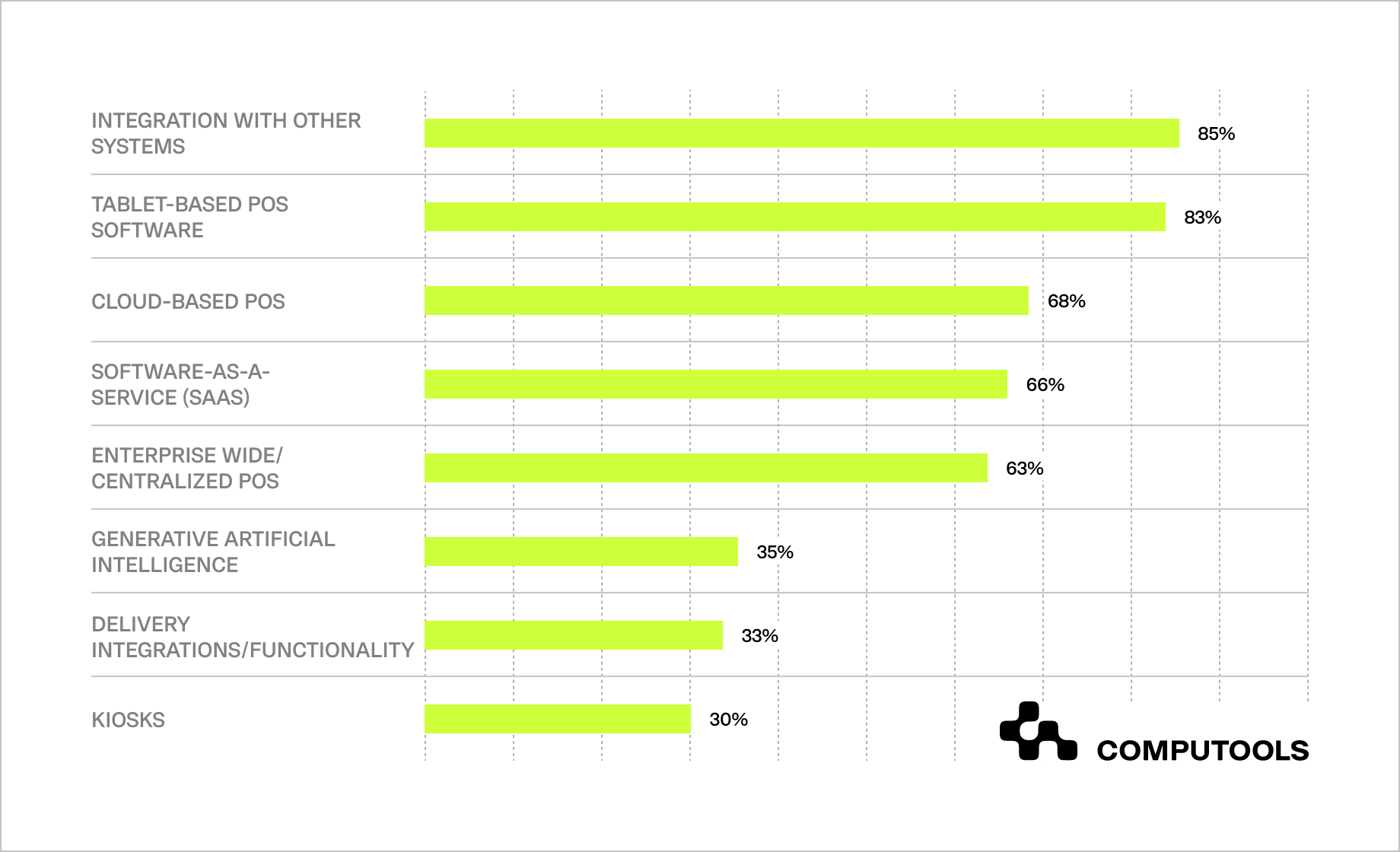
According to Hospitality Technology’s 2024 POS Software Trends Study, 85% of restaurant operators identify integration with other systems as the single top functionality driving their POS investment decisions, a clear signal of how central connectivity has become to restaurant operations strategy.
2. CRM and Analytics Synchronization
Every order placed through a restaurant’s own app generates structured, owned first-party data: who ordered, what they ordered, when, how much they spent, whether they used a discount, and whether they returned within 30 days. Synchronized with a CRM platform, this data enables precise customer segmentation, lifecycle marketing automation, churn prediction, and personalized re-engagement — all at a scale and accuracy that is simply impossible with third-party platform data.
This is where custom software engineering that connects mobile ordering infrastructure to CRM platforms transforms raw transaction data into actionable customer intelligence. For restaurant groups managing multiple locations, this unified data layer is the foundation of any consistent, scalable customer experience strategy.
3. Unified Order Management Across All Channels
For restaurant groups operating multiple locations, brands, or formats, a unified order management ecosystem is essential — a single back-office dashboard that consolidates orders from the mobile app, web platform, third-party delivery integrations, self-service kiosks, and in-restaurant POS, with real-time inventory sync and centralized menu management. Modern software development services for HoReCa built on scalable API architecture make this achievable not only for enterprise chains but also for mid-sized restaurant groups looking to professionalize their operations.
Explore the top restaurant POS software development firms helping businesses streamline operations, enhance customer experiences, and drive growth with innovative point-of-sale solutions.

Launch your digital restaurant experience within 1–3 months instead of years, and unify ordering, payments, rewards, and customer engagement in one scalable platform.
Why Choose Computools
Choosing the right technology partner is one of the most consequential decisions in any restaurant digital transformation initiative. Not every software firm understands the operational realities of food service: the complexity of POS integration, the nuance of multi-location menu management, the UX demands of a high-throughput ordering flow, or the performance expectations of hospitality customers. Computools does, and our track record in travel and hospitality software development services demonstrates it.
1. Deep Expertise in Hospitality and Food Technology
Computools is an experienced restaurant app development partner with a proven history of delivering high-performance digital products for the food service, tourism, and hospitality sector. Backed by 12+ years of subject matter expertise in the travel and hospitality industry and 20+ custom software solutions delivered globally for HoReCa businesses, our teams bring sector-specific expertise across mobile ordering platforms, real-time loyalty ecosystems, restaurant POS integrations, and multi-location management dashboards.
A representative example of this work is Tap App, a cross-platform ordering solution we built for a UK-based hospitality client serving a diverse network of restaurants and cafes. The client faced a tight investor-driven launch schedule, varied menu requirements across partner venues, and the need to balance operational simplicity with a consumer-grade ordering experience. Computools delivered a stable, high-performance application on both iOS and Android, integrating multiple payment gateways and real-time business performance monitoring tools.
The result: a 7% increase in top-line growth through cross-selling opportunities, and an 85% reduction in unfulfilled or modified orders through better ingredient management and digital workflow automation.
We have also delivered digital transformation projects in adjacent travel and hospitality contexts. SmartCity, a geolocated travel application for a U.S.-based startup, required integrating geospatial search, augmented reality, and real-time social features into a single stable platform, connecting tourists with nearby attractions, events, and businesses. The project resulted in a product distributed across local and international users, with the client’s revenue increasing several times following launch. This project demonstrates Computools’ ability to handle technically complex, multi-feature hospitality applications where performance, real-time data, and user experience must all operate at the same high standard.
For clients operating in the broader entertainment and ticketing space, which often intersects with restaurant and venue management, our work with Multitrading further illustrates our backend engineering depth. We developed a multi-threaded web application capable of handling millions of simultaneous user requests, integrating data collection, API connections, and scalable infrastructure. The platform enabled Multitrading to significantly reduce wait times, improve user satisfaction, and expand its customer base — capabilities that translate directly to high-volume restaurant and hospitality environments.
2. End-to-End Cross-Platform Restaurant App Development
Computools delivers complete cross-platform app development services, from product discovery and technical architecture through frontend and backend engineering, QA, system integration, and post-launch scaling. Our teams work with both Flutter and React Native, selecting the right framework based on client requirements, team composition, and long-term maintenance considerations.
3. Integration, Scalability, and Long-Term Partnership
Restaurant technology is not a project that ends at launch, it is an ongoing capability that must evolve alongside the business. Computools structures client engagements as long-term partnerships, with dedicated teams who understand your architecture, your customer base, and your growth trajectory. Whether you are a single-concept restaurant building your first cross-platform food ordering app or a multi-country food group modernizing legacy ordering infrastructure, our mobile app development services are built to grow with you.
Our custom software engineering capabilities mean we build precisely what your operations require, not a templated product retrofitted to your business, but a tailored solution engineered for your specific context. And as AI continues to reshape restaurant operations, from personalized recommendation engines to demand forecasting and dynamic pricing, our AI development services ensure that Computools clients are positioned to leverage these capabilities as they mature, rather than racing to catch up later.
Conclusion
In today’s digital-first market, cross-platform restaurant app development is not a technology upgrade, it is a strategic business decision with direct implications for revenue, margin, customer retention, and long-term competitive positioning.
Restaurants that invest in purpose-built mobile ordering experiences, connected to their operational systems and powered by behavioral data, consistently outperform those relying on third-party platforms or static web interfaces. A cross-platform architecture, built with Flutter or React Native, delivering a native-quality experience on iOS and Android from a single shared codebase, makes this investment achievable at 30–60% of the cost of dual native development, with faster time to market and lower long-term maintenance overhead.
The case for restaurant mobile app development has never been clearer: over 60% of orders now arrive through mobile, 70% of consumers prefer ordering directly from a restaurant’s own app, and loyalty program members visit 20% more frequently and spend 20% more per transaction. The infrastructure to capture this opportunity, and to protect it from third-party platform dependency, is a cross-platform mobile strategy, executed with the right technology partner offering travel and hospitality software development services.
Computools
Software Solutions
Computools is an IT consulting and software development company that delivers innovative solutions to help businesses unlock tomorrow.