
THE AUTHOR:

Given the existing trade-offs, the hotel industry has a strong demand to build hotel operations management software as a critical part of its tech infrastructure. The fragmented nature of technology stacks continues to grow, and operators want to reduce the time to understand and evaluate the impact of various factors that affect operations on a daily basis, including rooms, staff, maintenance issues, and service requests.
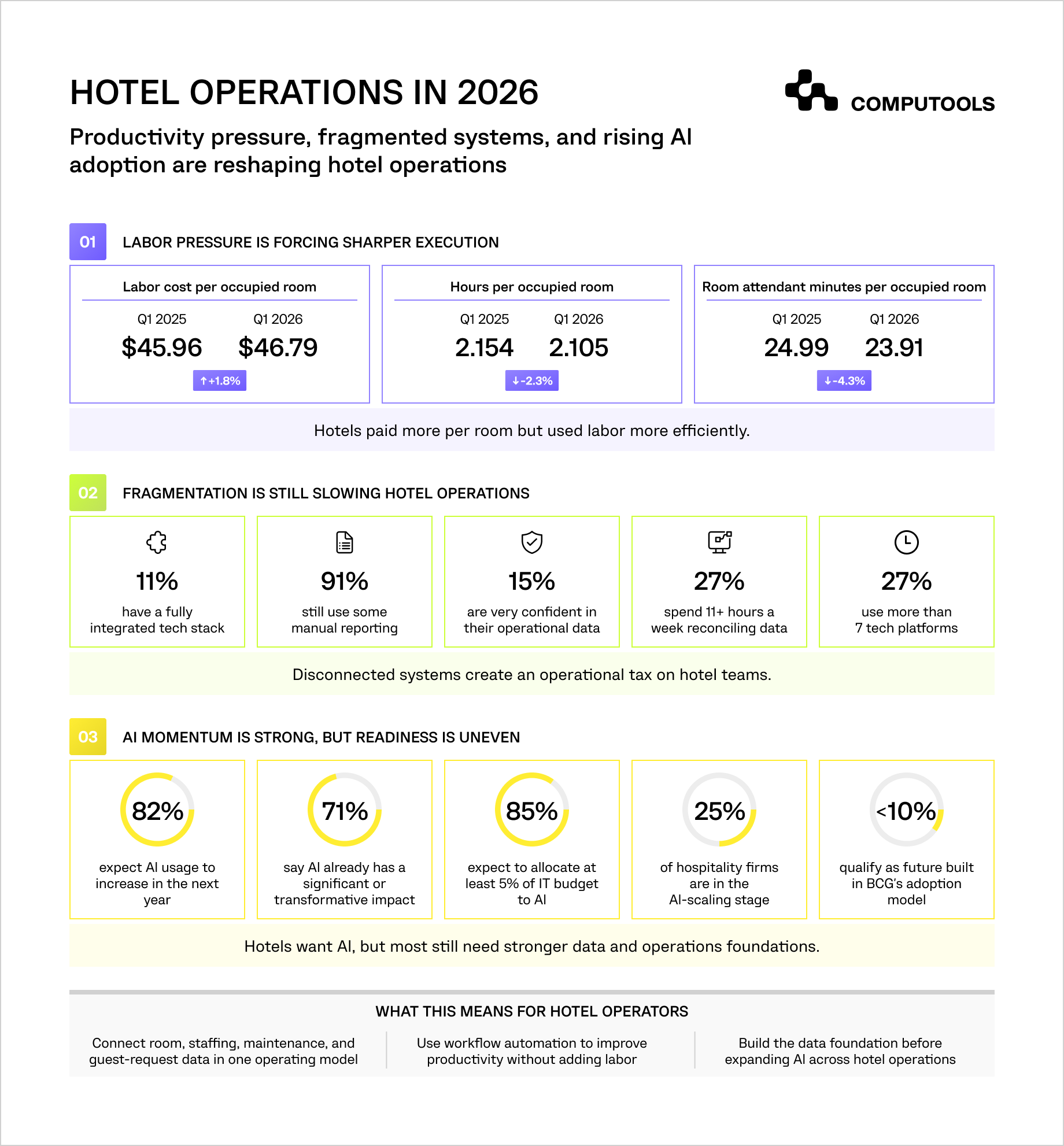
Q1 2026 data from approximately 5,000 U.S. hotels shows labor cost per occupied room rising 1.8% year over year even as hotels reduced labor hours per occupied room by 2.3%. Housekeeping productivity also improved, with room-attendant minutes per occupied room falling by 4.3%. For businesses, data such as this highlights the importance of labor allocation and processes in their product design.
In the absence of integrations, productivity is nearly impossible to improve. Fragmented data continues to reside in disjointed systems (PMS, spreadsheets, workforce tools, maintenance management tools, communication applications, and subject-specific software) across departments. The 2026 Hotel Operations Index found that only 11% of surveyed hotel operators had a fully integrated technology stack. Some 91% still relied on manual reporting to some degree. Only 15% of hotel operators were very confident in the accuracy and timeliness of their operational data. Modern hospitality operations management software is needed as a shared operational layer. This layer would integrate room status, tasks, staffing, guest requests, and asset data into a system that initiates coordinated actions across departments.
AI heightens the value of this foundation. In its 2026 hospitality research, Canary Technologies found that 82% of hotel technology decision-makers anticipated an increase in the use of AI by their organizations in the following 12 months. BCG also identifies staffing, maintenance, forecasting, property operations, and guest service as areas where AI is moving into hospitality workflows.
| 2026 hotel operations pressure | What the platform needs to address |
| Rising labor costs | Workload-based task assignment, staff scheduling, productivity tracking. |
| Pressure to increase housekeeping productivity | Real-time housekeeping management, room prioritization, inspection workflows. |
| Fragmented technology stacks | Shared data model, PMS integrations, APIs, event-driven workflows. |
| Low confidence in operational data | Centralized room, task, staff, asset, and request data. |
| Continued manual reporting | Automated data collection, dashboards, alerts, and exception reporting. |
| Rapid AI adoption | Structured data for forecasting, request routing, predictive maintenance, and AI-assisted operations. |
Request classification, workload forecasting, predictive maintenance, and AI-based scheduling have to use integrated operational data spanning multiple applications. Building this type of system demands the right choices for workflow logic, system ownership, integrations, mobile staff interfaces, real-time task orchestration, AI, security, and performance.
This article explains how to structure those components so the platform can improve multi-department coordination, labor productivity, service response, and operational control.
How to build hotel operations management software: case study
OpsCore Hospitality shows what happens when hotel departments rely on separate tools but still need to act on the same operational events. The U.S.-based client managed front desk, housekeeping, maintenance, guest requests, and staffing through phone calls, spreadsheets, internal messages, and manual updates. As operating costs increased, this setup made it harder to control labor, track service performance, and react quickly to changes in workload.
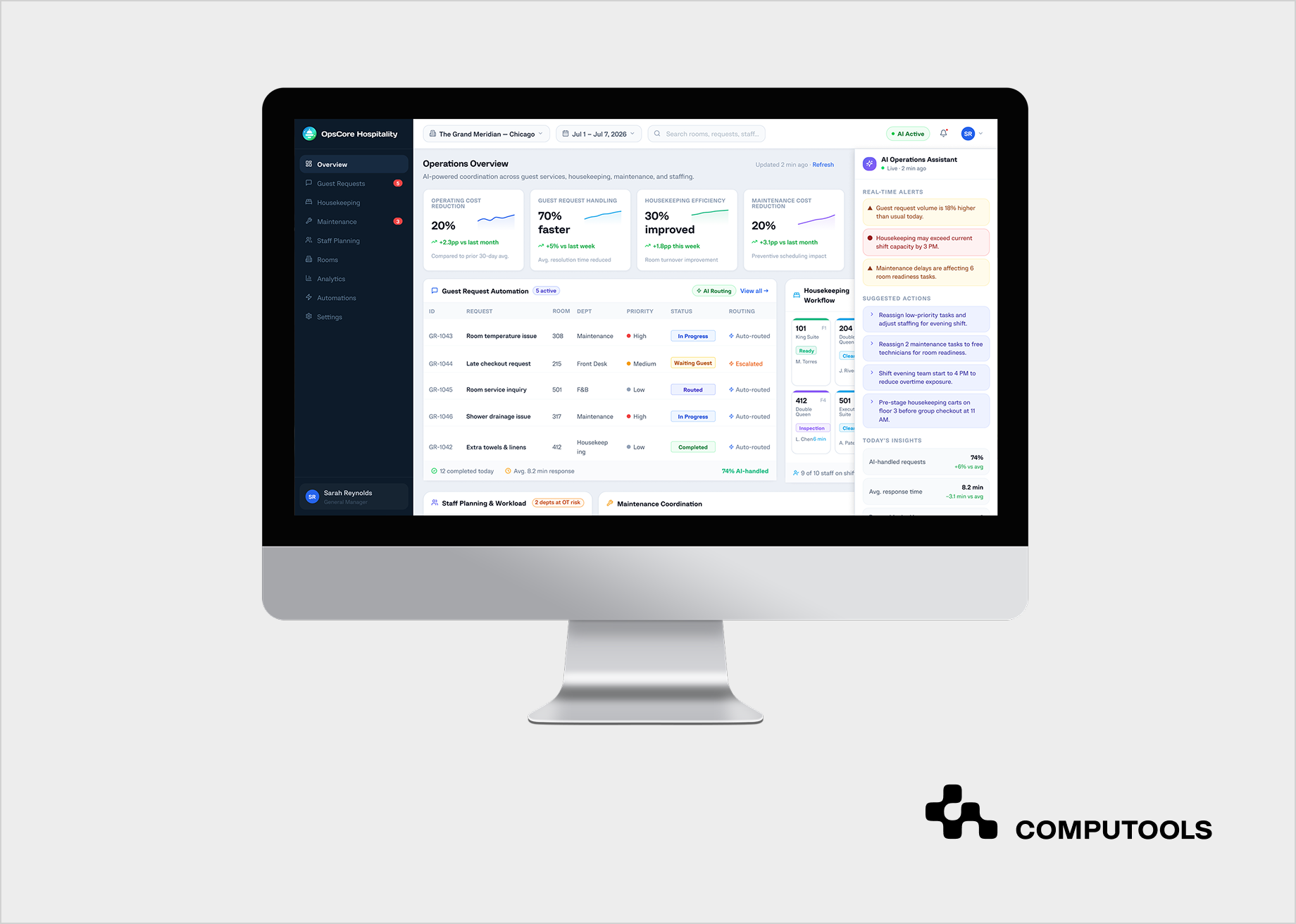
The biggest problem was not a lack of a common operational layer across front desk, housekeeping, maintenance, guest services, and staff management teams. One routine guest request could cross multiple teams, increasing the risk of duplicate work, lost information, delayed updates to the room, and unclear ownership. Managers had no insight into the workload or the capacity of the departments, which made them unable to control overtime or hotel staff management in response to changing needs.
To solve this, we mapped the flows of guest requests, housekeeping tasks, maintenance requests, and staffing among other loops within a hotel. Based on that, the team developed OpsCore Hospitality, which provides shared task routing, role-based dashboards, hotel workflow automation, and operational analytics, as well as room-readiness tracking, maintenance coordination, and workforce planning. AI concierge handled routine guest inquiries and classified hotel service requests, while forecasting logic supported staffing and maintenance decisions.
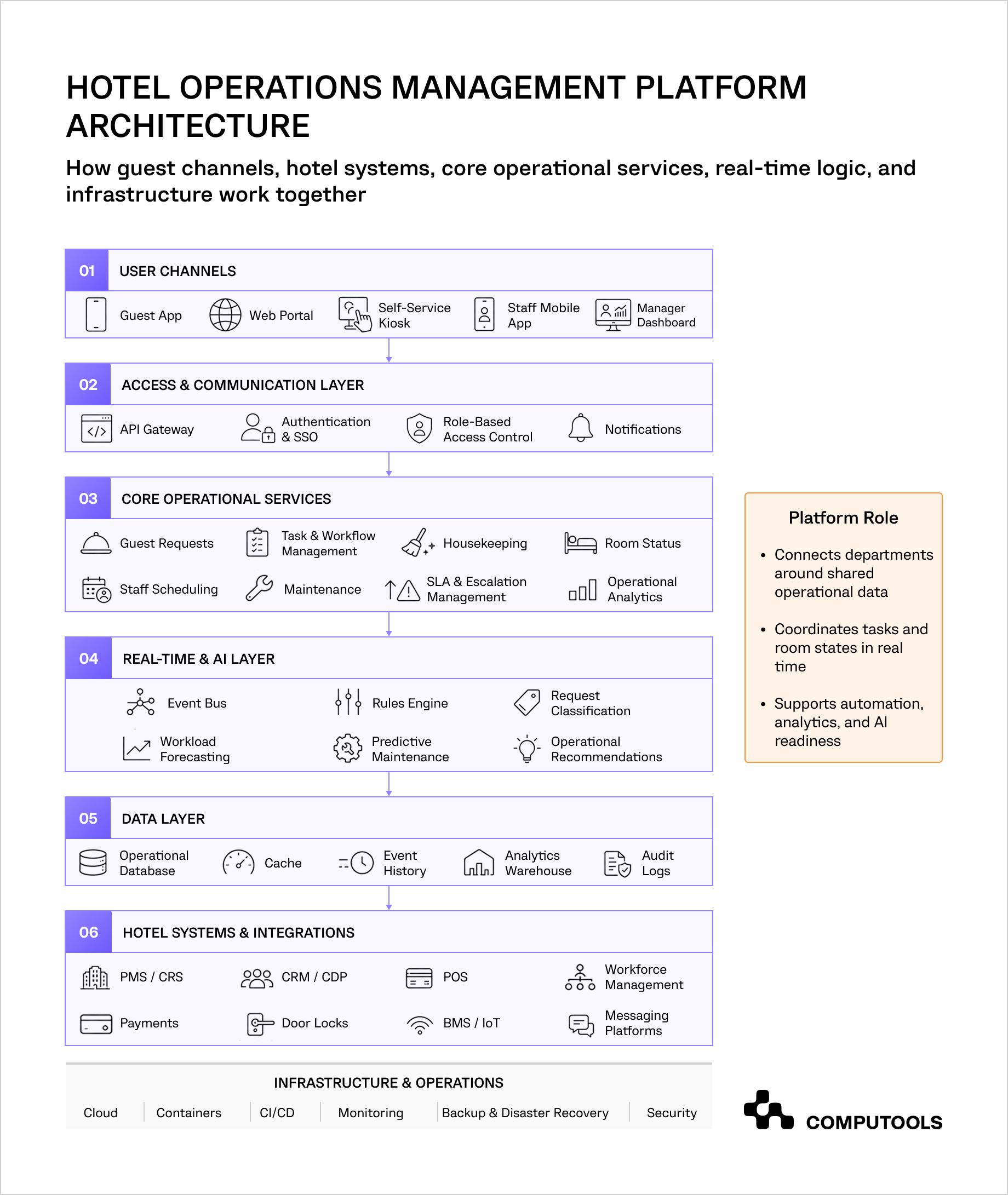
The technical architecture separated core hotel operations from AI processing. Next.js and React supported staff and management interfaces, Node.js and NestJS handled core backend logic, and PostgreSQL stored room statuses, schedules, requests, maintenance records, task history, and KPIs. Python and FastAPI supported AI and predictive functions. AWS, Docker, and Terraform provided the infrastructure for deployment and scaling.
Within three months, the client reported that OPEX fell by 20%, labor costs dropped by 20%, guest requests were processed 70% faster, housekeeping productivity improved by 30%, and maintenance expenses decreased by 20%.
What should a hotel operations management platform control?
A hotel operations solution complements rather than replaces components of the property’s systems. It connects operational events with the people and departments responsible for the event.
The PMS can continue to house the records of reservations, stays, guest profiles, and room assignments. The platform can then be used to initiate and manage work across front desk operations, housekeeping, maintenance, guest services, and management teams.
| Operational event | Platform action | Departments involved | KPI to track |
| Guest checks out | Create cleaning task and update room state | Front desk, housekeeping | Room-ready time |
| Early arrival is confirmed | Reprioritize room preparation | Front desk, housekeeping | Room ready by ETA |
| Housekeeper reports a fault | Create work order and hold room | Housekeeping, maintenance | Room downtime |
| Guest requests an amenity | Assign request based on role and workload | Front desk, guest services | Response and completion time |
| Occupancy forecast increases | Flag staffing or workload gap | Supervisors, management | Overtime, HPOR |
| Maintenance task is completed | Return room for inspection | Maintenance, housekeeping | Time to return room to inventory |
This shared workflow logic is what makes multi-department hotel management possible. Each team can keep a role-specific interface, but task ownership, room states, priorities, SLAs, and dependencies should come from the same operational data.
The same principle applies to room status management. The platform needs defined states and transition rules so every department works with the same version of the room’s operational status.
How to build hotel operations management software step-by-step
The following steps explain how to build hotel operations management software around connected workflows, reliable data, automation, and measurable operational results.
Step 1. Set operational and labor productivity targets before defining features
Before defining modules, dashboards, or automation rules, decide which operational results the platform must improve.
It should be designed around measurable operating targets such as:
- room-ready time;
- labor hours per occupied room;
- minutes spent cleaning each room;
- guest request resolution time;
- SLA breach rate;
- overtime hours;
- maintenance resolution time;
- room downtime;
- tasks completed per shift.
The next step is to map the workflows that affect those metrics. For each process, define the trigger, owner, priority, dependencies, expected completion time, escalation path, and final state.
A room-turnover workflow, for example, can be structured as: guest checkout → cleaning assigned → cleaning completed → inspection → room ready.
The system should record how long each stage takes and where delays occur. If inspection repeatedly creates a bottleneck, management needs to see that separately from total room-turnaround time. If a maintenance issue blocks the workflow, the delay should be attributed to that dependency rather than housekeeping.
The same approach applies to hotel workflow management for guest requests, maintenance incidents, early arrivals, room changes, or staff shortages. Each workflow needs clear state transitions and measurable completion criteria.
Technically, this requires workflow state models, SLA timers, priority rules, task dependencies, escalation logic, and KPI instrumentation from the start. If these rules are added only after the interface is built, the platform may record activity without giving managers enough control over productivity or operating costs.
In the OpsCore Hospitality project, the Computools team followed this sequence by analyzing workflows and OPEX drivers before defining the platform modules. That allowed the system to connect product functionality with measurable goals such as faster request processing, higher housekeeping productivity, and lower labor costs.
Step 2. Create a shared operational data model
Once the operating targets are clear, define how the platform represents rooms, guests, staff, requests, tasks, shifts, and assets. This is one of the most important parts of hotel operations software development because automation depends on consistent data.
The platform should define common entities such as:
- property, building, floor, and room;
- reservation, stay, and guest;
- request, task, department, and employee;
- shift, role, and availability;
- asset, issue, work order, and repair;
- SLA, escalation, and status history.
It also needs clear ownership rules. The PMS may remain the source of truth for reservations and stays, while the operations platform controls task execution. A workforce system may own employee records, and a maintenance platform may retain detailed asset history.
State definitions should be equally precise. A room, for example, can move through: Occupied → Vacant Dirty → Cleaning → Inspection → Ready.
A task may follow: Created → Assigned → Accepted → In Progress → Blocked → Completed → Verified.
These state changes should be timestamped and auditable.
Furthermore, building a shared data model is the beginning for forecasting and AI technologies. The platform will not be able to predict delays or staffing demands without a structured history of tasks, room states, workload data, and maintenance records.
Multi-property businesses should also determine which rules and data can be centralized and which can be property-specific.
In its guide on how to develop a multi-property reservation system for hotel chains, Computools explains that shared data structures must allow a balance of centralized control and differentiation for each property.
Step 3. Build an integration layer around the existing hotel stack
Most hotels employ a combination of PMS, CRS, POS, CRM, workforce, maintenance, messaging, access-control, and payment systems. The focus of hotel management software development should be on an a layer that integrates and standardizes data and events before reaching operational workflows.
A practical architecture can follow this pattern: PMS / POS / CRM / IoT / Workforce systems → Integration layer → Normalized events → Operational services
For example:
- PMS checkout becomes ROOM_CHECKED_OUT;
- guest app request becomes SERVICE_REQUEST_CREATED;
- housekeeping completion becomes ROOM_CLEANING_COMPLETED;
- sensor warning becomes ASSET_ALERT_CREATED.
This keeps core workflows independent of specific vendors. If the hotel changes its PMS later, the platform can update the adapter rather than rewriting housekeeping, maintenance, and guest-service logic.
The integration layer should support:
- APIs and webhooks;
- message queues;
- scheduled synchronization;
- retries;
- duplicate-event protection;
- idempotency;
- failed-event replay;
- reconciliation jobs;
- API version control;
- integration monitoring.
This matters because integration failure is an operational problem, not just a technical one. A missed checkout event can delay cleaning. A stale room status can create a front-desk error. A failed workforce sync can assign tasks to someone who is not on shift.
Integration requirements become even more important when operational data also feeds pricing and commercial systems.
Our guide on building a hotel RMS for multi-property hotel chains covers how PMS, booking engines, channel managers, OTAs, CRM, and reporting tools can exchange data without creating another isolated layer.
Step 4. Build real-time workload orchestration
Basic hotel task management software can assign a task to an employee. A stronger platform should continuously decide which task should be handled next, by whom, and under which priority.
The assignment logic can use: priority + employee role + workload + location + shift + guest status + arrival time + SLA + dependencies.
Consider an early-arrival request. If a guest changes arrival time from 4 p.m. to noon, the system can:
- receive the updated arrival event;
- increase the room’s cleaning priority;
- move it higher in the housekeeping queue;
- check whether current staff capacity can meet the new target;
- alert a supervisor if the room is at risk of being late;
- notify the front desk after inspection.
This type of hotel operations automation is increasingly relevant as hotels try to reduce labor hours per occupied room without lowering service standards.
Technically, the platform needs:
- event-driven processing;
- workflow or rules engines;
- workload balancing;
- SLA timers;
- priority recalculation;
- task dependencies;
- escalation rules;
- push notifications;
- WebSocket updates;
- concurrency controls.
Concurrency deserves particular attention. Two employees should not be able to accept the same room or maintenance task at the same time. The system should also prevent delayed events from overwriting a newer status.
Step 5. Design interfaces around how each role works
Frontline employees and managers need different views of the same operational data.
A housekeeper may need only: next room → priority → cleaning type → issue → completed.
A maintenance employee may need: work order → severity → room impact → asset history → action → status.
Front desk teams need access to:
- arrivals;
- room readiness;
- open guest requests;
- unresolved incidents;
- escalations.
Managers need a different interface. Instead of reviewing every task, they should see exceptions such as:
- rooms likely to miss arrival time;
- departments above capacity;
- SLA breaches;
- maintenance issues blocking inventory;
- unresolved guest complaints;
- overtime risk;
- unusual request volume.
This structure makes guest request management faster because employees see only the information required to act, while supervisors retain control over workload and service risk.
Mobile access is particularly important for housekeeping and maintenance teams. Interfaces should use short forms, clear statuses, fast updates, and offline recovery where connectivity is inconsistent.
Admin workflows also need attention.
Managers should be able to configure:
- roles and permissions;
- departments;
- task categories;
- SLA thresholds;
- escalation rules;
- operating hours;
- notification settings;
- property-level workflow differences.
In OpsCore Hospitality, our team used role-based interfaces for hotel managers, front desk employees, housekeeping teams, and maintenance staff so each group could work with the same operational data without using the same screen structure.
Step 6. Make the data AI-ready before adding AI features
AI should follow the data and integration work, not precede it.
The most practical AI applications include:
| AI capability | How it works | Business value |
| Request classification | Identifies guest intent and routes requests to the right department. | Reduces manual sorting at the front desk and speeds up response times. |
| Workload forecasting | Uses occupancy, arrivals, departures, historic task volume, and events to estimate departmental workload. | Supports better planning and reduces last-minute staffing pressure. |
| AI-assisted staff scheduling | Matches staffing levels with expected workload instead of relying only on fixed ratios. | Improves labor allocation and can reduce overtime or understaffing. |
| Predictive maintenance | Analyzes work-order history, asset age, repeat failures, and IoT data to identify higher-risk equipment. | Reduces unexpected breakdowns and room downtime. |
| Operational recommendations | Flags capacity risks, likely SLA breaches, and workload bottlenecks before they affect service. | Gives managers more time to reprioritize work or reassign staff. |
| Personalized offers | Combines guest preferences with current service availability and operating capacity. | Supports relevant upsells without promoting services the hotel may struggle to deliver. |
AI depends on clean, structured data. If room states, maintenance records, employee schedules, or task histories are incomplete, predictive outputs will also be unreliable. The same requirement applies to hotel revenue AI.
As explained in our guide on how to build dynamic pricing software for hotels, forecasting and adaptive recommendations become practical only when the hotel has enough structured historical and real-time data to support them.
Step 7. Connect operational metrics with revenue and margin
A hotel operations platform should make it clear how day-to-day operational problems affect revenue and costs.
Many hotel workflows have a direct financial impact:
- Slow room turnover keeps rooms unavailable longer and can delay check-ins.
- Maintenance problems can take rooms out of service, reducing sellable inventory.
- Poor staff allocation can increase overtime or leave departments understaffed during busy periods.
- Slow responses to guest requests can lead to complaints, refunds, discounts, or other service recovery costs.
- Unused capacity in paid services such as restaurants, spas, or late checkout creates missed upsell opportunities.
By connecting these operational events with financial data, the platform can show managers where delays, staffing decisions, and service issues are reducing revenue or increasing costs.
Management reporting should therefore connect operational KPIs with:
- occupancy;
- ADR;
- RevPAR;
- labor cost per occupied room;
- overtime;
- room downtime;
- maintenance cost;
- ancillary revenue;
- service recovery cost.
This changes how managers evaluate performance.
Instead of seeing “12 maintenance requests were completed,” they can see: “3 maintenance incidents kept 4 rooms out of service for a combined 18 hours.
That difference is important because hotel operations platform development should support revenue control, not only task tracking.
The same logic applies to upselling. If housekeeping is already at capacity, the system should avoid promoting late checkout aggressively. If spa or restaurant capacity is available, the platform can support targeted offers based on guest context and current availability.
Step 8. Design security, reliability, and testing around 24/7 operations
Hotel operations do not stop when an API fails or a database is unavailable. The platform therefore needs fault-tolerant architecture and practical security controls.
Access should be based on role, property, and responsibility. A housekeeper may need access to assigned rooms and guest-service notes, but not payment details or management reports.
Core controls should include:
- SSO and MFA;
- role-based access;
- property-level data isolation;
- encryption;
- audit logs;
- API authentication;
- secrets management;
- PII minimization.
Reliability measures should include:
- database replication;
- queue buffering;
- retries;
- autoscaling;
- integration health checks;
- backups;
- disaster recovery;
- centralized logs and metrics;
- graceful degradation.
For example, if the PMS API becomes unavailable during the morning checkout period, the platform should queue pending events and reconcile them after the connection returns rather than losing the data.
QA testing should also reflect real hotel workflows rather than isolated screens. A useful scenario is: checkout → cleaning → defect reported → maintenance task → repair → inspection → room ready → front desk update.
Other scenarios should include:
- duplicate PMS events;
- several hundred simultaneous checkouts;
- delayed webhooks;
- unavailable third-party APIs;
- lost mobile connectivity;
- two employees accepting the same task;
- incorrect AI classification;
- unauthorized cross-property access.
This is particularly important for maintenance management, where a failed update can keep a room unavailable longer than necessary.
After launch, compare performance against the targets defined in Step 1. The platform should continue to improve task rules, staffing logic, SLA thresholds, and automation based on real operating data rather than treating deployment as the end of the project.

Launch your hotel operations management platform in 1–3 months, not years, and give front desk, housekeeping, maintenance, and management teams one system to coordinate tasks, automate workflows, and resolve guest requests faster.
Why choose Computools for hotel operations management platform development
Computools approaches hotel operations projects from the operating model first. Our goal is to understand where delays, duplicated work, staffing pressure, data gaps, or service bottlenecks affect cost and guest experience before defining the product architecture. The OpsCore Hospitality project followed this approach by mapping hotel workflows and OPEX drivers before building task routing, workforce planning, housekeeping, maintenance, and analytics functions.
Through travel and hospitality software development services, Computools works with hospitality businesses that need to connect operational systems. That includes PMS and CRM integrations, real-time backend logic, property-level data models, staff-facing interfaces, cloud infrastructure, and reporting across multiple departments.
For businesses that need stronger operational control in hotels, restaurants, and related venues, our software development services for HoReCa cover workflows such as service coordination, workforce management, booking-related processes, payments, and customer-facing operations. We also apply experience from heritage tourism software development, where visitor services, operational systems, and digital channels often need to work from shared data.
The delivery model can combine web development services for management and administration interfaces with mobile app development services for employees who work across rooms, floors, and service areas. With AI development services, we support request classification, workload forecasting, predictive maintenance, and operational recommendations once the underlying data is structured and reliable.
The value of our solutions comes from connecting the platforms with the wider hotel business: rooms, staff, guest requests, maintenance, operational data, automation, and revenue controls. That gives management one system for improving how work is coordinated and measured as the property or portfolio grows.
Final thoughts
Designing software for hotel operations requires identification of the pain points within hotel operations. The most effective workflows are usually the ones that span multiple departments, for example checkout to housekeeping, housekeeping to maintenance, maintenance to ready for guests, or service request workflows that transit through many teams.
This is why platform architecture is critical. A unified data model ensures consistency across room, task, staff, and asset states. The integration layer connects with the PMS and other hotel systems without duplicating their responsibilities. In real time, workflow logic dictates dependencies and assignment priorities. When this layer is stable, AI can be added for work order forecasting, request routing, predictive maintenance, as well as staff scheduling, based on operational data of the hotel.
A hotel operations platform should give management more control over the decisions that affect both service quality and margin. Room turnover, maintenance, staffing, and guest requests all have a financial consequence when delays accumulate or resources are poorly allocated.
It should make it easier to answer practical questions such as: Which rooms are likely to miss arrival targets? Where is overtime coming from? Which maintenance issues are removing the most inventory? Which requests are at risk of breaching service targets? Where can automation reduce repetitive work without affecting service quality?
The same logic applies to ancillary revenue. Hotels can promote spa appointments, upgrades, or other paid services when capacity is available, while avoiding offers such as late checkout when housekeeping is already under pressure.
To build hotel operations management software that delivers this level of control, businesses need more than task tracking. They need shared operational data, reliable integrations, real-time workflow logic, and clear links between day-to-day activity and financial outcomes.
Computools
Software Solutions
Computools is an IT consulting and software development company that delivers innovative solutions to help businesses unlock tomorrow.