
THE AUTHOR:

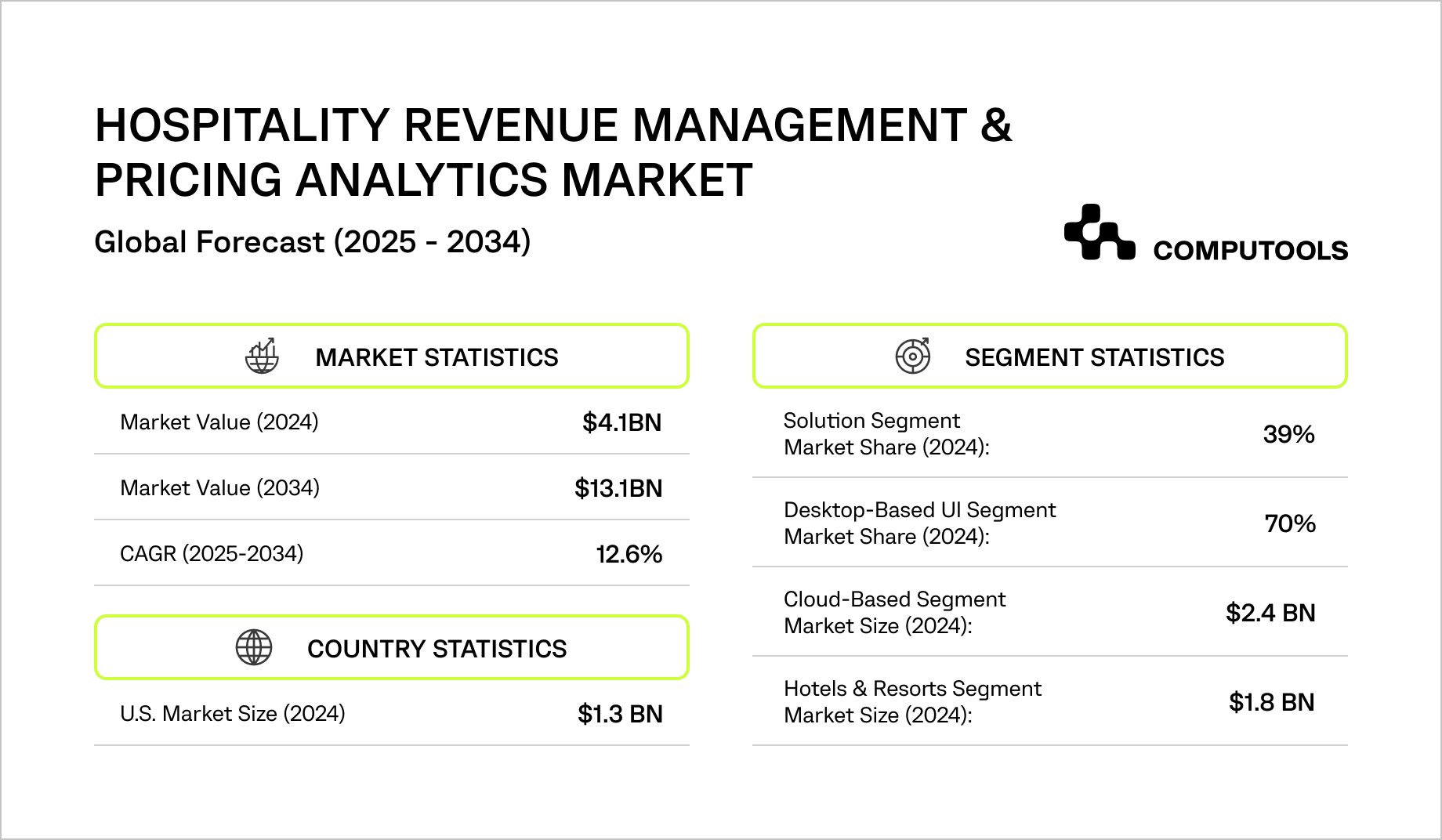
The business case to build a hotel revenue management system is growing stronger as hotels face uneven demand, tighter margins, and more complex booking behavior.The global hospitality revenue management and pricing analytics market was valued at USD 4.1 billion in 2024 and is expected to reach USD 13.1 billion by 2034, growing at a CAGR of 12.6%. In the U.S., CBRE reported Q1 2026 hotel RevPAR growth of 3.8%, driven by a 2.2% ADR increase and a 0.8% occupancy gain, while occupancy still remained below 2019 levels for most location types.
For hotel groups, this creates a clear operational problem. More demand does not automatically mean better revenue. A multi-property chain can keep occupancy stable while still losing margin if rates are updated too late, guest segments are priced the same, or OTAs, direct channels, and partner platforms show inconsistent rates. Pricing becomes harder to control when each property has its own seasonality, corporate accounts, local events, booking windows, and channel mix.
A reliable revenue management system for hotel groups integrates these variables into a single decision environment. It gives revenue teams a structured way to forecast demand, set pricing rules, review automated recommendations, synchronize rates across channels, and understand where revenue is lost. For multi-property hotel chains, the system also needs to separate global pricing strategy from property-level execution, so teams can manage the portfolio without flattening local market differences.
How Computools improved pricing control for a hotel group
Computools built Costavira RMS for a U.S. hotel group operating several urban and business-travel properties. The client had stable booking volumes, but pricing decisions were still managed through spreadsheets, manual reviews, and experience-based adjustments. Rooms were selling, but not always at the right rates. Manual updates, weak segmentation, and slow reactions to demand shifts were reducing margins across the portfolio.
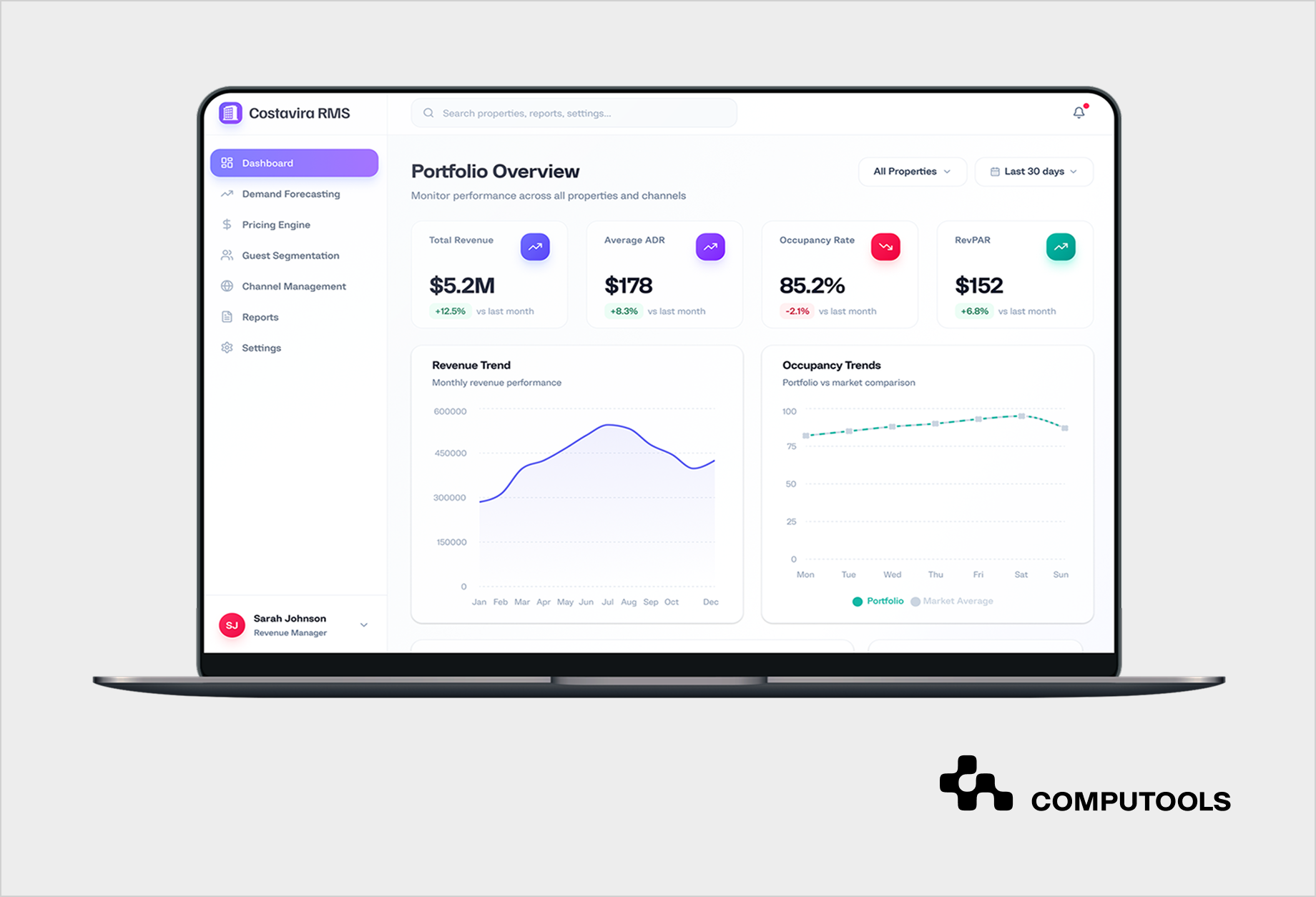
The project required more than standard hotel software delivery. As part of our travel and hospitality software development services, we approached the engagement as a pricing control and revenue optimization initiative. The first step was to audit how rates were set, how different booking channels behaved, and where delays were creating revenue leakage. From there, we designed a centralized structure for demand forecasting, pricing rules, rate recommendations, and channel synchronization.
A strong data engineering layer was essential because the platform had to process booking history, occupancy, rate changes, channel data, property-level configurations, and demand signals in one environment. The system analyzed occupancy, booking pace, historical patterns, day-of-week behavior, seasonality, and city-level events. It also supported different pricing paths for corporate travelers, early bookers, last-minute guests, and loyal customers. This provided the client with a more adaptable approach to managing revenue, moving away from using the same pricing strategy for all demand conditions and guest categories.
The RMS included forecast dashboards, pricing rule management, channel controls, alerts, role-based access, and reporting for revenue, commercial, and operations teams. PMS and channel manager integrations synchronized rates, inventory signals, and booking data across the client’s digital ecosystem, reducing pricing conflicts between the website, OTAs, and partner channels.
We also applied business process automation to reduce repetitive pricing work without removing revenue managers from the decision process. Forecasts could be reviewed, recommendations approved, and manual overrides applied when commercial judgment was needed. Pricing became faster, more consistent, and easier to scale across multiple properties.
Within approximately six months after launch, the client reported measurable improvements: room revenue increased by 21% without additional traffic, ADR increased by 12%, low-season occupancy improved by 9%, and manual pricing work dropped by 65%. The RMS also improved pricing visibility across the website, OTAs, and partner channels, giving the client stronger control over rate consistency across the portfolio.
Through software engineering services, Computools integrated forecasting, segmentation, pricing rules, integrations, reporting, and approval workflows into a single scalable RMS environment for multi-property revenue management.
How to build a hotel revenue management system for multi-property chains: 10 steps
This step-by-step guide to build a hotel revenue management system explains how hotel chains can move from manual pricing decisions to a centralized RMS that connects demand forecasting, pricing logic, segmentation, channel synchronization, and performance reporting across multiple properties.
Step 1. Audit current revenue workflows and pricing gaps
Before starting hotel revenue management system development, the team needs to understand how pricing decisions are made across the hotel chain. This audit should cover who sets rates, how often prices are updated, which data sources support decision-making, how pricing changes are transferred between systems, and where manual work slows the process.
For multi-property hotel chains, this step is especially important because pricing issues rarely look the same across all locations. One property may lose revenue because rates stay too low during event-driven demand. Another may struggle with unsold inventory when prices remain high after demand softens. A third may have rate inconsistencies between the direct website, OTAs, corporate booking channels, and partner platforms. If these problems are not mapped early, the RMS will automate broken workflows instead of improving them.
The audit should identify:
- how rates are currently created, reviewed, approved, and published;
- which teams participate in revenue decisions;
- how often pricing is updated across properties and channels;
- which demand signals are used and which are missing;
- where rate parity issues appear;
- how guest segments are priced;
- which manual tasks consume the most time;
- where delayed decisions create revenue leakage.
In the Costavira RMS project, this was the first practical step. The client had stable occupancy and consistent bookings, but pricing was still managed through spreadsheets, manual reviews, and experience-based decisions. Rates were updated every few days, while demand changed faster across properties, booking windows, and channels. The same room type could be priced similarly across different demand conditions, guest categories, and sales channels. As a result, the hotel group lost revenue in both directions: rooms were underpriced during high-demand periods and left unsold when demand softened, but rates stayed too high.
Computools mapped the client’s pricing workflows, booking channels, and decision delays before designing the RMS logic. This helped define the future system around real operational problems: delayed rate updates, weak segmentation, inconsistent channel pricing, limited forecasting, and excessive manual work. The audit also showed which pricing decisions needed automation and which decisions still required revenue manager control.
The output of this step should be a clear workflow map that connects commercial decisions with system requirements. It should show how data enters the RMS, how forecasts are generated, how rate recommendations are reviewed, how pricing rules are applied, and how approved rates are synchronized across channels.
For a hotel chain, this foundation prevents the RMS from becoming another dashboard. It turns the system into an operational layer for pricing control, demand visibility, and faster revenue decisions across the portfolio.
Step 2. Define the data model for properties, rooms, rates, and segments
Reliable revenue management software for hotels depends on the quality of its data model. Before forecasting or pricing logic can work, the system needs a clear structure for properties, room types, rate plans, guest segments, booking channels, inventory, restrictions, and historical performance.
For a multi-property chain, this model should support both shared standards and property-specific differences. The group may use the same commercial strategy across the portfolio, but each property has its own room categories, local demand patterns, corporate accounts, seasonal peaks, event calendars, and channel mix. If the data model is too rigid, revenue teams lose flexibility. If it is too loose, pricing logic becomes inconsistent and hard to control.
The core data model should usually include:
- property profiles with location, market type, capacity, and operating rules;
- room types, room attributes, and inventory structure;
- rate plans for direct, OTA, corporate, package, and partner bookings;
- booking windows, cancellation terms, stay restrictions, and minimum-night rules;
- guest segments such as corporate travelers, leisure guests, early bookers, last-minute
guests, and loyal customers;
- historical occupancy, ADR, RevPAR, pickup, and booking pace;
- channel-level pricing, availability, and performance data;
- local demand drivers, including seasonality, holidays, and city events.
In the Costavira RMS project, this step helped move the client away from fragmented pricing logic. Computools structured the future RMS around property data, booking history, pricing rules, segment configurations, and reporting needs, enabling the system to support pricing decisions across the entire portfolio rather than treating each rate update as a separate manual task.
This structure also made segmentation more useful. Corporate travelers, early bookers, last-minute guests, and repeat customers could be managed through different pricing paths instead of being pushed into the same general rate logic. That gave the client more control over how demand was priced across guest types and booking scenarios.
The output of this step should be a data model that shows how every pricing decision is connected to a specific property, room type, rate plan, channel, guest segment, and demand condition. Once this foundation is in place, the RMS can support forecasting, pricing recommendations, channel synchronization, and performance reporting without creating gaps between commercial logic and system behavior.
Step 3. Build the forecasting layer around demand signals
Forecasting should show how demand is likely to change before revenue is lost. For a hotel chain, this layer needs to process historical booking data, pickup pace, occupancy trends, cancellations, no-shows, day-of-week patterns, seasonality, local events, and channel performance across all properties.
A basic forecast that only compares last year’s occupancy with current bookings is too limited for multi-property revenue decisions. Each property may have different demand drivers. A business hotel can depend on corporate travel and weekday demand, while another property may be more sensitive to leisure stays, holidays, city events, or last-minute bookings. The RMS should be able to read these differences and turn them into practical pricing signals.
Hotel analytics and forecasting software becomes a core part of the RMS. The forecasting layer should help revenue teams answer several operational questions:
- which properties are pacing ahead or behind expected demand;
- where prices need to be adjusted before occupancy drops;
- which dates are likely to sell out too cheaply;
- where soft demand requires earlier commercial action;
- how booking windows differ by property, channel, and guest segment;
- which demand changes should trigger pricing recommendations or alerts.
In the Costavira RMS project, forecasting was one of the main reasons the client needed a custom system. The hotel group had no reliable demand forecasting layer to support rate adjustments based on seasonality, city events, booking pace, or segment-level changes. Computools designed the RMS around forecasting workflows, pricing rules, rate recommendations, and channel synchronization, enabling the client to respond more quickly to demand shifts across multiple properties.
The platform analyzed occupancy, booking pace, historical patterns, day-of-week behavior, seasonal trends, and city-level events. These signals were then used to support automated pricing scenarios and help revenue managers understand when demand required a rate change, a restriction adjustment, or manual review.
The output of this step should be a forecasting layer that connects demand signals with pricing action. It should not stop at showing charts. It should explain where demand is changing, how that affects revenue risk, and which pricing decisions need attention across the hotel portfolio.
Step 4. Create pricing rules for each property and demand scenario
Pricing rules define how the RMS turns demand signals into rate recommendations. For a hotel chain, these rules should account for property type, room category, occupancy level, booking pace, guest segment, booking window, market demand, and channel performance.
A single pricing rule across all properties will lead to poor decisions. Urban business hotels, resort properties, airport hotels, and extended-stay locations respond to demand differently. Even within one portfolio, a weekday rate increase may work well for a business-travel property but damage conversion for a leisure-focused hotel in a softer period. The RMS needs enough flexibility to reflect these differences without turning pricing into another manual spreadsheet routine.
Effective hotel pricing optimization software should support rule groups for different scenarios, such as:
- high-demand dates with strong pickup;
- low-demand periods that require earlier price adjustments;
- event-driven demand spikes;
- last-minute booking windows;
- early booking campaigns;
- corporate account pricing;
- repeat guest or loyalty-based pricing;
- minimum stay and restriction-based pricing;
- channel-specific rate logic;
- room type and upgrade pricing.
In the Costavira RMS project, Computools designed pricing logic around occupancy, booking pace, historical patterns, day-of-week behavior, seasonality, and city-level events. The platform also supported different pricing paths for corporate travelers, early reservations, last-minute demand, and repeat guests. This helped the client move away from flat, experience-based pricing and manage demand with more precise commercial logic.
Pricing rules should specify the system’s control level. Some rate changes can be recommended automatically, while others need review by a revenue manager. For instance, small adjustments during predictable demand growth may be automated. Major changes before events, holidays, or corporate bookings might require approval.
The output of this step should be a structured pricing rule framework. It should show which demand signals trigger recommendations, how rules differ by property and segment, which rate changes can be automated, and which decisions require human review. This gives revenue teams a controlled way to respond more quickly without losing accountability for final pricing decisions.
Step 5. Design dynamic pricing logic with human approval controls
Dynamic pricing should help revenue teams react faster to demand changes, but it should not turn the RMS into a black box. For hotel chains, the system needs clear pricing logic, configurable thresholds, and approval rules that show when a rate can be updated automatically and when a revenue manager should review the recommendation.
A hotel dynamic pricing system should usually account for:
- current and forecasted occupancy;
- booking pace against expected demand;
- day-of-week patterns;
- local events and seasonal peaks;
- room category and inventory pressure;
- cancellation and no-show behavior;
- competitor rate movement, if available;
- guest segment and booking window;
- channel performance and commission impact;
- minimum and maximum rate limits.
For multi-property operations, dynamic pricing logic should not apply the same rate movement across the whole portfolio. A 10% rate increase may be justified for one property during a city event, while another property in the same chain may need a softer adjustment because its booking pace is weaker or its demand mix is different. The RMS has to support this level of control.
In the Costavira RMS project, Computools built automated pricing scenarios around occupancy, booking pace, day-of-week behavior, seasonal trends, and city events. The platform also created different pricing paths for corporate bookings, early reservations, last-minute demand, and repeat guests. This helped the client respond faster to demand shifts without relying on manual rate checks every few days.
Human approval was still important. Revenue managers needed to review forecasts, approve recommendations, and intervene when the commercial context required it. For example, a sudden demand spike could trigger a rate recommendation, but the final decision might still depend on group bookings, corporate contracts, local competition, or strategic occupancy goals.
The output of this step should be a dynamic pricing logic framework that defines:
- which demand changes trigger rate recommendations;
- which rate updates can be automated;
- which changes require approval;
- how pricing limits are set by property, room type, and segment;
- how the system records pricing decisions for later review;
- how revenue teams override or adjust recommendations.
This keeps pricing fast without making it uncontrolled. The RMS should reduce manual work, improve reaction time, and give revenue managers enough visibility to trust the system’s recommendations.
Step 6. Connect the RMS with PMS, channel managers, OTAs, and direct booking channels
An RMS can support accurate pricing only when it exchanges data with the systems that already manage hotel operations. For multi-property chains, this usually means integration with the PMS, channel manager, booking engine, direct website, OTAs, corporate booking channels, CRM integrations, and reporting tools.
These integrations should allow the RMS to collect booking history, occupancy, inventory, cancellations, rate changes, restrictions, and channel-level performance data. The same connection layer should also push approved rates and availability updates back into the relevant systems. Without this structure, revenue teams still have to switch between platforms, manually check data, and resolve pricing conflicts after they have already affected sales.
The integration logic should usually cover:
- PMS data for reservations, occupancy, room inventory, cancellations, and no-shows;
- channel manager connections for rate and availability updates;
- OTA data for channel performance, commission impact, and booking patterns;
- direct booking engine data for website conversions and direct revenue share;
- CRM or loyalty data for guest segmentation;
- event and market data sources, if they are part of forecasting logic;
- reporting tools for revenue, ADR, RevPAR, pickup, and channel performance.
In the Costavira RMS project, PMS and channel manager API integrations were essential to the platform. They allowed the client to synchronize rates, inventory signals, and booking data across the digital ecosystem. This improved pricing consistency and reduced conflicts between the website, OTAs, and partner channels.
The integration layer also supported faster pricing execution. Once forecasts and pricing rules generated a recommendation, approved changes could move through connected systems instead of remaining in the RMS as isolated suggestions. This helped the client reduce manual updates and maintain more consistent pricing across properties and channels.
The output of this step should be an integration architecture that defines which systems exchange data with the RMS, how often updates happen, which data fields are required, and how errors are handled.
This is what separates isolated pricing dashboards from reliable RMS software for hotel chains: rates, availability, and inventory signals stay connected across the whole sales ecosystem.
Channel consistency also affects direct booking performance. If rates, availability, or booking conditions differ between the hotel website and OTAs, guests are more likely to complete the reservation through third-party platforms. For a deeper look at this issue, read our guide on how to increase direct hotel bookings and reduce OTA dependence.
Step 7. Set up portfolio-level controls for multi-property operations
A multi-property hotel management system should give revenue teams control over the whole portfolio without forcing every hotel into the same pricing model. Hotel chains need shared standards for reporting, approval workflows, pricing limits, and channel governance, but each property still needs flexibility to account for local demand patterns, market conditions, room categories, and segment-specific rules.
The RMS has to balance centralization and flexibility. Headquarters may define portfolio-wide pricing policies, minimum rate thresholds, approval rules, and reporting formats. Property-level teams may still need to adjust rates based on local events, corporate demand, competitor activity, weekend patterns, or sudden changes in booking pace.
The system should usually support:
- portfolio-level dashboards for revenue, ADR, RevPAR, occupancy, and pickup;
- property-level pricing rules and rate limits;
- centralized approval workflows for major pricing changes;
- local overrides with audit history;
- comparison views across properties, markets, and segments;
- alerts for underperformance, rate parity issues, or unusual demand changes;
- separate user roles for revenue managers, commercial directors, property teams, and administrators.
In the Costavira RMS project, this structure mattered because the client operated several urban and business-travel properties across different markets. The platform had to support centralized pricing control while still reflecting property-level differences in demand, booking pace, seasonality, city events, and guest segments. A flat pricing model would have repeated the same problem the client already had: decisions that looked simple on paper but failed in real operating conditions.
Computools designed the RMS to centralize pricing workflows, forecasting, rate recommendations, and channel synchronization. At the same time, the platform allowed different pricing paths for corporate bookings, early reservations, last-minute demand, and repeat guests. This gave the hotel group stronger portfolio control without removing the local context needed for accurate revenue decisions.
The output of this step should be a control model that defines what is managed globally, what is managed locally, and which actions require approval. For hotel chains, this prevents revenue management from becoming either too fragmented or too rigid. The RMS should help teams compare property performance, apply consistent commercial rules, and still respond to market-specific demand changes with enough precision.
Step 8. Add dashboards, alerts, and revenue performance reporting
Revenue teams need reporting that shows what changed, why it changed, and which decisions require attention. A dashboard that only displays occupancy, ADR, and RevPAR is useful, but not enough for a multi-property chain. The RMS should help teams understand pricing performance by property, room type, guest segment, booking window, sales channel, and demand period.
The reporting layer should usually include:
- portfolio and property-level revenue performance;
- occupancy, ADR, RevPAR, pickup, and booking pace;
- forecasted vs. actual demand;
- rate changes and their revenue impact;
- channel performance and commission influence;
- underpricing and overpricing signals;
- rate parity issues across direct and OTA channels;
- alerts for unusual demand shifts or pricing conflicts;
- approval history and manual overrides;
- segment-level performance across corporate, leisure, early booking, last-minute, and repeat guest demand.
In the Costavira RMS project, reporting was part of the core platform scope. Computools set up analytics, alerts, and performance reporting for revenue, commercial, and operations teams. The platform also included forecast dashboards, pricing rule management, channel controls, alerting, and role-based access, enabling different teams to work with the same revenue data without losing control over their responsibilities.
The reporting layer also helped the client see where pricing decisions affected margins. Before the RMS, revenue leakage was difficult to measure because rate decisions were spread across spreadsheets, manual reviews, and disconnected channels. After implementation, the team could track pricing visibility across the website, OTAs, and partner channels, compare performance across properties, and identify rate inconsistencies faster.
Alerts should be practical. The system should notify revenue teams when demand is pacing ahead of forecast, when occupancy is falling short of expected levels, when rate parity issues arise, or when a pricing recommendation needs approval. Too many alerts create noise. Too few alerts leave teams reacting after pricing risks have already affected performance.
The output of this step should be a reporting environment that turns revenue data into daily action. Strong hotel revenue optimization tools help teams monitor portfolio performance, catch pricing risks earlier, and understand which rate decisions improve revenue across properties, channels, and guest segments.
Step 9. Build role-based workflows for revenue, commercial, and operations teams
An RMS for hotels should reflect how different teams actually work with pricing data. Revenue managers, commercial directors, property managers, finance teams, and operations staff do not need the same access, dashboards, or approval rights. If the system gives everyone the same view, teams either miss critical information or waste time filtering through data they cannot act on.
Role-based workflows should define:
- who can create and edit pricing rules;
- who can approve recommended rate changes;
- who can override automated recommendations;
- who can view portfolio-level revenue performance;
- who can manage property-level configurations;
- who receives alerts for demand changes, rate parity issues, or underperformance;
- who can export reports for finance, ownership, or commercial reviews;
- how every pricing decision is logged for later analysis.
For multi-property chains, role design also needs to separate central and local responsibilities. Headquarters may control strategic pricing rules, approval thresholds, reporting standards, and access permissions. Property-level teams may need visibility into local demand, room inventory, channel performance, and specific rate recommendations for their hotel.
In the Costavira RMS project, Computools designed the platform for revenue, commercial, and operations teams. The RMS included forecast dashboards, pricing rule management, channel controls, alerting, role-based access, and reporting, so each team could work with the same revenue environment while keeping responsibilities clear.
For this type of product, custom hotel management software development should connect permissions, workflows, alerts, and approval logic from the beginning. Access control is part of the revenue process because pricing decisions affect margins, channel consistency, and portfolio performance.
The output of this step should be a workflow structure that defines what each role can see, change, approve, and override. This keeps the RMS practical for daily use and prevents revenue decisions from getting stuck between teams, spreadsheets, and unclear ownership.
Step 10. Test, roll out, and optimize the RMS across the hotel portfolio
RMS rollout should be gradual because pricing errors can directly affect revenue, channel consistency, and guest bookings. Before the system goes live across the whole portfolio, teams need to test forecasting logic, pricing rules, integrations, permissions, alerts, reporting, and channel synchronization under real operating scenarios.
Testing should cover several layers:
- data accuracy across PMS, channel manager, booking engine, OTA, and internal reporting systems;
- forecast quality across high-demand, low-demand, event-driven, and seasonal periods;
- pricing rule behavior by property, room type, guest segment, and booking window;
- rate synchronization across direct, OTA, corporate, and partner channels;
- approval workflows and manual override logic;
- alert relevance and notification frequency;
- role-based access and permission boundaries;
- reporting accuracy for ADR, RevPAR, occupancy, pickup, and channel performance;
- system performance under multi-property data loads.
For hotel chains, rollout usually works best in stages. The first release can focus on a single property or a small property group, where revenue teams can validate forecasts, compare recommendations with actual market behavior, and verify that rate changes propagate correctly across channels. Once the logic is stable, the system can expand to more properties, additional guest segments, advanced pricing scenarios, and deeper reporting.
In the Costavira RMS project, Computools used an iterative delivery model, organizing work around pricing, forecasting, integrations, interface design, and reporting. This validated assumptions early and allowed priority adjustments as revenue teams tested in real conditions. After launch, the platform was optimized, with the client focusing on demand forecasting, rate recommendations, channel sync, and revenue reporting across properties.
Post-launch optimization is essential to the RMS lifecycle. Revenue teams must review forecast accuracy, compare rate change recommendations and approvals, monitor missed revenue, and modify pricing rules as demand shifts. The system should record decision history to identify which rules enhance performance and which cause noise.
The output of this step should be a stable rollout plan with pilot properties, test scenarios, success metrics, user training, integration checks, and post-launch optimization cycles. Strong hospitality revenue management technology becomes more valuable over time when pricing logic, forecasting models, and operational workflows are continuously refined against real portfolio performance.
Common сhallenges when building a hotel RMS for multi-property chains
Even when a hotel chain decides to build a hotel revenue management system, the main challenge goes beyond software development. The harder part is turning scattered property data, channel rules, demand signals, and pricing responsibilities into one clear revenue workflow. For multi-property groups, the RMS has to reduce manual work, improve pricing consistency, and still give revenue teams enough control to manage local market condition
| Challenge | Business impact | Solution |
| Fragmented property and booking data | Revenue teams work with incomplete forecasts and delayed pricing signals, which makes it harder to compare performance across properties. | Build a unified data layer that connects PMS, channel manager, booking engine, OTA, CRM, and reporting data. |
| Manual rate updates | Pricing changes move too slowly, so hotels can underprice rooms during high-demand periods or keep rates too high when demand softens. | Automate rate recommendations, approval workflows, and channel synchronization. |
| Weak guest segmentation | Corporate, leisure, early booking, last-minute, and repeat guests are priced similarly, limiting ADR growth. | Create segment-based pricing paths for different booking windows, guest types, channels, and demand scenarios. |
| Rate inconsistency across channels | Hotels lose control over rate parity, direct booking strategy, and pricing visibility across OTAs and partner platforms. | Connect the RMS with channel managers, OTAs, direct booking systems, and partner platforms. |
| Rigid pricing logic across properties | A rule that works for one property may hurt another, especially when demand patterns, events, and guest mix differ by market. | Use shared portfolio rules with property-level pricing logic, local overrides, and approval workflows. |
Benefits of a custom hotel revenue management system
Custom hotel revenue management solutions help hotel chains turn pricing from a manual, reactive process into a controlled revenue workflow. For multi-property groups, the value comes from better demand visibility, faster rate decisions, clearer segmentation, and stronger consistency across direct, OTA, and partner channels.
1. Better pricing control
A custom RMS provides revenue teams with a single environment for managing pricing rules, property-level configurations, approval paths, and pricing limits. This helps hotel chains keep portfolio-level control while still adapting rates to local demand, events, seasonality, and guest mix.
2. Faster response to demand changes
Manual pricing slows down revenue decisions. A custom RMS can process booking pace, occupancy, seasonality, events, and segment-level behavior faster than spreadsheet-based workflows.
In the Costavira RMS project, Computools built automated pricing scenarios based on occupancy, booking pace, day-of-week behavior, seasonal trends, and city events. This helped the client respond faster to demand shifts across several properties.
3. More accurate segmentation
Corporate travelers, early bookers, last-minute guests, leisure travelers, and loyal customers should not always follow the same pricing logic. A custom RMS supports segment-based pricing rules, booking window logic, rate restrictions, and targeted recommendations.
4. Less manual pricing work
A custom system reduces repetitive tasks such as checking occupancy, comparing rates, updating spreadsheets, reviewing channel prices, and correcting inconsistencies. In the Costavira RMS case, manual pricing work dropped by 65% within approximately six months after launch. The client also reported a 21% increase in room revenue, a 12% increase in ADR, and a 9% improvement in low-season occupancy.
5. Stronger channel consistency
Hotel chains often lose control when direct channels, OTAs, and partners display inconsistent rates or availability. A custom RMS connects pricing logic with PMS and channel manager integrations, helping approved rate changes move across the ecosystem with fewer delays.
6. Scalable revenue operations
Spreadsheets and disconnected tools become harder to manage as the chain grows. A custom RMS provides hotel groups with a scalable framework for pricing rules, forecasting, user roles, reporting, integrations, and post-launch optimization.

Launch a multi-property hotel revenue management system within 1–3 months, not years. Give your teams real-time pricing, occupancy, and forecasting control from a single platform.
Core modules of an enterprise hotel RMS
An enterprise hotel revenue management platform should integrate data, forecasting, pricing logic, integrations, and reporting into a single environment. For multi-property hotel chains, the system must support both centralized revenue control and property-level flexibility.
1. Data integration layer
The RMS consolidates data from PMS, channel managers, booking engines, OTAs, CRM, loyalty, and reporting tools, providing revenue teams a single source on occupancy, bookings, inventory, rate history, cancellations, guest segments, and channel performance.
2. Demand forecasting
The forecasting module analyzes historical bookings, pickup pace, seasonality, day-of-week patterns, local events, cancellations, and channel trends. It helps teams understand demand changes before they affect revenue.
3. Pricing rule engine
The pricing engine allows teams to configure rules by property, room type, rate plan, occupancy level, guest segment, booking window, and market condition. It also defines rate limits, restrictions, and approval thresholds.
4. Dynamic pricing recommendations
The system generates rate recommendations based on forecasts and pricing rules. Revenue managers should be able to review, approve, adjust, or reject recommendations before they are applied.
5. Channel synchronization
The RMS synchronizes approved rates, availability, and restrictions across direct channels, OTAs, PMS, channel managers, and partner platforms. This helps reduce rate conflicts and improve pricing consistency.
6. Segmentation management
The platform supports different pricing paths for corporate travelers, leisure guests, early bookers, last-minute guests, group bookings, and loyal customers. This gives teams more control over demand quality and ADR.
7. Approval workflows
Approval workflows define which pricing changes can be automated and which require human review. This keeps pricing fast without removing control over high-impact revenue decisions.
8. Reporting and audit history
The RMS should track ADR, RevPAR, occupancy, pickup, channel performance, forecast accuracy, rate changes, approvals, and overrides. This helps revenue teams understand which pricing decisions improve performance across the portfolio.
Trends in hotel revenue management technology
Hotel revenue management in 2026 is less about raising rates across the board and more about controlling pricing decisions across uneven demand. In the U.S., CBRE reported Q1 2026 hotel RevPAR growth of 3.8%, driven by a 2.2% ADR increase and a 0.8% occupancy gain, while occupancy still remained below 2019 levels for most location types. In Europe, CBRE expects measured hotel growth in 2026, supported by inbound and international business travel, though demand sources shift by market and segment.
1. AI-assisted forecasting
AI is moving deeper into revenue workflows because hotel chains need to process more demand signals at once: booking history, pickup pace, occupancy, channel data, local events, cancellations, and customer behavior. PwC’s 2026 hospitality outlook also points to accelerating AI adoption in hospitality, including dynamic pricing and operational efficiency.
2. Real-time pricing recommendations
Static rate reviews are less effective when demand changes by property, segment, and channel. RMS platforms are moving toward real-time pricing recommendations based on booking pace, occupancy, seasonality, events, competitor movement, and channel performance. Hotel booking and pricing automation helps hotel chains update approved rates across connected channels with fewer delays.
3. Connected revenue data
Revenue management is becoming more dependent on connected PMS, CRM, loyalty, direct booking, OTA, and channel manager data. This gives hotel groups a clearer view of guest segments, booking behavior, channel profitability, and rate performance across the portfolio.
4. Portfolio-level revenue control
Multi-property hotel chains need centralized visibility without losing property-level flexibility. Modern RMS platforms increasingly support portfolio dashboards, property-specific pricing rules, approval workflows, role-based access, and automated alerts for revenue teams.
5. Total revenue management
Hotels are expanding revenue management beyond room rates to include packages, F&B, meetings, spa, parking, and other ancillary streams, improving property performance and profitability.
For multi-property hotel chains, modern RMS technology’s value is connecting forecasting, pricing automation, channel data, and property decisions into a unified revenue workflow.
Revenue data is also becoming part of a wider travel ecosystem. Hotels, destinations, local services, events, and booking platforms increasingly need connected digital infrastructure. This logic is further explored in our guide to developing a smart tourism platform for an urban destination.
Why choose Computools to build a hotel RMS
Computools delivers software development services for HoReCa for hotel groups, restaurant businesses, catering companies, travel platforms, and hospitality brands that need operational software with measurable business impact. Our subject matter expertise covers revenue and channel management, booking platforms, guest engagement systems, mobile apps, PMS-related workflows, POS ecosystems, workforce tools, and data-driven hospitality platforms.
For hotel chains, frontend quality matters, but RMS value depends on the systems behind it. Our web development services are connected with backend engineering, data architecture, system integrations, automation logic, and revenue workflows. This is critical for RMS projects, where pricing decisions depend on PMS data, channel manager synchronization, booking behavior, guest segmentation, forecasting accuracy, and portfolio-level reporting.
Our experience includes Costavira RMS, where a U.S. hotel chain increased room revenue by 21%, improved ADR by 12%, and reduced manual pricing work by 65% within six months.
In Radesso Prime, an Austrian hotel chain increased direct bookings from 10% to 55% by improving the direct booking journey and reducing reliance on OTAs.
We also delivered TAP App for HoReCa ordering automation, SmartCity for heritage tourism and location-based travel experiences, and Multitrading, a high-load ticket booking web system capable of handling millions of simultaneous requests.
Computools has 250+ experts, 40+ travel and hospitality custom-built software projects, 20+ HoReCa projects, and 4.9 Clutch rating. With hospitality expertise, software engineering, and scalable delivery, they help hotel chains develop RMS platforms that enhance pricing, cut manual work, and grow revenue across multiple properties.
Planning to build a hotel RMS for a multi-property chain? Write to info@computools.com and Computools will help you evaluate revenue workflows, define RMS architecture, and create a platform for pricing control, forecasting, automation, and channel consistency.
Choosing the right delivery partner matters because RMS development requires expertise in the hospitality domain, integration, data architecture, and long-term product support. For a broader vendor comparison, explore our review of top hotel management system software development companies.
Computools
Software Solutions
Computools is an IT consulting and software development company that delivers innovative solutions to help businesses unlock tomorrow.