
THE AUTHOR:

Procedures change faster than training materials. Companies create new products, revise service policies, and assign employees to new responsibilities. Organizations that build AI course authoring software need a way to turn these changes into up-to-date training without weeks of development work.
The World Economic Forum Future of Jobs Report estimates that 39% of workers’ core skills will change by 2030, and 59 out of 100 employees will require some form of training to adapt. The 2025 Report by LinkedIn adds a new concern. 49% of learning and talent development professionals say their executives are concerned about employees lacking skills to implement the company strategy.
With regard to training development, this results in a heavy, recurring workload on learning teams. They must collect, gather, and verify information; conduct interviews, develop lessons, create assessments, translate content, and republish lessons.
With AI-powered corporate training, writing lessons and publishing changes are no longer required. This radically alters the economics of training. In most cases, the course authoring process becomes less time-consuming and more efficient.
Consider a hospitality group updating its cancellation policy. Reception teams need revised procedures, managers need escalation scenarios, and regional operations need translated versions. Each course must reflect the same approved rules.
The decision to build AI course authoring software therefore reaches beyond the editing interface. It connects company knowledge, workforce roles, approval responsibilities, and learning delivery. This article explains the development decisions, integration requirements, security controls, and performance measures that make that investment useful.
Build AI course authoring software with Computools: 70% less preparation time
As part of the Corporate Skillum project, Computools worked with a US B2B SaaS company with 3,530 employees. Learning operations were dispersed across HR software, a legacy LMS, collaboration tools, and manual process. It took 80 hours to create an interactive module. The client wanted to decrease the time it took to produce modules and retain control over internal information and compliance records.
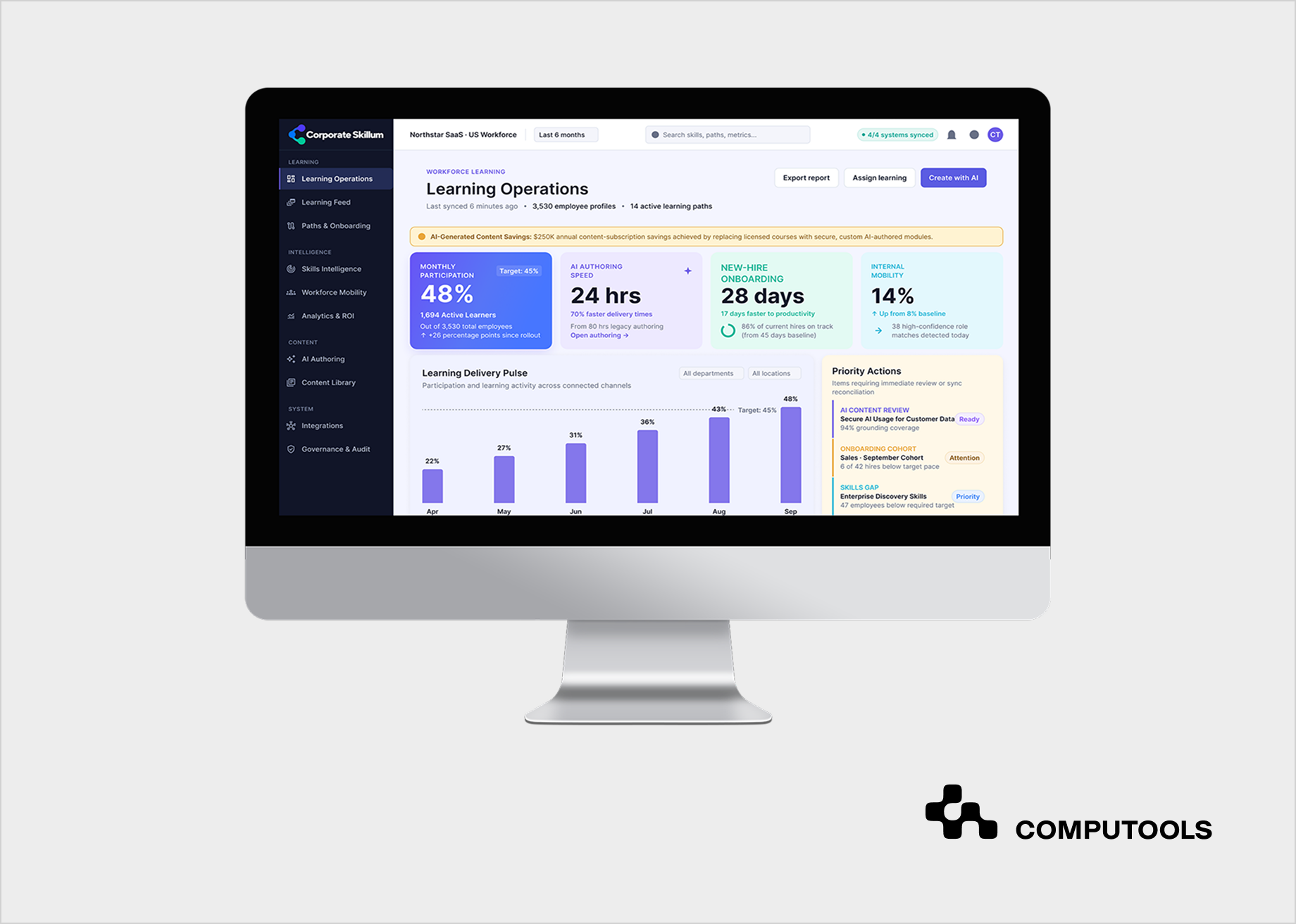
As a solution, we integrated BambooHR, the LMS, Slack and Microsoft Teams. The L&D team reviewed the modules. Other knowledge sources and approved PDFs supported the authoring process. We used Python and FastAPI for AI services; Pinecone and PostgreSQL for retrieval and structured records.
The client said time to create an interactive module decreased from 80 to 24 hours. The monthly learning participation rate increased from 22% to 48% within six months, and the time to productivity for new hires decreased from 45 to 28 days.
These results were project-specific and depend on the surrounding workflow. An AI course authoring platform relies on the integration of systems employees use, as well as the rules that govern the approval of course content.
How to build AI course authoring software: 8-step development guide
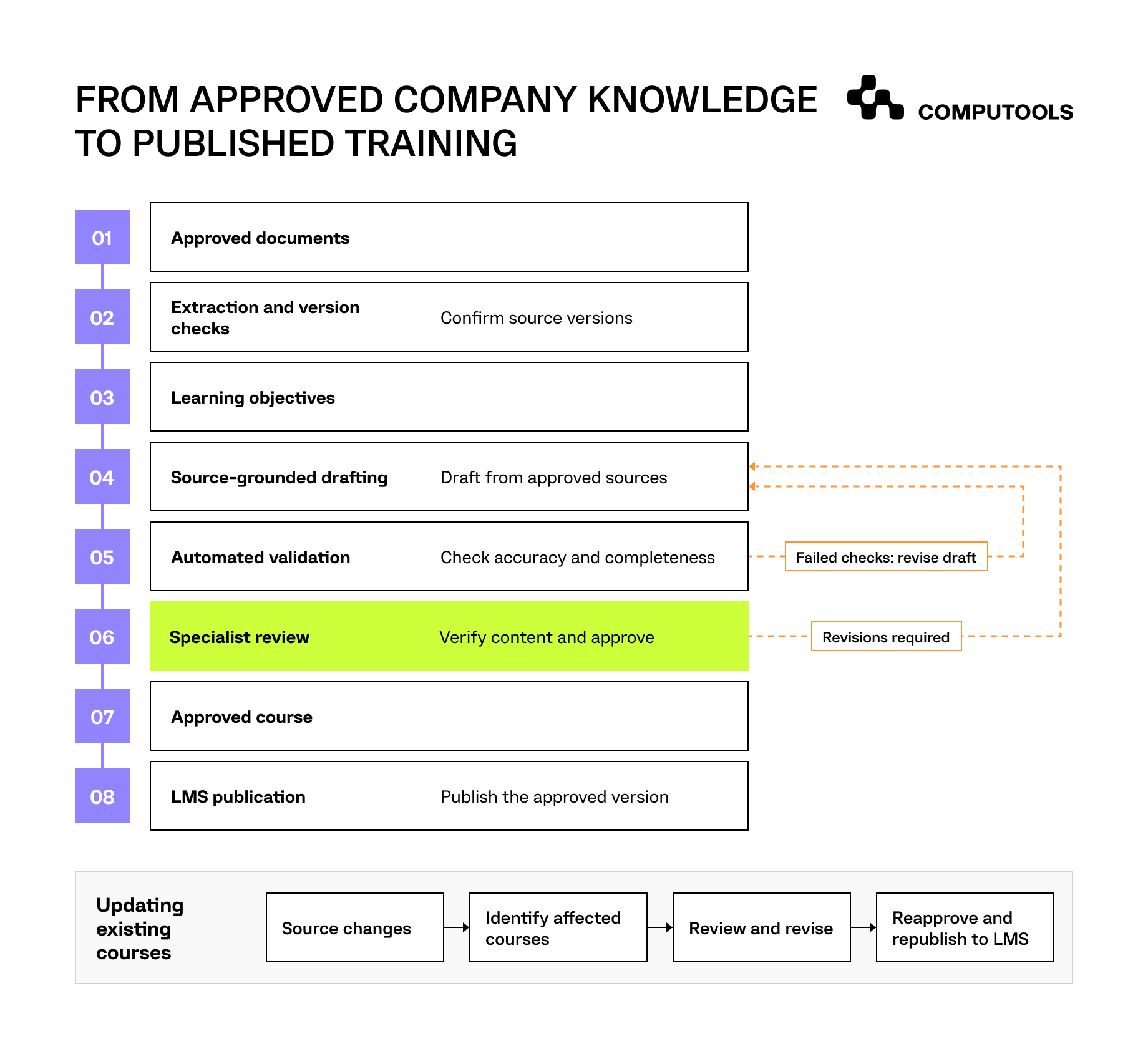
The following eight steps explain how to approach corporate learning content automation and make decisions on architecture, review workflows, establish integrations, and budget operating costs.
Step 1. Define the production bottleneck and investment case
Investigate the process by which a course gets created. Talk with people like authors, subject matter experts, reviewers, and LMS administrators. Note the steps and the amount of time they spend gathering information to create or change courses and LMS administrators to publish them.
This will help identify features of corporate training course authoring software that are most beneficial to clients and may illustrate areas where the technology puts unnecessary barriers to instructing. For example, if it takes less than 5 minutes to publish a course and the majority of the time is spent waiting for specialists to approve changes, the system should be evaluated against ease of course updates and review automation features.
Consider the expenses associated with modifying the current software to accommodate manual changes and the costs of integrating other services.
Build the first release around one clearly defined use case, for example, sales training or customer support. Identify what the source collection will be, determine the course format, choose reviewers, and decide where courses will be published before selecting a method.
Establish the financial case with approved output. Take the example of 20 modules produced monthly, saving 10 hours per module. This releases 200 working hours per month. If an illustrative loaded rate for an employee is $50/hour, the saving would be $10,000 before paying for the platform.
Make the distinction of released capacity from cash savings. A budget should be set for the development, model usage, hosting, review, maintenance and integration support. The proper measure is cost per approved course.
Step 2. Prepare company knowledge and define the course data model
When we deal with an employee training content creation, the knowledge provided to AI dictates the quality of AI. Inconsistent and inadequate training content happens when policies, presentations, and instructions that are out-of-date, incomplete, and contradictory are combined in one source.
Each knowledge source should be approved and versioned. There should be controls on who can view and edit the source. Extracted text should be preserved in relation to tables. Scanned documents should be checked for OCR errors.
A course data model should represent the relationships between training content and instructional sources.
| Record | Essential information |
| Source document | Owner, version, effective date, permissions |
| Learning objective | Target role, skill, expected action |
| Course module | Objectives, source references, language, version |
| Assessment item | Correct answer, explanation, supporting source |
| Publication | Approved version, reviewer, destination, date |
These relationships make updates manageable. When a refund policy changes, the system should identify the affected lesson blocks and questions for review. Corporate Skillum similarly grounded authoring in approved corporate materials.
Establish a rule for conflicting documents before generation begins. The system should flag uncertainty and request a source decision. Silently choosing between two policies creates avoidable operational risk.
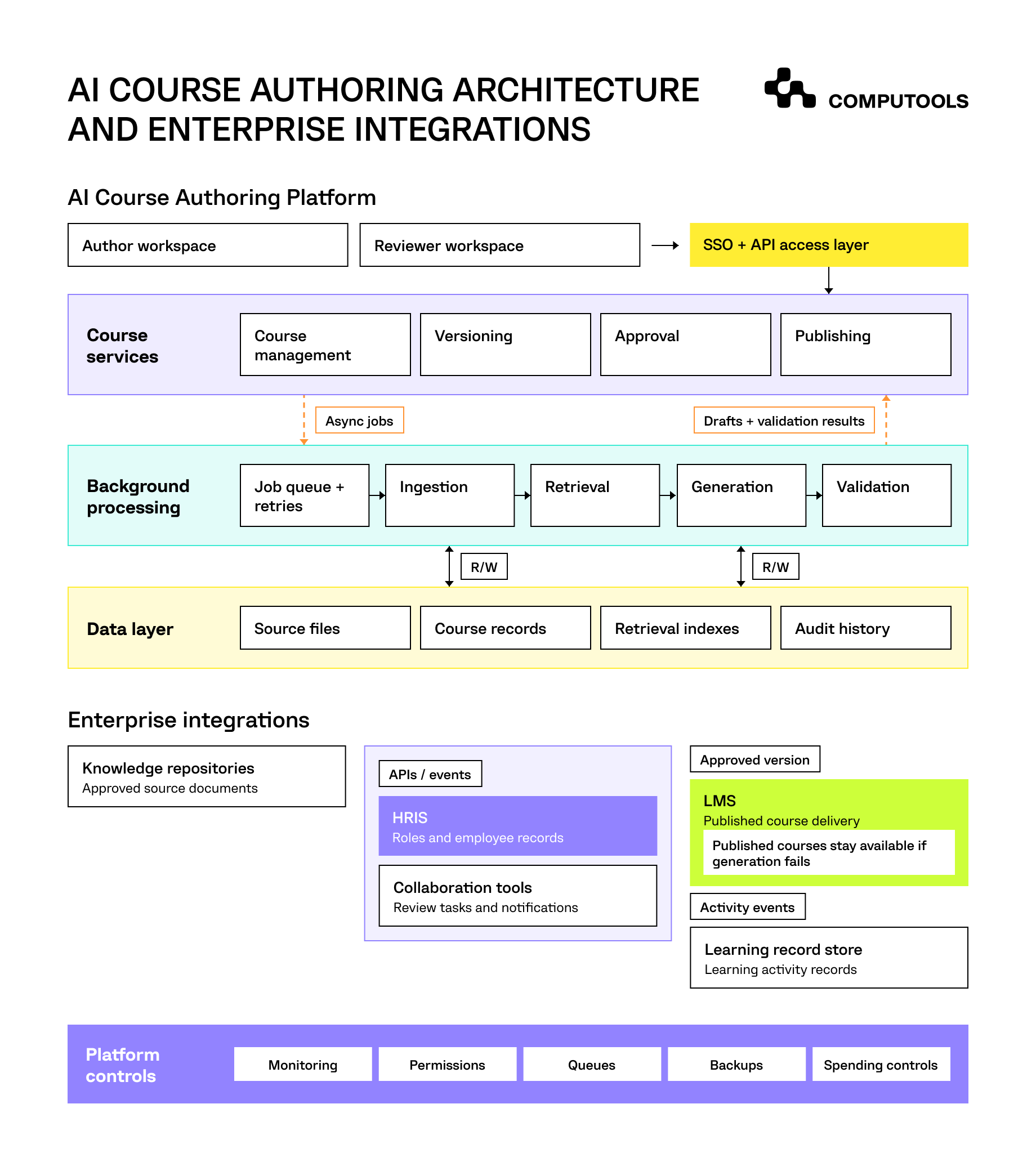
Step 3. Design generation around retrieval, structured output, and background processing
AI learning content generation software needs a controlled sequence of operations. Begin with learning objectives, retrieve relevant approved passages, generate an outline, and produce individual lessons and assessments.
Give reviewers outlines and factual statements that can be verified. Identify examples and policies of the company that have been generated by the model.
Though the model can complete company-related documents, it requires factual checks and reviewer approval. Restricted documents should be accessible only to authorized personnel.
It is important to separate the interactive editor from back-end processes.
Background processes should be as follows:
- extraction of courses and company documents;
- generation of company documents;
- translation of company documents;
- export of company documents.
Processes should be interruptible. Editing should be possible even when a document generation is in progress.
Use a relational database to store company documents and process workflows. Begin with architecture your team can operate. Separate processing workers where workload demands it; introduce additional services when scale or ownership justifies the complexity.
For related data ownership principles, see Computools’ guide to integrating SIS, LMS, and ERP systems, which examines these decisions in a university environment.
Step 4. Build an editor that supports review and controlled publication
The editor determines if automation saves time or makes extra work to clean up. Users should be able to inspect source documents, revise blocks of text, compare versions, and regenerate sections. Make sure they do not lose approved changes when a section is regenerated.
Define explicit workflow states (i.e. draft, automated checks, specialist review, approval, publication, retirement) and outline owners and exit conditions for each state.
Automated checks should assess if a claim is substantiated by the evidence, determine if terminology is correct, identify passages that are redundant, and point out assessment questions that are ambiguous. Instructional checks should assess if materials are useful. For instance, when training staff to resolve disputed charges, real-life scenarios would be more effective than multiple-choice questions.
For content approval, consider providing employees a unified workspace where they can view and approve content changes. Each employee should be able to review only the latest version of the content and approve only that version.
Step 5. Integrate publishing with the LMS, HRIS, and daily work tools
Define which system owns each record before connecting APIs. The HRIS typically supplies employee and role information. The authoring application owns course content and versions. The LMS may remain responsible for assignments, completion history, and mandatory training records.
In Corporate Skillum, the team preserved existing HR and compliance record ownership.
Your integration contracts should define stable employee identifiers, course identifiers, version references, and completion rules. Use webhooks where timely updates matter, supported by scheduled reconciliation to catch missed events.
Prevent duplicate processing when systems resend notifications. Failed publishing jobs need visible status, controlled retries, and an accountable administrator.
Choose interoperability formats according to the destination:
| Format | Main purpose |
| SCORM | Course packaging and runtime tracking in compatible LMS environments |
| xAPI | Recording learning activity in a learning record store |
| cmi5 | Adding defined LMS launch and course behavior conventions using xAPI |
These formats serve different roles. Test the actual combination of content package and LMS, including launch, resume, scoring, and completion behavior.
For frontline employees, validate delivery on phones and shared devices. Slack or Teams notifications may support access, but the destination still needs correct authentication and progress tracking.
Computools’ LMS Integration Guide explains additional considerations for HRIS, identity, communication, and reporting connections.
Step 6. Add personalization and automatic content maintenance
Once the core workflow produces reliable courses, expand into features that reduce recurring production work.
Personalized corporate learning should reflect role requirements, existing knowledge, and demonstrated skill gaps. Completing a course alone provides insufficient evidence of competence. Use relevant assessments and operational evidence where appropriate.
A venue operator, for example, might use one approved incident procedure to generate separate training for entrance staff, supervisors, and customer support. Each version should preserve the same rules while changing the decisions employees practise.
| Capability | Required controls | Operational benefit |
| Role-specific variants | Shared objectives and approved content blocks | Less duplicate writing |
| Scenario and quiz generation | Source-supported answers and specialist review | Faster assessment preparation |
| Multilingual drafts | Terminology glossary and local review | Shorter regional rollout cycles |
| Source-change alerts | Document comparison and dependency tracking | Faster course maintenance |
| Content reuse search | Permission and version filters | Fewer repeated modules |
Prioritize maintenance as much as generation. A source change should create an update task showing courses affected, owner, and publication status.
Automatic rewriting requires caution. A small procedural change may affect examples, questions, and translations differently. Propose any alterations for review, and then publish what has been approved.
This approach retains the flexibility to provide the most up-to-date training to the workforce, yet allows content owners to decide what training employees receive.
Step 7. Protect confidential knowledge and maintain continuity
When teams build AI course authoring software, security decisions should address specific consequences. For example, restricted information appearing in a course, unauthorized publishing, unexpected charges for LLM, and loss of access by employees due to an outage.
Use the enterprise’s authentication and least privilege permissions. Separate responsibilities of authors, reviewers, publishers, and administrators. Apply document permissions throughout ingestion, retrieval, generation and export.
OWASP identifies prompt injection and sensitive information disclosure as the two biggest risks with use of LLMs in a workforce setting. Uploaded material may contain instructions designed to redirect the model or expose information. Treat retrieved documents as reference content, and enforce authorization in application code.
Test attempts to retrieve restricted departmental content and to manipulate generation through malicious source documents. Validate generated output before inserting it into pages, packages, or downstream applications.
Review model-provider terms for training use, retention, processing locations, and access. Encryption, audit records, deletion procedures, and controlled logs should cover the complete data path.
Protect continuity by separating published training from generation services. An unavailable model provider should delay new drafts while existing approved courses remain accessible.
Set request quotas, job limits, and spending alerts. Test backups, restores, and rollback procedures. For platforms serving multiple client organizations, verify tenant isolation at every relevant data layer.
Step 8. Pilot the complete workflow and measure approved output
A useful pilot tests the entire production cycle. An illustrative scope of 10–20 modules gives teams room to examine different document formats, course lengths, roles, and assessment types before a wider rollout.
Select representative material, including difficult sources. Clean documents alone will conceal extraction problems, conflicting instructions, and missing context.
Define acceptance criteria before testing. Review factual accuracy, source support, instructional quality, accessibility, permissions, publishing behavior, and recovery from failed jobs. Set explicit thresholds for critical errors and required reviewer approval.
Measure the economics alongside quality:
| Metric | What it reveals |
| Source approval to publication time | Whether the complete workflow is faster. |
| Reviewer correction hours | Whether generation reduces total labor. |
| Cost per approved module | Whether production economics improve. |
| Source change to course update time | Whether maintenance keeps pace. |
| Role-specific assessments | Whether employees understand required actions. |
Test peak authoring demand separately from employee access. A batch of translation jobs should not make the editor unresponsive.
After launch, use representative evaluation courses when models, prompts, or retrieval rules change. Compare onboarding and performance outcomes using reasonably similar groups, accounting for other operational changes.
For broader measurement considerations, Computools’ article on the role of big data in education discusses learning analytics and the importance of usable data.

Build custom AI course authoring software to lower L&D operating costs, reduce cost per approved course, and get employees productive faster through more efficient content creation and maintenance.
Why choose Computools for AI course authoring system development?
Your training investment should reduce the time between a business change and employees knowing how to act on it. Computools builds the authoring workflows, integrations, and data controls that make that possible.
Through education software development services, we start with the work consuming your team’s productivity: repeated course updates, slow approvals, disconnected records, or inconsistent regional content. We use our knowledge of eLearning software development and EdTech software development expertise to address and eliminate these bottlenecks. We develop a custom plan that outlines specific delivery steps with acceptance criteria to measure progress.
AI development and data engineering, when paired with approval processes, introduce automated drafting and review workflows. Our solutions allow your subject matter experts to spend less effort assembling information and more time making decisions.
Web development services give authors and reviewers practical tools to manage versions, resolve feedback, and publish eLearning content through integrated systems.
Our clients can expect a measurable business impact, including a reduction in the cost per approved course, the number of hours spent in reviews, and the time required for updates. We use a phased approach to ensure the solution is effective before widespread deployment. After an implementation, we provide support to help our clients manage the cost of training as demand grows.
Build a training operation that keeps courses current
When a process changes, there should be procedures in place to revise lessons and assessments and to have them approved and published. Identify and document such rules. Each revision should follow a known path to completion.
Track the true investment associated with authoring a training component. This includes the time spent correcting by reviewers, and the effort invested in publishing and updating components.
Identify a single recurring training need and establish its current cost and turnaround time. Make sure that the pilot project reduces the expenses associated with publishing an approved component. Achieving this standard will enable your team to focus on more valuable work.
Computools helps teams initiate an automation pilot and streamline approval and publishing processes.
Computools
Software Solutions
Computools is an IT consulting and software development company that delivers innovative solutions to help businesses unlock tomorrow.