
THE AUTHOR:

Companies planning to develop a skills intelligence platform need answers to questions about growth and cost. Who is ready for the next project? Who is eligible for promotion with additional training? Where do gaps in the workforce require hiring? Managers must have real-time information on employee skills, roles and actual employment to make these decisions.
This information is available in most organizations but in various locations. HR systems log jobs and departments. Learning platforms inform of courses that have been completed. Project records tell of experience. Contributions from managers are included. The challenge is to integrate these sources and determine their relative importance.
Suppose a company is going to introduce a new product in three different regions. It has to hire implementation and support teams as well as sales management by a set date. For this, the team requires a reliable estimate of its existing workforce to plan its hiring budget, allocate training and schedule staffing.
Computools addresses this by providing IT consulting services, AI-driven software development, and tracking against agreed KPIs. The business action identified for improvement is the starting point. It then forges the roadmap and functional and non-functional requirements.
This guide provides helpful instructions on structuring skills information, validating assessments, integrating workforce systems, and turning capability gaps into action plans for staffing and development.
Why develop skills intelligence platform capabilities for workforce planning?
The shortage of skills slows down the business. The Future of Jobs Report revealed that 63% of employers saw lack of skills as a primary factor in preventing business transformation from 2025 to 2030. A Skills-First Labour Market report covers similar issues in relation to skills being more relevant in recruitment and talent management.
The challenges facing executives at the operational level are manifested in projects being delayed or stalled, extended vacancies, or the necessity of training interventions which are unsure of their return on investment.
A skills-based workforce planning platform matches the capabilities of employees with the needs of the business. The outcome of the match shows employees who are available and ready to perform the work.
| Business question | Information required | Decision supported |
| Can we staff the next project internally? | Verified skills, proficiency, availability | Reassignment or recruitment |
| Which training deserves funding? | Required capabilities and demonstrated gaps | Development priorities |
| What could delay a service launch? | Critical skills, coverage, preparation time | Hiring and launch planning |
| Who is ready for an internal move? | Role requirements, evidence, employee interests | Candidate assessment |
The business value comes from acting earlier. Managers gain time to arrange training, consider internal candidates, or adjust hiring plans before missing capabilities delay work.
How Computools made workforce skills more visible
In the Corporate Skillum project, Computools worked with a US B2B SaaS company with 3,530+ employees. HR records, learning histories, and skills details in spreadsheets provided an incomplete view of the workforce’s capabilities.
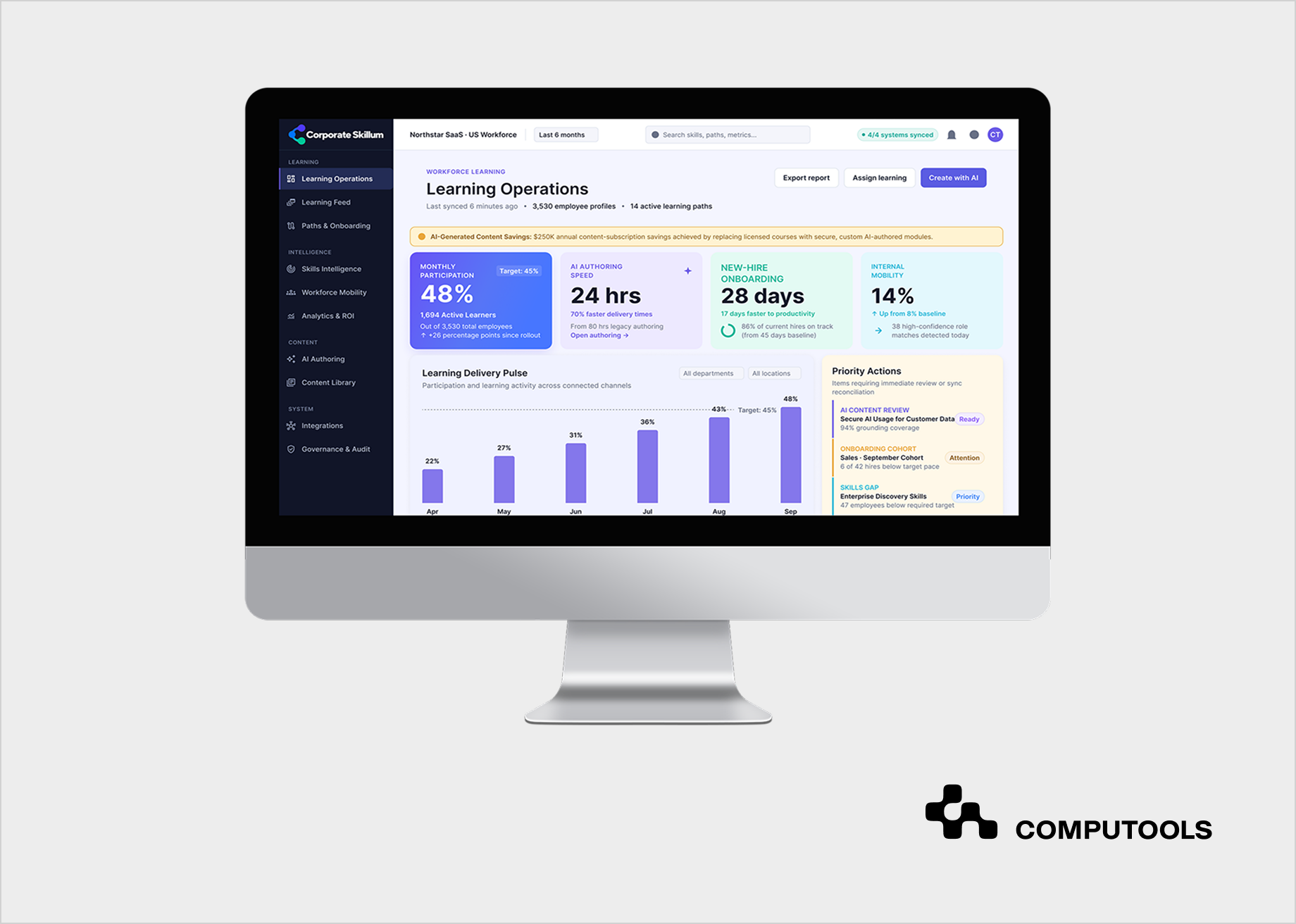
First, our team integrated BambooHR with the LMS, Slack, and Microsoft Teams. The platform connected employee roles with learning records and capability requirements for skills analysis and development.
PostgreSQL stored structured workforce and skills data. Python and FastAPI provided analytical services. BambooHR and the LMS kept their respective responsibility for workforce records, along with compliance and historical completion information.
As a result, internal mobility increased from 8% to 14% over two quarters among active platform users. Time-to-productivity for new sales and engineering hires reduced from 45 to 28 days.
This case illustrates the importance of integrating workforce information and automation. Prior to a significant investment, it is necessary to assess the highest priority business decisions and define measurable performance targets for each.
How to build a skills intelligence platform: 8 development steps
This process will require consideration of multiple elements of the business, the development and validation of data models, integration of AI and other technologies, evaluation of architecture and ongoing services.
Step 1. Establish the business case through discovery
Select a workforce planning task related to deliverables, costs, or growth, e.g., staffing, succession planning, identification of high-potentials, and readiness for advancement.
Meet with the people responsible. Watch what information they consider and the actions they take. Note the risks and consequences of bad decisions. Operating HR and L&D partners, and sometimes line partners, should be part of the meeting.
Analyze the effort required. If ten managers spend 6 hours each month reviewing employee skills, the total effort is 60 hours. Calculate the true fully loaded cost of a decision and consider the opportunity cost of not making it at all. Test your calculations using company finance records.
Determine a company baseline. Establish a baseline before the pilot. Record how long managers spend checking prerequisite training, how often candidates fail those checks, and how frequently assignment lists need revision.
Step 2. Create a shared skills vocabulary and proficiency framework
Reliable workforce skills mapping requires consistent definitions. Different departments may use “client onboarding” and “customer implementation” for overlapping responsibilities, while a broad label such as “data analysis” may cover several distinct capabilities.
Begin with the roles selected during discovery. Define their critical tasks, required skills, expected proficiency, and acceptable evidence.
Public frameworks provide reference material. The European Commission’s ESCO classification describes skills and occupations and provides APIs for their relationships. The O*NET site describes occupations with skills, tasks, and work requirements. Your internal specialists should assess how well these descriptions suit your operating environment
Describe proficiency through behavior you have directly observed.
| Level | Illustrative expectation |
| Foundational | Explains the procedure and completes guided tasks. |
| Independent | Performs standard tasks without assistance. |
| Advanced | Resolves exceptions and handles complex cases. |
| Expert | Defines practices and evaluates others’ work. |
Definitions of skills should be steadily identifiable. Keep a history of each definition, including its owners and versions. Document synonyms and relationships.
To develop a skills intelligence platform, skill definitions, credentialing activities, and learning activities should be distinct. A recent work example can demonstrate ability, and a certificate can define a prerequisite, but preserving that distinction improves recommendations.
Step 3. Build employee profiles around traceable evidence
Employee skills mapping software becomes useful when managers can inspect the basis of a profile. Source, assess, validate and define limitations for each claim.
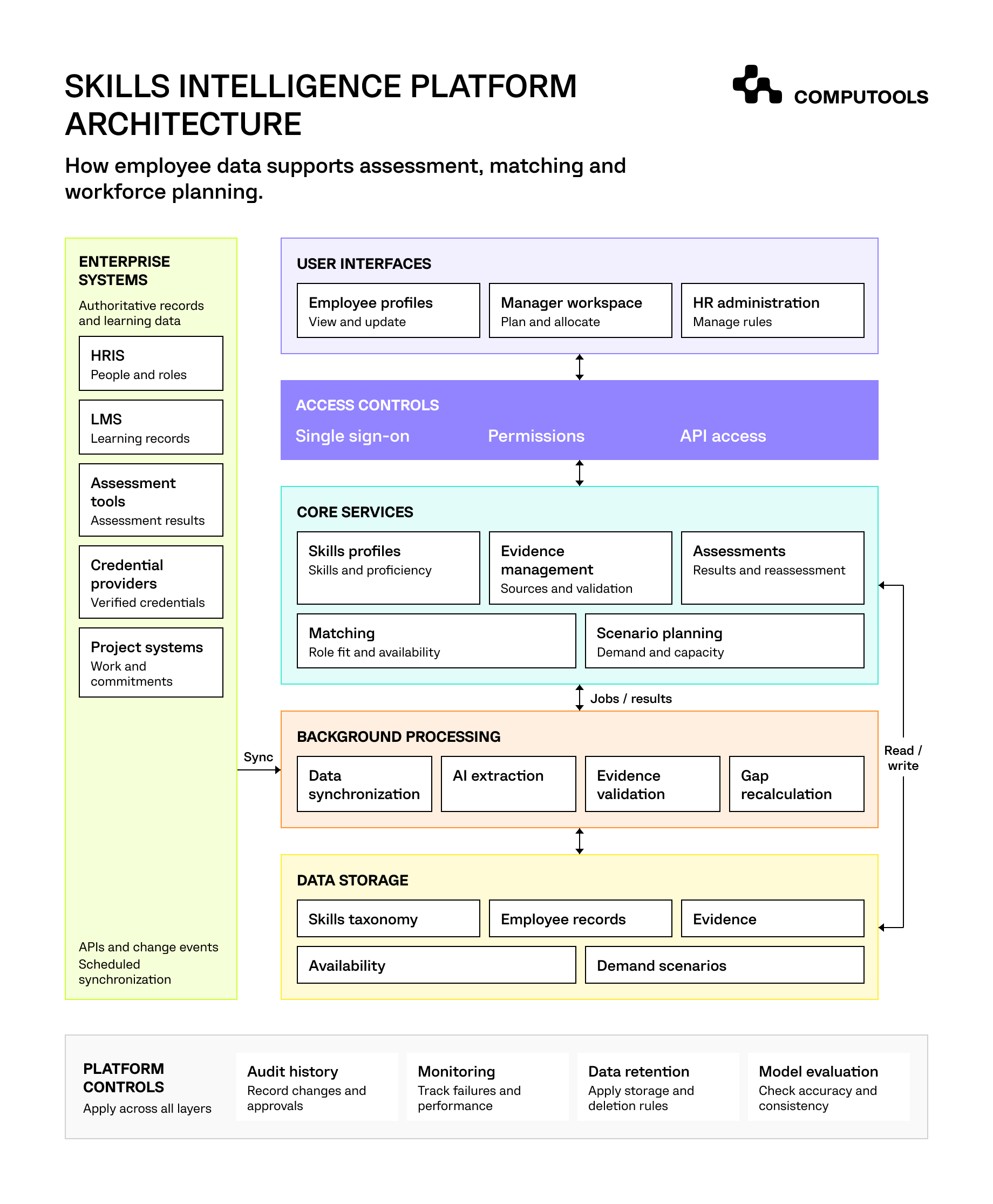
Connect HRIS, LMS, assessments, credentials and approved projects through persistent employee identifiers. Determine which application or system of record is for employment and organization data, learning and performance information.
Data engineering brings an employee’s training history, assessment results, and project experience into one consistent profile. It resolves duplicate records, aligns skill definitions across systems, and preserves each source and assessment date, giving managers a clear basis for judging whether the evidence is current and relevant to the role.
| Entity | Essential information |
| Skill | Identifier, definition, framework version |
| Employee skill claim | Skill, claimed proficiency, validation status |
| Evidence | Source, date, assessor, result, expiry where relevant |
| Role requirement | Skill, minimum proficiency, mandatory status |
| Availability | Dates, allocation, location, constraints |
| Demand scenario | Required capabilities, quantities, dates, assumptions |
Categorize information as verified, self-reported, imputed and obsolete.
Integrate data sources to support the implementation of the most business-critical function first. Define the duration each data element must be available to support ongoing planning. Reconcile records for employee transfers and/or terminations.
When building Corporate Skillum, the Computools team defined data ownership before implementing synchronization. BambooHR remained responsible for employee and role records. LMS held compliance and completion history. We used PostgreSQL to consolidate normalized workforce profiles, learning records, and skill relationships for analysis.
Computools’ LMS Integration Guide explains related connections between HR, learning, identity, and reporting systems.
Step 4. Add AI extraction and assessment with clear validation rules
An AI skills intelligence platform may extract and harmonize candidate skills from various sources and suggest skills and evidence that may need review.
Define success for each function. For skills extraction, consider the time saved in creating candidate profiles and the additional work required to modify the AI’s output.
Skill associations should be supported by evidence. The strength of the evidence may impact the level of confidence in the employee’s skill proficiency.
Use structured exercises, realistic work samples and scoring rubrics for AI-powered skills assessment. AI should not be relied upon to make final decisions. Prior to utilizing results generated by an automatic assessment, compare them with the findings of qualified evaluators.
Keep confidence separate from proficiency. The model might confidently identify a technology in someone’s work history while having limited evidence of advanced ability.
The AI development process should test employee competency analysis for relevant positions across different languages and/or forms of evidence. Retain source references, model versions, and state the reason when information is absent. There should be obvious ways for users to correct and approve.
In the case of Corporate Skillum, we utilized Python and FastAPI to implement learning recommendations and analysis of skills. In addition to structured workforce records, these services provided the team with distinct application workflows, AI processing, and data storage components.
Step 5. Calculate gaps against demand, timing, and capacity
Workforce skills gap analysis begins with a defined business requirement. To develop a skills intelligence platform, translate project plans and expansion targets into skills, proficiency levels, quantities, locations, and dates.
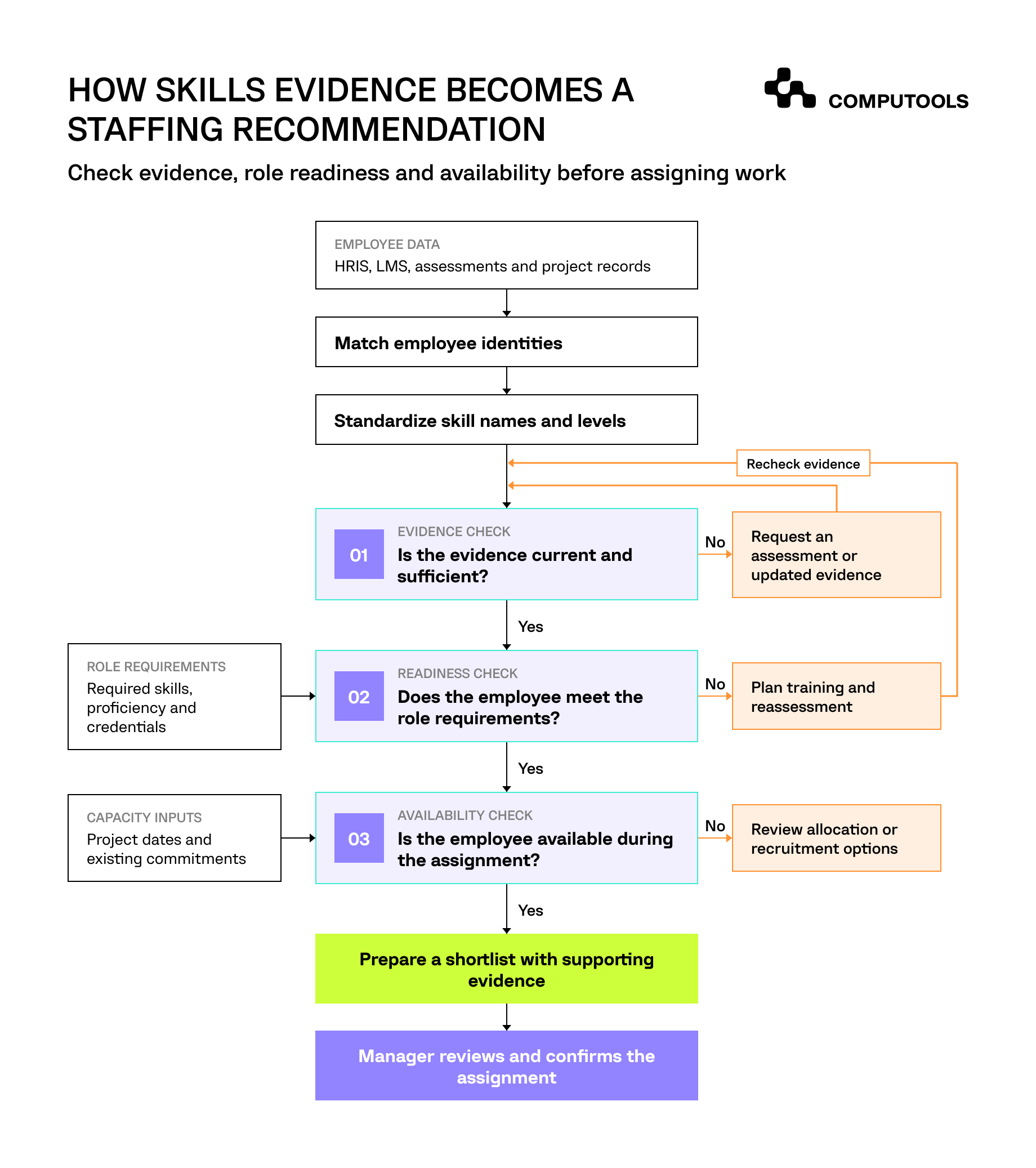
Suppose a launch requires six implementation specialists next quarter. Ten employees list the relevant skill, six meet the required proficiency, and four are available during that period. The immediate staffing gap is two people.
This illustrative example shows why capability and capacity must be evaluated together.
Effective skills gap identification distinguishes three situations:
| Gap | Required action |
| Evidence is incomplete or outdated | Assess or validate the capability |
| Proficiency falls below the requirement | Plan development and reassessment |
| Qualified people are unavailable | Adjust allocation or add capacity |
Include mandatory credentials, preparation time, and existing commitments. A candidate who could qualify after six months of development may be unsuitable for work beginning next month.
Prevent double-counting across simultaneous projects. Availability calculations should reflect the portion of each employee’s time required by an assignment.
Prioritize gaps according to their effect on delivery. Missing expertise that threatens a contracted deadline requires a different response from a longer-term development opportunity.
Ask operations managers to validate the calculations against real staffing examples before adding more complex forecasting.
Step 6. Compare staffing and development scenarios
Workforce capability planning should show managers the available options and their consequences. These may include internal reassignment, development, recruitment, temporary specialists, or changes to delivery scope.
Each scenario needs cost assumptions, lead times, dependencies, and unresolved constraints.
| Option | Information needed before approval |
| Reassign employees | Verified readiness, availability, impact on existing work. |
| Develop internal candidates | Missing skills, prerequisites, training time, reassessment. |
| Recruit | Role requirements, hiring lead time, onboarding capacity. |
| Engage temporary specialists | Expertise, duration, access, handover needs. |
Allow planners to adjust demand, start dates, and allocations. Preserve scenario versions so leadership can understand how changed assumptions affect the recommendation.
Connect development actions to specific missing capabilities. eLearning software development supports the link between learning assignments, assessments, and skills records. Be sure to require suitable evidence before treating a gap as closed.
Internal opportunity matching needs to take employee interests into account together with their skills, location and availability. Records of reason codes given by managers for accepting or rejecting recommendations will help to discover and implement missing rules to improve the recommendation process.
Analyze benefits and cost savings separately. Reduction in administrative costs and improvements in readiness of the organization to carry out its business should be considered separately. Each of these should be operationalized with clear definitions and methods of measurement.
Step 7. Deliver secure workflows through short development cycles
As the volume of data managed by the system increases, the architecture should support automation of more and more analytical processes. Design systems to prioritize concurrent access to limited data.
Use logical design to incorporate integration with other services, artificial intelligence and processing power. Systems should integrate with different organizations through controlled access and single sign-on.
Through web development services, these functions become usable workflows. Employees inspect evidence and request corrections. Managers compare staffing options. HR teams maintain role requirements and assessment rules.
Computools’ AI-native software engineering model applies AI across specification, development, testing, and review. Where scope and dependencies allow, working additions may be delivered in days. Each release still requires acceptance checks, integration testing, and accountable engineering review.
Apply permissions, encryption, audit history, retention rules, and access reviews throughout the design. Display data freshness and scenario timestamps. Test alternative assessment routes for employees whose work produces fewer digital records.
Computools’ guide to integrating SIS, LMS, and ERP systems provides a related example of data ownership and synchronization in a university environment.
Step 8. Run the platform against agreed KPIs
Computools piloted Corporate Skillum with Sales and Engineering teams before expanding to approximately 3,530 employees. Two-week iterations incorporated usage data and L&D feedback, with acceptance criteria covering integration reliability, skills-data quality, learning participation, and onboarding performance.
The pilot should establish whether better information improves actual workforce decisions. Select a real planning cycle, representative roles, and users responsible for acting on recommendations.
Test extraction quality, assessor agreement, profile freshness, and capacity calculations. Include conflicting evidence, expired credentials, transfers, and overlapping assignments.
| KPI | Business question |
| Time to prepare a staffing shortlist | Has planning effort decreased? |
| Verified coverage of critical skills | Is there usable evidence for priority roles? |
| Recommendation acceptance and rejection reasons | Are suggestions relevant and credible? |
| Time to close validated skills gaps | Are development actions improving readiness? |
| Internal placement and time-to-productivity | Are workforce outcomes improving? |
| Cost per completed profile review | Is the operating model sustainable? |
Assign responsibility for routine processing, exceptions, and improvement. Automation may handle synchronization checks, reassessment reminders, and preparation of review queues. Define who resolves failures and approves consequential changes.
Recheck results after changes to models, role definitions, and integrations. Track operating costs alongside recommendation quality.
For further context on learning data and measurement, see Computools’ article on the role of big data in education.

Reduce hiring costs, fill critical roles faster, and improve workforce productivity with a custom AI-powered skills intelligence platform built to increase internal mobility and shorten time-to-productivity.
Why choose Computools for skills intelligence platform development?
Your next project may require the skills that already exist within your company. Computools helps build the data connections, assessment workflows, and planning tools that allow organizations to evaluate their own talent before going down the recruitment path.
Define the return before committing the budget. Your platform should justify its cost through better staffing decisions or lower the effort and time needed to plan for growth. Our Discovery process takes 1 to 2 weeks to identify staffing-related delays and waste. We provide you with a prioritized roadmap showing cost, dependencies, and targets.
Leverage our integration expertise. At Uni-Campus, we joined academic, learning, financial, and identity systems, cutting synchronization time from 24 to 48 hours to less than 5 minutes.
In the British Council, the integration blended prepared materials and behavioral analytics to create a learning portal. This experience informs the work we’re doing on skills intelligence to establish reliable methods to exchange information and clear ways for employees to develop the skills and capabilities required to perform the next role.
Put working features in your managers’ hands early. We use AI to speed up writing specifications, coding, testing, and reviewing changes. The team delivers working features in short cycles, so your managers can test tasks such as finding qualified employees or comparing staffing options before the full platform is complete. Engineers check the code, security, and integrations before each release.
Through education software development services and EdTech software development expertise, we can connect identified gaps with learning and reassessment. For your workforce platform, that means linking missing skills to relevant training, recording reassessment results, and showing managers which employees are ready for upcoming assignments.
After launch, staffing speed, recommendation quality, internal placements, and operating costs guide your further investment.
Start with the workforce decision that costs you most
Before approving new hires, check whether existing employees meet the requirements and are available when work begins. Separate confirmed skill shortages from missing information. An employee with old assessment results may need additional validation. A qualified employee who is committed to another project creates a capacity problem. Each requires a different action.
Build the first release around a staffing requirement and show qualified candidates, supporting evidence, and current commitments. Compare the shortlist with your current process and identify the number of preparation hours, the candidates missed, and the inaccuracies in your records that caused the corrections.
The IT consulting services by Computools help assess data and system integration readiness within a period of 1 to 2 weeks. AI-native software engineering then turns the agreed scope into working features, with staffing accuracy, planning time, and operating costs guiding validation and further development.
Computools
Software Solutions
Computools is an IT consulting and software development company that delivers innovative solutions to help businesses unlock tomorrow.