
THE AUTHOR:

LMS HRIS integration is becoming essential for companies managing training across different departments, locations, and employee groups.
Though a tight budget means companies may need to get creative to keep learning programs, they are also concerned that training hours aren’t necessarily focused on the right skills. SHRM Learning and Development Benchmarking Report stated that while the median training hours remained the same, L&D spending per full-time-equivalent employee decreased by 28% compared to the previous year.
According to the LinkedIn Workplace Learning Report, 49% of learning and talent development professionals stated their executives were concerned about employees not having the necessary skills to execute the company’s business strategy.
When it comes to addressing employees’ skills and training, SHRM and LinkedIn both identify the same operational issue. HR teams have data about employees’ job titles, departments, and/or transfers. Learning platforms store information about courses, assessments and/or certifications. Without system integration, data exists in silos. Connecting the systems allows organizations to be responsive to employee changes, manage employee learning records and deliver training based on the job requirements of the employee.
A challenge is to decide which application controls each record, how data moves between the systems and what happens in case of a synchronization failure.
This article provides information about the integration of HRIS and LMS and includes details about data mapping, architectures of integration, training rules, security and implementation.
LMS HRIS integration for employee training: What changes for HR and L&D?
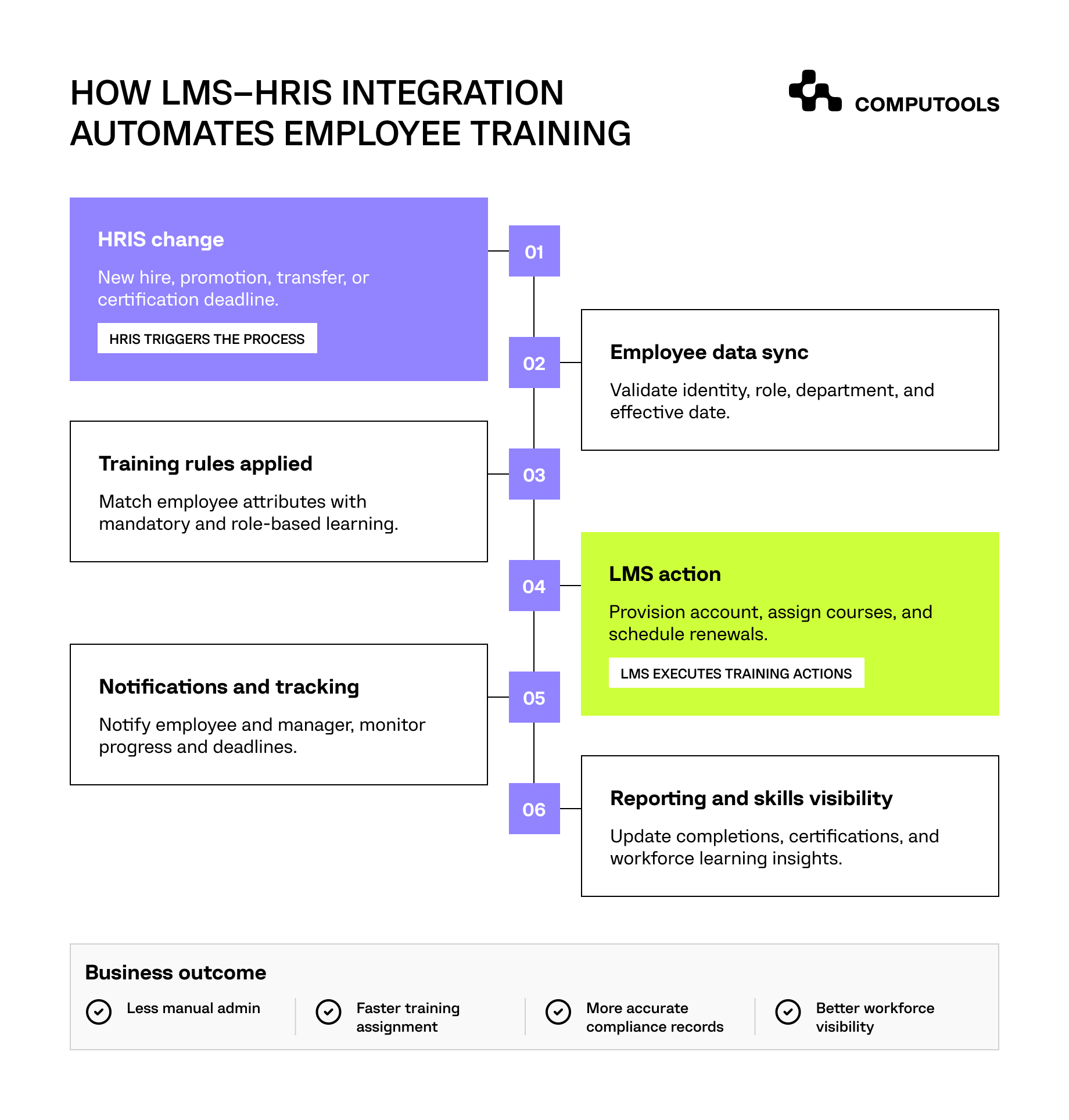
HRIS and LMS have different functions. HRIS records employees’ identities, job functions, department and management structure as well as employment status. LMS captures training assignments, completions and assessments, as well as certifications.
Linking them enables user changes in the HRIS to trigger learning activities. They also allow for consistent, concurrent learning records.
| Without integration | With connected systems |
| HR manually creates and updates LMS accounts. | Approved employee changes trigger account updates. |
| Training assignments rely on manually entered job data. | Course requirements reflect current employee roles. |
| Promotions and transfers require manual corrections. | Job changes trigger a review of learning requirements. |
| Managers request completion reports from L&D. | Authorized managers access current training status. |
| Certification renewals require manual checks. | Expiration dates trigger reminders or reassignment. |
| Skills information is scattered across applications. | Connected records support workforce skills analysis. |
However, connecting the databases is only part of the solution.
A company must also establish how employee changes affect training requirements, how historical records are preserved, and which system has authority over each type of information.
These decisions determine whether the integration reduces administrative work or introduces new inconsistencies.
Corporate Skillum: How Computools connected HR, learning, and skills data
A B2B SaaS company based in the US with over 3,500 employees faced a familiar challenge: its HR and learning applications didn’t integrate, and the data was difficult to use jointly.
BambooHR kept employee records, and an old LMS housed mandatory training and historical completions. Learning activities used a combination of Slack, Microsoft Teams, and internal documents. Employee skills were tracked in spreadsheets.
As the company grew, the L&D team had trouble keeping learning content current. Creating a training module was estimated at 80 hours and HR leadership had limited to no visibility into employees’ learning needs.
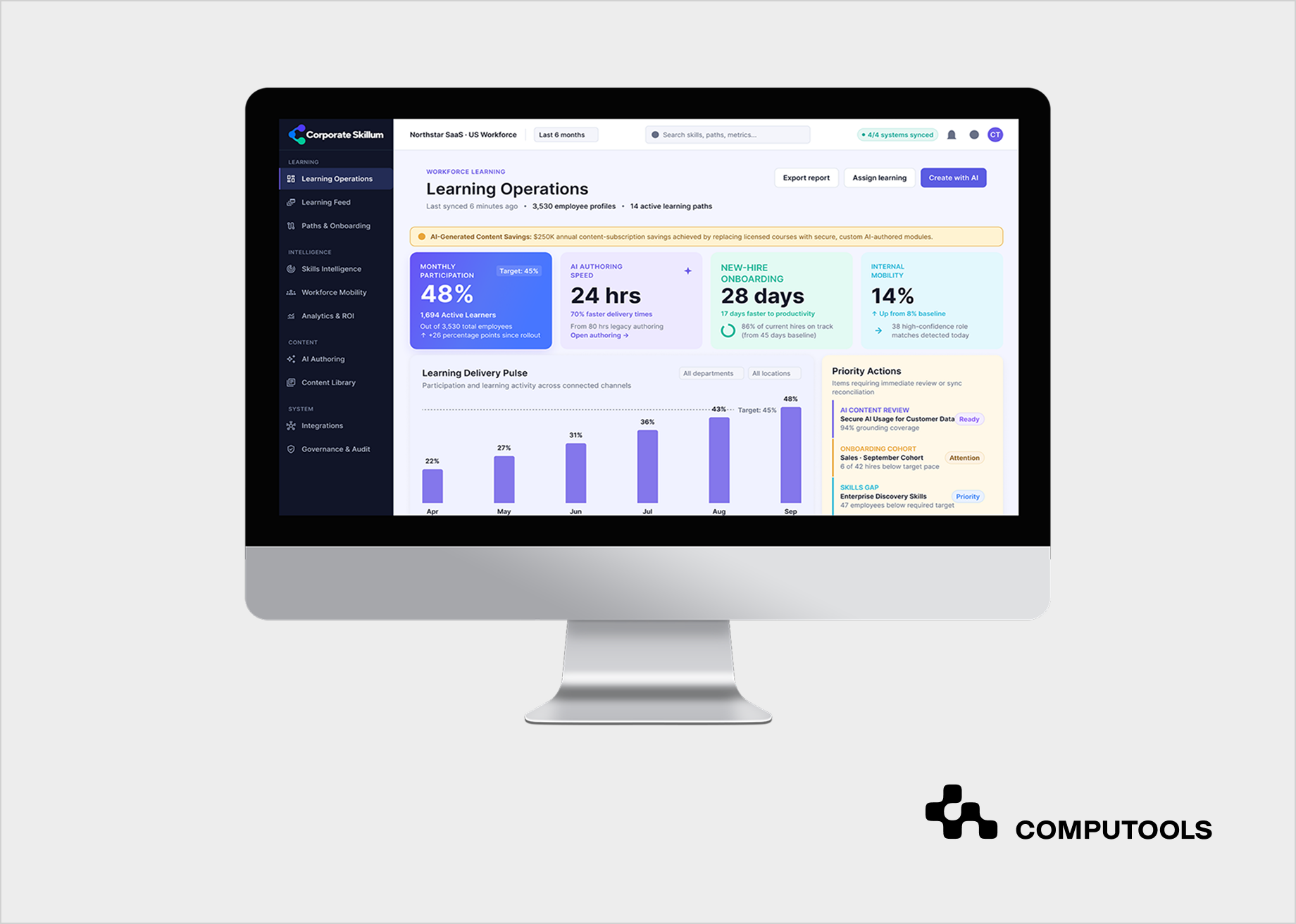
Computools resolved this challenge with Corporate Skillum, an AI-powered learning and skill development platform for the enterprise.
The solution integrated BambooHR with the client’s existing LMS and collaboration applications. BambooHR retained responsibility for employee records. The LMS continued to manage compliance records and learning history.
The Computools team used a mix of Node.js and NestJS services for application logic and integrations, PostgreSQL for structured data, and Python, FastAPI, and Pinecone for AI-assisted learning functionality.
Employee roles, training records, and competency requirements were brought into a coordinated learning environment. Staff could access short learning activities through Slack and Microsoft Teams, while L&D specialists used AI to prepare training content from approved company materials.
There were significant improvements, with the company reporting approximate annual savings of $250,000 from cancelling redundant learning subscriptions
| Business indicator | Before | After |
| Monthly learning participation | 22% | 48% |
| Course authoring time | 80 hours | 24 hours |
| New-hire time-to-productivity | 45 days | 28 days |
| Internal mobility among active platform users | 8% | 14% |
The improvements were attributed to a broader learning modernization project focused on integrations, use of AI to assist learning, skills mapping, and more accessible training.
How to Integrate LMS With HRIS: 8 Development Steps
Connecting two enterprise platforms can be challenging because of changing job roles and training requirements, historical data, varying security permissions, and situations where information becomes inconsistent or is received late.
The following steps explain how to design the integration around these operational requirements.
Step 1. Audit existing systems and define data ownership
The first issue to resolve is to figure out which of the systems can be trusted to provide correct employee information.
To illustrate, suppose the HR software shows an employee as a finance manager, and the LMS as a finance analyst. When systems don’t agree on a source of truth, training assignments can be based on outdated information.
A reliable LMS and HRIS integration will always need an assessment of data ownership. Generally, the HR system is authoritative for employment information, such as employee ID, department, job position, reporting manager, etc. In an integrated solution, the LMS should retain ownership of course assignments, completion and assessment results, and certifications.
Organizations may also use separate identity and skills platforms, each with its own responsibilities.
| Data category | Authoritative system |
| Employee ID, position, department | HRIS |
| Reporting manager and employment status | HRIS |
| User authentication and account access | Identity provider |
| Course assignments and completions | LMS |
| Certification history | LMS or designated certification system |
| Verified competencies | Approved skills or assessment platform |
It is preferable for the integration to exchange information based on these responsibilities rather than allow any app to update any record.
Documenting exceptions is important. Some training requirements may come from legal and/or compliance teams, and others may be from a department’s policies.
For more information on evaluating learning platforms and their integration with business applications, view the Computools LMS Integration Guide: 7 Steps for eLearning Businesses.
Step 2. Design a consistent employee and learning data model
Employees are described differently in various HR and LMS applications. The same employee may have different IDs and be referred to by different names, titles or departments in different applications.
Having reliable LMS HRIS data integration requires using consistent definitions and models to connect data without resulting in data duplication. It requires having stable employee identifiers and mapping such employee IDs to corresponding account IDs in both HR and LMS applications.
The model should illustrate employment, roles, and assignments, as well as training and courses. It should define and indicate various enrollments, completions and certifications; and describe various fulfillment of duties. It should illustrate training requirements and courses completed.
In the example above, if the employee is later transferred to the finance department, the system should determine if the employee meets the requirements to perform the functions in the new department.
Step 3. Choose the integration architecture and synchronization method
There are several ways to connect an HRIS with an LMS, but the appropriate approach depends on the existing software and the complexity of training rules.
| Integration approach | Suitable scenario |
| Native connector | Standard platforms with supported integrations and simple requirements. |
| Integration middleware or iPaaS | Several applications that need coordinated data exchange. |
| Custom API integration | Proprietary systems, complex learning rules, or specialized data models. |
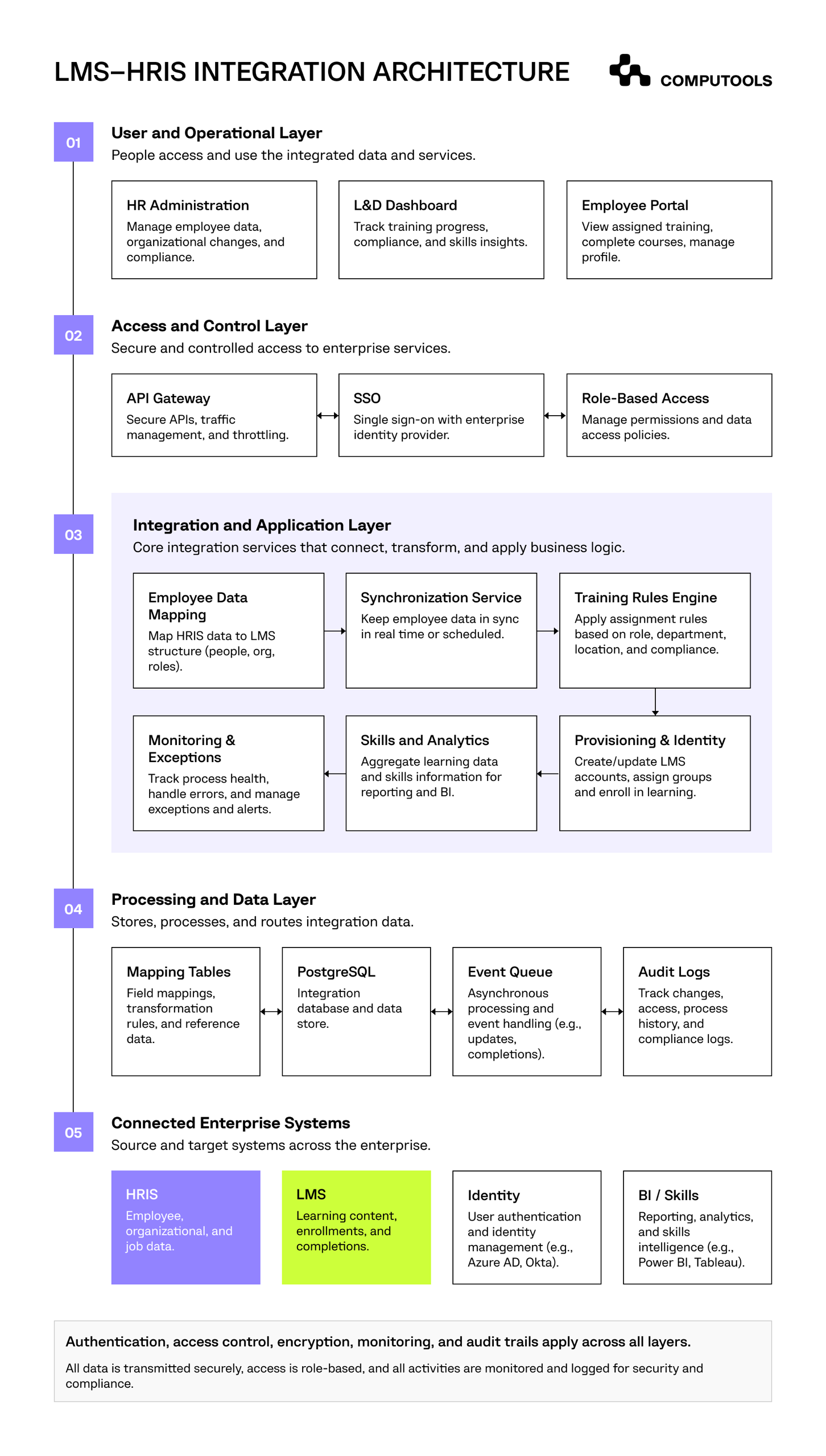
An integration layer can validate and transform records, process updates, and monitor failures.
Employee learning data synchronization typically leverages event-driven updates with scheduled reconciliations.
BambooHR employs webhooks to notify external services of employee changes. This minimizes polling for changes in the HRIS.
However, webhooks do not ensure reliable data synchronization. Asynchronous conditions may lead to inconsistencies with learning data, such as outages with an LMS, lag in the network, and API throttling.
Event queuing, retries, detection of duplicate events and periodic checks to compare records in the systems are some of the elements that should be included in the architecture.
In the case where an employee moves to a new department, the integration should get the event and retrieve the latest HR record, update the LMS record, and assess if the employee requires training in the new department.
If an LMS is unavailable, the update should still be processed upon restoration of the connection.
The same architecture principles apply to other education systems. Computools explores similar data ownership and synchronization challenges in How to Integrate SIS, LMS, and ERP Systems in Higher Education.
Step 4. Automate user provisioning and training assignments
An employee’s first working day should not begin with HR manually creating accounts and asking L&D to assign introductory courses. A connected platform can respond to approved hiring events and prepare the required learning activities automatically.
HRIS LMS integration for corporate learning should distinguish two separate processes: creating the employee’s learning account and determining which courses that employee must complete. User provisioning can be managed through identity services, using standards such as SCIM 2.0 where supported. Authentication may rely on SAML or OpenID Connect. Training assignment requires an additional rules engine.
When hiring a financial operations specialist in Germany, how might training be determined based on variables such as the department, location, employment type, the employee’s security and compliance responsibilities?
Training might occur in this order:
An employee record is created and the employee is given access to the system > the employee’s role is defined > training is assigned > the employee’s manager is notified of the training assignment.
Employee training automation can help assign required modules, set deadline reminders, and alert managers when an employee has failed to complete them. However, assignment rules need clear ownership. Compliance teams may define mandatory requirements. L&D teams may manage role-specific development programs.
The integration should execute these approved rules consistently, without allowing an AI recommendation or manually entered department name to override compliance requirements.
Step 5. Handle promotions, transfers, departures, and certification changes
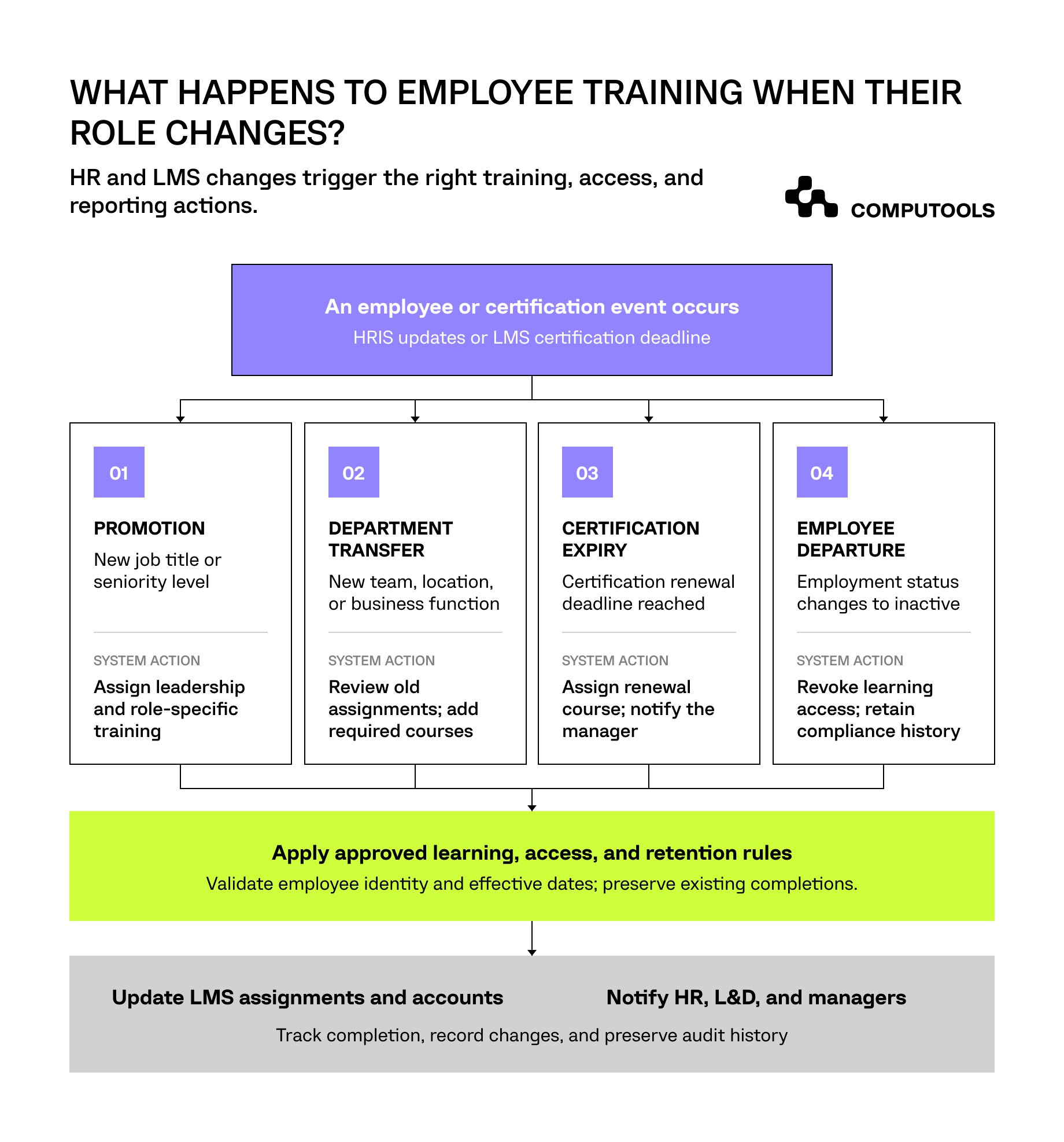
Following training, there are various scenarios that involve the integration of learning and development records with other systems and records. Employees are promoted, transferred, relocated, changed managers and leave the organization. Each of these events may impact an employee’s training and access needs.
Let us consider an employee who has been a customer support specialist and has been recently promoted to a team leader role. The promotion may require this employee to take management training and other courses relevant to their new role. Any previous certifications maintained on record should not be deleted. Learning assignments related to the previous role may also need to be removed.
The integration should recognize the effective date of promotion and identify the applicable rules to update the learning assignment without deleting the old records. Most reliable learning and development workflows should capture and process timely certification renewals. For example, 12-month certifications should be renewed and maintained before their expiration date and be triggered to do so if they are nearing their expiration date.
It is best designed to separate account access to records and retention of records. An employee may no longer have access to a record while the record retention policy states the record must be maintained by the organization.
Step 6. Connect learning results with skills and workforce analytics
Merely completing a course doesn’t mean an employee has mastered a skill. Hence, a corporate learning management system should be able to distinguish between learning activity and verified capability.
The LMS provides completion records. The HRIS stores an employee’s role, department and reporting structure. With employee competencies defined, this data can help with employee skills and competency tracking.
In addition, this helps address skill gaps. Recommending training can further assist development for higher roles and cross-departmental moves.
AI can recommend learning activities based on an employee’s skills and an organization’s competencies. However, recommendations are only as good as the source data. Training histories often miss key details or are entered inaccurately. Likewise, different managers can classify the same role differently, resulting in recommendations outside the employee’s scope.
Skillum offered a solution by providing a unified analytical environment for an employee’s data, learning histories and skills requirements.
Computools also examines how structured learning information supports analytics in its article on the role of Big Data in education.

Build a custom LMS-HRIS integration solution to cut training administration costs, accelerate employee time-to-productivity, and improve compliance without replacing your existing systems.
Step 7. Secure employee information and test integration reliability
HR and Learning systems contain data that is not necessarily accessible to all staff and departments. Access to employment status, assessment results, personal identifiers and training records, for example, should be restricted to certain employees and managers.
Integration should transfer only required data for approved business processes. An LMS, for example, requires employee identification, role and department to assign training. It does not need access to employee personal data or payroll information.
Secure API authentication, data encryption and role-based access should be employed to transfer data. Audit trails and logging should also be in place.
The security of Webhooks also needs to be considered. In Bamboo HR’s case, documents state that they use HMAC-SHA256 for signatures to confirm the webhook requests are from an expected source.
A service that receives the webhook should verify the signatures. Changes should not be processed unless the signatures are valid.
Integration testing needs to extend beyond ensuring that two applications transmit data. An employee could have their department changed twice in a single day. If the events arrive out of order, the LMS could save the first department change and overwrite the second.
There should be some mechanism for the system to retrieve the authoritative current data, or to implement appropriate versioning rules, before the data is saved and/or changed.
Some other important scenarios are duplication of events, temporary failures of an API, invalid mappings of fields, stale authentication tokens, incomplete user provisioning, and expired tokens.
There should be appropriate operational monitoring in place to capture all of the above.
Step 8. Launch a controlled pilot and monitor performance
A company with several thousand employees should rarely introduce a new integration to every department at once. A smaller pilot makes it easier to work through many considerations such as validating data mappings, training rules, account provisioning, and exception handling.
For companies determining the best method to integrate an LMS with an HRIS across a complex organization, a pragmatic first step is with a department that has a more reasonable number of roles and clear training requirements.
The pilot should test the full employee lifecycle, from new hire training through training for a promotion, department transfer, and employee departure.
Prior to go-live, employees’ training records should be reconciled to avoid duplication, and training records should be reassigned to the correct employee, if necessary.
The next step should be to compare HRIS events to LMS updates and confirm managers receive the correct training information.
Phased implementation was also the approach taken by Corporate Skillum, whereby a Sales pilot group and an Engineering pilot group preceded the full implementation.
For a closer look at API connections, data mapping, and synchronization failures, see Computools’ guide to integrating SIS, LMS, and ERP systems. These principles also apply to keeping employee roles, training assignments, and completion records consistent.
How to measure the ROI of LMS HRIS integration
A successful integration should reduce the administrative effort required to maintain employee training and improve the reliability of learning information.
| KPI | What it measures |
| LMS account provisioning time | Time from approved hire to learning account availability. |
| Training assignment accuracy | Share of required courses assigned correctly. |
| Synchronization latency | Time between HRIS changes and LMS updates. |
| Manual administration | Hours spent updating records and reconciling training information. |
| Compliance completion | Required courses completed within assigned deadlines. |
| Certification coverage | Employees holding valid qualifications for their roles. |
| Learning participation | Active engagement with relevant training programs. |
| Reporting preparation time | Time needed to prepare workforce learning reports. |
| Skills data completeness | Employee profiles with current, verified competency information. |
Companies should establish baseline measurements before implementation.
Why choose Computools for LMS HRIS integration?
How many people does it take to keep employee training records accurate? In some organizations, HR, L&D and compliance teams manage pieces of this process. Promotions, transfers and new hires cause discrepancies to multiply.
Computools aims to solve these issues with its unique approach to workforce data integration. With eLearning software development and education software development services, we help clients integrate employee and learning records and compliance data without replacing existing HR and LMS systems.
This approach starts with the toughest parts of the problem, such as identifying employee records that differ across various systems, including out-of-date department records, missing training assignments, and synchronization issues. Computools’ data engineering services help build and implement consistent data models. As a result, the systems are updated automatically, and learning records are preserved.
We connect this information to real-world management tools. Web development services support dashboards that manage certification renewals and training completion, as well as analyze the learning needs of the workforce.
Through EdTech software development and AI development, companies can extend these capabilities to competency assessments, skills-gap analysis, and role-based learning recommendations.
For organizations using several HR and learning systems, this approach supports a more manageable modernization process.
Final thoughts
Training needs continually change with employees joining and leaving the organization, as well as changes in employees’ roles and certifications.
Usually, it is the learning system that initiates the requests, and HR tools process them. As a result, L&D teams waste time correcting training assignments and reports.
Integrating HR and learning systems resolves these issues. These integrations show precise ownership of learning data, define and synchronize identifiers of learning participants, and automate various rules of learning.
Integrating HR and learning software lays a base for identifying learning and performance gaps of employees, creating individualized learning plans, and strategically planning the workforce.
Do employees of your organization still need to modify their training assignments manually? Partner with Computools to seamlessly integrate your HR and learning systems.
Computools
Software Solutions
Computools is an IT consulting and software development company that delivers innovative solutions to help businesses unlock tomorrow.