
THE AUTHOR:

Student information system development is entering a new modernization cycle in higher education. Gartner reported in its 2026 Magic Quadrant that cloud/SaaS SIS adoption has reached a “tipping point,” while budget limits, legacy models, and weak cross-unit collaboration continue to slow modernization.
The pressure is visible inside institutions: 60% of CTOs surveyed by Inside Higher Ed and Hanover Research in 2025 said legacy infrastructure was hampering innovation, and only 11% reported having unified data models.
Multi-campus universities face an additional problem: student and academic data often sit across campuses with different system configurations, course structures, enrollment rules, schedules, and reporting processes. In 2025, EDUCAUSE found that 51% of respondents identified siloed data across departments as a challenge to advancing institutional data strategy.
In a multi-campus environment, those silos can lead to duplicate student profiles, conflicting enrollment statuses, inconsistent course data, delayed reporting, and additional reconciliation work for academic and administrative teams.
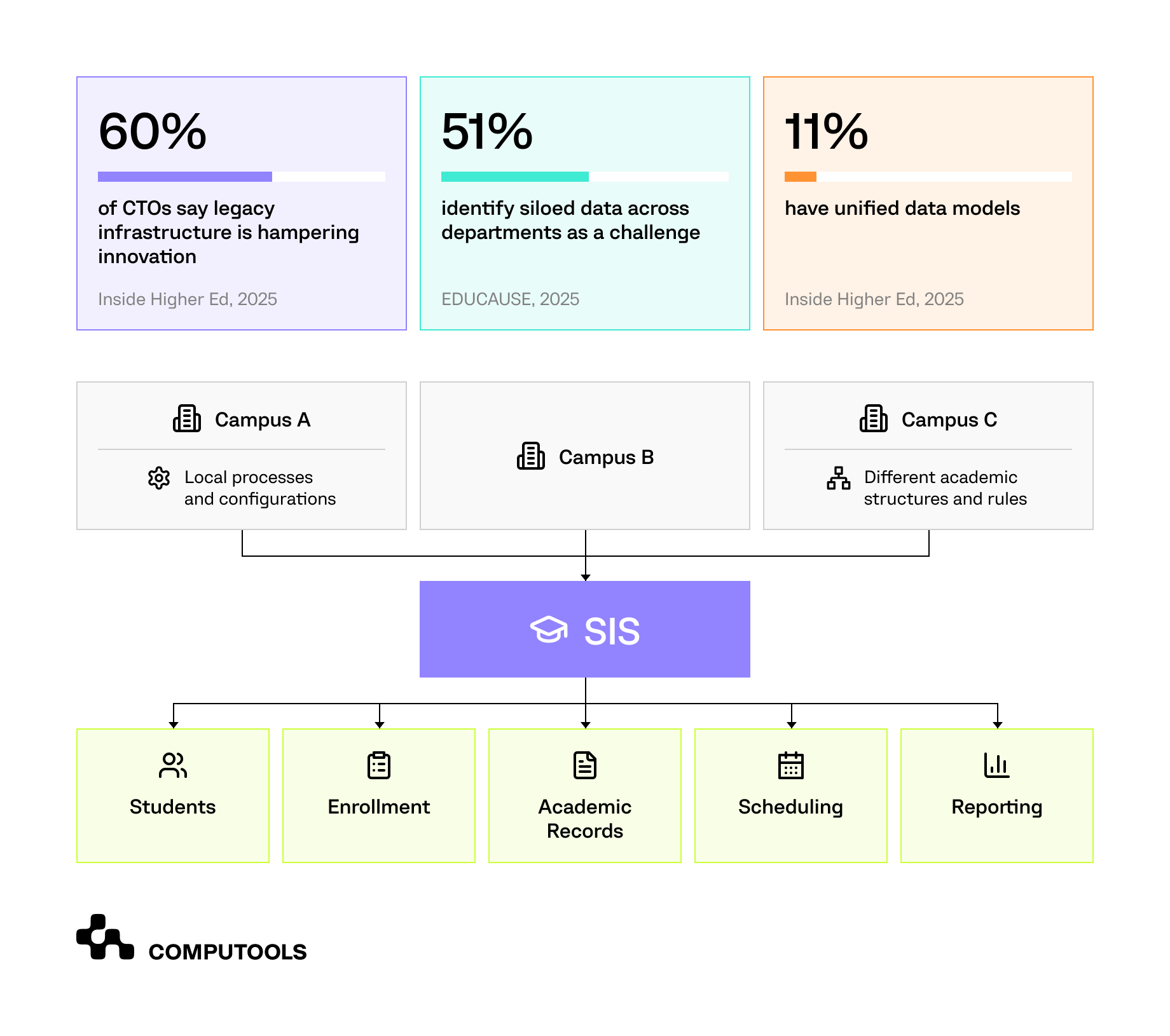
The architecture also needs to support cross-campus enrollment, faculty working across locations, integrations with LMS, ERP, IAM, and analytics platforms, and phased migration from existing systems without disrupting active academic operations.
How we addressed student information system development across three campuses
For Uni-Campus, Computools worked with a UK-based private university group operating three campuses and serving more than 25,500 students and 1,535 faculty members. Each campus used its own localized SIS, while LMS, ERP, IAM, reporting, and student-service processes operated across separate environments. The project required university system integration that could improve cross-campus data consistency without replacing the institution’s existing core systems.
As part of our education software development services, the team introduced an integration and data layer above the existing platforms. Computools mapped data ownership across campuses and created a unified model for student profiles, academic records, course structures, grading formats, billing references, schedules, and access roles. The existing SIS, LMS, ERP, and IAM platforms remained authoritative for their respective data domains.
The solution connected the three SIS environments with Canvas LMS, SAP ERP, Microsoft Entra ID, analytics, and a central student portal through an API-driven architecture. A unified data hub normalized records across campuses before they reached reporting and student-facing workflows, while role-based access controls and centralized governance supported secure access to academic, billing, scheduling, and identity data.
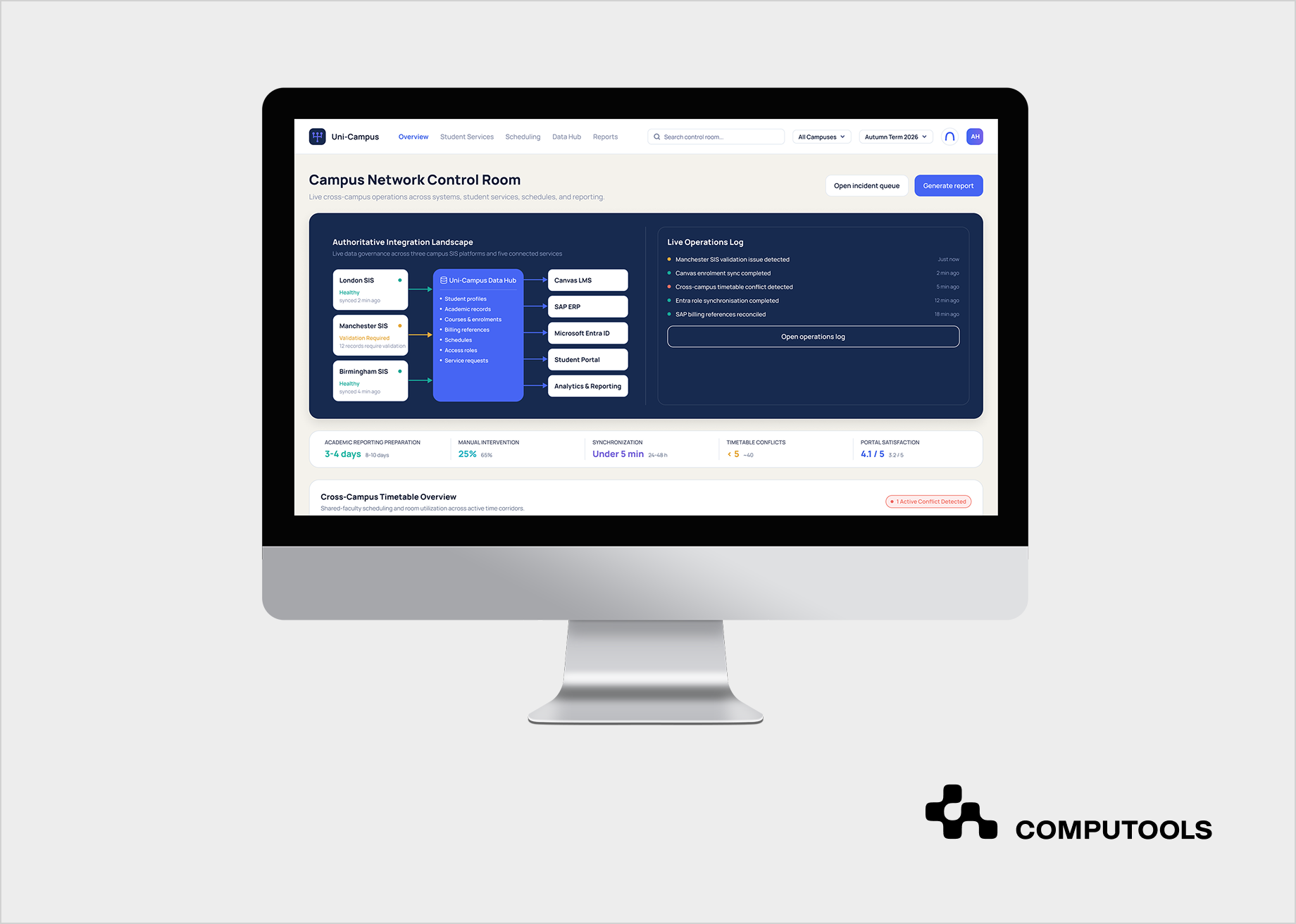
After rollout, the university achieved measurable improvements across several operational areas:
- Cross-campus synchronization: from 24–48 hours to under 5 minutes
- Academic reporting preparation: from 8–10 business days to 3–4
- Routine requests requiring manual intervention: from 65% to 25% of ticket volume
- Cross-campus scheduling conflicts: from about 40 per semester to fewer than 5.
This experience gives us a practical view of the architecture, data, workflow, and rollout decisions involved in multi-campus SIS projects. The guide below breaks down those decisions step by step.
How to build a scalable SIS for multi-campus universities: 9 implementation steps
Higher education SIS development starts with the university’s operating model, because campuses rarely share every academic rule, workflow, or data structure. The system must define where institution-wide consistency is required, where campus-level configuration is allowed, and how students, faculty, courses, schedules, and records move across those boundaries. The following steps cover the software architecture, data model, workflows, integrations, security, migration, and rollout decisions that shape a scalable multi-campus SIS.
1. Define the operating model across campuses
Before designing entities, screens, or APIs, document how the university actually operates across locations. A student information system for universities needs explicit rules for which processes are centralized and which remain locally managed.
Start by mapping the institutional hierarchy and decision rights across:
- campuses, schools, faculties, and departments;
- academic programs and course catalogs;
- academic calendars and term structures;
- enrollment and registration policies;
- grading schemes and credit rules;
- tuition, fees, and financial holds;
- room and resource scheduling;
- student services;
- faculty assignments;
- reporting and accreditation processes.
A critical architectural decision is defining which policies apply institution-wide and which require campus-specific configuration. A university may use one institutional student ID and one academic history while allowing campuses to maintain different course sections, registration windows, local fees, grading exceptions, or service workflows. These differences need to be represented as configuration or policy rules, not as duplicated versions of the same core process.
Document cross-campus scenarios early because they expose weaknesses in the operating model. Examples include a student enrolled at Campus A taking a course at Campus B, a lecturer teaching at two locations, a shared program using facilities across campuses, or a student transferring between campuses during the same academic year. The SIS must know which campus owns the record, which rules apply to the transaction, and how the change affects scheduling, billing, access, and reporting.
Governance boundaries must also be defined during this assessment. Central administration may own institutional identity, academic history, program structures, and consolidated reporting, while campus teams manage local sections, rooms, schedules, and selected service workflows. These ownership decisions later determine permissions, data models, validation rules, and integration flows.
In Uni-Campus, each of the three campuses had its own SIS configuration, academic processes, reporting routines, and student-service workflows. Computools first assessed those differences and mapped data ownership before defining the shared integration and data model.
Capture the decisions in an operating-model matrix covering policy ownership, campus scope, approval rights, and cross-campus exceptions. Resolve conflicting rules before defining the data model and access permissions.
2. Design the institutional hierarchy and academic data model
Once the operating model is defined, translate it into a data structure that can represent the university consistently across campuses. A custom student information system should model the institution explicitly, including campuses, schools, departments, programs, courses, sections, terms, and student affiliations, without reproducing each campus as a separate data environment.
The model should distinguish entities that legacy systems often merge. A course is different from a specific course section, a person from a student role, and a program from a student’s enrollment in that program. These distinctions matter most when students or faculty move between locations, because the SIS must preserve one institutional identity and complete academic history across campuses.
A practical hierarchy may look like this:
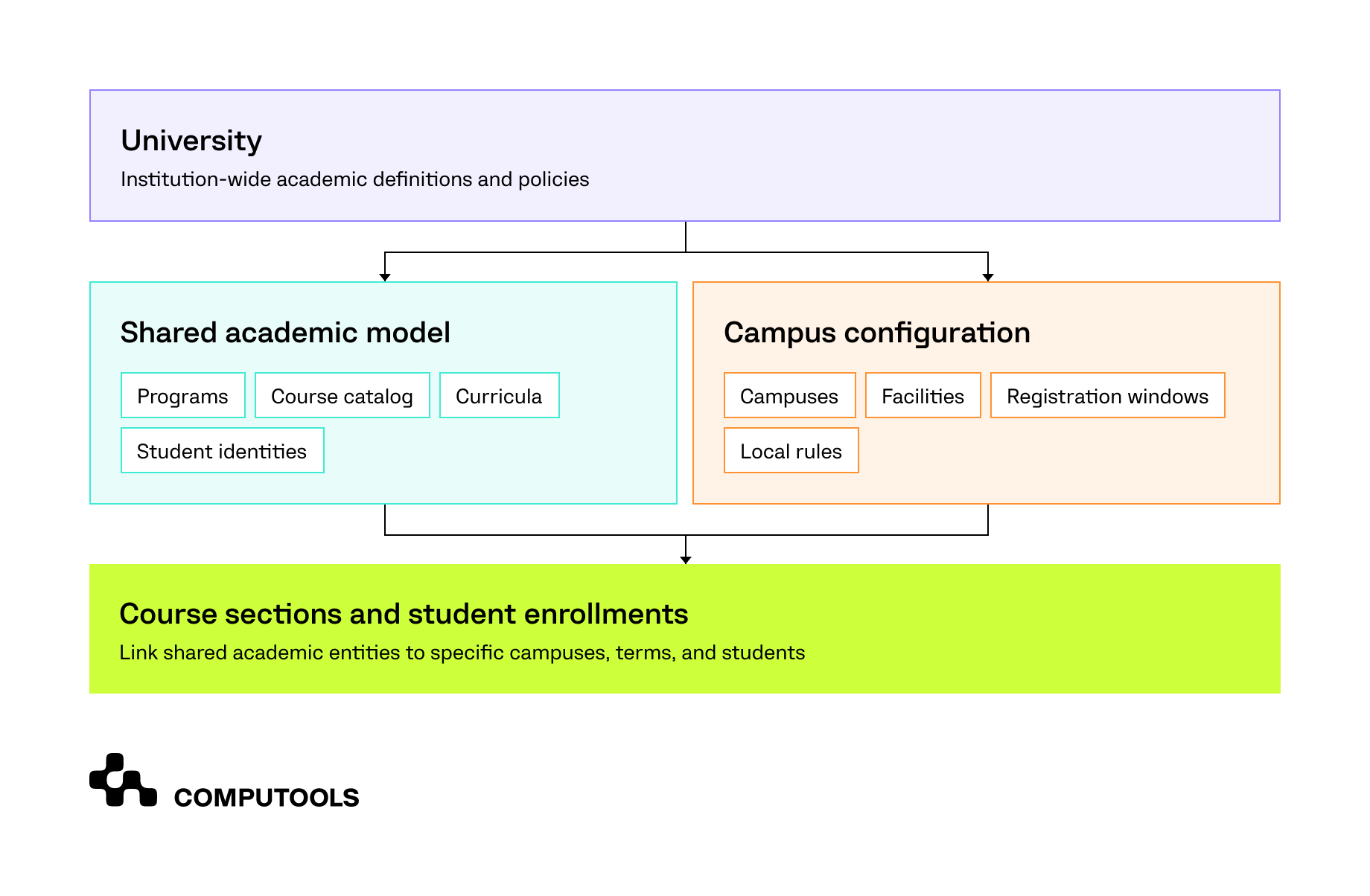
Model academic relationships explicitly: one centrally defined course can have multiple sections linked to different campuses and terms, while a program can be delivered at several locations. Specify cardinality and preserve historical student and course affiliations as these relationships change.
| Shared institutional data | Campus-level configuration |
| Student identity | Course sections |
| Academic history | Rooms and resources |
| Program definitions | Local schedules |
| Core curriculum rules | Registration windows |
| Reporting structure | Selected local fees and services |
Academic entities require versioning and effective dates. Curricula, grading schemes, and program requirements evolve over time, while completed courses and awarded grades must remain linked to the definitions that govern them. Historical records should retain their original meaning after a later curriculum or grading update.
Stable identifiers also matter. Email addresses, usernames, course codes, and even organizational names can change. The SIS should use durable institutional IDs for people, programs, courses, and other core entities, while platform-specific or campus-specific identifiers remain mapped to them.
These rules create a consistent foundation for academic data management. Enrollment, scheduling, reporting, integrations, and student services can then rely on the same institutional structure without rebuilding campus-specific logic in every module.
In Uni-Campus, Computools created a unified model covering student profiles, academic records, grading formats, course structures, billing references, schedules, access roles, and service requests. Normalization came before broader portal functionality so that student-facing and reporting workflows operated on consistent data across all three campuses.
3. Create one student identity across all campuses
A multi-campus SIS should maintain one institutional identity for each person while supporting multiple academic, employment, and campus affiliations. Reliable student data management depends on this separation because the same individual may interact with the university in several roles over time.
A typical lifecycle may include applicant, admitted student, active student, teaching assistant, employee, graduate, and alumnus. These roles should be attached to one persistent person record. Creating a new identity whenever someone changes campus, program, or role can fragment academic history, access rights, reporting, and downstream integrations.
The data model should therefore separate the person from their institutional relationships:
| Layer | Example data |
| Person | Institutional ID, legal name, date of birth, contact details |
| Student role | Status, academic standing, active/inactive dates |
| Campus affiliation | Home campus, secondary campus, effective dates |
| Program affiliation | Program, cohort, start date, current status |
| Course relationship | Section, term, campus, enrollment state |
This structure matters when students move between locations. A student based at Campus A may take a course at Campus B or transfer to another campus without receiving a second institutional identity. The SIS should add or update the relevant affiliation while preserving the same academic history.
Stable identifiers are essential. Email addresses, usernames, phone numbers, and campus-specific student numbers may change. A durable institutional ID should anchor the person record, while identifiers from legacy systems, LMS, ERP, IAM, and other platforms are stored as mapped references.
Duplicate detection also needs explicit rules, especially during migration from several campus systems. Matching can combine institutional or legacy IDs with attributes such as legal name, date of birth, contact details, previous campus, and program history. Ambiguous matches should go through manual review before records are merged.
Merging itself needs traceability. The SIS should retain historical identifiers and record which source contributed each important value. This allows staff to reconstruct what happened when a student changes name, transfers campuses, leaves and returns, or holds overlapping student and employee roles.
4. Build enrollment and curriculum logic around cross-campus scenarios
Student enrollment management across multiple campuses requires distinct workflows for university admission, program enrollment, term registration, and course-section enrollment. Each process has its own eligibility rules, statuses, effective dates, and downstream effects.
Core academic lifecycle events and processes include:
- admission to the university or a specific program;
- registration for an academic term;
- enrollment in a course section;
- waitlisting and course withdrawal;
- leave of absence and return to studies;
- program or campus transfer;
- program completion and graduation.
These events can trigger different validation and downstream actions. For example, a student based at Campus A may register for a course section at Campus B. The SIS may need to validate prerequisites, confirm seat availability, check timetable eligibility, and pass the approved enrollment to the finance system for fee assessment.
Prerequisite logic should work across the student’s full academic history. Courses completed at another campus, transferred credits, approved substitutions, repeated courses, and waivers may all affect eligibility. The same applies to program progression: the system needs to evaluate the rules attached to the curriculum version under which the student enrolled.
Enrollment capacity controls need to account for allocation rules as well as available seats.
A section may define:
- total capacity;
- seats reserved for a specific program or cohort;
- waitlist capacity;
- campus-specific allocations;
Waitlist promotion should recheck program eligibility, academic holds, seat allocations, and registration limits before assigning an available place. Failed validations should retain the student’s waitlist position or route the request through an approved exception workflow, according to institutional policy.
The workflow also needs a clear validation order. A typical registration transaction may check:
1. active student and term status;
2. program eligibility;
3. prerequisites and co-requisites;
4. academic or financial holds;
5. section capacity;
6. student timetable eligibility;
7. campus or delivery restrictions;
8. enrollment limits.
The system should return a clear result for each failed check so staff and students can see why registration was blocked and whether an approved exception can resolve the issue.
Curriculum management should follow the same principle. Programs need versioned requirements for required courses, electives, credits, prerequisites, and progression rules. A curriculum update should apply to the correct cohort without changing the requirements already governing students admitted under an earlier version.
Cross-campus enrollment makes these rules especially important because the SIS must combine central academic policies with local availability and scheduling constraints. The SIS must preserve a consistent enrollment history across campuses, programs, and delivery formats.
5. Separate institution-wide standards from campus-level configuration
A scalable SIS needs a clear boundary between rules that apply across the entire institution and settings that individual campuses can control. Without that separation, the platform can accumulate duplicated logic, conflicting policies, and maintenance overhead as each location develops its own exceptions.
Central administration typically controls university-wide identifiers, transcript requirements, and institutional reporting definitions. Campus registrars manage local registration windows, schedules, and services, while academic units maintain program-specific eligibility and progression rules within approved policy boundaries.
Implement policy inheritance so centrally approved rules apply by default and authorized campus exceptions change only the relevant setting. For example, a campus may adjust its registration period while retaining university-wide eligibility and academic standing rules.
For multi-campus university software, this model is especially important when locations operate under different calendars or administrative processes. A campus may open registration earlier, apply local service fees, or use different room-booking rules while still following the same institutional definitions for student status, course identity, academic history, and degree requirements.
Each policy override needs a defined scope, owner, approval route, and review or expiration date. The system should apply rules in an agreed priority order and record which rule governed a decision. Conflicting exceptions can then be reviewed by the responsible academic or administrative owner.
Permissions should mirror the configuration hierarchy. Central administrators may control institution-wide academic definitions and reporting structures, while campus registrars manage local sections, room assignments, or approved enrollment exceptions. Program administrators may maintain curriculum rules without gaining access to unrelated financial or identity data.
Local rules should be represented through configuration wherever possible. Hard-coded campus conditions become difficult to maintain as policies evolve or new campuses are added. A configurable model allows the university to add a location, revise a local process, or standardize selected policies later without rewriting core application logic.
6. Design scheduling and resource allocation across campuses
Scheduling becomes more complex once students, faculty, rooms, and academic programs operate across several locations. The SIS needs to evaluate these dependencies together, because a timetable that looks valid within one campus can still create conflicts elsewhere in the institution.
The scheduling model should account for several types of constraints:
- faculty availability and teaching load;
- student timetable conflicts;
- room capacity and equipment;
- campus opening hours;
- travel time between locations;
- shared laboratories or specialist facilities;
- room turnover and preparation time;
- hybrid and online delivery;
- cross-listed courses;
- campus-specific scheduling rules.
For a university student information system, it is useful to distinguish between hard and soft constraints. Hard constraints prevent impossible assignments, including overlapping sessions or insufficient travel time between campuses. Soft constraints cover scheduling preferences, such as preferred teaching hours or noncritical gaps between classes.
Travel time deserves explicit treatment in a multi-campus environment. Two sessions may not technically overlap, yet a lecturer finishing at Campus A at 11:00 cannot realistically start another class at Campus B at 11:10. The scheduling engine should therefore support configurable travel buffers between locations and include them when checking faculty or student availability.
Resource allocation should work beyond the room level. Some courses depend on laboratories, specialist equipment, accessibility requirements, or shared facilities used by several departments. These resources need availability calendars and capacity rules so the system can detect conflicts before publishing a section.
Scheduling must account for changes after sections are published. When a class moves to another time, room, or campus, the system should recheck room suitability, travel feasibility, instructor availability, and affected student timetables. Approved changes should trigger notifications before the revised timetable takes effect.
Manual overrides are sometimes necessary, but they should be controlled. Authorized users should be able to approve an exception with a reason, while the platform records who made the decision and which rule was overridden. This keeps exceptional scheduling decisions visible during audits and later planning.
In Uni-Campus, fragmented planning across three locations contributed to timetable overlaps and inefficient classroom allocation. After cross-campus scheduling and data flows were coordinated, scheduling conflicts decreased from about 40 incidents per semester to fewer than five.
The scheduling layer should ultimately give academic teams one view of people, sections, rooms, and shared resources across locations while preserving each campus’s local constraints.
7. Connect the SIS to the wider university ecosystem
A multi-campus SIS rarely operates on its own. Learning delivery, finance, identity, admissions, payments, analytics, and student services usually remain in separate platforms, so the SIS needs clear integration boundaries and controlled campus data integration across the wider technology environment.
The first decision is which system owns each type of information. The SIS can remain authoritative for academic records, programs, sections, enrollment, and student status, while other platforms retain responsibility for their own domains:
- LMS for course content, assignments, and learning activity;
- ERP for billing, finance, and related administrative records;
- IAM for authentication, roles, and account lifecycle;
- CRM for applicant and admissions workflows;
- analytics platforms for institutional reporting and historical analysis;
- payment or student-service systems for specialized workflows.
This separation prevents the SIS from becoming an oversized platform that duplicates functions already handled elsewhere. Integrations should exchange only the data each downstream process needs, with clear ownership of updates and conflicts.
For example, when a student enrolls in a section, the SIS may publish the approved enrollment to the LMS, update relevant financial context in the ERP, trigger the required access role through IAM, and expose the new timetable through the student portal. A withdrawal can require a different sequence, including access changes, billing adjustments, and retention of the academic history.
The architecture should also account for different integration patterns. Near-real-time APIs or events are appropriate for enrollment and access changes where delays affect active users. Scheduled synchronization may still work for historical reporting or less time-sensitive administrative data. Legacy platforms may require controlled file exchange until a modern interface becomes available.
Institutional identifiers should remain consistent across these flows. Campus-specific IDs can be stored as mapped references, but connected systems should resolve students, courses, sections, and terms back to shared institutional entities. This becomes especially important when a student studies at more than one campus or when the same course is delivered through several locations.
A shared integration layer or API management layer can help isolate the SIS from vendor-specific interfaces. It can handle transformation, routing, authentication, monitoring, retries, and version changes without pushing that logic into the SIS core. This reduces rework when the university changes an LMS, adds a campus, or introduces another service.
The integration architecture also needs defined security and availability requirements. These include least-privilege access, encrypted data exchange, audit retention, API rate limits, and monitoring of failed transactions. Privacy controls should reflect applicable regulations, such as FERPA in the US or UK GDPR for UK institutions.
Our eLearning software development experience is relevant on the learning side of this architecture, where course, enrollment, role, and approved grade data need to move between SIS and LMS without duplicating academic ownership.
The SIS retains authority over academic records and exchanges governed data with other platforms through defined interfaces.
8. Build student self-service and reporting on governed data
A modern SIS should reduce routine tasks that depend on administrative staff while giving students and faculty access to the information they need. The challenge is to expose this data through clear workflows without creating another layer of duplicated records.
Design self-service as governed transactions with clear approval and exception paths. Profile changes may need verification, registration must call eligibility rules, and academic requests may require staff review. Define which actions can complete immediately, which require approval, and how to track unresolved requests.
Faculty and administrative users need different views. Faculty may require rosters, teaching schedules, grading workflows, and advised information, while registrars and student-service teams need broader access to enrollment, exceptions, academic history, and cross-campus records.
Design reporting separately from day-to-day transactional workflows. Operational reporting may stay close to the SIS for questions such as current enrollment, section capacity, or active student status. Institution-wide analytics across several years, campuses, finance, LMS activity, and student outcomes are better handled through a dedicated analytics or data platform.
That separation matters for performance and governance. Large analytical queries should not compete with registration, scheduling, or grade-processing workloads, especially during peak periods.
Define reporting rules before building dashboards: census dates, campus attribution, term boundaries, and how to treat cross-campus students. Institution-wide headcount may count an individual once, while section-level enrollment captures participation across locations. Both measures need agreed definitions and traceable source data.
For student records management, historical consistency is especially important. Reports should use historical program, curriculum, grading, and enrollment definitions applicable to each reporting period.
In Uni-Campus, Computools used web development services to build a central student portal that brought timetables, academic requests, billing information, and student services into one interface. The portal used normalized data from the university’s existing systems, giving students consistent access to information across all three campuses.
9. Migrate legacy data and roll out campus by campus
Data migration is one of the highest-risk parts of a multi-campus SIS project because historical academic records, enrollment states, grades, credits, and program affiliations need to remain accurate after cutover. The challenge grows when campuses use different schemas, identifiers, status codes, and data-quality rules.
Start with data profiling before defining the migration itself. Assess each source system for duplicate identities, missing identifiers, inconsistent statuses, obsolete course codes, incomplete grades, orphaned enrollments, and differences in academic structures. This establishes which records can move directly, which require transformation, and which need manual resolution.
Source-to-target mapping should then define how every important entity moves into the new model. Typical mappings include students, programs, curricula, courses, sections, terms, enrollments, grades, holds, campus affiliations, and historical identifiers. Document transformation rules explicitly, especially when multiple legacy values map to a single normalized status.
Migration also needs clear decisions about history. Universities rarely need every operational field from every legacy platform in the new SIS, but academic records that affect transcripts, progression, accreditation, or reporting must remain accessible. Data that is not migrated should have a defined archival and retrieval strategy.
Several rehearsal migrations are usually safer than a single production import. Each dry run should test both technical migration and business reconciliation:
- record counts by campus and entity;
- duplicate and unmatched identities;
- active enrollment totals;
- program and course relationships;
- grade and credit histories;
- academic statuses;
- selected end-to-end student records;
- reporting totals before and after migration.
Reconciliation thresholds should be agreed before cutover. A migration should not be considered successful simply because the import completed without technical errors. The university needs to confirm that migrated records produce the expected academic and operational results.
Rollout strategy should reflect campus risk and academic timing. A phased deployment can start with a lower-risk campus or a limited set of workflows, then stabilize before introducing the next location. This gives teams time to resolve mapping problems, validate processes, and refine support procedures without exposing the entire institution to the same issue at once. The cutover plan should also define the final data freeze, delta migration, validation window, rollback criteria, and ownership of unresolved records. Where possible, avoid registration, examinations, grade submission, and major reporting periods because even a small migration defect can create immediate operational consequences.
Before rollout, test registration peaks, concurrent enrollment changes, backup restoration, failover, and disaster recovery procedures. Set measurable availability and recovery targets, then validate them under production-like workloads.
In Uni-Campus, Computools followed a phased modernization strategy while preserving the three existing SIS platforms. Releases were aligned with enrollment, examinations, and reporting periods, allowing the university to validate shared workflows without a full core-system migration.
The migration is complete only when the university can verify that students, academic histories, enrollments, grades, access roles, and reporting outputs behave correctly in the new environment. That final reconciliation matters more than the number of records successfully imported.

Launch a multi-campus student information system within 1–3 months, centralize student records and academic operations across locations, reduce duplicate administrative work, and improve reporting and student services without expanding back-office teams.
What features should a multi-campus SIS include?
SIS software for multi-campus universities should cover the core academic and operational functions shared across locations while allowing controlled campus-level configuration where processes differ.
- Unified student profile: one institutional identity with academic history, campus affiliations, program status, contact data, and linked records across all locations.
- Enrollment and registration: course registration, add/drop, waitlists, transfers, prerequisites, holds, capacity checks, and cross-campus enrollment rules.
- Program and curriculum management: program structures, curriculum versions, credits, prerequisites, electives, progression rules, and degree requirements.
- Course and section management: central course catalog with campus-specific sections, instructors, delivery formats, capacity, and term availability.
- Cross-campus scheduling: faculty, student, room, and resource scheduling with conflict detection, travel buffers, and local constraints.
- Student self-service: registration, timetables, grades, academic requests, profile updates, billing visibility, and document status.
- Role-based access: permissions for students, faculty, registrars, advisors, finance teams, campus administrators, and central leadership.
- Academic records and transcripts: grades, credits, academic standing, transfer credits, historical records, and transcript generation.
- Reporting and dashboards: enrollment, retention, progression, capacity, faculty load, resource utilization, and cross-campus performance.
- Integration APIs: controlled connections with LMS, ERP, IAM, CRM, payment, analytics, and other university platforms.
- Audit history and data lineage: traceable changes to grades, enrollment, identity, program status, and other sensitive records.
- Configurable campus rules: local registration windows, fees, service workflows, schedules, and exceptions without duplicating the core platform.
- Notifications and workflow automation: alerts, approval flows, status changes, and task routing for students and administrative teams.
A connected campus data environment can also support technologies for attendance, assessment, proctoring, and learning operations. Explore how computer vision in education is being applied across these use cases.
Why choose Computools for multi-campus SIS development?
Computools has 250+ experts on board and more than 40 delivered education software projects, covering SIS and core academic platforms, LMS, enrollment, assessment, finance, credentialing, analytics, and student services. Our EdTech software development experience includes both new education platforms and modernization of existing institutional environments.
For data-intensive university systems, our data engineering expertise covers governed pipelines, normalization, cross-system data models, analytics layers, and reporting infrastructure. This is especially relevant for multi-campus institutions where student, enrollment, assessment, finance, and operational data may originate from several systems and locations.
Our education projects show the operational impact of this work:
- Uni-Campus: connected three legacy SIS environments with LMS, ERP, IAM, and student services. Academic reporting time fell by about 60%, manual-intervention requests decreased from 65% to 25%, and cross-campus synchronization reached under five minutes.
- Corporate Skillum: connected HR, learning, and collaboration systems for about 3,530 employees. Monthly learning participation increased from 22% to 48%, course-authoring time dropped from 80 to 24 hours, and new-hire time-to-productivity improved from 45 to 28 days.
- Learnster: Computools helped modernize the learning platform, introducing flexible course management, HR integrations, and reporting capabilities. The published case reports improved profitability and customer conversion.
Once the SIS and data foundation are stable, our AI development capabilities can support student-service automation, retention-risk detection, enrollment forecasting, and resource planning with institutional rules and human review built into the workflow.
A reliable student data foundation also creates opportunities for automation and more personalized services. Our guide to AI in higher education looks at applications across student support, administration, assessment, and learning.
Conclusion
A multi-campus SIS should give the university one institutional view of students, programs, enrollment, and academic history while preserving the local rules each campus actually needs. The stronger the data model, identity structure, configuration logic, and rollout discipline, the easier it becomes to add campuses, reduce manual reconciliation, and modernize student services without creating another layer of fragmented systems.
Computools
Software Solutions
Computools is an IT consulting and software development company that delivers innovative solutions to help businesses unlock tomorrow.