
THE AUTHOR:

To reduce food waste in hotels, operators need to align purchasing decisions with usable inventory, expected guest demand, supplier lead times, and kitchen requirements. Connecting these records helps teams avoid excess orders, improve replenishment planning, and control food costs while maintaining service quality.
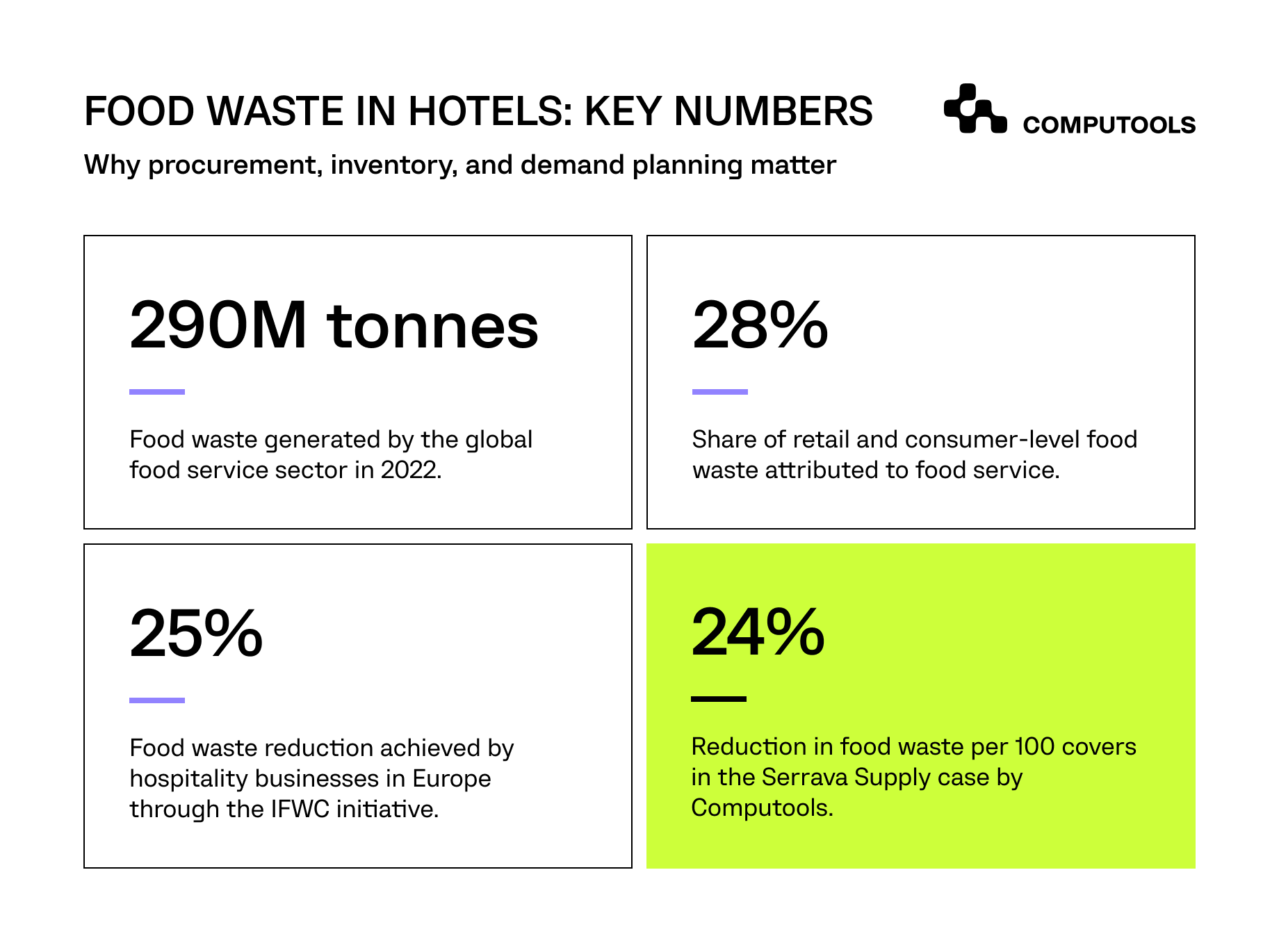
According to the UN Environment Programme’s Food Waste Index Report 2024, the global food service sector generated 290 million tonnes of food waste in 2022, accounting for 28% of food waste at the retail and consumer levels. WRAP’s 2025–26 Impact Report states that the International Food Waste Coalition helped hospitality businesses across Europe collectively reduce food waste by 25%.
The following sections explain how hotels can implement these controls, connect existing systems, and measure the financial impact of food waste reduction.
How Computools Helped Reduce Food Waste in Hotels by 24%
A casino resort operator managing six properties in Spain struggled to coordinate food purchasing and inventory across its hotels, restaurants, bars, and banquet facilities. Central buyers negotiated supplier agreements, while individual outlets managed replenishment and receiving through separate systems and spreadsheets. Procurement teams lacked reliable information about available stock and upcoming demand.
During busy weekends and major events, one outlet could hold excess perishable ingredients while another placed an emergency order for the same products. Inconsistent supplier catalogs, packaging sizes, and units of measurement complicated inventory reconciliation. Changes in occupancy, restaurant reservations, and banquet requirements also reached purchasing teams too late.
Computools developed Serrava Supply, a centralized platform for hospitality inventory management and procurement that integrates the operator’s existing finance, hospitality, supplier, and POS systems.
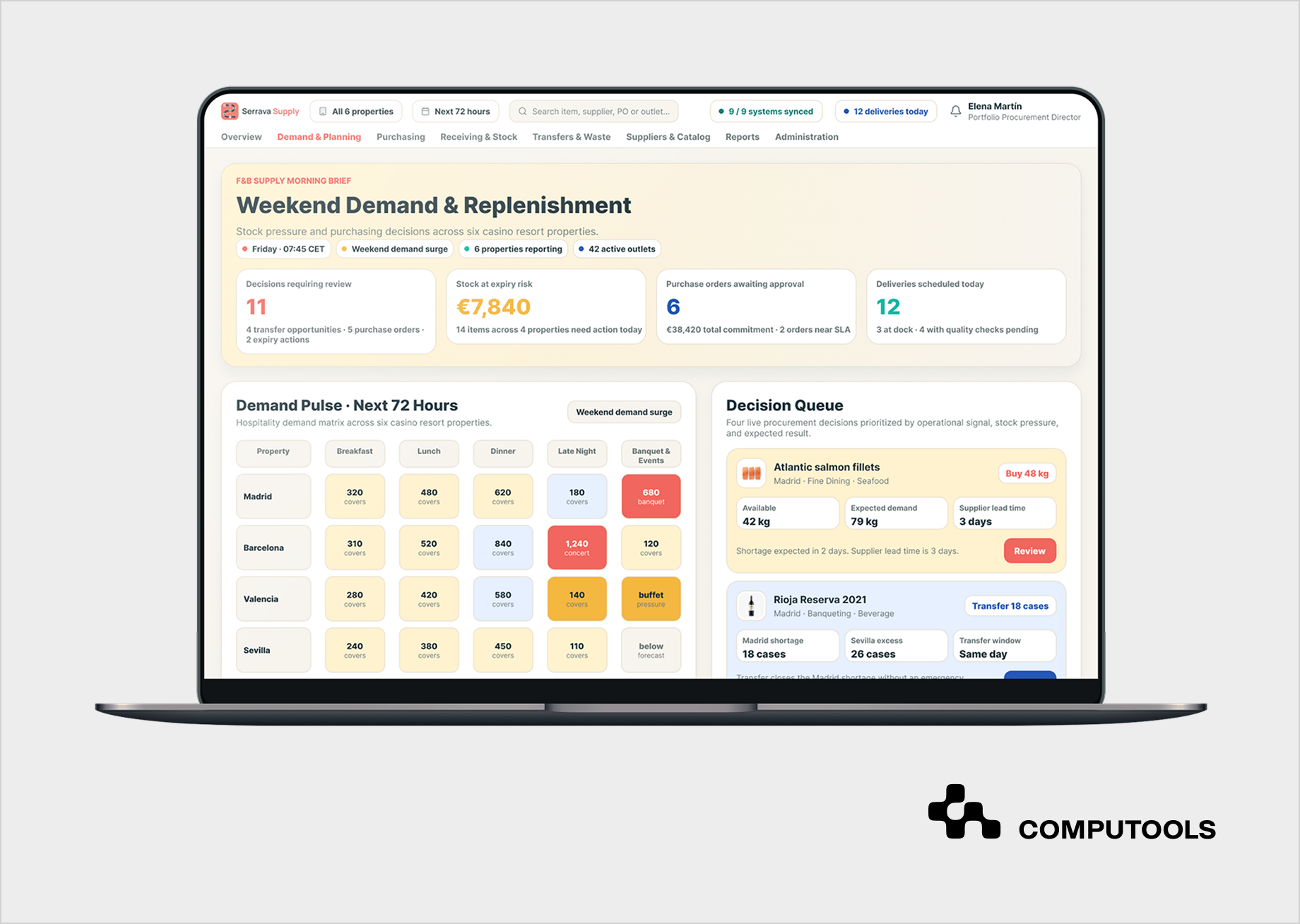
The implementation involved data engineering to standardize product records, reconcile inventory data, and connect purchasing workflows across the operator’s existing systems.
The platform included:
- Standardized inventory data: Unified product catalogs, supplier mappings, packaging conversions, and inventory records across six properties.
- Demand forecasting: Used historical sales, restaurant covers, occupancy expectations, and confirmed events to estimate food requirements.
- Automated replenishment: Calculated purchasing needs using available stock, expected consumption, shelf life, supplier lead times, and minimum order quantities.
- Purchasing workflows: Connected requisitions, approvals, deliveries, transfers, and receiving discrepancies.
- Waste reporting: Recorded discarded food and its causes alongside stock movements to identify spoilage and inventory discrepancies.
Computools piloted the system at two properties, validating inventory balances, receiving processes, and purchasing controls before extending it across the portfolio.
During the six-month measurement period, the operator recorded:
| Operational KPI | Result |
| Food waste per 100 covers | 24% reduction |
| Emergency purchasing | 29% reduction |
| Purchase-order approval time | 37% reduction |
| Inventory variance | 18% reduction |
| Stock reporting preparation time | 33% reduction |
Standardized inventory records gave purchasing teams a consistent view of usable stock, while demand forecasts and replenishment rules connected future orders to expected consumption and supplier constraints.
Why Do Hotels Lose Money on Food Purchasing and Inventory?
Food waste affects hotel operating costs long before ingredients reach the bin. According to WRAP, the UK hospitality and food service sector discards approximately 1.1 million tonnes of food annually, costing businesses £3.2 billion. About 75% of that waste is edible.
For hotel operators, hotel food waste management requires identifying where purchasing, storage, preparation, and service decisions create avoidable losses. These problems often overlap, especially when multiple restaurants and kitchens share suppliers but keep separate inventory records.
| Source of loss | Operational problem | Financial impact |
| Excess purchasing | Orders exceed actual consumption and available storage capacity | Spoilage, unnecessary spending, and tied-up working capital |
| Overproduction | Kitchens prepare more portions than guests consume | Higher ingredient costs and disposal expenses |
| Inventory discrepancies | Unrecorded transfers and inaccurate stock balances | Duplicate orders and emergency purchasing |
| Recipe inconsistencies | Actual ingredient quantities differ from recorded recipes | Unreliable food cost calculations |
| Supplier disruptions | Late deliveries, incorrect quantities, and unplanned substitutions | Additional purchasing costs and menu shortages |
| Incomplete waste records | Discarded food is recorded without identifying its cause | Recurring losses that remain unresolved |
These losses require different operational responses. Excess purchasing calls for better demand estimates and order controls, while inventory discrepancies require accurate receiving and transfer records. Address overproduction with preparation schedules and buffet replenishment rules.
Without consistent data across these processes, managers cannot reliably determine whether rising food costs result from supplier prices, inaccurate purchasing decisions, spoilage, or changes in guest consumption.
How to Build a Smarter Hotel Procurement and Inventory Management System
Building a connected procurement and inventory system requires accurate operational data, reliable integrations, and purchasing rules aligned with actual food consumption. The following eight steps cover implementation, from assessing existing processes to deploying the system across multiple hotel properties.
Step 1. Assess Food Waste and Existing Procurement Processes
Start by examining how ingredients move through the hotel’s operations, from purchase requisitions and receiving to storage, preparation, service, and disposal. Involve procurement managers, kitchen staff, F&B directors, and finance controllers to identify gaps between documented procedures and daily practice.
Establish a baseline by recording discarded food by weight, category, outlet, and reason. Separate expired ingredients, preparation losses, overproduction, and plate waste. Connect these measurements with restaurant covers, purchasing volumes, inventory adjustments, and emergency orders. For example, frequent breakfast overproduction may indicate inaccurate attendance forecasts, while recurring spoilage points to purchasing quantities or stock rotation problems.
Review how employees approve orders, receive partial deliveries, transfer ingredients, and reconcile inventory counts. Document which activities rely on spreadsheets, manual communication, or delayed updates. Examine whether discarded products can be traced to specific stock movements and purchasing decisions.
Define the baseline KPIs before development begins. Use food waste per 100 covers, inventory variance, emergency purchasing frequency, and menu availability as a starting point for measuring results. Apply consistent weighing and valuation rules across participating outlets so you can compare operational changes with the original conditions.
Step 2. Integrate Hotel Systems and Establish Data Ownership
Hotel procurement requires information from property management systems (PMS), point-of-sale (POS) applications, enterprise resource planning (ERP) platforms, supplier systems, and event management software. The integration architecture must make these records available to purchasing workflows without compromising existing financial controls.
Identify the authoritative source for each dataset. PMS applications provide occupancy expectations and meal-plan information; POS systems record restaurant transactions; event platforms maintain banquet requirements; and ERP software manages accounting records and purchasing commitments. Define common identifiers for properties, outlets, products, suppliers, and transactions.
Use APIs, webhooks, message queues, or scheduled imports based on each system’s capabilities and the data’s operational importance. Synchronize receiving transactions and stock transfers promptly, as delays can affect available balances and purchasing recommendations. You can generally synchronize historical consumption records and management reports on scheduled intervals.
Procurement is one part of a broader hotel operations architecture. Our guide on building a hotel operations management platform explains how shared data models, system ownership, and integrated workflows support coordination across hotel departments.
Integration reliability requires explicit failure handling. Use idempotent transaction processing to prevent duplicate inventory movements when a message is delivered more than once. Apply validation rules to detect missing product identifiers, inconsistent units, and invalid quantities. Failed transactions should enter monitored exception queues rather than silently changing inventory records.
In our Serrava Supply project, Computools connected finance, supplier, hospitality, POS, restaurant, and event systems across six properties. The team established authoritative data sources and reconciliation rules before introducing forecasting. This preserved the operator’s existing accounting and purchasing controls while making stock and demand information available through a shared platform.
Step 3. Standardize Product Catalogs, Recipes, and Inventory Records
Accurate hotel food inventory management depends on consistent product identifiers, measurement units, packaging conversions, and recipe definitions. Without standardized records, identical ingredients may appear as separate products, while quantities expressed in cases, bottles, kilograms, or individual units cannot be reliably compared.
Create a governed catalog that connects supplier-specific descriptions to standardized product records. Define base units for stock accounting, purchasing units for supplier orders, and recipe units for kitchen consumption. Conversion rules should account for packaging configurations and applicable preparation yields.
Recipe management requires similar controls. Record ingredient quantities, portion sizes, preparation yields, and approved substitutions. Preserve recipe versions so kitchens can trace historical consumption and costing when ingredients or serving sizes change.
Validate changes to supplier packaging before they affect purchasing calculations. For instance, if a supplier changes the number of units per case, applying the previous conversion rule could produce incorrect stock balances and replenishment quantities.
Step 4. Implement Inventory Tracking and Receiving Controls
Inventory systems must distinguish physical stock from products that are available for immediate consumption. An ingredient may be present in a storeroom but reserved for an upcoming event, past its usable shelf life, or awaiting a quality inspection.
Connect every delivery to an approved purchase order and record accepted quantities, rejected goods, partial shipments, and supplier substitutions. Inventory transactions should include product identifiers, storage locations, timestamps, and responsible employees.
Available stock calculations must account for more than recorded quantities. Separate on-hand inventory, reserved quantities, and products blocked from use. Include confirmed incoming deliveries in planning calculations, but do not treat them as physically available before receiving. These distinctions prevent replenishment rules from relying on stock that kitchens cannot use.
For perishable ingredients, track expiration dates, batches, and applicable storage requirements. Apply approved stock rotation rules, including first-expiring, first-out practices where appropriate. Automated alerts should identify products approaching their usable dates without replacing required food safety inspections.
Mobile receiving and inventory interfaces help employees capture movements close to the point of activity. Barcode-assisted counts reduce manual product selection, while discrepancy forms document damaged goods, incorrect deliveries, and missing quantities.
Step 5. Develop Demand Forecasting for Food and Beverage Operations
Effective hotel demand forecasting translates expected guest activity into meal demand and ingredient requirements. Occupancy alone is insufficient because not every guest uses the same dining services, while external restaurant visitors and banquet attendees create demand that room reservations do not capture.
Collect historical POS transactions, actual restaurant covers, meal-plan information, confirmed events, occupancy expectations, and relevant seasonal patterns. Normalize these records by property, outlet, and service period to distinguish breakfast consumption from à la carte dining and event catering.
Forecasting should follow a clear calculation sequence:
- Estimate service demand. Forecast the number of guests expected at each restaurant, buffet, or catered event.
- Estimate menu demand. Translate expected attendance into portions by dish or menu category using historical sales and known service requirements.
- Calculate ingredient requirements. Apply recipe quantities, preparation yields, and portion specifications to determine expected raw-material consumption.
- Transfer requirements to purchasing. Provide the resulting quantities for replenishment calculations, considering usable stock and supplier constraints.
Hospitality demand planning software should preserve the assumptions behind each forecast. Managers need to understand whether a projected increase results from confirmed banquet bookings, higher breakfast participation, or historical seasonal patterns.
Model selection should reflect data availability and demand complexity. Statistical forecasting or rule-based calculations may be sufficient for stable outlets. Where reliable historical data supports more complex relationships, AI development can introduce predictive models that combine occupancy, transactions, events, and other demand signals.
Evaluate forecasts using measures such as mean absolute error (MAE), weighted absolute percentage error (WAPE), and forecast bias. Compare performance by outlet, meal period, and forecast horizon rather than relying on one portfolio-wide accuracy score. Historical testing must use information available at the original forecast date to avoid introducing future data into predictions.
In Serrava Supply, Computools developed forecasting components using Python and FastAPI. The platform combined outlet consumption, restaurant covers, occupancy expectations, confirmed events, and supplier lead times. We introduced forecasting after validating inventory records and transaction workflows.
Our guide to AI-powered forecasting for hospitality operations explains how booking, occupancy, and operational data support planning across hotel departments.
Step 6. Automate Replenishment and Procurement Approvals
Inventory replenishment software translates forecasted consumption into purchase recommendations. The system must calculate what to order, when it should arrive, and which supplier restrictions affect the final quantity.
Start with projected demand for the period until the next replenishment opportunity. Account for usable stock, existing reservations, confirmed incoming deliveries, and approved safety-stock requirements. Calculate expected shortages before applying supplier-specific ordering rules.
A simplified replenishment calculation follows this logic:
Net purchasing requirement = Forecast consumption + Target safety stock − Usable available stock − Confirmed incoming supply.
This simplified calculation assumes that usable available stock excludes reserved and blocked quantities, while confirmed incoming supply includes only deliveries expected before the required service period. The final order quantity must also account for supplier packaging, minimum order quantities, lead times, and product shelf life.
Configure demand-based inventory replenishment to account for supplier lead times, minimum order quantities, packaging sizes, delivery schedules, and shelf-life limitations. For example, a supplier may accept orders only in full cases, even when the calculated requirement is smaller. The platform should flag the resulting excess quantity and its spoilage risk for purchasing review.
Introduce procurement workflow automation to route requisitions through budget validation and authorized approvals. Purchasing rules should consider supplier agreements, approval thresholds, existing financial commitments, and delivery conditions.
Exception handling is equally important. If a supplier changes a price, rejects a quantity, or proposes a substitute, the system should notify the responsible buyer and preserve the original order history. Buyers must be able to review recommendations, adjust quantities, select approved alternatives, and record reasons for overrides.
Step 7. Connect Kitchen Production Planning with Waste Records
Purchasing forecasts should inform kitchen preparation schedules, while actual service activity should influence subsequent production decisions. This connection matters most for buffets, where preparing the full expected volume before opening can leave substantial quantities of unused food.
Convert expected restaurant covers into initial preparation quantities by service period, menu item, and required ingredients. Kitchen managers should establish preparation batches based on cooking times, available equipment, staff capacity, and expected consumption patterns.
During service, update production decisions using actual attendance and transaction records. For example, if breakfast participation is lower than expected, the kitchen may reduce the next preparation batch instead of continuing with the original production schedule. Replenishment decisions must still respect food safety requirements, holding times, and menu availability.
Introduce food waste tracking at preparation and service points using standardized categories and reason codes. Record expired ingredients, preparation losses, overproduction, and plate waste separately. Mobile forms or connected scales can support data collection, as long as the process remains practical during peak operating hours.
Connect waste records to purchasing and production data. Trace discarded ingredients to relevant stock movements, and have recurring overproduction trigger reviews of portion assumptions, attendance forecasts, and replenishment schedules.
Demand forecast → Ingredient requirements → Purchasing → Food preparation → Actual consumption → Waste analysis → Updated planning
Step 8. Run a Pilot and Scale Across Hotel Properties
A controlled pilot verifies that inventory records, purchasing calculations, integrations, and staff workflows work reliably under real operating conditions. Start with one restaurant or a limited number of properties that represent the organization’s purchasing complexity.
Define acceptance criteria covering inventory reconciliation, product conversions, receiving accuracy, approval routing, integration reliability, and mobile usability. Test routine transactions alongside exceptions such as rejected deliveries, duplicate imports, canceled events, inventory adjustments, and supplier substitutions.
The pilot should also examine how employees use the system during busy service periods. Receiving screens must support rapid transaction entry, while buyers need clear explanations of recommended orders and exceptions. Excessive manual corrections or incomplete data entry can later undermine forecast reliability.
In Serrava Supply, Computools began with a two-property pilot and used two-week Scrum iterations with procurement, outlet operations, and finance representatives. The team validated transaction capture, product records, and opening balances before expanding forecasting and replenishment recommendations across the portfolio.
Evaluate results against a comparable baseline. Track food waste per 100 covers, emergency purchasing, inventory variance, demand forecast error, approval time, and menu availability. When interpreting performance, consider changes in guest volume, supplier prices, menu composition, and event schedules.
Monitor technical indicators alongside business outcomes, including failed synchronization events, unresolved inventory discrepancies, data freshness, and the frequency of manual overrides.
Scale the platform after the pilot meets agreed operational and financial criteria. Maintain common product definitions, reporting methods, and access controls across the portfolio while supporting local menus, suppliers, approval limits, and delivery schedules.
Multi-property operators also need consistent reporting across revenue and operational systems. Our article on how to build a hotel revenue management system for multi-property hotel chains explores the requirements for coordinating hotel data and management decisions across multiple locations.

Achieve measurable reductions in food costs, waste, and inventory losses with a custom AI-powered procurement and inventory solution built to improve margins.
What Features Should Hotel Procurement and Inventory Management Software Include?
Effective hospitality procurement software should give procurement teams, kitchen managers, and finance controllers consistent access to inventory, purchasing commitments, and expected consumption. The system must support daily operations across individual outlets while providing centralized control over purchasing policies and financial reporting.
| Feature | Business functionality |
| Centralized inventory dashboard | Provides inventory visibility across hotel properties, showing usable stock, reserved quantities, pending deliveries, and inventory discrepancies by location. |
| Ingredient and recipe management | Supports food and beverage inventory management by connecting ingredient consumption, standardized recipes, portion sizes, and preparation yields. |
| Batch and expiration controls | Enables perishable stock management through shelf-life records, stock rotation rules, batch tracking, and alerts for products approaching expiration. |
| Demand forecasting dashboard | Displays expected covers, ingredient requirements, forecast deviations, and demand changes across restaurants, breakfast services, and banquets. |
| Automated replenishment | Generates purchase recommendations using projected consumption, usable inventory, incoming deliveries, supplier lead times, and order constraints. |
| Supplier management portal | Supports supplier and purchasing management with product catalogs, negotiated prices, delivery schedules, purchase histories, and receiving discrepancies. |
| Purchase approval workflows | Routes requisitions through budget checks, authorization rules, and exception reviews while preserving approval histories. |
| Waste analytics and reporting | Tracks discarded ingredients by category, weight, cost, outlet, and cause, allowing managers to identify recurring losses. |
| Multi-property performance reporting | Compares inventory variance, purchasing efficiency, waste per cover, and product availability across participating properties. |
The platform should provide role-based access so employees see the information and actions relevant to their responsibilities. Kitchen managers need ingredient availability and production requirements, buyers need supplier commitments and recommended orders, and finance teams need purchasing costs, approval records, and inventory valuation.
Integration with existing PMS, POS, ERP, and supplier applications keeps these functions connected to operational data. For hotel groups, centralized reporting should use consistent product definitions and KPI calculations while allowing properties to retain their approved menus, suppliers, and purchasing limits.
How to Measure the ROI of Hotel Food Waste Reduction Software
Reducing food waste improves financial performance when lower purchasing and disposal costs outweigh the investment required to achieve them. Hotels must measure these savings alongside inventory accuracy, procurement efficiency, and service quality to determine whether operational improvements translate into financial returns.
According to the Champions 12.3 report, The Business Case for Reducing Food Loss and Waste: Hotels, an analysis of 42 hotel sites across 15 countries found an average benefit-cost ratio of nearly 7:1 over three years. More than 70% of participating hotels recovered their investment within the first year, while 95% did so within two years. The 2018 study examined broader food waste reduction programs, including staff engagement, measurement, buffet management, and operational changes, rather than software investments alone.
For a procurement and inventory platform, the financial assessment should combine direct cost savings with measurable improvements in purchasing and stock control.
| KPI | Calculation | Business significance |
| Food waste (kg per 100 covers) | Discarded food weight (kg) ÷ covers × 100 | Measures food waste relative to guest volume rather than total waste alone |
| Food waste cost per cover | Cost of discarded food at the defined inventory valuation basis ÷ covers | Tracks the financial value of wasted ingredients per guest served |
| Emergency purchasing rate | Unplanned purchasing value ÷ total purchasing value × 100% | Identifies dependence on urgent orders and reactive procurement |
| Inventory variance | Sum of absolute inventory value discrepancies ÷ recorded inventory value × 100% | Measures differences between physical stock and system records |
| Demand forecast error (WAPE) | Sum of absolute forecast errors ÷ total actual demand × 100% | Evaluates forecasting accuracy across comparable service periods |
| Purchase-order approval time | Average elapsed time from requisition submission to final approval | Measures administrative efficiency |
| Menu-item stockouts. | Number or duration of menu-item stockouts | Checks whether inventory reductions affect guest service |
Measure waste and consumption against a consistent baseline, accounting for occupancy, restaurant covers, menus, supplier price changes, and seasonal demand. When calculating inventory variance or forecast error, use consistent measurement periods and exclude percentage calculations with zero denominators.
Assess financial returns by comparing verified savings from reduced food waste, emergency purchasing, and administrative work with software development, integration, infrastructure, training, and maintenance costs over the same period. Count only realized cost reductions as financial benefits. Exclude overlapping savings to avoid double-counting.
Hotel operators should also monitor stockouts, food quality complaints, and employee workload. Lower inventory levels offer limited financial value if they increase emergency purchasing, disrupt menu availability, or require extensive manual corrections.
Why Choose Computools for Hotel Procurement Software Development?
Computools has delivered over 20 HoReCa software projects, covering restaurant operations, inventory control, procurement, ordering, and multi-location management. Our travel and hospitality software development services help hotel operators connect existing systems, standardize operational data, and introduce automation without disrupting daily operations.
Selected examples from our broader hospitality software portfolio include:
- PlateSign Operations: We developed an integrated operations platform for a restaurant group with 38 locations across Germany, Austria, and the Czech Republic. The system connected inventory, purchasing, recipe costing, demand forecasting, and workforce planning. Within six months of phased adoption, food waste decreased by 17%, inventory costs by 12%, and stockouts by 28%.
- TAP App: We developed a cross-platform restaurant ordering application for a UK-based client using React Native, PHP, PostgreSQL, and microservices. The platform integrated restaurant menus, ordering, payments, and order tracking. Improved ingredient management reduced unfulfilled or modified orders by 85%, while cross-selling opportunities drove a 7% increase in top-line growth.
Our horeca software development expertise covers POS and ERP integrations, supplier workflows, inventory tracking, demand forecasting, and operational analytics.
We begin by identifying data gaps and costly manual processes, then prioritize integrations and workflows against measurable business requirements. Pilot deployments let hotel operators validate inventory accuracy, purchasing efficiency, and staff adoption before rolling out the system across additional properties.
Conclusion
Reducing hotel food waste starts with accurate inventory records, reliable demand forecasts, and purchasing decisions based on actual consumption. Connecting these processes helps hotels avoid overordering, reduce spoilage, and cut emergency purchases without compromising guest service.
For hotel operators, the priority is to identify where losses occur, establish reliable data flows, and automate procurement decisions that can be measured against operational and financial KPIs.
Computools
Software Solutions
Computools is an IT consulting and software development company that delivers innovative solutions to help businesses unlock tomorrow.