
THE AUTHOR:

Europe’s museums, monuments, and cultural sites are building a growing visitor economy. In 2025, tourists spent approximately 3.1 billion nights in the EU. This increasing volume puts more strain on operators to manage timed entries, demand that fluctuates with the seasons, multilingual audiences, group visits, events, memberships, and commercial services through connected digital systems.
Because of this, heritage tourism software development companies in Europe have more demand for building solutions to integrate destination discovery, ticketing, and mobile guidance with visitor communication, audio guide apps, real-time payments, and operational reporting tools, as opposed to separating these functions and creating distinct digital projects.
Top 15 heritage tourism software development companies in Europe:
1. Computools
2. Fluxguide
3. DEPT®
4. Numiko
5. Digirati
6. Cogapp
7. Surface Impression
8. Keepthinking
9. Codex Software
10. OANDER Technologies
11. Delta Reality
12. LeanCode
13. Apadmi
14. Miquido
15. N-iX
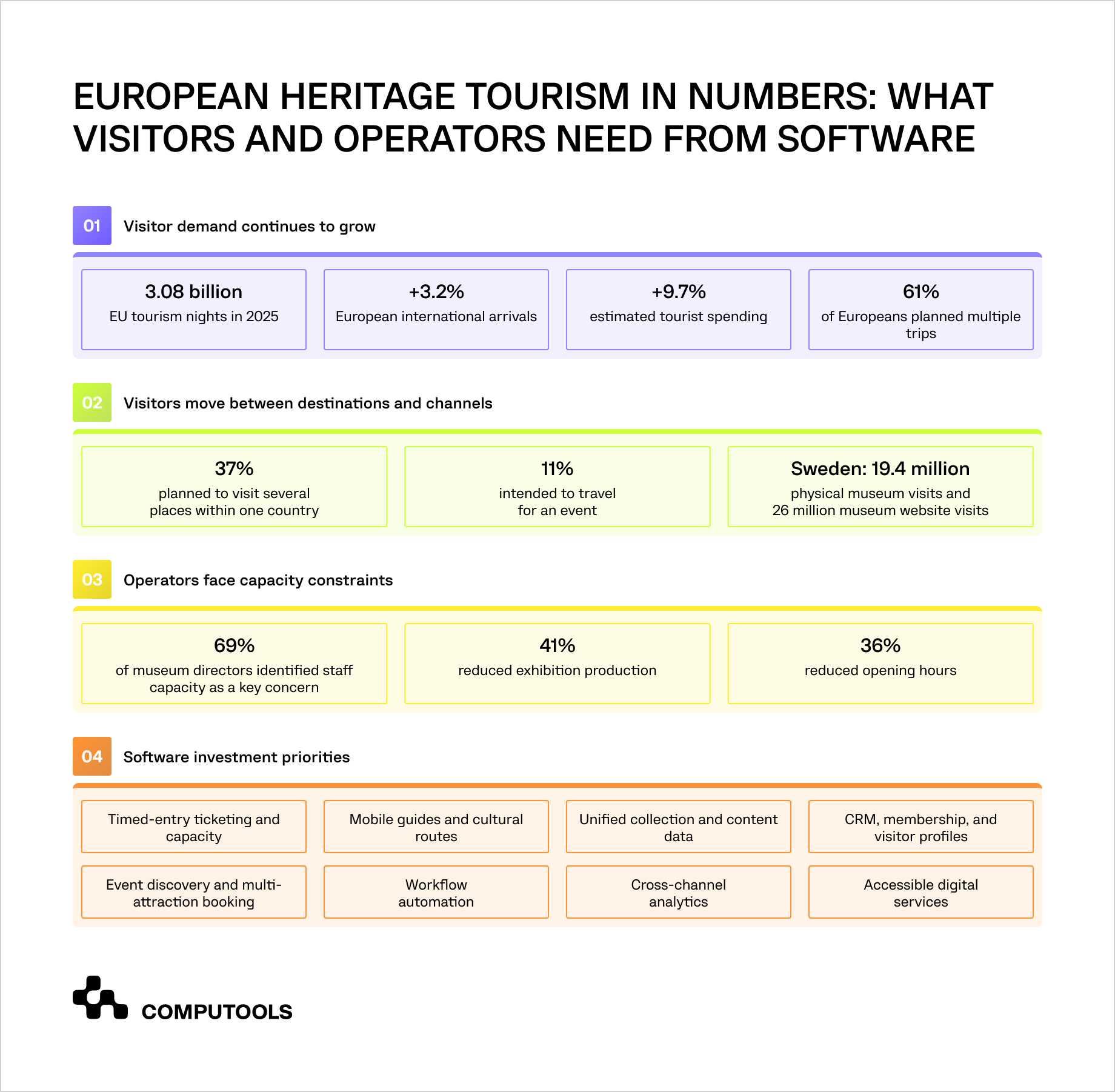
Visitor-facing technology represents only part of the challenge. The European Commission estimates that just 30% to 50% of Europe’s cultural collections have been digitised, while many existing records use inconsistent, poorly traceable, or insufficiently secure standards. At this point, museums and heritage institutions cannot rely on aesthetically pleasing webpages alone.
Development of digital heritage software solutions must incorporate normalized metadata, collection-management system integration, digital asset management, and enhanced search with rights and preservation workflows. Also, historical site management solutions need APIs that allow heritage institutions to publish approved content across websites, mobile apps, research portals, and interactive exhibits.
Accessibility has also become a software architecture and quality-assurance requirement. The European Accessibility Act creates EU-wide standards for products and services, such as e-commerce websites, payment services, mobile phones, and digital content. For cultural organizations, this includes online ticket sales, digital membership cards, mobile guides, multimedia content, donation flows, and visitor accounts. Development teams must consider keyboard and mouse navigation, screen readers, captions, audio description, an easy-to-understand checkout flow, simple, accessible authentication, accessible authentication. and manual testing with assistive technologies.
The tourism software development companies in Europe included in this ranking were evaluated on their ability to design custom visitor applications, collection and content platforms, reservation systems, cloud services and infrastructure, data products, and immersive virtual and augmented reality services and offers, including all necessary integrations with existing museum and tourism-related business services.
Heritage platforms increasingly connect attraction discovery with maps, reservations, payments, local events, and destination services.
Our guide to developing a smart tourism platform for an urban destination explains how these components can operate within one mobile-first architecture.
How we selected heritage tourism software development companies in Europe
This ranking assesses heritage tourism software development companies in Europe who act as engineering partners.
| Selection criterion | What we evaluated |
| Direct industry experience | Verified work with museums, galleries, archives, historic sites, cultural attractions, tourism authorities, or destination organisations. |
| Custom development capability | Ability to design and build tailored platforms rather than only configure or resell proprietary products. |
| Heritage workflow knowledge | Experience with collections, exhibitions, interpretation, visitor access, memberships, ticketing, digitisation, or preservation. |
| Visitor platform coverage | Websites, mobile guides, interactive museum applications, ticketing, maps, digital passes, accessibility, and self-service tools. |
| Data and content engineering | Collection databases, metadata migration, digital asset management, search, APIs, analytics, and content distribution. |
| Integration experience | Connections with collection management systems, CRM, CMS, ticketing, payments, POS, maps, identity, and third-party tourism services. |
| Modernization capability | Legacy assessment, phased migration, cloud adoption, replatforming, and replacement of tightly coupled systems. |
| Scalability and security | Peak-load support, identity and access control, privacy, secure payments, monitoring, and resilient infrastructure. |
| European presence | Headquarters, offices, delivery teams, or established client services within Europe. |
| Delivery and support capacity | Product discovery, design, engineering, QA testing, deployment, maintenance, and post-launch development. |
At the city level, cultural services often depend on shared location data, public information, transport links, and municipal integrations.
Our guide to building a city information system for urban services explains how cities can connect cultural routes, interactive maps, landmarks, events, and public services through a common platform.
15 leading heritage tourism software development companies in Europe
The companies below provide different combinations of heritage-sector knowledge, custom engineering,and historical site management. visitor experience design, collection data management, immersive technology, booking, and platform modernization.
1. Computools
Computools is a global software engineering and consulting company with engineering offices in the UK, Norway, Germany, Austria, Poland and Ukraine. The company provides end-to-end product discovery, UX and UI design, solution architecture, custom software development, quality assurance and testing, system integration, cloud engineering, deployment, and post-launch support.
Computools combines heritage tourism software development with broader travel and hospitality software development services. The company’s heritage offering covers connected visitor journeys, guided-tour applications, cultural content platforms, booking, and personalised communication. This makes Computools suitable for museums, historic sites, cultural routes, attraction groups, and tourism authorities that need to connect visitor applications with ticketing, content, maps, payments, data, and internal workflows.
Connect Content, Maps, and Visitor Services
For SMARTCITY, we developed a location-based tourism platform with attraction and event discovery, geospatial search, messaging, augmented reality, image sharing, and 3D navigation.
This experience can support city heritage routes, museum networks, archaeological trails, historic districts, cultural calendars, and multilingual visitor guides. Through mobile app development services and web development, we create one shared content layer for websites, applications, partner portals, and administrative tools.
Keep Ticketing Reliable During Demand Peaks
For Multitrading, an entertainment ticketing platform, our team built a multithreaded system that processed millions of simultaneous requests, reduced latency, collected operational data, and connected external services through APIs.
That same architecture would provide a solution to flexible timed entries, ticket reservations, group bookings, membership access, payment integration, and reseller outlets, as well as attendance reporting. Additional experience in land-based casino software development further supports high-volume payment integration, loyalty, identity, and venue operations systems.
Connect Admission With Cafés, Shops, and Events
For TAP App, Computools built a cross-platform ordering system with payment integrations and real-time business monitoring. The project increased top-line revenue by 7% through cross-selling and reduced unfulfilled or modified orders by 85%.
Experience providing software development services for HoReCa can support museum cafés, gift shops, workshops, event packages, mobile purchases, and combined admission offers. These services can connect with tickets, memberships, visitor profiles, and analytics instead of operating as separate systems.
Create Consistent Data and Reporting
For Costavira RMS, Computools built a revenue management platform that combined occupancy, booking pace, pricing, events, and channel data. It reduced manual pricing work by 65% and helped increase room revenue by 21%.
The same model can unify attendance, ticketing, memberships, donations, retail, and digital engagement in heritage management software.
Through AI development services, we can also support multilingual search, demand forecasting, content recommendations, metadata suggestions, and visitor assistants, with curator approval for public historical content.
Modernize Through Connected Modules
Profitento connected pricing, forecasting, competitor rates, events, CRM, direct booking, OTA analysis, and reporting in one platform. It increased RevPAR by 11.4%, direct bookings by 24%, and forecast accuracy by 32%.
In cultural tourism software development, Computools can apply the same modular approach to modernize ticketing, CRM, content, analytics, and mobile services without replacing every existing system at once.
Best for: Heritage organisations, attraction groups, and tourism authorities building an integrated platform across discovery, booking, content, visitor communication, and operations.
2. Fluxguide
Based in Vienna, Fluxguide has over 15 years of experience developing technologies for cultural institutions, tourism organizations, education, and smart cities. Its heritage software development services include museum applications, multimedia guides, web applications, augmented reality, mixed reality, digital learning platforms, and online collection experiences.
The company has one of the strongest direct heritage portfolios in this ranking. Its published projects include the Wien Museum, Deutsches Museum, Deutsche Bahn Museum, Mozart museums in Salzburg, castles and palaces in Münsterland, Schloesserland Sachsen, natural history institutions, art collections, national parks, and historic city routes.
Fluxguide is particularly relevant when digital interpretation forms the centre of the project. Their solutions included curated tours, maps, multilingual media, games, AR objects, location-aware storytelling and educational content. Fluxguide’s services can also accommodate a range of attractions, such as outdoor sightseeing tours, castles, protected landscapes, and others. attractions.
Best for: Cultural institutions and historic venues looking for mobile, easy-to-access, multimedia guidance and interpretation, outdoor cultural routes, AR, learning and education services, as well as specialized content and gamified tours.
Consideration: Digital visitor engagement is strongly addressed, but for large enterprises looking for integration of booking, financial, and legacy systems, Fluxguide might to be the best option.
3. DEPT®
DEPT® is a large digital agency with thousands of specialists and offices across Europe and other regions. It combines product development, user experience design, data, technology, commerce, and digital marketing, making it suitable for institutions that treat their website and mobile products as part of a wider audience strategy.
Its direct cultural experience includes work for the Mauritshuis, Van Gogh Museum, Louisiana Museum of Modern Art, ARTIS, and other visitor organisations. DEPT’s capabilities can cover museum websites, collection storytelling, digital identity, personalised content, membership and commerce journeys, analytics, and digital campaigns. Its scale is useful for institutions operating several venues, international audiences, or complex internal stakeholder groups.
The company is less focused on back-office collection management than specialist heritage-data providers. Its strongest work sits where experience design, content, public platforms, and institutional brand strategy meet.
Best for: Major museums and cultural brands planning a high-profile website, multimedia tour, personalised content platform, or broad digital audience programme.
Consideration: Its scale, service breadth, and commercial model may be more than a small museum or narrowly scoped technical project requires.
4. Numiko
Numiko is a Leeds-based digital agency with strong experience in museums, cultural institutions, universities, and public-interest organisations. Its services include digital strategy, user research, UX and UI design, Drupal development, accessibility, performance reviews, and long-term support.
The company has delivered platforms for the British Museum, Science Museum Group, Royal Armouries, and other collection-rich institutions. Numiko is well suited to organisations managing several websites, venues, collections, or audience groups. It can consolidate fragmented digital estates, create reusable components, integrate public collection data, and establish common publishing and accessibility standards.
The Royal Armouries project demonstrates its ability to support multiple physical sites, location-specific events, collection exploration, and visitor planning within one platform.
Best for: Museum groups and large institutions replacing disconnected websites with a consistent, accessible, collection-rich digital estate.
Consideration: Its public portfolio is strongest in websites, Drupal, content, and collection access. Buyers should request evidence for complex admission inventory, POS, native mobile applications, or operational workflow systems when these are central to the project.
5. Digirati
Digirati is a UK cultural heritage software development company with headquarters in Glasgow and an office in London. It works on digital strategy, collection infrastructure, preservation, IIIF, research platforms, crowdsourcing, and tools for presenting digitised materials.
Visible user interfaces hide much of the company’s potential. Digirati develops data services, imagery infrastructures, APIs, and other modular elements to help organizations make their large data collections more available and easily reused. Their portfolio includes collaborations with V&A, National Archives, National Library of Wales, University of the Arts London, Wellcome Collection, and Bibliothèque nationale de France.
The company’s focus on solving the challenges of fragmented metadata, multiple repositories, large images, and long-term preservation makes it well-suited for many organizations.
Best for: Building collection APIs, IIIF infrastructure, heritage preservation technology, and research infrastructure for museums, libraries, and research institutes.
Consideration: As a sole partner, Digirati is less appropriate for hospitality operations, broad consumer transaction systems, destination booking, and loyalty solutions.

Launch your heritage tourism software in 1–3 months instead of a year, and welcome more visitors with immersive digital experiences without increasing operational overhead.
6. Cogapp
Brighton-based Cogapp is a digital agency with a broad international client base. The company’s digital strategy, user experience, design, IoT technology, and agile delivery services cater to dozens of libraries, museums, and galleries. They build a variety of cultural institution software, including websites, digital collections, digital video libraries, and integration of digital asset management systems.
Their clients include the British Library, National Archives, National Gallery of Art, MIT Museum, National Trust for Scotland, Hammer Museum, Royal Society, and other collection-based institutions. Cogapp is a strong choice when a cultural organisation has technically complex source systems but still needs a clear and accessible public experience.
Best for: Organizations looking for a long-term digital partnership to build custom content platforms, DAM systems, and IIIF for their collection services.
Consideration: Since Cogapp is a small agency, larger organizations with many ongoing digital services may want to research Cogapp’s capacity further before starting a collaboration.
7. Surface Impression
Surface Impression is a UK and European digital partner that has collaborated with galleries, libraries, archives, and museums for over 20 years. Their projects involve collection accessibility, data integration, digital services for online exhibitions, community heritage site software solutions, and the application of AI and IIIF.
Surface Impression builds to museum and archive standards such as Spectrum, ISAD(G), MARC, IIIF, and widely used cultural vocabularies. They have implemented public collection systems for the National Gallery of Ireland, Royal Scottish Academy, Cooper Hewitt Smithsonian Design Museum, and several international collection collaborations.
The company is a good fit for projects that require the public to interact with complex collection information, while retaining accurate links to internal systems.
Best for: Museums, galleries, and archives that seek to create collection portals, online exhibitions, or wish to have data integrations that comply with standards.
Consideration: There is more publicly available evidence of their work with collections and content than for high-volume ticketing, native mobile services, and enterprise operational platforms.
8. Keepthinking
Keepthinking is headquartered in London and supports cultural institutions through collection management, data migration, web and mobile development, UX, accessibility, and digital strategy. Its central technology is Qi, a configurable collections and content management platform that also includes digital asset, publishing, workflow, and commerce functions.
Qi is used by more than 60 organisations, while Keepthinking’s portfolio includes museums, archives, foundations, historic map collections, universities, and art institutions. The company can combine internal collection workflows with public websites, allowing object records, media, interpretation, exhibitions, and editorial content to operate within a connected structure.
The company is particularly relevant when collection administration and public access need to be improved together rather than handled through separate suppliers.
Best for: Institutions seeking one partner for collection management, migration, public access, publishing, and digital asset workflows.
Consideration: Qi plays a central role in the service model. Buyers that require a technology-neutral architecture should clarify which components can be replaced, exported, or integrated independently.
9. Codex Software
Codex Software is registered in England and Wales and provides custom development, IT consulting, and dedicated engineering services. Its cultural-sector offering covers museums, galleries, libraries, archives, performing arts venues, and other cultural organisations.
The company describes capabilities in digital collections, collection-system integration, ticketing, membership, preservation, exhibition planning, visitor applications, and ongoing maintenance. Unlike a product-only vendor, Codex positions its work around tailored platforms and integration with existing systems.
Codex is relevant to both cultural institutions and cultural technology vendors. It can support a complete custom product, extend an existing platform, supply a dedicated engineering team, or modernize individual modules while retaining the client’s current infrastructure.
Its strongest value lies in product engineering. A museum software provider, archive technology company, or institution with internal product ownership could use Codex to increase delivery capacity without moving to a packaged museum system.
Best for: Cultural organisations and museum technology vendors that need a dedicated custom engineering team, platform modernization, or integration work.
Consideration: Its public cultural portfolio contains fewer detailed project descriptions and measurable outcomes than several higher-ranked specialists. Buyers should request architecture examples, named references, and evidence for the specific workflow being commissioned.
10. OANDER
OANDER develops websites, portals, e-commerce systems, event platforms, and custom integrations. Its strongest direct museum evidence comes from the Museum of Fine Arts in Budapest and the joint museum shop operated with the Hungarian National Gallery.
For the Museum of Fine Arts, OANDER created a modular website with prominent ticket-purchasing routes, editorial exhibition pages, visitor information, and an integrated collection browser. The public catalogue synchronises with the museum’s internal artefact records, allowing visitors to search the collection while staff retain the back-office system as the main data source.
The company also has experience with Magento-based ticketing and event management, online sales, cash-desk ticketing, product catalogues, and system integration. These capabilities can support museums that want to connect admission, exhibitions, retail, and content rather than operating separate websites for each service.
Best for: Museums and galleries requiring an integrated website, collection browser, event ticketing, and online store.
Consideration: OANDER’s public work is concentrated around web portals and commerce. Buyers should verify native mobile, cloud-data, AI, and large-scale modernization capabilities where those areas are required.
11. Delta Reality
Delta Reality specialises in augmented reality, virtual reality, mixed reality, interactive installations, 3D content, and immersive visitor experiences. Its cultural portfolio includes castles, fortresses, interpretation centres, historic towers, local traditions, museums, and archaeological environments.
For Trakošćan Castle, the company created a bilingual mobile application with an interactive map, seven marker-based AR experiences, animation, audio, and 3D historical scenes. Because the castle had weak internet and GPS coverage, the experience made content available offline after the initial download.
At the Museum of Bećarac, Delta Reality developed nine applications involving AI-generated content, quizzes, karaoke, animation, touchscreens, rhythm games, and AR. Its work with the Halubian Bell Bearers used five interactive applications to document and interpret intangible cultural heritage.
Best for: Castles, archaeological sites, museums, and visitor centres developing immersive exhibits, 3D interpretation, or location-based AR and VR.
Consideration: Delta Reality is an immersive-technology specialist. A wider project involving CRM, collection management, ticketing, finance, or enterprise integration may require another engineering partner.
12. LeanCode
LeanCode is a custom software and product engineering company with particular strength in Flutter applications. Its direct museum evidence comes from the Wedel Chocolate Factory Museum in Warsaw, where it designed and developed an interactive application used across ten remotely managed kiosks. The application allows visitors to create personalized product packaging through a curated AI image experience.
This project demonstrates capabilities relevant to interactive exhibits, short-form visitor interactions, kiosk fleets, remote content management, cloud back ends, and AI-assisted personalisation. LeanCode’s broader cross-platform expertise can also transfer to mobile guides and visitor-facing applications that must share logic across devices.
Best for: Attractions and branded museums that need Flutter-based kiosks, interactive applications, remote device management, or cross-platform visitor tools.
Consideration: LeanCode’s public museum work centres on interactive kiosks, so buyers should verify its experience with ticketing, collections, and multi-system integrations.
13. Apadmi
Apadmi is a mobile product company serving clients across Europe and other markets. Its travel and tourism portfolio includes destination applications, customer platforms, travel brands, loyalty systems, and mobile experience modernization.
Its most relevant cultural-attractions project is the Den Haag Pass application. The digital pass gives users access to offers and activities across museums, theatres, attractions, restaurants, excursions, and shops. It combines a city events calendar with mobile access to destination benefits.
This experience transfers well to city museum passes, cultural attraction networks, regional tourism programmes, digital memberships, and visitor loyalty. Apadmi can also support account management, payments, personalized offers, analytics, push communication, and integration with external visitor services.
The company is a stronger choice for customer-facing mobile products than for archive management or conservation workflows.
Best for: Cities, destination organisations, attraction networks, and cultural pass operators building a mobile visitor product or loyalty programme.
Consideration: Direct evidence is centred on mobile visitor journeys. Collection systems, preservation, and specialist museum data may require a separate provider or strong client-side domain leadership.
14. Miquido
Miquido provides product strategy, UX and UI design, mobile and web engineering, along with cloud development, data science, and AI. While their main focus is travel, they have created multiple visitor engagement software solutions that help city explorers with mapping, contextual discovery, bookings, and travel management.
These capabilities can transfer to cultural route applications, destination discovery, attraction recommendations, itinerary tools, and mobile products that connect heritage content with wider travel services.
Best for: Tourism organisations and cultural destinations building destination management software with or modern travel applications with map-based discovery, mobile itineraries, and social recommendations.
Consideration: Public evidence is adjacent to heritage. Museums requiring collection management, preservation, curatorial workflows, or specialised metadata engineering should seek museum software development companies with stronger direct experience.
15. N-iX
N-iX is a large software engineering provider with delivery centres in Ukraine and Poland. Its hospitality work includes real-time booking, corporate travel platforms, mobile development, cloud systems, high-load architecture, DevOps, testing, and dedicated product teams.
Most of its relevant experience is in travel, hospitality, booking, and user-facing digital systems. These services apply to building cultural attractions software that provides timed entry, group bookings, venue reservations, digital tickets, visitor accounts, payment systems, partner networks, and services across multiple sites.
N-iX can help modernize legacy booking and visitor systems and develop flexible web and mobile applications. It can provide systems integration for CRM, payment, identity, mapping, and analytics, and reconfigure applications to the cloud. Its services will also support data engineering for organizations wishing to unify ticketing, attendance, visitor, membership, and retail and marketing data in a single reporting framework.
Best for: Large attraction networks, destination platforms, and tourism organisations requiring scalable ticketing and reservation software, cloud modernization, or dedicated engineering teams.
Consideration: Public direct experience with cultural heritage management solutions is limited.
How to choose a heritage tourism software development company
The right provider of custom heritage tourism software must understand how public visitor services connect with collections, ticketing, exhibitions, memberships, retail, donations, facilities, and internal administration. A company may have an impressive museum portfolio but lack the engineering capacity to modernize business-critical systems. Another may build scalable travel platforms but require stronger client-side guidance on curatorial and heritage workflows.
Use the following areas to compare tourism digital transformation companies.
| Evaluation area | What to verify | Questions to ask |
| Heritage workflow knowledge | Experience with collections, exhibitions, visitor interpretation, ticketing, memberships, archives, events, and public access. | Which comparable workflows have you implemented, and what did your team own? |
| Platform architecture | Separation of content, collections, transactions, identity, analytics, and integration services. | Can we replace one system without rebuilding the entire platform? |
| Data interoperability | Metadata mapping, APIs, collection systems, DAM, CMS, search, IIIF, and European compatibility. | How will you normalise and synchronise records across our systems? |
| Ticketing performance | Timed entry, capacity, temporary holds, refunds, group visits, membership access, and ticket validation. | How will the platform prevent overselling during peak demand? |
| Visitor experience | Web, mobile, kiosks, maps, audio, accessibility, multilingual content, and offline use. | How will one visitor journey work before, during, and after a visit? |
| Migration planning | Source-system audit, data cleansing, testing, phased rollout, rollback, and staff training. | How will you prove that records and transactions migrated correctly? |
| Security and privacy | Identity, permissions, payment security, personal data, monitoring, and incident response. | Which security standards will you use as acceptance criteria? |
| Delivery team | Named architects, engineers, designers, QA specialists, data experts, and domain specialists. | Which people will work on the project after the sales process ends? |
| Post-launch support | Monitoring, maintenance, service levels, content releases, device support, and enhancement planning. | What support is available during exhibitions and high-traffic periods? |
| Commercial transparency | Assumptions, exclusions, dependencies, licensing, and third-party costs. | Which parts of the scope carry the greatest delivery or cost risk? |
Payment security must be addressed at the architectural level. Computools’ guide to building PCI-compliant transaction software covers payment-data boundaries, secure modernization, system access, and compliance-driven engineering decisions.
Final thoughts
The best development partner depends on the project’s operational scope. Large digital agencies suit major institutions planning complex public platforms, content programmes, and international visitor experiences. Heritage specialists are usually stronger when collecting data, archives, interpretation, accessibility, or digital preservation are the focus of the project. Immersive technology studios are well-suited for AR, VR, 3D reconstructions, and interactive exhibits. Travel engineering companies offer essential experience related to booking, mobile journeys, geolocation, payment, and high-load systems.
First-hand heritage experience is still important, but should not be the only focus. A company also needs to show that it can integrate existing systems, migrate sensitive data, build for peak visitor loads, and support ongoing accessibility and security of the systems post-launch.
Computools fits organisations that need one engineering partner across visitor applications, ticketing, content, data, integrations, and phased modernization. Our subject matter expertise in tourism platforms, high-load reservation systems, analytics, mobile products, hospitality services, and secure legacy environments can support both public-facing and operational requirements of heritage site management and museum management software.
Replace manual updates and disconnected systems with one platform for admission, content, visitor services, reporting, and partner coordination. Discuss a phased roadmap with Computools at info@computools.com.
Computools
Software Solutions
Computools is an IT consulting and software development company that delivers innovative solutions to help businesses unlock tomorrow.