
THE AUTHOR:

If two-thirds of restaurants prefer POS-integrated systems compared to third-party tools, and off-premise dining continues to expand as a fundamental revenue stream, why do so many operators continue to experience inefficiencies and complexity with their tech? This question is in the spotlight for restaurant POS software development firms in 2026.
In the following sections, we outline the primary trends in the market, expectations of restaurants with today’s POS systems, and how to choose the best-suited partner for your needs. Finally, we’ll top this up with a curated list of 15 companies leading custom restaurant POS software development this year.
Top 15 restaurant POS software development firms in 2026:
1. Computools
2. Endava
3. Thoughtworks
4. Praxent
5. Kindgeek
6. Netguru
7. Yalantis
8. Dinarys
9. Innowise
10. Digitalmara
11. Sysgears
12. Fingent
13. Code Brew Labs
14. Quokka Labs
15. Arctouch
The restaurant POS market landscape in 2026
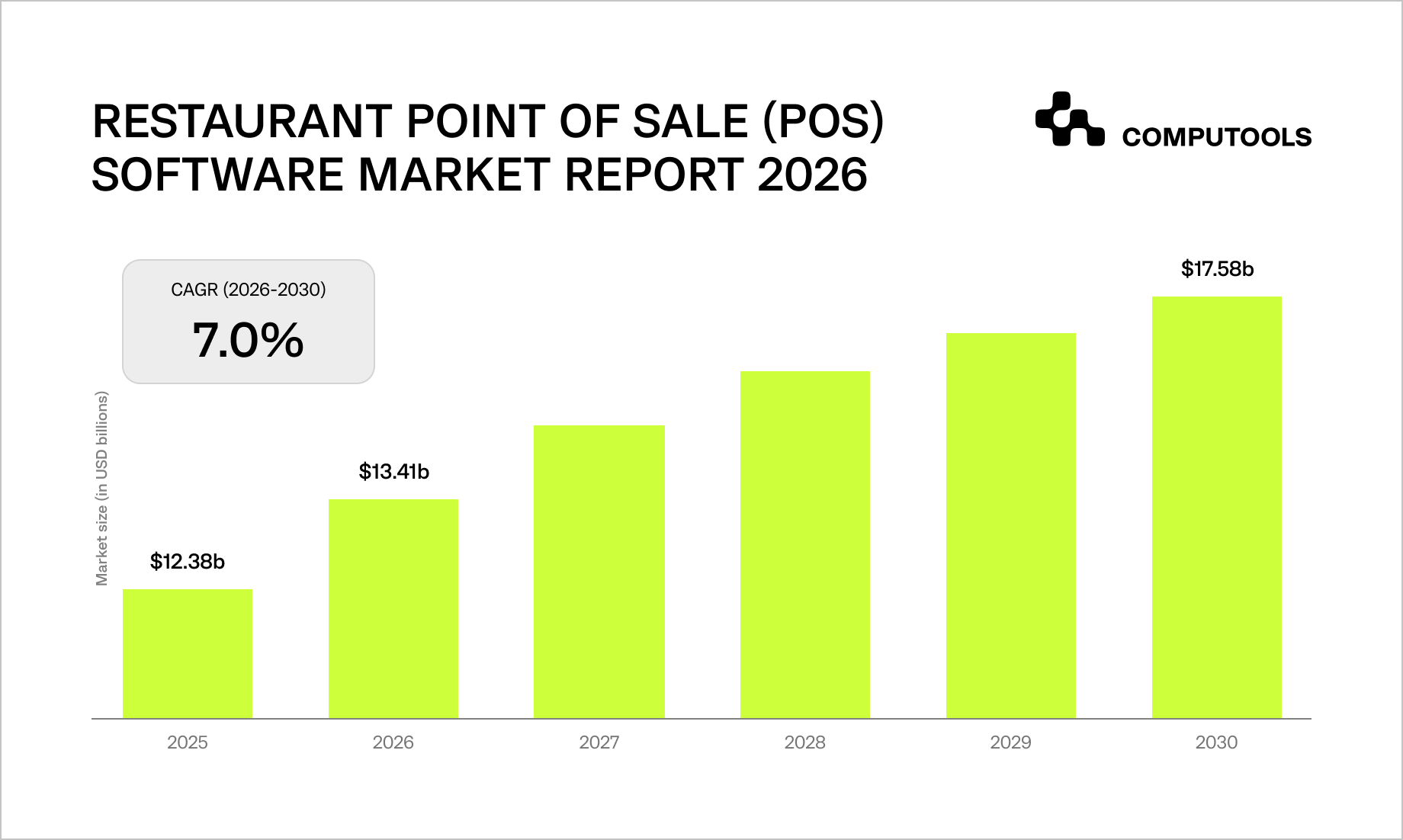
The restaurant point of sale software is evolving, and its market share increase is primarily driven by operational needs. The Business Research Company states that the market is projected to go up from $12.38B in 2025 to $17.58B by 2030. Growth factors include cloud POS, real-time analytics, contactless payments, self-service ordering, and inventory management.
On the other hand, the investment restaurants have been making is under pressure. Operators are experiencing climbing food and labor costs and a more price-sensitive consumer. Because of this, POS services are not merely transaction systems, but are becoming central to cost management, speed, accuracy, and multi-channel revenue.
What customers expect from restaurant billing and POS software
There has been a shift in preferences toward all-in-one operational solutions. TouchBistro states that 97% of full-service restaurants have POS systems, and 67% primarily use POS-integrated systems over 3rd party systems. The demand is clearly for unified platforms that feature payments, ordering, reservations, kitchen, and reporting functionalities.
Native off-premise ops support is another expectation. Online ordering needs to be integrated into the POS, as operators prioritize reliability, speed, and accuracy. Digital channels are core revenue, and are not just add-ons.
Read more on mobile experiences in restaurant app use cases and find out how apps drive engagement, streamline ordering, and support multi-channel revenue.
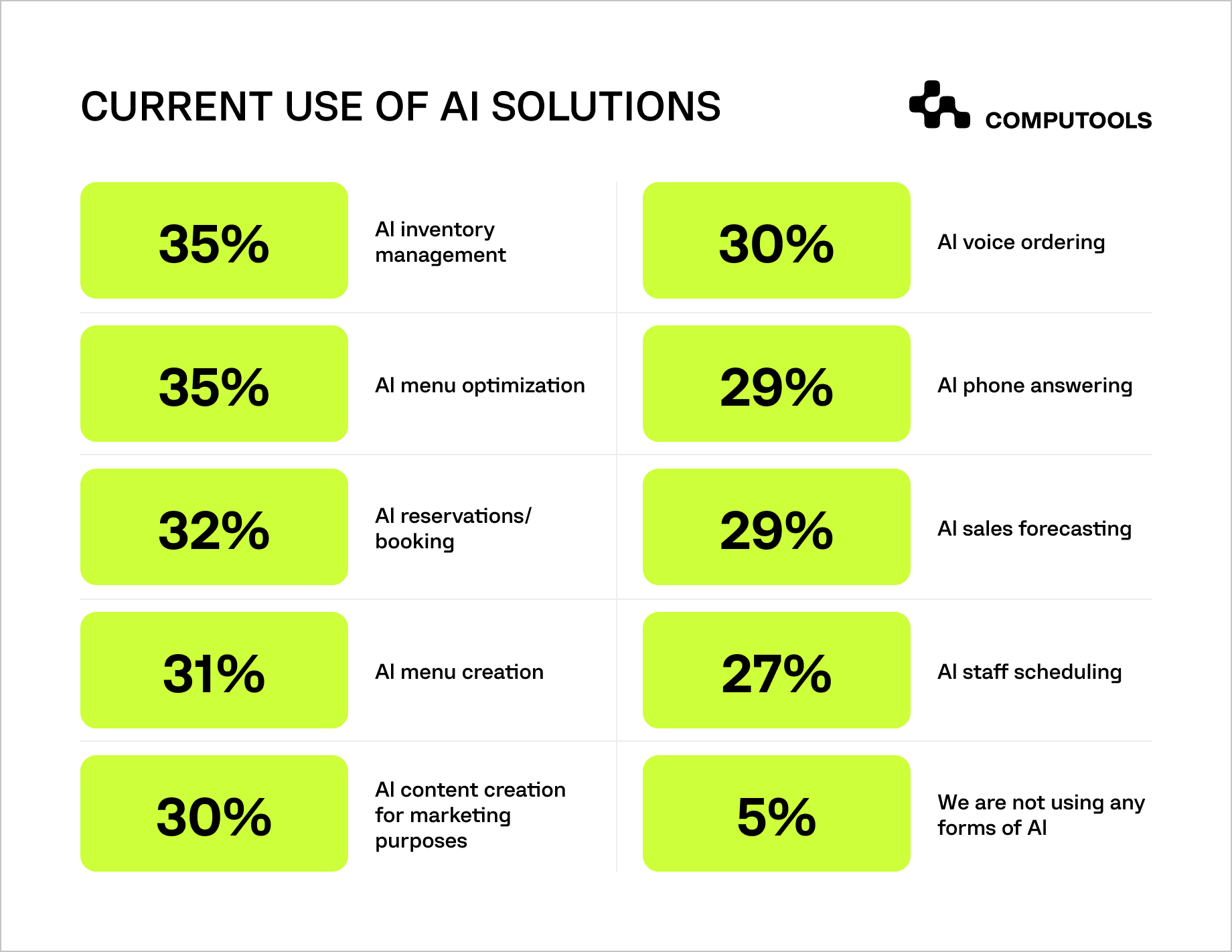
There is also growing demand for practical AI. Close to 95% of restaurant operators report using AI technology for tasks like inventory management, menu optimization, reservations, and forecasting to help improve their operational efficiency. The focus is on tools that directly improve margins, not on innovation for its own sake.
Where current POS solutions fall short
Despite high adoption, several gaps remain. For starters, there is complexity. Many operators continue to find restaurant technologies too complicated. This is a clear indication of a lack of alignment between the actual workflows and the software available.
Fragmentation is secondary. The use of several different processing and operational systems leads to poor synthesis, redundant tasks, and inconsistent data. The strong need for POS native integration is a clear indication of this problem.
The third problem is the lack of service stabilization. Operators complain of poor integrity, system reliability, and tech issues, particularly with online ordering. POS systems are central to all restaurant operations and failures can derail operational efficiency, impacting sales and the customer experience.
POS as an operational backbone
The POS software is the backbone of restaurant operations. Operators expect a unified system that will reduce manual work, make it easier for the restaurant staff to operate, and make it easier for the customer to make a purchase. The issues of complexity, fragmentation, and reliability explain why the focus has been, and will continue to be, on new systems that help alleviate these inconsistencies.
This shift is part of a broader wave of digital transformation in restaurants, where systems are no longer isolated tools but interconnected platforms driving both operations and revenue.
Selection criteria for best restaurant POS software development firms
In 2026, choosing a restaurant POS system development company means looking for a tech partner that can build a holistic restaurant commerce ecosystem with a real-time connection between orders, payments, operations, and consumer insights. Use the following framework to find the most well-suited option.
| Category | What to look for | Why it matters |
| Restaurant Domain Expertise | • POS, ordering, kitchen, and inventory workflow experience • Knowledge of dine-in vs. takeaway vs. delivery • Experience in real-time service environments (i.e. peak load) | Given the operational complexity and latency sensitivity of restaurant systems, a generalist team might overlook a lot of important details. |
| POS & Payments Architecture | • Experience with payment processors and gateways • Knowledge of PCI DSS compliance • Multi-currency and refund logic • Offline functionality (critical for restaurants) | This is the most mission-critical layer. If the POS fails, the impact on revenue is immediate. |
| Integration & API Capability (CRITICAL) | Experience with the integration of: • Delivery platforms (Uber Eats, DoorDash) • Reservation systems • Accounting software • Loyalty/CRM systems • API-first architecture or frameworks • Real-time data sync | Based on 2025/2026 data, this is one of the largest gaps in the market. Restaurants utilize multiple platforms simultaneously, and poor integration leads to operational silos and chaos. |
| Data, Analytics & Revenue Intelligence | • Real-time reporting and dashboards • Menu, sales, and labor analytics • Pricing and upselling suggestions from AI • Tracking of customer behavior | The new trend in POS values insights over transactions. Due to inflation, operators are focusing on profitability and managing margins. |
| Support for Multi-Location and Scalability | • Microservices-based, cloud-native architecture • Management across multiple locations for staff, menus, and pricing • Guaranteed high availability and uptime | This is critical for growing brands and chains. The system should be able to manage: • peak hour traffic • seasonal surges • regional/spatial expansion |
| User Experience & Efficiency | • Optimized mobile/tablet and role-based interfaces • Fast order processing (fewer clicks) • Optimized design for waitstaff, managers, and kitchens | Efficiency is critical. Every second saved reduces service time, increasing turnover and revenue. |
| AI and Automation Features | • Demand and inventory forecasting with staff order routing • Optimized staff scheduling • AI recommendations and upselling | Technology is supposed to decrease the labor burden on operators while improving efficiency, leading to less stress. |
| Security & Compliance | • PCI DSS Compliance • GDPR/data protection • Secure APIs • Encryption • Role-based access control | There are heavy fines and reputational damage from breaches when handling payment information and customer personal data. |
| Speed of Delivery & Engineering Maturity | • Proven delivery promises • Agile/DevOps • CI/CD • Strong QA • Testing frameworks | Restaurant technology has many opportunities and needs to change quickly. Delays become lost opportunities. |
| Product Thinking vs Pure Development | • Ability to advise not just build • Monetization (loyalty, upsell, subscriptions) • SaaS product development | Partnerships should help build a revenue engine, not just software. This is what differentiates top tier restaurant POS software development firms. |
15 restaurant POS software development firms setting the standard in 2026
1. Computools
Computools is a global custom engineering and IT consultancy company with delivery offices across USA, Europe and Asia. As part of its travel and hospitality software development services, the company creates tailored POS software solutions for restaurants. We never view POS as a separate module. Instead, we design it as the core transactional layer that integrates ordering, operations, payments, and customer data into a single entity.
This approach translates into platforms that provide real-time menu and table management, ordering, and payment across multiple devices, all in sync across locations and channels.
Engineered for High-Stakes, Revenue-Critical Environments
With 250+ engineers, 400+ delivered projects, and ISO 9001 / ISO 27001 certifications, the company operates at a level suited for business-critical solutions where reliability and data consistency directly impact revenue.
Operational and business value of our approach shows within the behavior and performance of the systems in real life. It operates as a single integrated workflow that manages orders, inventories, and pricing. This eliminates the bottleneck and delays across the kitchen, the front and back office, and the digital channels.
Flexible Architecture That Grows With the Business
Computools is incredibly adept at providing POS systems designed to operate as a flexible and scalable architecture, rather than a rigid product. We ensure a single data flow, reducing delays between kitchen, front-of-house, and digital channels. Multi-location setups can operate on shared logic while still supporting local variations.
It allows restaurant enterprises to progressively evolve their operational model across multiple channels, services, and refined workflows without the disruption of having to completely reconstruct the system.
Data That Drives Smarter Decisions and Better Margins
Aside from the nitty-gritty of operations, our restaurant POS system development services sets the groundwork for an impactful measurable improvement.
Integrated transactional, customer, and operational data allow businesses to:
- fine-tune pricing
- boost order accuracy
- eliminate manual handiwork
- facilitate quicker response to demand changes.
The POS evolves to become a processing layer and an optimization support system.
Applied AI Capabilities
Computools’s deep expertise in AI development services, powers integration of intelligent applications over the unified data stream, including location-based demand forecasting, personalized upselling, operational forecasting, decision-making based on real-time POS and customer data, as well as tailored support copilots.
Best fit
Restaurant groups developing proprietary systems with iterative operational models, multi-channel ordering, and a demand for closely integrated, flexible systems.
2. Endava
Endava is not a specialized restaurant POS software provider, but its services are highly relevant when POS projects prioritize payments and real-time transactions. Endava claims that 90% of the largest payment processors and 70% of the largest acquirers are its customers, and that it links AI and data to fraud prevention, predictive analytics, and payment facilitation.
This makes Endava particularly useful in restaurant POS when the real challenges are around transaction frameworks, reconciliation, omnichannel consistency, and the modernization of payments, as opposed to just restaurant UX.
Applied AI capabilities: fraud detection, chargeback risk scoring, reconciliation automation, and transaction anomaly insights.
Risks: Endava is more focused on payments and platform engineering than on restaurant-native workflows.
Best fit: payment-centric restaurant platforms and omnichannel commerce modernization.
3. Thoughtworks
Although Thoughtworks is primarily a technology consultant rather than a restaurant POS software company, it may present interest to restaurant groups who are reengineering their fragmented systems into modular platforms. In 2026, it is promoting AI/works, an agentic development platform that aims to accelerate software delivery with better outcomes.
For restaurant POS, it primarily provides architectural services: decomposing monolithic structures into composable services for menus, pricing, orders, payments, loyalty, and analytics. Its strongest offering is when the goal is transformation rather than just implementation.
Applied AI capabilities: agentic operating models, AI engineering delivery, and data-plus-agent orchestration across restaurant systems.
Risks: Thoughtworks may be overly strategic and costly for a basic POS rollout.
Best fit: enterprise restaurant groups modernizing fragmented commerce systems.
4. Praxent
Praxent describes itself as an AI engineering and consulting company tailored for fintech, highlights its SOC 2 Type II certification, and presents modular modernization services performed without downtime.
Although Praxent specializes in fintech engineering, it is applicable as a restaurant management POS software developer when transactional UX and payment systems modernizations are critical. Its credibility is primarily in the area of billing, digital wallets, payment refunds, split payment, and upgrading legacy transaction systems without breaking live operations.
Applied AI capabilities: AI-driven payment UX, exception handling automation, and financial data copilot.
Risks: more expertise in transaction than kitchen or service workflows.
Best fit: restaurant systems with sophisticated payment logic or legacy transaction systems.

Want to build or upgrade a POS system that supports multi-location growth and omnichannel orders? Contact our experts to scope your solution.
5. Kindgeek
Aside from having expertise in Fintech, software product development, AI and ML, Kindgeek’s other capabilities include predictive analytics, process automation, and custom user applications. They also have experience in payment-related services.
It may not be restaurant-first, but it is a potential partner for POS software development for restaurants, especially for tech-startup-type platforms with ordering systems, merchant dashboards, delivery logic, and wallet functionality.
Applied AI capabilities: predictive demand features, AI-driven upsell logic, smart dashboards, and workflow automation.
Risks: They are less proven for larger, multi-unit restaurant systems.
Best fit: startups, and teams building a POS or ordering system from the ground up.
6. Netguru
Netguru has a firm hold of the commerce, product design, and AI personalization intersection. The company assists in the transformation of retail ecosystems, marketplaces, and B2B solutions with AI personalization and scalable digital products.
As a result, it has become increasingly applicable in the customer-first layer of restaurant POS systems, which include branded ordering applications, loyalty, targeted promotions, and digital storefronts. It has less of an in-store operational focus.
Applied AI capabilities: recommendation systems, personalized offers, customer segmentation, and API assistance.
Risks: it is not the best option for hardware-centered or operationally focused enterprise POS platforms.
Best fit: restaurant chains with a focus on digital ordering and a loyalty-driven growth approach.
7. Yalantis
What makes Yalantis exceptional is the incorporation of software, AI, data, and hardware/IoT in one engineering profile. It positions itself around full-cycle software and hardware development, as well as scalable web and mobile applications, and AI systems.
This is particularly applicable for restaurant POS systems incorporating tablets, along with peripherals, kitchen displays, scanners, printers, and payment integrations. It goes beyond app development into device-linked operational systems.
Applied AI capabilities: operational forecasting, smart order routing, support assistants, and sensor- or device-linked intelligence.
Risks: may lack a well-defined restaurant product vision.
Best fit: mobile-first restaurant POS systems and hardware-connected workflow design.
8. Dinarys
Dinarys is strongest as a commerce engineering company specializing in digital platforms, composable commerce, and API integrations. Event-driven architecture, certified commerce partnerships, and Stripe payment integrations are highlighted in Dinarys’ public materials.
Dinarys is most relevant as a restaurant POS software developer when the business operates as a large commerce service with web ordering, retail crossover, subscription offerings, or branded marketplaces. It is less compelling for traditional dine-in operational depth.
Applied AI capabilities: cross-channel merchandising, inventory-aware offers, product recommendations, and commerce analytics.
Risks: more commerce-native than restaurant-native.
Best fit: restaurant brands with strong online ordering or omnichannel commerce aspirations.
9. Innowise
Innowise is a large-scale custom software engineering company with high customer satisfaction in recent rankings. In restaurant POS system development services, its focus is on building end-to-end systems for high-load scenarios, where uptime, speed, and transactional reliability are of the utmost importance.
When it comes to engineering, Innowise has top capabilities in creating architectures for multi-location restaurant chains, real-time order processing, and sustaining peak hour demand without system degradation.
Applied AI capabilities: demand forecasting, dynamic pricing models, operational analytics, and intelligent load balancing across locations.
Risks: requires clear requirements and longer implementation cycles.
Best fit: large enterprise restaurant chains requiring a sophisticated, fully customized POS solution.
10. DigitalMara
DigitalMara specializes in restaurant bookkeeping and custom POS systems for restaurants, with an emphasis on integration and operational backend financial systems. They excel at integrating POS systems with legacy accounting, ERPs, and supply-chain systems for seamless data transfer across all business processes.
Its relevance in POS development comes from solving operational complexity behind the scenes, especially for businesses with fragmented financial and inventory systems.
Applied AI capabilities: Financial forecasting, reconciliation, transaction and inventory anomaly detection, and cost optimization insights.providing insights for cost optimization, and detecting discrepancies in transactions and inventory.
Risks: Be mindful of the fact that it is less focused on front-end user experience or modern customer-facing POS interfaces.
Best fit: restaurant businesses with complex accounting workflows or heavy reliance on legacy infrastructure.
11. SysGears
SysGears designs and develops hardware-integrated systems to streamline and automate restaurant operations. They can make POS smart enough to interface with ovens and beer taps at the bar, and synchronize with kitchen displays and inventory sensors. Systems and operations can be deeply interconnected with this paradigm.
They change the POS from a transaction device to a real-time command center for the restaurant.
Applied AI capabilities: predictive maintenance for equipment, the automation of inventory tracking, and exploitation of data from discrete sensors.
Risks: niche IoT focus may not cover full-scale enterprise POS requirements on its own.
Best fit: restaurants that want to make significant investments in smart kitchen technologies, sophisticated device connectivity and operational workflows.
12. Fingent
Fingent is fully dedicated to enterprise software development and specializes in assisting businesses with the digital transformation and modernization of their legacy systems.
With restaurant POS, it focuses on helping established restaurant groups migrate from outdated, monolithic systems to cloud-native, mobile-first platforms.
Because Fingent’s restructuring approach is devoid of any disruption to the operations of the legacy systems, it has developed the trust of many clients as an ideal partner for a slow and gradual transformation.
Applied AI capabilities: operational analytics, the automation of workflows, and intelligent actionable data extraction from legacy systems.
Risks: as a cloud-based restaurant POS software developer, the company is less focused on cutting-edge UX or greenfield product innovation.
Best fit: legacy restaurant systems that need POS modernization, but do not require the POS to be fully replaced.
13. Code Brew Labs
Code Brew Labs has gained a positive reputation in the development of scalable systems, particularly with on-demand food delivery systems and POS-enabled marketplace systems.
They are fundamentally product-focused, and many of their systems utilize POS in conjunction with a full range of order and delivery functionalities, as well as multi-vendor management. This is especially applicable to businesses characterized by the hybrid model and dine-in and takeaway marketplace.
Applied AI capabilities: personalization through AI, recommendations, and optimizing services based on demand.
Risks: could focus on marketplace and delivery at the expense of in-depth operational workflows within stores.
Best fit: companies creating integrated POS with delivery systems or multi-brand restaurant ecosystems.
14. Quokka Labs
Quokka Labs classifies itself as a product engineering company and deals with mobile-first architecture and high-performance backend systems. For restaurant POS, it aims to design systems that manage peak traffic, real-time updates, and a huge number of concurrent transactions.
It excels in optimizing systems and maintaining stability, which is very important in a fast-moving restaurant environment.
Applied AI capabilities: real-time demand management, performance analytics, and smart traffic routing.
Risks: an emphasis on hardware integrations and complex enterprise POS ecosystems.
Best fit: quick service restaurant brands that need trustworthy and high-performance POS solutions.
15. ArcTouch
ArcTouch is a design and development company that focuses on mobile, the Internet of Things, and other digital ecosystems. In restaurant POS systems, ArcTouch focuses primarily on experience-based system integration of smart kiosks, mobile wearables, and other connected devices.
ArcTouch has a reputation for unique innovation, which is complimented by the quality of their interactive design.
Applied AI capabilities: context-aware suggestions, self-adjusting interfaces, and smart customer engagement layers.
Risks: as a restaurant technology software development firm, it may tend more towards experience innovation rather than profound operational backend intricacy.
Best fit: restaurant brands focused on next-generation, technology-driven customer experience.
Conclusion
The restaurant POS market in 2026 will be centered around operational impact rather than a set of features. With growth occurring under pressure, operators must evaluate technology in a different way.
POS has changed from a tool to a system that determines:
- operational efficiency
- how quickly a restaurant can respond to a shift in demand
- how much margin a business can protect.
The core takeaway is that restaurants are displacing fragmented, add-on driven stacks for unified, intelligent platforms.
The demand has shifted away from feature bloat to:
- a reduced service with a higher quality of integration
- improved real-time reliable system performance
- AI that can practically enhance profitability.
This is largely why the role of a tech partner is different now than in the past. Creating a POS now requires developing real-time commerce solutions that unify orders, payments, operations, and customer data into a single system that can make decisions for the business.
The market gap isn’t adoption, it’s alignment. The restaurant POS software development firms that will be successful in this space are those that understand why POS is the operational backbone for businesses.
Why choose Computools for restaurant POS development?
Restaurants prefer custom POS systems over SAAS products to better suit their business needs and provide and elevate customer service. Computools understands and practices a philosophy of system design. Our software development services for HoReCa emphasize long-term value of continual enhancements versus a one-off solution.
Extending Beyond the POS Layer
Rather than viewing the POS system as the finished product, Computools sees it as an integral component of a larger restaurant and commerce ecosystem. This allows POS to be integrated with the customer relationship management (CRM), Loyalty, Analytics, and Operational modules, so that businesses aren’t forced to ‘re-integrate’ later.
Built for Change, Not Just Scale
The primary problem is not growth, but rather the ability to evolve.
Computools system design allows the restaurant to:
- Open new revenue streams with little to no disruption
- Adapt to new sales channels
- Configure the workflow as the operational needs change
- Quickly alter pricing, menu items, and service delivery models
This is the kind of flexibility that is needed in a market characterized by cost constraints and rapidly changing customer needs.
Practical Intelligence Over Feature Overload
A primary goal of Computools design is removing barriers to productivity.
This is achieved through the use of:
- Intelligence from both the design and user perspectives
- Real-time analytics and proactive automation that reduce manual decision components
- AI application where the ROI is most significant (analytics, forecasting, optimization, and dynamic pricing).
Supported by robust mobile app development services and web development services this results in systems that enhance staff efficiency in addition to the revenue generated.
Why Clients Choose us
Clients go with Computools when there is a need for:
- greater alignment of technology with real workflows
- a system that can change with the organization
- integrated data that facilitate streamlined operations and provide insightful analytics.
This is especially true for restaurant groups developing proprietary systems that prioritize control, flexibility and long-term scalability over speed to market.
Proof in Practice: Tap App
A strong example of this approach is Tap App – a multi-venue ordering platform built to unify operations across diverse restaurants. Instead of adding another layer of tools, the solution consolidated ordering, payments, and data flows into a single system adaptable to different business models.
The results achieved by Tap App are a reflection of the primary reason companies partner with Computools:
- +7% revenue uplift by cross-venue upselling.
- 85% operational efficiency growth due to fewer order inaccuracies and modifications.
- improved real-time visibility, faster decision-making thanks to unified data
This case highlights the core value clients are looking for: systems that align with real operations, reduce fragmentation, and deliver measurable business impact.
Final Thought
The next generation of restaurant POS will not be defined by features, but by how well it supports real operations under pressure.
Operators partnering with companies who can build POS systems as living, adaptable platforms, rather than fixed products, will be able to compete best.
If you’re thinking about how to turn your tech into a real operational engine, this guide on digital transformation in restaurant operations is worth a closer look.
If you’re evaluating your POS strategy or planning a custom solution, reach out to Computools at info@computools.com to discuss your requirements.
You can also check out our overview of the 20 Best Travel Booking Platform Development Companies to get a broader perspective on today’s travel software landscape.
Computools
Software Solutions
Computools is an IT consulting and software development company that delivers innovative solutions to help businesses unlock tomorrow.