
THE AUTHOR:

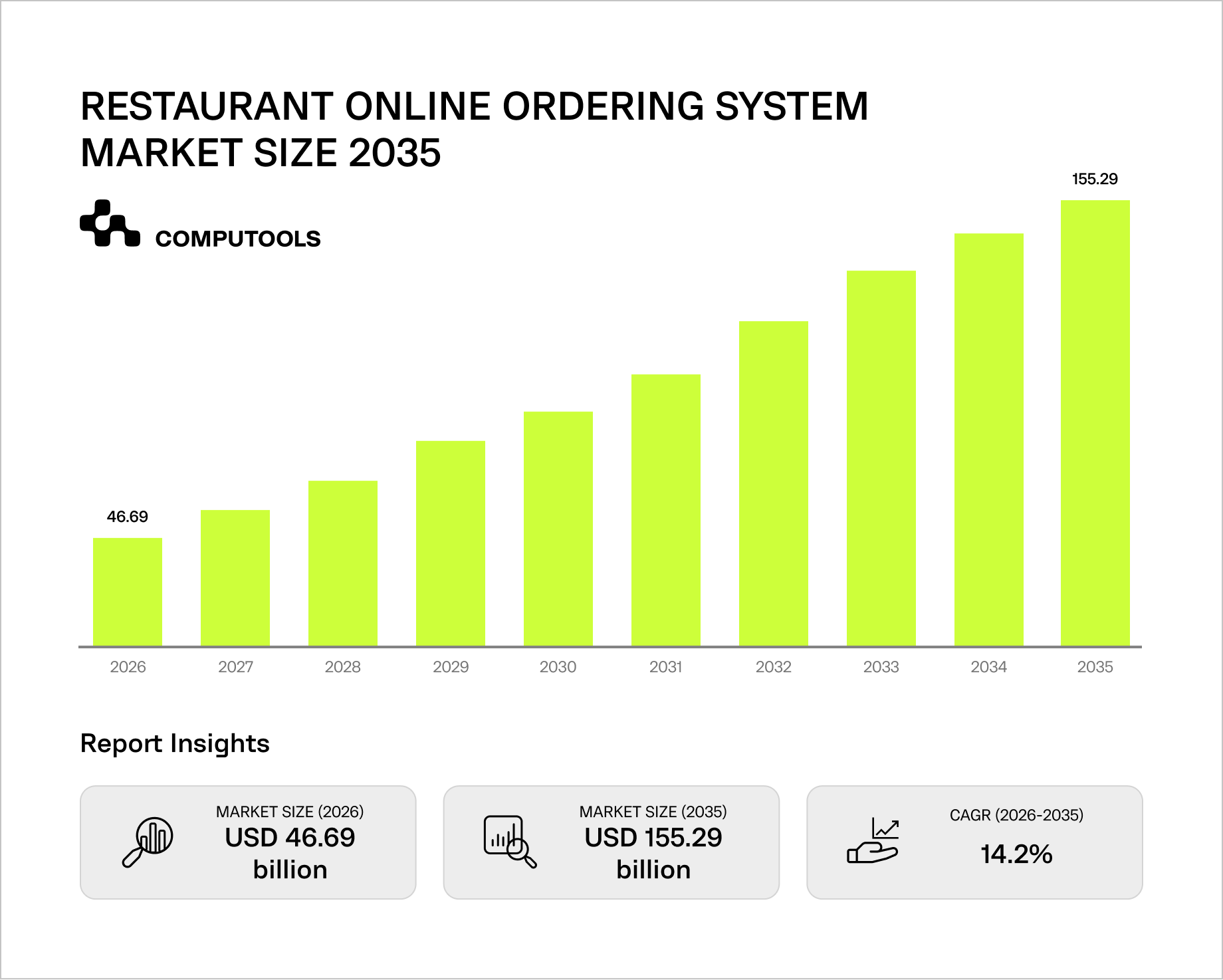
The global restaurant online ordering system market is valued at ~$46–47 billion in 2026, expecting to grow to over $150 billion by 2035 (~14% CAGR). Simultaneously, over 2.9 billion people use food delivery services, with over 84% of orders placed through apps. Digital ordering is now standard, and the key issue restaurants face is that their current software fails to meet such a high operational demand, prompting operators to seek custom food ordering app development services.
What defines food ordering app development in 2026
What was once considered optional is now a necessity that defines modern ordering systems.
Multi-channel consistency is the first. Keep, sync, and update menus, prices, and availability of food across all order placements. Over 65% of urban consumers order food weekly, with a 70% delivery vs pickup split. So, the venues should be able to sync and update menus, prices, and availability of food across all order placements.
The speed of the checkout process is the second. Cart abandonment results even from minor inconveniences like extra steps, slow loading, and missing payment methods. Modern apps prioritize fast, frictionless transactions.
Order accuracy comes third. Incorrect modifiers and availability issues can lead to delays, waste, and refunds. This is why a restaurant ordering system should feature real-time synchronization and structured backend logic.
Finally, first-party ordering is a strategic priority. About 62% of digital orders now happen via restaurant-owned channels, and 70% of customers prefer placing them directly. This improves margins, data ownership, and retention.
Where the market is heading
When the above-mentioned baselines are met, differentiation between the good and best food ordering software boils down to data and automation.
Operators are quickly adopting:
- AI-driven upsell and recommendations
- automated order routing and workflow management
- unified data layers integrating customer, order and operational insight.
Technological expectations continue to grow, with system requirements encompassing high traffic support at peak times and seamless multi-location and cross-channel operation.
Thus, a production-grade food delivery app development should include:
- real-time connections to ordering, kitchen, and fulfilling systems
- cross-channel operational consistency
- minimal errors and manual workloads
- ability to grow without performance constraints
- actionable business data
- direct contribution to revenue.
How Tap App addresses modern restaurant market needs
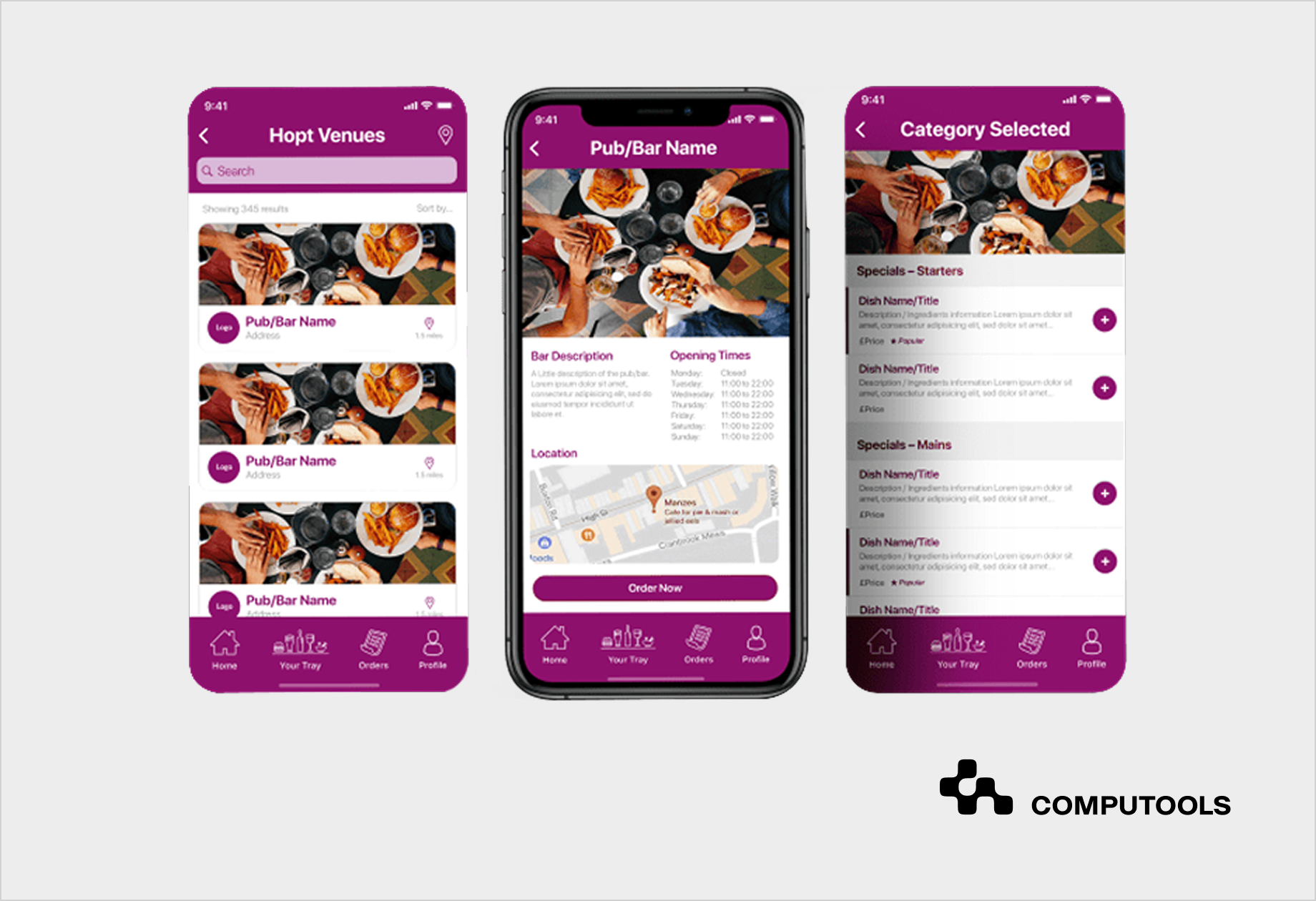
Tap App exemplifies an on-demand food ordering app that meets present customer- and operator-side expectations. The solution provides a connected operational system as opposed to merely an ordering interface.
1. Built as a Centralized Ordering Hub
Tap App was designed as a cross-platform app (iOS and Android) that allows multiple restaurants to be managed in a single workspace.
It integrates:
- menu and availability
- opening hours
- table and off-site ordering
- order tracking and payments
With this functionality, users can make site and delivery orders in a single system, whereas restaurants manage everything within a single platform.
2. Designed for Real Complexity
The online food ordering app had to accommodate restaurants with various workflows, menu items and requirements. Rather than trying to impose a predetermined structure, Tap App was built to be flexible, allowing the system to embrace the operational logic of each venue.
3. Focused on Efficiency
Tap App fundamentally changes the order management process in restaurants due to the following:
- real-time synchronization of order data
- integrated payments (tips included)
- automation of order and workflow management
- providing insights into the performance.
With these changes, Tap App reduces the manual work needed to resolve issues of order delays and mismatches that will arise.
4. Tangible Results
The impact of the changes made by Tap App is measurable and clear:
- 7% growth in cross-selling
- 85% decrease in unfulfilled or modified orders.
These results indicate that operational design directly affects both revenue and operational efficiency.
5. Constructed for Quick Launch and Scalability
With regards to a short deadline, the system was completed with the use of cross-platform technology (React Native), scalable backend (PHP, PostgreSQL), and iterative delivery (Scrum). This combination allowed the product to launch quickly while maintaining performance and stability.
How to build a custom food ordering app for restaurants: step-by-step
Building a custom food ordering app in 2026 requires more than assembling standard features. The system must be designed to support real operational workflows, scale under load, and contribute directly to revenue and efficiency.
Step 1. Define the Business Model and Platform Structure Upfront
Before choosing technologies or detailing features, outline the platform model. This lays a foundation for system architecture, data structure, and permissions.
At this point, the team should determine:
- If the solution is single-brand, multi-location, or multi-tenant.
- If restaurants have shared or completely separate configurations.
- The order types that need to be supported (delivery, pickup, dine-in, QR/table ordering).
- Whether there is single or multiple payment processing per restaurant.
From a technical perspective, this affects tenant isolation strategy, data schema design, roles and access, menu inheritance and overrides, environment settings per restaurant or location.
For example, Tap App meant to accommodate multiple restaurants and cafes with varying menu and operational requirements. This necessitated a system that was able to simultaneously bind different venues, availability rules, and service formats into a unified application.
Step 2. Model Operational Workflows as Explicit System States
Restaurant digital ordering solutions will fail if order handling is regarded as a UI problem rather than state management. The order lifecycle should be described as a formal workflow, for example:
created
pending_payment
confirmed
sent_to_kitchen
preparing
ready
completed
cancelled
failed
Every state transition should specify who (or what) can initiate it; which checks are required; if the transition is an event; which recipients are notified.
It is also important to define modifiers at the item level, special instructions like notes and allergies, orders that are scheduled, substitutions for out of stock items, the logic for branching dine-in and delivery as well as the paths for refunds and cancellations.
For instance, in Tap App we realized on-site and off-site order placement notes included, payments and status tracking, which implies a structured order-state model rather than a simple checkout flow.
Step 3. Design Features as Service Capabilities
The proposed features must convert into backend services and operational modules.
For the customer side, the list typically includes account and authentication, catalog service, pricing engine, cart, checkout, payment orchestration, order tracking and notifications.
The admin roles feature menu management, availability management, business hours and blackout logic, order operations dashboard, reporting and monitoring, campaign or promotion management.
For operations it’s important to figure out kitchen dispatch logic, preparation timing, ingredient-aware availability, escalation and exception handling.
Following the best practices of mobile food ordering app development, it’s important not to integrate catalog, cart, and payment logic into a single service. Even in a smaller system, a proper service separation lowers the risk of interdependencies.
A good division may look like this:
Catalog
Ordering
Payment
Notification
Admin/Operations
Analytics
Step 4. Choose Architecture Based on Load Profile and Integration Complexity
A food ordering app usually needs low latency for mobile performance, transactional consistency at the point of sale (checkout), robust third-party integration, status updates in real-time or near real-time.
Consider the following when making your choice of architecture:
- expected daily order volume
- peak concurrency
- how many restaurants and locations are involved
- how complex the integration is
- required release cadence.
For this type of application such as Tap App, the choice of technology stack may practically look like this:
- React Native when you have a single codebase, and faster deployment cycles are prioritized above having a platform specialized solution.
- PostgreSQL where consistency of transactions, relational integrity, and execution of complex queries are needed.
- Back-end systems should be along the lines of domain-driven design.
- Caching of the most accessed data like menus, restaurants, and availability information.
- Message queues for non-blocking tasks such as notifications, analytics events, and webhook processing.
Step 5. Design Integrations as First-Class System Contracts
In the online ordering system for restaurants, integrations are the most fragile layer, and should not be treated as afterthought connectors, but rather as stable contracts. Integrations typically include payment processors, point of sale systems, CRM/loyalty programs, delivery services, kitchen display systems, and analytics.
In a Tap App, we provided users with secure and easy transactions and integrated the solution with major payment processors.
To ensure successful integrations, be clear in defining the following for each one: timeout thresholds, retry logic, failure states, authentication, reconciliation and webhook management.
Also think through what occurs when integration issues arise.
Give answers to questions like:
- Is the order status pending?
- Does the payment need manual review?
- Is the restaurant informed?
- Can the user retry safely?
These scenarios must be detailed in the tech specifications.
As modern food ordering platforms integrate deeply with POS, it’s worth taking a deeper look at how these systems are built and what to expect from vendors.
Discover our in-depth research on top restaurant POS software development firms.
Step 6. Engineer the UX for Performance, Latency, and Failure Tolerance
Usability of a restaurant mobile ordering system is outcome-based. If the app is slow or inconsistent, the design fails. Continued high performance, accuracy, and reliability during busy times or poor network conditions is the design challenge to be resolved.
To do so, identify the most important user journeys, prioritized by how they impact conversion and retention.
These can include:
- App launch
- Browsing the menu
- Adding items to the shopping cart
- Checkout and payment
- Tracking the order.
Each piece of the journey must provide the lowest friction response in the shortest time possible. From the UX standpoint, this requirement translates into instant or near-instant menu load times, minimum number of steps to reorder items, uninterrupted and reliable checkout experience. In practice, this means designing systems for high-speed performance, not for high-visual impact designs.
Support performance through technical decisions, in order to achieve your goals of a fast, usable, and reliable app, your design team will need to implement supporting UX techniques:
- load only what is necessary to start
- cache frequently used data
- prefetch likely user actions
- store cart data locally to prevent interruptions
- give clear error messages.
These are baseline requirements for meeting usability in restaurant mobile app development.
If you’re also optimizing your digital presence beyond the app itself, this guide on restaurant web design steps to boost online presence outlines key principles for attracting and converting users.
Step 7. Build Analytics and Observability into the Platform Architecture
Order processing is just one aspect of a food ordering app. It should also help operators understand business performance and identify areas for improvement. That’s why they need visibility into how the system behaves. Are payments failing more often than usual? Are orders taking longer to process? Are certain locations underperforming?
To collect important data for analysis, the solution should be able to capture:
- completed and placed orders
- where users abandon the checkout process
- the most and the least selling items
- the frequency of delayed, cancelled, or refunded orders
- average order value
- repeat-order behavior.
Data analysis helps the restaurant identify challenges and make evidence-based adjustments to the menu, pricing, and operations.
Step 8. Integrate Revenue Logic into the Decision Engine
Cross-selling and upselling is more than just a marketing tactic. They should be considered during development and included in a system logic, often through:
- rule- and behavior-driven recommendations
- product affinity
- time-specific offers
- location-based offers
- basket-aware offers.
For instance, cross-selling in Tap App increased revenue by approximately 7%. To achieve results like this, we recommend designing the logic for promotions and upselling in a manner that allows for configuration of rules, such as:
“If the basket contains a burger, suggest fries and a drink.”
“If the order total exceeds the threshold, grant access to a bundle deal.”
“If the user often places an order on Friday evenings, offer a repeat offer.”
Please note, promotional logic should primarily reside outside the mobile app. A server-driven promo engine offers more control, flexibility, and ease of testing. It should allow for experimentation through A/B testing, segmentation, time-based campaigns, and location-based rules. This creates a more objective way to measure revenue optimization.

Want to create a custom food delivery app that drives repeat orders and customer loyalty? Reach out to our specialists for a detailed estimation.
Step 9. Use System Design to Limit Operational Errors
In restaurant applications, a predominant source of errors is not from the user, but from the design logic of the system. This is an easily correctable issue that can dramatically improve both operational margins and customer experience.
Some of the common errors include:
- Items that can be requested in the app, but are not available in the kitchen.
- Incorrect modifiers or combinations of modifiers.
- Incorrect pricing.
- Duplicate orders generated from multiple taps.
We took that into account when in a Tap App development. By improving ingredient control and order accuracy, we managed to reduce modified or unfulfilled orders by 85%.
To reduce inefficiencies like these, the system design should include error-avoiding mechanisms, such as:
- Real-time updates of menu item availability.
- Back end order validation (this is a critical requirement).
- Server-side recalculation of pricing to ensure accuracy.
- Control of duplicate order requests using idempotent operations (same request = one result).
- A well thought out system will eliminate issues before the kitchen or customer sees them.
Restaurants increasingly rely on integrated platforms to streamline workflows and reduce manual effort.
Explore this further in our guide on boosting restaurant operations through digital transformation.
Step 10. Use an Iterative Development Approach to Reduce Risk
Developing an ordering app in a single large-scale rollout is a risky venture. The workflows in restaurant operations are complex and many of the issues can be spotted only after the system has been put to use.
Therefore, it is preferable to build up product functionality in small controlled iterative cycles.
1. Begin with the minimum viable product (MVP).
2. Release it to a limited number of users or locations.
3. Test in real use cases.
4. Perform early bug fixing through user feedback.
5. Extend features in further iterations.
6. Ensure constant validation.
Together with feature engineering, every cycle should include testing key user flows (ordering, checkout, tracking), verifying integrations (payments, POS) and checking system performance under load. This helps identify issues earlier, reducing the costs associated with fixing problems.
For instance, Tap App was developed using Scrum with short sprints, which allowed the team to adapt quickly, meet tight deadlines, and maintain stability throughout the project progression. Rather than building everything in one go, we validate the system step by step, making it reliable, flexible and aligned with actual business needs.
Step 11: Test the App Under Applicable Conditions
Tap App went through extensive testing before its launch to successfully eliminate potential issues in unstable conditions. Validation should focus on how the app will be used in real-world conditions, not just hypothetical ones. Begin by determining where the app is most likely to fail.
This may include:
- peak-hour traffic with many orders at the same time
- slow or unstable Internet connections
- payment interruptions or timeouts
- stock imbalances with ordered items
- simultaneous multi-user participation.
Stability, accuracy, and responsiveness under pressure should be the focal point of your testing strategy.
Step 12: Be Prepared to Update and Support the App After Launch
Launching the app is not the final step, it’s the start of ongoing development. The best restaurant food ordering app keeps evolving, just like the business they support.
This means the dev team has to:
- monitor the system performance and address any issues
- adapt the app to how the consumer is using it
- add new features as the business expands
- optimize operations and integrations.
Why clients choose Computools for restaurant ordering app development
Goals may vary, but Computools clients aren’t seeking just another app. They are looking for a restaurant app development company to build a dependable and scalable ordering system that can withstand the real operation challenges. This is where our travel and hospitality software development services come into play, combining domain expertise with production-grade engineering.
With more than 250 engineers and 400+ completed projects and the ISO 9001/ISO 27001 certifications, Computools is a player in the field of performance. We know exactly where data consistency and the system uptime have a direct impact on revenue. Our mobile app development services help operators cope with peak-hour traffic, support multiple restaurants, and be fully synchronized in real time.
What makes Computools unique is the depth of operational logic. We design systems around how restaurants actually function, allowing for a complexity of menus, modifiers, availability, and fulfillment across delivery, pick-up, and dine-in. This results in the platforms working reliably day-to- day out.
Our approach is also strongly results-driven. In the case of the Tap App project, it directly translated to a 7% revenue increase from cross-selling and an 85% reduction in unfulfilled or modified orders, proving that the system’s design impacts both the bottom line and operational efficiency.
At the same time, Computools boasts quick and controlled delivery thanks to the Agile (Scrum) methodology, which allows for rapid deployment of new features. Along with that, our engineering expertise ensures a robust technical foundation to supporting growth across locations, channels, and integrations.
As a result, our clients receive more than just a working app, but a system that:
- manages real operational complexity
- evolves with the business growth
- minimizes the errors and the manual work
- demonstrates measurable positive business outcomes.
In practice, this means operators invest in a scalable digital infrastructure. To explore how this approach extends across the full restaurant ecosystem, see our software development services for HoReCa.
How to build a food ordering app for 2026 and beyond
At this stage of the market, performance is measurable. Faster checkout impacts conversion. Better order logic reduces errors. Smarter data usage increases average order value. The difference is no longer theoretical, it’s visible in metrics.
In food ordering app development, architecture, integrations, and operational logic matter as much as the interface itself.
If you’re planning to build a food ordering app for your restaurant, consider reaching out to Computools at info@computools.com to discuss your specific requirements.
Computools
Software Solutions
Computools is an IT consulting and software development company that delivers innovative solutions to help businesses unlock tomorrow.