
THE AUTHOR:

A loyalty app changes how restaurants work with repeat guests: it integrates rewards, customer profiles, order history, personalized offers, and direct communication into a single product. For operators planning to develop a restaurant loyalty app, the goal is to build a retention channel that supports engagement, profitability, and better use of first-party data.
The business case is already visible in restaurant traffic data. Loyalty members now account for 39% of total restaurant visits, while loyalty traffic grew by 5% in 2024, even as overall restaurant traffic declined by 2%. Loyalty members also make 22% more restaurant visits per year than nonmembers, which makes them one of the most valuable customer segments for restaurants focused on long-term growth.
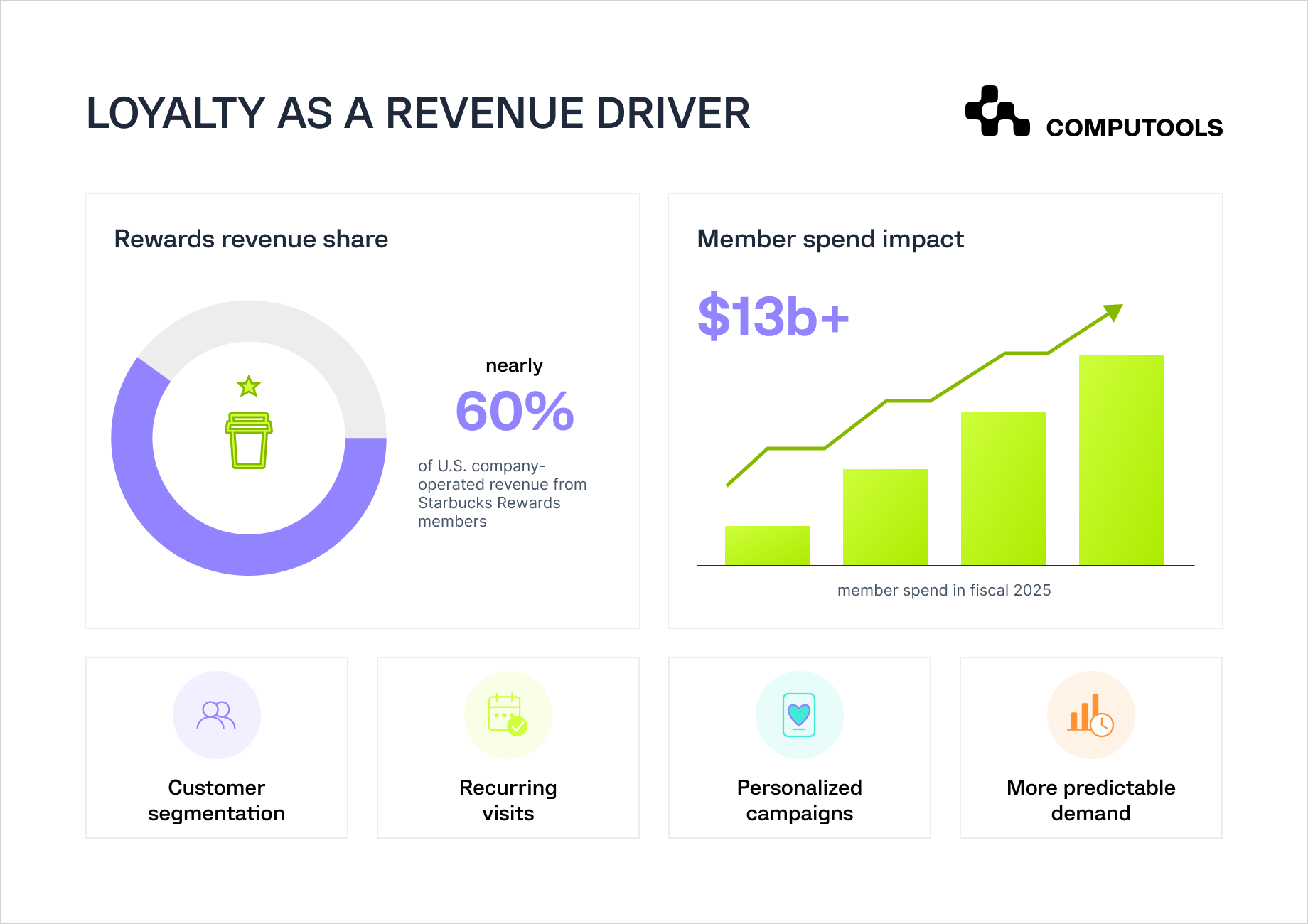
At enterprise scale, loyalty can become a major revenue driver. Starbucks reported that its Rewards members generated nearly 60% of U.S. company-operated revenue in fiscal 2025, equal to more than $13 billion in spend.
For restaurant operators, this shows why a loyalty product should be treated as part of the digital growth infrastructure: it can support customer segmentation, drive recurring visits, enable personalized campaigns, and lead to more predictable demand.
The same logic applies across hospitality: hotels also use direct channels to reduce platform dependence, strengthen guest relationships, and collect better first-party data. We explored this in our article on how to increase direct hotel bookings and reduce OTA dependence.
How Computools’ Tap App experience helps develop a restaurant loyalty app
In the Tap App project, we built a cross-platform ordering application for a UK-based hospitality business serving multiple restaurants and cafes. The product needed to handle varied menu logic, venue details, operating schedules, table availability, payments, tips, order notes, and real-time order tracking while keeping the customer journey clear and reliable.
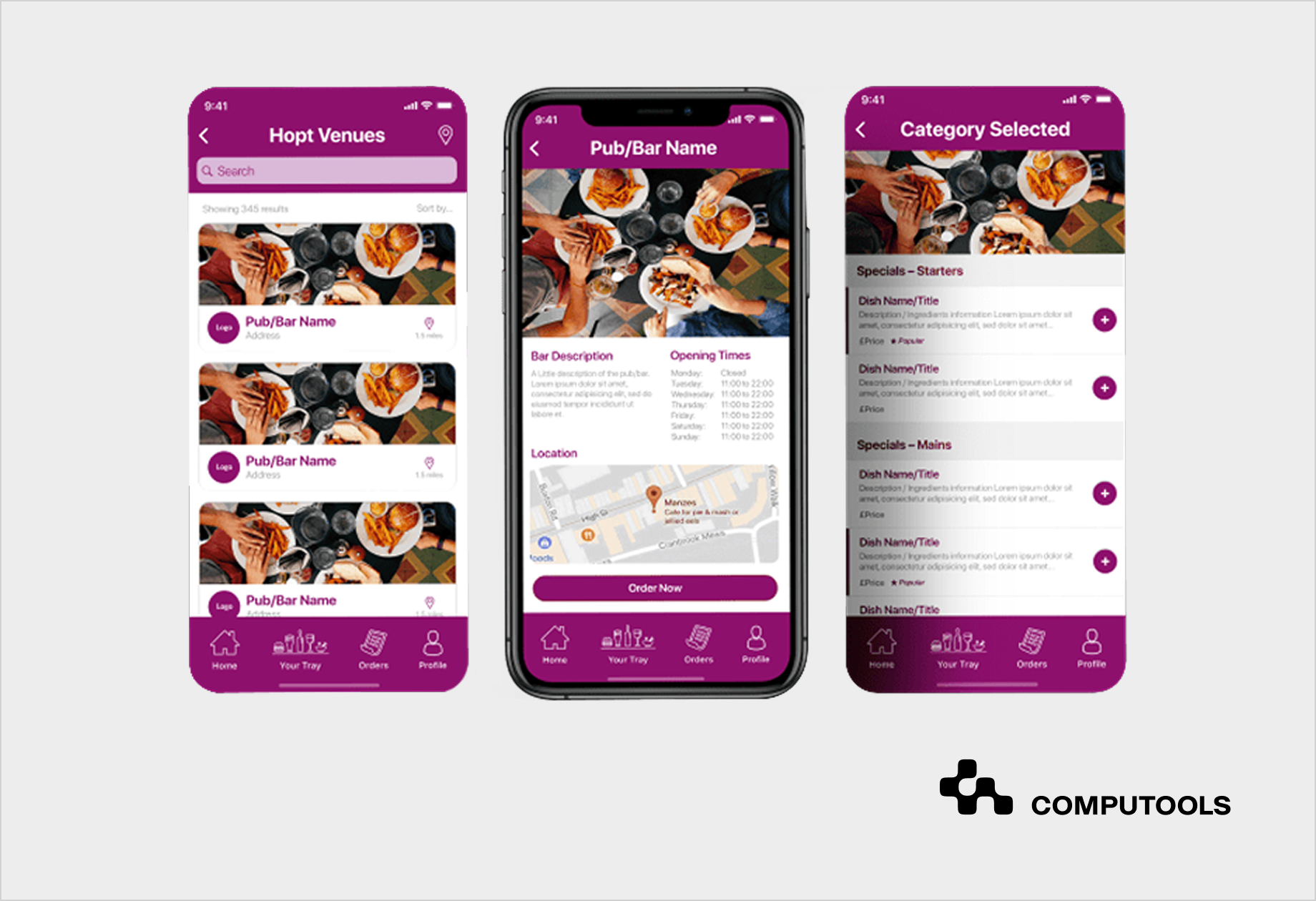
As part of our software development services for HoReCa, we started with the operational specifics of restaurant ordering: venue differences, menu logic, customer flows, payment scenarios, and the need for reliable performance under a tight launch schedule. Based on this analysis, we shaped the application architecture, selected the technology stack, and managed delivery through development, testing, launch, and further support.
Although Tap App was built as a restaurant ordering product, its architecture is directly relevant for businesses planning to develop a restaurant loyalty app.
A loyalty product needs the same core foundation: customer profiles, transaction flows, order history, secure payments, engagement logic, restaurant-specific integrations, and reliable mobile performance. These components help turn a standard ordering product into a restaurant customer engagement app that can later support rewards, personalized offers, CRM logic, and retention campaigns.
Through our mobile app development services, we delivered a cross-platform application for iOS and Android with secure payment functionality and scalable architecture. The product contributed to a 7% increase in top-line growth through cross-selling opportunities and reduced unfulfilled or modified orders by 85% through improved ingredient management.
For restaurants building a rewards and engagement platform, this experience shows how ordering, payments, customer data, and operational analytics can serve as the technical foundation for stronger retention.
How to develop a restaurant loyalty and customer engagement app: 9 steps
1. Set business goals, customer segments, and retention logic
The first stage should clarify what the restaurant wants to change through the product. A loyalty app can support repeat visits, direct ordering, higher average order value, customer data collection, lower dependence on third-party platforms, stronger campaign performance, or better visibility into guest behavior. These goals should be ranked before the team defines features, because each goal requires different logic, data flows, and success metrics.
For restaurant loyalty app development, the discovery phase should cover both business and operational questions. A restaurant needs to define whether the app will serve one location, a chain, a franchise network, or a multi-brand restaurant group.
It should also clarify which customer journeys matter most: dine-in visits, takeaway, delivery, pre-orders, table service, catering, corporate meals, or repeat coffee-style purchases. A loyalty system built for a quick-service restaurant will differ from one built for casual dining, fine dining, or a multi-location HoReCa brand.
Customer segmentation should go deeper than “new” and “returning” users. The product team should identify high-frequency guests, high-spend guests, dormant users, discount-sensitive customers, families, lunch customers, delivery-first users, corporate customers, and visitors tied to specific locations. Each segment may require different triggers: welcome rewards, birthday offers, reactivation campaigns, referral incentives, visit-based rewards, tier upgrades, or personalized menu offers.
At this stage, the team should also define the data model. Loyalty logic depends on accurate customer profiles, order history, transaction value, visit frequency, favorite items, preferred locations, redemption behavior, payment activity, and communication permissions. If these data points are not mapped early, personalization becomes decorative rather than useful. A restaurant may have a polished app interface and still fail to understand who its best customers are, which weakens personalization and campaign performance.
The business team should agree on measurable KPIs before development starts.
Relevant metrics may include:
- repeat purchase rate;
- loyalty enrollment rate;
- active loyalty users;
- offer redemption rate;
- average order value;
- customer lifetime value;
- visit frequency;
- churn rate;
- referral activity;
- revenue from loyalty members;
- campaign conversion;
- app retention after 30, 60, and 90 days.
This step should also include margin logic. Rewards need to motivate customers without damaging profitability. A free item, cashback offer, or discount should be assessed against food cost, average ticket size, visit frequency, and expected incremental revenue. A loyalty product should help restaurants create profitable repeat behavior, not create discount dependency or reduce margins on orders customers would have placed anyway.
For restaurants that already have ordering, POS, CRM, or payment tools, this phase should also identify integration requirements. The team needs to understand where transaction data comes from, how rewards will be applied, how customer profiles will be updated, and which systems will remain the source of truth.
In the Tap App project, this kind of early operational understanding was essential because the product had to support a growing network of restaurants and cafes with different menu structures, opening hours, table availability, and ordering needs. The app was designed to adapt to varied venue requirements instead of forcing every restaurant into the same workflow.
2. Choose the loyalty model and reward mechanics
The reward model defines how customers earn value, how restaurants control margins, and which behaviors the app should encourage. This decision should be made before feature planning because the loyalty mechanics affect backend logic, customer journeys, POS integration, campaign management, analytics, and even UX writing.
A restaurant loyalty program app can support different reward structures depending on the restaurant format, order frequency, and customer behavior. A quick-service restaurant may need a simple visit-based system that encourages frequent returns. A coffee shop may benefit from subscriptions or “buy X, get Y” logic. A casual dining restaurant may use points, tiers, and birthday rewards to increase repeat visits and average order value. A multi-location restaurant group may need flexible rules that vary by location, brand, customer segment, or campaign period.
The main loyalty models include:
- points-based rewards, where customers earn points for every purchase;
- visit-based rewards, where customers receive perks after a defined number of visits;
- tiered rewards, where higher activity unlocks better benefits;
- cashback or wallet balance;
- referral rewards;
- subscription-based perks;
- personalized offers based on order history;
- limited-time campaigns;
- location-specific rewards;
- hybrid models that combine several mechanics.
The choice should be tied to business goals. If the restaurant wants to increase visit frequency, a visit-based model may be more effective. If the goal is higher spend, points tied to order value can create a clearer connection between purchase value and rewards. If the business wants to strengthen emotional attachment, tiered status, exclusive perks, and personalized offers can create stronger engagement than plain discounts.
The team also needs to define reward economics. Every reward should be checked against food cost, average order value, expected incremental revenue, and redemption behavior. A free dessert, cashback offer, or discount campaign can support profitability only if it increases meaningful repeat behavior rather than simply reducing margin on orders customers would have placed anyway.
At this stage, the product team should also define operational rules:
- how points are earned;
- when points become active;
- whether points expire;
- how refunds affect reward balances;
- whether rewards apply to delivery, dine-in, takeaway, or all channels;
- whether rewards can be combined with discounts;
- how staff can verify rewards;
- how fraud or duplicate transactions are prevented;
- how reward rules differ by location;
- who can create and approve campaigns.
For restaurants with several locations, reward logic should be flexible enough to support both centralized and local campaigns. A head office may want unified brand-wide rewards, while individual locations may need their own offers for slow hours, seasonal menus, or local customer segments.
3. Map customer engagement journeys across the full lifecycle
Customer engagement should be mapped from the first interaction with the app: discovery, registration, first order, first reward, repeat visit, feedback, inactivity, and reactivation. Each stage should have a clear trigger, message, user action, and business outcome.
The product team should define how customers move through the app before designing screens or backend logic. A new user may need a welcome reward after registration. A customer who places the first order may need a progress update that shows how close they are to the next benefit. A frequent lunch customer may receive a weekday offer. A dormant customer may receive a reactivation campaign after a defined period of inactivity. A high-value guest may receive early access to seasonal menu items instead of another standard discount.
Effective customer loyalty solutions for restaurants should connect customer actions with communication logic. The app should define what happens after a user signs up, places an order, earns points, redeems a reward, refers a friend, leaves feedback, ignores an offer, or stops visiting. This prevents the product from becoming a passive points wallet that customers open once and then forget.
Key journeys may include:
- new user registration;
- first purchase after sign-up;
- first reward earned;
- first reward redeemed;
- abandoned order;
- repeat visit;
- birthday or anniversary offer;
- referral invitation;
- referral completion;
- inactive customer reactivation;
- post-order feedback;
- low-rating follow-up;
- tier upgrade;
- location-based offer;
- seasonal campaign;
- win-back campaign.
Each journey should define the customer segment, trigger, timing, communication channel, offer type, and success metric. For example, a customer who usually orders takeaway during lunch hours should not receive the same campaign as a customer who books dinner for four people on weekends. The system should reflect real ordering behavior, not generic personas detached from actual customer patterns.
The engagement logic should also define channel use. Push notifications work for urgent or time-sensitive offers. Email can support tier updates, monthly summaries, and longer campaigns. SMS may work for direct promotions, but it should be used carefully, as overusing such channels can reduce trust and increase opt-outs.
4. Define customer-facing and admin-side features
Feature planning should separate the customer experience from the restaurant management experience. Customers need a simple interface to join the program, earn rewards, redeem offers, order, pay, and receive updates. Restaurant teams need tools to configure loyalty rules, launch campaigns, segment users, monitor performance, and manage location-specific settings.
The customer side should focus on clarity and speed. Users should immediately understand how the program works, what they can earn, what they can redeem, and what action they should take next. If the app hides reward rules, makes redemption unclear, or turns every offer into a small legal document, engagement will drop.
The strongest restaurant app features for customer loyalty usually include:
- customer registration and profile;
- reward balance;
- points, tiers, cashback, or coupons;
- personalized offer feed;
- order history;
- favorite items;
- QR code or promo code redemption;
- in-app ordering;
- payment options;
- push notifications;
- referrals;
- birthday rewards;
- location-based offers;
- ratings and feedback;
- loyalty terms and reward rules.
Admin-side functionality should give restaurant teams control without forcing them to involve developers for every campaign change. The admin panel should allow teams to create offers, adjust reward rules, define customer segments, schedule campaigns, monitor redemptions, and compare performance across locations.
Admin features may include:
- customer database;
- campaign creation;
- reward rule configuration;
- segmentation tools;
- offer scheduling;
- branch-level settings;
- redemption tracking;
- campaign performance reports;
- customer activity dashboard;
- role-based access;
- content management;
- notification management;
- feedback review;
- exportable reports.
For multi-location brands, access logic matters. A headquarters team may need full visibility across all locations, while local managers may only manage campaigns for their branch. Franchise models may require stricter control over brand-wide offers, local promotions, reporting visibility, and approval workflows.
In the Tap App project, the product supported restaurant information, different menu structures, table availability, opening and closing times, order notes, payments, tips, and real-time order status updates. These flows are relevant to loyalty apps because earning and redeeming rewards often depend on transaction data, order status, customer activity, and venue-specific rules.
This logic is also relevant for multi-venue restaurant products. Our guide on building a multi-restaurant food marketplace platform explains how ordering, payments, venue data, and customer activity can work across multiple restaurants within a single digital environment.
5. Design UX/UI for repeat customer actions
The interface should make the loyalty program’s value visible from the first session. Customers should not have to search for their reward balance, guess how points work, or discover at checkout that an offer does not apply to their order. Loyalty UX should reduce friction at every repeated action: signing in, ordering, earning, redeeming, paying, and returning.
The home screen should show what matters most: available rewards, progress toward the next benefit, active offers, nearby locations, and quick access to ordering or scanning. Reward status, eligible offers, expiration dates, and redemption rules should be visible before checkout.
A strong loyalty interface should include:
- simple registration;
- visible reward progress;
- clear reward rules;
- personalized home screen;
- quick access to active offers;
- easy redemption flow;
- clear expiration dates;
- order history;
- saved preferences;
- saved payment methods;
- location selection;
- referral flow;
- feedback flow;
- support or FAQ access.
For a mobile app for restaurant loyalty programs, UX should support habit formation. The app should create value beyond checkout. It should give customers reasons to return between purchases through progress reminders, personalized offers, birthday rewards, seasonal campaigns, tier updates, and limited-time perks.
Staff-facing UX should also be considered if rewards can be redeemed in-store. Employees need a clear way to validate rewards, scan QR codes, apply discounts, and explain failed redemptions.
If a reward does not work, the app should show a clear reason: an expired offer, the wrong location, a minimum order not reached, or an incompatible campaign. Otherwise, failed redemptions can slow service and create avoidable workload for staff.
In the Tap App project, UX/UI work began at the prototyping stage and included user personas, a sitemap, wireframes, and interface design. This process is relevant for loyalty apps because repeated customer behavior depends on simple flows, clear screens, and low-friction interactions across ordering, payment, and engagement features.
6. Build CRM logic and customer data flows
A loyalty app becomes useful when it connects customer actions with structured data. The system should collect and organize information about identity, orders, payments, visit frequency, reward activity, preferences, locations, campaign responses, and communication permissions. Without this layer, the app may still issue points, but it will not support a serious retention strategy.
The data model should define which information is collected, where it is stored, how it is updated, and which systems can access it. Customer identity, transaction history, reward balances, consent records, and campaign responses need clean logic from the beginning. Otherwise, the restaurant may end up with duplicate profiles, broken segmentation, and unreliable reporting.
This is where restaurant CRM and loyalty apps become central to retention strategy. Instead of sending the same offer to every user, restaurant teams can segment customers by frequency, spend, menu preferences, location, inactivity risk, and response to previous campaigns.
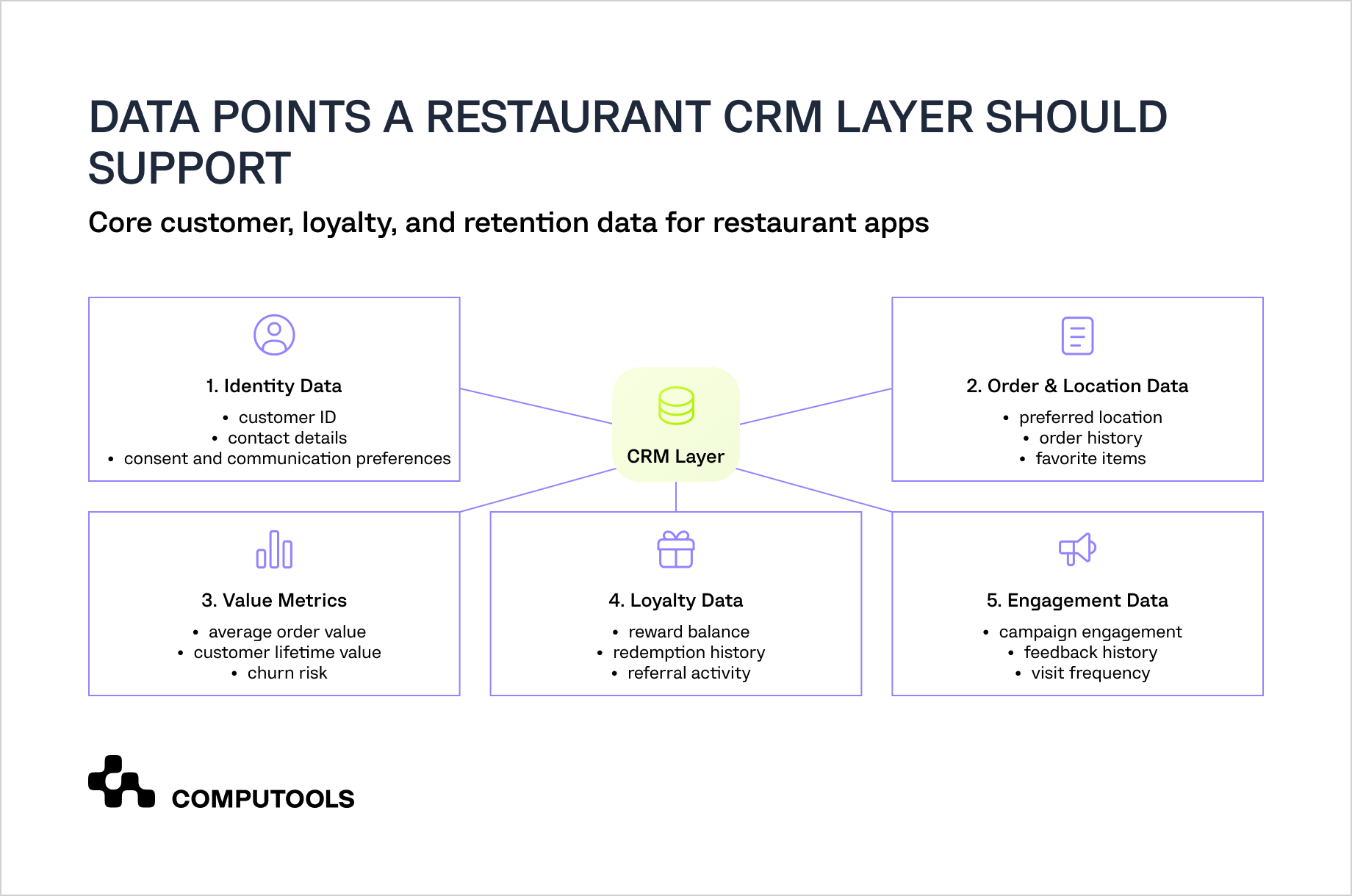
Segmentation should be practical. A restaurant may need segments such as high-frequency lunch customers, high-spend dinner guests, inactive users, customers who redeem often, users who never redeem, delivery-first customers, location-specific regulars, and customers who respond to personalized offers.
The CRM logic should also support business automation. The system can trigger a welcome offer after sign-up, a progress reminder before reward expiration, a win-back offer after inactivity, or a feedback request after a completed order. These automations should be controlled by business rules, not hard-coded, which would make future campaign changes slow and expensive.
Data privacy also belongs at this stage. Loyalty products collect first-party customer data, so consent management, data retention rules, communication preferences, access controls, and secure storage should be built in from the start. Personalization works only when customers trust the system enough to share data.
7. Plan integrations with restaurant systems
Integrations define whether loyalty logic works in real restaurant operations. A restaurant app cannot calculate rewards correctly if it does not receive accurate order and payment data. It cannot personalize offers if customer activity is scattered across POS, website ordering, delivery, CRM, and payment tools.
The integration plan should identify which systems already exist, which data they hold, how often data should sync, and which platform will act as the source of truth. Customer identity may live in the loyalty app, transactions may come from the POS, payments may be processed through a third-party gateway, and campaign data may be stored in the CRM. If this logic is unclear, the product can create duplicate accounts, incorrect reward balances, and unreliable analytics.
Most loyalty products need integrations with:
- POS systems;
- online ordering platforms;
- payment gateways;
- restaurant websites;
- CRM tools;
- email platforms;
- SMS tools;
- push notification services;
- reservation systems;
- delivery management tools;
- analytics platforms;
- accounting or reporting systems.
POS, payment, ordering, CRM, notification, reservation, and analytics integrations are usually the technical base for digital loyalty programs for restaurants. They allow the app to connect purchases with reward balances, apply discounts, update customer profiles, synchronize activity across channels, and measure campaign performance.
Integration planning should cover:
- API availability;
- data sync frequency;
- authentication;
- error handling;
- offline scenarios;
- duplicate transactions;
- refund logic;
- reward rollback;
- multi-location data;
- reporting consistency;
- security requirements.
POS integration is especially important because it connects real purchases with loyalty activity. Payment integration supports secure checkout, refunds, tips, stored cards, and reward redemption. CRM integration supports segmentation and personalized campaigns. Website or ordering integration connects loyalty with direct digital sales.
In Tap App, we integrated popular payment gateways and built the application to support a range of restaurants and cafes with unique requirements and menu structures. That experience is relevant to loyalty development because reward logic also needs to work across restaurant-specific workflows, transaction types, and customer journeys.
8. Develop backend architecture and admin tools
The backend development should support the logic customers never see but constantly depend on: customer profiles, reward balances, campaigns, transactions, rules, notifications, integrations, analytics, and permissions. For a loyalty product, backend quality directly affects customer trust. If points disappear, rewards fail, or discounts apply incorrectly, users may lose trust in the product and stop using the program.
The system should include backend modules for:
- customer profile management;
- loyalty rules engine;
- reward balance calculation;
- campaign management;
- segmentation;
- transaction processing;
- POS and payment integrations;
- notification logic;
- admin permissions;
- analytics and reporting;
- fraud prevention;
- audit logs.
A restaurant rewards and engagement platform needs a configurable loyalty rules engine. It should define how customers earn points, when rewards become available, whether benefits expire, which orders qualify, how refunds affect balances, and which campaigns can overlap. These rules should be manageable through the admin panel where possible, so restaurant teams can adjust campaigns without rebuilding the product.
The admin panel should allow teams to:
- create reward campaigns;
- set earning and redemption rules;
- define customer segments;
- schedule offers;
- manage campaign expiration;
- create branch-level campaigns;
- track reward usage;
- monitor active users;
- compare location performance;
- review feedback;
- control user roles;
- export reports.
For multi-location restaurant groups, architecture should support location hierarchy. A brand may need global campaigns, regional campaigns, and location-specific offers. The backend should also handle customers who earn rewards in one location and redeem them in another.
Scalability should be planned early. A simple MVP development may start with points, coupons, and push notifications. Later, the same product may need subscriptions, tiers, referrals, AI-based recommendations, web ordering, CRM integration, or advanced analytics. If the architecture is too rigid, every new business idea becomes a costly development change instead of a manageable product update
9. Test, launch, and optimize retention performance
Loyalty products affect money, discounts, customer data, and brand trust, so QA should verify reward logic, transaction accuracy, campaign rules, integrations, permissions, analytics, and customer-facing flows. A bug in a loyalty app can lead to incorrect discounts, revenue leakage, or customer support issues.
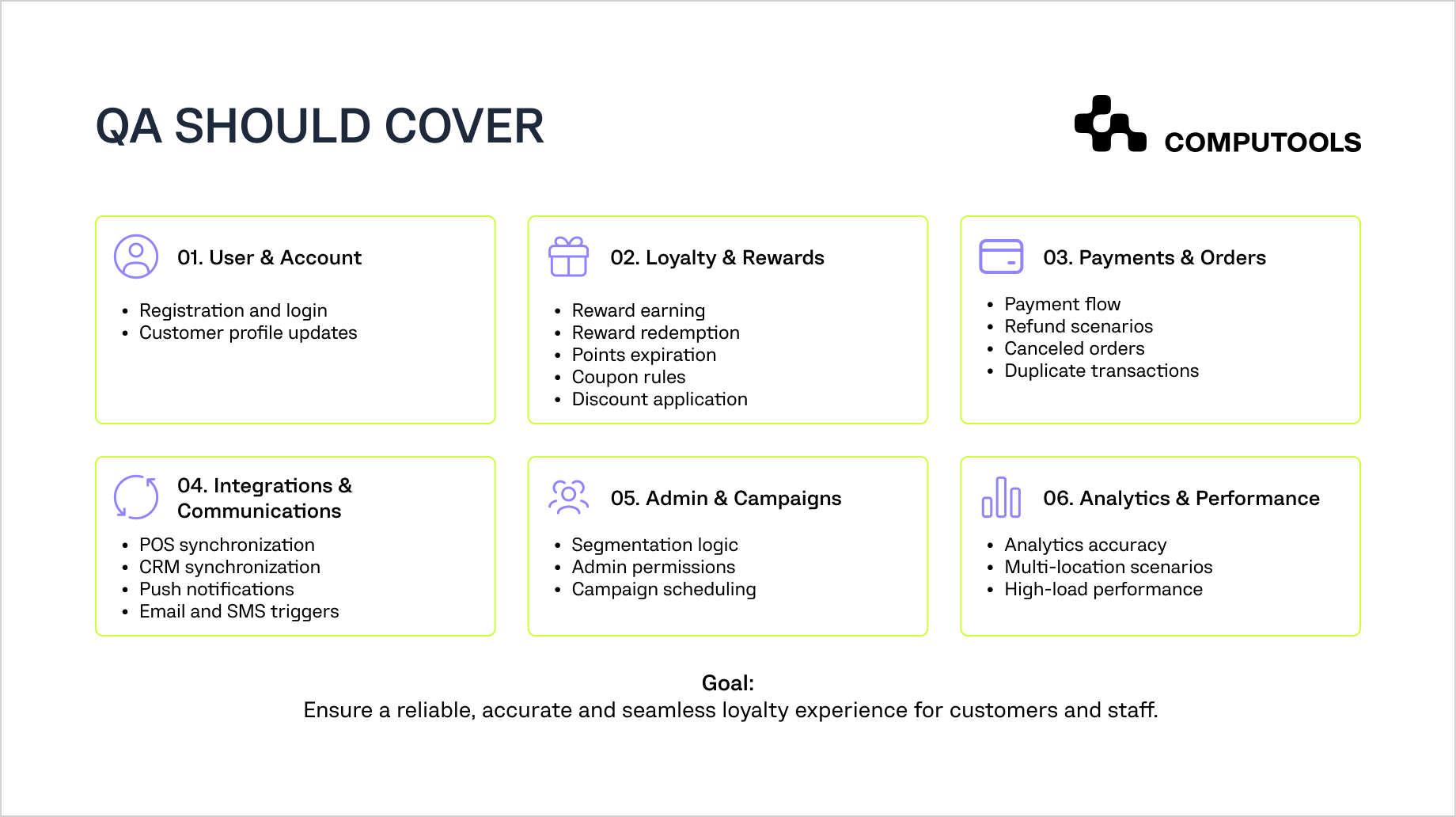
QA testing should include edge cases. What happens if a customer earns points and then cancels the order? What if a reward expires during checkout? What if the POS sends duplicate transaction data? What if a discount conflicts with another offer? What if the customer earns points in one location and redeems them in another? These edge cases should be tested before launch because they directly affect revenue, customer trust, and staff workload.
The launch plan should include a controlled rollout. Restaurants can start with one location, one customer segment, or one reward model before expanding. This allows teams to validate engagement, reward costs, technical stability, staff workflows, and customer support issues before scaling.
After launch, the product should be optimized as a restaurant customer retention app, not just monitored as another mobile channel. The team should track active loyalty users, repeat purchase rate, redemption rate, average order value, churn, customer lifetime value, campaign conversion, and revenue from loyalty members.
Optimization should be tied to profitability. If customers enroll but do not redeem, rewards may be unclear or too hard to earn. If redemption is high but revenue does not grow, the program may be discounting existing demand. If app activity drops after the first reward, the engagement journey needs stronger triggers, more personalized experiences, or more relevant offers.
In the Tap App project, QA specialists conducted comprehensive testing to ensure application stability and performance. The product contributed to a 7% increase in top-line growth through cross-selling opportunities and reduced unfulfilled or modified orders by 85% through improved ingredient management. For loyalty and engagement products, this shows why launch and optimization should measure both customer experience and operational impact.

Launch your restaurant loyalty and customer engagement app in just 1–3 months, instead of years. Turn one-time diners into loyal regulars with automated rewards, seamless ordering, payments, and personalized engagement in one scalable platform.
What affects the cost of restaurant rewards app development?
The cost of restaurant rewards app development depends on the product scope, loyalty mechanics, integrations, and the number of operational scenarios the app needs to support. A simple app with customer profiles, points, coupons, and push notifications will differ from a multi-location platform with POS synchronization, CRM integration, personalized campaigns, advanced analytics, and role-based admin access.
The main cost factors include:
- loyalty model complexity;
- customer-facing app functionality;
- admin panel scope;
- POS, payment, CRM, and ordering integrations;
- segmentation and personalization logic;
- analytics and reporting requirements;
- multi-location or franchise support;
- cybersecurity services, consent, and data protection requirements;
- QA depth and launch support.
Reward logic directly impacts development effort. Points, tiers, cashback, referrals, subscriptions, coupon rules, expiration dates, refunds, and partial redemptions all require clear backend logic and careful testing.
Integrations also affect the final scope. The app may need to exchange data with POS systems, payment gateways, CRM platforms, ordering tools, notification services, and analytics systems to track purchases, update reward balances, apply discounts, and personalize offers.
For restaurant groups, the scope often expands because the product must support branch-level campaigns, centralized reporting, local manager permissions, location-based customer segmentation, and different reward rules across venues.
Choosing between custom and ready-made restaurant loyalty software
Restaurants can use ready-made tools for basic rewards, but custom restaurant loyalty software solutions give more control over reward logic, customer data, integrations, and multi-location management.
| Criteria | Ready-made tools | Custom product |
| Best fit | Single-location restaurants or small chains with basic loyalty needs | Restaurant groups, franchises, multi-location brands, or businesses with complex workflows |
| Launch speed | Faster to launch because most functionality is already built | Takes longer because the product is designed around specific business logic |
| Loyalty logic | Usually limited to standard points, coupons, and basic rewards | Can support points, tiers, cashback, referrals, subscriptions, location-specific campaigns, and custom reward rules |
| Customization | Limited branding, fixed templates, and predefined workflows | Fully tailored UX, branded customer journeys, flexible admin logic, and custom campaign flows |
| Integrations | May support only selected POS, CRM, payment, or marketing tools | Can be integrated with existing POS, CRM, payment gateways, ordering systems, analytics, and internal tools |
| Customer data control | Data access may depend on the vendor’s platform rules | The business has stronger control over first-party customer data, segmentation, and reporting |
| Multi-location support | Often basic or available only in higher-tier plans | Can support branch-level campaigns, local manager permissions, centralized reporting, and location-specific rules |
| Analytics | Usually includes standard reports and basic engagement metrics | Can include custom dashboards, customer lifetime value, churn risk, campaign ROI, and location-level performance |
| Scalability | Works well for simple use cases but may become restrictive as needs grow | Can scale with new locations, reward models, customer segments, and integrations |
| Long-term value | Good for quick adoption and simple loyalty mechanics | Better for businesses that treat loyalty as part of retention, CRM, and digital growth infrastructure |
Why choose Computools to build a restaurant loyalty app
Computools builds digital products for hospitality and restaurant businesses: mobile apps, web systems, ordering platforms, booking tools, revenue management systems, and guest engagement solutions. Our experience in travel and hospitality software development services helps us work with products that depend on customer data, payments, integrations, analytics, and multi-location operations.
For Tap App, we developed a cross-platform mobile application for a UK-based restaurant ordering business. The product helped customers browse venues, place orders, make payments, track order status, add tips, and leave order notes. This experience is relevant to loyalty app development because retention products rely on the same core logic: customer profiles, transaction flows, secure payments, order history, and engagement triggers.
Our hospitality portfolio also includes web-based systems. For Costavira RMS, we delivered a revenue management platform for a U.S. hotel chain, helping automate demand-based pricing and reduce manual pricing work.
For Radesso Prime, we built a booking platform for an Austrian hotel chain, helping increase direct bookings and reduce reliance on OTA channels. These projects show how our web app development services support complex hospitality workflows, analytics, and revenue-focused digital products.
Computools can help design and build a restaurant loyalty app from discovery and architecture to development, integrations, QA, launch, and optimization. To discuss your restaurant loyalty app, write to us at info@computools.com.
For a deeper view of hospitality products built around data, automation, and revenue control, read our guide on how to build a hotel revenue management system for multi-property hotel chains.
Computools
Software Solutions
Computools is an IT consulting and software development company that delivers innovative solutions to help businesses unlock tomorrow.