
THE AUTHOR:

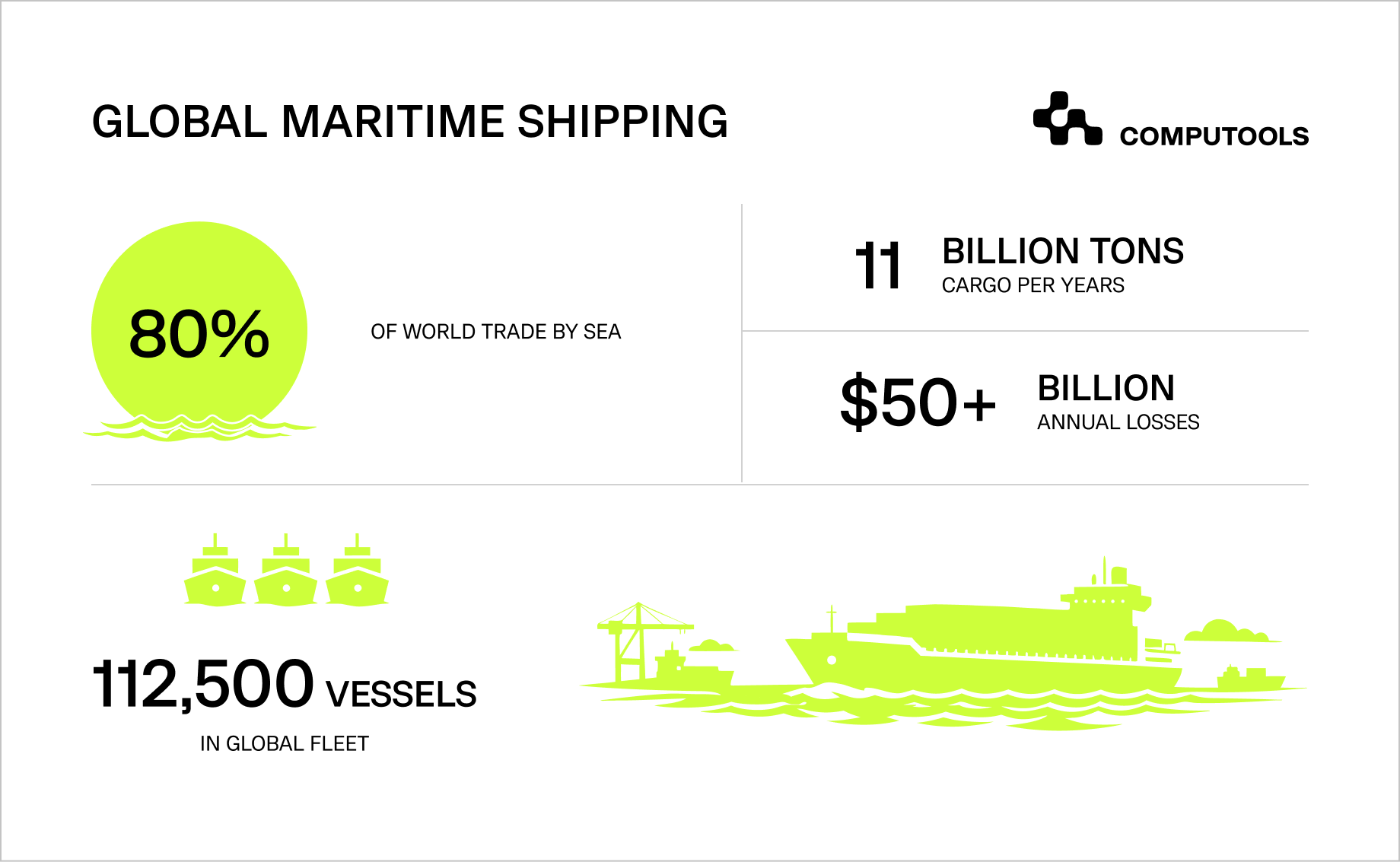
The maritime industry is the backbone of global trade, accounting for over 80% of world trade by volume.
According to UNCTAD, global maritime trade reached 12,292 million tons in 2023, while the global merchant fleet comprised around 112,500 vessels of at least 100 gross tons at the start of 2025, including 60,300 vessels over 1,000 GT.
Shipping companies collectively spend billions each year on operational costs, with inefficiencies and delays resulting in significant financial losses – estimated at over $50 billion worldwide.
These figures highlight the critical need for shipping companies to build maritime fleet management software tailored to their specific operational needs, enabling them to optimize operations, improve decision-making, and maintain a competitive advantage in a rapidly evolving market.
Traditional systems often rely on fragmented data sources, manual updates, and siloed communication channels. These limitations hinder real-time decision-making and increase the risk of delays, inefficiencies, and compliance issues.
A modern, integrated solution can transform operations by providing real-time visibility, predictive insights, and automation capabilities.
How we built a real-time cargo visibility solution: Navis Horizon case study
Computools delivered a real-time cargo-tracking and dispatch-coordination platform for a Hamburg-based port logistics operator that needed to improve cargo visibility, accelerate issue resolution, and reduce manual coordination across daily operations.
As part of our maritime software development services, we created a unified operational environment that consolidated AIS, GPS, and carrier-event data into a single interface, replacing fragmented portals, spreadsheets, and manual status checks.
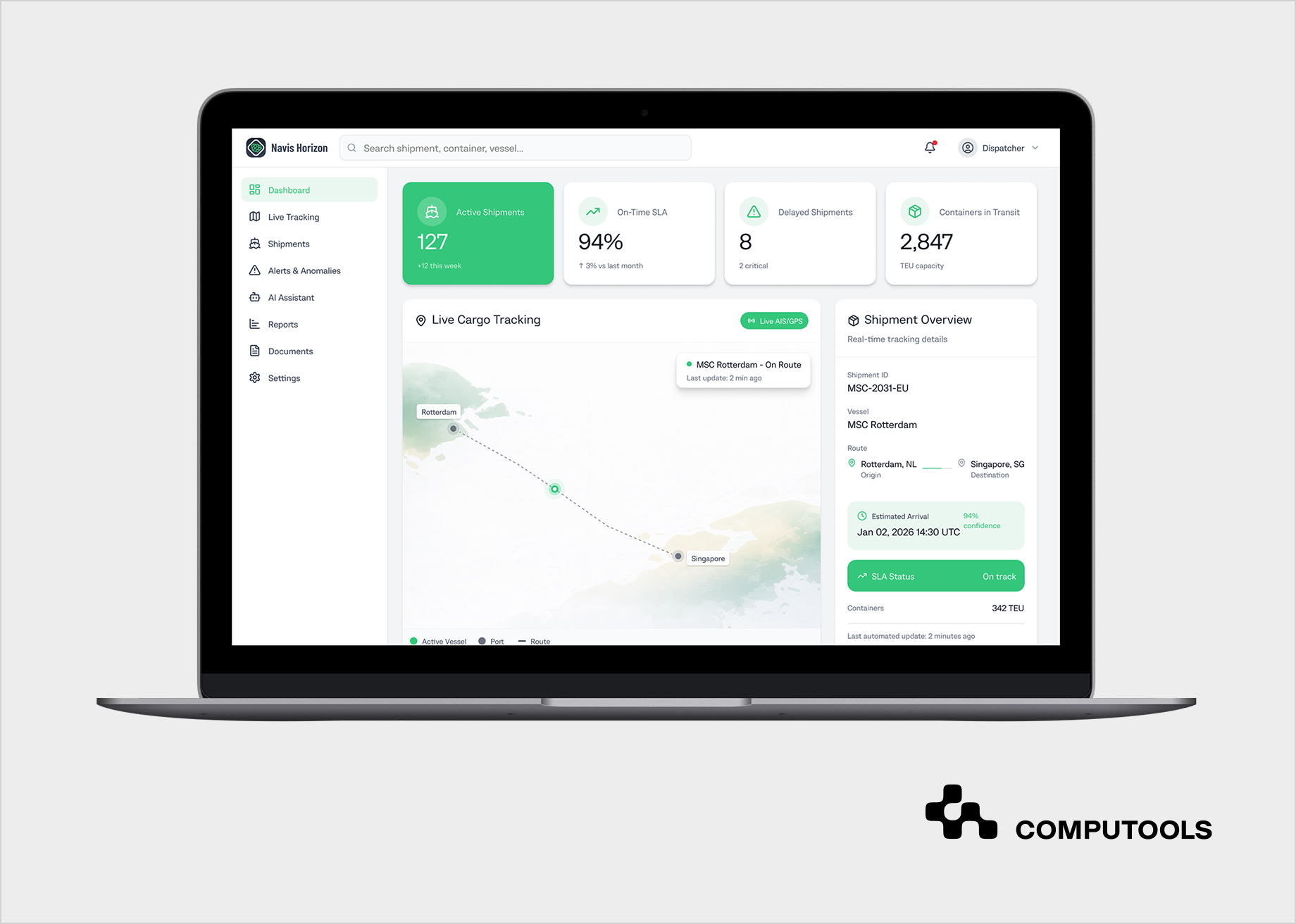
To support continuous vessel and shipment monitoring, we also used IoT development services to integrate partner GPS devices and external maritime tracking providers into a single, reliable data stream. This allowed the client to automate status detection, improve event accuracy, and maintain a complete real-time view of cargo movements across routes.
On top of that, Computools used AI development services to introduce predictive delay detection, anomaly alerts, and an AI assistant for dispatchers and customers, helping teams reduce repetitive communication and respond to disruptions earlier.
The business impact was visible. The platform reduced dispatcher workload by 40%, increased customer satisfaction by 23%, accelerated shipment incident resolution by 18%, and delivered 100% transparency in cargo status updates.
The solution also helped reduce SLA penalties and improve overall operational reliability, giving the client a stronger foundation for scalable maritime operations.
Step-by-step guide: how to build maritime fleet management software for shipping companies
Drawing on our hands-on delivery experience, this step-by-step guide to build maritime fleet management software explains how to design a solution that supports real shipping operations.
1. Start With Operational Discovery and Workflow Mapping
Any serious maritime logistics software development project starts with operational discovery. Before defining product architecture, integrations, or automation logic, you need a precise understanding of how fleet operations work in practice: how vessel and shipment data is received, which teams act on it, where updates slow down, how exceptions are escalated, and which gaps create delays, service risks, or unnecessary manual work.
In maritime environments, critical operational data is scattered across AIS feeds, GPS inputs, carrier systems, port-event updates, internal records, spreadsheets, emails, and manual reporting loops.
As long as teams rely on fragmented sources, they spend more time reconciling information than acting on it. That makes real-time coordination harder, weakens decision-making, and increases the risk of missed milestones, inconsistent communication, and SLA pressure.
That is why the first step is to map the full operational workflow end-to-end. At this stage, product and engineering teams should identify all major data sources, define how shipment and vessel events move through the business, document who owns each decision, and determine where visibility breaks down between operations, dispatch, and customer communication.
This is also the point where the future system’s core business logic begins to take shape: status hierarchies, milestone definitions, alert thresholds, escalation rules, user roles, and the boundaries between automation and human control.
This approach was essential in the Navis Horizon case. Before building the platform, Computools analyzed the client’s workflows, communication patterns, and data dependencies across fragmented tracking sources, manual status checks, and disconnected reporting processes.
That discovery phase enabled the design of a unified operational environment that addressed the real source of inefficiency rather than simply adding another interface on top of the existing chaos.
Completing this stage produces a detailed operational blueprint. This framework specifies what the platform must unify, key decisions, priority exceptions, and processes to streamline without losing control. Everything that follows, from data architecture to AI support and user experience, depends on the quality of this foundation.
2. Define Roles, Decisions, and Access Boundaries Early
Effective fleet management systems for shipping companies are built around operational responsibility. In maritime environments, various participants access the same data for different reasons.
Dispatchers need quick responses, exception visibility, and real-time updates. Customer teams require verified status and context. Business clients want self-service for shipment tracking, milestones, docs, and delays without relying on support. Using a single logic overloads the platform, making it slow and less trustworthy.
That is why the second step is to define user roles through decision ownership, access scope, and action rights. At this stage, the product team should determine who monitors live events, who receives alerts, who can escalate disruptions, who can confirm or edit shipment data, who only consumes information, and which actions must remain restricted.
This is not a UX detail. It is the core product architecture. In fleet and shipping operations, unclear access logic creates duplicated work, inconsistent responses, and avoidable operational risk because the wrong people either see too little to act or too much to interpret quickly.
A strong role model should reflect how information density varies across users. Operational teams need frequent updates, anomaly context, timelines, and direct access to event data. External users need a narrower, reliable layer focused on visibility, status, and documentation.
The goal isn’t just hiding or revealing screens but creating a system where each user sees the appropriate complexity for their decisions. Ignoring this causes even a strong platform to fail at the interface between operations and execution.
This was a critical design decision in the Navis Horizon case. The platform was structured around two core user groups: dispatchers responsible for monitoring shipments and managing exceptions, and business clients who needed self-service access to real-time cargo visibility and documentation.
Role-based access separated dispatcher workflows from client portals and defined clear navigation paths to shipments, alerts, documents, and AI tools.
As a result, dispatchers could work with live operational context and AI-generated insights, while customers could track cargo, verify timelines, and check delays through a simpler natural-language interface.
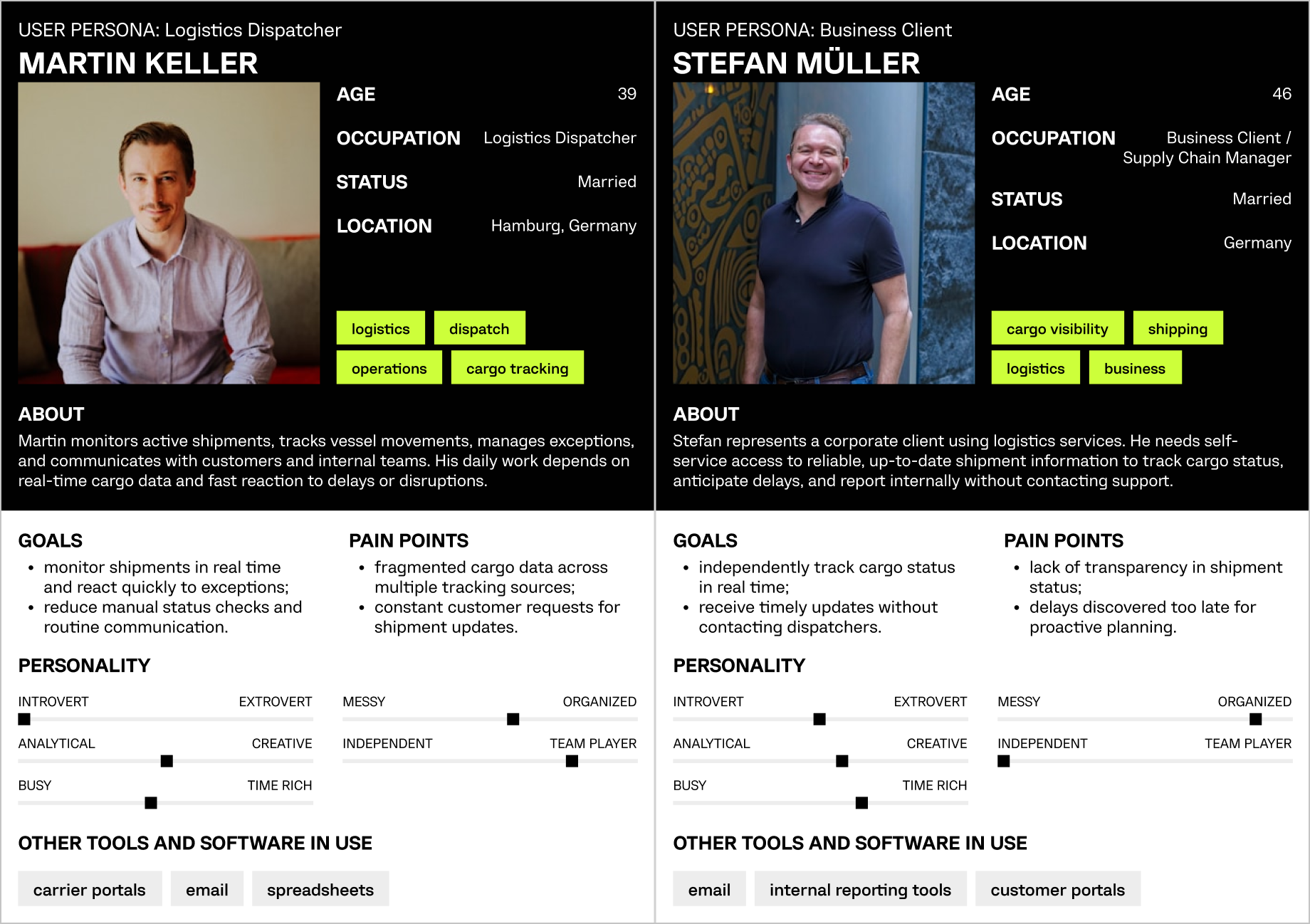
Role-based personas used to define access scope, decision logic, and interface priorities for dispatchers and business clients.
When handled correctly, this step builds the operational structure for the product: who acts, monitors, confirms, escalates, and only needs visibility. This becomes essential for alert routing, automation, interface, and AI workflows. Without it, the platform might work technically, but it won’t operate smoothly in maritime operations.
3. Build a Unified Real-Time Data Layer Before Adding Intelligence
A maritime fleet platform is only as strong as the quality of the data layer behind it. Before adding predictive models, automation logic, or advanced dashboards, the system must be able to collect, normalize, and synchronize operational signals from all sources that affect fleet visibility.
In practice, that means combining AIS feeds, GPS data, carrier updates, port-event messages, and internal shipment records into one reliable operational stream. Without that foundation, teams are forced to reconcile conflicting updates manually, and even the best interface will still sit atop fragmented information.
This is where many products fail. They try to look advanced before they become operationally trustworthy. But ship tracking and fleet monitoring software cannot support real decision-making if timestamps do not align, event logic is inconsistent, vessel identifiers are duplicated across systems, or status updates arrive with gaps and contradictions.
In maritime environments, the hard part is making sure the data reflects what is actually happening across routes, vessels, milestones, and disruptions.
The engineering task now is to establish a single source of truth for fleet and shipment events, including event normalization, signal validation, conflict resolution, status hierarchy mapping, and rules for interpreting milestones.
The product team must also decide which events trigger alerts, need enrichment, or are only for context. Weak logic hampers downstream functions, leading to noisy alerts, unreliable models, inconsistent updates, and dispatchers reverting to manual checks due to a lack of trust in the platform.
In the Navis Horizon case, Computools built a unified cargo-tracking platform that consolidated AIS, GPS, and carrier-event data into a single operational interface, while also integrating multiple carrier APIs and port-event systems into a single, reliable data stream.
That eliminated the need for constant manual reconciliation and gave both dispatchers and customers access to a consistent, real-time view of cargo movement and shipment status.
The platform could then automatically detect status changes, support predictive delay analysis, and deliver proactive notifications, because the operational data foundation was stable enough to support those layers.
When done properly, this step creates a controlled context that transforms fragmented maritime data into actionable information. This supports alerting, exception management, AI support, and platform logic as it scales
4. Design Exception Management and Alert Logic Around Operational Impact
Effective maritime coordination remains intact when plans go smoothly, but it falters when key milestones are missed, vessel movements are delayed unexpectedly, port events occur late, carrier updates clash with internal status logic, or customers request answers before the operations team has fully evaluated the situation.
Therefore, exception management should be integrated as a fundamental part of the product architecture rather than added on after the tracking interface is developed.
The platform should identify significant operational events, interpret their meaning, determine who to notify, and decide subsequent actions. This requires logic to group signals, distinguish noise from real issues, assign severity, and link exceptions to shipments, routes, milestones, or customer impacts. Over-alerting causes mistrust, and hiding critical anomalies leads teams to revert to manual monitoring.
This is where maritime operations management software has to prove its value. A strong platform should provide enough decision context for users to respond quickly. That means linking alerts to shipment timelines, recent status changes, route history, document context, and likely business impact.
In practice, the best systems help teams answer four questions immediately: what happened, why it matters, who owns the response, and what should be checked next. Without that level of operational framing, alerts create activity but not control.
In the Navis Horizon case, this layer was designed to reduce the burden on dispatchers who had previously spent too much time collecting updates, interpreting fragmented signals, and manually communicating delays.
Computools built the platform to automatically detect status changes, surface anomaly alerts, and enable faster responses through AI-generated summaries and proactive notifications. Predictive delay insights were added to help the team identify weak signals earlier, before operational issues escalated into larger service or SLA problems.
When exception logic is designed properly, the platform becomes an operational control system that helps teams focus on the disruptions that actually require action, respond more effectively, and reduce the constant friction caused by fragmented communication and reactive decision-making.
For a more detailed view of automating shipment visibility and status flows across complex maritime networks, see How to Automate Shipment Status Management Across Maritime Supply Chains.
5. Build the Interface Around Speed, Clarity, and Operational Pressure
Once the data layer and exception logic are in place, the next challenge is turning that operational complexity into an interface users can easily navigate under pressure. In maritime environments, teams face overlapping shipments, changing statuses, customer requests, route disruptions, and competing priorities.
The interface must be a decision surface, helping users understand what’s happening, what’s important now, and what to do next.
The product team should now organize information by urgency, ownership, and decision context, integrating real-time maps, shipment cards, timelines, alerts, milestones, and documentation so users don’t switch screens.
The system must minimize cognitive load by prioritizing essential context and hiding less critical details in drill-down layers. Clutter hampers interpretation and slows teams, reducing control.
This is where logistics software development services must go beyond visual polish and solve a real operational problem. A strong interface for shipping operations should make status confidence clear, separate normal movement from exceptions, surface route or milestone risk early, and give users immediate access to the context behind each alert.
For customer-facing users, the same platform should present a narrower, cleaner experience focused on visibility, timelines, documents, and verified updates rather than exposing internal operational noise.
The Navis Horizon platform was built around real operational roles, with separate dispatcher workflows and client-facing access paths. Computools designed shipment cards, a global map with markers, event timelines, alert-driven navigation, and a conversational AI sidebar to support fast lookups and lower cognitive friction.
The interface was intentionally structured around clarity and operational speed, using role-based navigation, color-coded statuses, and streamlined data panels so dispatchers could act faster while customers could follow shipment progress without relying on manual support requests.
When done properly, the interface shifts from a reporting layer to part of the operational system. It reduces noise, speeds decision-making, and maintains control during unstable shipment conditions.
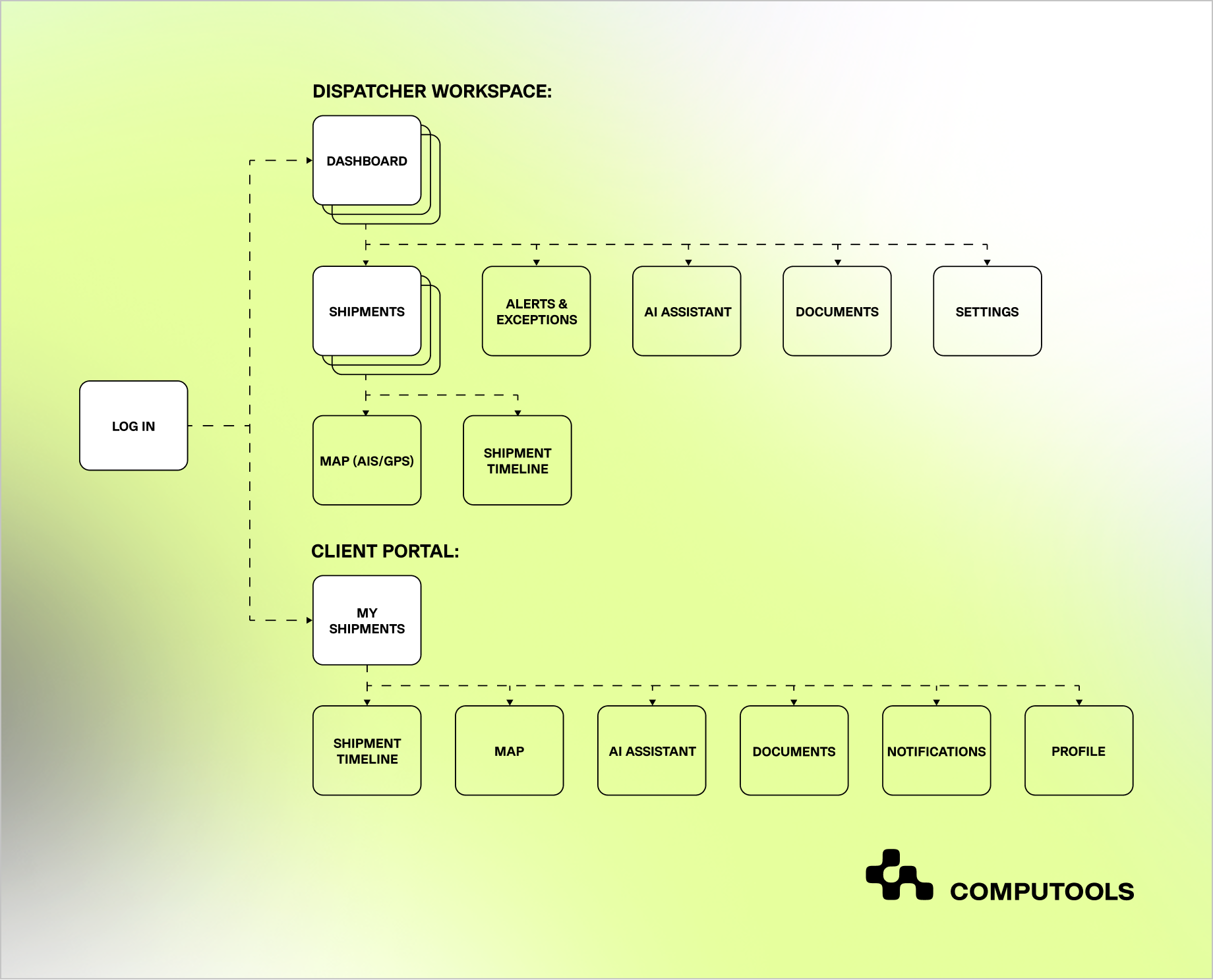
Role-based site map designed to separate dispatcher workflows from client-facing access and simplify navigation across real-time maritime operations.
6. Add Predictive Intelligence and AI Support Only After the Core Is Stable
Once the platform has a reliable data foundation, clear exception logic, and a usable interface, it can incorporate intelligence that enhances decision-making.
This is where predictive analytics and AI add value: detecting weak signals earlier, predicting disruptions, reducing repetitive work, and shifting teams from reactive to proactive control. Introducing these capabilities before system stability is achieved often amplifies noise rather than boosting performance.
In practical terms, this step is about deciding where intelligence should help and what kind of help is operationally useful. In maritime environments, predictive models can detect vessel slowdowns, delay patterns, missed milestones, abnormal event sequences, and other early indicators that may affect shipment timing and customer communication.
At the same time, an AI assistant can support both internal teams and external users by retrieving shipment details, summarizing status changes, answering routine questions, and reducing the volume of manual follow-up work. The goal is to remove friction from the workflows that cost the most time and attention.
This is where vessel fleet management platforms begin to differentiate themselves from basic tracking tools. A system that only displays location data provides visibility, but one that interprets patterns, prioritizes risk, and supports operational response provides control.
That distinction matters because maritime teams do not just need to know where a vessel or shipment is. They need to understand whether the situation is stable, where risk is emerging, and what should be addressed before service quality, customer confidence, or SLA performance erodes.
That logic was built directly into Navis Horizon. After establishing a unified operational layer, Computools added Python-based predictive models, including LSTM forecasting for delay prediction and anomaly detection, as well as an LLM-powered assistant with RAG for natural-language access, automation, and real-time operational support.
The assistant was designed to handle repetitive tasks, summarize shipment data, and deliver actionable insights to both dispatchers and customers, while predictive analytics helped the team identify potential disruptions earlier and respond more effectively.
Proper implementation integrates intelligence into the operating model. It helps teams focus on key signals, reduce manual coordination, and make faster, confident decisions in maritime conditions.
For a deeper look at how AI can support vessel operations, cargo monitoring, and dispatch workflows, read AI Agents in Maritime Logistics: Automating Vessel Operations, Cargo Monitoring, and Dispatch Decisions.
7. Define Automation Boundaries and Keep High-Impact Decisions Under Human Control
Once AI support is in place, the next challenge is choosing where to stop automation. In maritime operations, this is a practical product decision, not a philosophical trust issue. Some repetitive, rules-based actions are safe to automate at scale. Others – affecting customer commitments, service recovery, routing, SLA, or accountability – should stay under human control even with advanced platforms.
The product team must classify workflows by risk, importance, and impact. Routine updates and lookups can be automated without reducing control. However, critical decisions such as shipment reassignment, escalation, or overriding milestones should be supported by the system, not blindly automated. Too little automation causes repetitive work; too much risks operational oversight.
Marine fleet management system development must be grounded in real operational logic. A strong platform should automate information flow, reduce unnecessary manual effort, and accelerate coordination, while still preserving human judgment where context matters most.
In real shipping environments, critical decisions often depend on incomplete signals, shifting priorities, customer commitments, and commercial implications that cannot always be resolved through predefined rules alone. The system should help teams act faster and with better context, but it should not remove them from the loop where accountability still belongs.
Navis Horizon was built with this balance in mind, with Computools designing the platform to automate status updates, notifications, and repetitive requests while allowing dispatchers to retain control over key decisions.
The AI assistant supported the team by summarizing shipment data, surfacing alerts, and reducing manual coordination, but the final responsibility for high-impact actions remained with human operators.
This approach improved reliability, reduced response friction, and helped the client build trust in the system instead of treating automation as a black box.
Proper handling of this step turns automation into a force multiplier, reducing operational risk. The platform eliminates repetitive work, boosts response speed, and supports better execution while maintaining human control for complex maritime decisions.
8. Engineer for Scale, Security, and Operational Resilience From the Start
A maritime platform is truly useful only when it can handle operational growth without sacrificing stability, performance, or control. As shipping operations expand, the system has to support more vessels, more routes, more external integrations, more users, and a higher volume of real-time events without turning every product improvement into an architectural rebuild.
That is why scalability, security, and resilience cannot be treated as late-stage technical refinements. They have to be designed into the platform from the beginning.
The product and engineering teams should define how the system processes live data, stores and queries event history, delivers instant updates, and isolates failures. The architecture must also accommodate growth in carrier coverage, partner systems, alert volumes, and customer traffic.
Without that level of preparation, even strong maritime software solutions for shipping industry start breaking at the exact moment the business needs them most, which is a very expensive way to discover that “MVP thinking” is not an infrastructure strategy.
Security must be built with discipline. Maritime platforms handle route data, shipments, customer records, logs, and sensitive communications, so access control, encryption, and system isolation are essential. A strong solution protects data in transit and at rest, enforces role-based permissions, and limits user access to necessary contexts.
Resilience is crucial: when data flow or event delivery fails, dispatchers lose trust, and falling back to manual workarounds makes recovery harder than meetings suggest.
This principle was built into Navis Horizon, which uses Go for real-time data, PostgreSQL for storage, and WebSockets for instant shipment updates. It also used GDPR-aligned security, encryption for data in transit and at rest, role-based access control, and a zero-trust front-end approach.
Just as importantly, the architecture was designed for expansion, making it possible to support additional routes, carriers, and operational features without major rework as the client’s needs evolved.
When done properly, the platform remains fast, secure, and dependable as complexity increases, distinguishing a usable maritime product from a short-lived prototype with a nice interface.
9. Roll Out Iteratively, Validate in Live Operations, and Refine Based on Feedback
Even well-architected platforms continue to evolve after launch. In maritime environments, true validation occurs when operational teams use the system in real workflows under pressure, dealing with disruptions, customer requests, and urgent decisions.
Teams must assess the relevance of alerts, accuracy of status logic, interface effectiveness, and whether automation reduces manual work or causes confusion. Hidden issues like overload, unclear milestones, missing context, or manual steps often surface here.
The strongest custom maritime software solutions are refined through real operational feedback, not frozen in their first production version. A phased rollout allows product and engineering teams to release functionality in controlled stages, monitor adoption, collect feedback early, and adjust the platform before small design flaws turn into structural limitations.
In shipping operations, that flexibility is critical because workflows evolve, data dependencies change, and service expectations rarely stay still for long.
That approach was built into Navis Horizon from the start, delivered through iterative cycles with testing, early client reviews, and ongoing refinement based on operational needs.
This helped ensure stronger adoption, better alignment with live workflows, and measurable business results, including a 40% reduction in dispatcher workload, an 18% improvement in shipment incident resolution time, a 23% increase in customer satisfaction, and full cargo status transparency.
When done properly, rollout becomes part of product engineering, and the platform continually improves in real use, building trust in daily maritime operations.

Want to modernize fleet monitoring, maintenance, and voyage operations with custom software? Our tech experts are ready to estimate your project.
What are the key benefits of maritime fleet management software for shipping companies?
Building a modern fleet platform gives shipping businesses stronger operational control, faster response times, and more reliable decision-making across daily workflows.
1. Improved real-time visibility into vessel locations and shipment statuses. With integrated vessel tracking software, fleet managers and dispatchers can continuously monitor movements, respond more quickly to unexpected events, and make routing and coordination decisions based on live operational data.
2. Reduced dispatcher workload through automation. By automating routine tasks such as status updates, alerts, and document workflows, dispatchers can focus on higher-value activities like exception management, coordination, and operational planning, thereby improving overall productivity.
3. Improved customer satisfaction through self-service access. Giving customers direct access to shipment tracking, documentation, and status information reduces reliance on support, improves transparency, and strengthens trust through faster, more consistent communication.
4. Lower operational costs through predictive insights and route optimization. Advanced analytics help teams identify likely delays earlier, improve route efficiency, reduce unnecessary manual intervention, and support better use of operational resources across the fleet.
5. Stronger compliance and reporting readiness. Automated monitoring, event logging, and structured operational records help shipping companies maintain better control over reporting processes, reduce the risk of missed requirements, and respond more effectively to regulatory and service-related obligations.
What are the main risks of maritime fleet management software development?
While the upside is substantial, digital fleet management for shipping companies also carries risks that can undermine adoption, delay ROI, or weaken operational impact if not addressed early.
- Significant upfront investment and long-term delivery commitment. Building a reliable maritime fleet platform requires real-time data architecture, integrations, event normalization, access control, security, software testing, and ongoing refinement. Shipping companies face not only high initial costs but also the need for a product that performs reliably in demanding conditions over time.
- Complex integration across fragmented operational ecosystems. Maritime organizations seldom operate in a clean digital environment. Fleet operations depend on legacy tools, databases, spreadsheets, carrier systems, port feeds, and third-party providers. Integrating these is complex due to inconsistent identifiers, timestamps, event formats, and update logic. These integration challenges often prevent platforms from providing a clear operational view.
- Security exposure across sensitive operational and commercial data. A fleet management platform manages route data, vessel and shipment events, customer records, communications, and history. Neglecting security risks, data breaches, service disruption, and loss of trust. Implementing encryption, role-based access, isolation, and resilient infrastructure is vital to minimizing these risks.
- Operational resistance and slow adoption at the user level. A strong platform can underperform if users don’t trust it. Dispatchers, coordinators, and customer teams may hesitate due to noisy alerts, unfamiliar workflows, or automation that feels like losing control. Risks rise with manual workarounds. Successful rollout needs phased implementation, training, and visible early benefits.
- Poorly defined automation boundaries. Automation creates value only with clear limits. Too little automation burdens teams, while too much can reduce accountability, induce false confidence, and increase risk. In maritime, effective systems automate routine tasks but keep humans in control of major decisions.
Mitigating these challenges requires disciplined product strategy, resilient architecture, structured change management, and a delivery model that aligns the system with real operational behavior from the start.
What does the future of maritime fleet management software look like?
The future of maritime transportation management software will be shaped by several strategic shifts that are already redefining how shipping companies operate, optimize fleet performance, and respond to regulatory and commercial pressure.
As these trends accelerate, shipping fleet management software will play a more central role in connecting operational visibility, automation, compliance, and decision support within a single digital environment.
- Integration with autonomous vessels. Autonomous shipping is expected to reduce human error, improve voyage efficiency, and increase reliance on real-time operational data. This process will require fleet platforms that can integrate with vessel control systems and adapt quickly to changing conditions.
- Green shipping initiatives. As decarbonization targets tighten, shipping companies are adopting alternative fuels and emissions-tracking technologies. Fleet software will need to support environmental monitoring, reporting, and more informed decisions around fuel use and route planning.
- Blockchain for documentation and compliance. Blockchain development can improve trust and traceability across shipping documentation, contracts, and compliance records. Its use may help simplify audits, reduce fraud risk, and strengthen coordination between stakeholders.
- Advanced predictive analytics and monitoring capabilities. AI-driven analytics and real-time monitoring will play a bigger role in forecasting delays, detecting anomalies, and improving route efficiency. The value of maritime platforms will increasingly depend on their ability not just to show data, but to help teams act before issues escalate.
Why companies choose Computools
Companies choose Computools for software engineering services that combine strong delivery discipline with hands-on experience in complex maritime products.
Over 12+ years, our 250+ in-house engineers have delivered 400+ projects globally, including 40+ logistics and maritime solutions across visibility platforms, fleet monitoring systems, freight marketplaces, and dispatch coordination tools.
Our maritime software development services cover real-time visibility platforms, fleet monitoring systems, marina operations solutions, and other custom products built for complex maritime workflows.
Our experience in maritime fleet management software development includes HubMarine in Israel, where we built a marina operations platform with IoT-enabled berth allocation and AI-driven pricing; Navis Horizon in Germany, where we developed a real-time cargo tracking platform that reduced manual dispatch workload by 40% and improved incident resolution time by 18%; and a shipbuilding management platform in the UK, where we modernized the system with role-based interfaces and blockchain-based data security.
This breadth of delivery allows us to build maritime solutions that are technically strong, operationally practical, and ready to scale. To discuss your maritime software initiative, contact our team at info@computools.com
To sum up
For shipping companies, operational efficiency hinges on how quickly they can transform live data into action. Well-structured maritime analytics and fleet monitoring systems enable this by enhancing visibility, minimizing delays, and strengthening daily control.
If you are also evaluating providers in this space, our article 15 Best Vessel Tracking & Maritime Analytics Software Development Firms offers a useful starting point.
Computools
Software Solutions
Computools is an IT consulting and software development company that delivers innovative solutions to help businesses unlock tomorrow.