
THE AUTHOR:

Planning to develop a smart tourism platform? In this article, we break down the key trends shaping smart tourism and highlight the essential features and technologies. We also provide a step-by-step guide to building a mobile-first, fully integrated platform that engages travelers as well as supports destination management and local businesses.
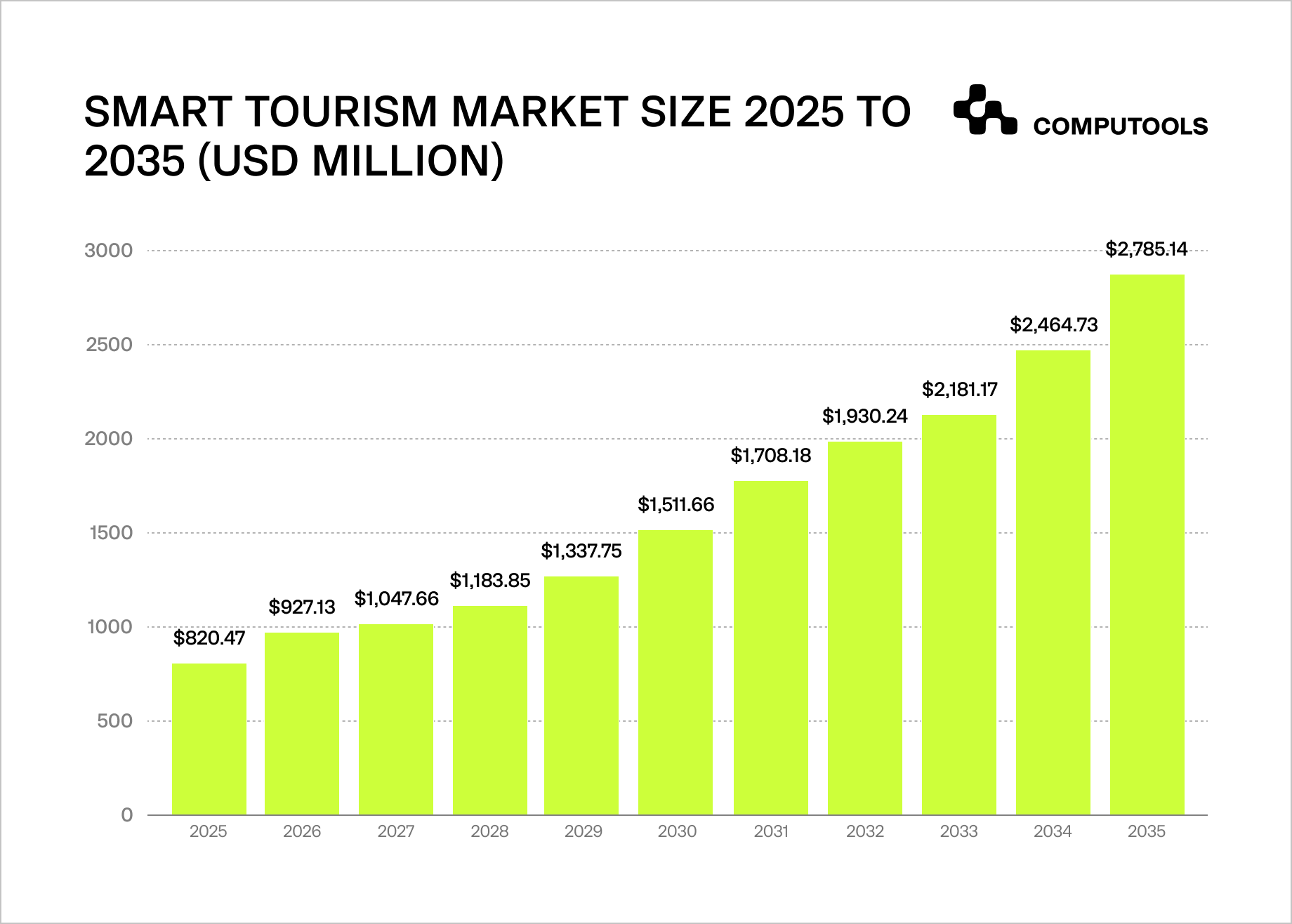
The smart tourism market has a high projected growth rate, likely increasing from 820 million dollars in 2025 to 2.8 billion dollars in 2035 at a 13% CAGR. Smartphone dependence and the construction of digital infrastructures are driving widespread demand for personalized, self-created travel.
Tourism software incorporates big data, cloud, IoT, AI, and AR/VR, and helps manage and optimize digital connections between citizens, travellers, and businesses. Key features include smart ticketing, travel booking, navigation, virtual tours, and personalized engagement.
AI and IoT in tourism platforms, along with AR and VR technologies, deepen the experience through real-time suggestions, personalized routes, and other enhancements. Managing and optimizing the real-time travel to offer fewer and more useful transportation options is a primary benefit of a tourism data platform for cities.
Individual and family travelers are major users, comprising over 55%. Governments and tourism organizations employ smart tourism innovations to manage and control tourist activities, make efficient use of resources, and protect cultural assets.
This context sets the stage for developing smart tourism platforms that are mobile-first, AI-enabled, and fully integrated, addressing both tourist engagement and destination management.
As more destinations immerse themselves in the world of connected digital traveler experiences, we recommend this guide to discover what differentiates the best travel booking platform development companies from other software vendors.
Computools expertise: SMARTCITY case study
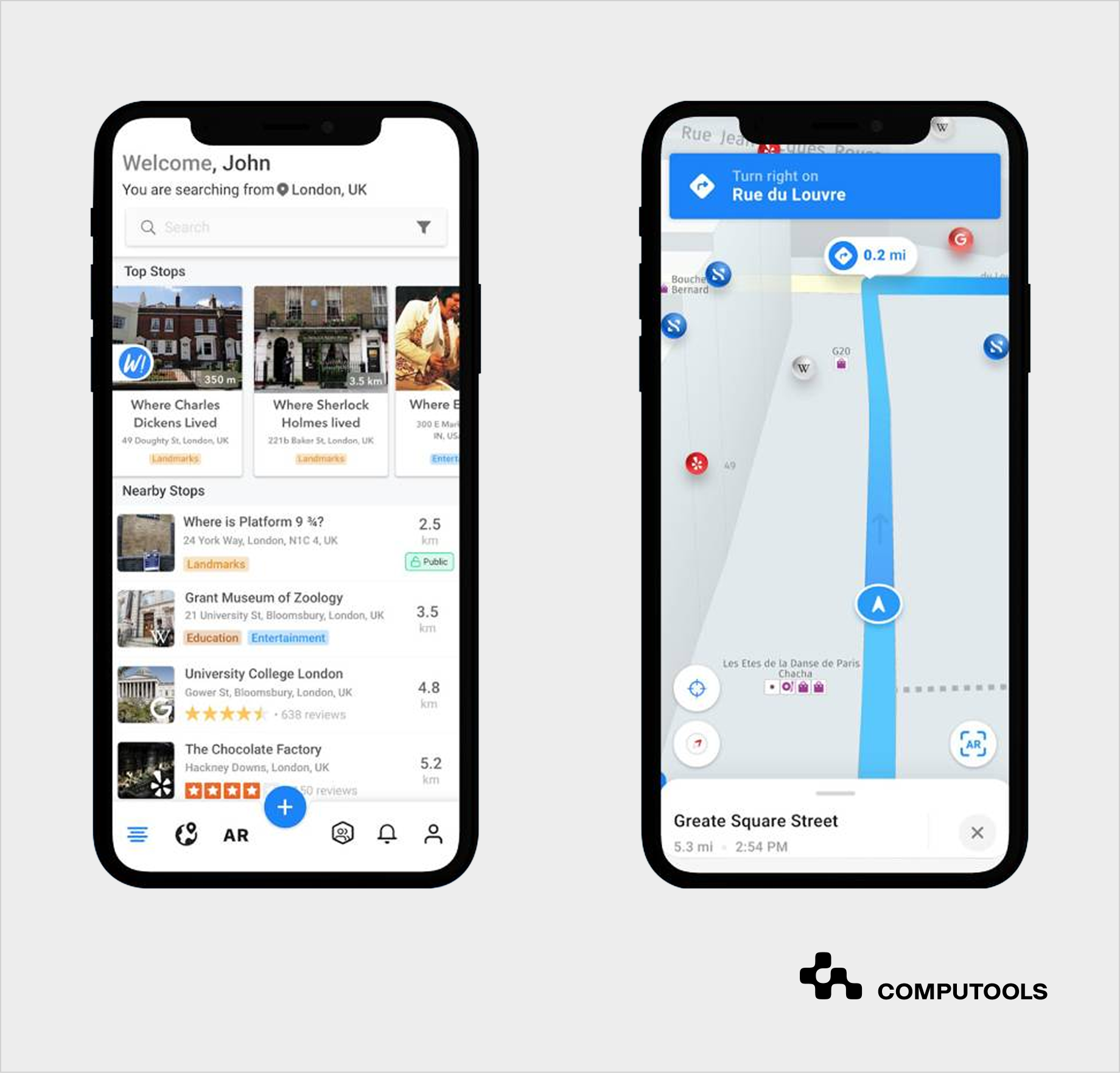
SMARTCITY is an example of Computools’ expertise in tourism mobile app development. We built a travel social network where tourists can get live content, places, and local services. The platform also includes instant messaging, 3D navigation, and other interactive features like public and private groups, as well as tagging, photo sharing, and information exchange among travelers.
Business Challenge
The client sought a mobile experience with augmented reality, live communications, and messaging. These features enhance the experience of travelers and provide destinations and local businesses with valuable services.
Computools Solution
When developing the SMARTCITY application, Computools managed the product’s journey from its initial idea to the completed integration.
- Core Architecture
Created a backend that could manage geolocation features, augmented reality, and messaging, with stability and scalability.
- Geospatial Search and AR
Helped tourists find nearby points of interest and enriched their experience by viewing AR overlays as well as information from Wikipedia, Google Places, and internal geo-content.
- Instant Messaging
Computools developed tourist messaging with real-time private, public, and group chat.
- 3D Navigation
Integrated navigation and routing through the city, augmented by real-time recommendations based on the user’s location.
- User Interface & User Experience
Designed a responsive, intuitive interface to ensure high engagement and retention, supported by structured wireframes and user personas.
Tech Stack
Technologies needed to develop a smart tourism platform allowed for complex, real-time operations.
We used:
- Java facilitates writing modular and reusable backend code that works on any system.
- Android SDK allows the coverage of many devices by supporting many Android versions.
- Retrofit 2 and RxJava for asynchronous operations to perform REST API calls and implement reactive data streams.
- ButterKnife simplifies view injection and click handling for cleaner code and faster development.
Impact
The SMARTCITY app achieved high adoption among local and international users. Local businesses benefited from increased visibility and traffic, while the client reported significant revenue growth.
How to develop a smart tourism platform step by step
Below are practical steps to engineer a smart tourism platform addressing urban destination needs.
Step 1: Define the Destination Strategy and User Scenarios
When designing the platform, focus on real user flows and business goals. The SMARTCITY case showed the importance of combining tourist and business perspectives.
The platform can aim to mitigate strain on overused sites, improve direct ticket sales, promote local merchants, improve visitor access, or provide tourism boards with a deeper understanding of tourist behaviour. Then transform these objectives into specific user flows and technical needs.
| Goal | User Scenario | Technical Requirement |
| Increase ticket sales | The visitor identifies a museum, checks ticket availability, and proceeds to make a purchase. | Real-time ticket inventory, payment integration, and QR ticketing. |
| Promote local businesses | Tourist receives recommendations for restaurants or shops in the vicinity | Partner profiles, user geolocation, and recommendation capabilities. |
| Enhance accessibility | The visitor adjusts route preferences to prioritize step-free access. | Accessibility metadata, GIS routing rules. |
| Control visitor distribution | City team assesses popular visitor routes and determines the most congested areas | Analytics dashboard, visitor distribution, event tracking. |
| Improve trip planning | Visitor creates a travel route based on available time, personal preferences, and location | Itinerary logic, operating hours, route optimization. |
In SMARTCITY, we mapped the visitor journey alongside partner and admin workflows. For example, a tourist may tag a photo of a landmark, which then links to the corresponding partner entry. Plan these flows early to define your data model.
Here is an example of a typical user journey:
Search attraction → view live info → create route → purchase → payment → QR code sent → additional suggestions given.
This captures all major technical requirements, such as CMS, map integration, availability, booking, payment, notifications, and analytics modules. It will also help prioritize the essential and non-essential MVP product features. For example, a basic route planner may suffice for the initial product, whereas an advanced feature like AI-based itinerary generation may be added in a subsequent product release.
Once the essential components, including user roles, primary user journeys, MVP scope, success criteria, and data requirements, are defined, this phase of the project will be considered complete.
Step 2. Design the Platform Architecture Around Connected Modules
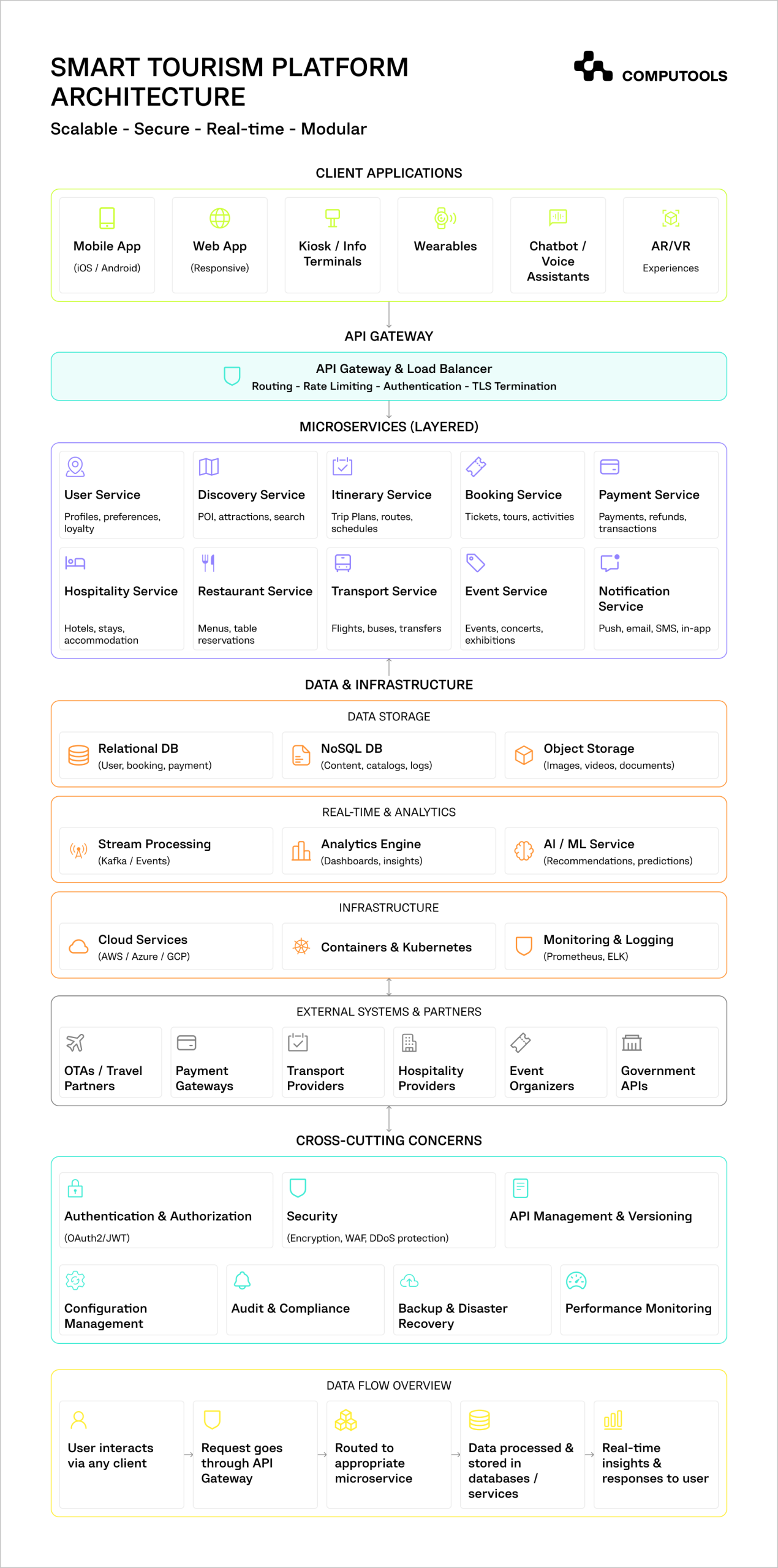
Before starting coding, determine how the system’s major components will interact. Most smart city tourism platforms include a visitor app, a web portal, an admin panel, a partner portal, and systems for bookings, integrations, and analytics.
| Module | Purpose | Technical Focus |
| Visitor app | Discovery, routes, bookings, updates | Mobile UX, offline access, multilingual UI |
| Web portal | Public destination content and event visibility | SEO structure, responsive design, content performance |
| Admin dashboard | Content, routes, campaigns, reports | RBAC, CMS workflows, analytics |
| Partner portal | Profiles, offers, availability | Validation, moderation, booking rules |
| Booking engine | Tickets, reservations, confirmations | Real-time inventory, transaction safety |
| Integration layer | Maps, transport, weather, payments, PMS, POS | APIs, data normalization, retry logic |
| Analytics layer | Tracks behavior and platform performance | Event tracking, dashboards, BI layer |
The main architectural question is how data moves between these modules. Implement a single source of truth for POIs, availability, and content metadata. Use API gateways to connect partner updates, real-time events, and location data, as Computools did to maintain AR and chat accuracy in SMARTCITY.
Static content, such as descriptions and images, can be cached. Semi-dynamic data, such as opening hours and offers, needs scheduled updates and moderation. Transactional data, such as ticket availability, prices, payments, and booking status, must be validated in real time.
A good rule of thumb is: cache what informs the visitor, validate what affects the transaction.
For instance, the app can cache the museum description, photos, and the historical context. However, prior to payment confirmation, it must check the price, availability, and current status of the time slot.
Step 3. Build the Core Feature Set for the MVP
The MVP needs to cover/encompass the entire visitor journey rather than the full smart tourism feature set. An example of a recurring error is to integrate AI, AR, loyalty, marketplace logic, and advanced analytics too early, before the core experience is in place.
Core MVP features:
| Feature | Purpose | Technical Note |
| Destination catalogue | Attractions, events, restaurants, routes, local services | Use structured categories, tags, and location data. |
| Interactive map | POIs, geolocation, route display | Support clustering and fast tile loading. |
| Search and filters | Category, location, time, price, accessibility | Use indexed metadata for fast results. |
| Route planning | Walking, cycling, transport, accessible routes | Connect routing APIs and destination rules. |
| Booking or reservation flow | Tickets, tours, tables, time slots | Add availability checks and booking statuses. |
| Notifications | Confirmations, reminders, route updates | Triggered by booking, location, or scheduling events. |
| Admin panel | Content, routes, events, basic reports | Include approval workflows and audit logs. |
| Basic analytics | Searches, route views, bookings, popular places | Track events. |
The first release should support this path:
Open app → choose language → search place → view map → build route → book if needed → receive confirmation.
Once a tourism experience platform has proven its worth, advanced capabilities like itineraries, dynamic routing based on crowd flows, Augmented Reality, and predictive analytics can be added. This keeps development focused and reduces the risk of building expensive features that visitors or partners do not use.
Step 4. Design the Data Architecture and Content Governance
Smart tourism technology solutions flourish based on data precision. Incorrect data on partner offers, opening hours, tickets, and routes will eventually result in the collapse of the tourism experience.
Data architecture should particularly answer the questions, “What data will the platform contain? Where will it come from? How will data change over time? How will the updates take place?”
Data architecture should outline the types of information, where information will be sourced from, the frequency of updates, and the list of data owners.
Since data updates occur at different rates, data can be separated as follows:
| Data Type | Examples | Technical Approach |
| Static | Descriptions, images, historical facts | CMS, localization, caching |
| Semi-dynamic | Opening hours, accessibility details, offers | Partner portal, approval workflows |
| Real-time | Availability, bookings, transport changes | APIs, validation, event-driven updates |
| User-generated | Reviews, saved places, preferences | Moderation, consent, profile storage |
| Analytics | Searches, route views, bookings | Event tracking, BI dashboards |
SMARTCITY required structured POI data, Wikipedia/Google Places integration, and partner-supplied content for AR overlays. This shows the importance of data normalization and validation.
Use a clear schema for every object: coordinates, images, accessibility, category, time slots, and metadata for AR visualization. This framework enhances search and filter capabilities, as well as smart recommendations, analytics and localization.
Content ownership should be well defined. Tourism boards may control official content, while partners update business profiles, offers, and availability. Properly implementing role-based access, audit logs, validation rules, and moderation workflows will be the governance system to support this.
For example, a restaurant can update its opening hours and menu link, but a city admin should approve whether it appears in a featured food route.
Step 5. Include Maps, Geolocation, and Route Planning Logic
The main interaction layer of a tourism application is the map. Visitors use it to identify their location, nearby sites of interest, plan their routes, and decide what to do next.
The main functions of the maps include:
| Function | Technical Focus |
| Interactive map | Use of a Map SDK, GIS layers, and POI clustering |
| Geolocation | GPS, app permissions, accuracy for users, and battery health |
| Route Planning | Routing APIs and the calculation of travel time |
| Nearby Discovery | Radius search, category filters, ranking logic |
| Offline Access | Usage of cached map data, preserved routes, and local storage |
| Accessibility Routing | GIS constraints and accessibility metadata |
Avoid loading the entire city data at once. Map tiles, clustering, and location-specific data fetching should be used. Say the application is to load the attractions in a 1–3 km radius. More results can be added via a user request as they move or zoom out.
Distance is also a major consideration. Planning routes should consider transport options, the time it takes to book and explore the attraction, and factors of interest, and user interests. For example, if a visitor has a museum ticket at 15:00, the platform should recommend nearby stops that fit the available time window instead of sending them across the city.
Offline servicing is also essential. Connectivity is often lost at metro stations, in old city districts, as well as in museums and crowded events. Important routes, saved tickets, and key components of the map should remain available without the app accessing the Internet.
Step 6. Integrate Booking, Ticketing, and Payments
At this stage, the application will begin receiving direct revenue. Users should be able to make bookings for museums, tours, events, transport, local experiences, and restaurant tables.
A standard flow will look like this:
Select service → check availability → create temporary hold → start payment → confirm booking → issue QR/NFC ticket → update inventory → send confirmation.
Key elements:
| Component | Technical focus |
| Availability service | Real-time inventory, partner APIs |
| Booking Engine | Temporary holds, cancellation rules, status tracking |
| Payment Module | Gateway integration, refunds, tokenized payments |
| Digital Ticketing | QR/NFC codes, ticket validation, anti-fraud |
| Notifications | Booking confirmations and change updates, service reminders |
| Partner Reporting | Revenue, commissions, payouts |
Employ temporary holds to avoid double booking. If payment has not been confirmed and the user leaves the booking/checkout process, the service lock will expire, and the inventory item will become available again.
The system should also be able to track a variety of booking statuses. These include availability, service holds, payments being processed, confirmed, or failed, as well as cancellations and refunds. Statuses should be displayed to avoid confusion among the app, admin dashboard, partner portal, and payment provider.
Although SMARTCITY initially focused on discovery and messaging, the same architecture supports ticketing and reservations for museums and events. Our approach was to ensure atomic transactions and real-time updates between the geolocation layer, content, and messaging systems.
Dev tip: Even if bookings are added later, design your backend with event-driven architecture.
For destinations that combine tourism with concerts, exhibitions, festivals, or cultural programs, event discovery and ticketing often become a core part of the platform experience. This is further discussed in this guide on how to build an event discovery platform with ticket sales.
Step 7. Add AI and Personalization
The purpose of AI-powered features is to improve the platform’s usability rather than overcomplicate the system. AI can increase the accuracy of route planning, suggest attractions and services, and respond to users more efficiently.
Below are useful AI capabilities:
| AI Feature | Practical Use | Technical Dependency |
| Itinerary planner | Builds plans based on time, location, interests, and bookings | Structured POI data, routing, availability |
| Nearby recommendations | Suggests places, restaurants, events, and offers | Geolocation, user preferences, ranking logic |
| Chatbot | Answers tourist questions and supports search or booking | Knowledge base, multilingual NLP, platform APIs |
| Demand prediction | Helps destination teams understand interest by area or event | Historical data, searches, bookings |
| Dynamic ranking | Prioritizes places based on context and availability | Real-time signals, content metadata |
AI suggestions should rely on real-time data. A closed location, a destination too far away, a fully booked offer, and a place that does not match a user’s preferences should never make a top suggestion.
As an example, if a visitor selects “architecture,” “local food,” and “3 hours,” the system should combine interest tags, location, opening hours, route duration, restaurant availability, and current weather before suggesting an itinerary.
People’s privacy should be a consideration. Therefore, clear consent, anonymous analytics, and transparent preference settings should be in place. AI should augment the visitor experience, rather than overly track it.
Step 8. Build Admin and Partner Dashboards
Back-office tools keep the platform modern. Without them, content goes stale, partners lose control of their data, and destination teams lose the ability to manage operations.
The admin dashboard must provide:
- Tools to manage partners, attractions, routes, events, and content.
- Bookings and campaigns supervision.
- Partner approval and moderation.
- Translation and localization workflows.
- Analytics and reports.
- User role management.
With the partner dashboard, businesses should be able to manage their profiles, opening hours, photos, information, offers, availability, bookings, and data, as well as booking performance.
Permission control is important. For example, a restaurant partner should be able to manage their own profile, but shouldn’t have access to creating or editing city routes. This logic is enforced through role-based access, audit logs, approval gates, and data verification.
An update flow can be created as follows:
Partner submits update → system validates required fields → moderator approves changes → update goes live → analytics tracks performance.
Things that require frequent changes, such as ticket availability and schedule times, should be integrated with real-time updates. The dashboard should support API synchronization or calendar-based integration.
Step 9: Test Performance, Security, and Real-Time Accuracy
Simulate real urban conditions for the system. Peak city activity, festivals, limited ticket bursts, poor mobile network performance and sudden surge in city traffic are excellent criteria.
Consider the following for the platform’s quality assurance:
| Area | What to Test |
| Mobile Performance | App start, map loading, search, route |
| Load Handling | High-traffic scenarios during events or campaigns |
| Booking Accuracy | Holds, payments, QR ticket issue, and cancellations |
| Data Synch | Opening hours, availability, and partner data updates |
| Security | Accounts, payments, permissions, and admin activity |
| Offline Behavior | Saved routes, tickets, and cached maps |
| Integration Reliability | API and provider downtime, and webhook failures |
An effective load test could include:
10,000 users open an event page → 3,000 check availability → 1,000 start checkout → 600 complete payment → tickets are issued and inventory updates everywhere.
Security testing should cover every role. Tourists should only view bookings. Partners manage only their profiles and their offers. Audit logs should capture admin actions like refunds, featured placements, and partner approvals.
Real-time accuracy is crucial for transactional flows. Static content is the only place where latency is acceptable. Availability, payment status, ticket validation, and booking confirmation must be real-time.

Launch your smart tourism platform in 1–3 months instead of years. Connect travelers with personalized experiences, local attractions, and real-time city insights in one seamless journey.
What makes Computools the best choice for smart tourism platform development
Smart destination management systems are much more than apps that tell visitors where to go. They feature mobile navigation, events and POI content, partner data, booking flows, payments, analytics, and AI-based recommendations. Computools integrates these elements together, allowing users to go from finding an attraction to planning their itinerary and booking in one single flow. Our completed projects align perfectly with the tourism digital transformation.
The company has expertise in travel and hospitality software development services, mobile and web engineering, integrations, and AI-enabled platforms.
Computools also aids destinations with museums, historical attractions, and cultural routes, with specialized heritage tourism software development that combines geolocation, mobile experiences, booking systems, and interactive visitor engagement. Offered services cover the areas below:
1. Booking and High-Load Experience
In Multitrading, Computools upgraded a ticketing platform for concerts, sports, and theatrical performances to increase booking efficiency, accommodate more concurrent users and reduce latency.
This experience is relevant to destinations with festivals, exhibitions, or various seasonal campaigns that implement time-slot bookings. The app is expected to maintain inventory accuracy, process payments, and avoid overbooking.
2. Hospitality and Local Business Integration
Urban tourism platforms often connect visitors with restaurants, cafés, hotels, shops, guides, and local venues.
In the Tap App project, we developed a multi-venue restaurant platform that improved the efficiency of the ordering process and revenue, and decreased unfilled and modified orders by 85%.
This experience fits smart tourism features such as:
- restaurant discovery;
- table booking;
- menu integration;
- local offers;
- partner dashboards;
- hospitality marketplace features.
Computools can also support this part through software development services for HoReCa, especially when the platform needs restaurant workflows, multi-location ordering, or hospitality partner management.
3. Engineering Capacity for Complex Smart Tourism Infrastructure Solutions
With over 250 engineers, 400+ projects completed, and ISO 9001 and ISO 27001 certifications, Computools offers full scope of tourism software development services, such as architecture, UX/UI, backend, mobile, web, integrations, QA services, security, and long-term support. This end-to-end support is important because projects often fail when mobile, backend, content, and integrations are developed without a shared architecture.
4. AI, Mobile, and Web Capabilities for Growth
A city tourism management software MVP can start with discovery, maps, routes, bookings, and basic analytics. With time, it has the potential to grow into a more comprehensive destination platform, which could include AI itineraries, multilingual chatbot support, AR routes, loyalty features, advanced analytics, and local marketplace partnerships.
Computools supports this growth through AI development services, mobile app development services and web development services.
If you’re looking to develop a smart tourism platform for a city, Computools streamlines the process by providing the right architecture and a fully integrated service for the product to grow with the support of visitors, local businesses, and the destination.
Our experience with travel, hospitality, booking, and location-based products positions Computools among the top hospitality mobile app development companies working with modern tourism and guest experience platforms.
Final thoughts
How cities compete for visitors is changing because of smart tourism technology. More and more people don’t want separate applications for maps, tickets, events, restaurants, and local happenings. Travellers want a comprehensive app that integrates discovering new places, navigation, service booking, and updates.
Providing that seamless experience involves more than appealing design. The solution requires robust software architecture, precise geolocation, seamless booking, and reliable integrations across transportation, hospitality, entertainment, and businesses. In this article, we have outlined the technologies that fuel market demand, the anticipated value and app features, and the key milestones and practical steps to develop a smart tourism platform.
Planning to develop a smart tourism platform? Let us know, and Computools will help you implement a flexible, AI-oriented solution that addresses real urban dynamics, peak user demand, and long-term growth of the destination. Contact our team at info@computools.com.
Computools
Software Solutions
Computools is an IT consulting and software development company that delivers innovative solutions to help businesses unlock tomorrow.