
THE AUTHOR:

Travel and tourism generated $11.6 trillion in global GDP and supported 366 million jobs in 2025, according to the World Travel & Tourism Council. The sector’s 4.1% growth also exceeded overall global economic growth of 2.8%. This expansion creates more competition for visitors’ time and spending among operators and a larger commercial opportunity for guided tour app development companies.
Platforms must help travellers discover experiences, reserve places, follow routes, access content and purchase additional services while giving operators better control over capacity, customer data and engagement.
15 guided tour app development companies:
1. Computools
2. Infinum
3. Calvium
4. Nagarro
5. IndiaNIC
6. Makeable
7. MoodUp
8. Logicnord
9. Vsteq Softwares
10. Apadmi
11. hedgehog lab
12. MobiDev
13. Brightec
14. The Distance
15. PRELOADED
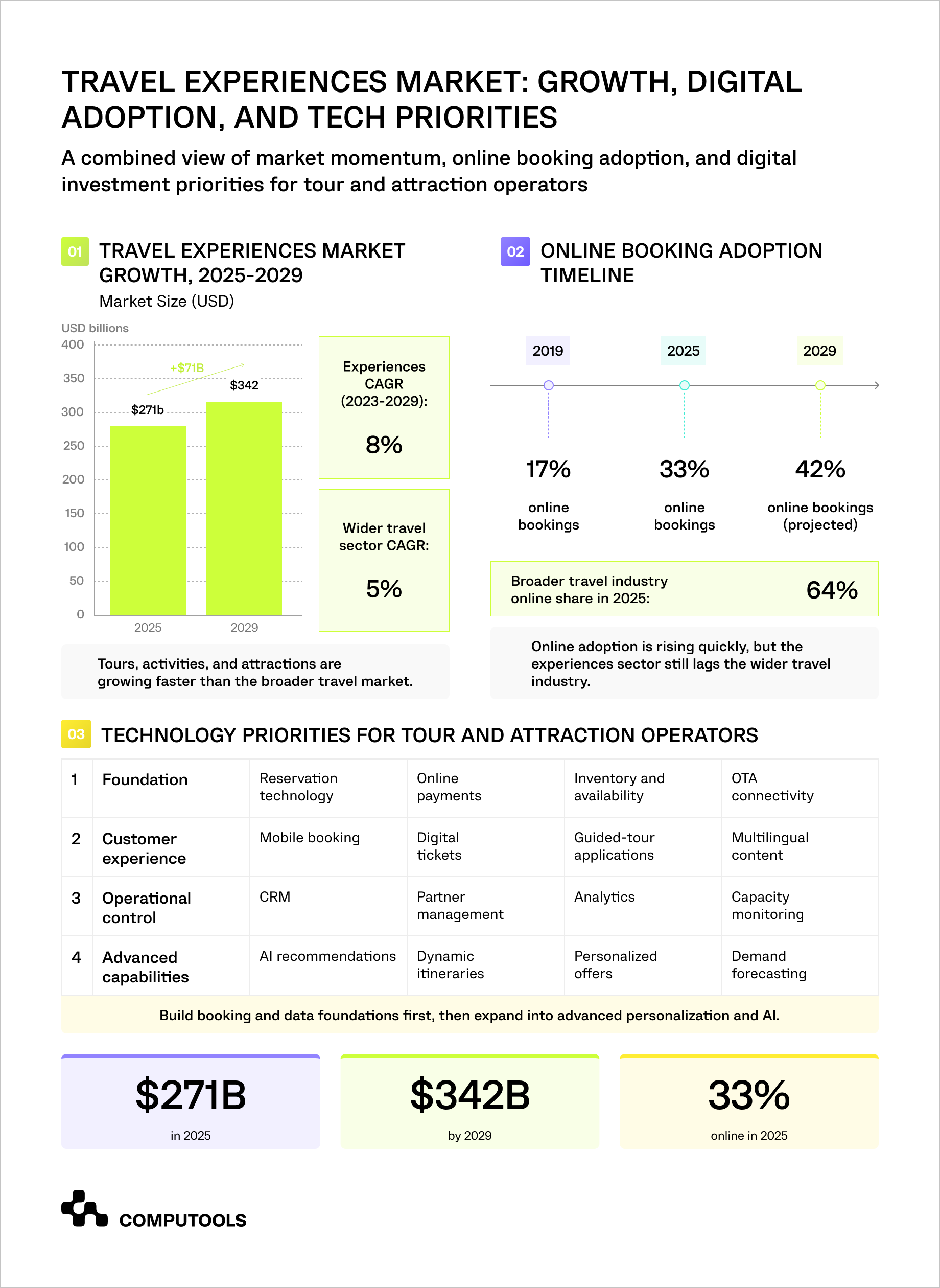
Distribution is one of the clearest pressures. Arival reports that online travel agencies captured 33% of tours, activities and attraction bookings in 2024. As third-party channels take a larger share, operators need direct digital products that can convert interest before arrival and continue supporting visitors at the destination.
Effective guided tour app development may combine reservations with real-time availability, secure payments, ticket validation, CRM connections and post-visit communication. A standalone walking tour app or city guide application cannot provide the same commercial value when booking, customer and content data remain fragmented across separate systems.
Visitor expectations are also moving beyond basic maps and recorded commentary. Travel guide apps should include destination discovery, personalised travel route planning, saved itineraries and contextual recommendations, as well as support multiple languages. Guided travel apps may feature geofencing, indoor positioning, augmented reality, camera landmark recognition, and location-activated storytelling. For self-guided tours, these app functions must adequately replace a human guide while avoiding confusing the traveler and maintaining a sense of connectivity to the environment.
Connectivity remains a practical design constraint. The GSMA reports that 4.7 billion people used mobile internet on their own devices in 2025, yet 3.1 billion people still did not use mobile internet despite widespread network coverage. Even connected travellers can lose service inside museums, historic buildings, national parks and rural destinations. As a result, audio guide apps, location-based travel apps and GPS tour apps should support downloaded media, cached maps, offline route progress and delayed analytics synchronisation. A museum guide app may also require indoor alternatives to GPS, while a city product must manage battery use and background location permissions carefully.
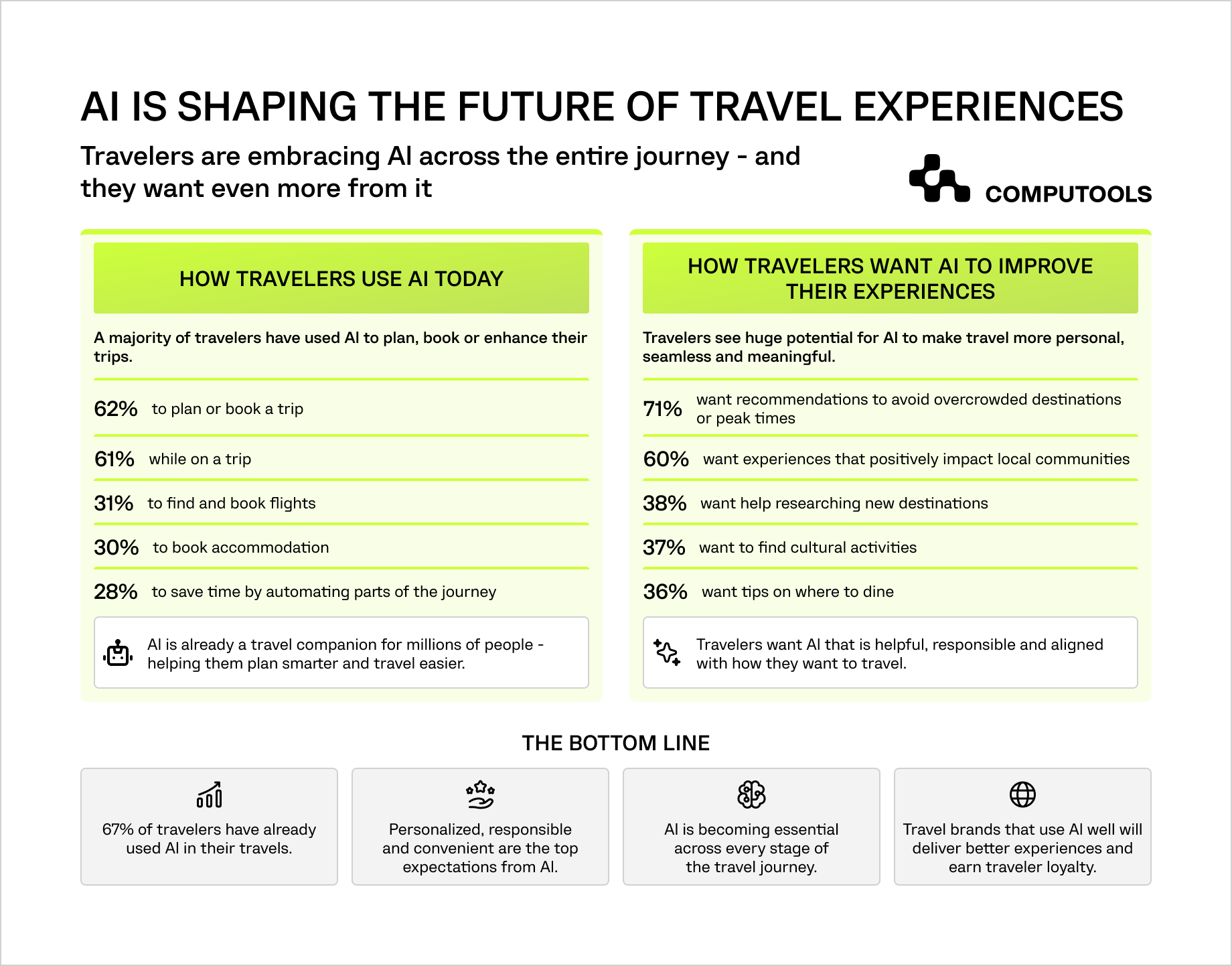
Artificial intelligence adds another opportunity, but it should not remove traveller or curator control. According to the Booking.com survey, while 89% of respondents expressed an interest in AI-assisted travel planning, only 12% expressed a willingness to grant AI the autonomy to make decisions on their behalf. For digital tour guide platforms, AI can be applied to itinerary, translation, content search, and chat services. Yet, operators still require approved content sources, a review of workflow, and a rationale for the AI recommendations. Cultural and historical content information will still need some sort of editorial oversight to avoid misinformation.
Rather than an amenity, accessibility has become a product feature and a procurement mandate. The requirements of the European Accessibility Act, which has been in effect for products and services since June 2025, apply to custom tour app development. This implies the provision of navigation via screen readers, adjustable text, transcripts, captions, and support for navigation via a keyboard and accessible purchasing flows from the start. .
This comparison includes custom software engineering, digital product and technology consulting companies capable of building or modernising a complete tourist experience platform.
How we selected guided tour app development companies
We assessed tour guide app development providers based on their ability to design, build, integrate and modernise complete visitor platforms. The review covers companies with verified experience in guided tours, destination applications, museum technology, sightseeing products, travel booking, geospatial services and other closely related areas.
| Selection criterion | What we evaluated |
| Relevant project evidence | Publicly verified work involving city guides, audio tours, museum applications, heritage trails, destination platforms or sightseeing products. |
| Custom engineering | Ability to create original architecture, workflows and business logic. |
| Mobile product coverage | Native applications, cross-platform development, progressive web apps and operator-facing interfaces. |
| Geospatial capabilities | GPS tracking, maps, geofencing, route planning, proximity triggers and offline navigation. |
| Content operations | Support for audio, video, translations, points of interest, route editing and editorial approval. |
| Booking and ticketing | Integration with inventory, timed-entry systems, payments, passes, QR codes and reservation platforms. |
| Data and AI | Analytics, recommendations, itinerary generation, translation and controlled AI-assisted content. |
| Accessibility | Screen-reader support, transcripts, captions, scalable text and accessible purchasing flows. |
| Modernisation | Migration of legacy applications, backend replacement and API development. |
| Delivery capability | Geographic reach, engineering capacity, testing, monitoring and post-launch support. |
For a wider view of how travel-sector providers differ in engineering scale, industry knowledge and service coverage, our comparison of travel and hospitality software development companies examines custom engineering partners across booking, guest experience, data and operational systems.
15 guided tour app development companies around the globe
The companies below include custom engineering firms, travel technology specialists, mobile product agencies and interactive-experience studios. The ranking considers their ability to support complete visitor products through mobile engineering, location services, content management, booking integrations, data platforms, accessibility and continued product support.
1. Computools
Computools provides custom engineering for travel companies, destinations, cultural organisations and hospitality operators. Our tour guide app development services cover product discovery, UX design, mobile and web engineering, backend architecture, data platforms, third-party integration, cloud migration and continued support.
Connect Visitors With Places in Real Time
A digital guide must respond to where the visitor is, what is nearby and what they have already seen. Computools builds mobile tourism apps with geospatial search, interactive maps, proximity triggers, route navigation, attraction discovery and augmented-reality features.
For SMARTCITY, the team developed a geolocated travel platform that combined nearby places and events, messaging, image sharing, augmented reality and 3D navigation. This experience can transfer to walking routes, heritage trails, sightseeing products and digital tour guide platforms covering several attractions or districts.
With travel and hospitality software development services we help tourism businesses connect these visitor-facing functions with a wider commercial platform. Our heritage tourism software development experience is also relevant to museums, historic sites and cultural organisations managing location-specific public content.
Turn Discovery Into Direct Revenue
A tourist experience platform creates more business value when visitors can move directly from discovering an attraction to reserving and paying for it. Computools can integrate guide applications with booking engines, ticket inventories, payment gateways, customer accounts, local offers and partner services.
The Multitrading experience demonstrates the ability to modernise a reservation system and support millions of simultaneous requests. The same engineering principles apply when popular tours release limited tickets or seasonal events produce sudden demand peaks.
GoneTrippin, a mobile product connecting travellers with local businesses and secure transactions, provides additional travel-sector expertise. The same model can support paid upgrades, partner offers and local-service marketplaces inside guided travel apps.
The company’s software development services for HoReCa can extend the platform to restaurants, hotels and other businesses included in a route.
Experience in land-based casino software development adds transferable knowledge of high-volume guest interactions, loyalty, payments and regulated operational workflows.
Give Staff Control Over Content and Visitor Data
Tour content changes frequently. Operators need to update routes, recordings, opening hours, translations and seasonal information without waiting for a new application release. Through web development and mobile app development services, Computools can create both the visitor product and an administration portal for managing content, locations, partners and publishing permissions.
Our AI development services extend the product functionality with itinerary recommendations, multilingual search, content classification and visitor assistance.
The Profitento platform demonstrates Computools’ ability to combine forecasting, customer data, channel information and commercial workflows in one control system. For a tour operator, the same approach can connect engagement data with bookings, route performance, partner revenue and repeat-visit campaigns.
Modernise Without Losing Operational Control
Computools can replace outdated interfaces, introduce APIs, migrate content and rebuild individual modules gradually. This phased approach reduces disruption for organisations already operating travel guide apps, booking tools or fragmented tourism software.
Best for: Organisations that need custom travel app solutions connected to booking, content and operational systems.
2. Infinum
Infinum is a digital product consultancy that specializes in a wide range of services from mobile product strategy and UX research, to native app development, backend engineering and product modernisation. Its teams can develop location-based travel apps that provide and use real-time data, multilingual and media content, support journey bookings and operate consistently across iOS and Android platforms.
The company is particularly relevant to sightseeing app development because it has experience combining live location information with contextual audio and landmark content. This capability can transfer to sightseeing cruises, bus tours, scenic rail routes and other experiences where content must change as the visitor moves.
Best for: Operators developing polished, location-triggered sightseeing and audio experiences.
Consideration: Organisations needing complex tour inventory or back-office automation should verify the depth of Infinum’s reservation-system experience.
3. Calvium
Calvium focuses on digital placemaking, cultural interpretation and location-based visitor experiences. It can design and implement mobile products using GPS, trails, augmented reality, audio stories, and maps, as well as game features. Its services also include the design of products with accessibility features.
Calvium’s work with museums, heritage sites, and public locations has given it an understanding of the functional relationship of digital and physical content. The company can provide solutions for self-guided tours with routes, story-based images and media and support visitors exploring the site at their own pace. It also augments its offerings with content strategy and on-site testing, both of which are highly relevant to a walking tour app.
Best for: Heritage trails, museums and cultural destinations where storytelling is central.
Consideration: Buyers should clarify whether the solution will use Calvium’s existing platform components or completely bespoke architecture.
4. Nagarro
Nagarro is a global digital engineering company with capabilities spanning mobile development, cloud architecture, experience design, data engineering, DevOps and legacy software modernisation. Its travel work covers destinations, tour operators, transportation providers, attractions and hospitality businesses.
For travel guide apps, Nagarro can modernise unstable or difficult-to-maintain products while preserving existing content, integrations and user accounts. Its engineering scale also suits platforms serving several languages, locations or visitor groups. Experience with Vienna’s city guide demonstrates relevant knowledge of itineraries, walking routes, attraction content and audio features, but its broader value lies in architecture renewal and long-term platform evolution.
Best for: Established tourism organisations replacing or modernising an existing city guide application.
Consideration: Its enterprise delivery model may involve more process and cost than a small destination or startup requires.
5. IndiaNIC
IndiaNIC develops consumer and enterprise digital products across mobile, web, cloud and emerging technologies. Relevant capabilities include native and cross-platform applications, GPS, interactive maps, multilingual interfaces, augmented reality, proximity technologies, payments and administration systems.
These services suit mobile tourism apps that need to combine destination discovery, attraction information, event listings and transactional features. IndiaNIC can also build management portals for controlling content, analysing user activity and coordinating multiple points of interest. Its tourism work in Dubai provides direct evidence of cultural content, location services, bookings and multilingual delivery.
Best for: City authorities and cultural organisations that need maps, AR, payments and multilingual content in one product.
Consideration: Buyers should request detailed evidence of post-launch support, analytics architecture and large-scale performance testing.

Launch your guided tour app within 1–3 months instead of years, and scale bookings, routes, multilingual content, and visitor engagement without increasing operational overhead.
6. Makeable
Makeable is a digital product agency with experience in tourism, museums, mobility and location-aware consumer applications. It provides product strategy, user research, interface design, native development, backend engineering and continued product improvement.
The company is relevant to regional tourism platforms that aggregate attractions, local offers, events and destination stories. Its capabilities can support a shared content model across several municipalities, museums or tourism partners, allowing staff to update information without submitting a new application release. Makeable also understands how push notifications, maps, quizzes, video and nearby recommendations can improve visitor engagement during a trip.
Best for: Regional destinations and museum networks that need a manageable content-led application.
Consideration: Its geographic experience is concentrated primarily in Denmark and nearby European markets.
7. MoodUp
MoodUp provides custom mobile and web development, backend engineering, product design and administration-system development. Its experience includes travel, location-based services, marketplace products and gamified consumer applications.
The company is a relevant option for guided travel apps that use challenges, points, rewards or interactive missions to encourage exploration. MoodUp can build both the visitor application and the management interface used to create locations, update challenges and review user activity. Its experience with map-led city discovery shows how gamification can support destination discovery without turning the app into a conventional static guide.
Best for: Family trails, city games and tourism products built around participation and gamification.
Consideration: Limited public information is available about the scale and long-term operation of its tourism deployments.
8. Logicnord
Logicnord is a smaller software engineering company with capabilities in native mobile development, backend infrastructure, interactive maps, offline functionality and accessibility-oriented digital products.
Its experience is particularly relevant to audio guide apps for parks, nature reserves and heritage landscapes where mobile connectivity cannot be guaranteed. Logicnord can support downloaded routes, media files, points of interest and content synchronisation when a connection becomes available again. The company’s work with accessibility tools also suggests useful subject matter expertise in transcripts, audio description and alternative content formats.
Best for: National parks and rural attractions requiring offline-first GPS tour apps.
Consideration: Its delivery capacity and international support model may be more limited than those of larger providers.
9. Vsteq Softwares
Vsteq Softwares develops mobile applications, web platforms, AI products and backend systems. Its relevant strengths include itinerary generation, ticketing integrations, personalized recommendations, location data and offline mobile functionality.
The company can support a travel itinerary app that considers opening hours, visitor preferences, journey times, budget and ticket availability. This makes it suitable for cultural destinations and city products that want to turn editorial recommendations into practical, bookable routes. Its work with AI planning also provides experience beyond a simple chatbot, covering the business rules and data required to create a usable itinerary.
Best for: Personalised city guides and AI-assisted travel route planning.
Consideration: Its public travel portfolio is narrower than its general software-development experience.
10. Apadmi
Apadmi is a mobile product company with broad experience in travel, retail, transport, loyalty and payments. Its services include product strategy, mobile engineering, system integration, data platforms, analytics and ongoing optimisation.
For tour booking app development, Apadmi can connect attraction discovery with city passes, ticket purchasing, transport planning, customer accounts and partner offers. Its experience with high-usage travel and mobility applications is also relevant to reliability, secure transactions and real-time information. The company is best suited to visitor products that operate as commercial channels rather than content-only guides.
Best for: Destination passes and tourism products combining attractions, mobility and payments.
Consideration: Its public evidence is stronger in ticketing and transport than in audio interpretation or historical content.
11. Hedgehog Lab
Hedgehog Lab is a digital product consultancy specialising in mobile strategy, user research, UX design, application development and product improvement. It has experience with tourism passes, travel services, transport and customer-facing leisure products.
Its capabilities are relevant to a tourism app development company selection when visitor research and conversion are major priorities. Hedgehog Lab can support attraction search, nearby recommendations, pass management, personalised offers and mobile purchasing. The company’s research-led approach also suits organisations that need to understand how visitors plan, navigate and make decisions before defining the product roadmap.
Best for: Attraction groups and pass providers that need a consumer-focused mobile experience.
Consideration: Complex reservations, destination-data management or operator workflows may require additional specialist expertise.
12. MobiDev
MobiDev offers a diverse line-up of technology services including mobile and web engineering, AI, augmented reality, computer vision, cloud infrastructure and data-platform services. The company’s expertise in the travel industry feature camera-based recognition and location services, along with destination-data aggregation and functionality for use in low-connectivity environments.
As a travel app development company, MobiDev can support digital tour guide platforms that identify landmarks, display contextual content or add AR layers to physical locations. It is also relevant to regional tourism initiatives that need to consolidate information from multiple providers before delivering it through apps, websites and partner services. This combination of customer-facing technology and shared data infrastructure differentiates it from agencies focused only on application design.
Best for: AR discovery products and tourism platforms requiring a central destination-data layer.
Consideration: Some relevant public work involved anonymous clients or team augmentation rather than complete platform ownership.
13. Brightec
Brightec is a UK mobile product agency with capabilities in product discovery, UX design, native and cross-platform engineering, backend integration, QA testing and continued support. Its travel experience is strongest in booking, ticketing and mobile commerce.
This tour app development company is well-suited for projects where revenue generation is the main priority. Relevant capabilities include availability search, customer accounts, secure payment flows, loyalty, travel-data integration and mobile ticket delivery. Brightec is less specialised in cultural interpretation but can help connect a visitor product with commercial booking and customer systems.
Best for: Tour operators that need a booking-led application with strong mobile conversion.
Consideration: Public evidence around museum content, audio routes and location-triggered storytelling is limited.
14. The Distance
The Distance develops and supports mobile products across travel, transport, retail and membership services. Its capabilities include product strategy, UX and interface design, native development, backend integration, testing, analytics and application maintenance.
With mobile app development for tour operators, the company can create companion products that support customers before, during and after an experience. Possible functions include digital tickets, departure information, notifications, saved bookings, service updates and destination content. Its continued-support model also suits operators that expect to release frequent updates based on seasonality and customer behaviour.
Best for: Travel companion applications requiring regular updates and long-term support.
Consideration: Its public portfolio contains limited evidence of heritage interpretation, audio tours or advanced geospatial features.
15. PRELOADED
PRELOADED is an interactive design studio focused on museums, cultural institutions, education and public visitor experiences. It offers creative strategy and experience design for mobile products, installations, games, augmented reality, virtual reality, and interactive systems.
As a travel software development company, PRELOADED is well-suited for visitor engagement projects that prioritize active participation, learning, and narrative construction over typical booking services. It can help museums and attractions turn collections, locations and educational themes into interactive digital experiences. The studio also brings experience designing for public environments with varied audiences, usage patterns and accessibility needs.
Best for: Museums and cultural attractions seeking immersive or educational visitor experiences.
Consideration: Reservations, CRM, payments and complex operational integrations may require a separate engineering partner.
Organisations comparing the wider mobile market can also review our selection of hospitality mobile app development companies, which covers providers working with guest applications, booking platforms, payments and operational integrations.
How to choose a tour app development company
Choosing a provider requires more than comparing portfolios or hourly rates. A capable tour app development company should understand how routes, content, bookings, payments, visitor data and on-site conditions work together.
| Evaluation area | What to verify | Questions to ask |
| Product scope | Visitor journey, operator tools and commercial model. | Which user journey will the first release support? |
| Offline operation | Maps, audio, tickets and saved routes without connectivity. | What remains available when the device loses internet access? |
| Content management | Routes, translations, media and approval workflows. | Can staff update content without developer support? |
| Location technology | GPS, geofencing, indoor positioning and route accuracy. | How will location triggers be tested at the destination? |
| Booking integration | Inventory, payments, refunds and ticket validation. | Which platform remains the source of truth for availability? |
| Accessibility | Screen readers, transcripts, captions and scalable text. | Which accessibility standards will be tested? |
| Data and privacy | Consent, location tracking, analytics and retention. | Which visitor data will be stored, and for how long? |
| Scalability | Seasonal traffic, media downloads and multiple destinations. | What peak load will performance testing reproduce? |
| Ownership | Source code, cloud accounts, content and data. | What can we export if we change providers? |
Museums, cultural routes and historic attractions may need a more specialised provider than a conventional travel application requires.
Our comparison of heritage tourism software development companies in Europe covers firms working with cultural content, collections, visitor guidance, ticketing and heritage-sector integrations.
Final thoughts
The best choice among guided tour app development companies varies with the scale and type of the product. For focused tour applications, large consultancies may be too expensive or process-heavy. These firms are ideal for complex international programs that consist of many systems, markets, and internal teams.
Companies specializing in heritage and interactive experience design have a solid background in narrative and spatial design, as well as museum knowledge. Yet, they will probably need support for booking, payment, and enterprise integrations.
Travel technology firms understand reservations, ticketing and distribution, while digital product studios often provide stronger consumer research and mobile UX. Here is a quick comparison of the guided tour app development companies from the article ranking.
Company | Headquarters or main region | Best for | |
| 1 | Computools | Europe and North America | Connected tourism platforms |
| 2 | Infinum | Europe and North America | Location-triggered sightseeing experiences |
| 3 | Calvium | United Kingdom | Heritage trails and cultural destinations |
| 4 | Nagarro | Global | Modernising destination applications |
| 5 | IndiaNIC | India, North America and the Middle East | Multilingual city and cultural apps |
| 6 | Makeable | Denmark | Regional tourism and museum products |
| 7 | MoodUp | Poland | Gamified city exploration |
| 8 | Logicnord | Lithuania | National parks and offline audio guides |
| 9 | Vsteq Softwares | India | AI itinerary and city-guide products |
| 10 | Apadmi | United Kingdom and Europe | Tourism passes and route planning |
| 11 | Hedgehog Lab | United Kingdom | Attraction-pass applications |
| 12 | MobiDev | Europe and North America | AR and tourism data platforms |
| 13 | Brightec | United Kingdom | Booking-led travel applications |
| 14 | The Distance | United Kingdom | Travel companion applications |
| 15 | PRELOADED | United Kingdom | Museum and immersive visitor experiences |
Custom engineering partners provide the most flexibility when the application must connect routes, content, visitor accounts, bookings, analytics and internal workflows. The right company should understand both software architecture and how the organisation manages visitors, inventory, partners and content.
Computools brings together travel-industry experience, mobile product development, location-based technology, reservation integrations, data engineering, AI, and legacy system renewal. Our teams can shape the full digital product, including the traveller-facing app, staff portal, API layer, and reporting tools. For tour operators, museums, heritage venues, and destination organisations, we create a more consistent operating environment, clearer ownership of customer information, and greater freedom to expand the platform beyond the limits of off-the-shelf software.
Computools
Software Solutions
Computools is an IT consulting and software development company that delivers innovative solutions to help businesses unlock tomorrow.