
THE AUTHOR:

Restaurant operators evaluating restaurant inventory management software development companies need partners that can connect purchasing, ingredient usage, and financial reporting, along with menu availability and waste. A simple inventory-counting system may not meet the needs of restaurant groups that sell across multiple POSs, websites, delivery platforms, mobile apps, kiosks, and third-party marketplaces.
The restaurant sector is still massive, but growing sales do not equate to higher profit margins. The National Restaurant Association updated forecast anticipates inflation will result in real sales growth of only 0.8%, a decrease from the previously estimated 1.35%. Labor and food costs each consume about 33 cents of every restaurant revenue dollar. Coupled with uneven customer traffic and high operating costs, these challenges make it hard to achieve a reasonable profit. Restaurant inventory software must help operators examine inefficiencies and identify lost revenue caused by supplier pricing, poor portion control, recipe changes, inventory overages and stockouts, unrecorded waste, and more.
15 restaurant inventory management software development companies:
1. Computools
2. ScienceSoft
3. Chetu
4. Vention
5. Mallow Technologies
6. Magora
7. Orases
8. Selleo
9. Dev.Pro
10. Softjourn
11. SumatoSoft
12. S-PRO
13. COMPU-VISION
14. Pace Wisdom
15. Devox Software
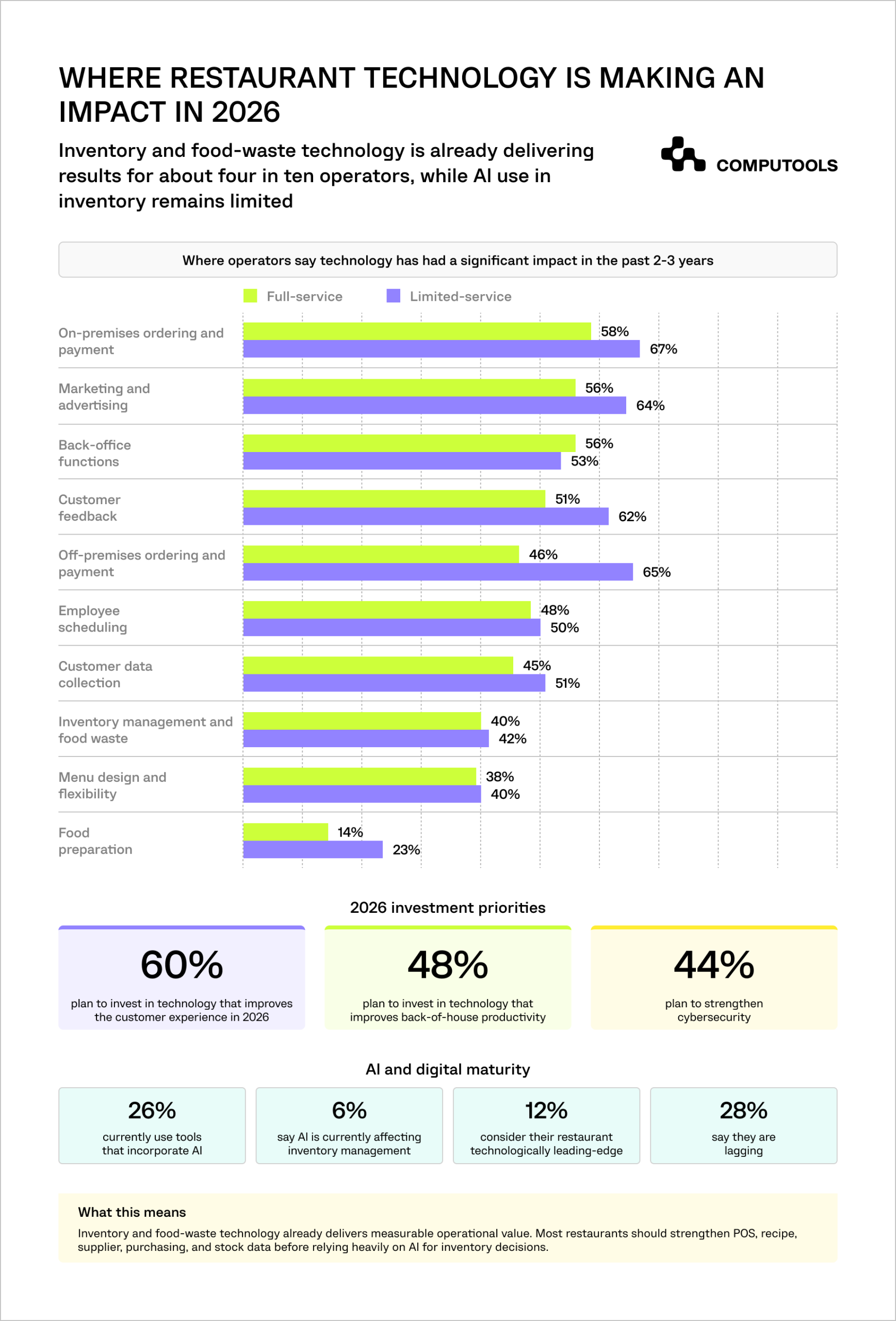
The first step toward food cost management is collecting the right data about each ingredient. Restaurants need to take into account pack sizes, units of measurement, recipe yields, prep loss, menu modifiers, substitutions, location pricing, and more. If these records are inconsistent, the theoretical and actual food costs can vary greatly.
Therefore, modern ingredient inventory management should integrate food service POS sales and anticipated usage, identify the cause of discrepancies, and calculate food cost and menu item profitability using the most recent purchase price. For businesses that span multiple locations, the software should account for item transfers, central kitchens, franchises, and varying supplier contracts.
Waste presents a strong additional case for replacing spreadsheets and disconnected applications. According to the UNEP, the food service industry produced about 290 million tonnes of food waste in 2022, making up 28% of food waste at the consumer level. The actual number is probably higher, since many restaurants and hotels do not regularly measure waste.
Good inventory management software for restaurants can track spoilage, prep waste, returned meals, stock expiry, and delivery errors. It can also issue shelf life alerts and apply a first-expired-first-out policy, generate demand forecasts and waste reports to help managers differentiate between types of loss.
Along with the demand for inventory traceability, structured inventory records will be necessary for compliance with new regulations in the EU and the US. The revised EU Waste Framework Directive mandates that Member States reduce food waste by 30% per capita in the sectors of retail, restaurants, food services, and households by 2030. In the United States, the FDA Food Traceability Rule takes effect in July 2028 and requires food businesses to maintain traceability of lot and line data for certain foods. New compliance regulations will pose a demand for detailed tracking and fast data in the food supply sector. Custom restaurant inventory tracking software should provide support for supplier identifiers, lot numbers, delivery records, affected ingredients, recall searches, and audit-ready exports.
The task of unifying restaurant operations becomes significantly harder when the venue employs different systems for sales, accounting, purchasing, warehousing, online orders, and delivery. An integrated restaurant POS and inventory software environment must automate sales deductions, availability of menu items, orders to suppliers and goods received, all without the need for labor-intensive input of data. Larger businesses may require restaurant supply chain software that supports management of suppliers and their purchasing order approvals, as well as distribution centers, commissaries, and transfers between their various locations.
This article looks at the custom software engineering, digital product, integration, and technology consulting companies able to develop or modernize such systems. The ranking focuses on companies with a validated history of working in the restaurant, food-service, POS, procurement, inventory, and supply chain systems.
Inventory cannot remain reliable when each ordering channel follows a separate workflow.
Our article on developing a restaurant order management system examines how restaurants can coordinate order intake, inventory availability, kitchen routing, fulfillment, and reporting through one operational layer.
How we selected restaurant inventory management software development companies
We reviewed companies that can design, develop, integrate, or modernise inventory platforms for restaurant groups, food-service operators, hospitality technology providers, and multi-location businesses. This ranking prioritised restaurant inventory software developers with evidence of work involving ingredient availability, stock control, purchasing, supplier workflows, menu data, POS integrations, waste reduction, traceability, or restaurant operations.
| Selection criterion | What we evaluated |
| Restaurant industry experience | Verified work with restaurants, cloud kitchens, food-service businesses, restaurant SaaS providers, or hospitality operators. |
| Custom engineering | Ability to build bespoke modules, platforms, integrations, and workflows rather than only configure a standard product. |
| Inventory knowledge | Ingredient records, units of measurement, recipes, stock counts, transfers, expiry dates, waste, and replenishment. |
| Procurement capability | Supplier catalogues, price comparison, purchase approvals, receiving, invoice matching, and purchase order management. |
| POS and ordering integration | Synchronisation of sales, menu availability, modifiers, online orders, and ingredient deductions. |
| Platform coverage | Web applications, mobile tools, backend services, administrative portals, cloud infrastructure, and reporting |
| Data and AI | Demand forecasting, anomaly detection, invoice extraction, operational analytics, and replenishment recommendations. |
| Modernisation | Legacy-system assessment, data migration, API development, cloud migration, refactoring, and phased replacement. |
| Scalability and security | Multi-location support, access controls, audit logs, transaction reliability, and data protection. |
| Long-term support | QA testing, monitoring, technical support, optimisation, and post-launch feature development. |
Restaurants building their own sales channels must connect the customer journey with actual stock and fulfilment capacity.
Our guide to developing an online food ordering system for restaurant websites covers structured menus, location-specific availability, payments, delivery, pickup, and restaurant administration.
15 restaurant inventory management software development companies to consider for custom platforms
The ranking gives greater weight to restaurant inventory software developers with direct industry work, while also considering platform modernisation, integration, data engineering, scalability, and long-term support.
1. Computools
Computools combines software development services for HoReCa with broader travel and hospitality software development services to connect inventory with ordering, procurement, sales, operational reporting, and customer-facing channels. Our supporting experience in heritage tourism software development and land-based casino software development also covers reservations, payments, loyalty, multi-location operations, and high-volume transactions. Our portfolio features more than 20 delivered HoReCa projects and over 40 projects across travel and hospitality.
Keep ingredient availability consistent across sales channels
A restaurant can lose revenue and customer trust when its website, mobile app, or ordering platform accepts an item that staff cannot prepare. Ingredient availability must remain aligned with menus, modifiers, opening hours, order statuses, and location-specific stock.
Within the Tap App project, Computools developed a cross-platform ordering system for restaurants and cafés with different menus, service models, schedules, payment methods, and operating requirements. Better ingredient management reduced unfulfilled or modified orders by 85%, while cross-selling contributed to a reported 7% increase in top-line results.
We can apply this experience through mobile app development services and custom web development to create stock-aware ordering channels, mobile counting tools, management dashboards, and supplier portals. POS deductions, recipe mappings, and availability rules can update every customer and staff interface from the same inventory record.
Replace fragmented reports with one operational data layer
Restaurant groups often store POS sales, supplier prices, recipes, waste records, invoices, and location performance in separate applications. This makes it difficult to calculate current food costs or forecast demand using reliable information.
For Profitento, we designed an AI revenue platform for a coastal resort with several restaurants and other services for guests. The platform aggregated data from their property management system, booking engine, CRM, POS, online travel agencies, and services like the spa and restaurants. In the first six months, our client reported a 32% improvement in forecast accuracy.
Through data engineering services, we can create a common data layer for sales, purchasing, recipes, suppliers, deliveries, waste, and transfers. It will support actual versus theoretical usage, supplier comparisons, location-level margin, and executive-level reports.
Improve demand planning and control inventory costs
AI cannot compensate for inconsistent units, incomplete recipes, duplicate supplier records, or delayed POS updates. Restaurants should first establish clean ingredient, transaction, and purchasing data before introducing predictive replenishment.
Computools’ AI development services cover forecasting, intelligent applications, data pipelines, AI consulting, and workflow automation. For restaurant inventory, we can implement demand forecasts by location, expected ingredient consumption, replenishment recommendations, unusual-usage alerts, and supplier-risk analysis.
Automate workflows without disrupting daily service
Inventory modernisation may affect receiving, counting, purchasing, transfers, accounting, kitchen preparation, and menu management. Replacing every system in one release can create unnecessary operational risk.
For OpsCore Hospitality, Computools built an AI operations platform that linked guest requests to housekeeping, maintenance, workforce planning and operational analytics. The project achieved a 20% reduction in operating and labor costs and improved the time to process guest requests by 70% within just 3 months.
This phased approach can be applied to restaurant operations by introducing an integration layer, shared ingredient model, mobile stock counts, purchase-order controls, or reporting dashboards before older applications are gradually replaced.
Support restaurant growth with broader hospitality experience
Our experience also includes heritage tourism software development and land-based casino software development. These sectors require reliable reservations, payments, loyalty programmes, multi-location operations, and high-volume transaction processing. With these capabilities, we can build and support restaurant platforms that must coordinate inventory with customer channels, financial systems, and operational workflows.
Best for: Restaurant groups building an integrated inventory, ordering, procurement, and analytics platform.
2. ScienceSoft
ScienceSoft has one of the clearest direct references involving inventory management software for restaurants. The company developed a responsive web application that allows restaurant executives, managers, waiting staff, and bar employees to check, transfer, track, and order stock from mobile devices. The platform also connects current inventory information with a configurable customer menu.
ScienceSoft’s broader capabilities cover stock visibility, automated ordering, inventory planning, POS and ERP integration, data migration, and supply-chain workflows. This makes it suitable for businesses replacing spreadsheets or separate applications with one operational system.
Best for: Established restaurant groups modernising stock, purchasing, and inventory workflows.
Consideration: The published restaurant project uses an older technology stack, so buyers should evaluate the proposed architecture for a new implementation.
3. Chetu
Chetu offers restaurant inventory tracking software with real-time stock visibility, mobile access, warehouse integration, and end-to-end traceability. The service includes lot tracking, shelf life management, waste management, recipe scaling, multiple site stock consolidation along with EDI communication and automated replenishment.
The company can further develop supplier management services that connect restaurant locations to distributors, warehouses, accounting systems, and food service systems. Rules can be established for reorder points, receiving, approval limits, and stock transfers.
Best for: Restaurant chains with multiple suppliers, large central warehouses, complex traceability requirements, and multiple stockrooms.
Consideration: Chetu offers a broad range of services and therefore requires a well-defined architecture, product owner, and acceptance criteria from the client side.
4. Vention
Vention has worked with a cloud-based restaurant inventory and vendor-payment platform that required continuing feature development, performance improvements, technical-debt reduction, and gradual migration from a monolithic architecture to microservices.
The company also supported a foodtech product connecting restaurants with suppliers. Its mobile workflows covered stocktaking, delivery verification, order processing, and collaboration between restaurants and vendors. This combination makes Vention relevant to established restaurant inventory software products that need scaling or modernisation.
Best for: Restaurant inventory SaaS companies expanding an existing platform or replacing parts of a legacy architecture.
Consideration: Its delivery model works best when the client already has clear product leadership and detailed domain requirements.
5. Mallow Technologies
Mallow Technologies developed restaurant procurement software for restaurants, hotels, hostels, and central kitchens. The platform replaced manual sourcing with real-time reverse auctions, supplier participation, automated order allocation, and web and mobile purchasing workflows.
In another project, Mallow integrated a food-delivery platform with Petpooja POS. The integration synchronised restaurant menus, order statuses, stock availability, and inventory changes. Together, these projects provide relevant evidence in purchasing, availability management, and purchase order management.
Best for: Restaurant procurement portals, supplier marketplaces, price-discovery tools, and POS-connected ordering platforms.
Consideration: Its strongest public evidence concerns purchasing and availability rather than recipe costing or complete inventory accounting.

Launch your custom restaurant inventory management platform in 1–3 months, not years, and give your teams real-time control over stock, purchasing, and food waste without adding operational overhead.
6. Magora
Magora developed BarTrack, an IoT-based beverage and restaurant inventory control software platform. Sensors monitor keg levels, pressure, temperature, pours, and product quality, while POS integrations compare the quantity poured with recorded sales. This helps managers detect waste, overpouring, equipment problems, and unexplained stock variance.
The company also created an application for Star Buffet that monitored food availability and coordinated replenishment across buffet stations and kitchen teams. These projects demonstrate practical experience connecting operational data, POS records, equipment, and management reporting.
Best for: Bars, breweries, venues, and restaurant groups requiring beverage monitoring or automated replenishment.
Consideration: Its strongest inventory work focuses on beverages and buffet operations rather than full ingredient procurement.
7. Orases
Orases has expertise in building restaurant software to optimize ingredient usage, purchasing, predictive preparation, waste reduction, and food cost control. Orases’ solutions can connect POS and buying records to enable operators to match their forecasted ingredient consumption to the movements of their actual stock.
The company builds custom inventory and ERP platforms that manage supplier relationships and purchases, warehouse operations, reporting, enterprise integration, and more. These systems can assess the profitability of their menus based on their current ingredient costs instead of outdated average values.
Best for: US restaurant businesses with specialised recipes, costing rules, or operational processes that do not fit a standard product.
Consideration: Its official material describes relevant capabilities clearly but provides limited detail about named restaurant inventory implementations.
8. Selleo
Selleo helped build ETRON, a modular ERP, POS, and inventory system for retail, service, trading, and gastronomy businesses. Its features include cash register software, warehouse management, order processing, e-commerce, and CRM system integration with customer records. It also covers supplier workflows.
The platform can support multiple branches and continue operating during temporary internet disruptions. These capabilities are relevant to restaurant operators that need sales, stock, customer, and purchasing data within the same environment.
Best for: Restaurant technology providers combining POS, warehouse, supplier, order, and customer-management functions.
Consideration: ETRON serves several industries, so ingredient, recipe, and food-waste requirements would need to be defined during discovery.
9. Dev.Pro
Dev.Pro provides restaurant technology consulting and engineering for established POS and SaaS platforms. The company helped Lavu migrate a restaurant and hospitality POS product to AWS while improving IT infrastructure, deployment processes, legacy code, and platform performance.
It has also worked with Popmenu, a restaurant SaaS platform used across thousands of locations. Its restaurant experience covers integrations, payments, reporting, ordering, billing, digital menu boards, and cloud infrastructure.
Best for: Established restaurant software companies modernising POS-connected platforms or expanding enterprise SaaS products.
Consideration: Its strongest public evidence concerns POS, digital engagement, and infrastructure rather than detailed ingredient inventory.
10. Softjourn
Softjourn has been a development partner for Tacit’s white-label restaurant ordering platform for over 10 years. The company’s services range from web or mobile ordering to POS systems, payment processing, in-seat ordering, reconciliation of delivery networks, and custom APIs.
The team works with integrations needed for extracting menu items, pricing, and availability that may not be exposed through the standard interface of POS systems. This experience is relevant when stock availability must remain consistent across websites, apps, kiosks, and delivery channels.
Best for: Restaurant products that need complex POS, menu, payment, ordering, kiosk, and delivery integrations.
Consideration: Procurement and inventory planning are adjacent to its strongest documented work rather than the main platform focus.
11. SumatoSoft
SumatoSoft has developed a POS system for a multi-location bar and snack chain, a food-delivery platform with automated stock updates, restaurant robotics interfaces, and connected refrigeration-monitoring products.
Its Sous Kitchen platform recorded available and sold products as orders were processed, while refrigeration monitoring helped food-service businesses respond to temperature changes and reduce spoilage risk. These projects show practical food inventory management capability across sales, storage, delivery, and connected equipment.
Best for: Restaurant and food-service companies combining POS, stock visibility, refrigeration, delivery, and operational automation.
Consideration: Its experience is distributed across several focused projects rather than one complete enterprise inventory platform.
12. S-PRO
S-PRO provides restaurant operations software development for cloud kitchens and delivery-focused brands. The company created an end-to-end automation platform for TSO Chinese, supporting digital ordering, restaurant administration, kitchen operations, and fulfillment.
This experience can transfer to menu availability, production planning, kitchen capacity, order routing, delivery coordination, and ingredient consumption. Cloud kitchens may also use the same software architecture to manage multiple virtual brands from one production location.
Best for: Cloud kitchens, virtual restaurant brands, and delivery-first operators developing custom operational platforms.
Consideration: The public case provides limited detail about suppliers, purchasing, lot tracking, and financial inventory valuation.
13. COMPU-VISION
COMPU-VISION develops restaurant applications together with stock, retail, warehouse, accounting, and food-production systems. Its weighing-management solution for abattoir operations tracks stock quantities, orders, dispatches, expenses, delivery transactions, and financial reports.
Although this is not a direct restaurant inventory case, it demonstrates relevant experience with perishable goods, stock movement, fulfilment, weighing, and operational accounting. The company has also developed restaurant applications covering menus, payments, reservations, loyalty, and venue administration.
Best for: Regional restaurant and food-service businesses requiring custom ordering, stock, delivery, or back-office applications.
Consideration: Its strongest inventory evidence comes from adjacent food production rather than ingredient-level restaurant workflows.
14. Pace Wisdom
Pace Wisdom brings transferable restaurant supply chain software capability from grocery fulfillment, warehousing, dark stores, Odoo ERP, and supply-chain integration projects. Its hyperlocal grocery platform selected nearby dark stores for fulfilment, while its warehouse projects addressed receiving, stock visibility, order processing, and third-party logistics.
Additionally, the company builds systems that integrate POS, mobile, web, warehouse, pricing, catalog, and order systems.
Best for: Restaurant groups that have commissaries, central warehouses, grocery operations, or complex distribution networks.
Consideration: Its public project examples mainly come from grocery, retail, logistics, and warehousing.
15. Devox Software
Devox Software builds custom inventory and AI solutions for HoReCa businesses. Their offerings include systems to monitor and optimize inventory and supply, as well as tools to manage shelf-life and minimize spoilage, predict ordering, and estimate demand. The company also provides solutions to analyze sales and inventory data.
The company builds order and logistics services that integrate reorder points, warehouse operations, stock status, and operational reporting.
These capabilities may suit operators that want to add AI forecasting without replacing every existing system at once.
Best for: Mid-market restaurant businesses developing focused inventory applications or controlled forecasting features.
Consideration: Public named restaurant inventory cases are limited, so buyers should request relevant project references during evaluation.
How to choose a restaurant inventory software development company
The right development partner must understand how ingredients, recipes, suppliers, locations, and sales channels affect each other. A technically capable team may still design the wrong system if it treats restaurant inventory as standard warehouse stock. Before selecting a restaurant software development company, verify how it approaches ingredient conversions, recipe yields, POS deductions, purchasing, waste, transfers, and financial reconciliation.
| Evaluation area | What to verify | Questions to ask |
| Restaurant workflow experience | Direct work with ingredients, recipes, POS, purchasing, waste, or multi-location operations. | Which restaurant inventory workflows have you implemented before? |
| Inventory data model | Units, pack sizes, yields, substitutions, prep recipes, and modifiers. | How will the system convert purchasing units into recipe and serving units? |
| Integration architecture | POS, ERP, accounting, ordering, delivery, warehouse, and supplier connections. | Which integrations operate in real time, and which use scheduled updates? |
| Procurement controls | Supplier catalogues, approval limits, receiving, invoices, and purchase orders. | How will price changes, substitutions, and partial deliveries be handled? |
| Multi-location support | Transfers, central kitchens, location permissions, and franchise rules. | Can each location use different recipes, suppliers, prices, and approval levels? |
| Data migration | Historical stock, recipes, suppliers, invoices, and purchase records. | How will migrated quantities, costs, and units be checked for accuracy? |
| Performance and reliability | Peak transaction volume, offline work, recovery, and monitoring. | What happens when a POS integration or internet connection becomes unavailable? |
| Ownership and support | Source code, cloud accounts, documentation, SLAs, and data exports. | What remains under our control if we change development providers? |
Connected customer data can also make demand patterns easier to understand. Our article on restaurant loyalty and customer engagement app development explains how transaction history, visit frequency, preferred items, and location activity can support segmentation and more predictable demand.
Final thoughts
The choice of the right tech partner depends on where inventory failures occur in your operation. If POS sales do not reduce ingredient balances accurately, prioritise restaurant inventory management software development companies with proven POS, menu, modifier, and availability integrations, such as Computools, Softjourn, Dev.Pro, or Selleo. If purchasing is still managed through spreadsheets, email, and manual supplier comparisons, Mallow Technologies, Chetu, or ScienceSoft may offer a closer match because their experience covers procurement, supplier workflows, order allocation, and stock control.
Bars and beverage-led venues should examine Magora’s work with keg monitoring, pour data, temperature, and POS reconciliation. Cloud kitchens may benefit more from S-PRO’s experience with production, ordering, and delivery operations. Restaurant technology companies modernising an existing SaaS product should consider Vention, particularly when the project involves technical debt, microservices, testing, and ongoing feature development. Here is a short breakdown of each company’s strengths from our list:
| Company | Main region | Best for |
| Computools | USA and Europe | Integrated restaurant operations platforms. |
| ScienceSoft | USA and Europe | Custom inventory and procurement systems. |
| Chetu | USA | Detailed food-service inventory workflows. |
| Vention | USA and Europe | Restaurant inventory SaaS modernisation. |
| Mallow Technologies | India and international delivery | Restaurant procurement and supplier platforms. |
| Magora | UK and Europe | Beverage inventory and IoT monitoring. |
| Orases | USA | Ingredient control and food-cost systems. |
| Selleo | Poland and European delivery | POS, warehouse, supplier, and ERP platforms. |
| Dev.Pro | USA and global delivery | Enterprise restaurant technology products. |
| Softjourn | USA and Europe | POS, menu, payment, and ordering integrations. |
| SumatoSoft | USA and Europe | POS-connected stock and operational systems. |
| S-PRO | Switzerland and Europe | Cloud kitchens and delivery-led operations. |
| COMPU-VISION | Middle East and international delivery | Regional restaurant and food-stock systems. |
| Pace Wisdom | India and international delivery | Warehouses, dark stores, and central distribution. |
| Devox Software | Europe | Inventory forecasting and custom HoReCa tools. |
Computools is a strong option when the project must connect inventory with ordering channels, operational data, forecasting, and phased software modernisation. We start by creating one reliable source of data, then connect the most important workflows first. Our clients report progress through fewer stockouts, less waste, faster stock counts, and a smaller gap between expected and actual food costs.
Computools
Software Solutions
Computools is an IT consulting and software development company that delivers innovative solutions to help businesses unlock tomorrow.